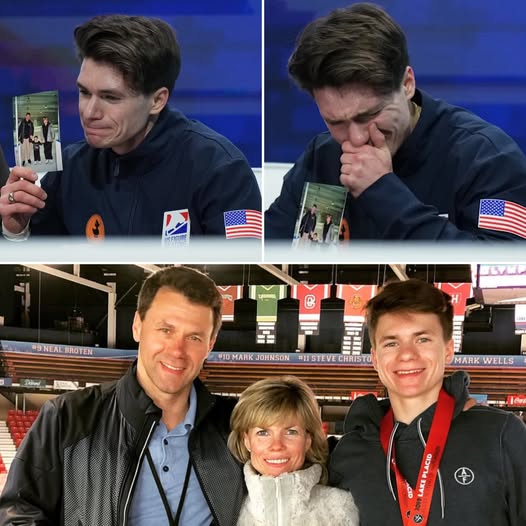
ST. LOUIS — On the surface, it was a simple photograph: a toddler in tiny white ice skates, beaming as he held the hands of two proud adults on a small Connecticut rink.
The image—a snapshot of family joy—was timeless, unremarkable, and full of hopeful promise. No one could have known that it would one day stand as a testament to resilience amid unfathomable loss.
More than two decades after that innocent moment was captured, the boy in the photo—now 24‑year‑old figure skater Maxim Naumov—sat quietly in an arena in St. Louis, staring at the image.
Moments later, he took to the ice and delivered one of the most powerful and emotionally charged performances of his career, a defining moment for an athlete who has skated through grief and adversity.

A Tragedy That Shook a Community
Just under a year earlier, Maxim’s life was shattered in an aviation disaster that claimed 67 lives. On January 29, 2025, American Eagle Flight 5342, traveling from Wichita, Kansas, toward Washington, D.C., collided mid‑air with a U.S. Army helicopter over the Potomac River.
Among those killed were Evgenia “Zhenya” Shishkova and Vadim Naumov, Maxim’s parents—former world champion pair skaters and his lifelong coaches.
Shishkova and Naumov had been returning from a developmental camp for young figure skaters, a common tradition following the U.S. Figure Skating Championships in Wichita.
Meanwhile, Maxim had flown home earlier after competing in the same nationals, narrowly avoiding the flight that would alter his world.
The crash sent shockwaves through the tight‑knit figure skating community. Coaches, athletes, families, and fans were devastated by the loss of so many people connected to the sport, including young skaters and parents who had been on the trip.
The crash didn’t just claim lives—it cast an emotional shadow over the sport’s national events and the community that supports them.
The Parents Behind the Photograph
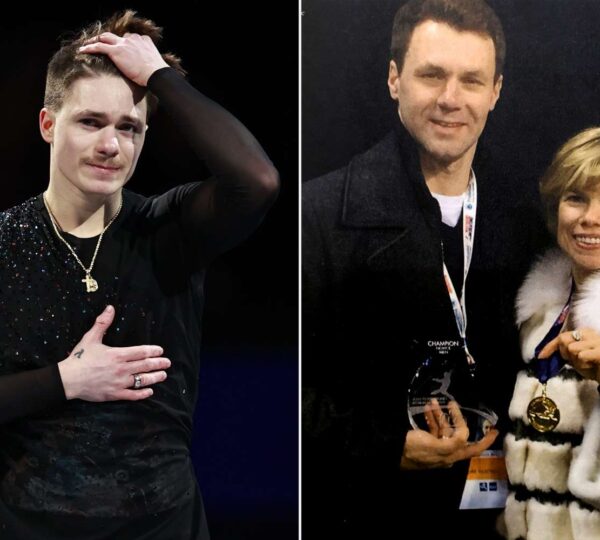
Vadim Naumov and Evgenia Shishkova were more than parents to Maxim; they were legends in the sport. The Russian pair won the 1994 World Figure Skating Championships and competed together at multiple Winter Olympics before moving to the United States to coach elite skaters.
They settled in Connecticut in the late 1990s and became highly respected coaches at the Skating Club of Boston and other elite training programs.
Their students and colleagues describe them as generous, talented, and deeply invested in nurturing the next generation of skaters.
One former coach said that they trained with the traditional Russian method—a rigorous and respected coaching philosophy—yet they balanced that with warmth and encouragement in their relationships with students.
For Maxim, ice skating was not just a sport but a family legacy. From his earliest years he watched his parents glide across the rink, their partnership in life and competition shaping his own journey on the ice.
The photo he held so dearly showed him as a child cradled between them—innocent, joyful, and unaware of how that moment would come to echo so painfully in his adult career.
A Year of Grief and Reflection
In the wake of the tragedy, the broader figure skating world rallied. Tribute events were held, including fundraisers like “Legacy on Ice” in Washington, which brought together skaters from across generations to honor those lost and support grieving families.
Maxim himself performed in tribute there, met with a standing ovation from a crowd deeply affected by the tragedy.

He also shouldered new responsibilities personally and professionally. In the months following the crash, he took leadership of the Skating Club of Boston’s Youth Academy Program, an initiative his parents had helped build and nurture.
It was an act that honored their legacy and connected him even more firmly to the community that had supported his family for years.
Throughout his grief, Maxim spoke candidly about how his parents’ last words of love and encouragement stayed with him—words that pushed him to keep skating even when it felt almost impossible.
“They told me they loved me and were proud of me,” he said in an interview, emphasizing how deeply those moments shaped his motivation and his identity.
The Return to Competition: A Test of Heart
In early 2026, the U.S. Figure Skating Championships in St. Louis became more than a qualifying event—it became a public testament to resilience. For Maxim, returning to the ice at the same venue where his parents last watched him skate was an emotional milestone.
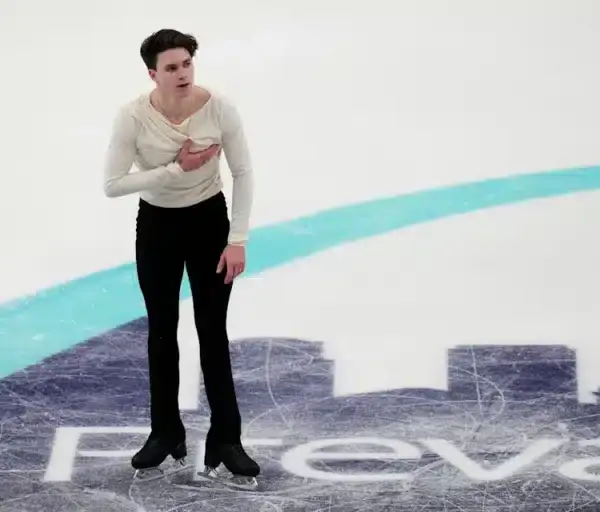
Thursday night’s men’s short program, held in the Enterprise Center, was among the most heartfelt in recent memory. Before his routine, Maxim paused at center ice and raised his hand to the sky in a silent tribute.
The crowd understood immediately what this gesture meant—not just a moment of respect, but a declaration of gratitude, remembrance, and continuing pursuit of a dream that once belonged to all three of them.
With Chopin’s Nocturne No. 20 swelling around him, he skated with a combination of technical precision and emotional depth, blending athleticism with raw feeling in every turn and jump.
The result was a standing ovation, plush toys raining down upon his acknowledgment of the crowd, and a score of 85.72, placing him atop the leaderboard momentarily.
Afterward, at the kiss‑and‑cry area, Maxim held the old photo of his parents and kissed it before the cheering erupted again. The moment crystallized his emotional journey—grief, love, pain, and aspiration all converging in a single act of tribute on the ice.
Supporting Friends and Fierce Competition
By the end of the championships, Maxim finished third overall, earning a bronze medal and securing a spot on the U.S. Olympic team bound for the 2026 Winter Olympics in Milan–Cortina.
He joins teammates including Ilia Malinin and Andrew Torgashev in men’s figure skating, marking a major achievement in his career under circumstances that few athletes ever endure.
Malinin, who had won the competition and clinched his own place on the Olympic team, openly supported Maxim, acknowledging what a challenge it has been to return after such profound loss.
“We all support him. Whatever he needs,” Malinin said, reflecting the deep camaraderie within the skating community.
The emotional backdrop for Maxim’s long program is equally poignant: he chose “In This Shirt” by The Irrepressibles, a hauntingly beautiful piece that mirrors the ache and longing of his past year.
The choice underscores how his artistry and personal narrative have intertwined on the Olympic journey ahead.
Grief, Strength, and Growth
Maxim’s personal reflections in interviews reveal a philosophy shaped by adversity. “In moments of real emotional strain,” he said, “you ask yourself, what if I can still do this? What if, despite everything,
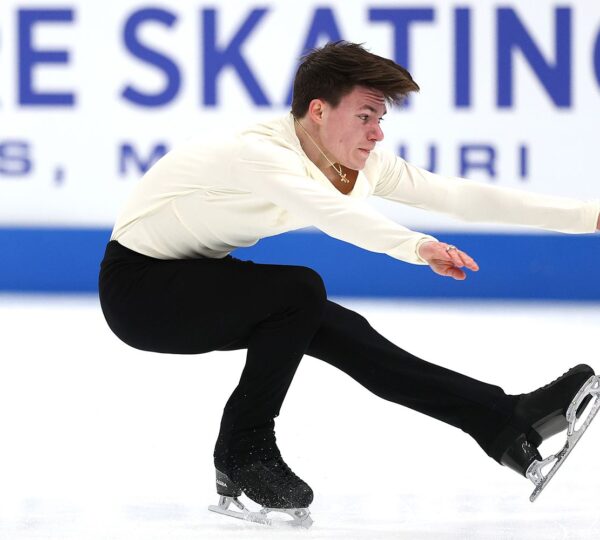
I can go out there and skate? That’s where strength comes from. That’s how you grow.” His words capture the essence of how he approaches skating—not as an escape from grief, but as a way to transform heartbreak into purpose.
He often refers to his achievements not as solo triumphs but as shared victories—ones that include his parents’ influence and presence, even though they cannot be physically beside him.
“We did it,” he said movingly upon learning of his Olympic team selection, a phrase that implicitly acknowledges all three of them together.
Legacy Beyond Competition
Maxim’s journey has become a source of hope and inspiration not only for figure skating fans but also for anyone navigating profound loss.
Throughout competitions, moments of silence, tributes, and communal remembrance by the skating community have kept the memory of the victims alive, particularly those directly connected to Maxim’s family.
His parents’ legacy as world champions, coaches, and mentors continues through the skaters they trained and the programs they helped develop.
Their influence lives on in students who remember them not just for their technical expertise but for their kindness and dedication to the sport.
Looking Forward: The Olympic Dream
For Maxim Naumov, the Olympic Games represent more than rare athletic opportunity—they represent the fulfillment of a promise, a continuation of a conversation that began long ago with his parents.
One of the last discussions he shared with them was about competing in the Olympics, and achieving that dream now carries a profound emotional meaning.
“It’s the ultimate goal,” he has said, clutching the cherished photograph. “One of the last conversations my parents and I had was about that. Making the Olympics would mean everything.”
As he prepares for the biggest stage in his sport, Maxim embodies a blend of grit, grace, and gratitude that transcends medals and scores.
His story is not just about an athlete returning to competition—it’s about honoring legacy, finding strength in sorrow, and carrying forward the love that shaped his life on and off the ice.
A Life Transformed on Ice
The image of a smiling toddler in white skates now carries a deeper significance: it is not just an early moment of joy, but a symbol of continuity and resilience.
In St. Louis, as Maxim stood atop the podium, kissed that photo, and thanked the crowd with a wordless gesture toward the sky, he showed the world that profound loss can become a source of remarkable courage.
In the months and years ahead, whether at the Olympics or in future competitions, his skating will continue to reflect not only athletic excellence but a deeply human story of love, loss, and perseverance. T
hat is what makes Maxim Naumov’s journey so unforgettable—not just as a skater, but as a testament to the enduring power of the human spirit.