I still smell the harsh, chemical bite of acetone whenever I close my eyes and think of that Tuesday afternoon.
But stronger than the smell of the salon was the sudden, suffocating scent of pure terror.
You see, working in a nail salon, you become a silent observer of human nature. You see the tired mothers who just want thirty minutes of peace. You see the anxious brides, the gossiping teenagers, the women who treat you like a therapist, and the women who treat you like a piece of the furniture.
You see everything. But sometimes, you pray to God you hadn’t.
My name is Elena. I’m thirty-four, and I own “Polished Haven,” a modest little salon tucked between a dry cleaner and a struggling bakery in a fading strip mall in Oak Creek, Ohio.
It was mid-July, the kind of oppressive, suffocating summer day where the heat waves shimmered off the asphalt parking lot, and the air conditioner in the shop was rattling, struggling to keep the humidity at bay.
The salon was busy, humming with the familiar sounds of my life: the low bubbling of the pedicure basins, the whir of the drill files, the low murmur of daytime television playing in the corner.
At station three, Marcus was working on a regular. Marcus is my youngest tech, twenty-two, with a neck tattoo of his late mother’s name and a heart of pure gold hidden beneath a defensive, hot-headed exterior.
In the pedicure chair closest to the window sat Sarah Jenkins. Sarah was in her late fifties, a retired social worker who always asked for a simple French tip. She was a woman who had seen the worst of the world, carrying a permanent, exhausted cynicism in the deep lines around her eyes. She sat there quietly, drinking black coffee from a dented thermos, watching the world go by.
I was finishing up a gel topcoat when the little bell above the glass door chimed.
A blast of hot air swept into the cool room, carrying with it a woman and a little girl.
The woman, who I would later learn was named Brenda, immediately sucked the oxygen out of the room. She was in her late thirties, dressed in an expensive white linen sundress that contrasted sharply with her deeply tanned skin. She wore oversized designer sunglasses indoors and held a massive iced latte in one hand, her phone gripped tightly in the other.
She was beautiful, in a harsh, manufactured sort of way, but there was a sharp, vibrating impatience radiating from her.
And then, trailing behind her, holding onto the very edge of Brenda’s dress, was the little girl.
She looked to be about seven years old. While Brenda looked like she was ready for a yacht party, the little girl was practically drowning in a faded, oversized grey long-sleeved sweater.
In ninety-degree heat.
My breath caught just a little. As someone who had spent four years in my twenties wearing long sleeves in the summer to hide the bruises left by an ex-boyfriend, the sight of a child bundled up in July triggered a tiny, cold alarm bell in the back of my mind.
I rubbed my left wrist subconsciously, my fingers tracing the thick silver bracelet I always wear to cover the faint, white scar underneath. An old wound. A closed chapter. Or so I thought.
“Do you have room for a deluxe spa pedi with hot stones?” Brenda asked loudly, not bothering to take off her sunglasses. Her acrylic nails tapped a rapid, annoying rhythm against the screen of her iPhone. “And someone needs to do something with her.”
She gestured dismissively toward the little girl with her latte cup. “Just paint the kid’s nails or something so she shuts up. She’s been whining all morning.”
The little girl hadn’t made a single sound.
She stood absolutely still, her thin shoulders hunched, her eyes fixed firmly on the scuffed linoleum floor. She had mousy brown hair, slightly tangled, and pale skin that looked almost translucent under the harsh fluorescent lights of the salon.
“We can absolutely take care of both of you,” I said, putting on my best customer service smile. “Marcus can start your pedicure, and I’ll take…?”
“Lily,” Brenda snapped, already walking toward the pedicure chairs, leaving the child standing alone by the door. “Her name is Lily. Make it quick, I don’t want to be here all day.”
Marcus shot me a look. A dark, knowing look. He hated women like Brenda. But he grabbed a fresh towel and led her to the back, leaving me alone with Lily.
I walked around my counter and crouched down to be at eye level with her. Up close, she looked even smaller. Her eyes were a pale, washed-out blue, and they held an emptiness that made my chest physically ache.
“Hi, Lily,” I said, keeping my voice soft, the way you would speak to a frightened stray animal. “I’m Elena. Have you ever had your nails painted before?”
She didn’t speak. She just slowly shook her head, her eyes darting nervously toward the back of the salon where Brenda was already complaining to Marcus about the water temperature.
“Well, it’s very fun,” I promised, offering my hand. “We have a whole wall of colors. Do you want to come pick one out?”
She hesitated for a long moment. Then, she reached out with her right hand. Her fingers were ice-cold.
I led her over to the massive wall of nail polish bottles, organized by color like a rainbow. Usually, little girls her age immediately gravitated toward the neon pinks, the bright purples, or anything packed with chunky glitter.
“What’s your favorite color, sweetie?” I asked. “We have princess pink. Or maybe this sparkly blue? It looks like a mermaid’s tail.”
Lily didn’t look at the pinks. She didn’t look at the glitters.
Her eyes scanned the bottom row, the section reserved for the deep, moody colors usually chosen by older women in the dead of winter.
Slowly, she raised her left hand—the hand tucked deep inside the oversized sleeve of her sweater—and pointed with a trembling finger.
She was pointing at a shade called “Midnight Crimson.” It was a dark, heavy, brownish-red. The color of dried blood.
“Oh,” I said, trying to mask my surprise. “That’s a very grown-up color, Lily. Are you sure you wouldn’t like a bright pink? Or maybe some silver stars?”
She shook her head stubbornly. She pointed at the dark red polish again.
Then, she looked up at me. It was the first time she made direct eye contact. There was an intense, desperate urgency in her pale blue eyes.
“Okay,” I said gently, pulling the bottle from the rack. “Midnight Crimson it is.”
I led her to my station, right near the front window where the natural light poured in. Sarah Jenkins was sitting a few feet away, her feet soaking, her magazine lowered. I could feel Sarah watching us. With her background in social work, Sarah had a radar for trouble that was sharper than a hunting dog’s.
I pulled out the small chair for Lily. She climbed into it awkwardly, keeping her arms pinned tightly to her sides.
“Okay, Lily, I’m just going to hold your hands and shape your nails a little bit, okay? It won’t hurt at all,” I explained, trying to keep up a steady stream of comforting chatter.
I reached out and gently took her right hand. She flinched. It was a microscopic movement, a tiny jolt of her shoulders, but I felt it all the way down to my bones.
“It’s okay,” I whispered.
I started to file her tiny, brittle nails. They were chewed down to the quick, the skin around them red and raw. As I worked, I tried to make conversation.
“Are you excited for the summer?” I asked. “Going to the pool?”
Silence.
“Do you like school?”
Silence.
I glanced over at Brenda. She was lying back in the massage chair, her eyes closed, noise-canceling earbuds in. She was completely checked out. Completely oblivious to the child she had brought in.
“Okay, let’s switch hands,” I said softly, reaching for Lily’s left hand.
This was the hand she had kept hidden. As I pulled it forward, the oversized sleeve of her thick grey sweater began to ride up her forearm.
Lily panicked.
She tried to yank her arm back, her eyes going wide with terror, darting toward the back of the room to check if Brenda was watching.
“Shh, shh, it’s okay,” I soothed, holding her fingers gently but firmly. “I just need to paint these ones, sweetie. I won’t hurt you.”
The sleeve slipped down to her elbow.
The breath was knocked out of my lungs so violently I felt dizzy.
There, on her thin, fragile forearm, was a cluster of bruises. But they weren’t the normal, messy bruises of a clumsy child who fell off a bicycle or bumped into a coffee table.
These were distinct. Shaped.
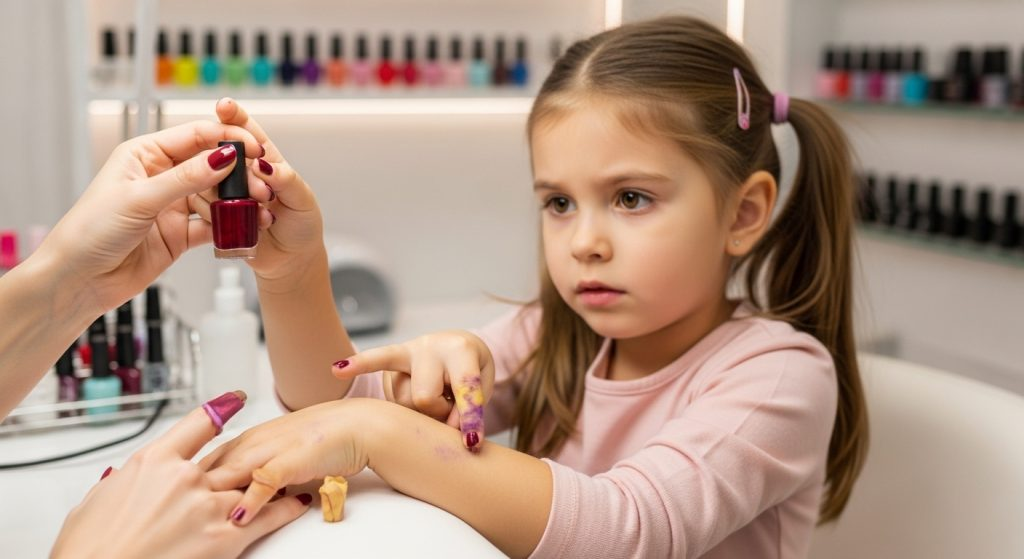
They were the dark, mottled purple, angry yellow, and sickening black impressions of large fingers. A handprint. Someone had grabbed this tiny child with enough brutal force to leave a permanent map of their rage on her skin.
The room suddenly felt unbearably hot. The buzzing of the salon faded into a distant, muffled hum. The only thing I could hear was the frantic hammering of my own heart against my ribs.
My eyes darted from the bruises on her arm to the dark red bottle of polish sitting on my desk.
Midnight Crimson.
I looked back at Lily. She wasn’t crying. That was the most horrifying part of all. A child her age should be crying. A child her age should be screaming. But Lily had the terrifying, hollow stillness of a survivor. The silence of someone who has learned that crying only makes the monster hit harder.
Slowly, deliberately, Lily raised her right hand.
She pointed a tiny, trembling finger at the dark, bruised handprint on her left arm.
Then, she moved her finger, slowly tracking across the desk, until she tapped the glass bottle of the dark red polish.
She pointed to the bruise. Then she pointed to the red polish.
The color of blood. She looked at me, her pale blue eyes boring into mine. She wasn’t just picking a color. She was matching it. She was showing me.
She was trying to tell me a story without using the words she had been forbidden to speak.
A cold sweat broke out on the back of my neck. My hand instinctively flew to my own wrist, my fingers gripping the silver bracelet, pressing into the old, faded scar beneath it. The ghost of my own past roared to life in the back of my mind. The memory of my ex-boyfriend’s hand around my throat. The memory of the police officer asking me if I had just “fallen down the stairs.” The memory of feeling entirely, completely alone in a world full of people.
I swallowed hard, fighting the bile rising in my throat. I looked at this seven-year-old girl, sitting in my salon chair, screaming for help in the only language she had left.
“Lily,” I breathed, my voice barely a whisper. “Did… did someone hurt you?”
Before she could even blink, a sharp, angry voice sliced through the heavy air of the salon.
“What is taking so long over there?”
I jumped, my heart leaping into my throat.
Brenda had pulled one earbud out and was glaring at us across the room, her eyes narrowed with suspicion. The hot stones Marcus was preparing were forgotten. She was staring directly at Lily’s exposed arm.
Lily flinched so hard she nearly fell out of the chair. With lightning speed, she yanked her arm back, pulling the heavy wool sleeve down to her knuckles, hiding the evidence in an instant. Her small body began to tremble like a leaf in a hurricane.
“Nothing,” I called back, my voice shaking despite my desperate attempt to control it. “Just… just prepping the nails. We’re doing a dark red.”
Brenda rolled her eyes, irritated. “Whatever. Just hurry up. We have places to be, and she’s useless when she’s tired.” She shoved the earbud back in and closed her eyes.
I turned back to Lily. The girl was staring at her lap, her breathing shallow and fast.
I looked up and caught Sarah Jenkins’ eye in the mirror. The retired social worker hadn’t missed a single second of the exchange. Sarah’s magazine was flat on her lap. Her jaw was set. She gave me a single, barely perceptible nod.
She saw it too.
I looked down at the bottle of dark red polish. I looked at the little girl trembling in my chair.
In my twenties, I had waited for someone to notice. I had waited for a stranger, a friend, a coworker to look past the long sleeves and the forced smiles and ask me if I was okay. No one ever did. I had to save myself, and it nearly killed me.
I picked up the small brush, dipped it into the thick, blood-red polish, and took Lily’s small, freezing hand in mine.
I wasn’t just going to paint her nails. I was going to find out exactly what was happening in that house. And heaven help the woman in the white sundress, because I was not going to let this little girl walk out of my salon and disappear into the dark.
Chapter 2
The first brushstroke of Midnight Crimson went onto Lily’s tiny thumbnail, and it felt like painting a crime scene.
The polish was thick, opaque, and carried that sharp, intoxicating chemical smell that had been the background noise of my life for the past decade. Usually, the scent of acetone and lacquer was comforting to me. It meant I was at work. It meant I was in control. It meant the rent on my small duplex was going to get paid.
But today, the smell just made me nauseous.
I held Lily’s right hand, the unbruised one, with the utmost care. Her fingers were so small, the knuckles white from how hard she was tensing her muscles. She felt like a baby bird that had fallen out of a nest, rigid and waiting for the final blow from a predator.
“You have very pretty nail beds, Lily,” I whispered, keeping my head bowed. I didn’t want Brenda to see my mouth moving too much. If I looked like I was just focusing on the manicure, maybe I could buy us some time.
Lily didn’t respond. Her chest rose and fell in shallow, rapid breaths beneath that heavy, suffocating grey wool sweater. It was ninety-two degrees outside, according to the digital thermometer flashing on the bank across the street. The thought of wearing wool in this weather was pure torture. The thought of why she was wearing it was something worse altogether.
I needed to know more, but I had to tread carefully. In my experience—both professionally and personally—pushing a terrified person too hard, too fast, only made them retreat further into their shell. You had to leave breadcrumbs. You had to show them you were safe.
“When I was your age,” I murmured, keeping my voice pitched at a frequency only she could hear over the drone of the air conditioner and the daytime talk show playing on the wall-mounted TV, “I used to hate getting my hair brushed. My mom would pull so hard. I used to hide in the laundry basket so she couldn’t find me.”
It was a mundane story, a normal childhood complaint. I watched her face out of the corner of my eye.
Her pale blue eyes flickered toward me, just for a fraction of a second. There was a spark of something there. Not trust, not yet. But comprehension. She understood what it meant to want to hide.
I moved to her index finger. The dark red polish glided smoothly over the nail.
Across the room, Brenda shifted loudly in the massage chair. “Marcus, honey, this water is practically freezing. Are we at a ski resort or a nail salon? Turn the heat up.”
Marcus, who had a temper that usually flared at the slightest disrespect, surprised me. He didn’t snap back. I looked up and saw his jaw tight, his eyes fixed on Brenda’s foot as he mechanically adjusted the hot water valve. But the look he shot me over Brenda’s head was loaded.
He had seen the sweater. He had seen the fear. Marcus grew up in the foster system in Cleveland; he knew what a broken kid looked like before they even walked through the door. He gave me a barely perceptible nod, adjusting his stool to intentionally block Brenda’s line of sight to my station. He was giving me a shield.
“Sorry about that, ma’am,” Marcus said to Brenda, his voice dripping with a fake, sugary customer service tone that I knew took every ounce of his willpower to maintain. “Let me go grab those hot stones from the back. It’ll just be a minute. Why don’t you close your eyes and enjoy the massage feature?”
He hit a button on the side of her chair. The mechanical rollers began to knead her back, and Brenda let out a long, theatrical sigh of relief, leaning her head back and finally closing her eyes.
“Perfect,” I breathed to myself.
I turned my full attention back to Lily. We were on her ring finger now.
“Lily,” I whispered, my voice urgent but soft. “I need you to listen to me. You don’t have to talk. You can just nod or shake your head. Do you understand?”
She stared at the dark red polish on her fingernails. For a terrifying ten seconds, she did absolutely nothing. Then, slowly, almost imperceptibly, her chin dipped down and up. Once.
My heart hammered against my ribs like a trapped bird.
“Okay,” I said, my hands trembling slightly as I dipped the brush back into the bottle. “Okay, good girl. That mark on your arm… did someone do that to you?”
She didn’t move. She didn’t nod. But a single, fat tear welled up in her right eye, clinging to her pale eyelashes before spilling over and tracking a silent path down her cheek.
It was an answer louder than a scream.
“Was it her?” I asked, my blood turning to ice. I didn’t want to look at Brenda, didn’t want to draw any attention. “Was it your mom?”
Lily shook her head. A fast, frantic shake. No.
I let out a breath I didn’t realize I was holding, but the relief was short-lived. If it wasn’t Brenda, who was it? And why was Brenda letting it happen? Why was she dragging this bruised, terrified child to a nail salon to be silenced with a fresh coat of paint?
“Is it someone who lives in your house?” I pressed gently.
She hesitated, her eyes darting toward the back of the room again, then nodded.
My stomach plummeted. I remembered a man named David. I remembered how he moved into my apartment, how charming he was for the first six months, bringing me coffee in bed, fixing the leaky faucet, making my friends laugh at dinner parties. I remembered how the charm slowly peeled away, revealing a violent, controlling possessiveness that eventually left me in the ER with a fractured cheekbone and a lie about slipping on wet tile.
I knew the exact flavor of the terror Lily was tasting. It tasted like copper and ashes.
“Okay,” I whispered, finishing her right hand. “We have to do your left hand now. I promise I won’t roll the sleeve up all the way. I’ll just hold your fingertips. Okay?”
She nodded again, taking a shaky breath, and slowly slid her left hand out of the safety of her lap.
As I took her left fingers, I felt a shadow fall over my station.
I looked up, startled.
Sarah Jenkins was standing there.
The retired social worker had quietly slipped out of her pedicure chair. Her bare feet were in the flimsy disposable foam slippers we provided. She had brought her dented thermos of coffee with her.
Sarah didn’t look at Lily. She didn’t look at the sweater. She looked directly at me. Her face, usually lined with an exhausted indifference, was completely transformed. Her eyes were sharp, calculating, and fully awake. She looked like a general surveying a battlefield.
“Elena, honey,” Sarah said, her voice completely normal, cheerful even. It was a stark contrast to the thick tension at the desk. “I think I smudged my big toe. Could you fix it when you’re done with this sweet little girl?”
I stared at her, confused for a split second, until Sarah subtly angled her body. She positioned herself right between my desk and Brenda’s chair. She was creating a physical wall.
“Of course, Sarah,” I said, catching on. “Just give me a few minutes.”
Sarah didn’t move. She stood there, sipping her coffee, looking out the front window of the salon at the shimmering heat of the parking lot. “Terrible heat out there today,” she remarked casually to no one in particular. “Makes people crazy. Makes people do awful things.”
Lily flinched at the word ‘awful’.
I focused on Lily’s left hand. The bruising I had seen earlier extended down past her wrist, faint yellow marks disappearing beneath the cuff of the sweater. It wasn’t just an isolated incident. This was ongoing.
I finished painting the dark red polish on her left hand. The contrast of the beautiful, glossy Midnight Crimson against her pale, trembling skin and the frayed edge of the dirty grey sweater was heartbreaking.
“They look beautiful, Lily,” I said.
I needed to see more. I needed to know the extent of it. If I was going to call the police—and I was going to call the police—I needed specifics. “My boyfriend hit me” was one thing. A child in a hot sweater in July with defensive wounds was another. Child Protective Services in Oak Creek was notoriously underfunded and overworked. They needed a concrete reason to dispatch a unit immediately, not just a suspicious nail tech’s hunch.
I made a split-second decision. It was risky, but I was running out of time.
I reached for the small, plastic pump bottle of pure acetone I kept on my desk. As I brought it over, I intentionally fumbled it.
The bottle tipped.
A splash of clear, freezing cold acetone spilled directly onto the cuff of Lily’s grey sweater and over her left hand.
Lily gasped, jerking her hand back.
“Oh my gosh! I am so, so sorry!” I said loudly, injecting my voice with exaggerated panic. “I am so clumsy today!”
Brenda’s head snapped up from the massage chair. She pulled an earbud out, her face contorted in anger. “What did you do? Did you ruin her clothes? That sweater is cashmere!”
Cashmere. It was cheap, synthetic wool, but I wasn’t going to argue.
“I spilled a little polish remover, ma’am, I am so sorry,” I called out, grabbing a paper towel. “It can irritate the skin. I need to take her to the sink in the back and wash it off immediately with soap and cold water.”
Brenda let out an exaggerated groan, rolling her eyes toward the ceiling. “You have got to be kidding me. You people are incompetent. Just clean it up! I’m not waiting another twenty minutes.”
“It’s store policy, ma’am,” Marcus chimed in from the back, returning with a steaming towel wrapped around hot stones. He didn’t miss a beat. “Health department regulations. Acetone chemical burns are a liability. She just needs to rinse it for two minutes. I’ll start your stone massage right now to make up for the wait.”
The mention of the stone massage, and the fear of a ‘chemical burn’ making her stay longer, seemed to pacify Brenda. She waved her hand dismissively. “Fine. Whatever. Just get it done. Lily, go wash your hands and don’t touch anything.”
She put her earbud back in and closed her eyes.
I stood up, holding my hand out to Lily. She looked terrified, looking from the wet spot on her sleeve to my face.
“Come with me, sweetie,” I said softly. “It’s okay.”
She slid off the chair. I guided her past Sarah, who gave my shoulder a brief, firm squeeze as I walked by. I walked Lily past the rows of nail polish, past the drying stations, and pushed open the swinging wooden door that led to the back room.
The back room of Polished Haven was small. It held our break table, a massive utility sink, a washer and dryer constantly churning through white towels, and a single, tiny bathroom.
I led Lily into the bathroom and locked the door behind us.
The room was no bigger than a closet. The hum of the salon was muffled here. It was just me, the little girl, and the harsh fluorescent vanity light reflecting off the mirror.
Lily stood backed against the door, her wet sleeve dripping slightly onto the cheap tile floor. She looked like a prisoner waiting for the executioner.
I knelt down in front of her, putting myself lower than her so I wouldn’t seem imposing.
“Lily,” I said, my voice shaking slightly. “I lied. I spilled that on purpose.”
Her eyes widened.
“I did it because I needed to get you away from her for a minute. I needed to ask you if you are safe.”
She stared at me, the silence stretching out, heavy and suffocating.
“You’re not safe, are you?” I asked.
She slowly shook her head. The tears she had been fighting back finally broke free. They didn’t come with sobs. They were silent, continuous streams of water running down her pale cheeks. It was the most unnatural, heartbreaking way a child could cry. She had been taught that making noise brought pain.
I reached out slowly. “Can I see your arm? The wet one? We need to take the sweater off to wash the chemicals off, or it will burn your skin.”
She hesitated, her small hands clutching the hem of the oversized sweater. It was her armor. Her shield against the world seeing the truth.
“I won’t be mad,” I promised, my voice cracking. “And I won’t tell the man who hurt you. But I can’t help you if I don’t know what he did.”
Slowly, agonizingly, Lily let go of the hem. She reached up with trembling hands and pulled the heavy grey sweater up and over her head.
She stood before me in a thin, faded pink tank top.
I clamped my hand over my mouth to physically stop the scream from ripping out of my throat.
The bruises on her forearm were just the beginning.
Her thin, fragile upper arms were covered in a mosaic of violence. There were older, yellowish-green bruises fading into her skin. There were fresh, angry red welts that looked like they had been made by a belt or a cord. But the worst part, the part that made the room spin and black spots dance at the edges of my vision, was her collarbone.
Just below her neck, blooming across her chest like a horrific, dark flower, was a massive, dark purple contusion. It was the distinct shape of a heavy boot tread.
Someone had stepped on this child. Someone had pinned her to the ground with their foot.
Hot, blinding tears blurred my vision. I felt the phantom weight of David’s hands around my neck, the memory of the cold bathroom floor pressing against my cheek. I had survived my monster, but this little girl was still living with hers. And her monster wasn’t just hitting her. Her monster was trying to break her into pieces.
“Oh, Lily,” I sobbed, unable to hold it back anymore. I didn’t care about being professional. I didn’t care about anything except the broken child standing in front of me.
I pulled her into my arms. I expected her to stiffen, to pull away, but she didn’t. She collapsed against my chest, burying her face into my shoulder, her small hands gripping the fabric of my apron like it was a life raft. She didn’t make a sound, but her entire body shook with the force of her silent weeping.
I held her tightly, rocking her back and forth on the bathroom floor.
“Who did this to you?” I whispered fiercely into her tangled hair. “Tell me his name.”
Lily pulled her head back just enough to look at me. Her pale blue eyes were red and swollen.
“Gary,” she whispered. Her voice was raspy, unused. It sounded like dry leaves scraping across pavement. “Mommy’s friend.”
“Does your mommy know he does this?”
Lily nodded, a slow, miserable movement. “She says… she says I have to be good. She says if I’m bad, Gary gets mad, and then Gary won’t pay the rent.”
Bile rose in my throat, hot and acidic. Brenda wasn’t just ignoring the abuse. She was trading her daughter’s physical safety for a roof over her head. She was a complicit monster.
“He told me,” Lily whispered, her eyes widening with a sudden, fresh terror. “He told me if I ever tell anyone at school… or tell a doctor… he’ll put me in the dark box in the garage again. He said he’ll leave me there forever.”
The dark box.
My God.
I wiped my face with the back of my arm, forcing myself to take a deep, steadying breath. Falling apart wasn’t going to save her. I had to be smart. I had to be calculating. I had to be the adult that Brenda refused to be.
“Lily, listen to me very carefully,” I said, looking directly into her eyes. “You are not going back in that box. Do you hear me? You are not going back to Gary. I am going to stop him.”
She looked at me, a flicker of desperate hope fighting through the absolute terror in her eyes. “How?”
“I don’t know yet,” I admitted honestly. “But I have friends out there. Marcus and Sarah. They are going to help us.”
I turned the tap on, wetting a clean paper towel with cold water, and gently dabbed at the acetone on her arm. I helped her pull the heavy, suffocating wool sweater back over her head. It felt like a crime to put it back on her, to cover up the evidence, but we had to play the game until the police arrived.
“Okay,” I said, standing up and smoothing my apron. “We’re going to go back out there. We’re going to act like everything is completely normal. I’m going to put a shiny top coat on your dark red nails. You just sit there and be brave. Can you do that for me?”
Lily wiped her nose with the back of her hand and gave me a single, determined nod. She was so much stronger than I had ever been at her age.
I unlocked the bathroom door.
As we stepped back into the break room, the swinging wooden door to the main salon pushed open.
Sarah Jenkins stood there.
She had left her coffee mug up front. She looked at me, then looked down at Lily, taking in the little girl’s red-rimmed eyes and the tense set of my shoulders.
Sarah stepped fully into the back room and let the heavy wooden door swing shut behind her, cutting us off from Brenda’s view.
“I called them,” Sarah said, her voice a low, gravelly whisper.
I stared at her. “You called who?”
“The Oak Creek Police Department. Specifically, Detective Miller. I worked with him for ten years on child welfare cases before I retired.” Sarah crossed her arms, her face set in grim determination. “I saw the handprint when she pulled her sleeve back at your desk, Elena. I know what that looks like. I’ve seen it a thousand times.”
“Sarah, it’s worse,” I whispered, stepping closer to her. “It’s not just her arm. Her chest… she was stepped on. A man named Gary. Her mother knows.”
Sarah closed her eyes for a brief second, a flash of pure, agonizing sorrow crossing her features. But when she opened them, the sorrow was gone, replaced by a cold, hardened fury.
“Okay,” Sarah said briskly. “Miller is sending a patrol car. They’ll be here in under five minutes. They’re going to park out back in the alley so the mother doesn’t see them pull up.”
“What do we do until then?” I asked, my hands shaking.
“We stall,” Sarah said, her voice steady and commanding. “You take her back out there. You paint those nails the slowest, most meticulous way you know how. Marcus is already dragging out the hot stone massage. We keep the mother completely comfortable and completely oblivious until the badge walks through that front door.”
Sarah looked down at Lily. The retired social worker knelt on the floor, her joints popping slightly. She looked Lily right in the eye, her expression softening into something incredibly maternal and safe.
“Lily,” Sarah said gently. “My name is Sarah. I used to make sure bad people couldn’t hurt kids anymore. That was my job. And today, I’m coming out of retirement just for you.”
Lily looked at Sarah, then looked up at me. For the first time since she had walked into the salon, the rigid, terrified tension in her small shoulders seemed to drop, just a fraction of an inch.
“Let’s go,” I said, taking Lily’s hand.
We pushed through the swinging doors and walked back into the bright, hot, chemical-smelling main room of the salon.
Brenda was still in the massage chair, her eyes closed, her phone resting on her stomach. Marcus was methodically rubbing a dark, oiled stone against the arch of her foot, moving at a glacial pace. He looked up as we walked out, his eyes locking onto mine, a silent question in his gaze.
I gave him a slow, deliberate nod. The police are coming.
I walked Lily back to my station. I pulled her chair out, and she climbed up. I sat down across from her, picking up the bottle of clear topcoat.
“Okay, sweetie,” I said, my voice steady, professional, masking the storm raging inside my chest. “Let’s make these shine.”
I took her small hand in mine. Her dark red nails—Midnight Crimson—looked like ten tiny shields. She had chosen the color of blood to tell a story she couldn’t speak, and that story had finally been heard.
I applied the brush to her thumbnail.
One minute passed.
The low hum of the daytime television droned on. A commercial for car insurance played.
Two minutes passed.
Brenda sighed loudly, adjusting her position in the chair. “Marcus, could you press a little harder on the heel? I have awful tension.”
“Absolutely, ma’am,” Marcus said through gritted teeth.
Three minutes.
My hands were sweating inside my latex gloves. I kept my eyes glued to Lily’s fingers, terrified that if I looked out the front window, I would see Gary pulling up in a truck, coming to collect his punching bag.
Four minutes.
Sarah had returned to her chair, casually flipping through an old issue of Vogue, but I noticed her foot was tapping a rapid, anxious rhythm against the floorboard.
And then, I heard it.
It wasn’t a siren. It was the heavy, distinct sound of a car door slamming shut in the alleyway behind the salon.
Then another door slammed.
Heavy footsteps crunched on the gravel outside the back entrance.
I stopped painting. I froze, the brush hovering an inch above Lily’s pinky finger.
Brenda opened her eyes, pulling one earbud out. She frowned, looking toward the back of the shop. “What’s that noise? Is someone getting a delivery?”
Before Marcus or I could answer, the heavy wooden door to the back room didn’t just swing open. It was pushed open with authority.
Two Oak Creek police officers stepped into the salon. Their heavy boots thudded against the linoleum. They were large men, their duty belts rattling slightly in the sudden, deafening silence of the room.
Brenda sat up straight, her iced latte slipping from her hand and crashing to the floor, spilling brown liquid and ice cubes everywhere. “What the hell?” she shrieked.
The lead officer, an older man with grey hair at his temples—Detective Miller—didn’t look at Brenda. He didn’t look at Marcus or the spilled coffee.
His eyes scanned the room, locked onto Sarah Jenkins, gave her a brief nod of recognition, and then his gaze landed squarely on my station.
He looked at me. And then he looked at the little girl in the oversized grey sweater, sitting perfectly still, her hands covered in fresh, dark red polish.
“Ma’am,” Detective Miller said, his voice echoing in the quiet salon, carrying the heavy weight of authority. “We received a call regarding the welfare of a child.”
Chapter 3
The heavy, authoritative thud of the Oak Creek police officers’ boots against the cheap linoleum floor of Polished Haven seemed to echo louder than a gunshot. The sound sucked the remaining air out of the room, leaving behind a thick, suffocating silence. Even the background drone of the daytime talk show on the wall-mounted television seemed to instinctively lower its volume.
The spell of the ordinary Tuesday afternoon was broken, shattered into a million irreparable pieces by the presence of dark blue uniforms and the metallic clink of duty belts.
Brenda sat bolt upright in the massage chair. The sudden, violent jerk of her body sent her oversized iced latte tumbling from her manicured hand. The plastic cup hit the floor, popping the lid off and sending a tidal wave of milky brown liquid and crushed ice surging across the white tiles, pooling around the base of the pedicure station.
“What the hell?” Brenda shrieked, her voice a shrill, piercing siren that cut through the heavy tension. She scrambled backward in the chair, pulling her knees up as if the spilled coffee were toxic waste. She yanked her remaining earbud out, her face contorting into a mask of pure, unadulterated indignation. “What is the meaning of this? Is there a robbery? Did someone trigger an alarm?”
Detective Miller, the older officer with the silver hair at his temples and the deeply lined, weary face of a man who had seen too many broken things in his lifetime, did not flinch. He didn’t look at the spilled coffee. He didn’t look at the frantic, indignant woman in the expensive white sundress.
His eyes were locked onto my station. Specifically, they were locked onto the small, trembling figure of Lily, who had frozen completely solid, her tiny hands resting on the towel, the fresh coat of Midnight Crimson polish gleaming like wet blood under the harsh fluorescent lights.
“Ma’am,” Detective Miller repeated, his voice calm, deep, and carrying the undeniable weight of absolute authority. “We received a call regarding the welfare of a child.”
The words hung in the air, heavy and damning.
Brenda’s mouth dropped open. She looked from the officers, to me, to Sarah Jenkins, and finally to Lily. The confusion on her face rapidly morphed into a defensive, ugly sneer.
“A child?” Brenda scoffed, letting out a sharp, incredulous laugh that held absolutely no humor. She pointed a perfectly manicured, acrylic-tipped finger at Lily. “You mean her? My daughter? Are you people out of your minds? Who called the police? Was it you?” She whipped her head toward Marcus, her eyes blazing. “Did you call the cops because I complained about the water temperature? Is this some kind of sick joke you people play on paying customers?”
Marcus stood up slowly. He wiped his hands deliberately on a fresh white towel, his jaw clenched so tight I could see a muscle feathering rapidly beneath his skin. The tattoo of his late mother’s name on his neck seemed to stand out darker against his flushing skin. Marcus had grown up bouncing between the darkest, most broken corners of the Cleveland foster care system. He knew exactly what was happening, and the fury radiating off him was palpable, a physical heat in the room.
“Nobody called the cops over water, lady,” Marcus said, his voice dropping an octave, losing every ounce of the sugary customer service tone he had forced himself to use earlier. He threw the towel onto the counter. “They’re here because you brought a battered kid into a nail salon and tried to cover it up with a topcoat.”
“Excuse me?!” Brenda shrieked, her face turning an ugly, mottled shade of red beneath her expensive spray tan. She swung her legs over the side of the chair, ignoring the spilled coffee, and stormed toward my desk. “How dare you? I am a respected member of this community! You have absolutely no right—”
“Brenda Willis,” Sarah Jenkins’ voice cut through the shouting like a sharp, cold knife.
Sarah hadn’t moved from her chair, but she suddenly seemed ten feet tall. The retired social worker stood up, her sensible walking shoes crunching slightly on the stray ice cubes on the floor. She walked purposefully toward Detective Miller, extending a hand.
“Tom,” Sarah said, her voice dropping the casual, friendly tone she used with me and adopting the crisp, sterile cadence of a seasoned professional.
“Sarah,” Detective Miller nodded, taking her hand briefly. There was a long history between them, an entire unspoken dictionary of shared horrors, late-night emergency removals, and court testimonies. “You made the call?”
“I did,” Sarah confirmed, turning her sharp, hawkish gaze onto Brenda. Brenda had suddenly stopped in her tracks, unnerved by the immediate, familiar rapport between the police detective and the unassuming woman getting a French tip. “I observed defensive bruising on the minor child’s left forearm. Elena here,” Sarah gestured to me, “took the child to the restroom under the guise of a chemical spill to investigate further. The injuries are extensive, Tom. Multistage contusions. Boot prints on the clavicle.”
The words hit the room like physical blows.
Brenda gasped, taking a stumbling step backward. The arrogant, entitled fire in her eyes was instantly extinguished, replaced by the frantic, wide-eyed panic of an animal caught in a trap.
“You… you took her in the back room?” Brenda stammered, her voice trembling. She looked at me, genuine terror finally breaking through her narcissistic shell. Not terror for her daughter, I realized with a sickening jolt of clarity. Terror for herself. “You stripped my daughter? That’s illegal! That’s assault! I’ll sue you! I’ll own this pathetic little strip mall operation by the time my lawyers are done with you!”
“Ma’am, I strongly suggest you lower your voice and step back,” the second officer—a younger, broad-shouldered rookie named Officer Davis—stepped forward, resting his hand casually but deliberately on his utility belt. The movement was a clear, unmistakable warning.
Detective Miller walked slowly toward my desk. As he approached, Lily shrank back into the vinyl chair, her small shoulders pulling up to her ears, her eyes squeezing shut. She was waiting for the screaming to start. She was waiting for the violence she believed inevitably followed any loud voices.
My heart broke into a thousand jagged pieces. I reached across the desk and gently placed both of my hands over hers, shielding the wet, dark red polish.
“Lily,” I whispered, keeping my voice as steady and soft as humanly possible. “It’s okay. Open your eyes, sweetie. You are safe. Nobody here is going to hurt you. I promise.”
Lily opened one pale, terrified blue eye. She looked at the giant man in the dark blue uniform standing over her.
Miller knelt down. It was a practiced, deliberate movement. He lowered his massive frame until he was beneath her eye level, forcing her to look down at him rather than up. It was a subtle psychological trick to strip away his imposing presence, something I had seen good cops do a few times when I was younger, though never for me.
“Hi there, Lily,” Detective Miller said softly. His voice was completely different now. The authoritative bark was gone, replaced by the gentle, rumbling tone of a grandfather. “My name is Tom. I’m a police officer. My job is to make sure kids are safe. And my friend Sarah here,” he gestured to the retired social worker, “she told me you might need a little bit of help today. Is that right?”
Lily didn’t speak. She looked frantically past Miller, her eyes locking onto her mother.
Brenda was vibrating with nervous energy. “Don’t say a word to him, Lily!” she snapped, her voice cracking. “We are leaving. Right now. Get up.”
Brenda lunged forward, grabbing Lily’s wrist—the left wrist. The bruised wrist.
Lily let out a sharp, high-pitched yelp of pain, a sound like a kicked puppy, and instinctively recoiled, pulling her arm back against her chest.
Before Brenda could pull again, Marcus was there.
He didn’t hit her. He didn’t yell. He simply stepped perfectly between Brenda and my desk, his broad shoulders creating an impenetrable, tattooed brick wall.
“Don’t touch her,” Marcus said. The absolute, freezing calm in his voice was more terrifying than if he had screamed. “If you put your hands on her again, I will personally throw you through that front window. Do we have an understanding?”
“Officer!” Brenda screamed, pointing frantically at Marcus. “Arrest him! He’s threatening me! He’s threatening a mother in front of her child!”
“Officer Davis,” Detective Miller said calmly, not taking his eyes off Lily. “Please escort Ms. Willis outside to the patrol car. I need to take a statement from the child in a quiet environment, and her presence is currently a disruptive factor.”
“You can’t do that!” Brenda shrieked, as the young rookie officer stepped up and firmly grasped her elbow. “She’s my property! She’s my daughter! You have no warrant! I know my rights!”
“Actually, ma’am, exigent circumstances regarding the immediate physical safety of a minor dictate that we can, in fact, do exactly that,” Officer Davis said smoothly, expertly turning her toward the glass door. “Now, let’s go outside before we have to add resisting arrest to whatever else is going to happen today.”
Brenda fought, digging the heels of her expensive sandals into the linoleum, but she was no match for the officer. As she was dragged backward toward the door, her eyes met mine. There was no motherly love in them. There was no concern for the agonizing pain her daughter was in. There was only pure, unadulterated hatred.
“You ruined my life!” Brenda screamed at me as the glass door swung open, the blast of ninety-degree heat hitting the salon. “Gary is going to kill you! Do you hear me? He’ll find out who you are!”
The heavy door slammed shut, cutting off her screeching. Through the large front window, I watched as Officer Davis walked her to the patrol car parked right in front of the bakery next door, forcing her to stand by the hood as he pulled his radio to call for a female unit and a Child Protective Services emergency response team.
The silence inside the salon returned, but the air felt entirely different now. The immediate threat was outside, but the phantom of the violence remained.
“Gary,” Detective Miller repeated softly, rolling the name around in his mouth. He looked at me, a question in his eyes.
“Her boyfriend,” I answered, my voice trembling despite my best efforts to remain strong. “Or the mother’s boyfriend. Lily told me he did this. She said her mother knows, but lets it happen because Gary pays the rent.”
Miller’s jaw tightened. He closed his eyes for a fraction of a second, and in that brief moment, I saw the immense, crushing weight of thirty years on the force. Thirty years of pulling broken children out of closets, out of bathtubs, out of the dark.
“Lily,” Miller said gently, turning his attention back to the little girl. “Your mom is outside now. She can’t hear us. Gary isn’t here. You are surrounded by people who want to protect you. But I need you to be very brave for me right now. Can you do that?”
Lily looked at me. Her pale blue eyes were searching my face for permission, for validation.
I swallowed the massive lump in my throat. I remembered being twenty-two years old, sitting in an emergency room with a fractured orbital bone, looking at a young, exhausted nurse. I remembered the nurse asking me, “Did he do this to you?” and I remembered the soul-crushing fear of saying yes. I had said I fell. I had protected my monster because I thought he was the only thing keeping me from falling off the edge of the world.
I was not going to let Lily make the same mistake.
“It’s okay, Lily,” I whispered, squeezing her hands. “You have to show him. You have to show him the dark box.”
Lily flinched at the words “dark box,” a full-body shudder wracking her tiny frame. But then, slowly, agonizingly, she nodded.
She let go of my hands. With stiff, robotic movements, she reached up and grabbed the hem of the heavy, suffocating grey wool sweater. She pulled it up over her head, her hair staticky and messy, and dropped the heavy garment onto the floor next to my desk.
She stood before us in the faded pink tank top.
I heard Sarah Jenkins let out a ragged, trembling breath behind me. Marcus cursed softly, violently, under his breath, turning his face away toward the back room. He couldn’t look. He had seen too much of this in his own life, and the ghosts were too close to the surface.
Detective Miller didn’t make a sound. His face went entirely blank, a professional shield dropping instantly over his emotions. But his hands, resting on his knees, gripped the fabric of his uniform trousers so tightly his knuckles were bone-white.
The mosaic of violence on Lily’s arms and chest was a horrifying roadmap of systemic, unchecked abuse. The dark purple boot print on her collarbone looked even more angry and swollen under the salon’s bright lights than it had in the dim bathroom. It was a brand. A mark of ownership by a monster.
“Okay, Lily,” Miller said, his voice a gravelly whisper. “You are the bravest girl I have ever met. I’m going to have a medic come in here and take some pictures, okay? So we can put the bad man in jail. Would that be alright?”
Lily nodded silently.
For the next thirty minutes, my salon transformed into a triage center and a crime scene. A paramedic unit arrived, wheeling a gurney through the front door. Two EMTs, a man and a woman, moved with quiet, heartbreaking efficiency. They set up a privacy screen around my desk using the salon’s fresh towels. They photographed every inch of Lily’s injuries, measuring the bruises, documenting the fading yellow marks and the fresh red welts.
I sat next to her the entire time, holding her uninjured right hand. I didn’t speak, and neither did she. We just sat there, two survivors connected by the dark red polish on her fingernails.
Outside the window, I watched as a black SUV pulled up behind the patrol car. An exhausted-looking woman in a business suit holding a thick manila folder stepped out. Child Protective Services. She spoke briefly with Officer Davis, then approached Brenda, who was now handcuffed and leaning against the police cruiser, screaming hysterically at the CPS worker.
Justice was moving. The gears of the system, often painfully slow, had finally caught the scent of blood and were grinding forward.
“Elena,” Sarah said softly, pulling up a chair beside me as the EMTs began carefully dressing a particularly nasty abrasion on Lily’s shoulder. Sarah offered me her thermos. “Drink some coffee. You’re pale as a ghost, honey. You’re going into shock.”
I took the thermos with shaking hands and took a sip. The black coffee was lukewarm and bitter, but the caffeine hit my system like a jolt of electricity.
“I keep thinking,” I whispered, staring blindly at the drying polish on Lily’s thumb, “what if she hadn’t pointed at the color? What if she had just picked pink? She would have walked out of here. She would have gone back to that house.”
Sarah reached out and placed a warm, steadying hand on my knee. “But she didn’t. Kids… they have a radar, Elena. They know who the safe people are. She looked at you, and she saw someone who would understand. She saw a lifeline, and she grabbed it.”
I thought about the thick silver bracelet covering the scar on my own wrist. I wondered if Lily had seen it. I wondered if the invisible tether of trauma connected us before either of us even spoke a word.
“We need to transport her to Oak Creek Memorial for a full skeletal survey and internal check,” the female EMT announced quietly to Detective Miller, packing away her medical kit. “Given the boot print on the clavicle, I’m concerned about hairline fractures or internal bleeding we can’t see.”
Miller nodded grimly. “Understood. CPS is outside. They’ll ride in the ambulance with her. I need to go officially arrest the mother and get a warrant for the residence. We need to find Gary.”
The mention of the name sent a fresh ripple of terror through Lily. She gripped my hand tighter, her fingernails biting into my skin.
“He’ll find me,” Lily whispered, the first words she had spoken since we were in the bathroom. Her voice was raspy, terrified. “Gary always finds me.”
“He is not going to find you, sweetheart,” Miller promised, standing up to his full, towering height. “I am going to find Gary. And when I’m done with him, the only box he’ll be sitting in is a concrete cell.”
The EMTs carefully helped Lily stand up. They had draped a soft, warm hospital blanket over her, hiding the injuries, hiding the pink tank top, making her look like just a small, tired child.
She turned to look at me before they guided her toward the door.
I knelt down one last time. I didn’t care that my knees hit the spilled, sticky coffee on the floor. I hugged her gently, being mindful of her shoulder.
“You did so good today, Lily,” I whispered into her ear. “You saved your own life today. Never forget how strong you are.”
She pulled back and looked at her left hand. The dark, blood-red polish of Midnight Crimson was perfectly dry, shiny, and flawless.
“Thank you,” she whispered.
I watched as the EMTs led her out the front door, the CPS worker falling into step beside her. The blazing Ohio sun swallowed her up, but this time, she wasn’t walking toward the darkness. She was walking toward the light.
I stood up, wiping a stray tear from my cheek, feeling a sudden, massive wave of exhaustion crash over me. The adrenaline was fading, leaving my muscles weak and trembling.
“Well,” Sarah Jenkins sighed, picking up her Vogue magazine and walking back toward her pedicure chair. “I suppose my French tip is completely ruined.”
I let out a wet, genuine laugh. “I’ll fix it, Sarah. Free of charge. For the rest of your life.”
“I’ll hold you to that,” she smiled softly.
Marcus emerged from the back room with a mop and a bucket of hot, soapy water. He didn’t say a word, just set to work violently scrubbing the spilled latte off the floor, channeling his lingering rage into the mundane task of cleaning.
Outside, Detective Miller was reading Brenda Willis her Miranda rights. Brenda was sobbing now, the true reality of her situation finally breaking through her delusions of grandeur. She was going to jail. She was losing her child. And it was entirely her own fault.
I walked behind my counter to grab some cleaning spray, the rhythmic sloshing of Marcus’s mop the only sound in the quiet salon. It was over. The nightmare had brushed against us, and we had pushed it back. We had won.
Or so I thought.
The heavy glass door of the salon didn’t chime gracefully this time. It violently slammed open, the bell above it shattering against the doorframe and raining tiny pieces of brass onto the welcome mat.
A wall of brutal, suffocating heat blasted into the room, carrying with it the overpowering smell of stale beer, cheap chewing tobacco, and raw, unadulterated aggression.
A man stood in the doorway.
He was huge, easily six foot four, pushing three hundred pounds of muscle and fat. He wore a stained white undershirt, heavy work boots, and a baseball cap pulled low over his eyes. His face was flushed red, covered in a patchy, unkempt beard, and his eyes were bloodshot and completely wild.
He didn’t look like a human being. He looked like a force of destructive nature. He looked exactly like the kind of man who would step on a seven-year-old child and throw her in a dark box.
Gary.
He must have been waiting in the truck somewhere nearby. He must have seen the police cars pull up. He must have seen his meal ticket, Brenda, getting handcuffed. And instead of running, his arrogant, violent pride had driven him straight into the storm.
“Where the hell is my kid?!” Gary roared. His voice rattled the glass bottles of polish on the wall. He took a heavy, thunderous step into the salon, his massive fists clenched at his sides.
I froze, the bottle of cleaning spray slipping from my hand and clattering to the desk. The terror wasn’t a memory anymore. It was standing right in front of me.
Marcus dropped his mop.
“Hey!” Marcus shouted, stepping squarely into the center aisle of the salon, putting himself directly between Gary and the rest of us. “Salon’s closed, buddy. Turn around and walk out.”
Gary didn’t even register Marcus as a threat. His bloodshot eyes scanned the room, bypassing Sarah, bypassing me, looking for the grey sweater. Looking for his punching bag.
“Brenda texted me!” Gary screamed, spittle flying from his lips. “Said you freaks called the cops! Where is she? Where’s Lily? If you hid her in the back, I’m gonna tear this place apart with my bare hands!”
“I said,” Marcus repeated, his voice dropping into a deadly, terrifying register, his hand sliding slowly toward the heavy metal drill file on his station. “Walk. Out.”
Gary let out a guttural roar. He lowered his massive shoulder and charged directly at Marcus like a raging bull.
The peaceful sanctuary of Polished Haven erupted into pure chaos.
Marcus was fast and vicious, a street fighter who had survived the worst of Cleveland, but Gary had at least a hundred pounds on him. Gary plowed into Marcus, the sheer force of the impact lifting my youngest technician off his feet and sending them both crashing violently into the rows of pedicure chairs.
Fiberglass cracked. Basins shattered. A geyser of hot water shot into the air as the plumbing ripped out of the wall.
“Marcus!” I screamed, terror ripping through my throat.
Sarah Jenkins was already moving. The elderly woman didn’t run; she swiftly backed behind the reception counter, grabbing the heavy metal cash box with both hands.
Gary was on top of Marcus, raising a massive, tree-trunk-sized fist to bring it down on Marcus’s face. Marcus was struggling, his hands desperately trying to block the incoming blow, but he was pinned beneath the giant’s weight.
I didn’t think. I reacted on pure, blinding instinct. The ghost of David, the ghost of my past, screamed in my ear, telling me to run, to hide, to survive.
But I looked at the dark red polish drying on my desk. I remembered the pale blue eyes of a little girl who had trusted me.
I grabbed the heavy, industrial-sized glass bottle of acetone remover from my station.
I vaulted over the desk, my apron catching on a chair and ripping. I sprinted toward the flailing men on the floor.
Gary’s fist came down, glancing off Marcus’s cheekbone with a sickening crack. Marcus groaned, his eyes rolling back slightly. Gary raised his fist again for the finishing blow.
“Hey!” I screamed at the top of my lungs.
Gary stopped. He turned his massive, ugly head toward me, a sneer of pure contempt twisting his bearded face. He opened his mouth to speak, to threaten me, to break me.
I didn’t give him the chance.
I swung the heavy glass bottle of acetone with every ounce of strength I had in my body, channeling every ounce of rage, every night I spent crying on a bathroom floor, every ounce of pain I had ever endured, directly into the blow.
The thick glass bottle connected squarely with the side of Gary’s skull.
The sound was a horrific, wet thud. The bottle didn’t break, but the impact was devastating.
Gary’s eyes rolled up into his head. His mouth went slack. Like a puppet whose strings had been abruptly cut, the massive man collapsed sideways, his dead weight sliding off Marcus and crashing onto the flooded, broken tile floor.
He didn’t move.
I stood over him, my chest heaving, the heavy glass bottle still gripped tightly in my trembling hand. The salon was dead silent, save for the sound of the broken water pipe spraying a steady stream of hot water over Gary’s unconscious body.
“Well,” a deep voice said from the doorway.
I whipped around, gasping for air.
Detective Miller stood in the shattered doorway, his hand resting on his unholstered weapon, his eyes wide as he took in the carnage of the salon. He looked at the broken pedicure chairs. He looked at Marcus, who was groaning and slowly sitting up, clutching his bleeding cheek. He looked at the three-hundred-pound monster unconscious on the floor.
And finally, he looked at me, a tiny, thirty-four-year-old nail technician holding a bottle of polish remover like a club.
A slow, wry smile spread across Detective Miller’s weathered face. He unhanded his weapon and pulled his radio from his shoulder.
“Dispatch, this is Unit 4,” Miller said calmly into the mic. “I’m gonna need another bus at the Oak Creek strip mall. And send an additional transport unit.” He paused, looking at Gary’s prone form. “Yeah, we found the suspect. Or, rather, the suspect found the wrong nail salon.”
I dropped the bottle. It hit the floor and rolled away. I collapsed into a nearby chair, my entire body shaking so violently I thought my bones would shatter.
Marcus limped over, his face bruised and bleeding, and put a heavy, comforting hand on my shoulder. Sarah Jenkins emerged from behind the counter, setting the cash box down, and handed me my thermos of lukewarm coffee.
“You okay, boss?” Marcus rasped, wiping blood from his chin.
I looked at the water flooding my salon. I looked at the broken chairs. I looked at the monster in handcuffs being dragged out the door by Detective Miller and Officer Davis.
I looked down at my own hands. They were shaking, but they were strong. They hadn’t painted over the truth today. They had dug it out.
I took a deep, steadying breath, the smell of acetone and damp earth filling my lungs.
“Yeah, Marcus,” I whispered, a fierce, protective fire burning away the last of the fear in my heart. “I think we’re going to be just fine.”
Chapter 4
The red and blue police lights pulsed through the shattered front window of Polished Haven, casting a hypnotic, spinning glow over the wreckage of my life’s work.
The immediate aftermath of violence is never like the movies. There is no swelling soundtrack. There is no sudden, triumphant fade to black. Instead, there is a ringing in your ears, the sickening smell of copper and adrenaline, and the chaotic, mundane reality of cleaning up the mess.
Gary was gone. Detective Miller and Officer Davis had dragged his massive, unconscious frame out the door, his heavy work boots dragging uselessly against the linoleum. An ambulance had arrived shortly after, loading him onto a reinforced stretcher under heavy police guard. I had watched through the broken glass as they strapped down his thick wrists, ensuring that when the monster finally woke up, he would be completely, utterly powerless.
Inside the salon, the silence was deafening. The geyser of hot water from the ripped plumbing had finally been shut off by a building maintenance worker who looked absolutely terrified. The floor was a swamp of lukewarm, soapy water, crushed ice from Brenda’s spilled latte, and the sharp, dangerous glittering of shattered fiberglass from the pedicure basins.
I was sitting on the edge of my desk, a shock blanket draped over my shoulders by one of the EMTs who had stayed behind to check on Marcus.
Marcus was sitting in Sarah Jenkins’ usual chair, holding a foil-wrapped ice pack to his swelling cheekbone. The skin around his left eye was already turning a deep, angry purple, and his lip was split, but his eyes were bright, filled with a manic, residual energy.
Sarah was standing behind the reception counter, quietly speaking with an insurance adjuster on her cell phone, having completely taken over the logistics of the situation while I sat frozen, trying to process what my own hands had just done.
I looked down at my right hand. The knuckles were scraped, and my wrist ached with a dull, throbbing intensity from the force of swinging the heavy glass acetone bottle.
I had hit him.
For the first time in my thirty-four years on this earth, I had not shrunk away from the violence. I had not apologized. I had not internalized the rage and let it consume me. I had weaponized my own pain, and I had swung back.
The realization washed over me not with a sense of triumph, but with a profound, earth-shattering wave of grief. The tears came suddenly, violently, tearing through my chest in great, ragged sobs.
I wasn’t crying for my ruined salon. I wasn’t crying because I was scared of Gary.
I was crying for the twenty-two-year-old version of myself. I was crying for the young, terrified Elena who had sat on the bathroom floor of a cheap apartment, pressing a cold washcloth to her own fractured cheekbone, praying that David would just go to sleep so she could finally stop holding her breath. I was grieving for the girl who had believed she deserved the darkness. By saving Lily, I had inadvertently reached back through time and finally pulled myself out of the dark box, too.
“Hey,” a rough voice said softly.
I looked up. Marcus had walked over, favoring his left leg slightly. He pulled up the small manicurist stool and sat directly in front of me. He didn’t offer empty platitudes. He didn’t tell me it was going to be okay. He just reached out and placed his large, tattooed hand over my trembling, scraped knuckles.
“You got a hell of a right hook, boss,” Marcus said, a small, painful smile cracking his split lip.
I let out a wet, breathless laugh, wiping my eyes with the back of my arm. “I ruined the salon, Marcus. Look at this place. The chairs are destroyed. The plumbing is ripped out. The front door is shattered.”
Marcus looked around the wreckage of Polished Haven. He looked at the waterlogged magazines, the toppled displays of nail polish, the cracked mirrors.
“Elena,” Marcus said gently, his dark eyes locking onto mine with an intensity that demanded my full attention. “This is just drywall and plastic. It’s chairs and pipes. We can buy new chairs. We can hire a plumber. But that little girl? She walked out of here alive today. She walked out of here breathing, and she’s never going back to that house. If we have to burn this entire strip mall to the ground to make that happen, I’ll light the match myself.”
He paused, swallowing hard, and his thumb traced the letter ‘M’ tattooed on his neck—the first letter of his mother’s name. “I watched my mom get beaten down for ten years,” he whispered, his voice thick with an old, jagged sorrow. “I watched neighbors look away. I watched teachers ignore the bruises because it was easier than getting involved. Nobody ever swung a bottle for my mom.”
A tear slipped down Marcus’s cheek, mixing with the blood from his split lip.
“You didn’t ruin the salon today, Elena,” he said fiercely. “You made it a sanctuary. You proved that this place is a safe house. And I have never been prouder to work for anyone in my entire life.”
I stared at him, completely overwhelmed by the raw, unadulterated grace in his words. I leaned forward and wrapped my arms tightly around his neck, hugging him as fiercely as I could. He hugged me back, his strong arms holding me together as the last remnants of the adrenaline crashed out of my system.
“Okay, you two,” Sarah Jenkins said briskly, stepping out from behind the counter, though her eyes were suspiciously bright and watery. “The police need us at the precinct to give our official statements. The insurance company is sending a remediation team in an hour to suck up the water and board up the door. Elena, honey, go wash your face. We have work to do.”
The next six months were a grueling, exhausting marathon of bureaucratic red tape, legal proceedings, and the slow, agonizing process of rebuilding both the physical structure of Polished Haven and the emotional architecture of our lives.
The local news had picked up the story. The headline had read: Local Nail Salon Owner Thwarts Child Abuse Suspect in Violent Confrontation. Suddenly, Polished Haven wasn’t just a struggling business tucked between a bakery and a dry cleaner. It became a local landmark.
When we finally reopened three weeks later, with brand new fiberglass pedicure basins and a reinforced glass door, we had a line wrapping around the building. Women came from three towns over, not just to get their nails done, but to sit in my chair, look me in the eye, and quietly tell me their own stories.
The salon became exactly what Marcus said it was: a sanctuary. It became a confessional for the wounded, a safe harbor for women who had survived the unthinkable, and a watchtower for those who were still looking for a way out.
But the true battle was being waged inside the heavy, imposing oak doors of the Oak Creek County Courthouse.
I will never forget the day I had to take the witness stand.
It was mid-November, the air outside crisp and biting, stripping the leaves from the trees. The courtroom was vast, smelling of lemon polish and old, dusty paper.
I sat in the heavy wooden chair, gripping the armrests to stop my hands from shaking. Across the room, sitting at the defense table in a bright orange county jumpsuit, was Gary.
Without his truck, without his beer, without a terrified child to step on, he didn’t look like a monster anymore. He looked like exactly what he was: a pathetic, weak, hollow shell of a man who used violence to mask his own profound inadequacies. He refused to look at me. He kept his eyes fixed firmly on the table in front of him.
The prosecutor asked me to recount the events of that July afternoon. I spoke clearly, my voice ringing out in the silent courtroom. I didn’t stumble. I didn’t falter. I looked directly at the jury and told them about the heavy grey sweater. I told them about the dark red polish. I told them about the boot print on the collarbone of a seven-year-old girl.
And then, I told them about the bottle of acetone.
“I swung,” I told the silent courtroom, my eyes briefly meeting Sarah Jenkins, who was sitting in the front row of the gallery, nodding encouragingly. “I swung because he was going to kill my employee, and because I knew what happens when you let a man like that win. I swung because Lily couldn’t.”
Gary’s defense attorney tried to rattle me, tried to paint me as an overreacting vigilante, but I held my ground. I had survived David. A man in a cheap suit trying to confuse me with legal jargon was nothing.
The jury deliberated for less than four hours.
Gary was found guilty on all counts: aggravated child abuse, felony assault, and resisting arrest. The judge, a stern woman with a reputation for merciless sentencing in domestic violence cases, handed down a sentence of twenty-five years in a maximum-security state penitentiary, without the possibility of parole.
As the bailiff ordered Gary to stand, I watched as they shackled his wrists to a thick chain around his waist. He looked up, his bloodshot eyes finally meeting mine across the room. There was no rage left in him. Only the cold, terrifying realization that his life was over. The heavy wooden doors closed behind him, swallowing him into the system, and I felt a physical weight lift off my chest, a weight I hadn’t realized I was carrying for over a decade.
Brenda Willis’s fate was a different kind of tragedy.
She took a plea deal to avoid prison time, pleading guilty to child endangerment and criminal negligence. Her sentence was five years of supervised probation, mandatory parenting classes, and intensive psychological counseling. But the true punishment was the total, irrevocable termination of her parental rights.
The court had seen through her crocodile tears and expensive sundresses. They saw a woman who had prioritized a violent man’s rent money over her own flesh and blood. Brenda was barred from contacting Lily ever again. She faded into the obscurity of the probation system, a ghost of a mother who had chosen the dark over the light.
Through it all, Sarah Jenkins proved to be the ultimate guardian angel.
Using her extensive network of contacts from her decades in social work, Sarah bypassed the clogged, overburdened foster care pipeline and personally advocated for Lily’s placement.
Lily wasn’t sent to a group home. She wasn’t bounced around from house to house. She was placed with the Hendersons, a middle-aged, deeply compassionate couple in a neighboring, affluent suburb. Mark Henderson was a high school music teacher, and his wife, Claire, was a pediatric nurse. They couldn’t have children of their own, and they had been approved as therapeutic foster parents for years, specializing in trauma recovery.
For the first few months, I didn’t see Lily. Her trauma therapists advised a period of absolute stability and isolation from the events of that summer, allowing her nervous system to finally power down and realize the threat was truly gone.
I respected the boundary, but my heart ached for her every single day. I kept the bottle of Midnight Crimson polish on a special shelf at my station, a silent, daily reminder of the little girl with the pale blue eyes who had changed my life forever.
A full year passed.
It was mid-July again, a beautiful, breezy Tuesday afternoon. The suffocating humidity of the previous summer had been replaced by clear, brilliant blue skies and a gentle wind that made the chimes above the newly replaced glass door of Polished Haven sing.
The salon was busy, humming with laughter and the low, bubbling sounds of the pedicure basins. Marcus was at station three, expertly applying a set of acrylics to a regular customer, his face completely healed, save for a tiny, barely visible white scar above his left eyebrow—a badge of honor he wore with quiet pride.
Sarah Jenkins was in her usual chair, drinking iced tea from her dented thermos, happily chatting with the woman next to her while her French tips dried under the UV light.
I was wiping down my desk, preparing for my next appointment, when the chimes above the door sang out.
I looked up.
A woman stood in the doorway. She had kind, crinkling eyes and a warm smile, dressed casually in a floral blouse and jeans. Claire Henderson.
And holding her hand, bouncing slightly on the balls of her feet, was Lily.
I gasped, dropping my towel.
Lily was eight years old now, and the transformation was so profound it stole the breath directly from my lungs.
She wasn’t drowning in an oversized, suffocating wool sweater. She was wearing a bright, cheerful yellow sundress with spaghetti straps. Her arms, her pale, delicate arms, were completely bare.
The dark, angry map of violence that had covered her skin was gone. The yellowing bruises, the red welts, the terrifying boot print on her collarbone—they had all faded away, leaving behind smooth, unbroken skin. The physical wounds had healed, and the hollow, terrified emptiness in her pale blue eyes had been replaced by a bright, vibrant, entirely normal childish curiosity.
She looked like a little girl. She just looked like a little girl.
“Elena!” Lily cried out.
She let go of Claire’s hand and ran across the salon. She didn’t flinch. She didn’t hesitate. She threw her arms around my waist, burying her face into my apron.
Tears immediately sprang to my eyes as I dropped to my knees, wrapping my arms tightly around her, burying my face in her soft, clean hair. She smelled like strawberries and sunshine, not fear and damp wool.
“Oh, Lily,” I whispered, my voice breaking. “Look at you. You look so beautiful.”
“I missed you,” she mumbled into my shoulder. “Claire said I was finally ready to come back and see my friends.”
Marcus had stopped his drill file, staring at Lily with a massive, beaming smile. Sarah Jenkins put her magazine down, pulling her sunglasses down over her eyes to hide the fact that she was openly weeping in the pedicure chair.
Claire walked over, offering her hand. “Elena,” she said softly. “It is so incredibly wonderful to finally meet you. I’ve heard so much about you. We all have.”
“It’s an honor, Claire,” I choked out, shaking her hand. “Thank you. Thank you for taking such good care of her.”
“She takes care of us, too,” Claire smiled, looking down at Lily with a gaze so full of pure, unconditional maternal love it made my heart ache in the best possible way. “Lily has a very important question for you today.”
I pulled back, sitting cross-legged on the floor, looking Lily in the eye. “What’s your question, sweetie?”
Lily beamed, a massive, gap-toothed smile that lit up the entire room. She looked at the rows of nail polish on the wall, and then she looked at me.
“Can I get my nails painted today?” she asked. “For my birthday party this weekend?”
“Absolutely,” I laughed, wiping my eyes. “You can have any color in the entire shop. Whatever you want.”
I stood up, holding her hand, and walked her over to the massive wall of polish.
A year ago, she had stood in this exact spot, a terrified prisoner searching for the color of blood to match the violence she couldn’t speak of. She had reached for the darkest, lowest corner of the rack.
Today, she didn’t even look at the bottom row.
Lily reached up high on her tiptoes. Her finger hovered over the neon pinks, the bright purples, and the ocean blues. Finally, she pointed to a bottle right in the center of the display.
It was a shade called “Starlight Sunshine.” It was a brilliant, blindingly bright, glitter-packed yellow. The color of joy. The color of warmth. The color of a child who is entirely, beautifully safe.
“This one,” Lily said confidently.
I took the bright yellow bottle from the rack, my heart overflowing with a gratitude so immense I thought it might shatter my ribs. I looked at the little girl, and then I looked at my own wrist, tracing the silver bracelet covering my old scar.
We were both survivors. We had both walked through the fire, and we had both come out the other side, a little singed, a little scarred, but fundamentally unbroken.
“Starlight Sunshine it is,” I smiled, leading her to my chair.
As I painted the bright, shimmering yellow polish onto her tiny fingernails, the salon buzzed with life, laughter, and the beautiful, ordinary sounds of peace. I realized then that the truest measure of strength isn’t just surviving the darkness; it’s having the courage to finally embrace the light.
Notes from the Author:
Violence thrives in silence, and abuse operates under the assumption that the world will look the other way. We are conditioned to mind our own business, to avoid making a scene, to not interfere in “family matters.” But intuition is a primal alarm system. When you see something that makes your stomach drop, when a child’s demeanor doesn’t match the weather, when the silence feels heavier than it should—trust that feeling.
You don’t need a badge to save a life. You don’t need a law degree to advocate for the vulnerable. Sometimes, all it takes is offering a safe space, asking the right question, and being willing to look closely at the things others choose to ignore. If you or someone you know is experiencing abuse, please reach out to the National Domestic Violence Hotline (1-800-799-SAFE). Your life is precious, your voice matters, and you are never as alone as the darkness wants you to believe.

