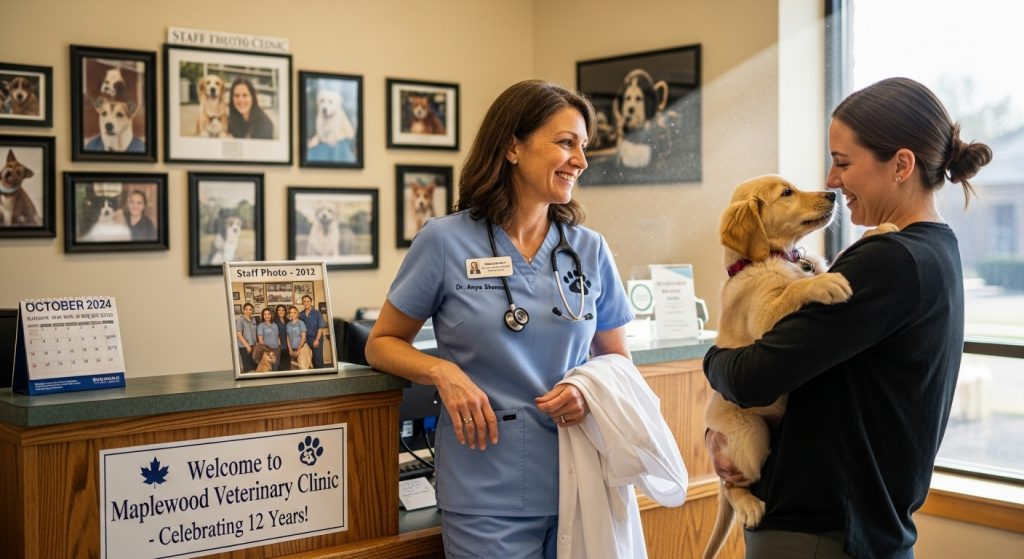
I’ve been a veterinary technician in suburban Ohio for over twelve years, but absolutely nothing could have prepared me for the sickening reality I uncovered when I unclipped the collar of a trembling little pug on a rainy Tuesday morning.
The clinic was unusually quiet that day. It had been pouring rain since dawn, and most of our morning appointments had canceled. I was at the front desk, organizing some files and sipping lukewarm coffee, just waiting for the clock to hit noon.
That’s when the front door chimed.
A man walked in. He was a tall, heavily built white guy, maybe in his late thirties, wearing a faded, mud-splattered canvas jacket and a baseball cap pulled down low over his eyes. He didn’t hold the door open; he just let it slam shut behind him.
But it wasn’t him that caught my attention. It was the dog.
He was dragging a small, fawn-colored pug by a thick, dark leather leash. I mean literally dragging her. Her little paws were sliding against the wet linoleum floor of our waiting room.
She wasn’t walking. Her belly was practically pressed against the ground, her ears were pinned back flat against her head, and her wide, bulging eyes were darting around the room in absolute terror.
I immediately felt a knot form in my stomach. You see a lot of things in veterinary medicine. You see dogs who are scared of the vet, sure. It’s common. But there’s a difference between a dog who is nervous about getting a shot, and a dog who is fundamentally terrified of the person holding their leash.
“Can I help you?” I asked, forcing a polite, professional smile as I stepped out from behind the reception desk.
“She needs her shots,” the man grunted. He didn’t look at me. His eyes were scanning the waiting room, looking at the security cameras, looking at the empty chairs. He was shifting his weight from foot to foot. Agitated. Restless.
He yanked the leash upward. The poor pug choked, letting out a pitiful, wheezing gasp, and scrambled to her feet, her whole body vibrating with fear.
“Hey, let’s take it easy on her neck,” I said gently, stepping closer. “Pugs have sensitive airways. A harness is usually better.”
He glared at me. It was a cold, hard look that made the hair on my arms stand up. “She’s just being stubborn,” he snapped. “Always been a stubborn, useless dog. Just give her the damn shots so I can get out of here.”
I looked down at the dog. She was looking up at me. I swear to you, it felt like she was pleading with me. She was panting rapidly, but it wasn’t from the heat. It was pure, unadulterated stress.
“Okay,” I said, keeping my voice calm and steady. “What’s her name?”
“Bella,” he muttered.
“Alright, Bella,” I knelt down to her level, extending my hand slowly. She flinched violently as I moved. My heart broke right then and there. Whatever this dog’s life was like at home, it wasn’t good.
“Do you have her previous medical records? Proof of her last rabies vaccine?” I asked, looking back up at the man.
“No. I lost them,” he said quickly. Too quickly. “Just give her new ones. I have cash.” He reached into his pocket and pulled out a crumpled wad of twenty-dollar bills, tossing them onto the reception counter.
Everything about this interaction was screaming at me. The lack of records. The cash payment. The way he handled her. The sheer panic radiating from the animal. In our field, we are trained to look for signs of animal abuse, but you have to be very careful about how you proceed. You can’t just accuse someone without proof.
“I’m going to need to take her to the back room to get a weight on her and let the doctor do a quick exam before we administer any vaccines,” I told him, standing up.
“Do it here,” he demanded, stepping forward and gripping the leash tighter.
“I’m sorry, sir, but clinic policy requires us to weigh her on the back scale, and Dr. Evans needs a proper sterile table for the exam,” I lied smoothly. We do exams in the rooms all the time, but I needed to get this dog away from him. I needed to see her alone.
He stared at me for a long, tense moment. The silence in the waiting room was deafening, broken only by the sound of the rain beating against the front windows and Bella’s ragged, terrified breathing.
Finally, he huffed in annoyance. “Fine. But hurry up. I’m double-parked.”
He handed me the leash. The moment the leather strap transferred to my hand, Bella dropped entirely to the floor, refusing to move.
“Come on, sweetheart. It’s okay,” I coaxed, bending down to scoop her up. She weighed almost nothing. She was shockingly thin under her loose skin. As I lifted her against my chest, she buried her face into my scrub top, shaking so hard it felt like she was having a seizure.
I carried her down the hallway to Exam Room 3, the one furthest from the waiting area. I closed the heavy wooden door behind me, letting out a breath I didn’t know I was holding.
“It’s just us now, Bella,” I whispered, setting her gently on the cold metal exam table.
She didn’t try to run. She just pancaked herself against the metal, trembling uncontrollably. I grabbed a warm towel from the cabinet and draped it over her back to try and calm her down.
I needed to do a basic triage before Dr. Evans came in. Heart rate, temperature, check her gums.
I started by checking her head and neck. That’s when I really noticed the collar.
It was entirely out of place for a dog her size. It was a thick, rigid, dark brown leather collar, at least two inches wide, the kind you would normally see on a Doberman or a Pitbull, not a ten-pound pug. It looked incredibly heavy.
“Let’s get this bulky thing off you,” I murmured.
I slid my fingers under the leather to find the buckle. As soon as I touched her neck, Bella let out a sharp, high-pitched scream of pain.
I yanked my hand back. “Oh my god, I’m so sorry, baby.”
I looked closer. The collar was fastened insanely tight. It was digging into her skin, hiding beneath the folds of her neck.
I carefully reached around to the back of her neck, trying to find the metal clasp without putting pressure on her throat. It was secured with an old, rusted buckle. It took me a good minute of careful maneuvering, my fingers slipping on the rigid leather, before I finally got the prong free.
I unbuckled the collar and gently pulled it away.
The moment it came off, I gasped out loud, slapping my hand over my mouth.
The skin underneath the collar was completely raw. It was a horrific, weeping ring of infected tissue that went all the way around her neck. It looked like the collar hadn’t been taken off in months, maybe years. The smell of infection hit me immediately—a sickening, sweet and sour odor of rotting tissue.
Tears immediately pricked my eyes. I was furious. I wanted to march out to the waiting room and scream at that man.
But as I set the heavy leather collar down on the counter next to the sink, something caught my eye.
The collar had landed upside down. Along the inside of the thick leather strap, there was a deep slit cut into the lining. It looked like a hidden compartment.
And sticking halfway out of that slit was a piece of paper.
It was folded tightly into a small, thick square. The edges of the paper were stained dark brown. Blood. It had soaked through from the horrific wounds on Bella’s neck.
My heart started to pound in my chest. A cold, heavy sense of dread washed over me. Why would a dog have a hidden note in its collar?
With trembling fingers, I reached out and pulled the paper from the leather lining. It was damp and stiff from the dried blood and dirt.
I slowly unfolded it.
As I read the smeared, frantic handwriting scrawled across the page, my blood ran completely cold. The room started to spin. My hands shook so violently that the paper rattled.
The dog wasn’t the only one in danger.
I stared at the crumpled, blood-stained piece of paper, my vision blurring at the edges.
The silence in Exam Room 3 was suddenly deafening. The only sounds were the relentless drumming of the rain against the frosted glass window and the ragged, shallow breathing of the tiny dog huddled on the metal table.
My hands were shaking so violently that the stiff paper rattled. I had to place it down on the cold stainless steel counter just to read it.
The handwriting was erratic. It was scribbled in what looked like a dull pencil, the letters pressed so hard into the paper that they had almost torn through the cheap material. You could see the sheer panic in every single stroke of the pencil.
I leaned in closer, my heart hammering against my ribs like a trapped bird.
“If you find this, please God, help me,” the note began.
The first line alone made my stomach drop into my shoes. I swallowed hard, forcing my eyes to keep reading, even though every instinct in my body was screaming at me to run out the back door.
“He doesn’t know I hid this in Bella’s collar. He beat her with a heavy flashlight because she wouldn’t stop crying when he hit me. The collar is to hide her neck. He says I’m next. He took my phone. He nailed the front windows shut. He told me he’s going to finish this tonight when the sun goes down. Please don’t let him take the dog back. Please call the police. Send them to the old gray farmhouse at the dead end of Miller Road. Tell them to check the root cellar. He locked my little boy down there. Please hurry. – Chloe.”
I stopped breathing.
I literally forgot how to draw air into my lungs.
A wave of profound, icy nausea washed over me, chilling me right down to the marrow of my bones. I had to grip the edge of the stainless steel counter to stop my knees from buckling.
This wasn’t just an animal abuse case.
This was a hostage situation. This was domestic violence. This was a mother and her child trapped in a farmhouse with a monster who was planning to kill them tonight.
And that monster was sitting right now in my waiting room, twenty feet away, casually flipping through a hunting magazine and waiting for me to bring his dog back.
I looked down at Bella.
The little fawn pug was still pancaked flat against the exam table. She was looking up at me with those huge, bulging, watery eyes. Now I understood why she had been fighting so hard against the leash. She wasn’t just terrified of him. She had been trying to protect her owner. She had been trying to stay at that farmhouse.
And the raw, weeping wounds around her neck… they weren’t just from a tight collar. They were from being violently beaten and then having that heavy leather strap buckled tightly over her injuries to hide the evidence.
“Oh, you brave little girl,” I whispered, my voice cracking as a hot tear spilled over my cheek.
I reached out with a trembling hand and gently stroked the soft, uninjured fur on the top of her head. She leaned into my touch ever so slightly, letting out a tiny, broken whimper that shattered what was left of my heart.
I had to do something. I had to call 911 right this second.
But a sudden, terrifying thought paralyzed me.
What if he got suspicious? What if the police pulled up with their sirens blaring, and he saw them through the clinic’s front windows? He could easily pull a weapon. He could take me, the receptionist, and Dr. Evans hostage. Or worse, he could bolt out the door, speed back to that farmhouse, and hurt Chloe and her son before the cops even figured out what was happening.
I needed to be smart. I needed to be perfectly calm.
Just as I reached for the clinic’s landline phone mounted on the wall, the heavy wooden door of Exam Room 3 swung open.
I violently jumped, knocking a plastic jar of cotton swabs off the counter. It clattered loudly against the linoleum floor.
“Whoa, easy there, Sarah,” Dr. Evans said, stepping into the room and closing the door behind him.
Dr. Evans was in his late fifties, a tall, gentle man with graying temples and a calm, soothing demeanor that usually put both animals and their owners at ease. He had been a vet for thirty years. He had seen everything.
But he hadn’t seen this.
“Sorry,” I gasped, pressing a hand to my chest to try and calm my racing heart. “You startled me.”
He frowned, his eyes darting from my pale face to the trembling dog on the table, and finally to the heavy, bloody leather collar sitting next to the sink. His professional demeanor instantly shifted. His jaw tightened.
“What happened here?” he asked, his voice dropping to a low, serious whisper. He stepped toward the table, his eyes fixed on Bella’s horrific neck injuries. “Good lord. Who brought this dog in?”
“The guy in the waiting room,” I whispered back, my voice shaking so badly I could barely form the words. “The tall guy in the canvas jacket.”
“I saw him,” Dr. Evans murmured, gently pulling a pair of latex gloves from the wall dispenser. “He looks like trouble. This is severe, intentional abuse, Sarah. We’re going to have to involve animal control. I’ll go speak to him—”
“No!” I hissed, lunging forward and grabbing Dr. Evans by the sleeve of his white coat.
He stopped, looking at me with genuine surprise. “Sarah, what is it?”
Without saying another word, I picked up the crumpled, blood-stained note from the counter and pressed it into his gloved hand.
“Read this,” I whispered, glancing nervously at the closed door. “Read it fast.”
I watched Dr. Evans’s face as his eyes scanned the scribbled pencil marks. I watched the color completely drain from his cheeks. I watched his mouth fall open in silent horror.
When he finished reading, he slowly lowered the paper. He didn’t say a word for a long time. He just stared at the wall, processing the sheer magnitude of the nightmare that had just walked into our suburban clinic.
“Miller Road,” Dr. Evans finally breathed, his voice barely audible. “That’s out past the county line. It’s completely isolated out there. Nothing but woods and abandoned properties.”
“He’s in the waiting room right now,” I said, my voice trembling uncontrollably. “He’s waiting for me to bring Bella back out. He told me to hurry because he’s double-parked.”
Dr. Evans looked down at the little pug. His expression hardened into something I had never seen before in all my years working for him. It was pure, focused resolve.
“He is not getting this dog back,” Dr. Evans said firmly.
“But what do we do?” I panicked. “If we take too long, he’s going to come looking for us. If he realizes we found the note, he might try to hurt us, or he’ll just run and go back to the farmhouse to hurt them.”
Dr. Evans took a deep breath, slipping the note into the deep pocket of his white coat.
“Okay. Here is the plan,” he said, keeping his voice incredibly low and calm. “You are going to walk out of this room. You are going to go to the front desk and act completely normal. You tell him that I am giving Bella her vaccines right now, but we noticed a slight ear infection and I’m cleaning it out.”
“Okay,” I nodded, swallowing hard.
“While you stall him, I am going to use the phone in my private office to call Sheriff Miller directly. He’s a personal friend. I’m going to tell him to send plainclothes officers to the clinic, and I’m going to give him the address on Miller Road so they can dispatch a tactical unit out there immediately.”
The plan made sense. It was the safest way. But the thought of going back out there and looking that monster in the eye terrified me more than anything I had ever experienced in my life.
“What if he doesn’t want to wait?” I asked, my voice cracking. “What if he gets angry?”
“You have to make him wait, Sarah,” Dr. Evans said, looking me dead in the eye. “Offer to comp his visit. Offer him a free bag of food. Do whatever it takes to keep him sitting in that chair for the next ten minutes. Can you do that?”
I looked at Bella. She was still shivering, but she had stopped panting. She was watching me.
I thought about Chloe. I thought about a little boy locked in a dark, cold root cellar, waiting for a monster to come home.
“I can do it,” I said, forcing my shoulders to drop. I wiped the tears from my cheeks and took a deep, shuddering breath.
“Good,” Dr. Evans nodded. He reached over and gently squeezed my shoulder. “You’re doing great. I’m going to take Bella to the surgical suite in the back and lock the door. If he tries to push past you and search the rooms, he won’t find her.”
He carefully scooped the tiny dog into his arms. Bella didn’t resist. She just buried her face into his coat.
“Go,” he whispered.
I turned around, my hand hovering over the doorknob of Exam Room 3. My hands were sweating. My pulse was throbbing in my ears. I felt like I was about to step onto a battlefield without a weapon.
I opened the door and stepped out into the quiet hallway.
The clinic was still empty, except for the receptionist, Jessica, who was typing away at her computer up front.
I walked down the hallway, forcing my face into a pleasant, customer-service smile. Every step felt like I was walking through thick mud.
As I rounded the corner into the main waiting room, my heart stopped.
The tall man in the canvas jacket was no longer sitting in the plastic waiting chair.
He was standing right at the reception desk, leaning aggressively over the high counter, staring down at Jessica. His hands were curled into tight fists by his sides.
“I said, where is my dog?” he growled, his voice loud and echoing in the quiet clinic.
Jessica looked up at him, her eyes wide and startled. “Sir, the technician is with her right now. It should just be a few more minutes—”
“It’s been ten minutes!” he shouted, slamming his heavy fist down on the counter. The sudden noise made Jessica flinch violently. “I told that girl I was in a hurry! What the hell are you people doing back there?”
I froze in the hallway.
He was agitated. He was escalating. He knew something was wrong.
He suddenly turned around, his dark, furious eyes scanning the hallway. And then, he saw me.
His eyes locked onto mine. There was no dog in my arms. There was no leash in my hand.
A dark, terrifying realization washed over his face. His eyes narrowed, and the muscle in his jaw twitched.
“Where is she?” he demanded, taking a heavy step toward me.
My mouth went completely dry. I tried to speak, but no sound came out.
He took another step, his heavy boots thudding against the linoleum. He was closing the distance between us.
“I asked you a question,” he said, his voice dropping to a low, dangerous growl. He reached into the deep pocket of his canvas jacket. “What did you do with my dog?”
Time didn’t just slow down; it felt like it stopped entirely.
The heavy, rhythmic drumming of the rain against the large front windows of the clinic faded into a muted, distant hum. The low buzzing of the fluorescent lights overhead suddenly sounded as loud as a chainsaw in my ears.
Every single instinct in my body was screaming at me to turn around and run back down the hallway, to lock myself in the surgical suite with Dr. Evans and the dog.
But my legs refused to cooperate. I was rooted to the cold linoleum floor, my muscles locked in a state of absolute, paralyzing terror.
He was staring directly at me, his dark eyes narrowed into terrifying slits. The muscle in his jaw was twitching so violently I could see it from ten feet away.
His right hand was still buried deep inside the heavy canvas pocket of his jacket.
My mind raced through a thousand horrifying scenarios in the span of a single second. Was it a gun? A hunting knife? In suburban Ohio, carrying a concealed weapon was common enough, but the sheer, unadulterated malice radiating from this man told me whatever he had in that pocket wasn’t for self-defense.
He took another step forward. His heavy, mud-caked work boots left dark, dirty prints on the pristine floor we had just mopped that morning.
“I asked you a question,” he repeated, his voice dropping an octave. It wasn’t a shout anymore. It was a low, guttural growl that vibrated right through my chest. “Where is my dog?”
Out of the corner of my eye, I saw Jessica, our receptionist. She was barely twenty-two, a recent college grad who usually spent her shifts playing with puppies and updating our social media pages. Right now, her face was the color of chalk.
She was slowly, imperceptibly sliding her hand underneath the reception counter. I knew exactly what she was reaching for. The silent panic button. We had installed it two years ago after a string of break-ins at local pharmacies, never thinking we would actually need to use it in the middle of a Tuesday afternoon.
I prayed she had pressed it. I prayed the signal was already pinging the local precinct.
But even if she had, the police were at least five minutes away. Five minutes is an eternity when you are trapped in a room with a violent man who thinks you are stealing his property.
I had to speak. If I stayed silent, he would know we were hiding something. I had to remember Dr. Evans’s instructions. I had to stall him.
“Sir,” I started, and I internally cursed myself when my voice cracked on the very first syllable. I cleared my throat, forcing myself to stand up straighter, to project an authority I absolutely did not feel.
“Sir, please lower your voice. You are in a veterinary hospital,” I said, trying to mimic the calm, clinical tone Dr. Evans always used with difficult clients.
He didn’t care. He took another step forward. He was only a few yards away from me now, looming at the entrance of the hallway that led back to the exam rooms.
“Don’t give me that attitude,” he spat, his eyes darting down the dark hallway behind me. He was looking for her. He was looking for Bella. “You went back there to weigh her. It doesn’t take ten minutes to put a ten-pound dog on a scale. Bring her out here. Now.”
“We did weigh her,” I lied, the words tasting like ash in my mouth. I forced myself to maintain eye contact with him, even though looking into his eyes felt like staring into an empty, dark abyss. “But when Dr. Evans did his preliminary exam, he noticed something highly concerning.”
That made him pause. The aggressive forward momentum broke for just a fraction of a second. His brow furrowed.
“What are you talking about?” he demanded, his hand gripping whatever was in his pocket a little tighter.
“Her heart rate, sir,” I continued, leaning heavily on medical jargon, hoping to confuse him, hoping to buy just a few more precious seconds. “When I placed her on the table, she went into a state of severe tachycardia. Her resting heart rate spiked to over two hundred beats per minute, and she was exhibiting signs of acute respiratory distress.”
He stared at me, his face twisting into a mask of confused anger. “English,” he snapped. “Speak English.”
“She couldn’t breathe,” I translated, keeping my voice incredibly steady, even though my hands, hidden behind my back, were trembling so hard my fingernails were biting into my own palms.
“Dr. Evans believes the stress of the car ride, combined with her pre-existing brachycephalic airway syndrome, triggered a minor cardiac event. She started turning blue. We couldn’t safely administer any vaccines in that state.”
It was a brilliant lie. It was a terrifyingly plausible scenario for a pug, especially one that had been dragged by the neck. Pugs are notorious for breathing issues.
For a moment, I thought he bought it. The intense, murderous glare in his eyes flickered, replaced by a momentary flash of something else. Not concern for the dog, but annoyance. Annoyance that his property was defective. Annoyance that his timeline was being interrupted.
“So where is she?” he asked, his tone slightly less threatening, but still sharp with impatience.
“Dr. Evans immediately transferred her to the intensive care unit in the surgical suite,” I said, pointing vaguely over my shoulder toward the heavy, locked double doors at the very back of the clinic.
“He had to put her in an oxygen cage to stabilize her vitals. If we hadn’t acted quickly, she could have gone into full cardiac arrest.”
I watched him process the information. He was a man used to being in control, used to dictating what happened and when. The fact that his dog was locked in a medical unit, out of his reach, was clearly infuriating him.
But he also didn’t want to look like he didn’t understand the situation.
“Fine,” he grunted, pulling his hand out of his pocket.
My heart did a massive leap of relief. His hand was empty. He just reached up to wipe a bead of sweat from his forehead, pushing his muddy baseball cap further back on his head.
“How long is this going to take?” he demanded, crossing his arms over his chest. “I have places to be. I told you, I’m double-parked out front.”
I glanced at the large clock on the wall behind the reception desk. 12:14 PM. It had only been three minutes since I left Dr. Evans in the back.
Three minutes.
It felt like three hours.
“It’s hard to say,” I told him, stepping slightly to the side to physically block the hallway, just in case he decided to go looking for himself. “She needs to remain in the oxygen environment until her mucosal color returns to normal and her heart rhythm stabilizes. It could be fifteen minutes, it could be an hour.”
“An hour?” he shouted, the rage instantly boiling over again. “I’m not waiting an hour for a damn dog to catch its breath! Go back there and get her.”
“I absolutely cannot do that, sir,” I said, my voice rising slightly. I was pushing my luck, and I knew it. But I had to keep him out here. I had to protect Chloe and her little boy. Every minute he spent yelling at me was a minute the tactical unit was getting closer to that isolated farmhouse on Miller Road.
“Taking her out of the oxygen cage right now could be fatal,” I insisted, lying through my teeth with a conviction that shocked even me. “Dr. Evans is monitoring her constantly. As soon as she is stable enough to be moved, he will bring her out.”
He let out a loud, aggressive breath, running a hand through his thinning hair. He began to pace.
He walked back toward the front door, looking out through the rain-streaked glass. I held my breath, terrified that a marked police cruiser would suddenly pull up and park right in front of the clinic. If he saw uniform cops right now, the situation would escalate beyond control.
But the street was empty. Just gray skies, pouring rain, and an old, beat-up black pickup truck idling illegally in the fire lane. His truck.
He turned back around, pacing the length of the waiting room like a caged tiger. He kicked a stack of dog food brochures that had fallen on the floor, sending paper scattering across the linoleum.
“This is ridiculous,” he muttered, his eyes darting to the security camera mounted in the corner of the ceiling. “It’s just a useless mutt. Should have just handled it myself.”
The casual cruelty in his voice made my stomach churn. I thought about the blood-stained note sitting in Dr. Evans’s pocket. He beat her with a heavy flashlight… He says I’m next.
This man wasn’t just impatient. He was a predator waiting to go back to his prey. And the prey was a mother and a child locked in a dark, damp root cellar.
I glanced at Jessica again. She gave me a tiny, almost imperceptible nod. The silent alarm was triggered. Help was coming. We just had to hold on.
“Sir, why don’t you have a seat?” I offered, gesturing toward the row of plastic chairs. “Can I get you some water? Or coffee?”
He stopped pacing and glared at me. “I don’t want your damn water. I want to talk to the vet. Where is he?”
“As I said, he is in the surgical unit with Bella—”
“Then I’ll go back there and talk to him,” he announced, taking a sudden, decisive step toward the hallway.
Panic flooded my veins like ice water. I stepped right into the middle of the narrow hallway, blocking his path with my body.
“Sir, you cannot go back there,” I said, holding both of my hands up in a gesture that was half-placating, half-defensive. “The treatment area is strictly off-limits to clients due to liability and sterile protocols.”
He stopped right in front of me. He was easily six-foot-two, broad-shouldered and heavy-set. I am five-foot-four. He towered over me, his chest almost touching my raised hands.
I could smell him now. A sickening mixture of stale cigarette smoke, damp canvas, cheap aftershave, and something metallic and sharp. Like copper. Like dried blood.
“Move,” he commanded, his voice barely a whisper.
“I can’t let you pass,” I managed to say, my voice trembling so violently I sounded like a terrified child.
He leaned down, his face mere inches from mine. His eyes were completely devoid of any human empathy. They were cold, flat, and dead.
“I’m not going to ask you again, little girl,” he whispered, a terrifyingly calm smile playing on his lips. “Get out of my way, or I will move you myself.”
I squeezed my eyes shut, bracing for the impact. I expected to feel his heavy hands grab my shoulders and throw me against the wall. I expected the violence that I knew he was so deeply capable of.
But the impact never came.
Instead, the soft, melodic chime of the front door bell echoed through the tense silence of the waiting room.
Ding-dong.
The man paused, his head snapping around to look toward the entrance. I opened my eyes, my heart hammering a frantic rhythm against my ribs.
Two men had just walked into the clinic.
They didn’t look like police officers. They were wearing thick, unzipped Carhartt jackets, faded blue jeans, and work boots. They looked like any other local contractors coming in to pick up some dog food on their lunch break.
But the way they walked was different. They didn’t saunter. They moved with a rigid, calculated purpose. Their eyes weren’t looking at the display shelves; they were instantly scanning the room, assessing the threats, identifying the targets.
One of them was tall and broad, with a closely cropped military-style haircut. The other was slightly shorter but incredibly stocky, with a thick beard and piercing blue eyes.
The tall man stepped right up to the reception desk, directly behind the man in the canvas jacket.
“Afternoon, ladies,” the tall man said, his voice calm, polite, but carrying a heavy weight of authority. He didn’t look at me or Jessica. He was looking directly at the back of the abuser’s head.
The man in the canvas jacket turned around slowly. His defensive posture instantly flared. He puffed out his chest, squaring his shoulders against the new arrivals.
“We’re busy here,” the abuser snapped, glaring at the two men. “Wait your turn.”
The shorter man with the beard casually stepped to the left, flanking the abuser, effectively blocking his path to the front door. It was a subtle, tactical maneuver, but the abuser noticed it immediately. His eyes darted between the two men, and that momentary flash of panic I had seen earlier returned, but this time, it was magnified a hundredfold.
“Actually, we’re not here for a checkup,” the tall man said smoothly.
Without breaking eye contact, the tall man reached into the inside pocket of his thick jacket and pulled out a leather badge holder, letting it flip open to reveal a heavy, silver star.
“Detective Miller, County Sheriff’s Department,” he stated, his voice ringing out clearly in the quiet room. “Are you Thomas Vance?”
The name hung in the air like a physical weight. Thomas Vance. This was the monster.
Vance didn’t answer. His entire body tensed like a coiled spring. His eyes frantically scanned the room—looking at the door blocked by the bearded detective, looking at the hallway blocked by me, looking at the large glass windows showing the empty, rainy street.
He was calculating his odds. He was cornered.
“I asked you a question, sir,” Detective Miller repeated, his hand casually dropping to rest on his right hip, sweeping back his heavy jacket just enough to reveal the black grip of a service weapon holstered on his belt. “Are you Thomas Vance?”
“What’s this about?” Vance demanded, his voice suddenly losing its aggressive edge, replaced by a defensive, high-pitched whine. “I’m just here getting my dog vaccinated. You guys have no right to harass me.”
“We’re not here to harass you, Mr. Vance,” the bearded detective spoke up from the side, his voice low and firm. “We received a highly concerning tip regarding a situation out at your property on Miller Road.”
The moment the words “Miller Road” left the detective’s mouth, the color drained entirely from Vance’s face. The arrogant, violent facade crumbled in an instant.
He knew. He knew the secret was out.
His eyes darted wildly, and then, they landed on me. The realization hit him with the force of a freight train. He looked past me, down the dark hallway leading to the back rooms.
He knew about the note.
“You,” he hissed, pointing a trembling, mud-stained finger directly at my face. The sheer hatred radiating from his eyes made me take a physical step backward. “You read it. You filthy little—”
Before the slur could even leave his mouth, he lunged.
He didn’t lunge for the door. He didn’t lunge for the cops. He lunged straight for me, his heavy hands reaching out like claws, aiming directly for my throat.
A scream ripped from my lungs as I stumbled backward, my foot catching on the edge of the hallway rug. I fell hard against the drywall, throwing my hands up to protect my face.
But he never reached me.
In a blur of sudden, explosive violence, the two detectives moved.
The tall detective grabbed Vance by the back of his thick canvas collar, violently jerking him backward, away from me. At the exact same moment, the bearded detective swept Vance’s legs out from under him with a brutal kick to the back of his knees.
Vance hit the linoleum floor with a sickening, heavy thud that shook the front desk.
“Police! Do not move! Put your hands behind your back!” the tall detective roared, the polite, calm demeanor completely gone.
Vance fought like a wild animal. He thrashed and kicked, screaming profanities, trying to roll over and throw punches. But the two detectives were highly trained. They pinned him down with practiced efficiency, driving their knees into his shoulders, forcing his arms behind his back.
The metallic click of handcuffs echoing in the waiting room was the most beautiful sound I had ever heard in my entire life.
“Thomas Vance, you are being detained on suspicion of domestic terrorism, aggravated assault, and kidnapping,” Detective Miller read out, breathing heavily as he wrenched Vance to his feet.
Vance was a mess. His baseball cap had fallen off, revealing a bald spot and a face twisted into a mask of pure, unadulterated rage. He glared at me as the detectives dragged him toward the front doors.
“You’re dead!” he screamed at me, spit flying from his lips. “You hear me? You’re dead! I’ll find you!”
“Shut your mouth,” the bearded detective growled, shoving Vance forward through the glass doors and out into the pouring rain.
The clinic doors swung shut behind them, and the silence that followed was absolute.
I was still sitting on the floor, pressed against the drywall, my chest heaving as I tried to pull air into my lungs. My entire body was shaking uncontrollably.
Jessica slowly stood up from behind the reception desk, her hands covering her mouth, tears streaming down her pale cheeks.
Then, the heavy wooden doors at the back of the clinic swung open.
Dr. Evans ran down the hallway, still wearing his surgical gown, his face pale and tight with worry. He stopped when he saw me sitting on the floor.
“Sarah!” he gasped, kneeling down next to me and grabbing my shoulders. “Are you hurt? Did he touch you?”
“No,” I choked out, a sob finally breaking through my throat. “No, the police got him. They took him outside.”
Dr. Evans let out a massive, shuddering breath, pulling me into a tight, fatherly hug. “You did it, Sarah. You held him long enough.”
He helped me to my feet. My legs felt like jelly. I leaned heavily against the wall, trying to regain my composure.
Just then, the front doors opened again. Detective Miller walked back inside, wiping rain from his face. He looked at Dr. Evans, then at me.
“Is everyone alright in here?” he asked, his voice returning to that calm, professional tone.
“We are fine,” Dr. Evans said, stepping forward. “Thank you for getting here so quickly, Detective.”
“We had units in the area,” Miller nodded. He reached into his jacket and pulled out a small notepad. “Now, Doc told me on the phone there was a note? Hidden on a dog?”
Dr. Evans reached into his coat pocket and pulled out the crumpled, blood-stained paper. He handed it to the detective.
Miller unfolded it carefully, reading the frantic, scribbled handwriting. I watched his jaw tighten. The seasoned cop, who had just physically wrestled a violent man to the ground without blinking, looked visibly shaken by what he was reading.
“Jesus Christ,” Miller breathed, closing the notepad. He immediately reached for the radio clipped to his belt.
“Dispatch, this is Miller. We have the primary suspect in custody at the veterinary clinic. I need you to confirm the status of the tactical entry team at the Miller Road property.”
The radio crackled with static for a long, agonizing moment. The silence in the clinic was heavy, thick with unspoken dread.
We had stopped the monster. We had read the warning.
But were we too late?
Finally, a voice broke through the static on the radio. It wasn’t the dispatcher. It was a breathless, urgent male voice, shouting over the sound of heavy rain and sirens.
“Miller, this is Unit 4. We’ve breached the farmhouse. The place is a complete wreck. Signs of a struggle everywhere. Blood on the walls.”
My heart plummeted into my stomach. I squeezed my eyes shut, praying to a God I hadn’t spoken to in years.
“What about the victims?” Miller barked into the radio. “Do you have eyes on the woman and the child?”
There was another burst of static. It lasted for five seconds, but it felt like five years.
“Negative, Miller,” the voice came back, sounding grim. “We’ve cleared the ground floor and the upstairs. The house is empty.”
“Check the root cellar!” I screamed, pushing past Dr. Evans. “The note said he locked the little boy in the root cellar!”
Miller held up a hand to quiet me, pressing the radio closer to his ear. “Unit 4, check the property for an underground root cellar. Suspect may have locked the victims inside.”
“Copy that,” the voice crackled.
We stood there in absolute silence. Nobody moved. Nobody breathed. We just stared at the black plastic radio on the detective’s belt, waiting for the words that would either save our souls or haunt our nightmares for the rest of our lives.
A minute passed. Then two.
Then, the radio crackled again.
“Miller… we found the root cellar. The doors were heavily padlocked from the outside. We had to use bolt cutters.”
“And?” Miller demanded.
“It’s bad, Miller. It’s really bad down here. You need to get an ambulance out to this location immediately. Full lights and sirens. Tell them to hurry.”
The harsh, fluorescent lights of the pediatric intensive care unit hummed with a low, sterile vibration that seemed to drill directly into my skull.
I was sitting in a stiff plastic chair in the waiting area, staring at a styrofoam cup of coffee that had gone ice cold hours ago. My uniform was still damp, smelling faintly of wet asphalt, rain, and the metallic tang of fear.
It had been fourteen hours since I sliced open that black trash bag on the side of Route 95.
Fourteen hours since I found a battered Golden Retriever using its own broken body to shield a freezing human infant from the storm.
The image was burned into the back of my eyelids. Every time I blinked, I saw the dog’s terrified, glassy eyes. I saw that tiny, pale hand grasping the matted golden fur. I heard that weak, suffocated cry that had completely shattered my heart.
The double doors of the ICU swung open, breaking me out of my trance.
Dr. Aris, the lead neonatal specialist, walked out. He looked exhausted. His green scrubs were wrinkled, and he was aggressively rubbing the bridge of his nose, pushing his glasses up his forehead.
I immediately stood up, my knees popping in protest. My heart hammered against my ribs.
“Doc?” I asked, my voice coming out as a raspy, dry croak. “How is she?”
Dr. Aris let out a long, heavy sigh. He dropped his hand and looked me in the eye.
“She’s a fighter, Officer,” he said, his voice quiet but steady. “It was incredibly close. When the paramedics brought her in, her core body temperature was sitting at eighty-eight degrees. She was in severe hypothermic shock. Her little organs were starting to shut down to conserve heat for her brain and heart.”
I swallowed hard, feeling a thick, painful knot form in my throat. “But she’s stable?”
“She is stable,” Dr. Aris nodded, offering the faintest ghost of a smile. “We’ve slowly brought her temperature back up to normal parameters using warmed IV fluids and a specialized incubator. Her breathing has regulated, and her heart rate is strong. She’s sleeping now.”
I let out a breath I felt like I had been holding since 3:15 AM. I had to grip the back of the plastic waiting chair to keep my legs from buckling beneath me.
“Thank God,” I whispered, wiping a hand across my exhausted face.
“Honestly, Officer,” Dr. Aris continued, stepping closer and lowering his voice, “she shouldn’t have made it. A baby that young, exposed to those elements in a plastic bag… she would have frozen to death in less than an hour.”
He paused, looking down at the chart in his hands before looking back up at me.
“The only reason that little girl is alive right now is because of the dog,” the doctor stated, his voice thick with raw emotion. “The paramedics noted it at the scene, and I can confirm it from her physical condition. That animal actively curled around her, using its own body heat to create a thermal barrier. The dog took the brunt of the freezing rain and the wind.”
Tears prickled the corners of my eyes. I didn’t try to hide them. I had been a cop for seventeen years. I had seen the absolute worst of humanity. I had seen what people were capable of doing to one another for money, for drugs, or just out of pure malice.
But I had never seen anything like this. I had never seen a level of pure, selfless devotion that crossed the boundary between species. That dog, beaten, starved, and discarded to die, had chosen to spend its last ounces of strength protecting a helpless child.
“What about the dog?” Dr. Aris asked gently, pulling me back to reality. “The EMTs told me you called animal control for an emergency transport.”
“I didn’t let animal control take him,” I said, shaking my head. “I followed the ambulance here, made sure the baby was in your hands, and then I put the dog in the back of my cruiser. I drove him straight to the 24-hour emergency veterinary hospital in Portland.”
“How is he doing?”
I looked down at my hands. They were trembling. “I don’t know yet. They rushed him into surgery the second I carried him through the doors. He had multiple broken ribs, a fractured hind leg, and severe internal bleeding from blunt force trauma. Someone beat the absolute hell out of him before tossing them both on the highway.”
Dr. Aris’s face darkened with a mixture of sorrow and profound anger. It was the same anger that had been simmering in my gut all night.
“Whoever did this…” Dr. Aris started, his voice trailing off as he struggled to find the words.
“I’m going to find them,” I promised, my voice hardening into cold steel. “I don’t care how long it takes. I don’t care what rocks I have to turn over. I am going to find the monster who zipped that bag shut.”
Just then, the heavy doors of the waiting room pushed open, and Detective Miller walked in.
Miller was a seasoned investigator with the state police, a guy I had worked with on a dozen different major cases over the years. He was usually calm, collected, and impossible to rattle.
But right now, he looked entirely unhinged. His tie was loose, his hair was a mess, and his eyes were blazing with an intensity that immediately put me on high alert.
“We got a hit,” Miller said, not even bothering to say hello. He marched straight over to where Dr. Aris and I were standing.
“A hit?” I asked, my pulse instantly accelerating. “From where? The highway cameras?”
“No. From a hospital over in the next county,” Miller explained, his voice rapid and urgent. “About an hour ago, a woman stumbled into the emergency room at St. Jude’s. She was badly beaten, disoriented, and suffering from a severe concussion. When she finally regained full consciousness, she started screaming hysterically for her baby and her dog.”
My stomach dropped into my shoes. “The mother.”
“Yes,” Miller nodded grimly. “Her name is Sarah Jenkins. She’s twenty-two years old. The baby’s name is Lily. The dog’s name is Duke.”
Hearing their names made them suddenly, painfully real. This wasn’t just a John Doe case anymore. This was Lily and Duke.
“Who did this to them, Miller?” I demanded, taking a step toward the detective. “Who put them in that bag?”
Miller’s jaw clenched so tight I thought his teeth might crack. He looked around the quiet waiting room before leaning in closer.
“Her ex-boyfriend,” Miller spat, his voice dripping with venom. “A guy named Marcus Vance. He’s a local mechanic with a rap sheet a mile long—aggravated assault, narcotics, domestic violence. Sarah broke up with him three weeks ago and filed a restraining order.”
I felt the blood rushing in my ears. It was a story as old as time, and it almost always ended in tragedy.
“According to Sarah,” Miller continued, pulling a small notepad from his jacket pocket, “Vance broke into her apartment late last night. He was completely out of his mind, high on something. He beat her until she blacked out. When she woke up hours later, Vance was gone. And so were Lily and Duke.”
I closed my eyes, picturing the horrific scene in that apartment. I pictured that monster grabbing a helpless infant and dragging a loyal dog out into the freezing storm, throwing them into his truck like they were nothing but garbage.
“He wanted to punish her,” I whispered, the realization hitting me with sickening clarity. “He didn’t just want to hurt her physically. He wanted to destroy everything she loved. He put them in that bag, tied it shut, and tossed them on the highway to freeze, knowing she would have to live with the agony of not knowing what happened to them.”
“Exactly,” Miller said, his eyes dark. “It’s pure, calculated evil.”
“Where is Vance now?” I asked, my hand instinctively dropping to the empty space on my belt where my service weapon usually rested. I had surrendered it at the hospital desk, standard protocol, but right now, I felt naked without it.
“He’s running,” Miller said. “But he’s not going to get far. We put out a statewide BOLO on his vehicle. An old, beat-up gray Ford F-150. State troopers caught him on a toll camera heading south toward the border about an hour after you found the bag. We have units converging on his last known location right now.”
“I want to be there,” I said, my voice leaving absolutely no room for argument. “When you bring him in, I want to be in the interrogation room.”
Miller looked at me, seeing the absolute exhaustion and the burning, unrelenting rage in my eyes. He gave me a slow, solemn nod.
“You’ll be the first to know,” he promised. “I need to get back to the precinct and coordinate the manhunt. You should get some sleep, man. You look like hell.”
“I’m not sleeping,” I told him flatly. “Not until he’s in cuffs. And not until I know if Duke is going to survive.”
Miller patted my shoulder, a gesture of silent solidarity, before turning and marching back out the heavy hospital doors.
I turned back to Dr. Aris, who had been listening to the entire exchange in silent horror.
“Can I see her?” I asked softly. “Can I just look at her for a minute?”
Dr. Aris nodded. “Of course. Come with me.”
He led me through the secure double doors, into the quiet, dim environment of the neonatal intensive care unit. The air here was warm and smelled of antiseptic. The only sounds were the rhythmic beeping of heart monitors and the soft whoosh of ventilators.
We walked down a long aisle of incubators until we reached the very back corner of the room.
There she was.
Baby Lily.
She was incredibly small, wrapped in a heated pink blanket inside the clear plastic incubator. Several small tubes and wires were taped to her fragile chest, monitoring her vitals. She was fast asleep, her tiny chest rising and falling in a slow, steady rhythm.
She looked so peaceful. So completely innocent.
I stood there for a long time, just watching her breathe. I thought about my own kids, teenagers now, safely asleep in their warm beds at home. I thought about how fragile life is, how quickly it can be snatched away by the cruelty of the world.
And I thought about the golden retriever who had refused to let that happen.
As if on cue, my cell phone vibrated violently in my pocket.
I pulled it out, checking the caller ID. It was the Portland Emergency Veterinary Hospital.
My heart stalled in my chest. I answered the phone, my hand shaking so badly I almost dropped the device.
“This is Officer Davis,” I said, stepping away from the incubator and keeping my voice low.
“Officer Davis, this is Dr. Evans at the animal hospital,” a tired but kind voice came through the speaker. “I’m calling with an update on the Golden Retriever you brought in.”
“Is he… is he alive?” I forced the words out, dreading the answer.
There was a pause on the line. It felt like an eternity.
“He made it through the surgery,” Dr. Evans finally said.
I let out a massive, shuddering breath, leaning heavily against the wall of the ICU. “Oh, thank God.”
“It was touch and go for a while,” the vet explained, his tone serious. “The internal bleeding was severe, and his core temperature was dangerously low. We had to remove a ruptured spleen, and we placed a steel plate in his fractured hind leg. He’s currently resting in our intensive care unit, hooked up to an IV and a warming blanket.”
“But he’s going to live?” I pressed, needing absolute confirmation.
“He’s a remarkably strong animal,” Dr. Evans said, and I could hear the sheer admiration in his voice. “Most dogs in his condition, considering the sheer level of trauma and the hypothermia, would have given up. But he fought. He fought incredibly hard on that operating table.”
“He’s a hero,” I whispered, looking back through the glass of the incubator at little Lily. “He’s the only reason that baby girl is alive.”
“I’ve seen the news reports,” Dr. Evans said softly. “It’s a miracle, Officer. Plain and simple. He’s not out of the woods yet, the next 48 hours are critical for infection, but if he keeps fighting like he did tonight, he has a very good chance at a full recovery.”
“Thank you, Doctor,” I said, my voice thick with emotion. “Thank you for saving him. I… I want to cover all of his medical bills. Whatever it costs. Put it on my personal credit card.”
“That won’t be necessary, Officer,” Dr. Evans replied gently. “Once the story started circulating on the local news this morning, our clinic’s phones have been ringing off the hook. We’ve received enough anonymous donations from the community to cover his surgery, his recovery, and his rehabilitation ten times over.”
A fresh wave of tears hit me. For every monster out there like Marcus Vance, there were thousands of good, decent people willing to step up and help.
“Can I come see him?” I asked.
“Give him a few hours to wake up from the anesthesia,” Dr. Evans suggested. “Come by this evening. I think seeing a familiar face might do him some good.”
I hung up the phone, wiping my eyes on the rough fabric of my uniform sleeve.
Lily was safe. Duke was alive.
Now, there was only one thing left to do.
It was time to catch a monster.
I left the hospital and drove straight back to the precinct. The sun was just starting to break over the horizon, casting a pale, cold light over the wet streets. The rain had finally stopped, leaving everything looking washed out and gray.
When I walked into the bullpen, the place was buzzing like a beehive. Detectives were shouting over phones, radios were crackling, and the large whiteboards at the front of the room were covered in maps, timelines, and photographs of Marcus Vance.
Miller spotted me from across the room and waved me over to his desk.
“We got him boxed in,” Miller said, his eyes glued to a computer monitor displaying a live map of the interstate. “State patrol spotted his truck hiding behind an abandoned diner just off exit 42. He tried to run on foot into the woods when they flashed their lights.”
“Did they catch him?” I asked, my hands curling into tight fists at my sides.
“They got the K-9 units out there right now,” Miller grinned, a cold, predatory smile. “He’s trapped in a heavily wooded ravine. It’s only a matter of time.”
I stood there, watching the radio traffic on the monitor, listening as the tactical units closed the net around him.
Twenty minutes later, the radio crackled with the definitive call.
“Dispatch, this is Unit 7. We have the suspect in custody. Suspect sustained minor bite wounds from the K-9 unit during apprehension. Requesting EMS at the scene before transport to county lockup.”
A cheer went up in the bullpen. Detectives clapped each other on the back.
I didn’t cheer. I just felt a deep, profound sense of relief wash over my exhausted body. It was over. The nightmare was finally over.
Later that afternoon, after giving my official statement and finally changing out of my damp, filthy uniform, I drove my personal truck over to St. Jude’s hospital, where Sarah Jenkins had been admitted.
Miller had arranged for baby Lily to be transferred there so the mother and daughter could be reunited.
I stood in the doorway of Sarah’s hospital room. She was sitting up in bed, looking incredibly frail. Her face was heavily bruised, one eye swollen completely shut, and her arm was in a cast.
But she wasn’t crying from pain. She was weeping tears of pure, unadulterated joy.
Because cradled gently against her chest, wrapped in a fresh white blanket, was little Lily. The baby was awake now, her tiny hands waving in the air as she cooed softly at her mother.
Sarah looked up and saw me standing in the doorway. Miller must have told her who I was, because her breath hitched, and fresh tears spilled down her battered cheeks.
“Officer Davis?” she whispered, her voice weak and trembling.
I took off my hat and stepped into the room. “Yes, ma’am. It’s an honor to finally meet you in person.”
“You saved her,” Sarah sobbed, pulling the baby closer to her heart. “You found my little girl. You gave me my life back.”
“I didn’t save her, Sarah,” I said gently, stepping closer to the bed. I reached into my pocket and pulled out a small, printed photograph I had asked the vet clinic to email me.
I handed the picture to her. It was a photo of Duke, heavily bandaged, sleeping peacefully in a massive, fluffy dog bed at the animal hospital.
“He saved her,” I told her, my voice cracking. “I just opened the bag. Duke is the hero of this story.”
Sarah stared at the picture of her dog, her hand trembling as she touched the glossy paper. She buried her face into her baby’s blanket and wept, a deep, soul-shaking release of all the terror and agony she had endured.
“Is he… is he going to be okay?” she asked, looking up at me with desperate eyes.
“He’s going to be just fine,” I promised her. “He’s a fighter. Just like you. And just like this little girl.”
Three months later, I stood in the driveway of my home, throwing a tennis ball across the frost-covered grass.
“Go get it, Duke!” I yelled, my breath misting in the cold December air.
A massive, beautiful Golden Retriever went tearing across the yard, his golden coat shining in the winter sun. He ran with a slight, almost unnoticeable limp in his back right leg, but it didn’t slow him down one bit. He snatched the ball up in his jaws and trotted back to me, his tail wagging so hard his entire body shook with happiness.
Sarah hadn’t been able to keep him.
After the horrific ordeal with Vance, Sarah had decided to move across the country to live with her parents in a small apartment complex that didn’t allow large dogs. She needed to start over, to build a safe life for Lily, far away from the memories of that town.
She had been completely devastated at the thought of giving Duke up to a shelter.
So, I didn’t let her.
The day Duke was discharged from the veterinary hospital, I was standing in the lobby with a new leash and a collar. I signed the adoption papers right there on the front desk.
My wife and kids had welcomed him into our home with open arms. He wasn’t just a pet to us. He was a member of the family. He was a daily reminder of the incredible resilience of the spirit, and the profound capacity for love that exists in this world.
Marcus Vance had been indicted on multiple counts of attempted murder, kidnapping, and severe animal cruelty. He pleaded guilty to avoid a trial. The judge, a stern woman who had clearly read every detail of the police report, showed absolutely zero mercy.
Vance was sentenced to forty-five years in a maximum-security state penitentiary without the possibility of parole. He would never hurt Sarah, Lily, or any innocent creature ever again. He would rot in a concrete box for the rest of his miserable life.
I knelt down on the cold grass as Duke dropped the sloppy, wet tennis ball at my feet. I reached out and buried my hands into his thick, warm fur, pulling him in for a tight hug.
Duke let out a happy huff, licking my face with enthusiastic affection.
I closed my eyes, leaning my forehead against his.
“You’re a good boy, Duke,” I whispered, the memory of that freezing, rainy night on Route 95 feeling like a lifetime ago. “You’re the best boy in the world.”
The darkness in this world is real. It’s violent, it’s cruel, and sometimes, it hides inside a trash bag on the side of a desolate highway.
But as long as there are fighters out there—cops, doctors, mothers, and even battered, broken dogs who refuse to give up—the light will always, always win.

