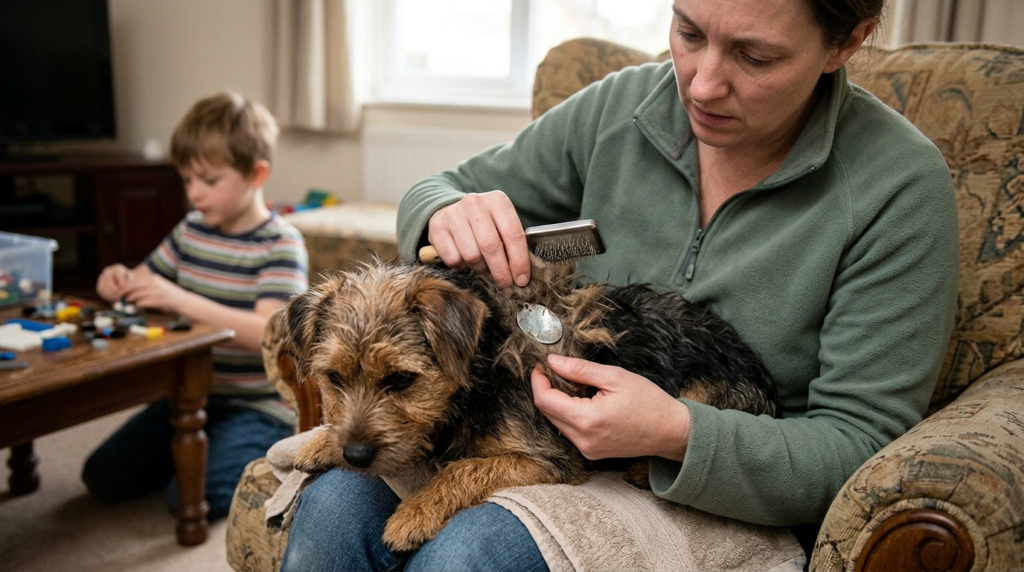
I’ve been a father for seven years, and I thought I knew everything happening under my own roof, but nothing prepared me for the sickening truth hidden deep inside the matted fur of our new rescue puppy.
My name is Mark. I live in a quiet, dead-end street in a small town in Pennsylvania. It’s the kind of neighborhood where everyone knows each other, where kids ride their bikes until the streetlights come on, and where doors are rarely locked.
I live here with my wife, Sarah, and our seven-year-old son, Leo.
Leo is a quiet kid. He’s always been a bit introverted, preferring his drawing books and action figures over loud sports or roughhousing. Recently, though, he had become even more withdrawn.
He was having nightmares. He would wake up crying, pointing at the window, saying the shadows were talking to him.
Sarah and I took him to a pediatrician. The doctor said it was just a phase, a normal part of childhood development. Night terrors, they called it. They told us to make him feel safe, to give him a sense of security.
That’s when Sarah suggested we get a dog.
“A dog will protect him,” she said one evening after another long, sleepless night. “A dog will sleep at the foot of his bed. It will give him a buddy. Someone to watch over him when we aren’t in the room.”
It made perfect sense. I grew up with dogs, and I knew the kind of unconditional love and security they could bring to a child’s life.
The very next weekend, we drove down to the county animal shelter. The place was loud, filled with the echoes of barking and the smell of bleach. We walked past dozens of cages.
Then, we saw him.
He was a Golden Retriever mix, probably about six months old. He wasn’t jumping against the chain-link fence or barking for attention like the others. He was huddled in the far corner of his concrete run, trembling.
His fur was a mess. It was overgrown, dirty, and heavily matted around his neck and shoulders.
The card on his cage said he had been found wandering near the edge of the woods on Route 9, just a few miles from our house. He had no microchip, no collar, no history. They just called him “Buddy.”
“He looks so sad,” Leo whispered, pressing his small hand against the fence.
The puppy looked up at Leo. For a brief second, the dog stopped shaking. He slowly walked forward, pressing his wet nose against the wire right where Leo’s hand was.
“This is the one,” I told the volunteer. “We’ll take him.”
We named him Barnaby.
The car ride home was peaceful. Barnaby sat in the back seat, his head resting heavily on Leo’s lap. Leo stroked his messy fur, and for the first time in weeks, I saw my son smile a real, genuine smile.
I thought we had made the best decision of our lives. I thought this dog was going to heal my son.
I couldn’t have been more wrong.
The strange behavior started on the second day.
It was a Tuesday afternoon. Sarah was at work, and I was working from my home office downstairs. Leo was playing in the living room with Barnaby.
Suddenly, I heard a sharp yelp.
I rushed out of my office, my heart pounding in my chest. “Leo? Everything okay?”
Leo was standing in the middle of the room, looking confused and upset. Barnaby was squeezed completely under the sofa, only his tail and back legs visible. The dog was whining a low, pathetic sound.
“I didn’t do anything, Dad,” Leo said, his voice shaking. “I just went to pet him, and he ran away screaming.”
I knelt down and peered under the couch. “Hey, Barnaby. Come here, boy. It’s okay.”
It took me ten minutes and a handful of treats to coax the dog out. When he finally emerged, he kept his head low to the ground. He wouldn’t make eye contact with Leo. In fact, he actively avoided him.
If Leo walked into the kitchen, Barnaby would scramble to get out, his claws slipping frantically on the hardwood floor.
If Leo sat on the rug to watch television, Barnaby would retreat to the farthest corner of the dining room, staring at my son with wide, terrified eyes.
It broke my heart, and honestly, it started to make me angry.
Was my son doing something to the dog when I wasn’t looking? I didn’t want to believe that. Leo was a gentle boy. He wouldn’t hurt a fly. But kids don’t always understand their own strength. Maybe he pulled the dog’s ears too hard. Maybe he stepped on his paw.
I pulled Leo aside later that evening. “Leo, buddy, you have to tell me the truth. Did you hit Barnaby? Did you scare him?”
Tears welled up in Leo’s eyes. “No, Dad! I swear! I just wanted to give him a hug. I love him.”
I hugged my son tight. “I believe you, buddy. He’s just a rescue. He’s probably had a hard life before he met us. We just need to give him time.”
But the time didn’t help.
By the end of the week, the situation had escalated to a bizarre extreme. Barnaby was perfectly fine with me and Sarah. He would wag his tail when I fed him. He would let Sarah rub his belly.
But the moment Leo entered the room, Barnaby transformed. The dog would freeze, his body stiffening like a board. His ears would pin back flat against his skull, and he would begin to shake violently.
It was a specific, pure terror.
It started to drive a wedge in our house. Leo felt rejected and cried himself to sleep. Sarah was stressed, suggesting maybe we needed to hire a professional dog behaviorist.
I decided I needed to bridge the gap. I needed to bond with the dog and show him that this family was safe.
Saturday morning, the sun was shining. The weather was cool and crisp. I decided it was the perfect time to give Barnaby a proper grooming. The shelter had given him a basic bath, but his fur was still a disaster. He had thick, tight mats of fur around his neck and behind his ears.
“Leo, go watch cartoons for a bit,” I told my son. “I’m going to brush Barnaby out on the back patio.”
I took Barnaby out back. I had a metal grooming comb and a soft bristle brush.
I sat cross-legged on the concrete patio. Barnaby lay down next to me, resting his chin on my thigh. He seemed completely at ease. He closed his eyes as I started running the soft brush down his back.
“You’re a good boy, Barnaby,” I murmured, working the brush through his golden coat. “You just need to realize Leo is a good boy, too.”
I worked my way up from his back to his shoulders. The fur here was much thicker.
I switched to the metal comb. I started to tackle the thick, nasty mats of fur around his neck. It was like thick wool, tightly knotted and dirty. I had to be careful not to pull his skin.
I gently worked the comb through a large knot right under his left ear.
One minute passed. The dog was relaxed, almost falling asleep.
Two minutes passed. I was making progress. The fur was starting to separate.
Three minutes in.
I pushed the metal comb deep into the thickest mat of fur, right against his collarbone.
Clink.
The comb hit something hard.
It wasn’t a knot of hair. It wasn’t a burr or a piece of dried mud. It felt solid. Metallic.
I frowned, pausing my hand. I tapped the comb against it again.
Clink.
Barnaby shifted slightly, opening one eye, but didn’t move away.
“What in the world have you got stuck in there, buddy?” I muttered to myself.
I put the comb down on the concrete. I used my fingers, digging into the thick, matted fur. It was buried deep, right against the skin of his neck, completely hidden by the overgrown hair.
I felt the shape of it. It was rectangular. About the size of a thick matchbox. It felt like hard plastic and metal.
My brow furrowed in confusion. A microchip? No, microchips are the size of a grain of rice. This was huge.
I gripped the fur with both hands and pulled the thick hair apart, peering down into the gap to see the skin.
My breath caught in my throat.
Tightly wrapped around the dog’s actual neck—hidden entirely underneath his normal nylon collar and completely obscured by his fur—was a thin, black zip-tie.
And attached to that zip-tie was a black, waterproof casing.
My heart started to beat a little faster. Why would a stray dog have this?
I carefully slid my fingers under the zip-tie. It was incredibly tight. Whoever put it there didn’t want it coming off.
I reached into my pocket, pulled out my everyday carry pocketknife, and carefully slipped the blade under the plastic zip-tie, making sure not to cut Barnaby.
Snap.
The zip-tie broke.
I pulled the black device out of the matted fur.
I sat there on the patio, the morning sun shining down on me, holding the object in the palm of my hand.
It was heavy for its size. I turned it over.
There was a small, green LED light on the side.
It was blinking.
Blink. Blink. Blink.
Right next to the light was a tiny pinhole. A microphone.
And on the back, stamped in white lettering, were the words: GPS TRACKER / LIVE AUDIO TRANSMITTER – MODEL 77A.
My blood ran cold.
This wasn’t a lost dog.
This was a Trojan horse.
Someone had bugged this dog. Someone was tracking its location. And because of the microphone, someone had been listening to everything happening inside my house for the last week.
But the horror didn’t stop there.
As I stared at the device, my mind raced back to Barnaby’s behavior. He wasn’t afraid of Leo because Leo was mean to him.
He was afraid of Leo because of what he had been trained to do.
I flipped the device over one more time, my hands trembling violently now. There was a piece of white masking tape stuck to the bottom of the plastic casing.
On the tape, written in hurried, black Sharpie marker, was a single sentence.
I read the words, and all the air left my lungs. The world started to spin.
It was a message. And it mentioned my seven-year-old son by name.
I stared at the piece of weathered white medical tape stuck to the bottom of the military-grade GPS tracker.
My vision actually blurred for a second. The edges of my vision went black, the way they do right before you pass out from a sudden drop in blood pressure.
I had survived ambushes in the desert. I had survived IED blasts that rattled my teeth in my skull. I knew how to process fear. I knew how to process a direct threat.
But I didn’t know how to process the five words written in thick, black Sharpie marker on that piece of tape.
ROUTE 9 WAS NO ACCIDENT. ASK SARAH.
My lungs seized up. I forgot how to breathe.
Sarah. My wife.
The woman I had been married to for ten years. The mother of my seven-year-old son. The woman who had held my hand through the darkest days of my PTSD when I first got back from my deployments.
The marker was slightly smudged, as if whoever wrote it had done so in a frantic hurry. But the letters were unmistakable.
Ask Sarah.
Route 9 was the desolate stretch of highway running along the edge of the woods just outside our town limits.
It was the exact location where the county animal control had supposedly found Ranger wandering as a stray.
A wave of nausea washed over me, so strong and violent that I actually had to lean over the wooden railing of the back porch, gagging on empty air.
My mind was a chaotic storm of fragmented thoughts.
Did Sarah know this dog was out there? Did she arrange for us to adopt him?
No, that didn’t make any sense. We went to the shelter together. We walked the aisles together. It was Leo who pointed Ranger out.
But then I remembered the conversation we had the night before we went to the shelter.
“A dog will protect him,” she had said. “I read about this shelter down by the industrial park. We should go there first thing tomorrow.”
She had specifically guided us to that exact shelter.
I looked down at the blinking green LED light on the transmitter in my hand.
Blink. Blink. Blink.
With every pulse of that tiny light, it was broadcasting my exact location. And with every breath I took, the high-gain microphone was recording the sound of my panic.
My military training, dormant for years, violently kicked back into gear.
I was no longer a suburban dad grooming his rescue dog on a Saturday morning. I was a Marine operating behind enemy lines, and my own home had just been declared a hostile combat zone.
First priority: neutralize the surveillance.
I couldn’t just smash the device with a hammer. If whoever was on the other end of that feed heard a sudden crunch and the signal went dead, they would know I had found it. They would know their operation was compromised.
I needed to blind them without them realizing they were blind.
I quickly scooped up my grooming tools, shoved the transmitter deep into my canvas military bag, and motioned for Ranger.
“Inside, buddy. Go.”
Ranger didn’t hesitate. He trotted into the kitchen, immediately taking up his post by the hallway leading to Leo’s room.
I walked into the kitchen, moving with silent, deliberate steps. I pulled open the bottom drawer of the pantry and grabbed a heavy roll of aluminum foil.
I took the tracker out of my bag and tightly wrapped it in five thick layers of foil. This creates a makeshift Faraday cage, bouncing the radio frequencies back inward and blocking the GPS signal from hitting the satellites.
It would look like the device just lost reception, maybe wandering into a basement or a dead zone.
But I didn’t stop there. I walked out to the detached garage. I found an old, heavy iron coffee can filled with rusty nails. I dumped the nails out, dropped the foil-wrapped tracker inside, and hammered the metal lid shut.
I shoved the can into the darkest corner of the bottom shelf, behind a stack of spare winter tires.
I stood in the dusty silence of the garage, my chest heaving, sweat dripping down my forehead despite the crisp morning air.
Ask Sarah.
The words echoed in my skull like a gunshot in an empty room.
I needed to think. I needed to analyze the battlefield.
If Sarah was involved in this… why? Who was she working with? Who was she talking to?
Was it the arrogant developer whose kids were bullying Leo? Was Sarah being blackmailed? Was she having an affair with someone dangerous?
Or was it something infinitely worse?
The crunch of gravel in the driveway snapped me out of my spiral.
I peeked through the dirty window of the garage door. Sarah’s white SUV had just pulled in.
I watched her put the car in park. I watched her step out, pushing her sunglasses up into her blonde hair. I watched her unbuckle Leo from the back seat, handing him a plastic grocery bag to carry.
She looked so normal. She looked like the same woman I had kissed goodbye two hours ago.
But suddenly, I felt like I was looking at a complete stranger. A sleeper agent living under my roof.
I wiped the sweat from my face, forced my muscles to relax, and plastered a calm, casual smile on my face.
The hardest thing I ever had to do in the military was lie to an enemy combatant to their face. This was going to be infinitely harder.
I walked out of the garage and met them on the driveway.
“Hey, guys. Need a hand with those?” I asked, keeping my voice light and steady.
“We got it, Dad!” Leo beamed, holding up a bag of apples. “Mom bought the good cereal with the marshmallows!”
“Awesome, buddy. Why don’t you take that inside and show Ranger?”
Leo sprinted toward the front door.
I walked up to Sarah and reached for the heavy canvas bags in the trunk.
“How was the store?” I asked, not looking her in the eye.
“Crowded,” she sighed, rubbing the back of her neck. “Everyone is stocking up for the long weekend. Did you finish brushing Ranger?”
My hands tightened around the handles of the grocery bags.
“Yeah,” I lied smoothly. “Got all the mats out. He looks like a completely different dog.”
“That’s good,” she said softly, closing the trunk. “He seems to be settling in well. Leo loves him so much.”
She smiled at me. It was a warm, loving smile.
I felt sick to my stomach.
“Yeah. He does,” I replied.
We walked into the kitchen. I started putting the groceries away in the fridge, carefully watching Sarah out of the corner of my eye.
She was humming quietly to herself as she folded the canvas bags. Everything about her demeanor was relaxed, completely unburdened.
If she was guilty of bugging our dog, she was an Oscar-worthy actress.
“Hey, Sarah?” I asked casually, keeping my back to her as I loaded milk into the fridge door.
“Yeah, babe?”
“Do you remember exactly how you found out about that animal shelter we went to? The one out by the industrial park?”
I held my breath, waiting for her answer. I listened for a stutter, a hesitation, a spike in her heart rate.
“Oh, um,” she paused. I heard the rustle of a plastic bag stop.
“I think I just Googled it?” she said, her voice sounding a little uncertain. “Or maybe I saw a flyer at the coffee shop downtown. Why?”
A flyer. A Google search.
She couldn’t give me a straight answer.
“Just wondering,” I said, closing the fridge and turning around to face her. “Ranger’s a great dog. Just curious what drew us to that specific place.”
Sarah avoided my gaze, suddenly very interested in wiping down the spotless granite countertop with a sponge.
“I don’t know, Mark. Just a feeling, I guess. I’m going to go take a quick shower.”
She dropped the sponge in the sink and practically bolted out of the kitchen, her footsteps hurrying up the carpeted stairs.
She was lying.
Every instinct I had honed over a decade of combat operations told me she was terrified of that line of questioning.
I waited until I heard the bathroom door click shut and the water turn on.
I had roughly fifteen minutes.
I sprinted upstairs, moving silently on the balls of my feet. I walked past the closed bathroom door, hearing the heavy spray of the showerhead.
I slipped into our master bedroom and quietly closed the door behind me.
If Sarah was communicating with whoever planted that device, she was doing it through a channel I didn’t know about. We shared a cell phone plan. I knew her number. I knew her email.
I needed to find her burner.
I started with her nightstand. I slid the drawers open, sifting through chapstick, old receipts, and paperback novels. Nothing.
I moved to her walk-in closet. I dropped to my knees, feeling through the pockets of her winter coats. I checked the inside of her tall boots. I checked the top shelf behind her hat boxes.
Empty.
I was running out of time. The water in the shower was still running, but it could stop at any second.
I looked around the room, trying to think like someone hiding a massive secret. Where would you put something you needed to access regularly, but keep entirely hidden from your husband?
My eyes landed on her heavy, mahogany vanity desk in the corner of the room.
Sarah spent an hour there every morning, doing her makeup and hair. It was her sanctuary. I never touched it.
I walked over and began opening the small, ornate drawers. Brushes, palettes, eyeliner pencils. Everything looked perfectly normal.
But the bottom right drawer felt different.
When I pulled it out, it only extended halfway. It stopped with a hard, wooden clunk.
I frowned. I pulled the drawer directly above it completely out and set it on the bed. I reached my arm down into the dark cavity of the desk, feeling the back of the bottom drawer.
There was a false back.
A thin piece of plywood had been wedged into the rear of the drawer, creating a hidden compartment barely two inches deep.
My heart hammered against my ribs like a trapped bird.
I slid my fingers into the tiny gap, caught the edge of the plywood, and popped it loose.
I reached into the hidden space.
My fingers brushed against something hard, cold, and rectangular.
I pulled it out into the light.
It wasn’t a burner phone.
It was a thick, black leather ledger. The kind of small notebook an accountant might use to track off-the-books expenses.
I quickly opened the leather cover, my hands shaking so badly I almost dropped it.
The pages were filled with Sarah’s neat, cursive handwriting.
But it wasn’t a diary. It was a logbook.
The first page was dated six months ago—right around the time Leo’s night terrors had started.
October 12th: Payment received. $5,000. Cash drop at Route 9 mile marker 4.
October 28th: Subject heavily medicated. Sleeping through the night. Sent updates.
November 15th: Payment received. $5,000. Mark suspects nothing. He thinks it’s just stress.
I stared at the pages, the numbers and words blurring together.
Payment received. Subject heavily medicated.
She wasn’t talking about a dog.
She was talking about our son.
She was talking about Leo.
I flipped the pages faster, tearing the thin paper in my frantic rush to read more.
The entries became more frequent. The amounts of money grew larger.
February 2nd: They want closer access. They suggested a tracking device. I told them I need more money to take that risk.
March 10th: Deal agreed. $20,000. I will convince Mark to get a dog. I will pick up the drop on Route 9.
The ledger slipped from my numb fingers and hit the carpet with a soft thud.
My wife—the woman I slept next to every night—was selling access to our seven-year-old child.
She had purposefully brought a bugged dog into our home. She was drugging Leo to keep him asleep while whoever was paying her monitored our entire lives.
The water in the bathroom suddenly shut off.
“Mark?” Sarah’s muffled voice called out through the wall. “Are you in there? Can you grab me a fresh towel?”
I stood frozen in the middle of the bedroom.
I looked at the closed bathroom door. I looked at the black ledger on the floor.
A cold, terrifying rage began to build in the pit of my stomach. It was a dark, violent energy that I hadn’t felt since I was kicking down doors in Fallujah.
I slowly bent down and picked up the ledger. I shoved it into the back waistband of my jeans, hiding it under my shirt.
I walked over to the linen closet, pulled out a clean white towel, and walked toward the bathroom door.
I didn’t know who she was working for. I didn’t know why they wanted my son.
But I knew one thing with absolute, deadly certainty.
Someone was going to die today. And I was going to make sure it wasn’t my family.
I raised my hand, curled it into a fist, and knocked on the bathroom door.
My knuckles rapped against the white painted wood of the bathroom door.
Every single muscle fiber in my body was coiled so tight I thought my bones were going to snap. My mind was screaming at me to take a step back, raise my boot, and kick the door completely off its hinges.
I wanted to shatter the wood. I wanted to drag the woman I had loved for ten years out of the shower and demand to know why there was a price tag on our son’s life.
But my military training kicked in, cold and ruthless.
You don’t engage an enemy until you know their strength. You don’t blow your cover when you lack critical intelligence. I didn’t know who she was communicating with. I didn’t know how many of them there were, or what their timeline was.
If I confronted her now, she would clam up. Or worse, she would panic and signal her handlers that the operation was compromised.
I needed to be smarter. I needed to be the ghost I used to be in the desert.
“Mark?” Sarah called out again, her voice slightly muffled by the running water and the heavy door. “Did you hear me? I need a towel.”
I squeezed my eyes shut, took a deep, shuddering breath, and forced my heart rate to slow down. I buried the rage deep inside a dark, heavy box in my mind and locked it tight.
“Yeah, honey,” I said. My voice was steady. Calm. Perfectly normal. “Coming right up.”
I turned the brass knob and pushed the door open just a crack.
Steam billowed out, smelling of vanilla shampoo and lavender body wash. It was a smell I associated with safety. With home. Now, it made my stomach churn.
I reached my arm through the narrow gap, holding the fluffy white towel out blindly.
I felt Sarah’s wet fingers brush against my knuckles as she took the towel from my hand.
“Thanks, babe,” she said softly. “You’re the best.”
The door clicked shut again.
I stood in the hallway for five seconds, perfectly still. Then, I moved.
I slipped back into the master bedroom. I took the black leather ledger and shoved it deep into my tactical go-bag at the bottom of my closet, burying it underneath my spare boots and a box of 9mm ammunition.
I checked my watch. 10:15 AM.
I had to separate her from Leo. I needed a reason to get my son and the dog out of the house, leaving Sarah completely alone. If her GPS tracker was dead, she was going to panic. She was going to try and make contact.
And I was going to be listening when she did.
I went downstairs. The house was quiet, save for the distant hum of the refrigerator.
I walked into the living room. Leo was sitting cross-legged on the rug, intensely focused on building a massive Lego spaceship. Ranger, the Belgian Malinois, was lying right next to him.
The dog’s head was resting on his paws, but his amber eyes tracked my every movement. Ranger knew something was wrong. He could smell the adrenaline pumping through my sweat.
“Hey, buddy,” I said, crouching down next to Leo.
Leo looked up, a bright, innocent smile on his face. “Look, Dad! I added a hyper-drive engine to the back. It goes a million miles an hour.”
I reached out and ruffled his hair. My hand was shaking slightly. I looked at his bright blue eyes, his pale cheeks.
Payment received. $20,000.
The words from the ledger flashed in my mind. The urge to vomit hit me again, but I swallowed it down.
“That is an awesome ship, Leo,” I said, keeping my tone light and enthusiastic. “Listen, I need to make a quick run to the hardware store. I need some new filters for the furnace. You want to come with me and ride in the truck?”
Leo’s eyes lit up. He loved riding in the front seat of my old Ford F-150. “Can Ranger come too?”
“Absolutely. Ranger is riding shotgun.”
“Yes!” Leo cheered, scrambling to his feet and leaving his Legos behind. “I’ll go get my shoes!”
As Leo ran toward the mudroom, I heard the stairs creak.
Sarah was coming down.
She was wearing a plush bathrobe, her blonde hair wrapped up in a towel. She looked fresh, relaxed, and completely put together. She walked into the kitchen and started filling the electric kettle with water.
“You guys heading out?” she asked casually, not looking up from the sink.
“Yeah,” I said, leaning against the doorframe, watching her every move. “Going to run to Home Depot. Need some furnace filters and maybe some grass seed for the backyard. We shouldn’t be more than an hour.”
“Okay, sounds good,” she smiled, finally turning to look at me. “I’m just going to make some tea and catch up on some laundry. Drive safe.”
“Always do,” I replied.
I turned and walked out to the mudroom. I helped Leo tie his sneakers, clipped a heavy-duty carabiner leash onto Ranger’s collar, and led them out to the driveway.
I hoisted Leo into the back seat of the crew cab and buckled him in. Ranger jumped into the front passenger seat, sitting up tall, surveying the street like a soldier on guard duty.
I climbed into the driver’s seat and started the engine.
I backed out of the driveway, put the truck in drive, and waved to the living room window. Sarah was standing there, holding her mug of tea, waving back with a gentle smile.
I drove down our quiet, tree-lined street until I reached the stop sign at the end of the block.
Then, I took a sharp right, drove exactly one block over, and pulled my truck into the empty driveway of a house that had been vacant for three months. It gave me a clear, unobstructed view of the back of my own property through a thin line of pine trees.
I put the truck in park and killed the engine.
“Dad?” Leo asked from the back seat, sounding confused. “Why are we stopping? The hardware store is the other way.”
I turned around in my seat and gave him a reassuring smile.
“I know, buddy. But Dad forgot his wallet. I just need to sit here for a second and try to remember where I put it. Why don’t you play your game on the iPad for a few minutes?”
I handed him his tablet from the center console. He happily grabbed it, slipping his headphones over his ears. He was completely distracted.
Ranger, however, was not.
The dog was staring intently through the windshield, his ears swiveled forward, locked onto the distant view of our house through the trees. He let out a low, almost silent rumble in his chest.
“I know, boy,” I whispered, reaching over and resting my hand on the back of his neck. “I know.”
I pulled my cell phone out of my pocket.
Before I had gone upstairs to confront Sarah, I had made a detour to the basement. I dug into a plastic storage bin and pulled out something we hadn’t used in six years.
Leo’s old baby monitor.
It wasn’t a modern, wifi-connected camera that could be tracked or hacked. It was an old-school, analog audio transmitter. It ran on radio frequencies.
While Sarah was in the shower, I had taken the transmitter, turned it on, and shoved it deep behind the microwave in the kitchen, completely hidden by the power cord.
I had the receiver unit sitting in the cup holder of my truck.
I reached down and twisted the volume dial all the way up.
A rush of white static filled the cab of the truck.
I waited. My eyes were glued to the back of my house, watching the windows.
Five minutes passed. Nothing. Just static.
Then, I heard the unmistakable sound of a kitchen cabinet slamming shut.
The static hissed, and then I heard her voice. It didn’t sound sweet or relaxed anymore. It sounded frantic.
“Come on, come on, pick up,” Sarah’s voice echoed through the plastic speaker of the baby monitor.
I held my breath. My grip on the steering wheel tightened until my knuckles turned white.
“It’s me,” she said abruptly. Her tone was sharp, strictly business. “We have a problem.”
There was a pause. I couldn’t hear the person on the other end of the line.
“I don’t know!” Sarah practically hissed into the phone. “I checked the app on my tablet five minutes ago. The GPS feed is completely dark. The audio is gone. It’s just showing a dead signal.”
Another pause. She was listening.
“No, he didn’t find it,” she argued, pacing the kitchen. I could hear her bare feet slapping against the hardwood floor. “He just told me he brushed the dog. If he found a wire on the animal, he would have torn the house apart by now. You know Mark. He’s too stupid to play it cool. He would have confronted me.”
The insult stung, but I pushed the ego aside. Let her think I was stupid. Stupidity was my greatest tactical advantage right now.
“Maybe the battery died,” Sarah suggested, her voice rising in panic. “Or maybe the dog chewed on the collar and broke the waterproof seal. I told you this was a bad idea. I told you bringing a stray dog into the house was too risky.”
A long silence followed. Whoever was on the other end of the phone was doing a lot of talking.
When Sarah finally spoke again, all the color drained from my face.
“Tonight?” she whispered. The panic in her voice was suddenly replaced by cold, hard shock. “Are you out of your mind? We aren’t ready for tonight. The arrangement was for the 15th.”
Silence.
“I don’t care if the client is getting impatient!” Sarah yelled, losing her composure. “You can’t just move up the extraction! Mark is home. He took the week off work. He’s sleeping in the same house. If you send a team in here tonight, he will kill them. I’m telling you, he has guns in the house. He sleeps with a pistol in his nightstand.”
My blood turned to ice.
Extraction. Client. Team.
They weren’t just monitoring us. They had a specific date. A specific target. They were treating my home like a military objective.
“Listen to me,” Sarah pleaded into the phone. Her voice was trembling now. “Just give me two days. I’ll slip the crushed phenobarbital into his coffee on Tuesday morning. He’ll be unconscious for twelve hours. You can walk right through the front door, take the boy, and walk out. Nobody will get hurt. I just need two days.”
Phenobarbital.
A heavy-duty barbiturate. A central nervous system depressant.
She wasn’t just drugging my son. She was planning to drug me. She was going to paralyze me in my own bed while men walked into my house and stole my child.
“No. No, please don’t do this,” Sarah begged, her voice cracking. “If you come tonight, it’s going to be a bloodbath. He’s a former Marine Force Recon. You don’t understand what he is capable of.”
The voice on the other end must have given an ultimatum, because Sarah suddenly went dead silent.
“Okay,” she finally whispered, her voice completely hollow. “Okay. What time?”
I leaned closer to the baby monitor, pressing my ear almost against the plastic grill.
“0200 hours,” Sarah repeated. “The back patio door will be unlocked. The dog sleeps in the hallway. You’ll have to use a suppressed tranquilizer on the animal before you breach the boy’s room.”
She was giving them the tactical layout of my house. She was telling them how to bypass our defenses.
“I want the rest of the money wired to the offshore account by midnight,” she added, her voice hardening. “If I’m risking my life by staying in the house while this happens, I want the final fifty grand. And I want the new passports ready.”
A click. The line went dead.
The baby monitor returned to a soft hiss of static.
I sat in the driver’s seat of my truck, staring blindly out the windshield at the trees.
My wife wasn’t being blackmailed. She wasn’t an unwilling participant forced into a corner by a bad debt.
She was a willing, active participant in a human trafficking operation. She was selling her own flesh and blood for a payout and a new identity. She was going to let armed men into our home at 2:00 AM, drug me, and let them take Leo away forever.
I looked in the rearview mirror.
Leo was sitting in the back seat, his headphones on, giggling quietly at the cartoon on his screen. He was completely oblivious to the fact that his own mother had just scheduled his abduction.
Ranger let out another low whine, nudging his wet nose against my forearm.
I looked down at the dog. His amber eyes were locked onto mine. He knew. He sensed the absolute, terrifying shift in my energy.
I reached down and turned the baby monitor off.
I didn’t have days to figure this out. I didn’t even have hours.
I had until 2:00 AM tonight.
If I called the police right now, what would happen? I had a ledger and an audio recording from an illegal wiretap I set up in my own house. The cops would come, they would question Sarah, she would deny everything and play the victim. The syndicate would see the police cars, realize the drop was blown, and scatter.
They would just wait. They would wait until my guard was down, until the police got bored, and then they would come back.
No. The police couldn’t stop this.
If you want to kill a snake, you don’t cut off its tail. You cut off its head.
I needed to meet this extraction team at the door. I needed to let them walk into the trap they thought they were setting for me.
But I couldn’t do it with Leo in the house. The risk of crossfire was too high. I had to get my son to safety, and I had to do it without Sarah knowing.
I started the engine of the truck.
“Did you remember where your wallet is, Dad?” Leo asked, pulling one earphone off.
“I did, buddy,” I lied smoothly. “It fell under my seat. We’re going to head to the store now.”
I drove out of the empty driveway and headed toward the commercial district of our small town.
My mind was working at lightspeed, drafting a tactical defense plan.
Step one: Secure the high-value asset. Leo. Step two: Prep the kill zone. My house. Step three: Neutralize the inside threat. Sarah.
We pulled into the sprawling parking lot of the Home Depot. I parked near the back, away from the crowds.
“Alright, Leo. Let’s go get those filters,” I said, unbuckling my seatbelt.
We walked into the massive, fluorescent-lit warehouse. I grabbed a flatbed cart. I didn’t go to the HVAC aisle.
I went straight to the hardware and security section.
I moved with quiet, terrifying purpose. I grabbed four heavy-duty deadbolt locks. I grabbed a box of three-inch steel screws—the kind that could secure a door hinge deep into the frame, making it impossible to kick down.
I grabbed a motion-sensor floodlight. I grabbed heavy-duty zip ties.
“Dad, what are all those for?” Leo asked, pointing at the locks. “I thought we needed furnace stuff.”
“We do, buddy,” I smiled, tossing the items onto the cart. “But Dad’s decided to do some upgrades around the house this weekend. Make it super safe.”
Next, I walked down the plumbing aisle. I grabbed a roll of industrial-strength duct tape and a length of nylon rope.
My final stop was the camping section. I picked up a high-lumen tactical flashlight and a large, heavy-duty metal padlock.
I paid in cash. Always cash. Leave no digital paper trail.
We got back into the truck. Ranger was exactly where I left him, sitting at attention.
I looked at my watch. It was 11:30 AM.
I had fourteen hours until the extraction team arrived.
I pulled out of the parking lot and drove toward the opposite end of town, away from our neighborhood.
“Where are we going now, Dad?” Leo asked.
“We are going to visit an old friend of mine,” I said, my voice hardening. “Someone you haven’t met before.”
I drove out past the city limits, out to the rural farm roads where the houses were spaced miles apart. I turned down a long, unmarked gravel driveway hidden behind a thick line of weeping willow trees.
At the end of the driveway was a massive, corrugated steel barn and a small, unassuming cabin.
I parked the truck.
“Stay here for a second, Leo,” I instructed. “Ranger, guard.”
The dog let out a sharp bark, planting his front paws firmly on the center console, positioning his body directly over Leo.
I walked up to the front door of the cabin and knocked. Three rapid taps, a pause, and two more taps. An old signal.
The door opened silently.
Standing in the doorway was a man who looked like he had been carved out of granite. He had a thick, graying beard, cold, calculating eyes, and a massive scar running down the left side of his neck.
His name was Elias. We served together in the same Force Recon unit for six years. He saved my life in Kandahar. I pulled him out of a burning Humvee in Ramadi. We bled in the same dirt.
He didn’t ask questions. He just looked at my face, read the absolute desperation in my eyes, and stepped aside.
“What do you need, Mark?” he asked, his voice like gravel grinding together.
“I need a fortress, Elias,” I said, stepping into the dim cabin. “And I need a babysitter. No questions asked.”
Elias looked past me, out the window, at the truck. He saw the silhouette of the little boy in the back seat and the massive dog standing guard.
He didn’t blink. He just nodded.
“Bring him in,” Elias said. “The perimeter is alarmed. I’ve got enough rations for a month and enough firepower to hold off a platoon. He’s safe here.”
I let out a breath I felt like I had been holding for hours.
I walked back to the truck and opened the back door.
“Alright, Leo,” I said, forcing a cheerful tone. “Change of plans. This is my friend Elias. He owns this massive farm, and he needs some help watching it today. I told him you were the bravest kid I know.”
Leo’s eyes widened with excitement. “Really?”
“Really,” I said. “You and Ranger are going to stay here and hang out with Elias. I have to go back to the house to do some boring grown-up work, but I’ll be back to pick you up tomorrow morning. Can you do that for me?”
“Yes, sir!” Leo saluted, hopping out of the truck. Ranger jumped out right behind him, instantly sniffing the grass, clearing the area.
I walked Leo up to the porch. Elias crouched down, extending a massive, calloused hand.
“Good to meet you, Leo,” Elias said gently. “I’ve got a Nintendo Switch inside, and a whole freezer full of ice cream. You like chocolate?”
“It’s my favorite!” Leo beamed.
I knelt down and pulled Leo into a massive hug. I squeezed him so tight, burying my face in his shoulder. I inhaled the scent of him—shampoo and boyish sweat.
“I love you, buddy,” I whispered into his ear. “So much.”
“Love you too, Dad,” he giggled, squirming away.
I stood up and looked at Elias. We didn’t need to exchange words. The look in his eyes told me everything I needed to know. Nobody was getting onto this property.
I walked back to my truck alone. The drive back to my house was a blur of cold, calculating rage.
I pulled into my driveway at 1:00 PM.
The house looked peaceful. The afternoon sun was shining. The lawn was neatly manicured. It looked like the perfect American dream.
It was a grave.
I walked through the front door, carrying the heavy plastic bags from the hardware store.
“Mark? Is that you?” Sarah called out from the living room.
“Yeah, it’s me,” I replied, dropping the bags heavily on the kitchen island.
Sarah walked into the kitchen, holding a laundry basket. She looked past me, her eyes scanning the empty hallway.
“Where’s Leo?” she asked. Her voice was casual, but I noticed the subtle tightening of her jaw. “And where’s the dog?”
I turned to face her. I leaned against the granite counter, crossing my arms over my chest. I looked at the woman who was willing to sell my son to monsters.
I gave her a slow, dead smile.
“I dropped them off at a friend’s house,” I lied, my voice dripping with honey. “I figured you and I could use a quiet night to ourselves. Just the two of us.”
Sarah froze. The laundry basket in her hands slipped slightly.
“A friend?” she repeated, a sudden, sharp edge of panic bleeding into her tone. “What friend? He wasn’t supposed to go anywhere today.”
“Oh, just an old buddy from the military,” I said softly, taking a step toward her. “Don’t worry about it. He’s perfectly safe.”
I watched the realization hit her. I watched the color drain completely out of her face as she realized her entire plan had just been blown to pieces.
And as I looked into her terrified eyes, I let my smile fade, replaced by the cold, dead stare of the soldier she thought I had left behind.
“So,” I whispered, reaching into my waistband and pulling out the heavy, black leather ledger. I tossed it onto the kitchen island between us. “Why don’t we talk about what’s happening at 0200 hours tonight?”
I watched the black leather ledger slide across the smooth granite of the kitchen island. It stopped exactly three inches from Sarah’s hand.
The silence in the kitchen was absolute. The only sound was the low, mechanical hum of the refrigerator.
Sarah stared down at the book. I watched her throat swallow hard. The color drained from her face, leaving her skin a sickly, ash-grey. For a second, her eyes darted to the heavy block of chef’s knives sitting on the counter to her left.
“Don’t even think about it,” I said, my voice dropping to a low, dead calm. “I will break your arm before your fingers even brush the handle.”
She froze. The mask she had worn for ten years—the mask of the loving suburban mother, the supportive wife—shattered right in front of my eyes. What was left underneath was something cold, calculating, and cornered.
“Mark,” she started, her voice trembling, taking a slow step back. “Mark, you don’t understand. I can explain this.”
“Explain it?” I asked, tilting my head slightly. “Explain what, Sarah? The offshore account? The passports? Or the fact that you agreed to slip phenobarbital into my coffee tomorrow morning?”
Her eyes widened in pure, unadulterated terror. She realized I didn’t just find the book. She realized I knew everything.
“I heard the phone call, Sarah. I heard every word. You sold our son.”
She pressed her back against the stainless steel of the refrigerator, her breathing turning into rapid, shallow gasps. “They were going to kill me, Mark! You don’t know these people. You don’t know what I owe them!”
“Then tell me,” I commanded, stepping around the island, closing the distance between us. “Right now. Who are they? Why do they want Leo?”
Tears started streaming down her face, ruining her perfect makeup. “It started two years ago. When you were having those rough nights. When the PTSD was bad. I felt so alone. I started going to the casino city across the state line. Just on weekends when you thought I was at conferences. I was playing high-stakes tables. I was losing.”
I stared at her, feeling absolutely nothing. The rage had burned so hot it had turned into ice.
“I borrowed money,” she choked out, sliding down the front of the fridge until she was sitting on the floor, pulling her knees to her chest. “From the wrong people. A private syndicate. The debt got so big, Mark. Three hundred thousand dollars. They told me I could never pay it back. But they said they had clients. Wealthy, sick clients overseas who pay top dollar for… for specific things.”
“For children,” I finished the sentence for her.
She squeezed her eyes shut and nodded, a pathetic sob escaping her lips. “They said Leo was perfect. Young, healthy, no preexisting medical conditions. They said if I gave him to them, the debt would be wiped clean. Plus, they would give me a half-million in an untraceable account and a new identity. A fresh start. They said they would do it quietly. A home invasion gone wrong. I would play the grieving mother. Nobody would ever know.”
“And the dog?” I asked, my voice barely a whisper.
“They needed inside access to monitor the house, to learn your routines. They didn’t want a firefight with a Force Recon Marine. They wanted to slip in and out. They planted the bug on a stray and had me steer you to that specific shelter. They knew you were looking for a guard dog to help Leo’s night terrors. They engineered the whole thing.”
I looked down at the woman on the floor. I didn’t see my wife anymore. I saw an enemy combatant. I saw a monster hiding in plain sight.
“Get up,” I ordered.
“Mark, please,” she begged, reaching a hand up toward me. “We can call the police. We can ask for protective custody. We can run.”
“There is no ‘we’ anymore, Sarah. And the police can’t stop a professional extraction team that already has the layout of my house. Get up.”
I reached down, grabbed her by the collar of her plush bathrobe, and hauled her to her feet. I dragged her into the dining room.
“Sit,” I shoved her down into one of the heavy, solid oak dining chairs.
She was sobbing hysterically now. “What are you doing? Mark, please! They’re coming at 2:00 AM! If you’re here, they’ll kill us both!”
I reached into the plastic Home Depot bag I had dropped on the table. I pulled out the heavy-duty, industrial zip-ties.
Before she could process what was happening, I grabbed her right wrist, pulled it behind the chair, and secured it to the wooden spindle. I pulled the plastic strap until it clicked tight, biting into the fabric of her robe.
“Mark! Stop! You’re hurting me!” she screamed, thrashing wildly.
I ignored her. I was entirely in the zone now. The combat zone. I grabbed her left arm, ignoring her scratching nails, and zip-tied it to the other side of the chair. I used two more ties to secure her ankles to the heavy wooden legs of the chair.
She was completely immobilized.
I reached back into the bag and pulled out the roll of industrial duct tape. I ripped off a long piece.
“You’re going to sit right here, Sarah,” I said, looking her dead in the eyes. “You are going to be the bait. When they walk through that back door tonight, they are going to see you sitting in the dark. And in that one second of confusion, I am going to end them.”
“No! Mark, please—”
I slapped the silver duct tape over her mouth, silencing her screams. I wrapped it twice around the back of her head, making sure it wouldn’t peel off.
Her eyes were wide, filled with a primal, animalistic panic. She thrashed against the chair, but the thick oak didn’t budge, and the heavy-duty plastic ties held firm.
I looked at my watch. It was 3:00 PM.
I had eleven hours to turn my suburban house into a slaughterhouse.
I went to work.
I started at the front door. Sarah had told them on the phone to use the back patio door, but you never trust an enemy’s stated entry point. I took the heavy steel deadbolts I bought at the hardware store and installed them on the front door, the garage access door, and the basement bulkhead. I used the three-inch steel screws, drilling them deep into the studs of the house framing. A battering ram wouldn’t take those doors off their hinges now.
I moved to the first floor windows. I closed all the heavy wooden plantation shutters, locking them tight. I left exactly one point of entry unfortified.
The back patio door. The glass slider leading into the kitchen.
If you want to catch a rat, you have to leave the trap open.
I walked through the kitchen, the dining room, and the living room, analyzing the sightlines. I was looking for fatal funnels—narrow spaces where the enemy would be forced to bunch up, limiting their mobility and their fields of fire.
The hallway leading from the kitchen to the living room was perfect. It was narrow, dark, and offered zero cover.
I moved the heavy living room sofa, dragging it across the hardwood floor until it blocked the far end of the hallway. It created a barricade. I positioned it at an angle, giving me a perfect, fortified firing position that covered the entire length of the hall and the entrance to the kitchen.
I walked upstairs to our master bedroom. I opened the biometric safe bolted to the floor of my closet.
I pulled out my Glock 19. I checked the chamber. Clean. Oiled. I loaded a fifteen-round magazine of hollow-point ammunition and slammed it home. I chambered a round. I grabbed three spare magazines and slid them into the tactical belt I strapped around my waist.
Next, I reached deeper into the safe and pulled out the Remington 870 tactical pump-action shotgun. I loaded the tubular magazine with double-aught buckshot. Devastating at close range.
I walked back downstairs.
Sarah was still tied to the chair in the dining room. Her eyes followed me as I walked past, carrying the arsenal. She was trembling violently, sweat pouring down her face. She tried to scream through the tape, a muffled, pathetic sound.
I didn’t even look at her.
I positioned myself behind the sofa barricade in the living room. I set the shotgun on the cushion next to me. I sat cross-legged on the floor, the Glock resting in my lap.
I checked the sightlines one last time. From my position in the dark living room, I had a clear view straight down the hallway, directly into the kitchen, and right at the glass patio door.
And positioned right in the middle of that sightline, illuminated only by the faint moonlight coming through the kitchen window, was Sarah, tied to the chair.
Now, the hardest part of any operation began.
The wait.
The sun slowly set. The shadows in the house grew long, stretching across the hardwood floors like dark fingers. The neighborhood outside grew quiet. The streetlights flickered on.
I sat in the dark for hours. I didn’t eat. I didn’t drink. I didn’t move.
My mind was a cold, calculating machine. I controlled my breathing, keeping my heart rate low and steady.
I thought about Leo. I thought about him sitting in Elias’s cabin, perfectly safe, playing video games, completely unaware of the violent storm about to break over our home. I thought about Ranger, standing guard over my boy.
I would do whatever it took to keep them safe. I would burn this entire world down to ashes if it meant protecting my son.
Midnight passed.
1:00 AM.
1:30 AM.
The silence in the house was deafening. The only sound was Sarah’s ragged, exhausted breathing from the dining room. She had stopped thrashing hours ago. She was just waiting to die.
1:50 AM.
My senses heightened. Every tiny creak of the house settling sounded like a gunshot. I slowly raised the Glock, resting my forearms on the back of the sofa, establishing a rock-solid shooting platform.
1:55 AM.
Outside, a dog barked in the distance. Then, absolute silence.
1:58 AM.
I heard it.
It was faint, almost imperceptible. The soft crunch of gravel in the alleyway behind our house.
Then, the nearly silent snick of the wooden gate latch on the backyard fence being lifted.
They were here.
I clicked the safety off the Glock. My finger rested lightly on the side of the trigger guard.
Through the glass of the back patio door, I saw a shadow detach itself from the darkness of the trees. Then another. And a third.
Three men. Dressed in tactical black gear, wearing heavy body armor and night-vision goggles. They moved with professional, terrifying fluidity. This wasn’t a street gang. These were highly trained operators. Ex-military or private military contractors.
They approached the glass sliding door. One of them knelt down by the lock.
I heard the faint scratching of a lock pick. Five seconds later, a soft click.
The heavy glass door slid open with a quiet whoosh.
The cool night air spilled into the kitchen.
The point man stepped into the house, his suppressed submachine gun raised, sweeping the room. The second man followed, instantly checking his six. The third man stepped in and quietly slid the glass door shut behind them.
They moved in complete, practiced silence.
The point man took two steps into the kitchen. Then, he stopped dead in his tracks.
Through his night-vision goggles, he saw her.
Sarah was sitting in the dining room chair, directly in front of him, tied down, duct tape over her mouth. Her eyes were wide with terror, staring right at him.
The point man lowered his weapon slightly, utterly confused. He raised his left hand, signaling a halt to the men behind him.
“What the hell…” I heard him whisper, his voice a harsh rasp in the quiet house.
That second of confusion was all I needed.
I squeezed the trigger.
The roar of the Glock 19 shattered the silence of the house like a bomb going off. In the enclosed space, the noise was physically painful.
The hollow-point bullet caught the point man directly in the gap of his body armor, right at the base of his throat. He dropped like a sack of concrete, his submachine gun clattering loudly against the kitchen tile.
“Contact!” the second man screamed, instantly raising his weapon and firing blindly down the hallway toward the muzzle flash.
Suppressed bullets chewed through the drywall above my head, raining white plaster dust down onto my shoulders.
I ducked behind the heavy frame of the sofa, letting the initial burst pass over me. I dropped the Glock on the cushion and grabbed the Remington 870 shotgun.
I racked the pump action—CHAK-CHAK—the loudest, most terrifying sound in the world.
I popped up from behind the sofa, aiming straight down the fatal funnel of the hallway.
The second man was charging down the hall, trying to close the distance.
I pulled the trigger.
The twelve-gauge roared, spitting fire and lead. At that close range, the double-aught buckshot hit him square in the chest plate with the force of a freight train. The sheer kinetic energy lifted him off his feet and threw him backward into the dining room wall. He slid down to the floor, the wind completely knocked out of him, his ribs shattered beneath the Kevlar.
The third man—the leader—was smart. He didn’t charge.
The moment I fired the shotgun, he dove behind the heavy kitchen island, using the thick granite for cover.
Total silence descended on the house again, broken only by the ringing in my ears and Sarah’s muffled, hysterical screaming through her tape.
I dropped the empty shotgun, grabbed my Glock, and quickly rolled to the left, repositioning myself at the edge of the hallway wall. Never fire from the same spot twice.
“You’re dead, man!” a voice yelled from behind the kitchen island. The leader. “You don’t know who you’re messing with! We have a dozen men outside!”
A lie. If he had a dozen men, they would be breaching the front windows right now. He was alone, and he was cornered.
“You came to the wrong house!” I yelled back, my voice completely devoid of fear.
I reached to my tactical belt and pulled out the heavy, high-lumen tactical flashlight I had bought at the hardware store. It was a thousand lumens, bright enough to blind a man in pitch darkness.
I held the flashlight in my left hand, extending it out far away from my body. I rested the Glock on my left wrist, keeping my aim steady.
I took a deep breath, stepped out from cover, and aggressively pushed down the hallway toward the kitchen.
As I entered the dining room, moving past Sarah—who was shaking violently, covered in the plaster dust from the shootout—the leader popped up from behind the kitchen island, his weapon raised.
I hit the switch on the flashlight.
A blinding, intense beam of white light flooded the kitchen, hitting his night-vision goggles directly.
The sudden influx of light overwhelmed the sensitive lenses of his optics. He screamed in pain, throwing his hands up to rip the goggles off his face, firing a wild, blind burst into the ceiling.
I didn’t hesitate. I fired two rapid shots. Center mass.
The bullets punched through the side of his armor where it was weakest. He grunted, spun around from the impact, and collapsed heavily onto the kitchen floor, his weapon skittering away across the tiles.
I kept my weapon raised, slowly advancing into the kitchen. I kicked his gun away, then kicked the weapon of the second man out of reach.
I stood over the three men. Two were dead. The leader was bleeding out on my kitchen floor, gasping for air.
I looked down at him. I didn’t feel triumph. I didn’t feel relief. I just felt a cold, hard finality.
I reached into my pocket, pulled out my cell phone, and dialed 911.
“My name is Mark,” I said calmly into the phone as the dispatcher answered. “I need police and an ambulance at my address immediately. Three armed men broke into my home. I engaged them. The threat is neutralized.”
I hung up the phone.
I turned around and looked at Sarah.
She was staring at the bodies on the floor, her eyes wide with a horrific, traumatized realization. She looked at me. The man she thought she could betray. The man she thought was just a broken veteran she could manipulate.
I didn’t say a word to her. I just walked past her, went to the sink, and washed the gunpowder residue off my hands.
Fifteen minutes later, the street outside exploded with the red and blue flashing lights of a dozen police cruisers. Sirens wailed, shattering the quiet suburban night. Heavy boots pounded on my front porch.
“Police! Hands where we can see them!”
I walked to the front door, unlocked the heavy deadbolts I had installed, and stepped out onto the porch with my hands raised, palms open.
The next few hours were a blur of flashing lights, yellow crime scene tape, and intense questioning. Detectives swarmed the house. Crime scene investigators took photos of the bodies, the broken glass, and the bullet holes in the walls.
I handed over the black leather ledger to the lead detective. I handed over the digital recording from the baby monitor. I gave them the GPS tracking device wrapped in foil from the garage.
I gave them everything they needed to put Sarah away for the rest of her life, and enough evidence to dismantle the entire trafficking ring she was working for.
When the police finally cut the zip-ties off Sarah and read her her Miranda rights, she didn’t fight. She didn’t cry. She just stared blankly at the floor as they clicked the steel handcuffs around her wrists and walked her out to the back of a squad car.
She was a ghost. She was already dead to me.
By the time the sun started to rise, painting the Pennsylvania sky in soft hues of pink and gold, the police told me I was free to go. It was a clear-cut case of self-defense, backed up by undeniable evidence of a violent conspiracy.
I walked to my truck. I climbed into the driver’s seat.
The house behind me was a ruined crime scene. My marriage was over. The life I thought I had built was a complete lie.
But as I put the truck in drive and pulled away from the curb, a deep, profound sense of peace washed over me.
I drove out of the town limits. I drove past the industrial park, past the animal shelter, and out onto the quiet, rural farm roads.
I turned down the long gravel driveway lined with weeping willow trees.
Elias was sitting on the front porch of his cabin, drinking coffee from a tin mug. He saw my truck pull up. He saw the grim, exhausted look on my face. He just nodded slowly, raising his mug in a silent salute.
I killed the engine and stepped out of the truck.
The front door of the cabin burst open.
“Dad!”
Leo came running out onto the porch, a massive smile on his face, a half-eaten pop-tart in his hand. Right beside him, matching his pace step for step, was Ranger. The Malinois bounded off the porch, his tail wagging furiously, letting out a sharp bark of pure joy.
I dropped to my knees in the dirt driveway.
Leo crashed into my arms. I wrapped my hands around him, pulling him tight against my chest, burying my face in his hair. I closed my eyes, letting the tears I had been holding back for twenty-four hours finally fall.
Ranger pushed his heavy head under my arm, licking the salt and sweat off my cheek, leaning his entire seventy-pound weight against me.
“Hey, buddy,” I choked out, my voice thick with emotion. “Did you have fun with Elias?”
“It was awesome!” Leo beamed, pulling back to look at me. “We played games, and Ranger chased a rabbit! Are we going home now?”
I looked at my son. I looked at his bright, innocent eyes, completely untouched by the darkness that had tried to consume him.
I reached out and petted the thick fur on Ranger’s neck. The dog let out a soft whine, pressing his nose against Leo’s cheek.
“No, buddy,” I smiled, wiping the tears from my face. “We aren’t going back to that house. We’re going to stay here for a little while. Just you, me, and Ranger. We’re going to start a new adventure.”
Leo’s eyes lit up. “Really? We get to stay on the farm?”
“Really,” I promised.
I stood up, holding my son’s hand tightly in mine. I looked down at the rescue dog sitting loyally at our feet.
I had brought a stray dog into my house to protect my son from the shadows. I didn’t know the shadows were already inside.
But as Ranger looked up at me with those intelligent, amber eyes, I realized something.
He didn’t just save Leo. He saved me. He forced me to wake up. He forced me to become the protector my family actually needed.
And as long as there was breath in my lungs and this dog by my side, no monster would ever touch my boy again.