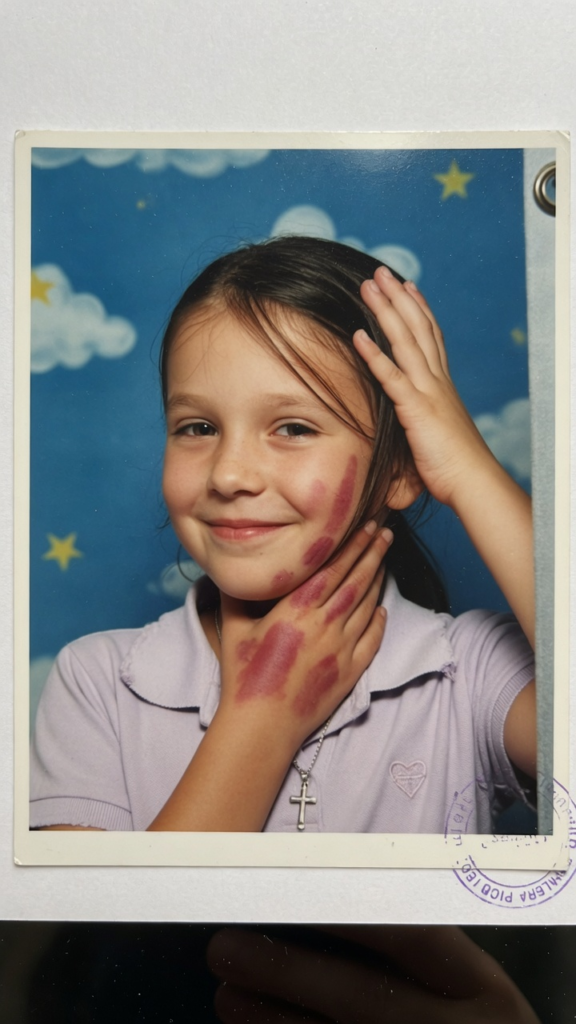
CHAPTER 1: THE BLINDING LIGHT
The smell of a school gymnasium in October is a universal constant. It’s a thick, heady mix of floor wax, stale rubber from thousand-dollar sneakers, and the faint, underlying scent of industrial-strength lemon cleaner. It’s the smell of childhood. It’s the smell of safety.
Or at least, that’s what I used to think.
I stood behind my Nikon D850, my back aching from six hours of “Chin up, honey,” and “Big smiles, everyone!” The line of second-graders from Oak Ridge Elementary seemed endless. They were a blur of Gap sweaters, dinosaur t-shirts, and glittery headbands. I was just a ghost in the machine to them—the “Picture Lady” who made them sit on a cold plastic stool and stare at a silver umbrella until they saw spots.
“Next,” I called out, my voice raspy. I didn’t look up from my monitor. I was checking the exposure on the last kid, a boy named Cooper who had managed to get chocolate milk on his white polo in the ten minutes between lunch and the gym.
I heard the soft scuff of sneakers. A pair of worn-out, pink high-tops entered my peripheral vision. They were mismatched—one lace was neon green, the other a frayed white. I liked that. It showed personality.
“Hi there,” I said, finally looking up. “Go ahead and take a seat on the stool. You’re doing great.”
The girl was small for seven. She had a mop of honey-blonde hair that looked like it hadn’t seen a brush in a few days, and eyes the color of a bruised Atlantic-ocean grey. Her name tag, taped precariously to a thick, oversized wool cardigan that looked three sizes too big for her, read Maya.
Maya didn’t say anything. She climbed onto the stool with a practiced, eerie stillness. She didn’t wiggle. She didn’t giggle. She sat there like a statue of a child, her hands gripped tightly in her lap.
“Okay, Maya,” I said, trying to inject some warmth into the room. “We’re just going to do a couple of quick ones. Can you give me a big smile? Think about something funny. Like a dog wearing sunglasses.”
Maya’s lips twitched, but the smile didn’t reach her eyes. She looked terrified. Not “I’m scared of the flash” terrified, but something deeper. Something older.
“Wait,” she whispered. It was the first time she’d spoken.
She raised her right hand. It was a slow, deliberate movement. She reached up to the side of her neck, tucking a thick lock of that honey-blonde hair behind her ear. Then, she pulled the collar of her oversized cardigan a little higher. She did it with such precision, such rehearsed grace, that if I hadn’t been looking through a 70-200mm lens, I might have missed the urgency of the gesture.
“Just fixing my hair,” she murmured, her eyes darting to the side, toward the line of kids waiting.
“No problem, honey,” I said. “Take your time. We want you to look your best.”
I adjusted the lighting. I wanted to catch the glint in her eyes, to make her look as vibrant as the other kids. I dialed up the power on the strobe.
“Okay, on three. One… two… three.”
Flash.
The gym went white for a microsecond. On my monitor, the raw image popped up instantly. It was a high-resolution, brutally honest depiction of a second-grader. And because I had bumped the light, the shadows in the creases of her neck were gone.
I froze.
My heart did a slow, sickening roll in my chest.
In the photo, Maya’s hand was still mid-air, caught in the act of “fixing her hair.” But her fingers had slipped. The hair had shifted. And there, revealed by the unforgiving brilliance of the professional strobe, was a mark.
It wasn’t a scratch. It wasn’t a rug burn from playing too hard.
It was the distinct, unmistakable shape of a human thumb and four fingers. A dark, mottled purple bruise that wrapped around the delicate column of her throat like a collar. It was fresh. The edges were angry and red, the center a deep, necrotic plum.
I felt the air leave the room. The sounds of the gym—the bouncing basketballs in the distance, the chatter of the kids, the rhythmic thump-thump of the heater—all faded into a dull, underwater roar.
I looked from the screen to the girl.
Maya was looking at me. She wasn’t looking at the camera anymore. She was looking at me. Her hand was back in her lap, but her cardigan had slipped again. She knew. She saw the way my hands had started to shake. She saw the way the color had drained from my face.
She didn’t cry. She didn’t ask for help. She just blinked, a slow, heavy movement of her lashes, and gave me a tiny, heartbreaking nod. It was the look of a soldier acknowledging a fellow prisoner in a camp. It was a look that said, Now you know. What are you going to do?
“Next!” shouted Marcus, the school’s physical education teacher who was helping manage the lines.
Marcus was a “man’s man” in his late forties—broad-shouldered, silver-haired, and wearing a whistle around his neck like a medal of honor. He was the kind of guy who believed a scraped knee was a life lesson and that “kids these days” were too soft. He’d lived in Oak Ridge his whole life. Everyone loved Marcus. He was the backbone of the community.
“Come on, Sarah, let’s keep it moving,” Marcus barked, clapping his hands. “We’ve got two more classes before the bell rings. Maya, honey, you’re done. Head back to your teacher.”
Maya slid off the stool. She didn’t look back. She walked toward the door, her oversized cardigan swallowing her tiny frame, her head bowed.
“Wait,” I choked out.
Marcus looked at me, his brow furrowing. “Something wrong with the shot?”
I looked at the monitor. I wanted to scream. I wanted to grab Marcus by his tactical polo and drag him over to the screen. Look! Look at what’s happening in your school!
But I didn’t.
Because I knew this town. I grew up in a town just like Oak Ridge. In places like this, the “perfect” facade isn’t just a lifestyle; it’s a religion. You don’t accuse a neighbor of the unthinkable based on a shadow in a photograph. You don’t disrupt the peace.
And more importantly, I saw Maya’s face again in my mind. That nod. It wasn’t just a greeting; it was a warning.
“The… the lighting was off,” I lied, my voice trembling. “I need a minute to recalibrate.”
Marcus rolled his eyes. “Artists. Everything has to be perfect. Take sixty seconds, Sarah. We’re on a clock.”
He turned back to the line, joking with a group of boys. I turned to my computer. My breath was coming in short, jagged gasps. I zoomed in on the image. 400 percent. 800 percent.
The bruise was even worse in close-up. I could see the individual burst capillaries. I could see the pressure points where the fingers had dug in. This wasn’t a “discipline” gone wrong. This was an attempt to silence someone.
I looked around the gym.
Mrs. Gable, the school secretary, was sitting at a folding table near the exit, checking names off a list. She was a bird-like woman in her sixties, wearing a sweater with pumpkins on it and glasses that hung from a beaded chain. She’d been at Oak Ridge for thirty years. She knew every parent, every grandparent, every dark secret hidden behind every manicured lawn.
I felt a sudden, desperate urge to show her. Mrs. Gable would know. She would know who Maya’s parents were. She would know if there had been “trouble” at that house.
But then I saw Maya’s mother.
She was standing by the gym door, waiting to pick Maya up early for an appointment. Her name was Elena—I remembered it from the schedule. She was beautiful in a way that felt curated. Her hair was a perfect platinum blonde bob, her trench coat was designer, and her smile was as bright and artificial as my strobe light.
She looked like the cover of a “Stepford Wives” reboot.
She saw Maya walking toward her and opened her arms. Maya walked into the hug, but I noticed something. Maya didn’t lean in. She stayed stiff. And as Elena’s hand reached up to stroke Maya’s hair—the same hair Maya had used to hide the bruise—Elena’s eyes swept the gym.
For a split second, her gaze landed on me.
It wasn’t a mother’s gaze. It was cold. It was calculating. It was the look of someone who was constantly scanning for threats, not to her child, but to her own image. She adjusted Maya’s collar, her fingers lingering just a second too long on the exact spot where the bruise lay hidden.
Then, they were gone.
I sat back in my chair, the plastic biting into my skin. The gym was loud again, but I felt like I was trapped in a vacuum.
I’ve been a photographer for fifteen years. I’ve shot weddings where the bride cried because the flowers were the wrong shade of white. I’ve shot corporate headshots for CEOs who wanted to look “approachable but powerful.” I’ve shot thousands of children.
I’ve always prided myself on my eye. I see the things people try to hide. The twitch of a lip, the tension in a shoulder, the way a couple avoids touching each other when the camera isn’t clicking.
But this? This was different. This wasn’t a secret. This was a crime.
I looked at the “Delete” button on my keyboard. If I pressed it, the evidence would be gone. I could finish my day, collect my check from the school district, and go back to my quiet apartment in the city. I could pretend I never saw it. I could tell myself that maybe it was an accident. Maybe she fell. Maybe they have a rowdy dog.
But I knew.
I reached for my phone, my fingers fumbling. I needed to call someone. Not the police—not yet. I didn’t have proof, and in a town like this, the police played golf with the school board.
I thought of Detective Miller. He was a friend of a friend, a guy who had left the city force after seeing too much. He lived a few towns over now, doing private security. He was the only person I knew who didn’t believe in the “perfect town” myth.
But before I could dial, a shadow fell over my desk.
“You done recalibrating?”
It was Marcus. He was leaning over my shoulder, his face inches from the monitor. My heart stopped. The image of Maya—the zoomed-in, 800-percent-crop of the bruise—was still right there on the screen.
I didn’t have time to hide it.
Marcus stared at the screen. He stared at the dark, finger-shaped marks on the little girl’s neck. He stared at the violent purple against the pale skin.
The silence lasted forever.
“That’s a hell of a shadow,” Marcus finally said. His voice was different. It wasn’t barking or jovial anymore. It was low. Warning.
“Marcus,” I whispered, “that’s not a shadow.”
He didn’t look at me. He kept his eyes on the screen. “Listen to me, Sarah. You’re a guest in this school. You’re here to take pretty pictures of kids for their parents to put on the mantle. You’re not a doctor. You’re not a social worker.”
“I’m a human being,” I snapped, my fear turning into a sudden, sharp anger. “Look at her neck, Marcus! Someone did that to her.”
Marcus straightened up. He looked around the gym to make sure no one was listening. When he looked back at me, his eyes were hard.
“Maya’s father is the District Attorney,” Marcus said, his voice dropping to a hiss. “Her mother is the head of the PTA. They are good people. They donate more money to this school than you’ll make in five years. Maya is a clumsy kid. She falls. She has… skin sensitivities. It’s been discussed.”
“Skin sensitivities don’t leave thumbprints,” I said, my voice rising.
Marcus grabbed my arm. Not hard enough to bruise, but hard enough to make his point. “Delete the photo, Sarah. Take a new one when she comes back for retakes. If you make a scene out of this, you’re not just losing this contract. You’re losing your career. I know the people who run the photography guilds in this state. Don’t be a hero. Just be a photographer.”
He let go of my arm and walked away.
I looked back at the screen. Maya’s grey eyes stared back at me.
In that moment, I realized that the photo booth wasn’t just a place for pictures. It was a confessional. And Maya had just given me her darkest sin—not hers, but the one being committed against her.
I didn’t delete the photo.
I hit Save. I encrypted the file. And then, I did something that would change my life forever.
I grabbed my camera bag, walked past the line of waiting children, ignored Marcus’s shouts, and walked out of the gym.
The rain was starting to fall as I reached my car. It was a cold, Oregon drizzle that blurred the world into shades of grey. I sat in the driver’s seat, the engine idling, watching the school entrance.
I saw the “perfect” families picking up their children. I saw the yellow buses pulling away. And I saw the red tail lights of Elena’s SUV disappearing into the mist, carrying Maya back to the house where the shadows lived.
I wasn’t just a photographer anymore. I was a witness.
And I knew one thing for certain: I wasn’t going to let that little girl hide behind her hair ever again.
CHAPTER 2: THE WEIGHT OF THE SILENCE
The windshield wipers on my old Subaru Forester groaned with every rhythmic sweep, struggling to keep up with the torrential downpour that had swallowed the afternoon. The sky over Oak Ridge wasn’t just grey; it was a heavy, bruised charcoal that seemed to press down on the tops of the Douglas firs lining the winding roads. I drove with my knuckles white against the steering wheel, my breath coming in shallow hitches.
Every time I closed my eyes for a second too long, I saw it again. The strobe light. The purple plum of a thumbprint. The way Maya’s skin looked so impossibly fragile, like parchment paper that had been crumpled and smoothed over one too many times.
I wasn’t just driving home; I was fleeing. I felt like a thief, even though the only thing I’d “stolen” was a digital file tucked away on an encrypted SD card inside my camera bag. But in a town like this, the truth was often treated like contraband.
I pulled into the gravel driveway of my small cottage on the outskirts of town—far enough away from the manicured lawns of the Vance estate to feel like a different world, but close enough to feel the chill of their influence. My house was a converted woodshop, filled with the smell of cedar and the ghosts of projects I’d never finished. It was usually my sanctuary. Today, it felt like a glass house.
I didn’t even take off my coat. I went straight to my workstation, the floorboards creaking under my boots. I pulled the SD card from my bag with trembling fingers and slotted it into the reader. The soft click sounded like a hammer cocking in the silence of the room.
The computer hummed to life. The blue light of the dual monitors washed over my face, making me look as pale as the girl in the photo. I opened the folder. Oak Ridge Elementary – Retakes – October 14th.
I scrolled past the smiling faces. There was Cooper with his chocolate milk stain. There was a girl named Chloe with a missing front tooth. And then, there was Maya.
I opened the raw file. No filters. No corrections. Just the brutal, 45-megapixel reality. I zoomed in until the pixels began to blur, then backed out just enough to see the architecture of the injury.
“God,” I whispered, the word catching in my throat.
Up close, it was worse. It wasn’t just a bruise; it was a map of violence. You could see where the pressure had been most intense—the tip of a thumb resting right over her carotid artery. It was a grip meant to control, to hush, to dominate. This wasn’t a fall. You don’t fall onto someone’s hand and stay there long enough for the capillaries to burst in a perfect crescent.
I leaned back, my head thumping against the headrest of my chair. I needed a witness. Not someone like Marcus, who looked at a crime and saw a PR nightmare. I needed someone who looked at a crime and saw a victim.
I picked up my phone and dialed a number I hadn’t called in two years.
Ben Miller lived in a cabin that looked like it was being slowly reclaimed by the forest. It was twenty miles outside of Oak Ridge, tucked into a ravine where cell service went to die. Ben was a man made of sharp angles and deep shadows—a former detective who had traded his badge for a bottle and eventually traded the bottle for a wood-burning stove and a dog named Blue.
He was sitting on his porch when I pulled up, the amber glow of a kerosene lamp illuminating the silver in his beard. He didn’t look surprised to see me. Ben wasn’t the type to be surprised by anything anymore. He’d seen the worst parts of humanity in the city, and when he moved out here, he’d brought the memories with him like heavy luggage.
“Sarah,” he said, his voice like gravel grinding together. “You look like you’ve seen a ghost.”
“Worse, Ben,” I said, my voice cracking as I stepped out into the rain. “I took a picture of one.”
We went inside. The air was thick with the scent of pine smoke and wet dog. Blue, a scruffy Australian Shepherd mix, gave my hand a cursory lick before settling back down by the hearth. Ben moved with a slight limp—a souvenir from a chase through a rainy alleyway five years ago—and poured me a mug of coffee that was strong enough to peel paint.
“I don’t have my laptop,” I said, my hands wrapped around the warm ceramic. “But I have the SD card. And my camera.”
I handed him the Nikon. I had the image queued up on the back LCD screen. Ben took it, his large, calloused hands dwarfing the professional body. He adjusted his reading glasses, leaning toward the lamp.
The silence in the cabin became absolute. The only sound was the rain drumming on the tin roof and the occasional pop of the fire.
Ben’s face didn’t change, but I saw his jaw tighten. A muscle jumped in his cheek. He stayed like that for a long time, staring at the small screen, his thumb hovering near the zoom button.
“Oak Ridge?” he asked, not looking up.
“Elementary,” I replied. “Her name is Maya Vance.”
Ben looked up then. His eyes were sharp, the weary fog of retirement momentarily cleared by the old, predatory instinct of a hunter. “Vance? As in Robert Vance?”
“The DA,” I said. “And the mother is Elena. PTA president, local darling, the woman who makes sure every bake sale is a triumph of social engineering.”
Ben set the camera down on the heavy oak table. He sighed, a long, weary sound that seemed to carry the weight of every case he’d ever lost. “Robert Vance is more than a DA, Sarah. He’s the crown prince of this county. His family has owned half the timber land since the fifties. He doesn’t just prosecute the law; he is the law in this corner of the state.”
“I don’t care who he is,” I said, my voice rising. “Look at her neck, Ben! She’s seven. She sat there on that stool and ‘fixed her hair’ because she knew that if I saw it, things would get worse. She was protecting him.”
“Or herself,” Ben corrected quietly. “Kids that age… they don’t have the luxury of justice. They only have the necessity of survival.”
He stood up and paced the small room, his limp more pronounced. “Marcus told you to delete it, didn’t he?”
“He threatened my career. Said I’d never work in this state again.”
“He’s probably right,” Ben said bluntly. He saw me flinch and softened his tone. “I’m not saying you shouldn’t do anything. I’m saying you need to understand what you’re up against. You go to the police with this, the report disappears before the ink is dry. You go to Child Protective Services, and the caseworker who gets assigned to the Vance house is probably someone who owes Robert a favor for getting their kid out of a DUI.”
“So what? I just sit on it? I let her go back there every night?”
Ben stopped by the window, looking out into the blackness. “No. But you don’t fight a god in his own temple. You find a different way.”
“What way?”
“Proof,” he said, turning back to me. “A single photo is a ‘shadow’ or a ‘skin sensitivity,’ like Marcus said. You need a pattern. You need more than just one moment in a photo booth. You need to see what’s happening when the cameras aren’t supposed to be on.”
“I’m a photographer, Ben. Not a private investigator.”
“Today,” Ben said, pointing to the camera, “you were both.”
I didn’t sleep that night. I stayed at Ben’s, curled up on his moth-eaten sofa with Blue at my feet. Every time the wind rattled the windowpanes, I jumped, convinced it was Robert Vance coming to reclaim the evidence.
In the morning, the rain had tapered off to a cold, clinging mist. I knew I couldn’t just stay in the woods. I had a life, a business, and a scheduled shoot at the Oak Ridge Country Club that afternoon—a high-end luncheon for the “Women in Leadership” group.
I knew Elena Vance would be there.
Before I went, I made a stop. I drove to a small, nondescript medical clinic on the edge of the city, far from the influence of Oak Ridge. I needed a professional opinion, someone who could look at the photo and tell me, with clinical certainty, what I was looking at.
Lydia Chen was a pediatric nurse practitioner and one of the few people I trusted with my life. We had been roommates in college, two girls from the “wrong side of the tracks” who had fought our way into our respective professions. Lydia was sharp, unsentimental, and had a heart that she kept under a layer of professional armor.
She met me in a back breakroom, smelling of antiseptic and cheap coffee. I showed her the tablet I’d transferred the photo to.
Lydia didn’t say anything at first. She took the tablet, her brow furrowed. She used her fingers to expand the image, focusing on the coloration of the bruise.
“The blanching here,” she said, pointing to the center of the mark, “indicates significant force. This wasn’t a momentary grab. This was sustained pressure.”
“Could it be an accident?” I asked, though I already knew the answer. “A fall? A rough game of tag?”
Lydia looked at me, her eyes flat and honest. “Sarah, look at the spacing. The distance between the thumb and the index finger. That’s an adult male hand. And look at the angle. This wasn’t done from the front. Someone reached around from behind her or from the side and squeezed. It’s a silencing grip. It’s what you do when you want a child to stop screaming without leaving marks that show above a high collar.”
She handed the tablet back, her hand shaking just slightly. “How old is she?”
“Seven.”
Lydia closed her eyes for a second. “There are other marks, Sarah. I’d bet my license on it. Bruises on the upper arms, maybe the ribs. Places where clothes cover the evidence. This kind of violence doesn’t happen in isolation. It’s a language. And whoever is speaking it to her has been doing it for a long time.”
“She’s the DA’s daughter, Lydia. Robert Vance.”
Lydia’s face paled. She knew the name. Everyone did. “Then you need to be careful. People like that… they don’t just hurt children. They destroy anyone who tries to stop them.”
“I can’t just walk away,” I said.
“I know,” Lydia replied, reaching out to squeeze my hand. “But if you’re going to do this, you need to be smart. You’re playing a game where they own the board, the pieces, and the referee.”
The Oak Ridge Country Club was a fortress of white stucco and green shingles, perched on a hill overlooking the valley. As I drove up the winding path, past the rows of Lexuses and Teslas, I felt like an interloper. My Forester felt clunky and out of place, a dusty relic in a world of polished surfaces.
I hauled my gear into the ballroom. The room was a sea of pastel blazers, expensive perfumes, and the tinkling of crystal. These were the women of Oak Ridge—the mothers, the wives, the power players. They were the ones who kept the gears of the town turning with a smile and a firm “no” to anything that threatened the status quo.
I set up my lights near the podium. I was there to take “candid” shots of the networking and “formal” portraits of the speakers.
And then, she walked in.
Elena Vance was even more striking in person than she had been in the gym. She was wearing a cream-colored silk blouse and a charcoal pencil skirt. Her hair was perfectly coiffed, every strand in its place. She was laughing at something a woman next to her said, a light, melodic sound that carried across the room.
She looked like the picture of grace. But as I watched her through my viewfinder, I saw the mask.
I waited. I stayed in the shadows of the stage, my long lens trained on her. I wasn’t looking for a “candid” smile. I was looking for the cracks.
For forty minutes, she was perfect. She shook hands, she took notes, she sipped her sparkling water. But then, a server—a young girl, maybe nineteen, with a nervous energy—accidentally bumped into Elena’s chair, spilling a few drops of water onto her charcoal skirt.
It was a tiny mistake. A nothing event.
But for a split second, the mask slipped.
Elena didn’t scream. She didn’t make a scene. She simply turned her head and looked at the girl. It was a look of such cold, concentrated vitriol that I felt a shiver run down my spine even from twenty feet away. Her eyes turned into chips of ice. Her mouth didn’t move, but her posture screamed You are nothing. You are beneath me. You have failed.
The server turned white, stammering an apology. Elena just stared at her for three seconds—a lifetime in social time—before turning back to her companion with a smile that was so sudden and bright it was terrifying.
“It’s quite alright, dear,” Elena said, her voice dripping with artificial honey. “Accidents happen.”
But she didn’t look “alright.” She looked like she wanted to erase the girl from existence.
I caught it. Click.
I had a photo of the “Saint of Oak Ridge” with the eyes of a predator. It wasn’t proof of child abuse, but it was proof of the darkness that lived under the silk and pearls.
After the luncheon, as the room was clearing out, Elena approached the podium. She saw me packing up my gear.
“You’re the photographer from the school yesterday,” she said. It wasn’t a question.
I felt my heart hammer against my ribs. “Yes. Sarah Jenkins.”
“Sarah,” she said, tasting my name like it was something sour. “Marcus told me you had some… technical difficulties with my daughter’s photo. Something about the lighting?”
She stepped closer. She smelled like lily of the valley and something sharp, like bleach.
“Yes,” I said, forcing my voice to remain steady. “The strobe was a bit too powerful. It created some… unusual shadows.”
Elena leaned in, her eyes boring into mine. “Shadows can be so misleading, can’t they? They make you see things that aren’t there. They distort the truth.”
“Sometimes,” I said. “And sometimes, they reveal it.”
The air between us went cold. Elena’s smile didn’t falter, but her hand reached out and touched the sleeve of my jacket. Her grip was surprisingly strong.
“My husband and I are very protective of our privacy, Sarah. And of our daughter’s image. We’ve worked very hard to build a certain… reputation in this town. It would be a shame if a ‘technical difficulty’ were to cause any unnecessary confusion.”
“I understand,” I said.
“I hope you do,” she replied. She let go of my arm. “Because Robert doesn’t like confusion. He likes things to be clear. He likes things to be… handled.”
She turned and walked away, her heels clicking rhythmically on the hardwood floor.
I stood there for a long time, my hands shaking. It wasn’t a suggestion. It was a threat. And it wasn’t just about a photo. They knew I knew.
That evening, I was back at my studio, trying to process the day. The sun was setting, casting long, orange fingers across the floor.
The phone rang. It was a local number, one I didn’t recognize.
“Hello?”
“Sarah Jenkins?”
The voice was deep, smooth, and commanded authority. It was the kind of voice that spoke in courtrooms and won over juries. It was the voice of a man who was used to being the most important person in the room.
“This is Robert Vance.”
I felt a cold sweat break out on my forehead. “Mr. Vance. To what do I owe the call?”
“I heard there was some trouble at the school yesterday. Marcus mentioned you were… distressed. About my daughter.”
He paused, letting the weight of the silence hang in the air.
“I wanted to call and apologize. Maya is a very active girl. She’s on the gymnastics team, and she’s always coming home with some bump or bruise. It’s a nightmare for her mother and me. We worry that people might… misinterpret things. You know how people love to gossip in a town like this.”
“I’m not a gossip, Mr. Vance,” I said, my voice surprisingly firm. “I’m a photographer. I record what’s in front of the lens.”
“Of course you do,” Robert said, his tone shifting. It was no longer apologetic. It was cold. “And I’m sure you’re a very good one. It would be a tragedy if your career were to be cut short by a misunderstanding. I’ve spoken to the school board. They’re very happy with your work, generally speaking. But they’re concerned about your… stability. Leaving a shoot in the middle of the day? That’s not very professional, Sarah.”
“I had a family emergency,” I lied.
“I’m sure you did. We all have emergencies, don’t we? The trick is making sure they don’t become permanent.”
He let that sink in.
“I’m going to send someone over to your studio tonight, Sarah. A courier. He’ll pick up the SD cards from yesterday’s shoot. All of them. We want to make sure the images are handled properly. For privacy reasons, you understand.”
“The contract is with the school district, Mr. Vance. Not with you.”
“The school district is me, Sarah. I thought you’d figured that out by now.”
He hung up.
I sat there in the darkening room, the dial tone buzzing in my ear like a hornet. They were coming for the evidence. And if I gave it to them, Maya would be lost. If I didn’t… I didn’t want to think about what “permanent” meant in Robert Vance’s vocabulary.
I looked at the computer. I looked at the photo of the little girl with the bruised neck.
Then, I looked at the “Wildcard” folder I’d started earlier—the one with the photo of Elena’s cold eyes and the medical notes from Lydia.
I wasn’t just a photographer. I was a witness.
And a witness doesn’t just watch. A witness tells the story.
I grabbed my laptop, my external hard drives, and my camera. I didn’t turn on the lights. I moved through the house by memory, packing a bag with the essentials. I knew I couldn’t stay here. If Robert Vance was sending a “courier,” it wouldn’t be a man in a uniform with a clipboard.
I was about to walk out the door when I saw a movement in the driveway.
A black SUV had pulled in, its headlights off. It sat there, a dark beast in the mist, its engine idling with a low, predatory hum.
I didn’t wait. I went out the back door, slipping into the woods that bordered my property. I knew these trails. I’d hiked them a thousand times, looking for the perfect light for my landscape shots.
I ran. I ran until my lungs burned and the branches tore at my face. I ran until the lights of my house were just a memory.
I reached the road a mile down, where I’d hidden my car earlier that evening—a precaution Ben had suggested. My heart was pounding so hard I thought it would burst out of my chest.
I got in, started the engine, and didn’t look back.
I had the truth in my pocket. And for the first time in my life, I realized that the truth wasn’t just a burden. It was a weapon.
I drove toward the only place I knew where the shadows couldn’t reach. I was going back to Ben’s.
But as I pulled onto the main highway, my phone buzzed in the cup holder. A text message from an unknown number.
It was a photo.
A photo of my own front door, taken just minutes ago. And sitting on the porch, right where I would have stepped out, was a single, honey-blonde lock of hair, tied with a pink ribbon.
The message underneath read: Don’t make this harder than it has to be, Sarah. We’re all family here.
The game wasn’t just beginning. It was already over. Or so they thought.
CHAPTER 3: THE ARCHITECTURE OF SECRETS
The gravel spun beneath my tires as I tore away from the hidden turnout where I’d stashed my car. My heart wasn’t just beating; it was a panicked bird thrashing against the cage of my ribs. The image of that lock of hair—honey-blonde, tied with a pristine pink ribbon—was burned into my retinas. It was a message written in the language of monsters: We can get to her. We can get to you. We are everywhere.
The drive back to Ben’s cabin felt like a descent into a fever dream. The rain had turned into a thick, clinging fog that swallowed the beams of my headlights. Every pair of glowing eyes from a deer on the shoulder looked like a searchlight. Every shadow of a towering fir tree looked like a man in a dark suit waiting to step into the road.
I didn’t call the police. Robert Vance was the District Attorney; he didn’t just work with the police, he held their leash. Calling 911 in this county would be like calling the predator to report the kill.
When I finally skidded into Ben’s clearing, the cabin was dark, save for the single amber eye of the porch lamp. I barely put the car in park before I was stumbling out, the wet earth soaking through my shoes.
“Ben!” I screamed, my voice cracking. “Ben, open up!”
The door creaked open before I reached the steps. Ben stood there with a shotgun cradled in the crook of his arm, his eyes scanning the tree line behind me. He didn’t ask questions. He grabbed me by the shoulder and hauled me inside, kicking the door shut and throwing the heavy iron bolt.
“They were at my house,” I gasped, collapsing onto the sofa. Blue, the Aussie Shepherd, sensed the adrenaline and began to whine, pacing in tight circles. “Robert Vance. He called me. And then… someone left a lock of Maya’s hair on my porch.”
Ben’s face went from guarded to murderous in a fraction of a second. He set the shotgun down on the table and knelt in front of me. “Did you see them? Did you see the car?”
“Just a black SUV. They were gone by the time I got to the woods. But Ben, they knew I was there. They knew I was leaving.”
Ben cursed under his breath, a low string of profanities that felt like the only honest thing in this town. He went to the kitchen and poured a finger of amber liquid into a glass—straight bourbon, no ice. He handed it to me.
“Drink it,” he commanded. “You’re in shock.”
I took a sip. The burn was a welcome distraction from the cold dread in my stomach.
“We can’t stay on the defensive,” Ben said, pacing the small room. His limp was more pronounced tonight, a physical manifestation of the stress. “They think they’ve scared you into submission. They think the ‘courier’ is going to show up at your studio, find you gone, and then they’ll just hunt you down. But they don’t know you’re here. Not yet.”
“What am I supposed to do?” I asked, looking at the camera bag huddled on the floor like a wounded animal. “I have the photo, Ben. I have the proof. But who do I give it to if the whole system is rigged?”
Ben stopped pacing. He looked at me with those weary, sharp eyes. “In the city, we used to say that if you want to take down a king, you don’t go for the crown. You go for the foundation. You find the people who built the pedestal and you start pulling out the stones.”
“Who built Robert Vance’s pedestal?”
“Oak Ridge did,” Ben said. “But someone kept the records. Someone knows where the bodies are buried—metaphorically and literally.”
He sat down across from me, leaning forward until the firelight caught the deep lines in his forehead. “I’ve been doing some digging since you left this morning. Robert Vance didn’t just appear out of nowhere. His father was a judge. His grandfather was a senator. But the power isn’t just in the bloodline; it’s in the silence. There have been ‘incidents’ before, Sarah. Reports that were filed and then vanished. Accusations of ‘roughness’ during his first term. A woman who worked as their nanny five years ago who disappeared from the public record after signing a very lucrative non-disclosure agreement.”
“We need that nanny,” I said.
“She’s in Idaho now. Too far for tonight,” Ben replied. “But there’s someone closer. Someone who’s been at the heart of that school for thirty years. Someone who sees every child, every parent, and every ‘incident report’ that crosses the desk.”
“Mrs. Gable,” I whispered.
The image of the bird-like secretary with the pumpkin sweater flashed in my mind. She had seen me look at the screen. She had seen Maya leave.
“She’s been the gatekeeper of Oak Ridge Elementary since before Maya was born,” Ben said. “She’s a creature of habit. She lives alone in a cottage on the east side of the lake. She’s religious, she’s meticulous, and she’s terrified of change.”
“She won’t talk to me,” I said. “She’s part of the machine.”
“Maybe,” Ben said. “Or maybe she’s just waiting for someone to give her permission to stop being a gear.”
We waited until 3:00 AM—the dead hour, when even the monsters in Oak Ridge are supposed to be sleeping. Ben insisted on driving. We used his old, beat-up truck, the one that looked like it belonged to a forest ranger, not a detective.
Mrs. Gable’s house was a small, white-shingled cottage surrounded by a picket fence that looked like it belonged in a storybook. It was the kind of place that screamed safety and tradition. But as we pulled up, the silence of the street felt oppressive.
“Stay in the truck,” Ben said.
“No,” I replied, opening my door. “She knows me. If she sees you, she’ll call the police. If she sees the ‘Picture Lady,’ she might just open the door.”
Ben hesitated, then nodded. “I’ll be right behind you. If I see a curtain twitch in the neighbor’s house, we’re out.”
I walked up the stone path, my heart hammering a frantic rhythm. I reached the porch and knocked. It was a soft, hesitant sound.
No answer.
I knocked again, louder this time. “Mrs. Gable? It’s Sarah Jenkins. From the school. Please, I need to talk to you.”
A light flickered on in the hallway. A few seconds later, the chain rattled, and the door opened a crack. Mrs. Gable peered out, her face pale and etched with exhaustion. She wasn’t wearing her pumpkin sweater now; she was in a thick flannel robe, her grey hair pulled into a tight, thin braid.
“Sarah?” she whispered. “It’s three in the morning. What on earth are you doing here?”
“I saw the photo, Mrs. Gable,” I said, my voice trembling. “And I think you saw it too. On my monitor. In the gym.”
Her eyes darted to the street, landing on Ben’s truck. She looked like she wanted to slam the door, but something stopped her. A spark of something old and buried.
“You shouldn’t be here,” she said, her voice shaking. “It’s not safe for you.”
“It’s not safe for Maya,” I countered. I stepped closer, closing the distance until I could see the tears welling in her eyes. “She’s seven years old, Mrs. Gable. She’s hiding bruises with her hair. She’s living in a house with people who treat her like a trophy they can kick when no one is looking. You’ve been at that school for thirty years. How many times have you seen this happen?”
Mrs. Gable’s lower lip trembled. She looked back into her darkened house, then back at me. “I… I don’t know what you’re talking about. The Vances are wonderful people. They’ve done so much for the library—”
“Stop it,” I snapped, the anger finally boiling over. “Stop the script. I’ve heard the script from Marcus. I’ve heard it from Elena. I even heard it from Robert himself. But I have the image. I have the thumbprints on her throat. Are you really going to let that little girl go back to that school tomorrow and pretend everything is fine?”
The silence stretched out, thick and heavy. A car drove by on the main road, its tires hissing on the wet pavement. Mrs. Gable seemed to shrink, her shoulders sagging under the weight of three decades of secrets.
“Come in,” she whispered. “Quickly.”
The inside of the cottage was a mausoleum of lace doilies, porcelain cats, and the scent of lavender and stale tea. Mrs. Gable led us into a small kitchen and sat down at a linoleum table. She didn’t offer us tea. She just sat there, her hands knotted together in her lap.
“I’ve kept files,” she said, her voice so low I had to lean in to hear her. “For twenty years, I’ve kept a ‘shadow’ filing system. My own personal record of the things that didn’t make it into the official state reports.”
Ben stepped into the light, his presence filling the small room. “Why, Martha?”
She looked at him, recognizing him now. “Detective Miller. I heard you’d moved out to the woods. I suppose I kept them because I thought one day, someone like you would come knocking. Someone who wasn’t on the payroll.”
She stood up and went to a pantry, pulling aside a stack of cookbooks to reveal a small, fireproof lockbox. She brought it to the table and opened it with a key she kept around her neck.
Inside were folders. Not many—maybe a dozen. But each one was a testament to the darkness of Oak Ridge.
“Robert Vance wasn’t always the DA,” she said, pulling out a yellowed newspaper clipping from fifteen years ago. “He was a rising star in the firm. Back then, there was a girl. A first-grader named Sophie. She came in with a broken collarbone. Said she fell off the monkey bars.”
“Did she?” Ben asked.
“The school nurse didn’t think so,” Mrs. Gable replied. “The nurse wrote a report. She said the break was consistent with a violent shove, not a fall. I typed that report. I saw it. But two days later, the Principal—a man named Henderson who was Robert’s golf partner—came into my office and told me there had been a ‘clerical error.’ He handed me a new report. This one said Sophie had a ‘history of brittle bones.’ The original report? Henderson took it to the shredder himself.”
She handed Ben the folder. Inside was a carbon copy of the original nurse’s report. Martha Gable had made a duplicate before the original was destroyed.
“I did it for all of them,” she said, her voice catching. “Every time a ‘prominent’ family had an ‘accident,’ I made a copy. I told myself I was just protecting the school. But I was really just waiting for the courage to use them.”
I flipped through the pages. It was a catalog of horrors. Broken fingers, suspicious “burns” from curling irons that were conveniently left out, “falls” down stairs that resulted in black eyes. And at the center of it all, like a recurring nightmare, was the name Vance.
“There’s more,” Mrs. Gable said, reaching into the bottom of the box. She pulled out a small, digital thumb drive. “This is from the school’s security cameras. From three months ago. It’s the hallway outside the auditorium during the winter recital.”
She looked at me, her eyes filled with a profound, soul-deep guilt. “I saw it on the monitor in real-time. I should have called the police then. I should have screamed. But I was afraid for my pension. I was afraid of Robert.”
Ben took the drive and plugged it into a ruggedized laptop he’d brought in his bag. We huddled around the screen.
The footage was grainy, the black-and-white of a low-end security system. It showed a hallway, empty except for two figures.
Robert Vance and Maya.
Maya was in a velvet dress, holding a violin case. She looked like a doll. Robert was standing over her, his face obscured by the angle of the camera, but his body language was unmistakable. He was shouting. You could see the tension in his shoulders, the way he loomed over her like a thundercloud.
Suddenly, Maya tried to turn away. Robert reached out. He didn’t just grab her; he snatched her by the back of the neck, his fingers digging into the same spot I had photographed in the booth. He shook her—a violent, jarring motion that made her violin case clatter to the floor.
He held her there for ten seconds, his face inches from hers. You could see her small legs trembling. Then, he let go, smoothed her hair with a terrifying, practiced tenderness, and walked away.
Maya stood there for a full minute after he left. She didn’t cry. She just picked up her violin case, straightened her velvet dress, and walked back toward the auditorium.
“He silences her before she even speaks,” I whispered, tears blurring my vision.
“That’s the pattern,” Ben said, his voice cold and clinical. “He breaks them, then he ‘fixes’ them. It’s a cycle of terror and grooming. He’s not just a child abuser; he’s a psychological predator.”
“This is enough, isn’t it?” I asked, looking at Ben. “This and my photo? We can go to the Attorney General. We can go to the FBI.”
“In a perfect world, yes,” Ben said. “But we’re in Oak Ridge. And Robert Vance just told you he’s sending a ‘courier’ to your house. He’s not waiting for a trial. He’s moving to erase the problem tonight.”
“We need to get Maya,” I said, standing up. “We can’t leave her in that house another hour.”
“If we go to that house, we’re kidnappers,” Ben warned. “Robert would have us shot on sight, and the law would back him up. We need a way to draw them out. A way to make them move in public where they can’t hide behind the badge.”
Mrs. Gable looked at us, her face etched with a sudden, desperate resolve. “The fundraiser. Tomorrow night. The ‘Oak Ridge Legacy’ gala. It’s at the Vance estate. Every important person in the county will be there. The Governor is even rumored to be attending.”
“A gala,” I said, a plan beginning to form in the back of my mind. “A room full of cameras and socialites.”
“It’s a suicide mission,” Ben said, but I could see the wheels turning in his head. “We’d never get past the gate.”
“I have an invitation,” I said. “I was hired to do the event photography. They haven’t fired me yet—Robert said he wanted me to ‘handle’ the emergencies.”
“You go in there, you’re walking into the lion’s den,” Ben said.
“I’m already in the den,” I replied. “And I’m the one with the camera.”
The rest of the night was a blur of tactical planning. Ben transformed from a retired drunk into a master strategist. He spent hours on the phone, calling in favors from old contacts in the city—people who didn’t owe Robert Vance anything.
We made copies of everything. Mrs. Gable’s files, the security footage, and my high-res photos were uploaded to a secure cloud server and sent to three different major news outlets with a “dead man’s switch” timer. If I didn’t check in by midnight the next night, the story would go live across the country.
But that wasn’t enough. We needed the “payoff,” as I called it in my video work. We needed Robert and Elena to convict themselves in front of the world.
“You’re going to need a wire,” Ben said, producing a small, high-tech microphone that looked like a button. “And you’re going to need to stay close to Maya. If they’re as stressed as I think they are, the cracks will show. They’re already panicking. Panic makes people stupid.”
“And if they find the wire?” I asked.
Ben looked at me, his eyes solemn. “Then you run. You don’t look back. You get to the gate and you don’t stop until you see the lights of a different county.”
I didn’t sleep. I spent the hours before dawn looking at the photo of Maya. I thought about her “fixing her hair.” I thought about the way she’d given me that tiny, heartbreaking nod.
She was waiting for me.
The Vance estate was a sprawling, neo-colonial monstrosity built of white brick and arrogance. As I drove up the long, winding driveway the next evening, the sun was setting behind the hills, casting long, bloody streaks across the sky.
The security at the gate was tighter than I’d ever seen. Men in earpieces checked every trunk, every bag. When they got to my car, I felt the weight of the hidden compartment Ben had built into my camera case.
“Sarah Jenkins. Event photographer,” I said, my voice remarkably calm.
The guard checked his clipboard. He looked at me, his eyes lingering a second too long on my face. “Mr. Vance is expecting you, Ms. Jenkins. He said to make sure you were… comfortable.”
“I’m sure he did,” I replied.
They waved me through.
The house was ablaze with light. Hundreds of candles flickered in the windows, and the sound of a string quartet drifted across the manicured lawn. It looked like a fairytale. But to me, it looked like a gilded cage.
I stepped into the grand foyer, my Nikon slung over my shoulder. The room was filled with the elite of Oak Ridge. Women in floor-length gowns, men in tuxedos, the smell of expensive champagne and even more expensive lies.
Elena Vance saw me almost immediately. She was wearing a dress of deep, blood-red silk. She looked like a queen. She glided across the room, her smile as sharp as a razor.
“Sarah! You made it,” she purred, her hand resting on my arm. She leaned in, her voice a whisper in my ear. “I was worried you’d decided to… retire early. After our talk yesterday.”
“I wouldn’t miss this for the world, Elena,” I said. “The light is just too perfect tonight.”
“Is it?” she asked, her eyes searching mine. “I find that sometimes, too much light can be… revealing. Don’t you?”
“That’s the point of photography, isn’t it?”
Elena’s grip tightened on my arm. “Be careful, Sarah. This isn’t a school gym. There are no witnesses here who aren’t on our side.”
She walked away, leaving me standing in the middle of the room. I took a breath and started to work. I moved through the crowd, snapping photos of the “great and the good.” I took pictures of the Governor laughing with Robert. I took pictures of Marcus, the PE teacher, looking uncomfortable in a tuxedo, hovering near the bar.
And then, I saw her.
Maya was sitting on a small velvet bench in the corner of the library, away from the noise of the party. She was wearing a white dress that made her look like an angel. But she wasn’t looking at the guests. She was looking at the floor, her hands folded in her lap in that same, eerie stillness.
I walked toward her, my camera held low.
“Hi, Maya,” I whispered.
She looked up. For a second, I saw a flicker of hope in her eyes, followed quickly by a wave of pure, unadulterated terror.
“You shouldn’t be here,” she whispered, her voice barely audible over the music. “He’s angry. He’s so angry about the picture.”
“I know,” I said, kneeling in front of her. I pretended to adjust my lens, using my body to shield her from the rest of the room. “But I’m here to help you, Maya. Do you remember what I told you? That we’d make sure you were safe?”
“Nobody is safe,” she said. She reached up and touched her neck. She was wearing a high, lace collar tonight. It covered everything. “He says that if I tell, the ‘Shadow Man’ will come and take you away too. Just like he took the others.”
“The others?” I asked, my blood running cold. “Maya, what others?”
Before she could answer, a shadow fell over us.
“Is there a problem, Sarah?”
Robert Vance was standing behind me. He looked magnificent in his tuxedo—powerful, handsome, the very image of a leader. But as I looked up at him, all I could see was the man in the grainy security footage, shaking a seven-year-old girl until her teeth rattled.
“Just getting a candid shot of Maya,” I said, standing up. “She looks beautiful tonight, Robert.”
Robert looked down at his daughter. He reached out and stroked her head, his fingers tangling in her honey-blonde hair. Maya didn’t flinch, but I saw her eyes go flat, the light in them extinguishing like a blown candle.
“She is my greatest pride,” Robert said, his voice smooth and terrifying. “And my greatest responsibility. Which is why I take it so personally when people try to… interfere with her well-being.”
He looked at me, his eyes like two dark tunnels. “The courier went to your studio tonight, Sarah. He said the place was empty. It seems you’ve been busy.”
“I’ve been working,” I said. “A photographer’s work is never done.”
“No,” Robert agreed. “But sometimes, it is finished.”
He leaned in, his voice dropping to a low, lethal hum. “I know where you went, Sarah. I know about Martha Gable. I know about the ‘shadow files.’ Martha is an old woman. She has a very weak heart. It would be a tragedy if the stress of a… police investigation were to be too much for her.”
My heart stopped. “You leave her alone, Robert.”
“I’ll leave everyone alone,” he said, “as soon as I have what belongs to me. The SD cards. The hard drives. And you.”
“You’re in a room full of people, Robert,” I said, looking around. “The Governor is thirty feet away.”
“The Governor is a man who likes to win elections,” Robert replied. “And I am the man who ensures he does. Now, you’re going to walk with me. We’re going to go into my study, and we’re going to settle this like professionals.”
He grabbed my arm. It wasn’t a request.
As he led me away, I looked back at Maya. She was watching me, her small face a mask of grief.
We walked through the library, past the rows of leather-bound books that looked like they hadn’t been opened in a century. Robert pushed open a heavy oak door and led me into a room that smelled of cigars and old money.
Elena was already there. She was sitting behind a massive desk, her red dress looking like a pool of blood in the dim light.
“Close the door, Robert,” she said.
He did. The sound of the lock clicking into place was the loudest thing I’d ever heard.
“Now,” Elena said, leaning forward. “Where are the files, Sarah? And don’t lie to us. We’ve already searched your car. We found the hidden compartment. It was empty.”
“Because I’m not stupid,” I said, my back against the door. “The files are already gone. They’re in the hands of people you can’t buy, Elena.”
Elena laughed—a cold, brittle sound. “There is no one we can’t buy. Or break. You think a few photos of a ‘bruise’ are going to take us down? We’ll have a dozen doctors testify that Maya has a rare skin condition. We’ll have Martha Gable declared senile. And you? You’ll be found in a ditch three counties over, the victim of a ‘tragic’ car accident caused by your own ‘unstable’ mental state.”
Robert stepped closer, his presence looming over me. “It’s over, Sarah. Give us the passwords to the cloud server, and maybe… just maybe… we’ll let you live long enough to leave the state.”
I looked at him. I looked at the man who had spent his life crushing anything that got in his way. And then, I did something he didn’t expect.
I smiled.
“You’re right, Robert,” I said. “This isn’t a school gym. And there are no witnesses here who aren’t on your side.”
I reached up and touched the “button” on my blazer—the one Ben had given me.
“But you forgot one thing,” I whispered. “I’m not just a photographer. I’m a storyteller.”
I looked toward the bookshelf. “Ben? Now.”
A section of the bookshelf swung open. Ben Miller stepped out, holding a tablet in one hand and a digital recorder in the other. He wasn’t alone. Behind him stood two men in windbreakers with ‘FBI’ emblazoned on the back in bold, yellow letters.
The silence in the room was absolute. Robert’s face went from arrogant to ashen in a heartbeat. Elena stood up, her hand flying to her throat.
“Robert Vance,” Ben said, his voice echoing in the small room. “You’re under arrest for child abuse, witness intimidation, and a laundry list of racketeering charges that are going to keep you in a cell until the sun burns out.”
“You… you can’t do this!” Robert sputtered, his voice cracking. “I am the District Attorney! I have rights!”
“You had rights,” Ben said, stepping forward. “Until you admitted to witness intimidation on a federal wire. We’ve been recording this entire conversation, Robert. Every word. Every threat. And we’ve been live-streaming it to the US Attorney’s office in Portland for the last twenty minutes.”
The FBI agents moved in. Robert didn’t fight. He collapsed into a chair, his head in his hands. Elena tried to scream, but one of the agents caught her arm, spinning her around and clicking the handcuffs into place.
I walked past them. I didn’t want to see their faces. I didn’t want to see the end of their story.
I walked back out into the library.
Maya was still there, sitting on the velvet bench. She looked at me as I approached.
“They’re gone, Maya,” I said, kneeling in front of her. “They’re never going to hurt you again.”
She didn’t say anything for a long time. She just looked at me with those bruised-ocean eyes. Then, slowly, she reached out and took my hand.
“Did you catch the light?” she whispered.
“I did,” I replied, a tear finally escaping and rolling down my cheek. “The light found the truth, Maya. And the truth is going to take you home.”
CHAPTER 4: THE LIGHT THAT REMAINS
The silence that followed the click of the handcuffs was more deafening than the sirens that eventually tore through the crisp night air of Oak Ridge. In the movies, an arrest is a moment of triumph, punctuated by a witty one-liner and a swelling soundtrack. In reality, it felt like the air had been sucked out of the room, leaving us all gasping in a vacuum of ruined lives and shattered illusions.
Robert Vance didn’t go out like a lion. As the FBI agents led him through the library, he looked small. The tuxedo that had looked like armor minutes ago now looked like a costume he’d stolen. His face was a mask of pathetic, trembling shock. Elena, on the other hand, was a statue of ice. Even as they walked her past the Governor and the horrified elite of the county, she kept her chin up, her eyes fixed on some point in the distance that only she could see. She wasn’t ashamed; she was indignant that the world had dared to stop spinning on her axis.
I stood by the heavy oak door, my camera still gripped in my hands like a holy relic. My knuckles were white, and my breath was coming in jagged, uneven bursts.
Ben Miller stepped beside me, his hand resting briefly on my shoulder. It was a heavy, grounding touch. “It’s done, Sarah,” he said, his voice low and raspy. “The monster is in the cage.”
“But the damage is already done,” I whispered, looking toward the hallway where Maya had been sitting.
I didn’t wait for the FBI to finish their sweep of the room. I didn’t wait to give my formal statement to the agents who were already bagging Robert’s computer. I turned and ran back into the library, my heart screaming.
Maya was gone.
The velvet bench was empty. The room was a chaotic swirl of panicked socialites trying to find their coats and security guards trying to maintain a perimeter. I pushed through the crowd, ignoring the glares and the whispers. I knew where she would go. A child like Maya doesn’t run toward the noise; she runs toward the dark.
I found her in the conservatory, a massive glass room filled with exotic ferns and the scent of damp earth. She was curled into a ball behind a giant Monstera plant, her white lace dress a pale ghost against the shadows. She was shivering so hard I could hear her teeth chattering.
“Maya,” I said softly, kneeling a few feet away so I wouldn’t startle her. “It’s me. It’s Sarah.”
She didn’t look up. “Is he coming?”
“No,” I said, and for the first time in forty-eight hours, I could say it with the absolute certainty of the truth. “He’s never coming back, Maya. The police took him away. They took her away, too.”
She finally lifted her head. Her eyes were wide, vacant, and terrified. “But the Shadow Man… he said he’d find me. He said if I let the light touch the secret, the world would break.”
“The world didn’t break, honey,” I said, moving closer and reaching out a hand. “The world just finally woke up.”
She looked at my hand for a long time before she reached out and took it. Her skin was like ice. I pulled her into my lap, wrapping my coat around her small, shaking frame. We sat there in the dark of the conservatory, the distant sound of police radios and shouting voices fading into a dull hum. I didn’t try to tell her it was okay—it wasn’t okay. It wouldn’t be okay for a long time. I just held her and let the rain drum against the glass ceiling, a rhythm of survival.
The weeks that followed were a blur of fluorescent lights, mahogany tables, and the relentless, soul-crushing machinery of the American legal system.
The “Fall of the House of Vance” became a national obsession. The news cycle couldn’t get enough of the “Perfect DA” who was a secret monster. They played the security footage I’d found with Mrs. Gable until the pixels were worn thin. They analyzed my photo—the one of the bruise—on every morning talk show, with experts debating the “psychology of the hidden victim.”
I hated all of it. Every time I saw Maya’s face on a TV screen, blurred but still recognizable to anyone who knew her, I felt like I was betraying her all over again. I had used the light to save her, but the light was now a magnifying glass that wouldn’t let her heal in peace.
Oak Ridge didn’t handle the truth well. The town went through the classic stages of grief, but they got stuck on Denial for a long time. People I’d known for years stopped speaking to me. I was the “troublemaker.” I was the outsider who had come in and ripped the band-aid off a wound they’d all agreed to ignore.
Marcus, the PE teacher, was fired three days after the arrest. He didn’t go quietly. He tried to sue the school board, claiming he was “just following protocol.” But then the FBI found his emails to Robert—emails where he’d warned the DA about my “unstable behavior” and promised to “keep the girl in line.” He wasn’t just a coward; he was an accomplice. Seeing him led out of the school in handcuffs provided a small, cold comfort.
Mrs. Gable fared better. She became the unexpected hero of the story. The “Secret Keeper” of Oak Ridge. She moved out of her cottage and went to live with her sister in Montana, far away from the lake and the memories of the files she’d kept in her pantry. Before she left, she sent me a handwritten note. “I can finally sleep without the light on,” it read. “Thank you for being the one who knocked.”
But the real battle was in the courtroom.
Robert Vance’s defense team was a pack of high-priced wolves. They didn’t try to prove he was innocent; they tried to prove everyone else was lying. They attacked Ben Miller’s record, calling him a “disgruntled ex-cop with a vendetta.” They attacked Mrs. Gable’s mental state. And then, they turned their sights on me.
I remember the day of my deposition. The room was small, windowless, and smelled of stale coffee and expensive cologne. Robert sat across from me, his hands folded on the table. He wasn’t wearing a tuxedo anymore; he was in a grey suit that made him look like a bank teller. But his eyes… his eyes were still the same. They were dark, bottomless pits of entitlement.
“Ms. Jenkins,” his lead attorney, a man named Sterling with hair the color of a shark’s belly, began. “You consider yourself an ‘artist,’ don’t you?”
“I’m a photographer,” I said, my voice flat.
“And as an artist, you’re interested in ‘drama,’ aren’t you? In creating a narrative? In making sure the ‘shot’ is perfect?”
“I’m interested in the truth.”
Sterling smiled, a flash of white teeth. “The truth. Let’s talk about that. You manipulated the lighting in that photo booth, didn’t you? You admitted to Marcus Thorne that you ‘dialed up the power’ on the strobe. Isn’t it true that you were looking for a way to make a common, everyday bruise look like something… more sinister? For the sake of your ‘narrative’?”
I looked at Robert. He was watching me with a faint, mocking smirk. He thought he was winning.
“I didn’t need to create drama,” I said, leaning forward until I was inches from Sterling’s face. “The drama was etched into that little girl’s skin. I didn’t ‘make’ the bruise. I just gave it enough light so that people like you couldn’t pretend it wasn’t there.”
“You have a history of trauma yourself, don’t you, Sarah?” Sterling continued, ignoring my point. “A mother who left? A father who struggled with his own… temper? Isn’t it possible you’re projecting your own childhood onto the Vance family?”
It was a low blow. A classic “gaslight” tactic. I felt the old familiar heat of shame rising in my chest, the urge to apologize for existing. But then I thought of Maya in the conservatory. I thought of the way she’d looked at the floor, waiting for the blow that always came.
“My past is my own,” I said, my voice ringing out in the small room. “But Maya’s future belongs to her. And I will sit in this chair and repeat the truth until your throat is as sore as hers was when he finished with her.”
Robert’s smirk vanished. For a split second, I saw the crack. I saw the fear. He knew he couldn’t break me because I’d already been broken, and I’d put myself back together with something stronger than silence.
The trial lasted six months. It was a grueling, ugly affair that stripped the skin off the town of Oak Ridge. One by one, the other victims from Mrs. Gable’s files came forward.
There was Sophie, the girl with the “brittle bones,” now a twenty-one-year-old woman with a haunted look in her eyes. She testified about the night her father’s “friend,” Robert Vance, had pushed her down the stairs because she’d seen him hitting her mother.
There was Clara, the nanny from five years ago. She had been hiding in Idaho, terrified that the NDA she’d signed was a death warrant. But when she saw the news, when she saw my photo, she drove eighteen hours straight to the courthouse. She testified about the “crying rooms” in the Vance estate. She testified about the way Elena would smile while she told Clara that “children need to be shaped, not heard.”
The evidence was an avalanche. Even the Governor couldn’t distance himself fast enough. He issued a public apology, citing his “deep regret” for having been misled by a man he thought was a pillar of the community. Nobody believed him, but it didn’t matter. The pedestal was gone.
On a rainy Tuesday in April, the jury came back with a verdict.
Robert Vance: Guilty on all counts. Twenty-five years to life. Elena Vance: Guilty of conspiracy, child endangerment, and witness tampering. Fifteen years.
As they were led out of the courtroom, I stood in the back, behind the row of reporters. Robert looked at me one last time. There was no anger left in him—only a hollow, empty void. He had been a god in this town, and now he was just a number in a system he had once controlled.
I didn’t feel joy. I didn’t feel triumphant. I just felt a profound sense of exhaustion. I walked out of the courthouse and stood on the steps, letting the rain wash over me.
Ben Miller was waiting at the bottom of the steps. He looked older, more tired, but his eyes were clear. “What now?” he asked.
“Now,” I said, “I have a promise to keep.”
Maya didn’t stay in Oak Ridge. The state found her maternal aunt, a woman named Jean who lived on a small farm in the Skagit Valley of Washington. Jean had been estranged from Elena for a decade—Elena had told everyone Jean was “unstable,” but the truth was that Jean had seen through the facade and tried to get Maya out when she was a baby. Elena had used Robert’s power to cut her off completely.
I drove up to visit them a month after the trial ended.
The farm was a world away from the stucco and brick of Oak Ridge. It was a place of mud, goats, and the smell of wet hay. There were no “perfect” lawns here. The fences were crooked, and the barn needed a coat of paint, but the air felt like you could actually breathe it.
I found Maya in the garden. She wasn’t wearing a lace dress or a velvet collar. She was in a pair of stained denim overalls and a t-shirt with a cartoon cat on it. Her honey-blonde hair was a mess of tangles, and there were streaks of dirt on her cheeks.
She was kneeling in the dirt, planting sunflower seeds.
“Hi, Maya,” I said, leaning against the fence.
She looked up, and for the first time, I saw it. The thing I’d been looking for since that day in the photo booth.
A real smile.
It wasn’t a “picture perfect” smile. It was a small, shy, slightly lopsided grin that reached all the way to her eyes. The grey of her eyes wasn’t bruised anymore; it was the color of the sky after a storm.
“Sarah!” she shouted, jumping up and running toward me.
She didn’t hesitate. She didn’t check for shadows. She threw her arms around my waist and squeezed. I held her, smelling the dirt and the sunshine on her skin.
“Look,” she said, pulling back and pointing to the row of seeds. “Aunt Jean says that if I take care of them, they’ll grow taller than me. She says sunflowers always find the light, no matter how much shade there is.”
“Aunt Jean is a very smart woman,” I said.
We spent the afternoon together, not talking about the trial, or the photos, or the “Shadow Man.” We talked about the goats. We talked about the way the mountains looked when the clouds touched the peaks. We talked about the future.
As the sun began to set, casting a golden, honeyed glow over the valley, I pulled my camera out of my bag. It was a new one—I’d sold my professional gear after the trial and bought a simple, rugged Fuji. I didn’t want to be the “Picture Lady” anymore. I just wanted to be Sarah.
“Can I take your picture, Maya?” I asked. “Just one.”
She hesitated for a second, then nodded. She stood by the fence, the sunflowers-to-be at her feet. She didn’t “fix her hair.” She didn’t pull up her collar. She just stood there, her shoulders relaxed, her head held high.
I looked through the viewfinder. I didn’t adjust the lights. I didn’t worry about the exposure. I just waited for the moment when she looked directly into the lens—not with fear, not with a secret, but with the quiet, indestructible strength of someone who had survived the dark.
Click.
It was the most beautiful photo I’ve ever taken. It wasn’t a confession. It was a declaration.
My career in Oak Ridge was over, just as Marcus had predicted. The town’s elite made sure I never got another wedding contract or corporate headshot within fifty miles of the county line. I ended up moving to the city, opening a small studio that specialized in “Authentic Portraits.” I don’t use strobe lights much anymore. I prefer the sun. It’s harder to control, but it’s a lot harder to lie to.
I still get letters from Maya. She’s ten now. She plays the violin again, but this time, she plays it because she loves the sound, not because she’s afraid of the silence. She sent me a photo last Christmas—taken by Aunt Jean. She’s standing in front of a giant sunflower, her hair wild and free, laughing at something off-camera.
There are no bruises on her neck.
People often ask me if I regret what I did. They ask if the loss of my “perfect” career and the hatred of a small town was worth it for one little girl.
I look at the photo of Maya in the garden—the one I keep on my desk, the only one I never sold. I look at the light in her eyes, the light that I helped find.
And I realize that being a photographer isn’t about capturing the perfect image. It’s about having the courage to see the imperfect truth. We spend our lives trying to hide the “ugly” parts of ourselves—the bruises, the secrets, the shadows. We build fences of white brick and reputations of silk to keep the world from seeing who we really are.
But the truth is like those sunflowers. It doesn’t matter how deep you bury it, or how much shade you try to cast over it. It will always, eventually, find a way to break through the dirt and reach for the light.
And once the light touches it, the shadows don’t stand a chance.
The camera doesn’t just capture a moment; it captures a choice—the choice to look away, or the choice to see.
ADVICE FROM THE FRONTLINES OF TRUTH:
In a world that values the “perfect” image above all else, remember that the most beautiful things are often the ones that have been broken and mended. Never prioritize a “perfect” reputation over a human life. If you see something that makes your soul ache, don’t look away. Silence is the oxygen that monsters breathe; the truth is the light that suffocates them. Trust your gut, protect the vulnerable, and never, ever be afraid to turn on the lights—even if you’re the only one in the room who wants to see.
The most powerful tool you own isn’t a camera, a phone, or a pen. It’s your voice. Use it to speak for those whose voices have been stolen by the shadows.