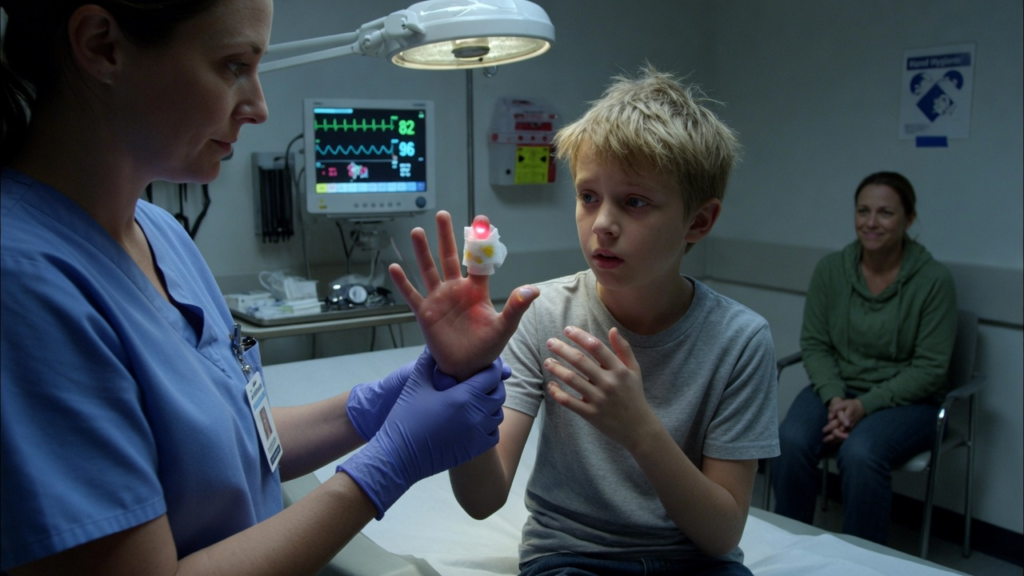
The ER was screaming that night.
It was a Tuesday in late November, the kind of night where the cold air outside smells like wet asphalt and bad news.
I’ve been a triage nurse at St. Jude’s for twelve years. I’ve seen everything.
I’ve seen the car wrecks, the botched robberies, the kids who swallowed pennies, and the ones who swallowed secrets.
But Room 5 was different.
Room 5 held Leo.
He was twelve, but he looked eight. Skinny, pale, with that messy blonde hair that hadn’t seen a comb in a week.
His mother, Sarah, sat in the corner chair. She was vibrating. That’s the only way to describe it.
She wasn’t crying. She wasn’t yelling. She was just… buzzing with a nervous energy that made the hair on my arms stand up.
“It’s just his hand, Nurse,” she said, her voice thin and reedy. “He fell off the porch. You know how boys are.”
I looked at Leo. He wouldn’t look at me.
He was staring at his right hand, which he held cradled against his chest like a wounded bird.
I walked over, pulling on a fresh pair of nitrile gloves. The snap of the rubber sounded like a gunshot in the quiet room.
“Hey, Leo,” I said softly. “Can I see that hand, buddy?”
He didn’t move. He just gripped it tighter.
“Leo, honey, show the lady,” Sarah said. Her voice had a sharp edge to it. A warning.
Slowly, Leo extended his arm.
His index and middle fingers were massive. They were twice the size they should have been.
The skin was stretched so tight it looked translucent, glowing with a sickly, angry purple hue.
“I thought it was just a sprain,” Sarah added quickly. “Maybe a bee sting? We have a lot of bees.”
In November? In Ohio? I didn’t say it. I just looked at the swelling.
It wasn’t a normal inflammation. It was localized, bulging in a way that looked… structural.
“Does it hurt, Leo?” I asked.
He nodded once, a tiny, jerky movement.
I reached out and gently took his wrist. His skin was ice cold.
That was the first red flag. Usually, an infection that bad is burning hot to the touch.
I moved my thumb toward the base of the swelling.
Leo’s breath hitched. He started to pull away, but his mother’s hand landed on his shoulder.
“Stay still, Leo,” she snapped.
I looked at her. Her knuckles were white. She wasn’t looking at me; she was looking at the door.
I turned my attention back to the fingers. I needed to see if it was fluid-filled or solid.
I pressed my thumb into the center of the largest bulge on his index finger.
I expected the soft give of an abscess. I expected pus, or maybe the crunch of a broken bone.
I didn’t get either.
When I pressed down, the skin didn’t just sink. It hit something.
Something hard. Something cold. Something that moved.
Underneath the flesh of a twelve-year-old boy, I felt the unmistakable click of a mechanical latch.
My heart stopped.
I didn’t let go. I pressed harder, sliding my thumb along the side of the bone.
That’s when I felt it. A jagged, metallic edge. And then, a tiny, rhythmic vibration.
It wasn’t a pulse. It was a countdown.
I looked at Leo. For the first time, he met my eyes.
His pupils were blown wide, black pits of pure terror.
“Please,” he whispered, so low I almost didn’t hear it over the hum of the hospital monitors.
“Please don’t let them take it back.”
I felt a chill wash over me that had nothing to do with the ER air conditioning.
I realized then that the swelling wasn’t the injury.
The swelling was a container.
And whatever was inside that boy’s hand was something he was willing to die to protect.
I looked at the mother. She was smiling now. A fake, plastic smile that didn’t reach her eyes.
“Is he going to be okay, Nurse? Can we go home now?”
I didn’t answer. I couldn’t.
Because under my thumb, the clicking had stopped.
And a small, red light began to glow faintly through the skin of his knuckle.
CHAPTER 2: THE TICKING BENEATH THE SKIN
The silence in Room 5 wasn’t empty. It was heavy. It felt like the air had been replaced with lead, pressing down on my lungs until every breath felt like a chore. I stared at the faint, rhythmic red glow emanating from Leo’s knuckle. It wasn’t a steady light. It was a pulse. A heartbeat made of electricity and light, buried beneath the soft, bruised skin of a child.
My hand was still resting near his wrist. I could feel his actual pulse—the biological one. It was racing. Thud-thud-thud-thud. It was the frantic rhythm of a bird trapped in a cage. But that other pulse, the mechanical one, was slow. Deliberate.
Click. Pulse. Click. Pulse.
I’ve spent twelve years in the ER. I’ve seen some strange things. I once saw a man come in with a live firework embedded in his thigh. I saw a woman who had tried to “cure” her own arthritis by injecting industrial lubricant into her joints. But this? This felt different. This felt like I had stepped onto a landmine, and the only thing keeping it from blowing was the weight of my thumb.
“Nurse?”
Sarah’s voice snapped me back. It wasn’t thin anymore. It was sharp. Like a razor blade hidden in a silk cloth. She had stood up. She wasn’t just vibrating now; she was poised. Her body was angled toward the door, but her eyes were locked on my hand.
“Is there a problem?” she asked.
I forced my facial muscles to relax. It’s the “Nurse Face.” We learn it in our first year. No matter if a patient’s leg is hanging by a thread or if you just realized you’re looking at something that shouldn’t exist, you keep your expression neutral. You keep your voice steady. You don’t spook the herd.
“I just want to check his capillary refill,” I said, my voice sounding steadier than I felt. “With this much swelling, I’m worried about the circulation. I’m going to go grab the portable ultrasound. It’ll just take a second.”
I started to stand up, but Sarah moved faster. She stepped between me and the door. She wasn’t a big woman—maybe five-four, five-five at most—but in that small exam room, she felt like a mountain.
“No,” she said.
Just one word. Flat. Final.
“We don’t need an ultrasound. We don’t need anything else. If it’s just a sprain, we’ll take him home and ice it. He’s tired. I’m tired. We’re leaving.”
She reached out to grab Leo’s good arm. Her fingers dug into his bicep. Leo didn’t cry out, but he whimpered—a small, broken sound that went straight to my heart. He looked at me, and in that look, I saw a plea. He didn’t want to leave. He was terrified of her. Or maybe, he was terrified of where she was taking him.
“Mrs. Miller,” I said, using the name on the chart. I kept my hands visible, palms open. “I can’t let you leave yet. Not with swelling like this. If there’s a blockage or a foreign body—which is what it feels like—moving him could cause permanent nerve damage. Or worse.”
“It’s not a ‘foreign body,’” she spat. The fake motherly concern had vanished. Her face was a mask of cold, hard desperation. “It’s a family matter. Give me his chart.”
I backed away a step, closer to the bedside computer. My heart was slamming against my ribs now. There was a “Code Gray” button on the wall—security for combative patients or visitors. My hand hovered near it, but I hesitated. If I pressed it, guards would swarm the room. If that thing in Leo’s hand was what I thought it might be—a device, a tracker, or something more volatile—a struggle was the last thing we needed.
“I can’t do that, Sarah,” I said, intentionally dropping the ‘Mrs. Miller.’ I wanted to see her reaction.
She flinched. Only for a millisecond.
“Leo,” I said, looking past her. “Where did this come from? Did someone put this in your hand?”
Leo’s mouth opened. He looked at his mother, then at me. His eyes darted to the red light, which was now pulsing a little faster. The glow was becoming more visible as the ER lights above us flickered.
Wait. The lights were flickering.
I looked up. The overhead fluorescent tubes were buzzing. It wasn’t the usual hum. It was a high-pitched whine, an electronic scream that seemed to be synced with the red light in Leo’s finger.
“Don’t talk to him,” Sarah snapped. She grabbed Leo’s shoulder and practically yanked him off the bed.
“Ow!” Leo cried out. “Mom, it hurts! It’s getting hot!”
“Shut up, Leo! We’re going!”
“Sarah, stop!” I stepped forward, my professional caution giving way to pure instinct. “The boy is in pain! Look at his hand!”
I wasn’t imagining it. The purple skin around the swelling was turning a bright, angry red. Wisps of what looked like steam were beginning to rise from his skin. The smell of something metallic and ozone-heavy filled the air.
Sarah ignored me. She was dragging Leo toward the door. But as she reached for the handle, the electronic lock on the door chirped.
Red light.
The door wouldn’t open. The hospital’s central security system had just engaged.
“Open the door,” Sarah said, turning back to me. Her eyes were wide, the whites showing all the way around. She reached into her oversized handbag.
I saw the glint of black plastic. The shape of a grip.
My stomach dropped into my shoes.
“Sarah, put the bag down,” I said, my voice trembling now. “The hospital is on lockdown. It’s automatic when there’s an electronic interference. The computers think there’s a hack.”
“It’s not a hack,” she whispered. She wasn’t looking at me anymore. She was looking at Leo’s hand.
The boy was cradling his fingers, tears streaming down his face. The red light was no longer just a pulse; it was a solid, glowing ember beneath his skin. The high-pitched whine from the ceiling was deafening now.
“It’s the proximity sensor,” Sarah muttered to herself. She sounded like she was in a trance. “They’re close. They found the signal.”
“Who found the signal? Who is ‘they’?” I demanded.
Suddenly, the door to Room 5 didn’t just open—it was bypassed. The magnetic locks groaned and clicked. Dr. Aris, our lead trauma surgeon, stepped in. He was a big man, a former Navy doc with silver hair and eyes that had seen every horror imaginable. Behind him were two security guards, their hands on their belts.
“What’s going on in here?” Aris asked, his voice booming over the whine of the electronics. “The whole wing just lost its server connection. Triage is dark.”
Sarah froze. Her hand was still deep in her bag.
“Doctor, stay back,” I shouted. “Look at the boy’s hand!”
Dr. Aris frowned, his eyes landing on Leo. He saw the red glow. He saw the steam. He saw the way the boy’s skin was beginning to blister around the hidden object.
“What the hell is that?” Aris breathed. He took a step forward, his medical instincts overriding the tension in the room. “Is that a lithium battery? Did he swallow something?”
“No,” I said. “It’s… it’s underneath. Inside the tissue.”
Aris reached for Leo’s hand. Sarah lunged.
She didn’t pull a gun. Not yet. She swung the heavy bag at Aris’s head. He ducked, the bag hitting the wall with a sickening thwack. One of the security guards moved in, grabbing Sarah’s arms, but she was like a wild animal. She kicked, scratched, and screamed—not the scream of a criminal, but the scream of a mother watching her child being led to a slaughterhouse.
“You don’t understand!” she wailed as the guards pinned her against the far wall. “If you touch it, they’ll know exactly where he is! You’re killing him! You’re bringing them right to us!”
Dr. Aris ignored her. He grabbed a pair of trauma shears from his pocket and looked at me. “I need to vent that heat before it cooks his hand. Hold him down.”
“No!” I yelled. “Doctor, wait! Look at the monitors!”
In the corner of the room, the heart rate monitor—which wasn’t even hooked up to Leo yet—started displaying data. It wasn’t a heart rate. It was a series of coordinates. Longitude. Latitude. And a countdown.
04:59… 04:58… 04:57…
The room suddenly felt ice cold. The medical equipment wasn’t malfunctioning anymore. It was being hijacked.
I looked at Leo. He wasn’t crying anymore. He was staring at the monitor, his face pale and resigned.
“They’re coming for the drive,” he whispered.
“The drive?” I asked, leaning in close. “Leo, what drive? What is in your hand?”
He looked at me with an old, weary sadness that no twelve-year-old should ever possess.
“My dad was a whistleblower,” he said. “He didn’t have time to hide the data. So he hid it in me.”
I looked at Dr. Aris. The surgeon’s hand was shaking. He looked at the countdown on the monitor, then at the glowing, blistering skin on the boy’s hand.
“If I don’t take it out,” Aris said, his voice a low growl, “this thing is going to burn through his radial artery. He’ll bleed out in minutes.”
“And if you do take it out,” Sarah screamed from across the room, “the signal goes full power! They’ll be here in seconds! They’re already in the parking lot! Look at the cameras!”
I looked at the small security monitor near the nurse’s station just outside the glass door.
Three black SUVs had just swerved into the ambulance bay. They didn’t have sirens. They didn’t have markings.
Men in tactical gear, carrying short-barreled rifles, were spilling out of the vehicles. They weren’t police. They weren’t FBI. They moved with a synchronized, lethal precision that made the hospital security guards look like mall cops.
“Lock the wing!” I shouted to the guards in the room. “Lock everything down!”
But it was too late. The high-pitched whine reached a crescendo, and every light in the ER went pitch black.
In the darkness, only one thing remained visible.
The glowing red light inside Leo’s finger, pulsing faster and faster.
04:01… 04:00… 03:59…
“Nurse,” Leo whispered in the dark. I could feel his cold, small hand reaching for mine. “Don’t let them take me back to the lab.”
I squeezed his hand. I didn’t care about the policy. I didn’t care about the “Code Gray.” I didn’t care about the men with the guns.
“I’ve got you, Leo,” I whispered back. “I’ve got you.”
But as the sound of heavy boots shattered the glass of the main ER entrance, I knew that my twelve years of nursing hadn’t prepared me for what was about to happen next.
We weren’t in a hospital anymore.
We were in a war zone. And the prize was a twelve-year-old boy’s hand.
CHAPTER 3: THE SHADOWS IN THE HALLWAY
The darkness wasn’t just the absence of light.
It was a physical weight. It was the kind of darkness that felt like it was pressing against your eyeballs, thick with the smell of scorched electronics and the metallic tang of blood.
In the ER, darkness usually means a backup generator kicks in within three seconds.
One. Two. Three.
Nothing.
The emergency red lights didn’t flicker to life. The humming of the ventilators in the distance died a slow, wheezing death. The only thing that remained was the silence—and that rhythmic, terrifying red pulse coming from Leo’s hand.
03:45… 03:44…
“Doctor Aris?” I whispered. My voice sounded small, like it belonged to someone else.
“I’m here, Riley,” his voice came from the dark, low and gravelly. “I’ve got the boy. Keep your head down.”
I felt a hand brush my shoulder. It was cold and shaking. Leo. I reached out and pulled him toward me, tucking him into the small space between the exam bed and the heavy medical supply cabinet.
“Don’t move,” I breathed into his ear. “Don’t make a sound.”
Outside in the hallway, the sound of the glass shattering had been replaced by something worse.
The sound of silence.
No one was shouting. No one was barking orders. There was just the synchronized click-thud of heavy boots moving across the linoleum. They weren’t searching. They were clearing.
Room 1. Thud. Room 2. Thud.
“They’re using night vision,” Aris hissed. I could see the silhouette of his head moving. “If they see that red light, we’re dead.”
He was right. The glow from Leo’s finger was growing brighter as the countdown dropped. It cast long, distorted shadows against the walls of Room 5. It looked like a flare in a coal mine.
I looked at Sarah. She was pinned against the wall by one of our security guards, Miller. In the faint red glow, I could see Miller’s face. He was terrified. He was a retired cop who took this job for the dental insurance, not to get into a firefight with a black-ops team.
“Let her go, Miller,” I whispered.
“She’s a suspect, Riley! She hit the Doc!”
“Let her go,” Aris commanded. “If those men come in here and see you holding her like that, they’ll shoot you first just to clear the line of sight. Get in the corner and stay quiet.”
Miller let go. Sarah didn’t run. She slumped to the floor, her head in her hands.
“It’s too late,” she sobbed, though she kept her voice muffled. “The drive is keyed to his DNA. If the internal temperature hits 105 degrees, it triggers a wipe. They won’t let that happen. They’ll take the hand. They’ll take the whole arm if they have to.”
My stomach turned. I looked at Leo’s hand. The skin wasn’t just blistering now; it was starting to char at the edges of the incision Aris had started.
The boy was shaking so hard his teeth were chattering.
“It’s hot,” Leo whispered. “It’s burning me, Nurse Riley.”
I had to do something. I couldn’t just sit here and watch this child be branded from the inside out by a piece of hardware.
“Aris, we have to move,” I said. “The utility closet. It’s lead-lined for the old X-ray storage. If we can get him in there, maybe it’ll mask the signal.”
“It’s twenty feet down the hall,” Aris replied. “In the dark. With those guys out there.”
“We don’t have a choice. Look at the timer.”
02:15… 02:14…
“Wait,” Sarah whispered. She crawled toward us on her hands and knees. “The bag. My bag. There’s a signal jammer in the lining. It’s why the hospital systems started failing when we walked in. If you put his hand inside it, it might buy us a few more minutes.”
“You brought a jammer into a hospital?” Miller hissed from the corner. “Do you know how many monitors you just killed?”
“I was trying to save my son!” she snapped back.
Aris reached for the bag. He fumbled in the dark until his fingers closed around the strap.
“Leo, give me your hand,” Aris said.
The boy hesitated, then extended his swollen, glowing hand. As soon as Aris shoved it into the depths of the heavy leather bag, the red glow vanished. The room plunged into absolute, suffocating darkness.
But the silence didn’t last.
CRASH.
The door to Room 4, right next to us, was kicked in.
I heard a muffled grunt, a brief struggle, and then a sound I will never forget. The phut-phut-phut of a suppressed weapon.
“Clear,” a voice said. It wasn’t human. It was modulated through a radio, cold and metallic.
They were executing a search-and-destroy pattern. They weren’t looking for a patient. They were looking for the “object.” And in their world, anyone between them and the object was just an obstacle to be cleared.
My heart was beating so hard I thought it would crack a rib. I looked at the silhouette of the door to Room 5.
A thin sliver of green light appeared at the bottom of the door.
A laser.
They were scanning the room.
I pressed my hand over Leo’s mouth. I could feel his hot tears on my palm. His breath was coming in ragged gasps.
The laser moved slowly, tracing the floor, the base of the bed, the cabinets. It stopped on the bag Aris was holding.
I held my breath. I stopped thinking about the past, the future, the nursing shifts, the bills. I only thought about the space between my heartbeats.
The laser lingered.
Then, it moved on.
“Room 5 clear,” the modulated voice said.
I heard their boots move away, heading toward the maternity ward.
I let out a breath I didn’t know I was holding. But Aris didn’t relax.
“They’ll be back,” he whispered. “They’re checking for life signs. When they realize the ‘heartbeat’ from the drive disappeared in here, they’ll come back with a thermal imager.”
“We need to get to the closet,” I said. “Now.”
We moved like ghosts. Aris went first, clutching the bag with Leo’s hand inside it. I followed, keeping my hand on Leo’s shoulder. Sarah and Miller brought up the rear.
The hallway was a graveyard of overturned gurneys and scattered charts. I stepped on something soft—a teddy bear dropped by a kid in Triage. I almost tripped, but Leo caught me. His grip was surprisingly strong.
We reached the utility closet. Aris fumbled with the heavy steel handle.
Creeeeeak.
The sound felt like a scream in the quiet hall.
We piled inside. The closet was tiny, smelling of floor wax and old paper. Aris shut the door and turned the deadbolt.
“Okay,” I panted. “We’re in. Now what?”
“Now,” Aris said, his voice grim. “I have to get that thing out of him. The bag is keeping the signal down, but the heat is trapped. If I don’t cut it out now, the drive will explode or melt into his bone.”
“Without lights?” I asked. “Without anesthesia?”
“I have my penlight,” Aris said. “And we have Leo.”
I looked at the boy. Even in the dim light of the doctor’s small penlight, he looked like he was fading. His skin was gray.
“Leo, look at me,” I said, grabbing his face. “I need you to be the bravest boy in the world. Can you do that?”
He looked at the penlight, then at the scalpel Aris was pulling from his kit.
“Will it stop the ticking?” Leo asked.
“Yes,” I said. “It’ll stop the ticking.”
“Then do it,” he whispered.
Aris didn’t hesitate. He placed Leo’s hand on a stack of printer paper. He handed the penlight to me.
“Keep it steady, Riley. Don’t look away.”
I held the light. Aris made the first incision.
Leo didn’t scream. He just bit down on his lip until it bled.
As Aris peeled back the charred skin, the red light flooded the closet again. It was blindingly bright now.
But it wasn’t just a light.
As the “drive” was exposed to the air, it began to hum. A low, vibrating frequency that made my teeth ache.
“I see it,” Aris muttered. “It’s… it’s not a drive. Riley, look.”
I leaned in.
Embedded in the boy’s muscle wasn’t a USB stick or a hard drive.
It was a small, translucent cylinder filled with a swirling, silver liquid. It looked like mercury, but it was alive. It was moving, pulsing against the glass.
“What is that?” I breathed.
“It’s not data,” Sarah whispered from the corner, her voice trembling. “It’s a sequence. A genetic map for something they haven’t released yet.”
“The whistleblower,” I realized. “Leo’s father… he didn’t steal a file. He stole a sample.”
Suddenly, the humming stopped.
The silver liquid froze.
The red light turned a brilliant, steady blue.
And from outside the closet door, we heard a voice. Not a modulated one. A human one.
“Leo? It’s okay now. We’re here to take you home.”
Leo’s eyes went wide. “That’s not my dad,” he whispered.
“I know,” I said, looking at the heavy steel door as it began to glow orange at the hinges.
They weren’t kicking the door down this time.
They were melting it.
CHAPTER 4: THE PRICE OF THE UNKNOWN
The steel of the utility closet door didn’t just buckle. It screamed.
It was a high, thin sound—the sound of metal being pushed past its breaking point by a focused thermal charge. A line of blinding orange light traced a jagged circle around the lock, and the smell of ozone and molten iron became so thick I could taste it on the back of my tongue.
I pulled Leo closer. He was so small in my arms, a bundle of shivering limbs and shallow breaths.
“Stay behind me,” Dr. Aris whispered. He was holding a heavy metal tray like a shield, but we both knew it was useless against the kind of hardware waiting on the other side of that door.
The glowing circle of the lock finally gave way. It hit the floor with a heavy clatter-thud, glowing cherry-red against the linoleum.
The door didn’t open slowly. It was kicked inward with such force that it dented the metal shelves behind us, sending boxes of surgical masks and gauze flying like confetti.
Two men stepped in.
They weren’t wearing the tactical gear of the soldiers in the hallway. They were in suits—expensive, charcoal-gray wool that looked completely out of place in a hospital closet. They wore thin, transparent earpieces and looked at us not with anger, but with the cold, clinical boredom of a mechanic looking at a broken engine.
“Enough of this,” the taller one said. His voice was smooth, cultured, and utterly terrifying. “Mrs. Miller, you’ve led us on a very expensive chase.”
Sarah stood up. She was shaking, her back pressed against the lead-lined wall, but she didn’t look like a victim anymore. She looked like a cornered wolf.
“He’s a child,” she rasped. “He’s a twelve-year-old boy. You can’t do this.”
“We aren’t here for the boy,” the man said, his eyes drifting down to Leo’s hand.
The hand was still resting on the pile of printer paper. The incision Aris had made was wide open, and the silver liquid in the cylinder was pulsing with a brilliant, steady blue light now. It wasn’t just glowing; it was vibrating the very air around it.
“We are here for the property of the Aegis Corporation,” the man continued. “The ‘Seed’ was never meant to be carried in a biological host. It’s unstable. If you don’t give it to us in the next sixty seconds, the stabilization field will fail, and this entire wing of the hospital will be leveled.”
I looked at Aris. He was staring at the silver liquid.
“Is that true?” I asked.
Aris didn’t look at me. He was looking at the way the silver liquid was beginning to tendril out of the cylinder, reaching toward the edges of Leo’s flesh like it was trying to weld itself to his DNA.
“It’s a mutagenic sequence,” Aris whispered. “It’s not just data. It’s a self-replicating biological code. It’s trying to merge with him.”
“Then take it out!” Sarah screamed. “Take it out of him!”
“I can’t,” Aris said, his voice cracking. “The vascular structure has already started to wrap around the casing. If I pull it now, I’ll pull his entire nervous system with it.”
The man in the suit sighed, a sound of genuine annoyance. He reached into his jacket and pulled out a small, sleek device that looked like a high-tech cattle prod.
“Step aside, Doctor,” the man said. “We have a specialized extraction tool. It’s… messy, but effective.”
He took a step forward.
I didn’t think. I didn’t weigh the pros and cons. I didn’t consider my retirement fund or my safety.
I stepped in front of Leo.
“No,” I said. My voice was surprisingly loud in the small space.
The man paused, his eyebrows arching in mild surprise. “Nurse, you are a civilian. You have no idea what you are protecting. That ‘boy’ is currently a walking biohazard.”
“He’s my patient,” I said. “And in this hospital, we don’t ‘extract’ things from children with cattle prods. You want him? You go through me.”
“Riley, don’t,” Miller whispered from the corner, but he stood up too, his hand going to his empty holster.
The man in the suit looked at his watch. “Thirty seconds. The choice is yours. The boy dies here, or he dies in our lab. But the Seed is coming with us.”
He raised the device.
I closed my eyes, bracing for the impact, for the sound of gunfire, for the end.
But instead of a bang, there was a hum.
A deep, resonant sound that felt like a church organ playing in the basement of my soul.
I opened my eyes.
Leo had stood up.
He wasn’t hiding behind me anymore. He was standing tall, his right hand extended. The blue light wasn’t just coming from the incision anymore; it was flowing through his veins. I could see the blue luminescence tracing the path of his arteries up his arm, across his chest, and into his eyes.
His pupils weren’t black anymore. They were silver.
“Leo?” Sarah gasped, reaching for him.
“It’s okay, Mom,” Leo said. His voice didn’t sound like a twelve-year-old’s anymore. It sounded layered, like a thousand voices speaking in perfect unison.
He looked at the man in the suit.
“You called me ‘property,’” Leo said.
The man in the suit actually took a step back. For the first time, I saw a flicker of something human in his eyes: fear.
“The Seed is stabilized,” the man stammered into his earpiece. “Target has achieved full integration. Initiate Containment Protocol Gamma!”
“Too late,” Leo said.
He didn’t move his hand. He didn’t throw a punch. He just… flexed.
A wave of blue energy erupted from his palm. It wasn’t an explosion of fire; it was a ripple in reality. The air distorted like heat rising off a highway.
The two men in suits were thrown backward through the melted doorway, flying twenty feet down the hall until they slammed into the opposite wall and slumped to the floor, unconscious.
The high-pitched whine in the ceiling stopped.
The lights in the hallway didn’t come back on, but the blue glow from Leo was enough to illuminate the entire ER wing.
Leo turned to me. The silver in his eyes began to recede, replaced by the familiar, terrified blue of a little boy who had seen too much.
The glow in his hand dimmed. The silver liquid in the cylinder was gone, absorbed entirely into his system. The incision Aris had made was closing before our eyes, the skin knitting itself back together until only a thin, white scar remained.
“Nurse Riley?” he whispered.
I caught him as he collapsed.
He was cold—deathly cold—but he was breathing.
The aftermath was a blur of chaos and red tape.
Within ten minutes of the “pulse,” a real FBI team—not the corporate suits—swarmed the building. They were followed by the National Guard and a team of doctors in hazmat suits I’d never seen before.
They took Leo. They took Sarah.
They tried to take me and Aris too, but Aris threatened to call every major news outlet in the country with the recording he’d secretly made on his phone during the standoff.
“You let the nurse go,” Aris told the man in the black windbreaker. “She was just doing her job. I’m the one who performed the surgery. You want someone to debrief? You take me.”
They let me go. But they made me sign things. So many things. NDAs that threatened me with life in prison if I ever spoke about what happened in Room 5.
But they couldn’t take my memories.
They told the public it was an “electrical fire caused by a faulty transformer.” They said the “mysterious black-clad men” were part of a high-level counter-terrorism drill that had gone wrong.
Standard cover-up stuff.
But I know what I felt when I pressed that swelling.
I know what I saw in those silver eyes.
It’s been six months now.
I still work at St. Jude’s. The ER has been rebuilt. Room 5 is now a storage closet for linens—they said the “structural integrity” of the room was compromised.
I was sitting in the breakroom yesterday, drinking a cup of lukewarm coffee, when a package arrived for me.
There was no return address. Just a plain brown box.
Inside was a single, small item.
It was a handheld game console—the kind Leo had been playing when he first came in.
I turned it on.
The screen didn’t show a game.
It showed a video.
It was Leo. He was sitting on a porch somewhere with a lot of trees behind him. He looked healthy. His hair was cut short, and he was wearing a bright red sweatshirt.
He looked at the camera and smiled.
“Hi, Nurse Riley,” he said. “The ‘uncles’ say I have to move again soon. They say I’m special now. Like a living library.”
He held up his right hand. The scar was gone.
“I wanted to say thank you,” he whispered. “For not letting go. My dad said there are only a few people in the world who would stand in front of a light for a stranger. He said those people are the real heroes.”
The video flickered.
“I’m learning how to control it,” Leo added, his voice dropping. “The silver stuff. It tells me things. It tells me the world is going to change soon. But it says it’ll be okay, as long as there are people like you.”
The screen went black.
Then, a single line of text appeared in a familiar, glowing blue font:
THANK YOU FOR ROOM 5.
I sat there for a long time, the plastic console warm in my hands.
Outside, the sirens of an incoming ambulance wattered through the air. Another night in the ER was beginning. More broken bones, more fevers, more secrets.
I stood up, tucked the console into my locker, and pulled on a fresh pair of nitrile gloves.
The snap of the rubber sounded like a promise.
I walked out to the triage desk.
“Next,” I said.
Because that’s what we do. We stay. We watch. And sometimes, if we’re lucky, we hold the hand of the future, even when it burns.
The world might be changing, and the shadows might be getting longer, but as long as the doors to the ER are open, nobody has to face the darkness alone.
Not on my watch.