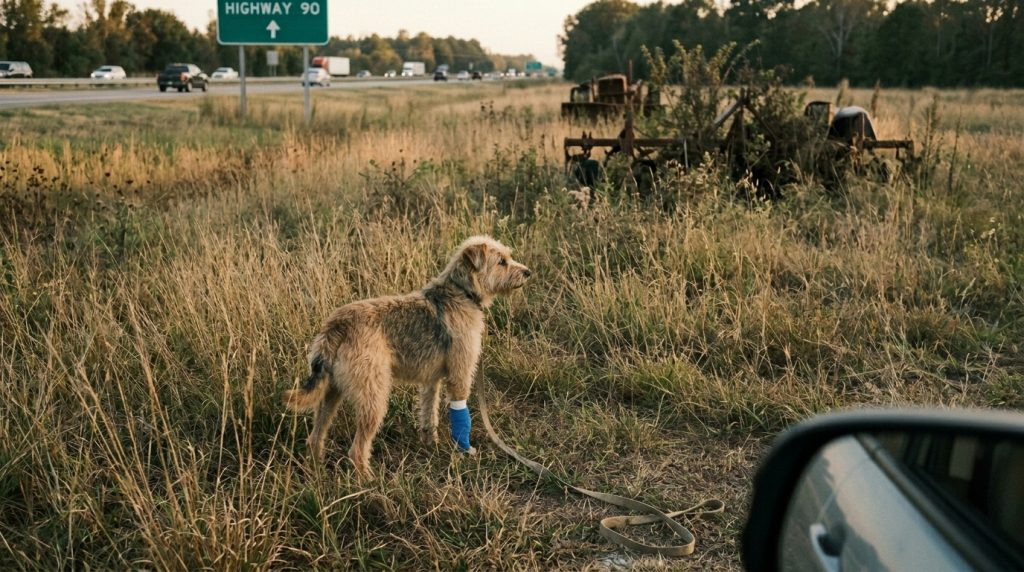
I’ve been an animal control officer in rural Montana for twelve years, but nothing could have prepared me for the chilling secret a dying stray led me to in the middle of nowhere.
It started on a freezing Tuesday afternoon in late November.
The sky was the color of bruised iron, and the wind cutting across Interstate 90 was sharp enough to slice right through my thick canvas work coat.
Dispatch had radioed in a code four: a stray dog creating a severe traffic hazard near mile marker 112.
Callers reported a large, dark-colored dog darting in and out of the eastbound lanes, narrowly avoiding getting crushed by the massive logging trucks that blow through that stretch of the highway.
When I pulled my county truck onto the gravel shoulder, the scene was pure chaos.
A massive eighteen-wheeler blared its horn, the sound vibrating in my chest, as the driver slammed on his brakes.
Tires squealed, leaving thick black streaks on the pavement.
Through the cloud of exhaust and brake dust, I saw him.
It was a German Shepherd mix, completely emaciated, his coat matted with mud, burrs, and what looked like dried blood.
He was standing right on the white line dividing the shoulder from the slow lane.
But he wasn’t running away from the traffic.
He was facing it.
Every time a car or truck roared past, he would lunge forward, barking wildly, snapping his jaws at the metal tires as if he were trying to physically fight the vehicles.
It was a suicide mission.
I grabbed my heavy leather gloves and my catch-pole from the back of the truck.
Usually, when you approach a stray on a busy highway, their flight response kicks in. They either bolt into the woods, or they freeze in terror.
This dog did neither.
As I slowly approached him, keeping my posture low and unthreatening, he barely even looked at me.
His eyes were locked completely on the other side of the highway.
Specifically, he was staring across the asphalt toward a massive, sprawling expanse of overgrown, dead grass—an abandoned agricultural field that hadn’t been farmed in decades.
“Hey buddy,” I called out softly, shaking a bag of beef treats I kept in my pocket. “Come here. Let’s get you out of the road.”
He ignored the food completely.
For a starving dog, that is a massive red flag. It means their brain is completely hijacked by something far more overpowering than basic survival instincts.
I inched closer. I could see the awful shape he was in.
His back right leg was trembling, bearing no weight. His paws were torn and bleeding, leaving perfect, bloody little paw prints on the freezing white line.
There was a nasty, jagged laceration across his left shoulder. It looked like he had already been clipped by a car.
But what haunted me the most were his eyes.
They weren’t wild with rabies. They weren’t clouded with the aggression of a feral animal.
They were desperate. Pure, unadulterated panic.
He let out a sharp, high-pitched whine that sounded almost human, turning his head to look at me for the first time.
It wasn’t a warning growl. It was a plea.
I finally managed to slip the loop of the catch-pole over his thick neck.
The moment the rope tightened, the fight left his body. His legs buckled, and he collapsed onto the cold pavement, utterly exhausted.
I had to physically lift his sixty-pound, bone-thin body into the transport cage in the back of my truck. He didn’t snap, he didn’t struggle.
But as I closed the metal cage door, he pressed his bloody snout against the steel mesh, staring intensely out the back window.
Staring directly at that empty, dead field across the highway.
I drove him straight to Dr. Evans at the county veterinary clinic.
When we got him on the stainless steel examination table, the reality of his condition became horrifyingly clear.
“He’s been out there for weeks, Dave,” Dr. Evans muttered, gently probing the dog’s ribs.
“He’s severely dehydrated, malnourished, and he’s got a fractured hind tibia. But look at this…”
Dr. Evans pointed to the dog’s paws. The pads were completely shredded, the claws worn down to the sensitive quick.
“He didn’t get these injuries from just wandering around,” the vet said, his voice dropping to a serious whisper. “He’s been digging. Frantically. For a very, very long time.”
We bandaged his wounds, gave him a heavy dose of antibiotics and painkillers, and set him up in the warmest, quietest run at the county shelter.
I filled his bowl with premium wet food and warm broth.
He didn’t touch it.
He just limped to the corner of the chain-link enclosure, faced the wall—which pointed directly east, toward the highway—and began to howl.
I have worked with dogs my entire adult life. I have heard every sound a canine can make.
But I had never heard a sound like this.
It was a deep, guttural wail that vibrated in the concrete walls of the shelter. It was the sound of complete, absolute heartbreak.
I finally left the shelter around midnight, completely exhausted, but I couldn’t get the sound of that howl out of my head.
I barely slept. I kept seeing those desperate, pleading eyes in the dark.
I got back to the shelter at 6:00 AM the next morning, carrying a fresh rotisserie chicken, hoping the smell would finally tempt him to eat.
When I walked into the kennel block, my heart stopped.
Run number four was completely empty.
I dropped the chicken on the floor and ran to the enclosure.
The heavy-duty chain-link fence at the back of the run had been torn apart.
Thick steel wire, meant to hold aggressive pit bulls and feral dogs, was bent and snapped.
There was fresh blood smeared all over the twisted metal.
He had literally chewed and torn his way through steel wire, shredding his own mouth in the process, ignoring a freshly broken leg, just to get out.
No dog does that. Not just to escape.
They only do that if they are trying to get back to something.
A cold spike of adrenaline hit my chest. I knew exactly where he went.
I sprinted to my truck, hit the lights and sirens, and drove like a madman back toward Interstate 90.
My mind was racing. Was it puppies? Did he have a litter stashed out there in the freezing cold?
But a male dog rarely destroys himself to get back to puppies. The maternal instinct isn’t there. This was something else entirely.
I pulled up to mile marker 112. The highway was quiet in the early morning light.
I parked the truck on the shoulder, grabbed my heavy flashlight and my radio, and stepped out into the freezing wind.
I didn’t look at the road. I looked directly at the overgrown, abandoned field across the asphalt.
The grass was waist-high, dead and yellow.
I started pushing my way through the thick brush, the dry weeds scraping against my jeans.
“Hey!” I yelled, my voice swallowed by the wind.
I walked for maybe two hundred yards, the terrain getting rougher, filled with hidden dips and rusted, forgotten farming equipment.
Then, I saw it.
About fifty yards ahead of me, standing perfectly still in a small clearing of flattened grass.
It was the shepherd.
His bandages were torn off. His mouth was bleeding from the shelter fence. He was shivering violently in the freezing morning air.
He was standing over a massive, dark patch of overturned dirt.
As I approached, he didn’t run. He didn’t bark.
He just looked up at me, let out one single, quiet whimper, and then looked back down at the ground between his bloody paws.
I walked up slowly, my boots crunching on the dead leaves.
When I finally reached him, I looked down at what he had been guarding.
I looked down into the freshly dug dirt.
And all the air violently left my lungs.
CHAPTER 2: The Whispers in the Frozen Earth
The silence in that field was heavier than the cold. In rural Montana, you get used to the quiet—the kind of quiet that feels like the world is holding its breath before a blizzard—but this was different. This was the silence of a tomb.
I stood there, my breath hitching in my chest, looking down at the patch of earth the German Shepherd had been guarding. He hadn’t moved. He was leaning his weight on his three good legs, his body trembling so violently I thought his heart might give out right there. His eyes were fixed on the dirt, a low, rhythmic whine vibrating in his throat.
I’ve seen things in twelve years of animal control that would make most people quit on their first day. I’ve found dogs chained to porches in sub-zero temperatures, cats left in taped-up boxes, and once, a horse that had been forgotten in a trailer for a week. I thought I was hardened. I thought my “rescue skin” was thick enough to handle anything.
I was wrong.
Slowly, I knelt beside the dog. The Shepherd didn’t snap. He didn’t even flinch. He just shifted slightly, as if making room for me.
At first, it just looked like a mess of mud and dead roots. But then, my eyes adjusted to the grey morning light. There, sticking out of the dark, wet Montana soil, was a small piece of fabric. It was bright blue—the kind of synthetic, high-visibility blue you see on children’s winter jackets.
My heart didn’t just race; it hammered against my ribs like a trapped bird.
I reached out with a gloved hand, my fingers shaking. I brushed away a layer of clotted mud, then another. The more I cleared, the more the shape began to make sense. It wasn’t just a rag. It was a sleeve. And beneath that sleeve, there was something solid. Something that shouldn’t be under three feet of dirt in the middle of a forgotten agricultural field.
“Oh, God,” I whispered. The words came out as a puff of white vapor.
The Shepherd let out a sharp, urgent bark and began to dig again, his shredded paws throwing dirt into the air. He was screaming in his own way—a frantic, desperate sound that told me we were running out of time.
I didn’t wait for backup. I didn’t wait for the Sheriff. I dropped to my knees and started digging with my bare hands.
The ground was partially frozen, the top layer like concrete. Every time I pulled back a handful of soil, the sharp edges of rocks and frozen roots sliced into my skin, but I didn’t feel it. The adrenaline was a cold fire in my veins.
“I’m here! Is anyone there?” I shouted, my voice cracking.
I dug until my fingernails were bleeding, until my shoulders screamed in protest. About a foot down, my hand hit something hard and flat. It wasn’t stone. It was wood.
It looked like an old cellar door or a piece of plywood that had been buried long ago. I cleared the edges, finding a rusted metal handle. With a primal grunt, I hauled upward. The wood groaned, the sound of snapping roots echoing through the empty field.
The Shepherd backed up, his ears pinned, let out a long, haunting howl that seemed to pierce the very sky.
The door came flying back, hitting the grass with a heavy thud. Below it wasn’t just more dirt. It was a hole—a narrow, hand-dug shaft that led into a small, hollowed-out space beneath the earth.
I clicked on my heavy-duty Maglite and shone the beam into the dark.
The light cut through the gloom, revealing a space no larger than a dog crate. It was lined with old blankets and scraps of cardboard. And there, curled into a tiny ball in the corner, was the source of the blue fabric.
It was a boy. He couldn’t have been more than six or seven years old.
His face was as white as the Montana snow, his eyes closed, his lashes frosted with ice. He was so still—so impossibly still—that for a second, I thought I was too late. I thought the Shepherd had led me to a grave.
“Hey! Buddy! Can you hear me?” I lunged into the hole, reaching for him.
His skin was like marble—dangerously cold to the touch. He was in the deep stages of hypothermia. But as I pulled him toward my chest, wrapping him in my heavy canvas coat, I felt it. A tiny, fluttering thud.
A heartbeat. Faint, erratic, but it was there.
I scrambled out of the hole, clutching the boy to my chest as if he were made of glass. The Shepherd was all over us, licking the boy’s pale face, whining with a frantic intensity that I now realized was pure, paternal love.
I fumbled for the radio on my shoulder, my fingers nearly useless from the cold.
“Dispatch, this is Unit 14! I need an ambulance and Life Flight at mile marker 112 immediately! I have a juvenile male, unresponsive, severe hypothermia. I repeat, this is a Search and Rescue recovery in progress!”
The radio crackled to life. “Copy, Unit 14. Did you say recovery? We don’t have any missing children reported in that sector.”
“I don’t care what’s reported!” I roared into the mic, my voice shaking with rage and relief. “He’s here! He’s alive! Just get the paramedics here now!”
I carried the boy back toward the truck, my boots sinking into the mud. Every step was a struggle, but the Shepherd stayed right at my heels, limping on his broken leg, never taking his eyes off the child.
I got to the truck, cranked the heat to its maximum setting, and laid the boy across the front seat. I stripped off his wet, frozen jacket and wrapped him in the emergency space blankets I kept in the back.
As I worked, I looked out the window. The Shepherd was standing by the passenger door, his head slumped against the glass, his body finally giving up. He had done it. He had stayed on that highway, risking his life against eighteen-wheelers, barking at the world, trying to find someone—anyone—who would listen to the secret hidden in the dirt.
He hadn’t been fighting the cars. He had been trying to stop them.
Ten minutes later, the horizon was filled with the flickering red and blue lights of the Montana State Patrol and the local EMS. The silence of the field was shattered by the roar of engines and the heavy thump-thump-thump of a medical helicopter descending from the clouds.
The paramedics swarmed the truck, taking the boy from my arms. They worked with a clinical, frantic speed, sticking IVs into his tiny arms and covering him with heated pads.
“Who is he, Dave?” Sheriff Miller asked, stepping up beside me. He looked at the hole in the field, then back at the dog, who was now lying in the grass, being tended to by a second vet team I’d called in.
“I don’t know,” I said, wiping the mud and blood from my face. “But he was down there. Someone put him there, Miller. That plywood was covered with dirt and brush. It wasn’t an accident.”
The Sheriff’s face hardened. He looked out over the vast, empty field. “This land belongs to the old Miller estate. It’s been in probate for five years. Nobody should be out here.”
As they loaded the boy into the helicopter, he stirred for a split second. His eyes fluttered open—dark, hollow pools of trauma. He didn’t look at the paramedics. He didn’t look at me.
He looked toward the grass, where the Shepherd was being lifted into a transport stretcher.
“Cooper…” the boy whispered. It was barely a sound, more of a breath.
Then his eyes closed again.
“The dog’s name is Cooper,” I whispered to myself.
But as the helicopter took off, kicking up a storm of dead grass and dust, a sickening thought hit me.
If the dog had been on the highway for weeks, and the boy was buried in that hole… how was the boy still alive? Who had been feeding him?
I looked back at the hole I had uncovered. Now that the sun was higher, I could see something I hadn’t noticed before.
Scattered around the edge of the plywood were several empty cans of cheap dog food. They hadn’t been opened with a can opener. They had been ripped open by teeth.
My blood ran cold.
The dog hadn’t just found the boy. He had been stealing food, dragging it to the field, and tearing the metal apart with his own mouth to drop the contents down to the child. The injuries on his mouth, the shredded paws—it wasn’t just from digging. It was from a weeks-long battle to keep that boy from starving to death.
But there was one more thing.
I walked back to the hole, my heart sinking. Near the blankets where the boy had been lying, I saw a small, handheld digital camera. It was half-buried in the cardboard.
I picked it up, wiped the screen, and hit the ‘Play’ button.
The video that flickered to life made me want to scream. It wasn’t a video of a child playing.
It was a man’s voice, low and distorted, filming the boy in the hole.
“Say goodbye to the world, Toby,” the voice whispered. “Because no one is coming. Not for you. Not ever.”
Then, the camera panned up, and for one brief, terrifying second, the man caught his own reflection in the lens.
I froze. I knew that face.
It was the one person in town who was currently standing right behind me, helping the Sheriff tape off the crime scene.
My hand went to my holster, but I realized too late—I was an animal control officer. I didn’t carry a sidearm.
And the man with the voice from the video had just noticed what I was holding in my hand.
He started walking toward me, a hunting knife glinting in the pale morning sun.
“Found something interesting, Dave?” he asked, his voice devoid of any emotion.
The nightmare was only beginning.
CHAPTER 3: The Predator in the Uniform
The cold of the Montana morning was nothing compared to the ice that flooded my veins when I recognized the voice on that digital screen.
I’ve lived in this county my whole life. I know the names of every ranch hand, every waitress at the diner, and every deputy who patrols these desolate stretches of asphalt. The voice on the camera—low, cold, and dripping with a terrifying kind of casual cruelty—belonged to Mark Vance.
Mark wasn’t just some guy. He was a volunteer firefighter, a member of the local search and rescue team, and a man I had shared a dozen thermos-sized coffees with during long winter nights on the highway. He was currently standing twenty feet behind me, helping Sheriff Miller stretch the yellow crime scene tape across the frost-bitten grass.
The realization felt like a physical blow to the stomach.
I kept my back to him, my hand trembling as I clutched the small camera. The screen had gone dark, but the image of Mark’s face, caught in the accidental reflection of the lens, was burned into my retinas.
I understood it all now.
Why the dog had been so desperate. Why he had been fighting the trucks. He wasn’t just trying to save the boy; he was trying to protect him from the very people who were supposed to be the “heroes.”
“Dave?”
The voice was close. Too close.
I didn’t turn around immediately. I shoved the camera deep into the inner pocket of my heavy canvas coat, fumbling with the zipper. My heart was a frantic drum in my ears, drowning out the receding thump of the medical helicopter that was carrying Toby away to safety.
“Dave, you okay? You look like you’ve seen a ghost, buddy.”
I forced my muscles to unlock. I took a breath of the biting air, trying to steady my voice. I had to be an actor. My life, and the secret of what really happened to Toby, depended on it.
I turned around slowly. Mark Vance was standing there, his hands tucked into his tactical vest, a look of faux-concern etched into his weathered face. He looked exactly like the man I’d known for a decade. But now, all I could see was the monster in the video.
“Just… the cold, Mark,” I said, wiping a smear of mud across my forehead to hide the sweat breaking out despite the freezing temperature. “And the shock. I didn’t think we’d find him alive.”
Mark nodded, his eyes scanning the ground around my feet. He was looking for the camera. He knew he’d dropped it. He knew it was down in that hole with the boy.
“Yeah, it’s a miracle,” Mark said. His voice was flat. “The Sheriff wants a full statement. He’s over by the cruiser. Why don’t you head over there? I’ll finish up here. I’ll make sure the site is secure.”
He took a step toward me. A single, predatory step.
I looked past him toward Sheriff Miller. The Sheriff was busy on his radio, his back turned to us. The paramedics were gone. It was just us, the wind, and the dead silence of the field.
“I think I’ll stay for a second,” I said, my hand instinctively moving toward the heavy flashlight on my belt. It was the only weapon I had. “I want to check on the dog one more time before they transport him.”
Mark’s eyes shifted to the transport stretcher where Cooper lay. The dog was sedated now, his breathing shallow.
“Dog’s fine, Dave. He’s just a mutt. Focus on the kid,” Mark said. He was closer now. I could smell the scent of stale tobacco and gun oil on him. “You find anything else down there? In the hole? Any… personal effects? Evidence?”
The question was a trap. If I said yes, he’d kill me right here.ếu I said no, he’d know I was lying.
“Just some old blankets,” I lied, my voice remarkably steady. “And the dog food cans. Whoever did this… they were feeding him. It’s sick.”
Mark tilted his head. For a heartbeat, I thought he believed me. Then, his gaze drifted to my coat pocket. The zipper wasn’t closed all the way. A tiny corner of the camera’s wrist strap was poking out.
The temperature seemed to drop another twenty degrees.
“You always were a shitty liar, Dave,” Mark whispered.
The transition was instantaneous. The “friendly neighbor” mask dissolved, replaced by the cold, hollow-eyed killer from the video. He didn’t reach for his gun—that would be too loud. He reached for the long, serrated hunting knife at his hip.
“Give me the camera,” he said. It wasn’t a request.
“Why, Mark? He’s a child. Toby is just a kid. What could he possibly have done to deserve being buried alive?”
Mark chuckled, a dry, rasping sound. “It’s not about what he did, Dave. It’s about who he is. That boy is the only thing standing between me and the Miller estate. Five million dollars in timber and land rights, and it was all going to a ‘lost’ nephew because some old man had a guilty conscience? I don’t think so.”
“You’re going to kill me in front of the Sheriff?” I asked, glancing desperately toward Miller, who was still sixty yards away, obscured by the tall grass and his own patrol vehicle.
“In this wind? With this terrain? You tripped, Dave. You fell into one of the old irrigation ruts and hit your head on a rock. Tragic accident. Just another victim of the Montana winter.”
He lunged.
I wasn’t a fighter. I was an animal control officer. I dealt with angry pit bulls and frightened deer. But there is a certain kind of instinct you develop when you spend your life handling unpredictable predators.
I swung my heavy Maglite with everything I had.
The heavy metal casing connected with Mark’s forearm with a sickening crack. He let out a grunt of pain, the knife slipping from his fingers, but he didn’t stop. He tackled me, his weight slamming me back into the frozen mud.
We rolled through the dead weeds, gasping for air. Mark was stronger, fueled by a desperate kind of greed. His hands found my throat, his thumbs digging into my windpipe.
“Give… me… it!” he hissed, his face inches from mine.
I couldn’t breathe. Black spots danced in my vision. I reached out, my fingers clawing at the dirt, searching for anything—a rock, a branch, a miracle.
And then, I heard it.
A sound that shouldn’t have been possible.
A low, guttural snarl that sounded like it came from the bowels of the earth itself.
Through the haze of my fading consciousness, I saw a blur of matted fur and blood-soaked bandages.
Cooper.
The dog should have been unconscious. The vet had given him enough sedatives to put down a grizzly. But the bond between that dog and the boy—and the man who had saved them both—was stronger than any drug.
Cooper didn’t jump. He couldn’t. His back leg was shattered.
Instead, he dragged himself forward, his front paws churning the mud, and sank his teeth into Mark’s calf with a ferocity that made my blood cold.
Mark screamed, his grip on my throat loosening as he was jerked backward. He tried to kick the dog away, his heavy boot thudding into Cooper’s ribs, but the Shepherd wouldn’t let go. He was a lock, a living trap of bone and fury.
“Get off me! You filthy animal!” Mark shrieked, reaching for his pistol.
I scrambled to my feet, my lungs burning as I sucked in the freezing air. “Miller! Help! Miller!”
The Sheriff finally looked up. He saw the struggle in the tall grass. He saw his deputy with a gun drawn on a bleeding animal control officer and a crippled dog.
“Vance! Drop it! Drop it now!” Miller shouted, his own service weapon clearing his holster in a blur of motion.
Mark froze. He looked at the Sheriff, then at me, then at the dog still clamped onto his leg. For a second, I thought he was going to pull the trigger. I thought he was going to take us all down with him.
But the light of the morning was finally hitting the field, exposing everything. The helicopter was a dot in the sky, carrying the evidence—the boy—to a place where Mark could never reach him.
Mark slumped, the gun slipping from his hand. Cooper finally let go, collapsing into the mud, his chest heaving with the final remnants of his strength.
Sheriff Miller ran forward, his face a mask of confusion and growing horror. “Dave, what the hell is going on? Why is Vance—”
I didn’t say a word. I just reached into my pocket, pulled out the camera, and handed it to the Sheriff.
“Watch the video, Miller,” I whispered, my voice raw and broken. “Watch what your ‘best deputy’ did to that little boy.”
As Miller watched the screen, his face turning a ghostly shade of grey, I knelt in the dirt beside Cooper.
The dog looked at me, his amber eyes dimming. I placed my hand on his head, feeling the warmth of his fur against the biting cold.
“You did it, buddy,” I whispered. “You saved him. You saved us both.”
But as the handcuffs clicked shut on Mark Vance’s wrists, and the sirens began to wail in the distance, I looked back at the hole in the ground.
Something was bothering me.
Mark had said he was the only one. He said he did it for the estate.
But as I looked at the muddy footprints leading away from the hole—footprints I hadn’t noticed before—I realized they were too small to be Mark’s. And they didn’t belong to the boy.
There had been someone else in that field.
Someone who was still out there.
CHAPTER 4: The Silent Guardian in the Shadows
The hospital hallway smelled of industrial-strength bleach and stale coffee, a scent that always seemed to cling to the worst days of my life. I sat on a hard plastic chair, my hands scrubbed raw but still feeling the phantom grit of the Montana soil beneath my fingernails.
Outside the window, the sun was finally beginning to dip toward the jagged peaks of the Bitterroot Range, painting the sky in bruises of purple and orange. It had been ten hours since I pulled Toby out of that hole. Ten hours since my world shifted on its axis.
Sheriff Miller walked toward me, his heavy boots echoing like gunshots on the linoleum. He looked older than he had this morning. The betrayal of a deputy—of a friend—takes a piece out of a man that you can’t ever really put back.
“He’s stable, Dave,” Miller said, sliding into the chair next to me. “The doctors say another hour in that hole and his heart would have just… stopped. But he’s a fighter. He’s been asking for the dog.”
I let out a breath I felt like I’d been holding since mile marker 112. “And Vance?”
Miller’s jaw tightened. “He’s in a holding cell in the next county over. I couldn’t keep him here. My boys wanted his head on a stake. He hasn’t said a word, but he doesn’t have to. That camera you found? It’s a roadmap to a life sentence. But there’s a problem.”
I looked at him, the hair on the back of my neck standing up. “The footprints.”
Miller nodded slowly. “The forensics team did a sweep before the snow started coming down hard. You were right. There were two sets of tracks near that plywood cover. One set was Vance’s size twelves. The other set… size seven. Narrow. A woman’s boot, maybe, or a teenager’s. And they weren’t just standing there. They were pacing. Someone was watching that hole, Dave. Someone was there when Vance wasn’t.”
I thought back to the empty dog food cans I’d found. Cooper was a smart dog, a hero dog, but he didn’t have thumbs. He could rip a can open, sure, but someone had to bring those cans to the field. Someone had to be the source of the food Cooper was dragging to that hole.
“Where are you going, Dave?” Miller asked as I stood up.
“Back to the shelter,” I lied. “I need to check on Cooper.”
But I wasn’t going to the shelter. Not yet.
I drove my truck back out to the highway. The wind had picked up, swirling the fresh snow into white ghosts that danced across the asphalt. I parked at mile marker 112, but I didn’t head for the hole. Instead, I followed the line of the old fence, moving toward the dense cluster of pine trees that bordered the Miller estate.
If someone was watching Toby, they weren’t living in the hole. They were watching from the treeline.
I pushed through the snow-laden branches, my flashlight beam cutting through the gathering gloom. The forest was silent, the kind of silence that feels like a physical weight. I moved slowly, looking for anything that didn’t belong—a broken twig, a disturbed patch of snow, the glint of a candy wrapper.
About half a mile in, I found it.
A small, dilapidated line-shack, the kind used by ranchers fifty years ago to escape the wind. It was half-buried in a drift, its wooden siding grey and rotting. But there was smoke—just a thin, wispy trail of it—curling out of the rusted stovepipe.
I didn’t call for backup. I didn’t have a radio. I just had my heavy Maglite and the memory of Toby’s pale, frozen face.
I stepped onto the porch, the wood groaning under my boots. I didn’t knock. I shoved the door open.
The heat hit me first, followed by the smell of woodsmoke and wet wool. Sitting on a crate in the corner, huddled over a small pot of beans, was a woman. She looked like she was in her early thirties, but her face was etched with a lifetime of fear. Her clothes were rags, and her eyes—wide and wild—reminded me exactly of Cooper’s when I first saw him on the highway.
“Don’t hurt me,” she whispered, her voice like dry leaves. “Please. I didn’t let him die. I gave the dog the food. I made sure he had the blankets.”
I lowered my flashlight, the light reflecting off the tears streaming down her face. “You’re Sarah,” I said.
I remembered the name now. Sarah Vance. Mark’s sister. The “black sheep” of the family who had supposedly moved to Seattle years ago and was never heard from again.
“He told me if I told anyone, he’d put me in the hole with the boy,” she sobbed, her body racking with tremors. “He’s been keeping me here for months. He said the boy was a mistake, a loose end for the inheritance. I couldn’t stop him, Dave. Mark… he’s not human. He’s something else.”
She told me everything. How Mark had kidnapped Toby from a playground three counties away, planning to let the winter take him so it would look like a tragic accident once the “body” was eventually found. But Sarah had seen the dog. Cooper had been a stray hanging around the woods, and Sarah had started feeding him.
When Mark put Toby in the hole, Sarah realized the dog was the only way she could help without Mark finding out. She knew Mark watched her every move, but he ignored the “mangy mutt.” She would leave the dog food cans near the shack, and Cooper would take them. She would sneak out at night, while Mark was on shift at the Sheriff’s office, to drop extra blankets and scraps of meat down to the boy.
“I’m the one who called you,” she said, looking up at me. “I used a burner phone I stole from Mark’s truck. I knew if I called the Sheriff’s office, Mark would intercept the call. But you… everyone knows you’re the guy who doesn’t give up on the lost ones.”
I looked at this broken woman, living in a shack in the middle of a Montana winter, risking her life against her own brother to keep a child alive through the proxy of a dog.
“You saved him, Sarah,” I said, stepping forward and wrapping my coat around her shoulders. “You and Cooper. You’re the reason he’s breathing right now.”
I called Miller. The sirens returned to the woods, but this time, they weren’t for a predator. They were for a witness.
Two Months Later
The Montana spring was finally beginning to show its face. The ice on the rivers was breaking up with the sound of distant thunder, and the first green shoots were pushing through the mud of the Miller estate—now a protected wildlife sanctuary, per the boy’s legal guardianship.
I stood on the porch of my small farmhouse, watching a sight that the doctors had said might never happen.
Toby was running through the yard, his cheeks flushed with color, his laughter ringing out across the valley. He wasn’t alone.
Lumping along beside him, his gait a bit uneven but his tail wagging like a metronome, was Cooper. The dog’s leg had healed, though he’d always have a bit of a hitch in his step—a permanent badge of honor from the day he fought a monster.
Sarah was there, too, sitting on the porch swing. She was working at the local library now, her eyes finally losing that haunted look. We didn’t talk about the hole much. We didn’t have to.
Toby stopped running and dropped to the grass, burying his face in Cooper’s thick neck. The dog licked the boy’s ear, a low, happy rumble in his chest.
I’ve been an animal control officer for twelve years. I’ve seen the worst that humans can do to the creatures who love them most. I’ve seen the cruelty, the neglect, and the cold indifference of the world.
But as I watched that boy and his dog, I realized something.
The world is a cold place, and the shadows are long. But as long as there are those who refuse to look away—those who will chew through steel and stand against the wind to protect the innocent—the light will always find a way back in.
Cooper looked up then, his amber eyes meeting mine. He didn’t bark. He just let out a small, contented sigh and rested his head on Toby’s shoulder.
He was home. They both were.