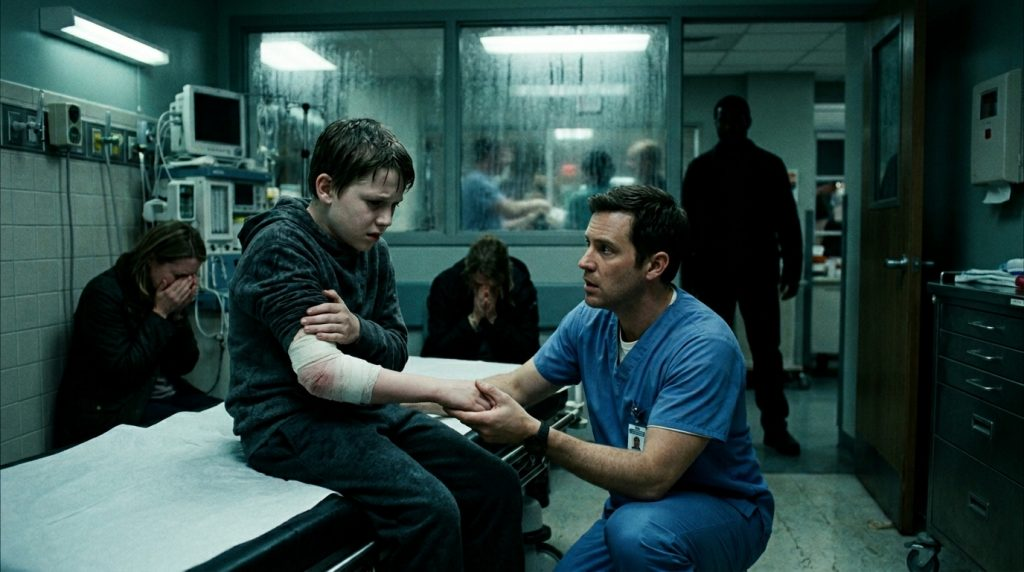
I’ve been an attending physician in the emergency room for exactly twenty-two years.
If you work in emergency medicine long enough, you develop a sixth sense.
You learn to smell trauma before it even rolls through the double doors.
You learn to read the micro-expressions of parents when they hand over their children.
You learn to tell the difference between a mother who is terrified for her child, and a mother who is terrified of something else entirely.
It was 3:14 AM on a relentless, pouring Tuesday.
The ER was running on fumes and stale coffee.
Most of the beds in the pediatric wing were empty, save for a toddler with a mild fever and a teenager sleeping off a bad reaction to some party drugs.
I was sitting at the charting station, rubbing my temples, trying to ignore the pulsing headache behind my eyes.
That’s when the automatic doors slid open with a heavy swoosh.
The cold rain blew into the waiting room, bringing with it the smell of wet asphalt and sheer panic.
A woman rushed in.
She was dripping wet, her blonde hair plastered to her skull, her trench coat hastily buttoned over pajamas.
But it wasn’t her that caught my attention.
It was the boy she was dragging behind her.
He looked to be about eleven years old.
He was incredibly small for his age, pale, with dark circles under his eyes that suggested he hadn’t slept in a week.
He was wearing an oversized gray hoodie, soaked through with rain.
His right hand was tightly gripping his left arm, holding it flat against his chest like a wounded bird.
“Help,” the mother gasped, her voice cracking. “He fell. He fell off his bike. His arm.”
I stood up immediately.
My charge nurse, Brenda, was already rounding the counter with a wheelchair.
“Let’s get him into Trauma Room 3,” I said, my voice steady, shifting instantly into professional mode.
But the boy didn’t move.
He planted his sneakers firmly on the linoleum floor.
He refused to sit in the wheelchair.
He just stared at the floor, his jaw clenched tight.
“Come on, sweetheart,” the mother pleaded, her voice high-pitched, almost hysterical. “The doctor needs to look at it.”
She reached out to guide him, but the moment her fingers brushed his left shoulder, he violently jerked away.
He didn’t scream. He didn’t cry.
He just let out this low, animalistic whimper that sent a chill straight down my spine.
“Okay, okay,” I intervened, holding my hands up. “No wheelchair. You can walk. Follow me, buddy.”
He hesitated, his eyes darting frantically toward the glass doors leading back out to the parking lot.
It was a look I recognized instantly.
It wasn’t the look of a child in pain.
It was the look of a hostage looking for an escape route.
I led them into Room 3, pulling the curtain shut to give them some privacy.
The fluorescent lights in here were harsh, illuminating every detail.
“I’m Dr. Evans,” I said, pulling up a stool so I was at eye level with the boy. “What’s your name?”
He didn’t answer.
He just kept his chin tucked into his chest, clutching that left arm.
“His name is Leo,” the mother answered quickly. Too quickly.
“Okay, Leo,” I said softly. “Your mom says you had a wipeout on your bike. In the rain?”
I glanced at the mother.
Who rides a bike at three in the morning in a torrential downpour?
The mother refused to meet my gaze. She was staring at her own hands, wringing them together so hard her knuckles were white.
“It was earlier,” she stammered. “He fell earlier this evening. But it just kept swelling. And the pain got worse.”
I nodded, keeping my expression neutral.
In my line of work, people lie. They lie because they are embarrassed, they lie because they are scared, and sometimes, they lie because they are trying to stay alive.
My job isn’t to be a detective right away. My job is to fix the immediate damage.
“Alright, Leo,” I murmured. “I need to take a look at that arm. I promise I won’t do anything without telling you first. Can we take the hoodie off?”
Leo shook his head violently.
“Leo, please,” his mother whispered, tears finally spilling over her eyelashes. “Just let him look.”
Slowly, agonizingly, Leo reached up with his good hand and grabbed the hem of the wet hoodie.
He pulled it over his head, wincing in obvious agony as the fabric dragged over his left elbow.
Underneath, he was wearing a thin, white t-shirt.
The left sleeve was pushed up, revealing the injury.
I leaned in, my brow furrowing.
The elbow was massively swollen.
It was easily three times its normal size, the skin stretched taut and shiny.
It was angry, violently red, with deep purple bruising spreading down his forearm and up toward his bicep.
It looked hot, infected, and incredibly painful.
But that wasn’t what made my heart skip a beat.
Swelling from a broken bone usually follows a predictable pattern. It pools, it spreads, it turns a specific color.
This swelling was completely wrong.
Right in the center of the inflammation, the skin was pushed upward in a very distinct, sharp ridge.
It didn’t look like a bone protruding from a compound fracture. A broken bone under the skin usually looks jagged, irregular.
This shape was perfectly geometric.
It was a hard, distinct rectangle, pushing desperately against the underside of the boy’s thin skin.
I stared at it for a long second.
The ER suddenly felt very quiet. I could hear the rain lashing against the frosted window above the sink.
“When did you say this happened?” I asked the mother, my voice dangerously calm.
“A-around six o’clock,” she choked out.
Impossible.
An impact injury wouldn’t create a localized mass like this in nine hours. And it certainly wouldn’t create a shape with right angles.
“Leo,” I said, shifting my gaze back to the boy. “I need to touch it. Just gently. Just with two fingers.”
He locked eyes with me for the first time.
His eyes were an intense, icy blue, and they were filled with a terror so profound it made my own chest ache.
He didn’t say a word, but he gave a minuscule nod.
I put on a pair of latex gloves.
The snap of the rubber echoed in the small room.
I reached out, my fingers hovering over the angry, red skin.
I could feel the heat radiating off his arm from an inch away. It was a massive localized infection.
Gently, applying barely an ounce of pressure, I placed my index and middle finger directly over the rectangular bulge.
Leo gasped, his whole body going rigid, kicking his legs out in pure agony.
But I didn’t pull my hand back.
My brain was trying to process what my nerve endings were telling me.
Underneath the hot, inflamed tissue, there was no shattered cartilage. There was no splintered bone.
It was solid.
It was utterly unyielding.
It was colder than the surrounding tissue.
And as I ran my gloved fingertip along the edge of the lump, I felt a distinct, perfectly straight edge.
Metal.
There was a piece of solid metal embedded deep inside this eleven-year-old boy’s arm.
And based on the scar tissue and the severity of the infection, it hadn’t happened at six o’clock tonight.
It had been there for days. Maybe weeks.
I pulled my hand back as if I had been burned.
I looked at the mother.
She was completely pale now, her eyes wide, staring at the door again. She looked like a woman waiting for an executioner.
“Mrs…” I trailed off, realizing I didn’t even have her last name.
“Sarah,” she whispered.
“Sarah,” I said, keeping my voice low. “There is a foreign object inside your son’s arm. It’s not a bone. It’s solid. It feels like metal.”
Sarah clamped a hand over her mouth, a sob tearing through her throat. She stumbled backward, hitting the wall and sliding down until she was crouching on the floor, rocking back and forth.
“I didn’t know,” she sobbed into her knees. “I swear to God, I didn’t know he actually did it.”
“Did what?” I demanded, the adrenaline finally hitting my bloodstream.
I looked back at Leo.
The boy was no longer crying. He was staring at me with a terrifyingly calm expression.
He leaned forward, his face inches from mine.
And in a voice that was far too deep, far too serious for a child his age, he whispered five words that changed the rest of my life.
“You can’t take it out.”
“Leo, whatever is in there is causing a massive infection. If we don’t remove it, you could lose this arm. Or worse. The infection is spreading to your blood.”
He shook his head slowly, deliberately.
“If you take it out,” Leo whispered, his eyes darting toward his weeping mother on the floor, “he will find us. And he will kill her.”
My blood ran completely cold.
I stood up slowly, stepping back from the examination bed.
My mind was racing through the protocols. Child protective services. Police intervention. Lockdown procedures.
I turned to the sink to strip off my gloves.
As I ripped the latex from my hands, a loud crash echoed from the main waiting room.
It sounded like a heavy chair being thrown through the glass partition at the front desk.
Then came a voice.
It was a man’s voice, booming, furious, and terrifyingly close.
“Where is he?! Where is my son?!”
Sarah let out a blood-curdling scream from the floor.
Leo didn’t flinch. He just looked at me, his icy blue eyes completely dead, and pulled his hoodie back down over his infected arm.
“He’s here,” Leo whispered.
CHAPTER 2
The sound of shattering glass in the waiting room was still ringing in my ears when instinct completely took over.
Twenty-two years in the ER teaches you that when violence erupts, it moves faster than you can think.
I lunged for the heavy wooden door of Trauma Room 3.
I slammed it shut and threw the deadbolt.
The loud, metallic click echoed in the small space, but it didn’t make me feel any safer.
Hospital doors are designed for privacy, not to withstand a battering ram.
“Move,” I barked at Sarah, abandoning my bedside manner entirely. “Get away from the door. Now.”
Sarah was paralyzed, huddled on the linoleum floor, her hands clamped over her ears.
She was shaking so violently I could hear her teeth chattering over the chaos outside.
I grabbed the heavy metal crash cart—loaded with defibrillators, oxygen tanks, and drawers of emergency meds—and shoved it hard against the door handle.
It wasn’t a perfect barricade, but it would buy us a few seconds.
Outside in the hallway, the shouting grew louder.
“I know she’s here! Her car is in the lot!”
It was a man’s voice. Deep, resonant, and entirely stripped of reason.
“Sir, you need to step back! Security is on the way!” That was Brenda, my charge nurse. Her voice trembled, and Brenda never trembled.
I spun around to look at my patient.
Leo hadn’t moved.
He was still sitting on the edge of the examination table, his gray hoodie pulled securely over his infected arm.
He wasn’t crying. He wasn’t shaking like his mother.
He was just staring at the door, his jaw locked tight, his icy blue eyes completely devoid of the panic a child should feel in this situation.
It was deeply, fundamentally unnatural.
“Leo,” I said, keeping my voice low. “Who is out there?”
“My dad,” he answered flatly.
“Why is he looking for you?”
Leo didn’t answer. He just looked down at his left arm.
I pulled my hospital radio from my belt and keyed the microphone. “Brenda. It’s Evans. I’m locked in Room 3 with the boy and the mother. What is his status?”
The radio crackled. Brenda’s voice came through, breathless and panicked.
“Dr. Evans… he’s at the nurse’s station. He’s demanding we hand over the boy.”
“Are the police on their way?”
“They’re three minutes out,” Brenda whispered over the radio. “But Evans… he’s showing us court papers. He says the mother is having a psychotic episode. He says she kidnapped the boy from his bedroom two hours ago.”
I froze.
The radio clicked off.
I looked down at Sarah.
She was still on the floor, her wet hair clinging to her pale face. She looked exactly like a woman having a mental break.
She was drenched, shivering in pajamas and a trench coat, and she had dragged her terrified son into an ER in the middle of a torrential storm.
Suddenly, the narrative shifted in my head.
What if she was the danger?
What if she had caused the injury to the boy’s arm?
Munchausen syndrome by proxy is a reality in pediatric medicine. Parents hurting their children for attention, or in the grips of a delusion.
“Sarah,” I said sharply. “Look at me.”
She slowly raised her head, her eyes wide and bloodshot.
“Your husband says you kidnapped Leo. He says he has custody.”
“He’s a liar!” Sarah shrieked, scrambling to her feet. “He’s a monster! He’ll kill us both, you don’t understand!”
“Then explain it to me!” I demanded. “Because right now, there’s a man out there with paperwork saying you’re a danger to this boy, and this boy has a piece of metal shoved inside his arm!”
“I didn’t do that!” she sobbed, backing into the far corner of the room. “I swear I didn’t do it!”
Bang. Bang. Bang.
Someone was hammering on the door of Room 3.
The heavy wood shuddered against the crash cart.
“Sarah! Open this door!”
The father’s voice was muffled by the wood, but the sheer rage in it was unmistakable.
“I know you’re in there! I saw the muddy footprints!”
I stepped back from the door, my heart hammering against my ribs.
“Sir,” I called out, trying to project a calm, authoritative doctor’s voice. “This is Dr. Evans. I am treating a patient in here. You need to step back and wait for hospital security.”
The banging stopped instantly.
For a terrifying five seconds, there was absolute silence on the other side of the door.
Then, the father’s voice changed.
The rage vanished. It was replaced by a smooth, desperate, almost tearful tone.
“Dr. Evans? Please. Oh, thank God. Please, you have to help me.”
I frowned, exchanging a quick glance with Sarah, who was shaking her head frantically, mouthing the word No.
“My wife is sick, Doctor,” the man pleaded through the door, his voice breaking perfectly. “She has severe paranoid schizophrenia. She hasn’t taken her medication in weeks.”
“Don’t listen to him,” Sarah whispered, digging her fingernails into her own arms.
“She took my son, Doctor,” the father continued, sounding like a heartbroken parent. “Leo has a severe blood infection. I was supposed to take him to a specialist in the morning. She took him out of his bed. Please, I just want my son safe.”
I looked at Leo.
A severe blood infection. The father knew about the arm.
He knew about the swelling.
“Doctor,” the father said, his voice dropping to a conspiratorial whisper. “Did she show you his arm? She did that to him. She thinks the government put a microchip in him. She’s been trying to dig it out.”
My blood ran absolutely cold.
I stared at Sarah.
Everything the man was saying fit the evidence perfectly.
The bizarre, metallic object under the skin.
The massive, localized infection.
The mother’s frantic, paranoid behavior.
The boy’s silent, traumatized demeanor.
It all pointed to a horrific case of child abuse driven by severe mental illness.
“Sarah,” I said slowly, stepping away from her and moving closer to Leo. “Did you put that thing in his arm?”
“No!” she screamed, dropping to her knees again. “I didn’t! He’s lying! He’s a police officer, he knows exactly what to say to make you believe him!”
A cop.
That explained how he tracked her so fast. It explained the booming voice of authority. It explained why he knew how to play the “concerned victim” role so flawlessly.
But it didn’t explain the metal.
“Leo,” I said, turning my back to the door and looking at the boy.
His face was flushed now. A fine sheen of sweat had broken out across his forehead.
The infection was moving fast.
“Leo, I need you to tell me the truth. Right now. Did your mom put that inside your arm?”
Leo looked at his mother.
Then he looked at me.
He shook his head.
“No,” Leo whispered. His voice was getting weak. “She didn’t do it.”
“Then who did?” I asked. “Did your dad do it?”
Leo hesitated. He looked at the heavy wooden door.
“No,” he said softly.
“Then how did a piece of metal get under your skin, Leo?” I pressed, my medical panic rising.
If this boy went into septic shock, I wouldn’t be able to stabilize him in a locked room without a surgical team.
Leo took a slow, rattling breath.
He reached over with his right hand and gently touched his swollen, purple left elbow.
“I did,” he whispered.
The room spun.
“You did?” I repeated, stunned. “You cut your own arm open?”
Leo nodded slowly. “With an X-Acto knife. From my art kit.”
“Why?” I asked, my voice barely a breath. “Why would you do that to yourself, buddy?”
Before he could answer, the boy swayed on the examination table.
His eyes rolled back in his head, and he collapsed sideways, hitting the metal rail of the bed with a sickening thud.
“Leo!” Sarah screamed, lunging forward.
I caught him before he slid off the table entirely.
His skin was burning up. He was a literal furnace.
I grabbed my stethoscope and pressed it to his chest. His heart rate was skyrocketing—over 140 beats per minute. His blood pressure was plummeting.
Sepsis.
The infection from the foreign object had entered his bloodstream. His body was shutting down to fight it.
“He’s crashing,” I yelled, pulling the crash cart away from the door and spinning it toward the bed.
I didn’t care about the barricade anymore. I had a dying child in front of me.
I ripped the hoodie off Leo entirely.
Red streaks were now visibly traveling up his shoulder, heading straight for his heart.
“Get away from the door!” I yelled at Sarah. “I need to open it! We need to get him to the ICU right now!”
“No!” Sarah shrieked, throwing her body against the heavy wooden door, blocking the handle. “If you open that door, he’ll kill us! He doesn’t want the boy, he wants what’s inside the boy!”
“He’s going to die if I don’t get that object out and pump him full of broad-spectrum IV antibiotics!” I roared back, grabbing a syringe of epinephrine from the cart.
“Then take it out here!” Sarah begged, tears streaming down her face, her back pressed hard against the wood. “Cut it out of him right now!”
“I am an ER doctor, not a surgeon!” I yelled. “I don’t know what it is! It could be wrapped around a nerve! It could be pressing on an artery! If I slice into that swelling blind, he could bleed out in three minutes!”
“Do it anyway!” she screamed. “If my husband gets in here, we’re all dead!”
Suddenly, the handle of the door jerked violently.
Sarah screamed and pushed back against it.
“Sarah!” the father’s voice boomed from the other side, the rational facade completely gone. The rage was back, hotter and more violent than before. “Open the goddamn door!”
He threw his shoulder against the wood.
The entire frame groaned. The hinges cracked loudly.
He was a big man, and the door wasn’t going to hold for long.
“Police are in the lobby!” my radio suddenly blared. It was Brenda. “They’re coming down the hall!”
“Officer!” the father yelled in the hallway. “In here! My wife is locked inside with my son! She’s hurting him!”
I heard heavy boots running down the corridor.
“Step away from the door, sir!” a deep voice commanded.
“She’s cutting him!” the father lied, his voice echoing with fake panic. “You have to break it down!”
I looked at Leo on the bed.
His lips were turning blue.
I looked at the swollen mass on his arm. The sharp, rectangular edge pushing against the skin.
I had seconds.
If the police broke down the door and arrested the mother, they would hand the boy over to the father.
If the mother was telling the truth, I was about to hand a dying child over to a murderer.
If the father was telling the truth, I was aiding a psychotic kidnapper.
I needed to know what was inside the boy’s arm. Right now.
I looked at the corner of Room 3.
The portable ultrasound machine.
I didn’t need to cut him open to see it.
I lunged for the machine, ripping the power cord from the wall and rolling it violently to the bedside.
I squirted a massive glob of cold, blue gel directly onto the angry, red skin of Leo’s elbow.
“Hold him still!” I yelled at Sarah.
She abandoned the door and rushed to the bed, pinning her unconscious son’s shoulders down.
Smash.
Something heavy struck the door. The police were using a battering ram.
“Dr. Evans! Step away from the door!” a cop shouted from the hallway.
I ignored them.
I pressed the ultrasound wand firmly against the rectangular lump on Leo’s arm.
Leo’s body convulsed, even in his unconscious state.
I looked up at the grainy, black-and-white monitor.
The sound waves penetrated the swollen tissue, creating a digital map of the inside of his arm.
The fluid buildup was massive. It looked like a dark storm cloud on the screen.
But right in the center of the dark cloud was a solid, bright white rectangle.
Ultrasounds bounce completely off solid metal, creating a bright white echo.
It was unmistakably a small, metallic box. About two inches long, one inch wide.
But as I adjusted the frequency of the wand, trying to get a clearer picture of the edges to see if it was near the brachial artery, the image shifted.
The white block wasn’t just a solid piece of steel.
There were tiny, intricate patterns visible inside the casing.
Lines. Nodes. Symmetrical architecture.
It wasn’t a microchip planted by the government.
It wasn’t a piece of shrapnel.
I stared at the screen, my breath catching in my throat as I realized exactly what the 11-year-old boy had sliced open his own arm to hide.
It was a standard, heavy-duty USB flash drive.
CRACK.
The door hinges finally gave way.
The heavy wooden door burst inward, splintering loudly, knocking the crash cart aside like a toy.
Two police officers flooded into the room, their weapons drawn, flashlight beams cutting through the harsh fluorescent light.
And standing right behind them, wearing a rain-soaked leather jacket, was a towering man with cold, icy blue eyes.
Leo’s eyes.
The father looked past the cops, past his sobbing wife, and locked eyes directly with me.
He wasn’t looking at my face.
He was staring directly at the ultrasound monitor.
He saw the glowing white image of the flash drive embedded in his son’s arm.
And in that split second, the terrified, concerned parent routine completely vanished.
His face contorted into a mask of pure, unadulterated panic.
He didn’t wait for the cops to secure the room.
He shoved past the armed officers, lunging straight for the medical tray where my scalpels were resting.
CHAPTER 3
He moved with a speed that defied his massive frame.
One second, he was standing in the shattered doorway, playing the role of a traumatized father.
The next, he was a predator who had just spotted his prey.
He didn’t care about the two armed police officers standing right beside him.
He didn’t care about his sobbing wife pinned against the wall.
His eyes were locked completely, obsessively, on the glowing white rectangle on the ultrasound monitor.
The USB drive.
He shoved the younger of the two police officers hard against the doorframe, sending the cop stumbling backward into the hallway.
Before the second officer could even raise his flashlight, the father lunged across the small examination room.
He was heading straight for the stainless steel Mayo stand where my surgical instruments rested.
Where the scalpels were.
Twenty-two years of ER instincts flared in my brain.
I didn’t think about the danger. I didn’t think about his size or his rage.
I only thought about the eleven-year-old boy lying unconscious on the bed.
I threw my entire body weight forward, slamming my hip hard against the rolling metal tray just as the man’s massive hand reached for it.
The tray violently tipped over.
Stainless steel instruments—forceps, scissors, clamps, and three surgical scalpels—went flying across the linoleum floor with a deafening crash.
“Get back!” I roared, shoving both hands hard against the man’s chest.
It was like trying to push a concrete wall.
He didn’t budge.
Instead, he grabbed the collar of my scrubs in one massive fist and effortlessly hurled me backward.
My spine hit the edge of the heavy medical sink.
The breath was knocked completely out of my lungs, black spots dancing in my vision as I slid down the wet cabinets to the floor.
“Police! Freeze! Put your hands in the air!”
The older officer had recovered, stepping over the splintered wood of the door, his service weapon drawn and pointed directly at the father’s chest.
“Drop to the ground! Now!” the younger officer yelled, mirroring his partner, laser sights dancing across the man’s wet leather jacket.
For a split second, I thought it was over.
I thought the presence of two drawn firearms would end the nightmare.
I was wrong.
The man didn’t freeze. He didn’t put his hands up.
He slowly reached his right hand into the inner pocket of his leather jacket.
“Hey! Hands where I can see them!” the older cop screamed, his finger tightening visibly on the trigger. “Do not pull it out!”
“Stand down, officers,” the man barked.
His voice had changed again.
It wasn’t the frantic father. It wasn’t the raging monster.
It was the calm, booming, authoritative voice of a commanding officer giving a direct order to his subordinates.
He slowly pulled his hand from his jacket.
He wasn’t holding a gun.
He was holding a worn leather wallet, flipped open to reveal a gleaming gold shield.
“Detective Miller,” he said, his voice echoing in the small, silent room. “Narcotics Task Force. Badge number 4409. Lower your weapons.”
The two patrol officers froze.
The psychological shift in the room was instant and terrifying.
The thin blue line. The immediate deference to a higher-ranking shield.
“Detective?” the younger cop stammered, lowering his weapon by a fraction of an inch.
“I’ve been tracking this woman for three hours,” Miller lied smoothly, not breaking eye contact with the cops.
“She is having a severe, meth-induced psychotic break. She kidnapped my son, stabbed him, and barricaded herself in here.”
“No!” Sarah shrieked from the corner. “He’s lying! Look at the screen! Look at the screen!”
“She has a concealed weapon,” Miller continued, his voice steady, drowning out Sarah’s hysterical cries. “She already tried to use it on the doctor.”
He pointed a massive finger directly at me, still gasping for air by the sink.
“Secure the suspect,” Miller ordered the cops. “Before she hurts someone else.”
The two officers hesitated for exactly one second.
Then, their training took over. They turned their attention away from the towering man and toward the shivering, soaking wet woman in the corner.
“Ma’am, keep your hands where we can see them,” the older officer commanded, stepping toward Sarah.
“Are you blind?!” I finally managed to croak out, grabbing the edge of the sink and pulling myself to my knees.
“He’s the threat! He’s trying to cut his own son open!”
Miller didn’t even look at me.
He used the momentary distraction of the officers moving toward Sarah to do exactly what he had come to do.
He dropped to his knees, his massive hands scanning the linoleum floor.
He picked up a size-10 surgical scalpel from the scattered instruments.
The overhead fluorescent lights caught the razor-sharp edge of the blade.
“No!” I yelled, scrambling to my feet, my ribs screaming in pain.
Miller stood up, his eyes locked dead on Leo’s unconscious, violently swollen left arm.
He stepped toward the examination bed.
He wasn’t acting like a father anymore. He was acting like a man who needed to extract a highly valuable piece of contraband, no matter the collateral damage.
“Hey!” the younger officer shouted, finally realizing what was happening behind him. “Detective, put the blade down!”
“Back off, rookie,” Miller growled, raising the scalpel. “This is my son. He has a tracking chip in him. I have to get it out.”
The lie was so bizarre, so completely unhinged, that it finally shattered the illusion of his authority.
The older officer spun around, aiming his gun squarely at Miller’s head.
“Drop the knife, Miller! I don’t care if you’re the police commissioner, drop it now!”
Miller ignored him.
He reached down with his left hand, brutally grabbing Leo’s swollen arm, pinning it flat against the mattress.
Leo let out a weak, unconscious whimper as the massive fingers squeezed the infected, angry red tissue.
“Don’t touch him!” Sarah screamed, launching herself off the wall.
She slammed into the younger officer, knocking him off balance as she desperately tried to reach her son.
Total chaos erupted in Trauma Room 3.
The younger cop tackled Sarah to the floor, thinking she was attacking him.
The older cop was screaming at Miller to drop the weapon.
And Miller was pressing the tip of the scalpel directly against the swollen, shiny skin of the eleven-year-old boy’s elbow.
I had no choice.
I grabbed the heavy metal base of the IV pole next to me and swung it like a baseball bat.
The heavy steel pole crashed squarely into Miller’s right shoulder.
The impact sent a sickening crunch through the room.
Miller roared in pain, dropping the scalpel. It clattered harmlessly onto the mattress, inches from Leo’s side.
Miller spun around, his icy blue eyes wide with pure, homicidal rage.
He backhanded me across the face with his uninjured arm.
The force of the blow lifted me off my feet. I crashed back into the heavy metal crash cart, sending defibrillator paddles and medication vials flying everywhere.
“Officer down! Officer down! Send backup to the ER now!” the younger cop screamed into his shoulder radio, struggling to pin a thrashing Sarah to the ground.
Suddenly, a new sound cut through the shouting.
It was a sound that freezes the blood of every doctor, nurse, and medic on the planet.
BEEEEEEEEEEEEEEEEEEP.
It was a solid, continuous, high-pitched wail from the heart monitor above the bed.
Leo’s heart hadn’t just spiked. It had stopped.
The massive surge of adrenaline, pain, and the overwhelming septic infection had finally tipped his fragile eleven-year-old body over the edge.
He was in ventricular fibrillation. His heart was just quivering, no longer pumping blood.
“He’s coding!” I screamed, spitting blood onto the floor. “The boy is dead! Let me work!”
The word ‘dead’ seemed to finally snap the older officer out of his hesitation.
He took two quick steps forward and jammed the barrel of his service weapon directly into the back of Miller’s skull.
“Move away from the bed,” the officer snarled, his finger trembling on the trigger. “Or I will blow your brains all over this wall.”
Miller froze.
He looked at the flatlining monitor. He looked at his son’s blue lips.
And then, incredibly, he smiled.
It was a cold, terrifying, dead smile.
“Go ahead, doc,” Miller said softly, raising his hands and taking a slow step backward. “Save him.”
I didn’t waste a second trying to figure out why he had suddenly backed down.
I threw myself toward the bed, my hands moving entirely on muscle memory.
“Brenda! I need a team in here now!” I roared at the shattered doorway, hoping my charge nurse was still out there.
I grabbed the defibrillator paddles from the floor.
“Gel!” I yelled, smearing conductive paste across the metal plates.
Sarah was screaming hysterically from the floor, pinned under the knee of the younger cop.
“Charge to 100 joules!” I yelled to nobody in particular, hitting the button on the machine myself.
The machine whined loudly as it built up the electrical charge.
I pressed the heavy paddles to Leo’s small, pale chest.
“Clear!”
His body violently arched off the mattress as the electricity surged through him.
I looked up at the monitor.
Nothing. Just a flat, green line.
“Damn it! Charge to 150!” I yelled, my hands shaking as sweat poured down my face.
Miller was still standing against the far wall, a gun to his head, watching me work.
He didn’t look worried. He looked incredibly, impossibly patient.
“Clear!” I shouted again, pressing the paddles down.
Thump.
Leo’s body jerked again.
I stared at the monitor.
A single, jagged spike appeared on the screen.
Then another.
Then a weak, irregular, but undeniable rhythm.
Beep… beep… beep.
He was back.
But his blood pressure was practically nonexistent. The infection from the massive USB drive had completely poisoned his blood.
“I need broad-spectrum antibiotics, fluid bolus, and a surgical tray, now!” I yelled as a team of nurses finally flooded through the broken doorway.
Brenda rushed to my side, immediately hooking up a new IV line to Leo’s uninjured right arm.
“We need to get him to the OR,” Brenda said, her eyes wide as she took in the chaos of the room, the cops, the gun, the blood on my face.
“We don’t have time,” I said, my voice trembling. “His blood pressure is 60 over 40. He won’t survive the elevator ride. We have to take the object out right here.”
I turned to look at the massive swelling on his left arm.
The skin was stretched so tight it looked like it was going to tear open on its own.
The bright white rectangle on the ultrasound screen was burning into my memory.
“Dr. Evans,” the older officer said, not taking his eyes or his gun off Miller. “Is it true? Did she put something inside him?”
“No,” I said, grabbing a fresh, sterile scalpel from Brenda’s emergency tray. “He did it himself.”
I looked at Sarah, who was sobbing openly, finally released by the younger officer.
“Sarah,” I said, my voice dropping to a harsh whisper. “I have to cut it out. If I don’t remove the source of the infection, he will die in the next five minutes.”
“Do it,” she wept. “Just save my baby.”
I positioned the scalpel directly over the sharp, geometric ridge beneath the shiny, purple skin.
My hand was shaking.
I had performed hundreds of emergency procedures. Chest tubes, tracheotomies, cracking chests open.
But I had never sliced into an eleven-year-old’s arm to retrieve a piece of computer hardware.
“Doctor,” Miller said suddenly.
His voice was terrifyingly calm. The fake panic was gone. The fake authority was gone.
“If you take that out,” Miller whispered, locking his icy blue eyes onto mine, “you make sure you hand it directly to me.”
“Shut up,” the older cop snapped, pressing the gun harder against his skull.
“You don’t understand,” Miller said, a chilling smile creeping across his face.
He didn’t care about the gun. He didn’t care about the cops.
“If you hand that drive to anyone else in this room,” Miller said, his voice dropping to a dead, mechanical pitch, “every single person in this hospital is going to be dead before sunrise.”
My hand froze, the blade hovering a millimeter above Leo’s skin.
“What is on that drive?” the older officer demanded, his voice finally wavering.
Miller just kept smiling, staring directly at me.
“Cut it out, doc,” he whispered. “Let’s see what the kid thought was worth dying for.”
I took a deep breath, braced my wrist, and pressed the scalpel into the boy’s flesh.
Dark, infected blood immediately welled up, spilling down his pale arm.
I made a precise, two-inch incision, straight across the massive bulge.
The swelling was under so much pressure that the skin literally popped apart.
Thick, purulent fluid drained rapidly onto the sterile drapes.
And there, sitting in a pocket of inflamed, ruined tissue, was a heavy, silver, metallic USB drive.
It was coated in blood and infection, but the metal casing was completely intact.
I grabbed a pair of surgical forceps and gently clamped down on the silver edge.
As I slowly pulled the flash drive out of the boy’s arm, I noticed something etched into the side of the metal casing.
It wasn’t a brand name.
It wasn’t a storage size.
It was a string of seven numbers, deeply scratched into the metal.
I wiped the blood away with my thumb, staring at the digits.
My heart completely stopped.
I knew those numbers.
Everyone in the city knew those numbers.
They had been plastered across the news for the last forty-eight hours.
They were the license plate numbers of the unmarked police cruiser belonging to the chief of police.
The same cruiser that had been found blown to pieces two days ago, with the chief and his family still inside.
I looked up from the bloody flash drive.
I looked at Detective Miller.
His smile was gone.
“Hand it over, Doctor,” Miller whispered, slipping his hand slowly toward a second, hidden holster inside his jacket.
CHAPTER 4
The movement was a blur of wet black leather.
Detective Miller didn’t hesitate. He didn’t try to negotiate.
He knew the second I saw the engraved license plate number on the bloody USB drive, his cover was completely, irreparably blown.
His hand darted inside his jacket, bypassing the primary holster the cops already knew about, reaching for a secondary weapon strapped to his ribs.
“Gun!” the older officer screamed, his voice cracking with pure terror.
The small, sterile trauma room erupted into deafening chaos.
The older officer pulled the trigger of his service weapon.
In a room made of tile, steel, and cinderblock, the gunshot sounded like a bomb going off.
My ears instantly rang with a high-pitched whine, the smell of burnt gunpowder masking the metallic tang of blood in the air.
The bullet hit Miller in the right shoulder—the exact same shoulder I had smashed with the IV pole minutes earlier.
A mist of crimson sprayed across the frosted glass window.
But the massive man didn’t go down.
Fuelled by adrenaline, rage, and the desperate instinct of a cornered animal, Miller roared and spun around.
He didn’t fire at the cop.
He fired directly at me.
Or rather, he fired at the bloody silver flash drive clamped in the forceps in my hand.
The bullet struck the stainless steel Mayo tray right next to my hip, shattering the metal and sending a spray of sharp shrapnel into the air.
I felt a hot, stinging pain slice across my cheek, but I didn’t stop moving.
I dove backward, curling my body protectively over Leo’s unconscious, bleeding form.
“Drop the weapon!” the younger cop screamed, scrambling up from the floor, his own gun finally drawn.
Miller fired again. Blindly this time.
The bullet smashed into the overhead surgical light, plunging half the room into terrifying, strobe-like darkness.
Glass rained down on my back.
Sarah was screaming, a continuous, raw sound that vibrated in my teeth.
I lay over the boy, my hand clutching the forceps so tightly my knuckles were white.
I knew Miller couldn’t leave this room without this drive.
It was the only piece of physical evidence linking him to the assassination of the city’s police chief.
I heard heavy boots crunching on broken glass.
He was coming for me.
I rolled onto my back, kicking out with both feet, desperately trying to create distance.
Miller loomed over me in the dim, flickering light.
His face was contorted into a mask of pure evil, his right arm hanging limp and bleeding, his left hand pointing a snub-nosed revolver right at my face.
“Give it to me,” he snarled, his breath smelling heavily of stale coffee and copper.
“Evans, look out!” Brenda’s voice shrieked from the hallway.
The older cop tackled Miller from the side, a desperate, flying leap that sent both men crashing into the heavy medical sink.
The revolver fired a third time, the bullet burying itself harmlessly into the ceiling tiles.
I didn’t wait to see who won the wrestling match.
I scrambled to my feet, my eyes darting frantically around the destroyed room.
I needed to secure the drive.
If Miller broke free, if he killed the cops, he would take it and vanish, and Leo’s sacrifice would mean absolutely nothing.
My eyes landed on the bright red, heavy-duty plastic bin bolted to the wall near the door.
The sharps container.
It was designed to hold used, contaminated needles and surgical blades. It had a one-way, weighted drop chute.
Once something went inside, you couldn’t get it out without a specialized lock key or a blowtorch.
And if you tried to reach your hand inside, you would shred your fingers to the bone on hundreds of infected needles.
I lunged for the wall.
“No!” Miller roared from the floor, struggling under the weight of the two officers.
I slammed my bloody hand against the plastic lid, dropping the forceps and the silver USB drive directly into the chute.
Clack.
The weighted lid flipped down, swallowing the drive into a sea of medical waste.
It was gone. It was completely out of his reach.
Miller let out a sound that wasn’t human.
It was a guttural, hollow howl of total defeat.
The fight instantly drained out of him. His massive body went limp beneath the officers.
“Cuff him! Cuff him now!” the older officer yelled, pulling Miller’s arms behind his back, securing the heavy steel bracelets around his wrists.
“We need backup in the ER! Shots fired! Suspect is down but breathing!” the younger cop yelled into his radio, his hands visibly shaking.
I didn’t care about Miller anymore.
I spun back to the examination bed.
Leo was bleeding heavily from the incision I had made. The infection was draining, but so was his vital fluids.
“Brenda!” I yelled, my voice cracking. “Get in here! I need pressure dressings, heavy gauze, and a liter of saline, wide open!”
Brenda rushed through the shattered doorway, kicking broken glass out of her way, pushing a fresh rolling cart of supplies.
Sarah crawled out from under the wreckage of the crash cart, her face smeared with blood and dust, her eyes locked on her son.
“Is he… is he alive?” she sobbed, grabbing the metal rail of the bed.
“He’s fighting,” I gritted out, packing thick, sterile gauze deep into the open wound on Leo’s arm.
His blood pressure was still terrifyingly low, but the heart monitor was holding a steady, if weak, rhythm.
By removing the massive, contaminated foreign object, we had given his immune system a fighting chance.
Within ninety seconds, the ER was swarming.
Not with local police.
I demanded Brenda call the State Bureau of Investigation and the FBI field office directly.
I wasn’t taking any chances with local corruption, not after holding a piece of the murdered police chief’s car in my hand.
Paramedics rushed in with a specialized transport gurney.
We transferred Leo, hooking him up to portable monitors and a heavy IV drip of the strongest broad-spectrum antibiotics we had in the pharmacy.
“We’re taking him straight to the pediatric ICU,” the lead paramedic said, securing the straps over Leo’s small chest.
“I’m going with him,” Sarah said, her voice finally finding a sliver of strength.
“Ma’am, you need to be cleared by the officers first,” a local sergeant started to say, stepping in her way.
“She goes with her son,” I snapped, pointing a bloody finger right at the sergeant’s chest. “Anyone tries to stop her, they deal with me. And I’m currently holding a lot of sharp objects.”
The sergeant backed down.
Sarah gave me a look of profound, tearful gratitude before sprinting down the hallway behind the rolling gurney.
I slumped against the wall of the destroyed trauma room, sliding down until I hit the cold floor.
My ribs ached. My cheek was stinging from the shrapnel. My scrubs were soaked in sweat, iodine, and a child’s blood.
Two men in dark suits walked through the doorway, flashing FBI credentials.
They looked at the shattered room, the bullet holes, the bloody footprints.
Then they looked at Detective Miller, who was now sitting on the floor, heavily guarded, bleeding from his shoulder, staring blankly at the red plastic box on the wall.
“Dr. Evans?” the taller agent asked, stepping over a broken syringe. “Agent Harris. I understand you have something for us.”
I nodded slowly, exhausted to my bones.
I pointed a trembling finger at the red sharps container.
“It’s in there,” I rasped. “You’re going to need a key. Or a saw.”
It took four hours for the FBI to safely extract the drive, clean the biohazard material off it, and decrypt the files.
During those four hours, I sat in the pediatric ICU waiting room, holding an ice pack to my bruised ribs, refusing to go home.
I needed to know the boy was going to wake up.
Agent Harris finally walked into the quiet waiting area just as the sun was beginning to rise, casting a pale, gray light over the hospital parking lot.
He sat down in the plastic chair next to me. He looked older than he had four hours ago.
“The boy is going to make it,” Harris said quietly, staring at the floor. “His fever broke an hour ago. The antibiotics are working.”
I let out a breath I felt like I had been holding for twenty-two years.
“What was on it?” I asked, my voice barely a whisper.
Harris was quiet for a long time.
“Audio recordings,” he finally said. “Dashcam footage. Financial records.”
He looked up at me, his eyes dark with anger.
“Miller wasn’t just a dirty cop. He was the middleman for the largest narcotic syndicate on this side of the state. The police chief had been quietly building a RICO case against him for six months.”
I closed my eyes, the pieces falling into place.
“Miller found out,” I murmured.
“He found out,” Harris confirmed. “And he planted the explosive under the chief’s cruiser himself. The audio on that flash drive is Miller making the phone call, confirming the hit, watching the car detonate.”
“But how did an eleven-year-old boy get it?” I asked, opening my eyes. “How did Leo end up with the smoking gun?”
“Because Miller isn’t Leo’s biological father,” Harris said, his voice dropping an octave.
I stared at him.
“Miller married Sarah three years ago,” Harris explained. “Leo’s real father was a confidential informant. A good man who got in too deep trying to help the chief build the case against the syndicate.”
“Miller killed him?”
“Two years ago,” Harris nodded. “Made it look like a tragic overdose. Then, playing the hero, he swooped in, comforted the grieving widow, and married her. He kept them close to ensure Sarah never found the evidence her first husband had hidden.”
My stomach turned violently.
“But the chief found the evidence,” I deduced. “And when Miller killed the chief, he took the flash drive from the wreckage.”
“Exactly,” Harris said. “Miller took the drive home to destroy it. But before he could, he got called back out to the precinct to manage the fallout of the assassination.”
Harris leaned forward, resting his elbows on his knees.
“He left his bloody jacket on the chair in his home office. Leo was supposed to be asleep. But the boy saw him come home covered in blood. When Miller left, Leo went into the office.”
I pictured the small, terrified boy, piecing together the horror of his reality in the middle of the night.
“Leo found the drive in the jacket pocket,” Harris continued softly. “He plugged it into his laptop. He heard the audio. He heard his stepfather admitting to killing the police chief. And… he heard Miller bragging about how easy it was to kill Leo’s real dad two years ago.”
Tears pricked the corners of my eyes.
“When Miller realized the drive was missing from his pocket,” Harris said, “he locked the house down. He knew Sarah didn’t have it; she was asleep. He knew the boy took it.”
“He tore the house apart,” I whispered, remembering the terror in Sarah’s eyes.
“He ripped Leo’s room to shreds,” Harris nodded. “He strip-searched the kid. He threatened to kill Sarah right in front of him if Leo didn’t hand it over.”
“But he couldn’t find it.”
“No,” Harris said, a small, grim smile touching his lips. “Because Leo is the smartest, bravest kid I’ve ever encountered in twenty years with the Bureau.”
Leo knew Miller would search his pockets, his shoes, his backpack, his toys.
Leo knew he couldn’t hide it in the house, because Miller would eventually burn the place down to find it.
He needed to hide it somewhere Miller could never, ever reach it.
Somewhere he could take it to the police once they escaped.
“He went into his art supplies,” I said, my voice thick with emotion as the horrible reality washed over me. “He took the X-acto knife.”
“He went into the bathroom, locked the door, turned on the shower so Miller couldn’t hear him, and he sliced his own arm open,” Harris confirmed, his voice thick with awe. “He jammed the drive deep into the muscle, superglued the wound shut, and pulled his hoodie down.”
He walked around for two days with a piece of heavy metal festering inside his flesh.
He endured agonizing pain, a raging fever, and a lethal infection, all while smiling at his murderous stepfather, waiting for the perfect moment to tell his mother they needed to run.
He didn’t just save his mother’s life.
He took down the man who murdered his father.
“Can I see him?” I asked, standing up slowly, my ribs protesting every movement.
“Room 412,” Harris said, standing up with me and offering a respectful nod.
I walked down the quiet, sterile hallway of the pediatric ICU.
The morning sun was pouring through the large windows, casting a warm, golden glow over the polished floors.
I pushed open the heavy wooden door to Room 412.
Sarah was sitting in a chair pulled close to the bed, holding Leo’s uninjured right hand, her head resting on the mattress as she slept from sheer exhaustion.
Leo was lying flat on his back, hooked up to a dozen different monitors, his left arm heavily bandaged and elevated on a stack of pillows.
His eyes were closed. His breathing was finally deep and even.
The dark circles under his eyes were still there, but the terrified, hunted look was completely gone.
I stood at the foot of the bed, watching the gentle rise and fall of his small chest.
In twenty-two years of emergency medicine, I had seen incredible things.
I had seen miracles. I had seen tragedy. I had seen the absolute worst of humanity.
But as I looked at the eleven-year-old boy sleeping peacefully in the morning light, I realized something profound.
I hadn’t saved a child tonight.
Tonight, a child had saved all of us.
I quietly backed out of the room, letting the door click softly shut, leaving the bravest person I had ever met to finally get some rest.