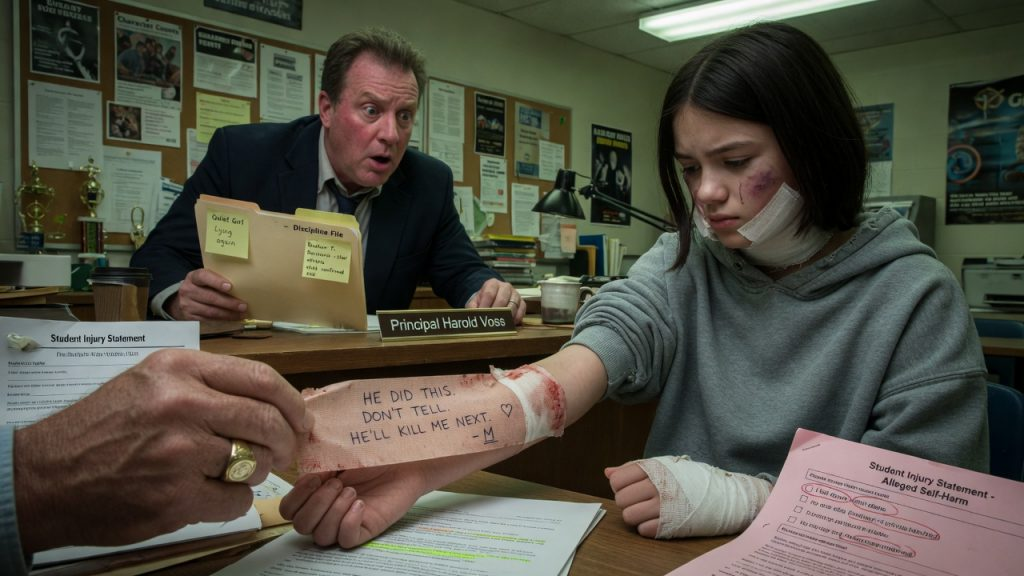
Principal Sterling’s hand was clamped entirely too tightly around Lily’s narrow shoulder when he marched her into my clinic.
“She’s lying, Eleanor,” he announced, his voice booming off the sterile white tiles, sharp enough to make the little girl flinch. “Third time this week she’s tried to get out of Coach Miller’s gym class with some imaginary ailment. I need you to give her a band-aid, a pat on the head, and send her back to dodgeball. I’m not dealing with the mother again.”
I stood up from my desk, my chair squeaking loudly in the sudden, heavy silence that followed his outburst.
I am the school nurse at Oak Creek Elementary, a sprawling brick building in a middle-class Ohio suburb where the lawns are manicured and the secrets are kept strictly behind closed doors. I’ve been here for twelve years. I know the sound of a kid faking a stomach ache to miss a math test. I know the exaggerated limp of a boy who just wants to sit on the bleachers and play on his phone.
But looking at eight-year-old Lily Jenkins, every instinct in my body screamed that this was not a drill.
She was tiny for her age, drowning in an oversized, faded gray hoodie that looked like it belonged to a teenage boy. Her pale blonde hair hung in stringy, unbrushed clumps around her face, obscuring her eyes. She was staring a hole into the linoleum floor, her small chest barely moving as she breathed.
“Richard,” I said softly, using his first name to remind him we were peers, even if he treated everyone like his subordinates. “Let me do my job. I’ll take a look at her.”
Sterling sighed, a massive, put-upon exhale that smelled faintly of stale coffee and peppermint breath mints. He checked his gold wristwatch, a retirement gift to himself that he never stopped flashing. He cared deeply about the school’s “Blue Ribbon” status, test scores, and optics. Messy domestic issues were bad optics.
“Five minutes, Eleanor,” Sterling warned, dropping his hand from Lily’s shoulder. “If she’s not back in the gymnasium by 10:15, I’m calling her mother to come get her. I won’t have students using the health room as a lounge.”
With a sharp pivot of his polished loafers, the principal walked out, pulling the heavy wooden door shut behind him. The click of the latch echoed in the quiet room.
Suddenly, the clinic felt suffocatingly small.
I looked down at Lily. She hadn’t moved an inch. Her arms were wrapped tightly around her own torso, a classic self-soothing posture. She looked like a bird that had flown headfirst into a glass window—stunned, fragile, waiting for the predator to finish the job.
“Hi, Lily,” I said, keeping my voice low, dropping the register to a calming, even hum. “You want to take a seat on the examination bed? The paper makes a funny crinkling sound.”
She didn’t answer. She didn’t look up. Slowly, agonizingly slowly, she shuffled over to the padded table and climbed up. Her worn pink sneakers dangled a few inches from the floor.
I walked over to the mini-fridge in the corner. “Apple juice or orange juice?” I asked, pulling out two tiny plastic cartons.
Nothing.
“I’m going to put the apple juice right here next to you,” I said, setting it on the metal tray. “Just in case.”
I pulled my rolling stool over and sat down so I was slightly below her eye level. It’s a trick I learned years ago. Never tower over a frightened child. Make yourself small. Make yourself safe.
“Mr. Sterling said you were hurting,” I said gently. “Can you show me where?”
Lily kept her eyes glued to her own knees. She gave a microscopic shrug.
I felt a cold prickle of dread wash down the back of my neck. I’ve seen that specific kind of silence before.
Three years ago, a fourth-grader named Toby had sat on that exact same exam table. He had a black eye that he swore came from falling off a skateboard. I cleaned him up, gave him an ice pack, and logged it in the system. Standard protocol. I didn’t push. I didn’t ask the hard questions. Two days later, Toby was in the pediatric ICU with three broken ribs and a ruptured spleen because his mother’s boyfriend had lost his temper over a spilled glass of milk.
Toby lived, but the guilt nearly destroyed me. It cost me my marriage. My husband couldn’t handle the nightmares I kept waking up with, the constant, paranoid obsession I developed over every bruise I saw on a kid’s shin. He left, saying I cared more about other people’s kids than our own life. Maybe he was right.
But I promised myself, sitting alone in my empty house, that I would never, ever look the other way again. I would never let a kid walk out of my clinic if I felt that cold prickle of dread.
And right now, looking at Lily, I was freezing.
“Lily, honey,” I whispered, leaning in just a fraction. “You’re not in trouble. I promise you. But I can’t help you if you don’t show me.”
Her bottom lip began to tremble. It was a tiny, involuntary movement, but it was the first crack in her armor. Slowly, she uncrossed her arms.
She pushed the oversized sleeve of her gray hoodie up past her right elbow.
I sucked in a breath.
Her forearm was wrapped in a messy, bulky layer of white athletic tape. It wasn’t medical gauze. It looked like the cheap, rigid tape athletes use to bind sprained ankles. It was wrapped haphazardly, overlapping in thick, uneven ridges from her wrist up to the crook of her elbow, pulled tight enough to leave faint indentations on her pale skin. It was yellowed at the edges, stained with dirt and what looked like a dark smear of dried blood.
“Good lord,” I muttered under my breath. “Who wrapped this for you, sweetheart?”
Lily swallowed hard. Her voice, when it finally came, was a raspy, terrifyingly small whisper. “Sammy.”
Sammy. Sam Jenkins. Her older brother. He was a junior at the high school across town. I remembered Sam from when he was at Oak Creek. A quiet, brooding kid who always sat in the back of the class, wearing clothes that were just a little too worn out. He used to wait for Lily by the flagpole every single day at 3:00 PM to walk her home, holding her tiny hand tightly in his.
“Why did Sam put this tape on you, Lily?” I asked, reaching out to gently support her elbow.
As soon as my fingertips brushed her skin, she violently flinched, pulling her arm back against her chest. Her eyes shot up to meet mine for the first time, and the sheer, unadulterated terror in her wide blue eyes stopped my heart.
“No,” she gasped out. “No, you can’t take it off.”
“It’s okay,” I said quickly, holding my hands up in surrender. “I won’t. I won’t take it off if you don’t want me to. But Lily, it looks very tight. If there’s a cut under there, it needs to be cleaned so it doesn’t get infected. Athletic tape doesn’t let the skin breathe.”
“He said to leave it,” she whispered, tears finally spilling over her eyelashes and cutting clean tracks down her dusty cheeks. “He said nobody can see it.”
The hair on my arms stood up. Nobody can see it.
“Who can’t see it, Lily? Sam?”
She shook her head rapidly. “Marcus.”
Marcus. The name clicked into place. Sarah Jenkins, Lily’s mother, had been a regular fixture at the school’s PTA meetings until about eight months ago. Then, she vanished. Parent-teacher conferences were skipped. Phone calls went to voicemail. The rumor in the teacher’s lounge—courtesy of the school secretary, who knew everything—was that Sarah had moved a new boyfriend into their cramped apartment. A guy named Marcus who had a rap sheet and a bad temper.
“Did Marcus hurt your arm?” I asked, keeping my tone completely neutral, fighting the surge of adrenaline flooding my veins.
Lily clamped her mouth shut. She shook her head, but her eyes darted to the clinic door, as if Marcus himself were about to burst through the wood.
“Okay,” I breathed out. “Okay. We don’t have to talk about him. But Lily, I need to look under that tape. Just a little peek. If it’s a bad cut, I have to put medicine on it. Sam did a good job trying to help, but nurses have special bandages that make the pain go away.”
I opened a drawer and pulled out a pair of blunt-nosed medical scissors. I held them up where she could see them, flat on my palm.
“I’m going to be so careful. I won’t even touch the skin,” I promised.
She stared at the scissors. She looked at the clock on the wall. The second hand ticked loudly. 10:10 AM. Five minutes until Sterling threatened to call her mother. If he called her mother, the mother would tell Marcus.
Lily squeezed her eyes shut and slowly extended her arm toward me.
“Brave girl,” I murmured.
I slid my stool closer. The athletic tape was incredibly stiff. I carefully slipped the blunt edge of the scissors under the thickest layer near her wrist. As I began to cut, the smell hit me. It wasn’t the metallic tang of fresh blood. It was the sour, musty smell of unwashed skin and stale sweat, mixed with something sharp and metallic.
I snipped through the final layer. The tension in the tape snapped, and it peeled back like the rind of a thick fruit.
I braced myself for a deep laceration. A burn. A break.
But as the tape fell away, I frowned in confusion.
There was no cut. There was no blood.
Her skin was pale and covered in a faint, mottled yellow bruise, likely from the tape cutting off her circulation, but the arm was structurally fine. No swelling. No open wounds.
Why would Sam tape her arm like this? I thought, my mind racing. Was it a distraction? Was he hiding something else?
Then, I saw it.
Pressed flat against the soft, vulnerable skin of her inner forearm, directly over her veins, was a tiny, folded square of lined notebook paper. The tape had been holding it in place, molding it perfectly to the curve of her arm.
I looked up at Lily. Her eyes were still squeezed tightly shut, her jaw clenched as if preparing for a blow.
With trembling fingers, I reached out and gently peeled the damp square of paper off her skin. It was warm to the touch.
I unfolded it. It was a torn piece of college-ruled paper, the kind you rip hastily out of a spiral notebook. The ink was dark blue, written in a frantic, jagged scrawl. The letters were pressed so hard into the paper they had nearly torn through the cheap fiber.
It was Sam’s handwriting.
I read the words once. Then I read them again. The air completely left my lungs, leaving me dizzy and lightheaded. The buzzing of the fluorescent lights overhead suddenly sounded like a roar.
The note said:
To whoever finds this. PLEASE do not send her home. Do not call our mother. He knows Lily told her teacher about the closet. He said if she comes back to the apartment today, he’s going to make sure she never talks again. I am cutting school. I stole his truck keys. I am going to the police station to show them the video on my phone, but I have to wait until he passes out from the pills. Hide her. Keep her there. If you send her home, she is dead. I swear to God. Just keep her safe until I get there. – Sam
My hands were shaking so violently the paper fluttered like a leaf in the wind.
I stared at the words never talks again. I stared at the words she is dead.
I looked at the eight-year-old girl sitting on my exam table. She had opened her eyes and was watching my face with a terrifying, hollow sort of calmness. It was the look of a child who had already accepted that the adults in her life were powerless to save her.
“Lily,” I choked out, my voice cracking entirely. “What closet?”
“The one he locks us in when his friends come over,” she whispered flatly. “It’s small. It’s dark. Sammy tries to kick the door, but Marcus laughs.”
A heavy, sickening dread settled in the pit of my stomach, turning my blood to ice water.
I glanced at the clock. 10:14 AM.
Right on cue, the heavy wooden door to the clinic swung open.
Principal Sterling stood there, his arms crossed over his tailored suit, his mouth set in a grim, impatient line. Behind him in the hallway, I could see the bustling chaos of third-period class changes.
“Well, Eleanor?” Sterling demanded, stepping into the room. “Is she bleeding? Is a bone sticking out? Or was I right?”
I instinctively crumpled the note into a tight ball in my right fist, hiding it behind my thigh.
“No physical injuries,” Sterling noted, looking at Lily’s bare, unbandaged arm. He let out a harsh, victorious laugh. “Exactly as I said. Attention seeking. I’ve already got her mother’s contact pulled up on my phone. I’ll dial it right now and tell her to come collect her daughter.”
He pulled his iPhone from his breast pocket, tapping the screen to unlock it.
“Richard, wait—” I started, stepping between him and Lily.
“No waiting, Eleanor,” he snapped, his thumb hovering over the green call button. “This school is not a daycare for kids who don’t want to run laps. I’m calling Sarah Jenkins. They can sort this out at home.”
He pressed the button and raised the phone to his ear.
Chapter 2
The ringing of Principal Sterling’s iPhone felt like a countdown to an explosion.
In that sterile, white-tiled room, the sound was deafening. Ring. Ring. Ring. Each one was a hammer blow against my ribs. I looked at Lily. She had gone perfectly still, a statue of a little girl, her eyes fixed on the phone in Sterling’s hand as if it were a coiled rattlesnake.
She knew. She knew that on the other end of that digital connection was her mother, and by extension, Marcus. And if Sam’s note was right—if Sam was currently risking everything to get to the police—then Marcus was likely at that apartment, pacing, waiting, a ticking time bomb of unhinged rage.
“Richard, stop!” I shouted.
It wasn’t a request. It was the voice I used when a kid was about to run into traffic. Sterling flinched, his thumb slipping off the screen, but the call was already connecting. He looked at me, his face reddening, his eyebrows knitting together in a mask of pure, bureaucratic indignation.
“Eleanor, what on earth has gotten into you?” he hissed, keeping the phone to his ear. “I am trying to resolve this—”
“I found something,” I lied, the words tumbling out of my mouth before I could even process them. I had to pivot. I couldn’t show him the note. If I showed Sterling that note, he’d follow ‘procedure.’ Procedure meant calling the School Resource Officer, which meant a police radio dispatch, which meant Marcus—who Sam said had a police scanner in his truck—would know the walls were closing in before anyone actually reached the apartment.
“What do you mean, you found something?” Sterling asked, his voice dropping an octave, his professional curiosity battling his ego.
“It’s… it’s not just a fake injury,” I said, stepping closer to him, lowering my voice so Lily wouldn’t hear, though I knew she was hanging on every syllable. “I need you to look at her arm again. Closely. Under the light.”
Sterling sighed, the sound of a man deeply inconvenienced by reality. He pulled the phone away from his ear. “Sarah? Yes, hold on one moment… I’ll call you right back.”
He tapped the screen. End Call.
The silence that followed was heavy enough to crush us both.
“You have thirty seconds, Eleanor,” Sterling warned. “I have a budget meeting with the superintendent at 10:30, and I will not be late because of a school nurse’s ‘hunch.’”
I took a deep breath, the smell of rubbing alcohol and cheap floor wax filling my lungs. I reached back and shoved the crumpled note deeper into my pocket. I needed a distraction. I needed a reason to keep Lily here that didn’t involve the words ‘abuse’ or ‘murder’ until I could get Sam or the police on the line.
“Look at the rash,” I said, pointing to the mottled yellow and purple bruising left behind by the athletic tape. “I think it’s meningitis. The petechial kind. It’s highly contagious, Richard. If she goes back to class, or if she goes home without a full screening, we’re looking at a potential lockdown of the entire third-grade wing. Think of the paperwork. Think of the Board of Health.”
I saw the exact moment the word paperwork hit him. Sterling’s face went from red to a pale, sickly gray. To him, a dying child was a tragedy; a state-mandated audit was a catastrophe.
“Meningitis?” he whispered, glancing nervously at Lily as if she had suddenly turned into a radioactive isotope. He took a subconscious step toward the door. “Are you sure?”
“I need to run a few more checks. I need to call the county health liaison,” I said, my heart hammering against my teeth. “Go to your meeting, Richard. I’ll handle the protocols. But for the love of God, don’t call the mother again until I confirm the diagnosis. If it’s what I think it is, we need to have the CDC-approved script ready before we notify the parents. You know how they panic.”
Sterling nodded fervently. He was hooked. I had used his own obsession with optics against him. “Right. Yes. The script. Good call, Eleanor. Very professional. I’ll… I’ll check in after my meeting. Keep her quarantined.”
He didn’t even look back at Lily as he beat a hasty retreat, pulling the door shut with a definitive thud.
I slumped against the examination table, my legs feeling like overcooked noodles. I looked at Lily. She was watching me, her expression unreadable.
“You’re a good liar,” she whispered.
“I’m not a liar, Lily,” I said, moving back to her, my voice trembling. “I’m a nurse. And sometimes, nurses have to use different tools to keep people safe. Now, tell me about Sam. Where would he go?”
Lily bit her lip. “He said the police station on 4th Street. The one near the park with the big slide. But he has to be quiet. Marcus sleeps with his ears open.”
I grabbed the desk phone, my fingers fumbling as I dialed the High School’s main office. I knew the secretary there, Brenda Gable. Brenda had been at the district for thirty years; she was the kind of woman who knew whose father was a drunk and whose mother was cheating before the families even knew themselves.
“Oak Creek High, this is Brenda,” the voice crackled.
“Brenda, it’s Eleanor over at the Elementary. Listen, I need you to do something for me, and I need you to be very, very discreet.”
“Eleanor? You sound like you’ve seen a ghost, honey. What’s wrong?”
“Is Sam Jenkins in class today? Junior. Dark hair, usually looks like he hasn’t slept.”
I heard the clicking of keys. A long silence.
“No,” Brenda said, her voice dropping. “He’s marked absent for first and second period. His mother called him in sick this morning. Said he had a fever.”
My stomach dropped. She called him in sick. Sarah was covering. Whether it was out of fear or something worse, she was helping Marcus keep the kids under wraps.
“Brenda, if you see him, or if a boy fitting his description shows up at the office asking for help, you call me immediately on my personal cell. Do you understand? Don’t log it. Just call me.”
“Eleanor, what’s going on? Is this about that boyfriend of Sarah’s? I saw him at the grocery store last week, and he looked like—”
“I have to go, Brenda. Just… please. Keep your eyes open.”
I hung up.
I turned back to Lily. “Sam isn’t at school. He’s doing exactly what he said he’d do. But Lily, we can’t just sit here. If Marcus realizes the truck keys are gone, or if he wakes up and Sam isn’t there…”
I didn’t finish the sentence. I didn’t have to.
I walked over to the window that looked out onto the staff parking lot. It was a grey, overcast Ohio morning. The kind of day where the sky felt like a heavy wool blanket. I saw the usual line-up of minivans and mid-sized SUVs.
And then, I saw it.
A rusted, black Chevy Silverado was idling at the far end of the lot, near the dumpsters. It didn’t have a parking permit. The windows were tinted dark, but the engine was chugging, spitting out clouds of grey exhaust that dissipated into the damp air.
My breath hitched.
“Lily,” I said, my voice barely a whisper. “Does Marcus drive a black truck?”
Lily scrambled off the table, her pink sneakers hitting the floor with a soft slap. She ran to the window, peering over the ledge.
She turned back to me, her face losing what little color it had left. She didn’t say a word. She just nodded, her eyes wide with a primal, bone-deep terror.
He was here.
He hadn’t waited for the school to call. He had woken up, found the keys gone, or found the note, or simply felt the shift in the air that happens when a victim finally decides to run.
I looked at the clinic door. It didn’t have a lock. School clinics are designed for accessibility, not defense. There was a small supply closet in the corner, barely big enough for a few boxes of gauze and a mop bucket.
“In the closet,” I commanded, grabbing Lily by the waist and hoisting her toward the small door.
“No!” she shrieked, a sound so raw it felt like it tore my own throat. “Not the closet! Please, Nurse Eleanor, not the closet!”
The trauma. I had forgotten. The closet was her prison at home. To her, I wasn’t hiding her; I was re-enacting her nightmare.
“Lily, listen to me!” I grabbed her shoulders, forcing her to look at me. “This isn’t his closet. This is my closet. And I’m going to give you the key. You see this?” I grabbed a heavy metal letter opener from my desk—a gift from a former student. “If anyone tries to open this door who isn’t me, you hold this. But I am going to stand right in front of this door, and no one is getting past me. Do you hear me? No one.”
I saw the internal battle in her eyes. The terrified child vs. the girl who wanted to live. She grabbed the letter opener, her small knuckles white.
“Okay,” she whispered.
I shoved her inside, clearing a space between the stacks of paper towels. “Don’t make a sound. Not a breath.”
I closed the door just as the heavy main door to the clinic swung open.
It wasn’t Principal Sterling.
The man who stepped into the room was large, but not in a healthy way. He had the bloated, hardened look of a long-term substance abuser. He wore a grease-stained Carhartt jacket and a baseball cap pulled low. His eyes were bloodshot, darting around the room with a frantic, predatory energy.
He smelled like stale cigarettes and something chemical—bleach or meth, I couldn’t tell which.
“Can I help you?” I asked, stepping in front of the supply closet, my heart hammering so hard I thought he might actually see it jumping under my scrubs.
The man didn’t answer. He looked at the empty examination table. He looked at the discarded athletic tape on the floor.
“Where is she?” he rasped. His voice sounded like gravel being crushed.
“I’m sorry, you’re not on the approved visitor list,” I said, my voice surprisingly steady. Years of dealing with hysterical parents and entitled administrators had given me a ‘nurse voice’ that was as thick as armor. “I’m going to have to ask you to return to the front office and sign in.”
The man took a step closer. He was barely five feet away now. I could see the yellowing of his teeth, the jagged scar that ran from his earlobe down into his collar. This was Marcus. This was the monster from Lily’s stories.
“I ain’t signin’ shit,” he said. “The school called. Said she was hurt. I’m here to take her home. Her mom’s in the truck.”
Liar. Sterling had only just called, and he hadn’t even finished the conversation.
“Lily Jenkins is currently undergoing a medical assessment,” I said, crossing my arms. “She cannot be released until the school administration clears her. If you’d like to wait in the lobby—”
“I said,” Marcus stepped into my personal space, the smell of him turning my stomach, “where is she?”
He looked toward the small inner office. He looked toward the bathroom door. And then, his eyes settled on the supply closet right behind me.
A slow, ugly grin spread across his face.
“She likes closets, don’t she?” he chuckled. It was a wet, horrible sound. “She’s a real quiet one. Likes to hide. But she knows she can’t hide from me.”
He reached out, his hand—huge and calloused—moving to shove me aside.
I didn’t move. I planted my feet.
“If you touch me, I will scream,” I said, my voice low and lethal. “And this hallway is full of teachers and a Resource Officer who is a former Marine. You will be in handcuffs before you hit the parking lot.”
Marcus paused. He wasn’t stupid. He was a bully, and bullies are, at their core, calculators of risk. He looked at the door, then back at me.
“You think you’re real brave, don’t you, Nurse?” he sneered. “Protecting the little brat. You don’t know what she told us. You don’t know what her brother did.”
“I know enough,” I said.
“Yeah? Well, tell me this. Does your ‘Resource Officer’ know that Sam Jenkins is currently sitting in a stolen truck at the bottom of the Ravine Road? Because he didn’t quite make it to the police station.”
The world tilted. Sam.
“What did you do?” I whispered, my resolve flickering for the first time.
“I didn’t do nothin’,” Marcus said, his eyes gleaming with malice. “Kid can’t drive for shit. Took a turn too fast. If you want to save a kid today, maybe you should be callin’ an ambulance for the boy instead of hidin’ the girl.”
My mind raced. Was he lying? It was the perfect distraction. If I ran to call for Sam, he’d have Lily. If I stayed, Sam might be bleeding out in a ditch.
Suddenly, the phone on my desk rang.
Marcus looked at it. I looked at it.
I lunged for the receiver.
“Oak Creek Clinic,” I barked.
“Eleanor? It’s Officer Miller.”
Officer Dave Miller was the SRO. He was a good man, a man who had helped me through the Toby situation three years ago. He was the one who had held me while I cried in the parking lot after the ambulance took Toby away.
“Dave,” I gasped. “I have a situation in the clinic. Right now. I need you here.”
“I’m already on my way, Eleanor,” Miller’s voice was grim. “We just got a 911 call from a kid named Sam Jenkins. He’s patched through from the high school. He’s at the 4th Street station. He’s got video, Eleanor. He’s got everything.”
I looked at Marcus. The grin on his face vanished. He saw the change in my expression. He knew the game was up.
“Where’s the girl?” Marcus roared, abandoning all pretense. He lunged at me, his hand swinging in a wide, clumsy arc.
I ducked, the blow clipping the top of my head, sending me spiraling into the desk. The phone flew off the hook, dangling by its cord, Dave Miller’s voice shouting my name into the empty air.
Marcus turned toward the closet. “Lily! Get out here! Now!”
He grabbed the handle of the supply closet and yanked.
But the door didn’t budge.
I had locked it from the outside when I shoved her in—a small, sliding bolt I’d installed years ago to keep kids out of the cleaning chemicals.
Marcus let out a roar of frustration and kicked the door. The wood groaned. A hairline fracture appeared in the center panel.
“Leave her alone!” I screamed, grabbing a heavy glass jar of tongue depressors and hurling it at his back. It shattered against his shoulder, wooden sticks flying everywhere like shrapnel.
Marcus spun around, his face a mask of pure, murderous intent. He wasn’t thinking about the police anymore. He wasn’t thinking about the truck. He was thinking about silencing the woman who stood between him and his prey.
He reached into the pocket of his Carhartt jacket.
I saw the glint of steel. A folding knife.
“You shoulda just given her the band-aid, Nurse,” he growled, stepping over the broken glass.
I backed away, my hands searching the desk behind me for anything—a stapler, a lamp, a pair of scissors. My fingers closed around the heavy ceramic mug my daughter had made me in three years ago. World’s Best Mom.
“Dave is coming,” I said, my voice trembling. “He’s seconds away.”
“He won’t be fast enough for you,” Marcus said.
He lunged.
I didn’t think. I didn’t strategize. I swung the mug with everything I had.
It connected with his temple with a sickening crack. Marcus groaned, his knees buckling, but he didn’t go down. He swiped the knife out, the blade catching the sleeve of my scrubs, slicing a clean line through the fabric and into the meat of my upper arm.
I didn’t feel the pain. Not yet. The adrenaline was a roaring fire in my veins.
I scrambled over the examination table, trying to put an obstacle between us. Marcus was shaking his head, trying to clear the cobwebs from the blow, blood beginning to trickle down the side of his face.
“You bitch,” he spat.
He was about to lung again when the clinic door exploded open.
Officer Miller didn’t shout a warning. He didn’t ask for a surrender. He saw the knife in Marcus’s hand, he saw the blood on my arm, and he saw the shattered closet door.
“Drop it! Now!” Miller’s service weapon was out, his stance rock-solid.
Marcus froze. He looked at the barrel of the Glock 17. He looked at the grey-haired officer who looked like he was more than willing to pull the trigger.
Slowly, Marcus let the knife clatter to the floor.
“She attacked me,” Marcus whined, his voice suddenly high and pathetic. “I just came to get my kid. She hit me with a cup.”
“Shut up, Marcus,” Miller growled, moving forward with the fluidity of a hunter. He kicked the knife across the room and slammed Marcus against the wall, the sound of handcuffs clicking into place sounding like the most beautiful music I’d ever heard.
I collapsed onto the floor, my back against the exam table, the room spinning in slow, dizzying circles.
“Eleanor? You okay?” Miller asked, his eyes darting to the wound on my arm.
“The closet,” I choked out, pointing a shaking finger. “Open the closet.”
Miller kept one hand on Marcus’s collar and used the other to slide the bolt back on the closet door.
The door creaked open.
Lily was huddled in the corner, the metal letter opener held out in front of her like a sword. She was shaking so hard the tip of the blade was vibrating.
When she saw me, and then saw Officer Miller, she didn’t cry. She didn’t run to us.
She looked at Marcus, pinned against the wall.
“Sammy’s at the police station,” she said, her voice clear and stronger than I’d ever heard it. “He has the video, Marcus. He has the video of what you did to Mom.”
Marcus’s face went white. All the bravado, all the cruelty, drained out of him, leaving nothing but a hollow, pathetic shell of a man.
I crawled over to the closet and reached out my hand. Lily took it. Her palm was sweaty, but her grip was firm.
“It’s over, Lily,” I whispered. “It’s really over.”
Ten minutes later, the school was swarming.
Paramedics were tending to my arm, wrapping it in the kind of professional gauze I usually reserved for the kids. Principal Sterling was hovering in the hallway, looking like he was about to have a heart attack, trying to explain to a news crew—who had appeared out of nowhere—how the school’s ‘safety protocols’ had successfully neutralized a threat.
I didn’t care about Sterling. I didn’t care about the news.
I was sitting on the back of an ambulance, a shock blanket draped over my shoulders. Lily was sitting next to me, clutching a new carton of apple juice.
A black-and-white cruiser pulled into the lot, its lights off.
A teenage boy jumped out before the car had even fully stopped. He was wearing a torn t-shirt and jeans covered in dirt, his face streaked with tears and grease.
“Lily!” he screamed.
“Sammy!”
Lily flew off the ambulance. Sam met her halfway, picking her up and spinning her around, burying his face in her neck. They held onto each other like they were the only two people left on earth.
Sam looked over Lily’s shoulder at me. He didn’t know my name. He didn’t know who I was. But he saw the bandage on my arm. He saw the way I was looking at them.
He gave me a single, slow nod. A silent ‘thank you’ from one protector to another.
I leaned my head back against the cold metal of the ambulance. My arm throbbed, my head ached, and I knew that tonight, the nightmares of Toby would finally be replaced by something else.
I looked at the discarded athletic tape lying in the middle of the parking lot, being trampled by the boots of the police officers.
Sam had hidden a warning under a bandage.
And in doing so, he hadn’t just saved his sister. He had saved me, too.
Nurse Eleanor’s Final Note:
In twelve years at Oak Creek, I’ve learned that the loudest wounds aren’t always the most dangerous. The kids who scream and cry and demand your attention? They’re usually going to be okay.
It’s the quiet ones you have to watch. The ones who hide their pain under oversized hoodies and layers of athletic tape. The ones who have learned that silence is their only shield.
If you see a child who is too still, too quiet, too careful… don’t look away. Don’t accept the easy answer. Peel back the bandage. You might just find the message that saves a life.
Because sometimes, the greatest act of bravery isn’t a shout. It’s a whisper on a torn piece of notebook paper.
Stay safe, Oak Creek. And keep your eyes open.
Chapter 3
The silence that follows a trauma is never actually silent. It’s a physical weight, a thick, pressurized hum that rings in your ears until you think your head might crack open.
As the flashing blue and red lights of the police cruisers danced against the beige walls of the Oak Creek Elementary hallway, I sat on the bumper of the ambulance and watched the world splinter into a thousand pieces. My arm was numb—the paramedics had pumped it full of local anesthetic to stitch the jagged line Marcus’s knife had left behind—but my mind was racing at a hundred miles per hour.
Marcus was gone, shoved into the back of a cruiser, his face a mask of impotent, snarling rage. But the monster leaving the building didn’t mean the nightmare was over. In many ways, for Lily and Sam, the nightmare was only shifting shapes.
“Eleanor?”
I looked up. Officer Dave Miller was standing over me, his heavy tactical vest unbuttoned at the sides. He looked older than he had ten minutes ago. There was grey in his stubble I hadn’t noticed before, and his eyes were clouded with the kind of exhaustion that sleep can’t fix.
“He’s on his way to the station,” Dave said, gesturing toward the parking lot exit. “But we’ve got a problem. A big one.”
I pulled the shock blanket tighter around my shoulders. The late morning sun was trying to peek through the Ohio clouds, but I couldn’t stop shivering. “What kind of problem, Dave? Sam said there’s a video. He said he has everything.”
Dave sighed, rubbing a hand over his face. “Sam has a phone. But Marcus smashed it before the kid could get out of the apartment. Sam managed to grab it, but the screen is pulverized and the logic board looks like it took a hammer blow. We’ve sent it to the tech lab at the county level, but Eleanor… if that video is the only proof of what’s been happening in that house, and we can’t recover it, this might turn into a ‘he-said, she-said’ real fast. Marcus is already claiming self-defense. He’s saying you attacked him and he was just trying to retrieve his daughter from an ‘unstable’ school employee.”
I felt a surge of nausea. “He was kicking the closet door, Dave. He had a knife.”
“I know that. I saw it. I can get him on the assault on you, no question. But the domestic stuff? The years of whatever Lily and Sam have been through? Without that video, or a statement from the mother…” Dave trailed off, looking toward the second cruiser where Lily and Sam were sitting together.
“Where is Sarah?” I asked.
“She’s at the station. She’s… not doing well. She’s terrified, Eleanor. She’s terrified of Marcus, but she’s also terrified of losing her kids to the system. She’s currently sticking to the story that Marcus is a ‘good provider’ who just has a ‘short fuse.’ She’s protecting him.”
I stood up, the movement sending a sharp spike of pain through my arm despite the meds. “She’s protecting the man who locked her eight-year-old in a closet? The man who nearly killed her son today?”
“It’s a cycle, Eleanor. You know this.”
I did know it. I knew it because I’d seen it a dozen times in twelve years. I’d seen mothers come in with sunglasses covering bruised eyes, swearing they’d walked into a door, while their children sat nearby, silent and vibrating with a terror they couldn’t name.
But this time, I had a note.
I reached into my pocket and pulled out the crumpled, blood-stained piece of notebook paper I’d taken from Lily’s arm. I handed it to Dave.
He read it slowly. I watched his jaw tighten. I watched the way his eyes lingered on the words If you send her home, she is dead.
“This is a start,” Dave whispered. “But we need more. We need Lily to talk. And we need to make sure these kids aren’t separated. Which brings me to the second problem.”
He pointed toward a sensible, dark blue sedan that had just pulled into the school’s circular drive. A woman stepped out. She was dressed in a sharp charcoal power suit, her hair pulled back into a bun so tight it looked painful. She carried a leather briefcase like a shield.
“Who’s that?” I asked, though I already knew.
“Diane Vance,” Dave said. “County Children’s Services. The ‘Closer.’ If she decides the home is unsafe—which it clearly is—and there’s no immediate kin who can take them, Sam and Lily go into the emergency foster pool. And because of the age gap and the lack of available beds, they will be separated. Today.”
I looked at Sam and Lily. Sam was holding Lily’s hand so hard his knuckles were white. He was whispering in her ear, probably promising her that everything was going to be okay, that he’d never leave her. He was sixteen years old, carrying the weight of a father, a protector, and a martyr.
If the system took them today and put them in different homes, Sam would break. And Lily? Without Sam, Lily would simply fade away.
“No,” I said, the word coming out stronger than I felt. “No, that can’t happen.”
“Eleanor, you’re a nurse, not a social worker. There are rules—”
“I don’t care about the rules, Dave! I watched Toby fall through the cracks because I followed the rules! I didn’t push. I didn’t scream. I just filed my reports and waited for the ‘system’ to work, and that boy almost died in a cold hospital bed because I was too polite to cause a scene.”
I pushed past Dave, ignoring the protest of my arm, and marched toward the woman in the charcoal suit.
“Ms. Vance?” I called out.
The woman stopped, adjusting her glasses. She looked at my blood-stained scrubs, the heavy bandage on my head, and the wrap on my arm. She didn’t flinch. She’d clearly seen worse. “I’m Diane Vance. You must be the nurse. Principal Sterling gave me a brief overview on the phone. Quite a dramatic morning you’ve had.”
“Dramatic isn’t the word I’d use,” I said, stopping inches from her. “Traumatic is better. Or perhaps ‘pivotal.’ These children, Sam and Lily Jenkins… they cannot be separated.”
Diane Vance gave me a thin, professional smile. “That’s a lovely sentiment, Ms…?”
“Eleanor. Eleanor Vance. No relation,” I added dryly.
“Ms. Vance, I understand the emotional stakes here. Truly. But I have two children who have been living in a high-risk environment with a mother who is currently uncooperative and a stepfather who is in custody for felony assault. There are no registered relatives in the state of Ohio. My job is to ensure their immediate physical safety. That means state-regulated foster care.”
“Sam is the only thing keeping Lily grounded,” I argued. “If you take him away from her, you’re just finishing what Marcus started. You’re breaking her.”
“And what do you suggest?” Diane asked, her tone sharpening. “I leave them in a motel? I put them in a homeless shelter together? I have a duty of care, Eleanor. Unless you have a certified, background-checked guardian standing by with two extra bedrooms and a willingness to take on a high-trauma case at 11:00 AM on a Tuesday, they are going with me.”
I looked at Sam. He was watching us now. He knew what was happening. He’d lived his whole life waiting for the axe to fall, and he could see the blade swinging.
I thought about my house.
It was a three-bedroom Victorian on the edge of town. It was too big for one woman. It had been empty for three years, ever since my husband walked out. I kept the guest rooms clean, though no one ever stayed in them. I kept the fridge stocked, though I usually ate standing up over the sink.
It was a house built for a family that didn’t exist anymore.
“I’ll take them,” I said.
The silence that followed was different. It wasn’t the silence of trauma. It was the silence of a vacuum—the moment before the air rushes back in.
Dave Miller, who had walked up behind me, let out a soft “Jesus, Eleanor.”
Diane Vance actually blinked. “You? You’re the school nurse. You’re a witness in a criminal case. The conflict of interest alone—”
“I am a licensed medical professional with a clean record and a home that is already vetted for foster-to-adopt safety from back when my husband and I were trying,” I snapped. “My certification lapsed two years ago, but the physical requirements of the house haven’t changed. I have the space. I have the medical training to handle their injuries. And most importantly, they know me. They trust me.”
I looked back at Lily. She was staring at me. For the first time, I saw a tiny, infinitesimal spark of hope in her eyes. It was terrifying. Hope is a dangerous thing to give a child when you aren’t sure you can keep it alive.
“It’s irregular,” Diane said, but she wasn’t saying no. She was a woman of logic, and I had just handed her a solution to a logistical nightmare. “I would need an emergency waiver from the judge. And you’d have to agree to an immediate home inspection this afternoon.”
“Fine,” I said. “Do it.”
“Eleanor,” Dave whispered, pulling me aside. “Are you sure about this? You’re injured. You’re exhausted. Taking on two traumatized kids… it’s not just a few days of babysitting. This is a war.”
“I’ve been in a war for twelve years, Dave,” I said, looking at the blood on my sleeve. “I’m just finally picking up a weapon.”
The drive to the police station was a blur. Sam and Lily sat in the back of Dave’s cruiser, while I followed in my own car. Every time I looked in the rearview mirror, I expected to see Marcus’s black truck. My mind knew he was in a cell, but my body hadn’t received the memo yet.
The police station was a hive of activity. The news of the “School Nurse Attack” had leaked, and a few local reporters were already hovering near the entrance. Dave snuck us in through the side bay.
Inside, the air smelled of floor wax and ozone. We were led to a small, windowless waiting room.
“Wait here,” Dave said. “I need to go talk to Sam’s mother. And Eleanor… be careful. Sarah’s in a bad way.”
I sat down on a plastic chair, my arm beginning to throb with a dull, rhythmic heat. Sam sat across from me, Lily tucked under his arm like a precious cargo.
“Why are you doing this?” Sam asked. His voice was different now. The adrenaline had faded, leaving behind a raw, gravelly tone that made him sound thirty years old.
“Doing what, Sam?”
“The house. The lady in the suit said we might go to your house. Why? You don’t know us.”
I looked at him—really looked at him. He had a bruise forming on his cheekbone, and his hands were shaking, though he tried to hide them in his pockets.
“Because your note said to keep her safe,” I said softly. “And because I’m tired of watching good people get broken by bad ones. You did something incredibly brave today, Sam. You protected your sister when no one else would. I’m just trying to follow your lead.”
Sam looked down at his shoes. “The video… I don’t know if they can fix the phone. He caught me. I was filming him through the crack in the closet door. He was… he was doing something to Mom. He saw the light from the screen. He came at me like a freight train. I tried to run, but he grabbed me and smashed the phone against the kitchen counter. I thought I was dead. But then he just… he laughed. He told me to get out. He said he’d deal with me later. That’s when I ran to the school. I had to get Lily.”
“You did the right thing,” I said.
“Did I? Mom’s in there right now telling them I’m a liar. I can hear her through the walls sometimes. She’s crying, telling them Marcus loves us. She’s going to hate me for this.”
“She doesn’t hate you, Sam,” I said, though I wasn’t entirely sure if I believed it. “She’s just sick. Fear is a disease. It makes you say things you don’t mean.”
The door opened, and a young officer stepped in. “Ms. Vance? Sarah Jenkins wants to see you.”
I looked at Dave, who appeared in the doorway behind the officer. He nodded. “She won’t talk to us. She won’t talk to the social worker. She keeps asking for the ‘woman from the school.’”
I stood up, my heart hammering. I looked at Sam and Lily. “I’ll be right back. I promise.”
I was led down a narrow hallway to an interrogation room. It was exactly like the ones on TV—grey walls, a heavy metal table, and a one-way mirror.
Sarah Jenkins was sitting at the table.
I hadn’t seen her in months, and the change was staggering. She had always been a pretty woman, with a quick smile and a vibrant energy. Now, she looked like a shadow. Her hair was lank, her skin a sickly translucent grey. She had a deep purple bruise on her neck that looked like the shape of a human hand.
She didn’t look up when I walked in. She was staring at her own hands, which were twisting a damp tissue into a shredded mess.
“Sarah?” I said, pulling out the chair across from her.
She looked up. Her eyes were hollowed out, the pupils tiny pinpricks. “Is she okay? Is Lily okay?”
“She’s safe, Sarah. She’s with Sam.”
Sarah let out a jagged breath that sounded like a sob. “Sam… he shouldn’t have done it. He made it so much worse. Marcus was just stressed. The bills… the truck broke down… he doesn’t mean it. He has a heart, Eleanor. You didn’t see him when we first met. He brought Lily flowers. He helped Sam with his homework.”
“Sarah, look at me,” I said, leaning forward. “He put Lily in a closet. He nearly killed your son. He came to my school with a knife. That isn’t stress. That’s a monster.”
“You don’t understand!” Sarah cried, her voice cracking. “If he stays in jail, we have nothing! No money, no house! And if I tell the truth… if I tell them what he did… he’ll find us. He said he has friends. He said he’d burn everything down.”
I reached across the table and grabbed her wrists. Her skin was ice cold. “He can’t hurt you anymore. But you have to choose, Sarah. Right now. You have to choose between the man who breaks you and the children who love you. Because if you don’t stand up and tell the truth, those children are going to be taken away. They’re going to be put in foster care. They’re going to be separated. Sam will be in a group home in Cincinnati, and Lily will be with strangers who don’t know that she likes her apple juice cold or that she needs a nightlight to sleep.”
Sarah’s eyes filled with tears. “They’re going to take them?”
“Diane Vance is in the other room with a briefcase full of paperwork. She’s ready to sign them over to the state. The only thing that can stop this is a full statement from you and a plan for their safety.”
“I can’t,” Sarah whispered. “I’m too scared.”
I felt a flash of anger, but I pushed it down. This wasn’t the time for judgment. It was the time for a surgeon’s precision.
“I remember when Lily was in kindergarten,” I said softly. “She came into my clinic because she’d scraped her knee on the playground. You came to pick her up. You were wearing a yellow dress. You knelt down on the floor, and you kissed her knee, and you told her that as long as you were alive, nothing would ever really hurt her. Do you remember that, Sarah?”
Sarah closed her eyes, a single tear tracking down her cheek. “I remember.”
“Then be that woman again. Be the woman who protects her. Sam did his part. He carried the weight as long as he could. But he’s just a boy. He needs his mother to be the shield now.”
The room was silent for a long time. I could hear the muffled sounds of the precinct outside—the phones ringing, the heavy footsteps, the low murmur of voices.
Slowly, Sarah looked up. The fear was still there, but beneath it, something else was flickering. A spark of the mother she used to be.
“The video,” she whispered. “Sam told you about the video?”
“Yes. But the phone is broken.”
Sarah swallowed hard. “He didn’t know. He thought he was the only one filming. But I… I bought a nanny cam. A tiny one, hidden in the bookshelf in the living room. I was going to use it to show him how he looked when he was drunk. I thought maybe if he saw it, he’d stop.”
My heart leapt. “Where is the memory card, Sarah?”
“It’s in my purse. In the side pocket. I took it out this morning when Marcus was in the shower. I was going to throw it away. I was going to destroy it because I was so ashamed.”
“Don’t destroy it,” I said. “Give it to me. Give it to Dave.”
Sarah reached for her purse, which was sitting on the floor next to her. Her hands were shaking so much she could barely unzip the pocket. She pulled out a tiny, silver Micro-SD card. It looked like a grain of rice in her palm.
“If I give you this,” she said, looking at the card, “there’s no going back. He’ll go to prison for a long time.”
“Good,” I said.
She handed me the card.
I stood up and called for Dave. When he walked in, I placed the card in his hand. “Here is your evidence, Dave. Sarah is ready to give her statement.”
Dave looked at Sarah, then at me. He nodded, his expression solemn. “Thank you, Sarah. You’re doing the right thing.”
I walked out of the interrogation room, my legs feeling like lead. I found Sam and Lily in the waiting room. Diane Vance was standing over them, her phone to her ear, likely finalizing the foster placements.
“Diane,” I said, walking up to her. “Hang up the phone.”
She looked at me, annoyed. “Excuse me?”
“We have the evidence. We have a cooperating witness. And I have the emergency placement paperwork you mentioned.”
Diane looked at the determination on my face. She looked at the blood on my scrubs. She looked at the two broken children sitting on the plastic chairs.
She sighed and hit the ‘end’ button on her phone. “Fine. Let’s go see the judge.”
The rest of the afternoon was a whirlwind of legal jargon and paperwork. We stood in a small judge’s chamber—Judge Halloway, a woman who looked like she’d seen every tragedy Ohio had to offer.
She looked at the evidence Dave had quickly processed—the video from the nanny cam. I didn’t see the footage, but I saw the judge’s face while she watched it on a laptop. She turned the screen away after thirty seconds, her face pale.
“Mr. Jenkins will not be seeing the light of day for a very long time,” she said, her voice trembling with a rare flash of emotion.
Then she turned her attention to me.
“Eleanor Vance. You’re asking for emergency kinship-style placement for these two children. You understand the responsibility? You understand that Marcus has associates? That this won’t be a quiet transition?”
“I do, Your Honor.”
“And Sam,” the judge said, looking at the boy. “Are you okay with staying with Ms. Vance?”
Sam looked at me. Then he looked at Lily. “As long as we’re together. As long as he can’t get to us.”
“He won’t,” the judge promised.
She signed the order.
At 5:00 PM, I walked out of the courthouse with a sixteen-year-old boy and an eight-year-old girl. They had nothing but the clothes on their backs and a few things Sam had stuffed into a backpack before he fled the apartment.
As we walked to my car, the sun was finally setting, casting long, orange shadows across the pavement.
“Is this where you live?” Lily asked as I pulled into my driveway twenty minutes later.
My house stood there, the white trim glowing in the twilight. It looked peaceful. It looked like a sanctuary.
“This is it,” I said.
I led them inside. The house smelled of lavender and old books—the scents I used to mask the emptiness.
“Sam, you take the room at the end of the hall. Lily, you’re right next to him. There are extra towels in the bathroom, and I’ll order some pizza.”
Lily walked into the living room and stopped. She stared at the large, plush sofa and the bookshelf filled with colorful novels. She looked at the windows, which were large and let in the evening light.
There were no closets with locks on the outside. There were no shadows where a monster could hide.
“It’s big,” she whispered.
“It’s safe,” I said.
Sam stood in the kitchen, his hands hovering over the granite countertop. He looked like he didn’t know if he was allowed to touch anything.
“You okay, Sam?” I asked.
He looked at me, and for the first time, the “protector” mask slipped. His eyes filled with tears, and his chest began to heave.
“I thought I killed him,” Sam whispered. “When I took the keys… I thought about taking the knife and ending it. I wanted to. I wanted to kill him so he could never touch her again.”
I walked over and did something I hadn’t done in years. I pulled the boy into a hug. He was stiff at first, his muscles like knotted rope, but then he collapsed against me, sobbing into my shoulder.
“You didn’t have to kill him, Sam,” I whispered, stroking his hair. “You did something much harder. You survived him.”
We stayed like that for a long time, in the quiet of my kitchen, while the world outside continued to spin.
But as I held him, I saw Lily standing in the doorway. She wasn’t crying. She was watching us with a strange, intense focus.
And then, she did something that chilled me to the bone.
She reached into the pocket of her hoodie and pulled out a small, jagged piece of glass. It looked like a shard from the phone Marcus had smashed. She held it up to the light, her eyes narrowing.
“He’s not dead yet,” she whispered.
I let go of Sam, a cold prickle of dread washing over me. “Lily? What are you talking about?”
“The man in the truck,” she said, her voice flat. “The one who was with Marcus. He wasn’t in the jail, Nurse Eleanor. I saw him. He was at the courthouse. He was watching us.”
I felt the blood drain from my face.
I looked at the window. The street was dark now, the streetlamps casting pools of yellow light on the asphalt.
And there, idling at the end of the block, was a pair of headlights.
A black truck.
Not Marcus’s truck—his was in the police impound lot.
But a truck exactly like it.
The door of the truck opened, and a man stepped out. He wasn’t Marcus. He was younger, leaner, with a shock of red hair and a long, duster coat. He leaned against the hood and lit a cigarette, the orange glow of the cherry illuminating a face I recognized from a dozen “Wanted” posters in the police station breakroom.
Marcus’s brother. Silas.
He didn’t move. He didn’t shout. He just stood there, staring at my house, a silent promise of the violence yet to come.
I realized then that the “war” Dave Miller had mentioned wasn’t just beginning. It was escalating.
I reached for the phone to call Dave, but the line was dead. I tried my cell phone—no signal.
I looked at the front door. The lock was a standard deadbolt. It wouldn’t hold for more than a few seconds against a man like Silas.
“Sam,” I said, my voice steady despite the terror clawing at my throat. “Get Lily. Go to the basement. Now.”
“What? Why?”
“Just do it! Lock the door and don’t come out until I say.”
I watched them scramble toward the basement stairs. As soon as the door clicked shut, I walked to the hallway closet.
I didn’t keep a gun. I hated guns.
But I kept a heavy, steel oxygen tank from my days of home-health nursing. It was full, pressurized, and weighed forty pounds.
I dragged it to the front door and waited.
Outside, the man with the red hair finished his cigarette and flicked it into my yard. He began to walk toward the porch, his footsteps heavy and deliberate.
The nightmare wasn’t over.
Marcus was in a cell, but the system he had built—the network of broken men and violent debts—was still very much alive.
And it was coming for the girl who knew too much.
I gripped the valve of the oxygen tank, my heart hammering a frantic rhythm against my ribs.
“Peel back the bandage,” I whispered to myself, the words a prayer and a curse. “See what’s underneath.”
The first blow hit the door, and the wood groaned.
I didn’t scream. I didn’t cry.
I just waited.
Because I was a nurse. And I was done being polite.
Chapter 4
The house was too quiet.
It was the kind of silence that doesn’t just mean an absence of noise; it’s a physical entity that presses against your eardrums until you can hear the rush of your own blood. I stood in the dark hallway, my fingers white-knuckled around the cold, industrial steel of the oxygen tank. My arm throbbed, a rhythmic, burning reminder of the man currently sitting in a jail cell, but my eyes were locked on the front door.
Outside, Silas Jenkins was a shadow against the streetlights. He wasn’t rushing. He wasn’t screaming. That was the most terrifying part. Marcus was a storm—loud, chaotic, and predictable in his violence. Silas was a draught—cold, silent, and capable of killing you before you even realized the temperature had dropped.
I heard the floorboards on the porch groan. A slow, heavy creak-snap that echoed through the foyer. He was standing right outside the door now. I could almost feel his breath through the wood.
“Eleanor,” a voice whispered from the darkness behind me.
I nearly jumped out of my skin. It was Sam. He hadn’t stayed in the basement. He was standing at the top of the stairs, his face a pale blur in the shadows. He was holding my heavy cast-iron skillet from the kitchen. It looked ridiculous in his trembling hands, but the look in his eyes was anything but funny.
“I told you to stay down there,” I hissed, my voice barely a vibration.
“I’m not letting you do this alone,” he whispered back. “I’m done hiding in closets, Eleanor. If he gets through that door, he has to go through me first.”
At sixteen, Sam Jenkins was a man made of scrap metal and sheer will. He had spent years being the anvil for Marcus’s hammer, and tonight, he was finally turning into the spark.
Before I could argue, the front door rattled. It wasn’t a kick. It was a gentle turn of the knob. Silas was checking to see if I’d been foolish enough to leave it unlocked. When the deadbolt held, there was a long pause.
Then, the window in the parlor shattered.
The sound was like a gunshot in the stillness. Shards of glass rained down onto the hardwood floor, chiming like deadly bells. I didn’t wait. I knew the layout of my house better than Silas ever could. I grabbed Sam’s arm and pulled him back toward the kitchen, toward the heavy swinging door that led to the service porch.
“He’s in,” I whispered. “Sam, listen to me. The oxygen tank is a distraction. If he sees it, he’ll think it’s my only weapon. I need you to get Lily. There’s a crawlspace behind the water heater in the basement. It’s tight, but you both can fit. Do not come out until you hear the police sirens. Do you hear me?”
“What about you?”
“I’m the nurse, Sam. I’m the one who stays with the patient until the end of the shift.”
I shoved him toward the basement door and turned to face the hallway.
I could hear Silas moving through the parlor. He was humming. It was a low, tuneless sound—a nursery rhyme twisted into something jagged and wrong.
“Nurse Eleanor,” he called out, his voice smooth as silk and twice as dangerous. “You’ve got something of mine. My brother is real upset. He says you’re a thief. He says you stole his family.”
I didn’t answer. I stood in the shadows of the dining room, the oxygen tank positioned just behind the corner of the doorframe.
“I know you’re in here,” Silas continued. I could hear his boots crunching on the broken glass. “And I know the kids are here. You think you’re a hero, don’t you? Saving the poor little orphans. But you’re just a lonely woman in a big house who doesn’t know when to mind her own business.”
He stepped into the dining room. He was taller than Marcus, leaner, with eyes that looked like they had been scrubbed of any human warmth. He held a long, serrated hunting knife in his right hand, the blade catching the moonlight.
“Where are they, Eleanor?”
“They’re gone, Silas,” I said, stepping out into the light. “The police took them to a safe house twenty minutes ago. You’re too late.”
Silas stopped. He tilted his head to the side, like a dog trying to understand a new command. A slow, ugly smile spread across his face.
“You’re a bad liar, Nurse. I’ve been watching the house. No cruisers left this driveway. No one came out but the shadows.”
He started toward me, the knife held low.
“You should have stayed at the school,” he said. “You should have let Marcus take what was his. Now, I have to clean up the mess. And Silas doesn’t like messes.”
He lunged.
He was fast—much faster than Marcus. I swung the oxygen tank with every ounce of strength I had left in my body. It was a heavy, awkward weapon, but it had momentum. The steel base caught him in the ribs with a sickening thud. Silas grunted, the air leaving his lungs in a sharp whistle, and he stumbled back against the china cabinet.
A dozen of my grandmother’s crystal glasses shattered behind him.
“You… bitch…” he wheezed, clutching his side.
I didn’t wait for him to recover. I turned and ran for the kitchen. I needed to get to the back door, to get outside where I could scream for the neighbors, but Silas was already on his feet. He was fueled by a different kind of adrenaline—a cold, focused malice that didn’t feel pain the way normal people did.
He grabbed me by the hair just as I reached the kitchen island.
I screamed as he yanked my head back, the world spinning. The knife flashed near my throat.
“You think you’re tough?” he hissed into my ear, the smell of tobacco and rot filling my senses. “You’re nothing. You’re a footnote.”
Suddenly, there was a roar from the basement door.
It wasn’t Sam.
It was Lily.
She flew across the kitchen like a vengeful spirit, her small face contorted in a way no eight-year-old’s should ever be. In her hand, she wasn’t holding the letter opener. She was holding a heavy, glass decorative paperweight from my desk—a solid sphere of glass.
She slammed it into Silas’s kneecap with everything she had.
Silas let out a howl of pure agony as his leg buckled. His grip on my hair loosened, and I dropped to the floor, scrambling away.
“Run, Lily!” I choked out.
But Lily didn’t run. She stood over him, her chest heaving, the glass ball gripped in her hand. She looked like a tiny, terrifying judge.
“You hurt Sammy,” she whispered. “You hurt Mom. You don’t get to hurt her.”
Silas, blinded by pain, lunged for her with the knife.
“No!”
I grabbed the heavy cast-iron skillet Sam had dropped on the floor and swung it in a wide, desperate arc. It connected with the side of Silas’s head with a sound like a bell tolling for the dead.
Silas went down. This time, he didn’t get back up. He sprawled across my linoleum floor, the knife skittering away into the shadows under the refrigerator.
Silence returned to the house, but it was different now. The pressure was gone.
In the distance, I heard the faint, high-pitched wail of sirens.
Sam appeared in the doorway, his eyes wide. He looked at Silas, then at me, then at his little sister. He walked over and picked Lily up, holding her so tight she disappeared into his oversized hoodie.
I sat on the floor, my back against the oven, and finally, I began to cry.
Two Months Later
The courthouse in Oak Creek was bathed in the pale, golden light of a summer afternoon. The grass was green, the birds were singing, and for the first time in my life, the air felt clean.
Marcus Jenkins had been sentenced to twenty-five years without the possibility of parole. The video from the nanny cam, combined with the evidence on the smashed phone that the tech lab had miraculously recovered, was undeniable. The “closet” wasn’t just a story; it was a documented crime scene.
Silas was facing even longer. His history of violent felonies, combined with the attempted murder of a state witness and a minor, meant he would likely never see the sun as a free man again.
But the real victory wasn’t in the sentences.
I stood on the courthouse steps, watching Sam and Lily. They were wearing new clothes—clothes that fit, clothes that were bright and clean. Sam had started a summer job at a local auto shop, and his boss told me he was the most focused kid he’d ever hired. Lily was enrolled in a summer art program. Her latest drawing wasn’t of dark closets or broken windows; it was a picture of a house with a white fence and a giant, smiling dog.
Sarah Jenkins was there, too. She was staying at a women’s shelter three towns over, attending daily counseling sessions. She wasn’t ready to be a mother again—maybe she never would be—but she was sober, she was safe, and for the first time, she was honest. She had signed over temporary legal guardianship to me.
“You ready to go?” Sam asked, swinging his car keys—his own keys, to a modest sedan we’d bought together with his savings and my help.
“Ready,” I said.
Lily took my hand. Her grip wasn’t desperate anymore. It was just… there. Solid. Trusting.
As we walked toward the car, I thought about the twelve years I’d spent as a nurse. I thought about the band-aids I’d applied, the ice packs I’d handed out, and the “fakers” I’d sent back to class.
I realized then that my job hadn’t been about medicine. It had been about witnessing.
We live in a world that wants us to look away. It wants us to believe that if a wound isn’t bleeding, it isn’t there. It wants us to accept the “Principal Sterlings” of the world who prioritize optics over souls.
But every once in a while, life gives you a chance to stop being a witness and start being a shield.
I looked at my two children—the ones I hadn’t birthed, but the ones I had fought for in the trenches of a quiet Ohio clinic. My house wasn’t empty anymore. It was loud, it was messy, and it was full of the kind of healing that only happens when you refuse to let the darkness win.
I am Eleanor Vance. I am a nurse. And I know that the most powerful medicine in the world isn’t found in a bottle.
It’s found in a promise.
A Final Thought from the Clinic:
If you’re reading this and you feel like you’re trapped in a closet of your own—whether it’s a bad relationship, a secret pain, or a life that feels like it’s being taped shut—please know this:
Someone is looking for the note.
Don’t stop writing it. Don’t stop trying to signal. The world is full of people who are trained to look away, but it is also full of people who are waiting for a reason to stay.
Be brave enough to show your wounds. Because it’s only when we peel back the bandages that the healing can truly begin.
Stay loud. Stay seen. And never, ever let them tell you that you’re lying about your heart.