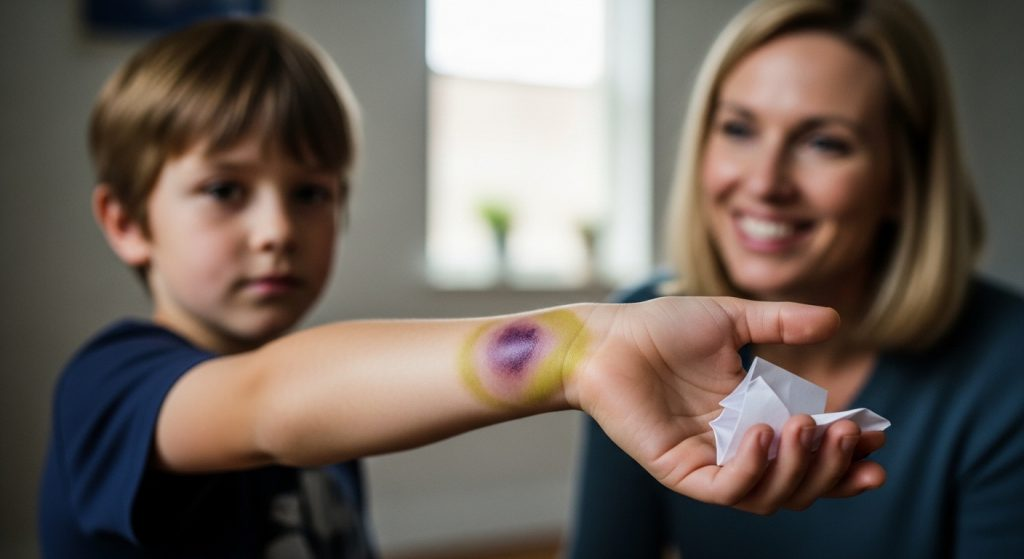
The air in the dining room smelled like organic lavender and freshly baked snickerdoodles, the kind of domestic perfection that usually made me feel instantly at ease.
But right then, all I could feel was the frantic, terrifying pulse of my own heartbeat drumming against my ribs.
Evelyn, the boy’s mother, was standing in the arched doorway of her immaculate Westport kitchen. She was holding a tray of iced lemonades, the glass pitchers sweating in the late afternoon heat. Her blonde hair was perfectly blown out, falling in soft waves over the collar of her cashmere cardigan.
She was smiling at me. It was a radiant, magazine-cover smile, full of straight white teeth and practiced warmth.
“You guys working hard in here?” she asked, her voice light and musical, chiming like the expensive crystal glasses on her tray.
“Just wrapping up fractions,” I said, forcing my voice to stay level, forcing the corners of my mouth to tilt upward.
I didn’t look down. I couldn’t.
If I looked down, Evelyn would see where my eyes were aimed. She would see that underneath the heavy mahogany dining table, her ten-year-old son, Leo, was pressing a small, crumpled square of lined notebook paper into my palm.
His hand was trembling so violently that I could feel the vibration through my skin.
His fingers were icy cold, slipping the paper against my lifeline with a desperate, terrifying urgency.
And just an inch above his small, pale hand, peeking out from the cuff of his oversized gray sweater, was the bruise.
It wasn’t a soccer bruise. I had been a middle school teacher and private tutor for eight years. I had seen every variation of turf burn, shin splint, and playground scrape imaginable. Kids collided, they tripped, they fell. They collected bruises like merit badges.
But gravity doesn’t leave perfect, oval-shaped indentations.
Turf doesn’t wrap entirely around a child’s narrow wrist, leaving a sickening constellation of purplish-black thumb and finger marks.
Someone had grabbed him. Someone had grabbed him hard enough to crush the delicate blood vessels beneath his skin, dragging him or holding him down.
“Here you go, Leo, sweetie,” Evelyn cooed, setting a glass down next to his math worksheet. She rested a hand softly on the back of his neck.
I saw Leo freeze. It was a microscopic movement, a sudden stiffening of his spine, his shoulders drawing up toward his ears like a turtle retreating into its shell.
“Thank you, Mom,” Leo whispered. He didn’t look up at her. He just stared blankly at the numerator on his paper.
My fingers curled tight around the hidden note, burying it deep in my fist. I slid my hand casually into the pocket of my slacks, praying the rustle of paper was masked by the clinking of ice cubes.
“He’s making great progress, Evelyn,” I lied smoothly, gathering my teaching materials. “We tackled least common denominators today. He’s a really focused kid.”
“Oh, Sarah, that’s just wonderful to hear,” Evelyn sighed, pressing a manicured hand to her chest. “We just want the best for him. You know how competitive the middle school track gets around here.”
She was perfect. The house was perfect. The manicured lawn, the shiny SUV in the driveway, the framed family portraits on the wall showing a smiling mother, a handsome father, and a bright-eyed boy on a ski trip in Aspen.
It was a masterclass in American suburban perfection.
And it was all a lie.
My name is Sarah. I’m thirty-two years old, and my life is entirely unremarkable, which is exactly how I prefer it.
I live in a small apartment complex in a neighboring town, driving my beat-up Honda Civic into these wealthy enclaves every afternoon to tutor the children of doctors, lawyers, and hedge fund managers. I teach them algebra, essay writing, and how to organize their binders.
I’m good at it. I’m patient. But more than that, I am observant.
You learn a lot about a family when you sit at their dining room table twice a week. You see the cracks in the porcelain. You hear the passive-aggressive arguments echoing from the master suite. You notice when the liquor cabinet starts emptying a little too fast.
Usually, I ignore it. I am paid fifty dollars an hour to fix math grades, not marriages.
But I carry a ghost with me.
His name was Tommy. Five years ago, in my second year as a full-time public school teacher, Tommy used to sit in the third row of my English class. He was a funny, loud, energetic kid who slowly, over the course of a brutal winter, went completely silent.
He started wearing heavy flannel shirts, even when the radiators in the classroom were blasting. He stopped turning in homework. He stopped looking me in the eye.
I asked him if he was okay. He said he was just tired.
I brought my concerns to Marcus, the school counselor. Marcus was a pragmatic, by-the-book guy who meant well but was utterly terrified of wealthy, litigious parents.
“Sarah,” Marcus had told me, leaning back in his leather chair and adjusting his glasses. “His dad is on the school board. His mom is a prominent real estate agent. Unless you have definitive proof, we cannot throw an accusation of abuse at that family. You’re going to ruin lives based on a hunch.”
So, I backed down. I convinced myself I was overreacting. I let the system handle it.
Two weeks later, Tommy didn’t show up for school. Or the next day. Or the next.
He ended up in the ICU with a ruptured spleen and three broken ribs. The father who sat on the school board had thrown him down a flight of carpeted stairs.
I quit teaching in the public system at the end of that semester. The guilt was a heavy, suffocating blanket that I couldn’t shake off. I started my private tutoring business so I could control my environment, keep my distance, and never, ever be responsible for missing the signs again.
My older brother, Dave, told me I was running away. Dave is an ex-cop, retired early after a bad shootout left him with a shattered knee and a quiet, functioning alcohol dependency.
“You can’t save everyone, Sar,” Dave had grumbled into his coffee mug just last week, sitting at my cramped kitchen island. “There are monsters in cheap trailers, and there are monsters in million-dollar mansions. You just gotta do your job and go home.”
But as I drove to the affluent Oak Ridge subdivision this afternoon, Dave’s words felt hollow.
Marcus—who had transitioned to a private educational consulting firm—had referred Leo’s family to me.
“Good family. Very well off,” Marcus had said over the phone. “The kid is slipping in math. Mother is highly involved. Easy gig, Sarah. Don’t overthink it.”
But I had been observing Leo for three weeks now, and my stomach had been in a slow, agonizing knot since day one.
Leo was painfully polite. He never complained, never fidgeted, never asked for breaks. He sat with a rigid, unnatural stillness that felt less like good behavior and more like a survival tactic.
He flinched when I reached out too quickly to hand him an eraser.
He apologized profusely, breathlessly, for getting a single multiplication problem wrong, his eyes darting toward the hallway where his mother’s footsteps usually echoed.
And then, today, the sleeve of his oversized sweater had caught on the spiral of his notebook. As he tugged it free, the fabric pulled back just enough.
That purplish-yellow ring of bruises.
When I asked him about it, casually, keeping my tone light—”Whoa, rough tackle at soccer practice?”—he hadn’t answered.
He just stared at me. His eyes, a pale, startling blue, were wide and hollow. It was the exact same look Tommy had given me five years ago. It was the look of a child who realizes they are drowning, and the adult in front of them doesn’t even see the water.
Except this time, I saw the water.
Back in the dining room, Evelyn was still talking about the PTA bake sale.
“We’re doing gluten-free this year,” she chuckled, her manicured fingers brushing a non-existent crumb off the pristine table. “You wouldn’t believe the drama it caused with the committee. Honestly, people get so worked up over nothing.”
“Absolutely,” I replied, standing up and slinging my tote bag over my shoulder. The paper in my pocket felt like a burning coal against my thigh. “Well, Leo did great. We’ll pick up with geometry on Thursday.”
“Can’t wait,” Evelyn smiled. “Say goodbye to Ms. Sarah, Leo.”
“Goodbye, Ms. Sarah,” Leo mumbled to the table.
“Bye, buddy. Good work today.”
I walked toward the heavy oak front door. Evelyn walked me out, chatting amiably about the unseasonable heat wave. I smiled, nodded, and played the part of the friendly neighborhood tutor perfectly.
As I stepped out onto the wide slate porch, the heavy door clicked shut behind me. The lock engaged with a loud, metallic thud.
The silence of the wealthy neighborhood rushed in. Lawn mowers hummed in the distance. The sun beat down on the freshly paved driveway.
I walked to my Civic. I didn’t run, though every muscle in my legs was screaming at me to sprint. I unlocked the door, slid into the driver’s seat, and slammed the door shut.
The heat inside the car was suffocating, but I didn’t turn on the engine. I didn’t roll down the windows.
My hands were shaking as I reached into my pocket.
I pulled out the crumpled piece of notebook paper. The edges were torn unevenly, as if it had been ripped from a binder in a blind panic.
I smoothed it out against the steering wheel. The graphite from the pencil was smudged, written in the clumsy, hurried block letters of a terrified ten-year-old boy.
There were only three sentences.
She’s not my mom. Please don’t tell him you saw this. He said he will bury me next to the real Leo.
The air vanished from the car.
A cold sweat broke out across the back of my neck, chilling me despite the baking heat of the interior.
I stared at the words until the graphite blurred. She’s not my mom.
I looked up through the windshield, staring at the massive, beautiful house. The pristine brick. The manicured roses. The white lace curtains hanging in the upstairs windows.
Behind one of those windows, a woman who smelled like lavender and baked cookies was living with a child who was wearing another boy’s name.
And somewhere in that house, or somewhere in the dark soil of that perfect, sprawling backyard, was the real Leo.
My phone buzzed in the cupholder, shattering the silence. It was an incoming call from Marcus.
I grabbed the phone, my thumb hovering over the green accept button.
You’re going to ruin lives based on a hunch, Marcus’s voice echoed in my memory. Definitive proof.
I looked down at the note again. This wasn’t a hunch. This was a nightmare hiding behind a picket fence.
I rejected the call. I didn’t need a bureaucrat right now. I needed someone who knew how to deal with monsters.
I pulled up my contacts and hit dial on my brother Dave’s number.
“Yeah?” Dave’s gruff voice answered on the second ring, accompanied by the background noise of a television sports broadcast.
“Dave,” I whispered, my voice finally cracking. “I need you. Right now. Tell me you’re sober.”
A long pause on the other end. The TV volume suddenly muted.
“I’m sober,” Dave said, his tone shifting instantly from annoyed to sharp, professional alertness. “Sarah, where are you? What’s going on?”
“I’m at the Oak Ridge subdivision,” I said, putting the car in drive, my eyes locked on the front door of the house. “And I think I just found a missing kid.”
Chapter 2
The drive from the Oak Ridge subdivision to the city limits was a blur of manicured lawns, wrought-iron gates, and towering oak trees that felt less like scenery and more like the bars of a gilded cage. I kept my eyes darting to the rearview mirror every ten seconds. A black SUV pulled out of a side street three blocks away from the Montgomery house, and for two terrifying miles, my heart hammered against my ribs, convinced it was them. Convinced he was coming for me.
It wasn’t until the SUV turned left toward the country club that I finally let out a breath I felt like I’d been holding since I walked out of that immaculate house.
I pulled into the parking lot of a dilapidated diner on the edge of the county line, a stark contrast to the world I had just left. The diner, affectionately known by locals as ‘The Rust Bucket,’ smelled of stale grease, burnt filter coffee, and the lingering phantom of indoor smoking. It was the kind of place where nobody looked at you twice, which was exactly what I needed.
I sat in my sweltering car for another five minutes, the AC struggling to combat the late afternoon sun. My hands were still shaking. The crumpled piece of notebook paper sat on my passenger seat like an unexploded bomb.
She’s not my mom. Please don’t tell him you saw this. He said he will bury me next to the real Leo.
I read the words again, the graphite smudged from the sweat of the boy’s palm. The handwriting was erratic, the letters pressing so hard into the cheap paper that they had nearly torn right through. It was the physical manifestation of sheer, unadulterated terror.
A sharp rap on my window made me jump, a choked gasp escaping my throat.
It was Dave.
He was standing outside the driver’s side door, his broad shoulders blocking out the glare of the sun. He wore a faded gray t-shirt and jeans, a dark scruff covering his jaw. His left leg, the one with the shattered knee, was locked straight, shifting his weight unevenly. He looked tired, older than his thirty-eight years, with dark bags under his eyes that spoke of too many sleepless nights and too many battles with the ghosts at the bottom of a bottle. But his eyes—pale green and sharp as cut glass—were alert. The ex-cop hadn’t died; he was just hibernating.
I rolled down the window. The oppressive summer heat rushed in, bringing with it the smell of exhaust fumes and hot asphalt.
“You look like you’re about to throw up or pass out, Sarah,” Dave said, his voice a low, gravelly rumble. He didn’t smile. He didn’t offer a brotherly greeting. He saw the panic in my eyes and instantly went into crisis mode. “Get inside. Booth in the back.”
I grabbed my purse, shoved the note deep into the zippered compartment, and followed him out of the glaring sun and into the dim, artificially cooled interior of the diner.
We slid into a cracked red vinyl booth at the very back, far away from the large front windows. A waitress who looked like she’d been working there since the Reagan administration silently dropped off two mugs of black coffee and walked away.
Dave took a sip of his coffee, wincing slightly at the bitterness, then leaned across the sticky Formica table.
“Talk to me,” he said softly, but with an intensity that commanded the room. “You said on the phone you found a missing kid. What the hell does that mean, Sar? Who did you find?”
My throat was dry, coated in a thick layer of dust and fear. I reached into my purse, my fingers trembling so badly I fumbled with the zipper. I pulled out the folded square of notebook paper and slid it across the table.
“His name is Leo,” I whispered, glancing around the empty diner out of pure paranoia. “Or, at least, that’s what they call him. He’s ten. I’ve been tutoring him in math for three weeks. The family… they’re perfect, Dave. Too perfect. Evelyn, the mother, is this Stepford-wife socialite. The house is a fortress of wealth. But the kid… he’s broken. I’ve felt it since day one. He’s terrified.”
Dave didn’t look at me. He unfolded the paper carefully, his large, calloused fingers treating the fragile sheet like a piece of critical evidence at a crime scene.
I watched his eyes scan the three lines of text. I watched the transformation happen in real-time. The tired, cynical, medically retired cop faded away, replaced by the hardened detective who used to break down doors in the narcotics division. His jaw clenched. The muscles in his neck pulled taut.
“Where did you get this?” Dave asked, his voice dropping an octave, turning flat and dangerous.
“He slipped it to me under the table,” I explained, the words tumbling out in a frantic rush. “His mother—Evelyn—was standing right there. She brought us lemonade. She was smiling, Dave. She was touching his neck, and he froze up like he was waiting to be struck. He slid this into my hand. And… and I saw his wrist.”
Dave’s eyes snapped up from the paper, locking onto mine. “What did you see?”
“Bruises,” I said, a sudden wave of nausea hitting me. I wrapped my hands around my hot coffee mug, trying to ground myself. “Dark, deep bruises. Finger marks. Thumbprints. Someone grabbed him hard enough to leave permanent damage. It wasn’t an accident. It wasn’t kids roughhousing. It was a grown man’s grip.”
Dave stared at the note again. He traced a finger lightly over the smudged graphite of the last line: He said he will bury me next to the real Leo.
“Jesus Christ,” Dave muttered, running a hand through his thinning hair. “You think the father killed their actual kid and replaced him?”
“I don’t know!” I cried, my voice pitching up before I quickly hushed myself. “I don’t know anything, Dave. But look at what it says. ‘She’s not my mom.’ Who is this kid? Where did he come from? If he’s not Leo Montgomery, then who the hell is sitting at that dining room table?”
Dave leaned back against the vinyl booth, crossing his arms over his chest. He was calculating. I could practically see the gears turning in his head, assessing the variables, the risks, the legal boundaries.
“Alright, let’s slow down,” Dave said, adopting his calm, authoritative police tone. The tone he used to de-escalate domestic disputes. It infuriated me. “We have a note from a ten-year-old kid. Kids have wild imaginations, Sarah. They say crazy things to get attention, especially if they’re struggling in school or feeling pressured by high-achieving parents.”
“Don’t do that,” I snapped, slamming my hand on the table. The coffee in the mugs sloshed over the rims. “Do not sit there and patronize me. I know what a cry for attention looks like. I know what an overactive imagination looks like. This isn’t a game of pretend, Dave. He is terrified for his life. And the bruises were real.”
“I’m not patronizing you, Sar,” Dave sighed, holding his hands up in surrender. “I’m telling you what Child Protective Services is going to say. I’m telling you what the local PD is going to say. You call them right now, what happens? They send a social worker to a two-million-dollar estate in Oak Ridge. The parents hire a high-powered attorney before the social worker even gets to the front porch. The kid gets terrified, retracts the story, says he made it up because he didn’t want to do math homework. And then what? They pull him out of tutoring, you never see him again, and if this guy is as dangerous as the note implies… the kid pays the price for your phone call.”
The air left my lungs. He was right. God, I hated that he was right.
Suddenly, the diner faded away. I wasn’t smelling stale grease anymore; I was smelling the harsh, sterile bleach of the county hospital. I was twenty-seven again, standing in the pediatric intensive care unit, looking through a glass window at Tommy. He had looked so small wrapped in all those white bandages. The rhythmic beep of the heart monitor was the only sound in the room. I had trusted the system. I had gone to the counselor. The counselor had called the home. And Tommy’s father had nearly beaten him to death for telling the teacher his secrets.
Tears pricked the corners of my eyes, hot and angry. “I can’t let it happen again, Dave,” I whispered, my voice breaking. “I can’t. If I walk away from this, and something happens to him… I won’t survive it. I’ll take a gun and handle it myself.”
Dave’s eyes softened. He reached across the table and placed his large, warm hand over my trembling ones. For a moment, he wasn’t the ex-cop, and I wasn’t the traumatized teacher. We were just brother and sister, clinging to each other in the wreckage of a cruel world.
“Nobody is walking away,” Dave said firmly, his thumb rubbing the back of my hand. “I promise you, Sarah. We are not walking away. But we are going to do this smart. We don’t kick the hornet’s nest until we know exactly how many stingers are inside.”
He let go of my hand, grabbed the note, and folded it carefully, slipping it into his own shirt pocket.
“Finish your coffee,” he ordered, sliding out of the booth. “We’re going to my place. We need to find out exactly who Richard and Evelyn Montgomery are. And more importantly, we need to find out who the hell they buried.”
Dave’s apartment was exactly what you would expect from a divorced, medically retired detective battling a mild drinking problem. It was a one-bedroom walk-up above a dry cleaner in the gritty part of town. The air inside smelled of dust, old leather, and a faint undertone of cheap whiskey. Stacks of old case files—unofficial copies he had smuggled out before his retirement—were piled precariously on the coffee table alongside empty takeout containers.
But his desk in the corner was immaculate. It held a high-end dual-monitor computer setup, the glowing screens casting a harsh blue light across the dim room.
Dave booted up the computer, his fingers flying across the keyboard with practiced speed. He bypassed the standard Google searches and logged into a series of proprietary databases he still had access to—friends in low places, he called it.
I stood behind his rolling chair, wrapping my arms tightly around my chest, shivering despite the stuffy heat of the apartment.
“Okay, give me the details,” Dave grunted, his eyes scanning the scrolling text. “Richard and Evelyn Montgomery. Oak Ridge subdivision, Westport. Do you know what he does for a living?”
“Marcus—the consultant who hired me—said Richard is in finance. Private equity, I think. Mergers and acquisitions,” I supplied, trying to remember the brief intake form I had skimmed three weeks ago. “He travels a lot. I haven’t actually met him yet. He’s always been ‘on a business trip’ when I’ve been there.”
“Alright, let’s see,” Dave muttered. The keyboard clacked loudly in the quiet room. “Got ’em. Richard Thomas Montgomery. Age forty-two. Evelyn Rose Montgomery, maiden name Vance. Age thirty-nine. They bought the Oak Ridge property two years ago. Paid in cash. Three point two million.”
“Cash?” I asked, my eyebrows raising.
“Finance guys make bank,” Dave said dismissively. “Let’s look at their history. Before Connecticut… they lived in Seattle, Washington. Medina neighborhood. Another rich zip code. Lived there for six years.”
“What about the son?” I pressed, stepping closer to the screen. “Look for Leo.”
Dave navigated to a different database, pulling up vital records from Washington state. The screen flickered, loading a digital copy of a birth certificate.
“Here we go,” Dave said, pointing a thick finger at the screen. “Leo James Montgomery. Born August 14th, 2016. Hospital in Seattle. Parents listed as Richard and Evelyn. The age matches up. The kid you’re tutoring is ten, right?”
“Yes,” I said, a cold knot forming in my stomach. “So… Leo Montgomery is a real person.”
“He was born, at least,” Dave corrected darkly. He started typing again. “Let me check national death registries. If the real Leo died, and they didn’t report it… or if they did report it and adopted a lookalike…”
We waited in agonizing silence as the database searched across state lines. The little loading icon spun and spun, mocking my rising panic.
No records found.
“No death certificate,” Dave announced, leaning back in his chair. He rubbed his chin, the stubble making a scratching sound. “Legally, Leo Montgomery is alive and well.”
“But the boy in the note said he isn’t,” I argued, pointing at Dave’s shirt pocket where the paper was hidden. “He said he’s going to be buried next to the real Leo. Why would he say that if he is Leo?”
“Because he’s not,” Dave said quietly. He minimized the database and opened a social media scraping tool. “If you have enough money, Sarah, you can buy a lot of things. You can buy a house in cash. You can buy silence. And you can buy a kid off the grid.”
The screen populated with images. Evelyn’s Instagram account was private, but Dave had ways around that. He pulled up an archive of her posts from four years ago, back when they lived in Seattle.
It was a grid of perfection. Evelyn in designer dresses. Richard, a tall, imposing man with sharp features and cold, dark eyes, wearing expensive tailored suits. And interspersed between the yacht trips and charity galas were pictures of a little boy.
“Look closely,” Dave instructed, clicking on a photo of the family at a ski resort. The boy in the photo was bundled in a heavy parka, grinning at the camera, missing a front tooth. He had blonde hair and bright blue eyes.
I leaned in until my nose was almost touching the monitor. I studied the boy’s face. The slope of his nose. The shape of his jaw. The spacing of his eyes.
“It looks like him,” I admitted, my heart sinking. “Dave, it looks exactly like the boy I tutor. The hair, the eyes… it’s a perfect match.”
“Look closer, Sarah,” Dave insisted, his cop instincts flaring. He zoomed in on the boy’s face, pixelating the image slightly. “You see this kid twice a week. You sit three feet away from him. Look at the details. Not the broad strokes. The details.”
I closed my eyes, summoning the image of the terrified boy sitting at the mahogany dining table just two hours ago. I remembered the way his hair fell over his forehead. I remembered the pale, almost translucent quality of his skin. I remembered the way his eyes looked when he handed me the note.
I opened my eyes and looked at the screen again.
And then, I saw it.
“The earlobe,” I gasped, pointing a trembling finger at the monitor.
“Bingo,” Dave said softly.
In the photograph from four years ago, the real Leo Montgomery had attached earlobes—the skin connected smoothly to the side of his head.
The boy sitting in my tutoring sessions, the boy with the bruised wrist and the desperate, pleading eyes… his earlobes were detached, hanging free in a distinct, rounded curve.
It was a microscopic difference. A genetic marker that no one would ever notice unless they were looking for it. Unless they were sitting across a table from him, watching him flinch at his mother’s touch.
“They’re different kids,” I whispered, stumbling back a step. The air left my lungs again. The room suddenly felt like a centrifuge, spinning wildly out of control. “Dave… they replaced him. They replaced their own son.”
“Or their son died, and they couldn’t face the social scandal, so they bought a replica,” Dave theorized, his face grim. “Or something much, much darker happened in Seattle.”
“We have to call the police,” I urged, grabbing his shoulder. “Dave, this is kidnapping. This is… God knows what this is. We have proof now. We have the photo.”
“An earlobe isn’t probable cause, Sarah,” Dave shot back, turning to face me. “A defense attorney would laugh a judge out of the room. ‘Oh, the angle of the photo is weird,’ ‘Kids grow and change,’ ‘The tutor is a disgruntled, hysterical woman.’ They will bury you, Sarah. And while they’re burying you in court, Richard Montgomery will make that little boy disappear. Forever.”
The sheer horror of his words slammed into me like a physical blow. I sank onto the edge of his worn-out sofa, burying my face in my hands. The image of Tommy’s bruised, broken body flashed behind my eyelids, instantly followed by the image of the new boy, writing that note with a trembling hand.
He said he will bury me next to the real Leo.
“So what do we do?” I asked, my voice muffled by my hands. I sounded like a lost, terrified child. “Do we just let him go back to that house? Do I just go back on Thursday and teach him fractions while that monster holds a shovel over his head?”
Dave was silent for a long moment. I heard the clink of glass, the sound of him pouring a finger of whiskey into a dirty tumbler. I didn’t scold him. If there was ever a time to drink, it was now.
“I have a friend,” Dave finally said, his voice rough with alcohol and exhaustion. “Detective Frank Miller. He’s still on the force in Westport. He’s a good cop. Burned out, cynical, but good. He owes me his career. I’m going to call him. I’m going to ask him to run a quiet, off-the-books background check on Richard Montgomery. See if there were any sealed investigations in Seattle. Any rumors, any whispers, any domestic disturbance calls that got swept under the rug.”
“And until then?” I asked, looking up at him.
Dave took a slow sip of his whiskey, his green eyes locking onto mine with a terrifying intensity.
“Until then, you go back on Thursday,” he said. “You play the perfect tutor. You smile at Evelyn. You don’t let on that you know a damn thing. But you watch, Sarah. You watch everything. You look for cameras. You look for locked doors. And you find a way to let that boy know that he is not alone. But you do not, under any circumstances, let Richard Montgomery know you’re onto him.”
The next forty-eight hours were a waking nightmare.
I couldn’t eat. I couldn’t sleep. Every time I closed my eyes, I saw a nameless little boy buried in the dark, damp earth beneath a bed of manicured roses. I obsessively checked my phone, waiting for an update from Dave, but his texts were short and frustratingly vague.
Miller is digging. Nothing concrete yet. These people are ghosts on paper. Be careful tomorrow.
When Thursday afternoon arrived, a suffocating blanket of dread settled over my shoulders as I drove my battered Civic back into the Oak Ridge subdivision. The sun was beating down relentlessly, turning the interior of the car into a furnace, but I was shivering.
I pulled into the Montgomery driveway. The pristine landscaping, the towering oak trees, the imposing brick facade—it didn’t look like a magazine cover anymore. It looked like a mausoleum.
I took a deep, shuddering breath, pasted a bright, fake smile on my face, and grabbed my tote bag.
Play the part. Don’t let them see you sweat.
I walked up the slate path and rang the doorbell. It chimed deep within the house, a melodic, cheerful sound that made my skin crawl.
The heavy oak door swung open, but it wasn’t Evelyn standing there with a tray of lemonade.
It was a man.
He was tall, easily six-foot-three, with the broad, muscular build of someone who spent two hours in a private gym every morning. He was wearing an impeccably tailored navy suit, the tie loosened slightly at his throat. His hair was dark, styled with expensive product, but it was his eyes that stopped my heart in its tracks.
They were the exact eyes from the photograph Dave had shown me. Dark, flat, and entirely devoid of warmth. They were the eyes of an apex predator looking at a rabbit.
“You must be Sarah,” he said. His voice was a rich, smooth baritone, polished to a mirror shine. It was a voice used to commanding boardrooms and intimidating rivals.
“I am,” I managed to say, my vocal cords tight. I extended a hand, forcing my muscles to remain steady. “It’s a pleasure to meet you, Mr. Montgomery. I’m Leo’s tutor.”
He took my hand. His grip was firm, powerful, and he held on for a fraction of a second too long. His skin was ice cold.
“Richard,” he corrected smoothly, his lips curving into a smile that didn’t reach his eyes. “Evelyn has told me wonderful things about you. She says Leo is making excellent progress.”
“He’s a very bright boy,” I said, finally pulling my hand free. I resisted the urge to wipe my palm on my slacks. “He just needs a little extra guidance with the foundational concepts.”
“Yes, well,” Richard said, stepping aside to let me into the cavernous foyer. The air conditioning hit me like a physical wall, chilling the sweat on the back of my neck. “We demand excellence in this house, Sarah. Potential is useless if it isn’t realized. I’m sure you understand.”
“Of course,” I nodded, keeping my eyes fixed on his chin. If I looked into his eyes, he would see the terror. He would see that I knew.
“Leo is waiting in the dining room,” Richard said, gesturing down the wide, hardwood hallway. “I’ll be working in my office down the hall. If you need anything… don’t hesitate to ask.”
I walked past him, every instinct in my body screaming to turn around and run out the open front door. I could feel his eyes on my back, tracking my movements, heavy and calculating.
When I entered the dining room, my heart broke all over again.
The boy was sitting in his usual spot at the massive mahogany table. He was wearing a long-sleeved polo shirt today, buttoned all the way up to his collarbone, hiding every inch of his skin. His posture was painfully rigid, his hands folded neatly on top of his closed math workbook.
He didn’t look up when I walked in. He just stared at the polished wood of the table.
“Hi, Leo,” I said softly, setting my tote bag down. I pulled out my chair and sat next to him, keeping my voice light, keeping the terrifying reality locked away in my chest. “Ready to tackle some geometry today?”
He gave a tiny, almost imperceptible nod.
I opened the workbook, my hands moving mechanically. I began to explain the concept of calculating the area of a triangle, pointing to the diagrams with my pen.
For the first twenty minutes, it was agonizingly normal. I spoke. He listened. He wrote down the answers with robotic precision. But the silence in the house was deafening. There was no Evelyn humming in the kitchen. There was no clinking of ice.
There was only the heavy, oppressive presence of Richard Montgomery, sitting in an office just thirty feet away.
I needed to communicate with the boy. I needed to let him know I got the note. I needed to know his real name. But Dave’s warning rang in my ears: You look for cameras.
I casually dropped my pen, letting it roll off the table and onto the plush Persian rug.
“Oops,” I whispered.
I leaned down to pick it up, using the moment beneath the table to scan the room. Above the antique china cabinet in the corner, a tiny, black dome was mounted flush against the ceiling. A camera. And it was pointed directly at the dining table.
My blood ran cold. He wasn’t just sitting in his office. He was watching us. Listening to us.
I sat back up, keeping my face perfectly neutral. I smoothed my skirt and picked up my pen.
“Okay, let’s look at problem number four,” I said aloud, my voice steady, professional.
I slid the workbook toward him. As I did, I took my pencil and wrote a single, tiny word in the margins of the page, right next to the triangle diagram.
I know.
I quickly erased it, leaving only a faint smudge, but I made sure he saw it.
The boy’s breath hitched. It was a microscopic intake of air, but I heard it. His pale blue eyes darted up to meet mine for a fraction of a second. The sheer volume of grief, terror, and desperate hope in that single glance nearly broke me in half.
He looked back down at the paper. His hand trembled as he picked up his pencil.
He pretended to work out the math problem. But beneath the equation, pressing hard enough to leave an indentation but light enough not to leave graphite, he traced three letters onto the paper.
S – A – M
Sam. His name was Sam.
A heavy footstep echoed in the hallway. The slow, deliberate sound of leather shoes on hardwood.
Sam froze, his pencil snapping against the paper. The color drained completely from his face, leaving him looking like a ghost.
Richard Montgomery appeared in the arched doorway of the dining room. He leaned against the frame, his arms crossed over his chest, a dark, unreadable expression on his face.
“How are we doing in here?” Richard asked, his smooth voice slicing through the tense air like a razor blade.
I forced myself to look up at him, summoning every ounce of false confidence I possessed.
“We’re doing great, Richard,” I said, smiling brightly. “Leo is grasping the concepts perfectly. He’s a very fast learner.”
Richard’s eyes flicked from me to the boy. Sam was staring at the table, trembling so visibly now that the entire heavy mahogany table seemed to vibrate.
“Is that so?” Richard murmured. He slowly uncrossed his arms and took a step into the room. “I’m glad to hear it. Because as I said, Sarah… we don’t tolerate failure in this family. We fix our mistakes.”
He walked up behind Sam’s chair. He placed a large, heavy hand on the boy’s shoulder.
I saw Sam suppress a whimper, his eyes squeezing shut.
Richard looked at me, his dark eyes boring into my soul, stripping away the polite facade of the neighborhood tutor, letting me see the monster hiding beneath the tailored suit.
“Isn’t that right, Leo?” Richard whispered, his fingers tightening on the boy’s shoulder.
“Yes, sir,” the boy whispered back, a tear slipping down his pale cheek.
Richard smiled at me. A cold, terrifying smile.
“We’ll see you on Tuesday, Sarah,” he said softly. “Drive safe. It’s a dangerous world out there.”
Chapter 3
I didn’t run to my car. I walked.
Every single muscle fiber in my body was screaming at me to sprint, to abandon my heavy tote bag, to tear across the manicured lawn and throw myself into the driver’s seat. But I knew the camera in the dining room wasn’t the only one. A man like Richard Montgomery—a man hiding a secret that monstrous—would have eyes everywhere.
So, I forced my legs to move at a casual, measured pace. I dug my keys out of my purse with steady hands. I unlocked the beat-up Civic, tossed my bag onto the passenger seat, and slid behind the wheel. I didn’t look back at the house. I didn’t glance at the upstairs windows.
I started the engine, put the car in reverse, and backed out of the driveway.
It wasn’t until I had navigated out of the Oak Ridge subdivision, passed the heavy wrought-iron gates, and merged onto the interstate that the adrenaline finally broke.
I pulled over onto the gravel shoulder, slamming the car into park. The hazard lights clicked rhythmically, the only sound in the suffocating heat of the cabin. I gripped the steering wheel so hard my knuckles turned a sharp, bruised white, and I finally let myself shatter.
I gasped for air, dry-heaving over the center console, my chest tight with a panic so profound it felt like a heart attack.
Sam.
His name was Sam.
I closed my eyes and saw the desperate, microscopic movement of his pencil. I saw the tear sliding down his pale cheek when Richard’s massive hand clamped down on his shoulder. I felt the ice-cold terror radiating off the boy, a silent, agonizing scream trapped beneath the collar of his heavy polo shirt.
We fix our mistakes. Richard’s voice echoed in the cramped space of my car, slick and poisonous.
He knew. He didn’t know exactly what I had seen, but he knew I was an anomaly in his perfectly controlled environment. He was testing me. He was warning me.
I grabbed my phone from the cupholder. My fingers were slick with cold sweat as I dialed Dave’s number.
He picked up on the first ring. “Talk to me. Are you out of the house?”
“I’m out,” I choked, my voice raw and broken. “Dave, I’m out, but it’s worse. It’s so much worse.”
“Deep breaths, Sarah,” Dave said, his tone instantly shifting into the calm, rhythmic cadence of a hostage negotiator. “Where are you? Are you being followed?”
I looked in the rearview mirror. Just a steady stream of minivans and commuter sedans flying past on the highway. “No. I’m on I-95, pulled over on the shoulder. Dave, there are cameras. He has a camera hidden in the dining room, watching the table. He was in his office the whole time, watching us.”
A sharp curse hissed through the phone speaker. “Did you say anything? Did you react?”
“No. I dropped my pen to check under the table and saw the lens. I kept my face blank. But Dave… I got him to tell me his name. I wrote ‘I know’ in his math book, and he traced his real name underneath a geometry problem. It’s Sam. His name is Sam.”
The line went silent for a long, heavy moment. Hearing the boy’s actual name stripped away the final layer of ambiguity. He wasn’t just ‘the boy’ anymore. He was Sam. A real child with a real identity, stolen from somewhere and trapped in a mausoleum of wealth.
“Okay,” Dave said, his voice dropping to a dangerous, gravelly register. “Get off the highway. Come straight to my apartment. Don’t go to your place. Just come here. I have someone you need to meet.”
When I pushed open the heavy wooden door to Dave’s apartment, the smell of stale cigarette smoke and strong, black coffee hit me like a physical wall.
Dave was sitting at his cluttered kitchen island, a topographical map of the county spread out in front of him. Sitting across from him, hunched over a steaming mug, was a man I had never seen before.
He looked to be in his late fifties, wearing a cheap, rumpled gray suit that hung loosely on his gaunt frame. His face was weathered, lined with deep creases, and he had the exhausted, cynical eyes of a man who had spent three decades staring at the absolute worst parts of humanity.
“Sarah,” Dave said, standing up. His bad knee popped loudly in the quiet room. “This is Detective Frank Miller. Westport PD.”
Miller didn’t stand. He just raised a hand, his eyes scanning me up and down, assessing me in a way that made me feel entirely transparent.
“Have a seat, Ms. Davis,” Miller said, his voice raspy, like he’d swallowed a handful of gravel. “Your brother tells me you’ve got a hell of a situation on your hands.”
I dropped my tote bag by the door and walked over to the island, pulling up a rickety barstool. My legs were still shaking. “It’s not a situation, Detective. It’s a hostage crisis. The boy’s name is Sam. Richard Montgomery knows I’m suspicious. He threatened me today.”
Miller took a slow sip of his coffee. He didn’t look surprised. He didn’t look skeptical. He just looked impossibly tired.
“Dave asked me to do some off-the-books digging on Richard and Evelyn Montgomery,” Miller began, leaning back on the stool and crossing his arms. “You were right, Sarah. These people are ghosts. On paper, they are the model American family. Generous political donors, perfect credit, no criminal records. But when you have that kind of money, you don’t get a criminal record. You get a fixer.”
“What did you find?” I asked, my heart hammering against my ribs.
Miller reached into his suit jacket and pulled out a manila envelope, tossing it onto the map between us.
“I made a few calls to some old buddies in the Seattle PD,” Miller said. “It took a lot of calling in favors to even get a whisper of this, because the files were sealed tighter than a submarine. Four years ago, when the Montgomerys lived in Medina, Washington, there was an incident.”
I stared at the manila envelope. It felt radioactive.
“What kind of incident?”
“A 911 call from a neighbor,” Miller explained. “The neighbor reported hearing a woman screaming, followed by a series of loud crashes from the Montgomery estate. By the time patrol cars arrived, Richard Montgomery met them at the gate. Calm, collected, wearing a tuxedo. He said his wife had a panic attack and dropped a tray of glassware. He refused to let the officers inside without a warrant. Because of who he was, and because they didn’t have probable cause, the cops left.”
“And?” I prompted, the dread pooling in my stomach.
“And,” Miller continued grimly, “three days later, the Montgomerys’ private pediatrician filed a report stating that four-year-old Leo Montgomery had tragically fallen from a second-story balcony inside the home. The boy suffered massive head trauma. He died in a private, high-end clinic before he could even be transferred to a public hospital.”
The air left my lungs. The room spun. I gripped the edge of the kitchen island to keep from falling out of the chair.
“He killed him,” I whispered, the words tasting like ash in my mouth. “Richard killed his own son.”
“Or Evelyn did, and Richard covered it up,” Dave interjected darkly, leaning against the counter. “Or they were both neglecting him. We don’t know the mechanics. But the result is the same.”
“Here’s where it gets complicated,” Miller said, tapping the envelope. “There was no police investigation into the death. The private clinic’s medical examiner signed off on it as a tragic accident. The body was cremated within forty-eight hours. No autopsy by the state. No public obituary. A week later, Richard and Evelyn Montgomery liquidated their Seattle assets, packed up, and vanished. They moved to a private, gated compound in rural Montana for eight months. They told their social circle they were taking time off to grieve in private.”
I looked from Miller to Dave, the pieces snapping together in my mind to form a picture so horrifying my mind instinctively wanted to reject it.
“But they didn’t just grieve,” I said, my voice trembling. “They went shopping.”
“Exactly,” Miller nodded, a grim respect in his eyes. “When they re-emerged from Montana and moved here to Connecticut, they had a son with them. A boy who looked remarkably like the child they had lost. They just told everyone the rumors of his death were exaggerated, that it was a severe injury, not a fatality, and they had kept him isolated for his recovery.”
“And nobody questioned it?” I asked, outrage flaring hot in my chest. “Nobody asked why his earlobes were different? Nobody asked why he was suddenly terrified of his own shadow?”
“People see what they want to see, Sarah,” Dave said quietly. “Wealth is a hell of an illusion. If a guy in a tailored suit tells you his kid recovered from a traumatic brain injury and is just a little quiet now, you nod, smile, and invite him to the country club. You don’t ask to check the kid’s DNA.”
“Which brings us to our problem,” Miller said, leaning forward, his demeanor shifting from storyteller to tactician. “I believe you, Sarah. I believe your brother. I believe this kid is not Leo Montgomery. But belief doesn’t hold up in court. I cannot walk into a judge’s chambers and ask for a search warrant based on a smudged note, a tutor’s intuition, and a zoomed-in photo of an earlobe. Richard Montgomery’s lawyers would have my badge on a platter before I even finished typing the affidavit.”
“So we get proof,” I said fiercely, slamming my hand on the table. The sudden burst of aggression surprised even me, but I was thinking of Tommy. I was thinking of the way I had let the rules dictate my actions, only to end up visiting a broken child in the ICU. I was not playing by their rules anymore. “Tell me what you need, Miller. You need DNA? You need a confession? What is the golden ticket?”
Miller looked at me, a flicker of genuine surprise crossing his worn face. He glanced at Dave.
“She’s a stubborn one,” Miller muttered.
“Runs in the family,” Dave replied, crossing his arms. “Tell her the plan, Frank.”
Miller sighed, pulling a small, plastic ziplock bag from his pocket. Inside was a sterile, individually wrapped cotton swab.
“I need a DNA sample from the boy,” Miller said, sliding the bag across the island toward me. “A hair follicle with the root attached, a swab of saliva, blood. Something. I have a buddy who runs an independent lab in Boston. If I can get him a clean sample from the kid, and secretly cross-reference it against the genetic markers of Richard and Evelyn Montgomery… I can prove mathematically that the boy is not their biological child. Once I have that piece of paper, I have probable cause. I can kick their front door off its hinges with a SWAT team.”
I stared at the plastic bag. It was so small. So clinical. But it was the key to unlocking Sam’s cage.
“I can do that,” I said, my voice rock steady.
“Sarah, hold on,” Dave warned, stepping forward. “Think about what happened today. Richard knows you’re sniffing around. He was watching you on camera. He came out to intimidate you. If you go back in there and he catches you swabbing this kid’s cheek, he won’t just fire you. Men like him don’t leave loose ends.”
“I am not leaving Sam in that house!” I yelled, standing up so fast my stool scraped violently against the floorboards. “Do you understand me? I don’t care about the risk. I don’t care about Richard Montgomery’s money. That boy is sleeping in a house with a man who murdered his own son and threatened to bury him next. I am going back on Thursday, and I am getting that sample.”
Dave stared at me, his jaw clenched tight. He knew he couldn’t stop me. He knew about the ghosts I carried, and he knew that if he tried to physically bar the door, I would fight him.
“Okay,” Dave finally said, letting out a long, heavy breath. He turned to Miller. “She goes in on Thursday. But we need a cover story. A distraction. Something that gets the camera off her and the boy.”
We spent the next four hours detailing the plan. We didn’t leave a single variable to chance. Dave gave me a small, secondary cell phone, a burner, programmed only with his and Miller’s numbers. He showed me how to conceal it in the lining of my tote bag.
We mapped out the blind spots in the Montgomery dining room based on my memory of the camera’s position. We rehearsed exactly how I would offer Sam a specific bottle of water, how I would casually take it back, and how I would extract the DNA without drawing the lens’s attention.
When I finally left Dave’s apartment, it was well past midnight. The city was quiet, but my mind was screaming.
The days leading up to Thursday were a masterclass in psychological torture.
I went through the motions of my life. I tutored two other students, forcing myself to smile, forcing myself to explain algebra while my brain was constantly running simulations of the Oak Ridge house. I barely slept. I ate mechanically.
When Thursday afternoon finally arrived, the sky over Connecticut had turned the color of a bruised plum. A heavy, oppressive summer thunderstorm was rolling in from the coast. The air pressure dropped, making everything feel tight and suffocating. It matched the violent knot in my stomach perfectly.
I parked my Civic in the Montgomery driveway. The pristine landscaping looked eerie under the dark, bruised clouds.
I had the plan memorized. I had a brand-new, sealed bottle of expensive Fiji water in my tote bag. The ziplock bag with the sterile swab was hidden inside my eyeglass case.
I walked up to the heavy oak door and rang the bell.
A crack of thunder echoed in the distance, a low, ominous rumble.
The door opened.
It wasn’t Richard. It was Evelyn.
But it wasn’t the Evelyn I knew.
The magazine-cover perfection was completely gone. Her blonde hair, usually blown out to perfection, was pulled back in a messy, frantic knot. She was wearing a loose silk robe over a pair of yoga pants, completely inappropriate for a mid-afternoon tutoring session.
But it was her face that shocked me the most. She looked ten years older. Her skin was sallow, the dark circles under her eyes prominent and heavy. She was clutching a heavy crystal glass filled with amber liquid, and her hand was shaking so badly the ice cubes were clinking together like chattering teeth.
“Evelyn?” I asked, feigning innocent surprise. “Is everything okay?”
She blinked at me, her eyes bloodshot and unfocused. For a terrifying second, I thought she was going to turn me away, telling me the session was canceled. If she did that, the plan was dead.
“Sarah,” she mumbled, her words slightly slurred. The smell of high-end bourbon rolled off her breath, thick and sweet. “Yes. Yes, come in. The weather… it always gives me a terrible migraine.”
“I completely understand,” I said smoothly, stepping past her into the foyer.
The house felt different today. It felt frantic. Unhinged. The chilling, controlled silence of Richard’s presence was absent, replaced by a chaotic, erratic energy emanating entirely from Evelyn.
“Is Richard home?” I asked casually as she locked the door behind me.
Evelyn let out a harsh, bitter laugh that sounded like tearing silk. “Richard? No. Richard is running errands. Making… arrangements. He’ll be back soon.”
Arrangements. The word sent a shard of ice straight through my heart.
“Well, Leo and I will just get straight to work, then,” I said, clutching my tote bag tighter.
“He’s in the dining room,” Evelyn said, waving her glass vaguely toward the hallway. She took a large gulp of the bourbon, her eyes vacant. As I walked away, I heard her whisper to herself, “It wasn’t supposed to be like this. We just wanted a family.”
I froze for a microsecond, the confession hanging in the air, but I didn’t stop. I couldn’t afford to engage her. Not now.
I entered the dining room. Sam was sitting in his usual spot. He looked even worse than Tuesday. The dark circles under his eyes rivaled Evelyn’s, and he was staring at his blank notebook with a look of utter, hollow defeat.
I sat down next to him. I didn’t look at the camera in the corner, but I could feel its lens boring into the back of my skull.
“Hi, Leo,” I said cheerfully, pulling out my materials.
He didn’t respond. He just kept staring at the paper.
“Rough day?” I asked, sliding the math workbook toward him.
Underneath the table, hidden from the camera’s view, I rested my hand on his knee. I squeezed gently.
Sam flinched, then looked at me. The terror in his eyes was absolute.
I reached into my tote bag and pulled out the bottle of Fiji water. I unscrewed the cap, taking a small, deliberate sip myself to show it was safe, then set it down directly in front of him.
“You look thirsty, buddy,” I said aloud. “Have some water.”
I slid my hand back under the table and tapped a frantic, rhythmic sequence on his knee. Drink. Please drink.
Sam stared at the water bottle. He hesitated. He knew there was a reason I was giving it to him. He knew everything in this house was a test.
Slowly, with trembling hands, he reached out, picked up the bottle, and took a long, desperate drink. His lips pressed firmly against the plastic rim.
“Good,” I said smoothly, taking the bottle back and capping it tightly. I didn’t put it back in the bag yet. I left it on the table, casually near my own materials.
Now came the hard part. The camera was recording everything. I couldn’t just swab the bottle in front of the lens.
“Okay, let’s look at chapter four,” I said, opening the textbook. “We’re moving on to fractions.”
For twenty minutes, we worked. Or rather, I talked, and Sam mechanically wrote down numbers. The tension in the room was unbearable. Every creak of the floorboards upstairs, every crack of thunder outside, made my heart skip a beat.
I needed a blind spot. I needed to drop my bag, obscure the camera’s view of the table with my body, and swab the rim of the bottle.
I shifted my weight, preparing to execute the maneuver Dave and I had practiced.
And then, the heavy front door slammed open, shaking the entire house.
The sound of heavy, rapid footsteps echoed in the foyer, followed by Evelyn’s startled gasp and the shatter of crystal against hardwood.
“Pack his bags!” Richard’s voice roared through the house, completely devoid of his usual polished veneer. It was the raw, primal yell of a cornered animal. “Right now, Evie! Get off the floor and pack his bags!”
Sam gasped, dropping his pencil. He curled into himself, bringing his knees up to his chest right there in the dining chair.
I stood up, my heart hammering a frantic rhythm against my ribs. I grabbed the water bottle and shoved it deep into my tote bag, zipping it shut.
Richard rounded the corner and stormed into the dining room. He wasn’t wearing a suit today. He was wearing dark jeans and a black jacket, his face flushed, his hair unkempt. He looked dangerous. He looked lethal.
He stopped dead when he saw me standing there.
The silence that followed was heavier than the thunderstorm outside.
“Sarah,” Richard said, his chest heaving as he caught his breath. His eyes darted from me, to Sam, to my zipped tote bag. The apex predator was assessing the threat.
“Richard,” I said, fighting to keep my voice from shaking. I forced a look of mild, professional confusion onto my face. “Is everything alright? We were just finishing up the lesson.”
Richard took a slow, deliberate step into the room. The polished facade was completely gone. I was looking into the eyes of a man who had killed once to protect his secret, and was entirely prepared to do it again.
“The lesson is over,” Richard said, his voice dropping to a terrifyingly calm, dead whisper. “We’re leaving.”
“Leaving?” I asked, my blood turning to ice. “For a vacation?”
“A permanent one,” Richard said, his eyes locking onto mine. He stepped closer, invading my personal space, towering over me. I could smell the metallic tang of adrenaline and expensive cologne. “There’s been a change of plans. A rather sudden business opportunity in Europe. We leave tonight. Leo will not be needing your services anymore.”
Tonight.
The timeline hadn’t just accelerated; it had collapsed entirely. There was no time for Miller’s lab in Boston. There was no time for warrants. If Richard got Sam on a private plane tonight, the boy was dead. He would disappear over the Atlantic, another tragic ‘accident,’ and Richard Montgomery would buy another quiet estate in another country.
“I see,” I said, gripping the handle of my tote bag so tightly my fingernails dug into my palms.
“So, if you’ll excuse us,” Richard said, gesturing toward the arched doorway with a mocking, cruel sweep of his hand. “We have a flight to catch. You can see yourself out, Sarah.”
He turned away from me, reaching down and grabbing Sam by the collar of his shirt, hauling the terrified boy to his feet. Sam let out a sharp, breathless whimper, his eyes silently pleading with me as his feet scrambled against the Persian rug.
Dave had told me to observe. Miller had told me to get the DNA and get out. They told me to play it smart, to let the system work.
But as I watched Richard drag that broken, terrified boy toward the hallway, the system burned to ash in my mind.
I wasn’t Sarah the tutor anymore. I was the woman who had failed Tommy.
And I was absolutely, unconditionally, not going to fail Sam.
I didn’t walk toward the front door.
I dropped my tote bag, reached into the pocket of my slacks, and wrapped my hand around the heavy, brass paperweight I had stolen from Dave’s desk.
“Richard,” I said, my voice echoing loudly in the cavernous dining room.
He paused, turning his head back to look at me, a sneer of pure annoyance twisting his lips.
“I said get out—”
I didn’t let him finish the sentence.
Chapter 4
I didn’t let him finish the sentence.
The brass paperweight in my hand was heavy, a solid block of metal meant to hold down case files, but in that fraction of a second, it felt like the weight of the entire world. It felt like Tommy’s hospital chart. It felt like the crumpled note in my pocket. It felt like justice, raw and unpolished, concentrated into a single, blunt instrument.
I didn’t think about the legal consequences. I didn’t think about Marcus, or the school board, or the fact that I was a thirty-two-year-old tutor standing in a three-million-dollar home about to commit an aggravated assault. I just stepped forward, closing the distance between us with a speed born of pure, unadulterated terror, and swung my arm with every ounce of strength I possessed.
Richard didn’t even have time to raise his hands.
The brass collided with the side of his head, right at the temple, with a sickening, wet crack that echoed over the deafening boom of thunder outside.
The impact sent a shockwave up my arm, jarring my shoulder, but the effect on Richard was instantaneous. His eyes rolled back into his skull. He dropped Sam’s collar, his massive frame swaying for a split second before he crashed to the hardwood floor like a felled oak tree. The sheer weight of his body shook the china in the antique cabinet.
He didn’t move. A slow, dark ribbon of blood began to pool beneath his head, staining the pristine, polished wood.
For one agonizing second, the house was entirely silent, save for the furious drumming of rain against the floor-to-ceiling windows.
I stood there, gasping for air, the brass paperweight hanging loosely from my trembling fingers. I stared down at the man who had terrorized this child, the man who had bought a human life to replace a tragedy of his own making.
“Sam,” I choked out, my voice cracking. “Sam, run. Run to the front door.”
The boy was frozen, his pale blue eyes wide with a mixture of awe and absolute horror. He looked at the blood. He looked at me.
Before he could take a step, a low, guttural groan vibrated from the floor.
Richard wasn’t unconscious. The blow had stunned him, knocked him down, but men like Richard Montgomery didn’t stay down easily. He was a predator, fueled by ego, rage, and the desperate need to preserve his perfect illusion.
His large, heavy hand shot out, wrapping around my ankle with a grip like a steel vice.
I screamed as he yanked his arm back, pulling my legs out from under me. I hit the floor hard, the breath exploding from my lungs as my ribs slammed against the hardwood. The paperweight skittered out of my hand, sliding across the room and disappearing under the mahogany dining table.
“You stupid, interfering bitch,” Richard snarled, his voice a wet, ragged rasp.
He was dragging himself up, blood pouring down the side of his face, staining the collar of his white shirt. His eyes were no longer cold and calculated; they were wild, completely unhinged. The mask had shattered entirely, revealing the monster underneath.
“Sam, go!” I screamed, kicking wildly at Richard’s chest with my free foot. “Get out of the house!”
Sam finally broke from his paralysis. He didn’t run for the front door—perhaps conditioned to know the deadbolts were too complex or too heavy. Instead, he bolted toward the back of the house, his small sneakers slipping on the hardwood before he disappeared into the labyrinth of hallways leading to the kitchen and the basement.
“I’ll kill you,” Richard hissed, ignoring the boy for the moment. He lunged on top of me, pinning my legs with his heavy knees. His hands, massive and suffocating, reached for my throat.
I fought back with a ferocity I didn’t know I possessed. I clawed at his face, my nails tearing into his cheek. I thrashed, bucked, and twisted, trying to dislodge his weight. But he was too heavy, too strong. His thumbs pressed into my windpipe, cutting off my air supply.
Black spots danced at the edges of my vision. The roaring in my ears grew louder, drowning out the storm outside. I was suffocating. I was dying on the floor of a wealthy man’s dining room, just another inconvenience swept under the rug.
No. The ghost of Tommy flashed in my mind. The bruises. The silence. The system that protected the powerful and buried the weak.
I reached my arm out, my fingers blindly sweeping the floor. My hand brushed against something sharp. It was the pen I had dropped earlier—the heavy, metal fountain pen from his immaculate desk set.
I grabbed it, gripped it like an icepick, and drove it with all my fading strength into the side of Richard’s thigh.
He roared in agony, a sound that ripped through the house, his grip on my throat instantly releasing. He grabbed his leg, rolling off me.
I didn’t waste a millisecond. I scrambled backward, coughing violently, sucking in massive, burning lungfuls of air. I grabbed my tote bag from where I had dropped it and scrambled to my feet.
“Evelyn!” Richard bellowed from the floor, pulling the pen from his leg with a sickening squelch. “Get the boy! Lock the doors!”
I didn’t run for the exit. I couldn’t leave without Sam.
I tore into the hallway, pulling the burner phone from the hidden lining of my bag. My fingers were slick with sweat and adrenaline, but I managed to hit Dave’s speed dial. I didn’t put it to my ear. I just hit send, dropped the phone into the deep pocket of my slacks, and prayed to God the microphone was picking up the chaos.
Suddenly, the house plunged into absolute darkness.
A massive lightning strike had hit a transformer nearby. The power grid failed. The hum of the central air conditioning died. The only light came from the violent, strobe-like flashes of lightning illuminating the rain-lashed windows.
The darkness was an equalizer. It blinded the cameras. It blinded Richard.
But it also blinded me.
I pressed my back against the cool wall of the hallway, trying to slow my ragged breathing. I could hear Richard dragging his injured leg down the hall behind me, his heavy, limping footsteps echoing in the dark.
“You can’t hide in my house, Sarah,” his voice echoed, distorted and terrifying. “There is nowhere you can go.”
I crept forward, my hands tracing the expensive wainscoting. I needed to find the kitchen. I needed to find Sam.
As I rounded the corner into the massive, open-concept kitchen, another flash of lightning illuminated the room.
Evelyn was sitting on the floor, her back pressed against the stainless-steel refrigerator. She was clutching her glass of bourbon, crying silently, her face a mask of ruined mascara and sheer terror.
I rushed over to her, dropping to my knees. I grabbed her by the shoulders of her silk robe and shook her hard.
“Evelyn,” I hissed in the dark. “Where did he go? Where would Sam hide?”
“I don’t know,” she sobbed, her breath reeking of alcohol. “He’s not supposed to be here. None of this is supposed to happen. We paid so much money. We just wanted to be a family again.”
I slapped her.
It wasn’t a hard slap, just enough to shock her out of her drunken, self-pitying spiral.
“Listen to me!” I whispered fiercely, my face inches from hers. “Your husband killed your real son. And now he is going to kill this one. He’s going to put him in the ground to cover up his crimes. Is that what you want? Do you want another dead child on your conscience, Evelyn? Because if you don’t tell me where he is right now, his blood is on your hands!”
The brutal, unvarnished truth hit her like a physical blow. The delusion she had been desperately clinging to for four years finally shattered. She looked at me, her eyes widening in the dark.
“The garage,” she choked out, pointing a trembling finger toward the heavy fire door at the end of the pantry. “The soundproof room behind the garage. It’s where Richard makes him stay when… when he’s bad. He thinks it’s a safe place.”
A soundproof room. A cell.
“Where did you get him, Evelyn?” I demanded, the journalist in me needing the final piece of the puzzle, needing the ammunition for the police I prayed were on their way. “Who is he?”
“Idaho,” she whispered, her voice breaking. “A private broker. His mother was an addict… she sold him to clear a debt. He didn’t have a birth certificate. He was off the grid. Richard said it was perfect. Richard said we could just… mold him. Make him our Leo.”
The sheer, staggering sickness of it made my stomach heave. They had literally purchased a discarded child to serve as a living prop in their sociopathic playhouse.
“Stay here,” I commanded. “If Richard comes in here, you tell him I ran out the back door. Do you understand me?”
She just nodded, burying her face in her hands, a pathetic, broken shell of a woman.
I left her on the floor and moved silently toward the pantry. The heavy fire door leading to the garage was ajar.
I slipped through it. The air in the garage was thick, smelling of motor oil, damp concrete, and exhaust. It was cavernous, housing three luxury vehicles.
“Sam?” I whispered into the pitch black.
No answer.
Another flash of lightning tore across the sky, briefly illuminating the space through the small frosted windows of the garage doors.
In that split second of light, I saw it. At the very back of the garage, past the sleek black SUV, was a heavy steel door, the kind you would see on a commercial walk-in freezer. The deadbolt on the outside was thrown open.
I moved toward it, my heart hammering in my throat. I reached the door and pulled it open.
Inside, it was pitch black. The air was stale and suffocating. I patted my pockets, realizing my phone was still on the call with Dave. I couldn’t use the flashlight.
“Sam,” I whispered again. “It’s Sarah. I’m here. You have to come with me now.”
I heard a small, terrified sniffle from the corner of the room.
“Ms. Sarah?” a tiny voice trembled.
“Yes, buddy. It’s me. I’ve got you.”
I walked toward the sound, dropping to my knees. My hands found his small shoulders in the dark. He was shivering violently, his clothes damp with sweat. He threw his arms around my neck, burying his face in my shoulder, clinging to me with a desperate, crushing grip.
“He’s going to kill us,” Sam sobbed into my shirt. “He has a gun, Ms. Sarah. He keeps it in the car.”
My blood ran cold.
A blinding light suddenly flooded the garage, cutting through the darkness like a physical blade.
I spun around.
Richard Montgomery was standing in the doorway of the house, holding a high-powered tactical flashlight. He was limping heavily, blood dripping from his chin, his face twisted into a mask of pure, demonic rage. In his other hand, resting casually against his side, was a matte-black handgun.
“How touching,” Richard sneered, his voice echoing in the cavernous concrete space.
He stepped into the garage, raising the gun and pointing it directly at my chest.
“Let him go, Richard,” I said, my voice eerily calm despite the absolute terror coursing through my veins. I stood up, pushing Sam behind me, using my body as a shield. “The police are already on their way. I called them before the power went out. They’ve been investigating you for weeks. They know about Seattle. They know about the grave.”
It was a bluff, a desperate Hail Mary to buy seconds, but it hit a nerve.
Richard paused, his eyes narrowing. The flashlight beam wavered slightly.
“You’re lying,” he hissed. “You’re a pathetic, minimum-wage tutor. Nobody is listening to you. Nobody cares about you.”
“They listened to the DNA test,” I lied, leaning into the bluff with everything I had. “They listened to Frank Miller from the Westport PD. You’re done, Richard. If you pull that trigger, you aren’t fighting a kidnapping charge anymore. You’re fighting capital murder.”
He let out a sharp, breathless laugh. “It doesn’t matter. With the money I have, I can make the jury believe whatever I want. I’ll tell them you were a deranged stalker. I’ll tell them you tried to kidnap my son, and I shot you in self-defense. And Evelyn will back me up, because she’s too weak to do anything else.”
He raised the gun, aligning the sights with my head.
“Close your eyes, Sam,” I whispered, tears finally blurring my vision. I braced myself for the impact, praying it would be fast. Praying Sam would run while Richard was reloading.
Suddenly, the unmistakable, deafening sound of a heavy vehicle smashing through wood and metal erupted outside.
Richard whipped around, his flashlight beam swinging wildly toward the closed garage doors.
The reinforced, insulated metal of the center garage door buckled inward with a terrifying screech. A second later, the front grill of Dave’s battered Ford F-150 smashed completely through the door, sending a shower of splintered metal and shattered glass raining down across the concrete floor.
The truck didn’t stop. It plowed forward, slamming directly into the side of Richard’s immaculate black SUV, pushing the heavy vehicle sideways until it pinned Richard against the concrete wall of the garage.
Richard screamed, dropping the gun and the flashlight as the crushing weight of the SUV trapped his uninjured leg.
The driver’s side door of the truck kicked open.
Dave stepped out. He looked like an avenging angel, water pouring off his coat, his face set in a grim, merciless line. He was holding his old service weapon, pointing it squarely at Richard’s head.
“Westport Police!” a raspy voice yelled from the passenger side. Detective Frank Miller emerged, his badge held high in one hand, his weapon in the other. He moved with a speed that belied his age, kicking Richard’s dropped handgun across the floor, far out of reach.
“Don’t move a muscle, Montgomery,” Miller barked, stepping over the debris and pressing the barrel of his gun against Richard’s forehead. “You twitch, and I swear to God I’ll save the state the cost of a trial.”
Richard was gasping, his face white with shock and pain. The monster was finally, utterly defeated, pinned like an insect on a board.
I collapsed to my knees, pulling Sam tightly against my chest. The boy was crying, deep, wracking sobs of release. I buried my face in his hair, rocking him back and forth on the cold concrete.
“We got you, Sar,” Dave’s voice came from above me. He holstered his weapon, kneeling down awkwardly on his bad leg. He placed a large, warm hand on my shoulder, his green eyes filled with a fierce, protective pride. “I heard everything on the open line. You kept him talking. You did perfectly.”
“He’s safe,” I whispered, looking up at my brother through a veil of tears. “Dave, he’s safe.”
“Yeah, he is,” Dave smiled gently, looking at the small boy trembling in my arms. “It’s over, kid. Nobody is ever going to hurt you again.”
Red and blue lights began to flash wildly through the broken garage door, painting the damp concrete in chaotic, swirling colors. The cavalry had arrived.
The aftermath was a blur of police stations, hospitals, and endless cups of terrible coffee.
For the next seventy-two hours, Dave, Miller, and I practically lived in the Westport precinct. The investigation moved with a speed and ferocity that only happens when undeniable truth meets undeniable wealth.
Evelyn, broken and terrified, folded almost immediately during interrogation. Without Richard there to control her, the psychological dam broke. She confessed to everything. She told the police about the night in Seattle, how Richard, in a fit of rage over a spilled drink, had pushed four-year-old Leo. She detailed the private clinic cover-up, the cremation, and the desperate, twisted plan to buy a replacement child to avoid the social stigma and criminal charges.
She gave them the name of the broker in Idaho. She gave them the financial records. She handed them the rope they used to hang her husband.
But the most damning piece of evidence didn’t come from Evelyn. It came from the property in Oak Ridge.
Miller had secured a search warrant for the entire estate. On the second day of the investigation, a forensics team with ground-penetrating radar found an anomaly beneath the rose garden in the backyard.
They dug.
What they found wasn’t a body. It was a heavy, waterproof lockbox. Inside the box were the personal effects of the real Leo Montgomery—his favorite stuffed bear, his baby blanket, and a chilling, detailed journal kept by Richard, documenting his failure to ‘mold’ Sam into the perfect replica. The journal chronicled the physical and psychological abuse, the systematic breaking of a child’s spirit, all justified by a sociopathic demand for perfection.
It was enough to guarantee that Richard Montgomery would never see the outside of a prison cell for the rest of his natural life. He was charged with kidnapping, child trafficking, aggravated assault, and a myriad of financial crimes. Evelyn was charged as an accessory, her plea deal offering her a reduced sentence in exchange for her testimony against him.
But the legal victory wasn’t the most important part of the story.
The most important part was Sam.
Because Sam was undocumented, a ghost in the system, he became a ward of the state. But Miller and Dave weren’t about to let him get swallowed by the foster care system. They pulled every string, called in every favor, and leveraged the massive media attention the case was garnering to expedite a special placement.
A month later, I stood in the hallway of the county courthouse.
The summer heat had finally broken, giving way to the crisp, clean air of early autumn. The leaves outside the courthouse windows were turning brilliant shades of gold and crimson.
The heavy wooden doors of the family court chambers opened.
Dave walked out, leaning heavily on his cane, but his face was split into a wide, genuine smile—a smile I hadn’t seen on him since before his injury.
Walking next to him, holding tightly to his large, calloused hand, was Sam.
The boy looked different. The dark circles under his eyes had faded. The heavy, oversized sweaters were gone, replaced by a bright red t-shirt and jeans. The hollow, terrified look in his eyes had been replaced by a quiet, cautious light.
He saw me and let go of Dave’s hand, running down the marble hallway.
“Ms. Sarah!” he yelled.
I dropped to one knee, catching him in a tight embrace. He smelled like regular kid shampoo and sunshine, entirely devoid of the organic lavender and terror that used to cling to him.
“Hey, buddy,” I said, fighting back tears as I hugged him. “How did it go in there?”
“The judge said yes,” Sam beamed, looking back at Dave. “I get to stay with Dave. Permanently. He’s my official foster dad.”
I looked up at my brother. Dave, the cynical, burned-out ex-cop who claimed he only wanted to drink his whiskey in peace, had opened his tiny apartment—and his heart—to a boy who had never known what a real home felt like. They were two broken people who had miraculously found exactly what they needed to heal each other.
“He needs someone to teach him how to throw a proper curveball,” Dave grumbled playfully, though his eyes were suspiciously wet. “And God knows I can’t help him with fractions. That’s your department.”
“I charge fifty dollars an hour,” I laughed, wiping a tear from my cheek.
“Put it on my tab,” Dave smiled.
As we walked out of the courthouse together, stepping into the bright, autumn sunlight, I felt a weight lift off my chest that I had been carrying for five years.
Tommy’s memory would always be with me. The guilt of failing him would never entirely vanish. But it no longer defined me. The ghost in the ICU had finally been laid to rest, replaced by the warm, living hand of the boy walking beside me.
I didn’t turn away from the shadows anymore. I had learned how to turn on the light.
And as Sam laughed at a joke Dave told, the sound echoing freely in the open air, I knew that no matter how deep the darkness hides, it only takes one person refusing to look away to shatter it completely.
Notes from the Author:
The world is full of perfectly manicured lawns and immaculate facades, but true empathy requires us to look past the porcelain surface. We are often taught to mind our own business, to avoid being ‘nosy,’ and to trust that systems will function as intended. But the bystander effect thrives in the silence of polite society.
If your instinct tells you something is wrong, listen to it. The bruises we cannot see are often the most fatal. It is better to risk the social embarrassment of being wrong than to live with the agonizing reality of being right and doing nothing. Real courage isn’t the absence of fear; it is the decision that someone else’s safety is more important than your own comfort. Keep your eyes open, trust your intuition, and never underestimate the power of simply asking, “Are you okay?”

