I should have looked closer on day one.
That thought is going to haunt me for the rest of my life.
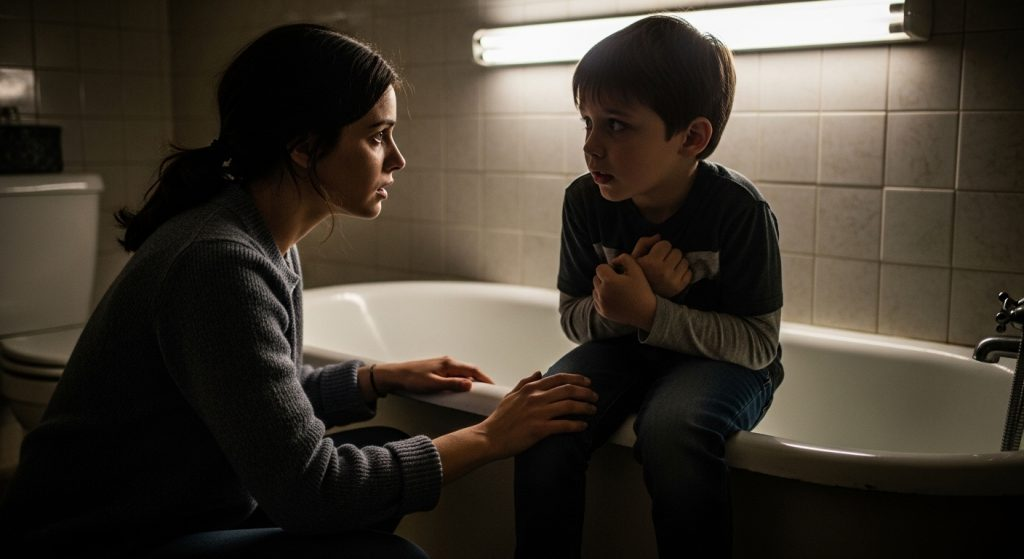
The fluorescent light above my bathroom sink flickered, emitting a low, mechanical hum that seemed to match the rapid pounding of my heart.
The air in the room was stifling, thick with the smell of cheap lavender soap and copper.
Sitting on the edge of the cold porcelain bathtub was Leo.
He was seven years old, weighing barely forty-five pounds, with a mop of dirty blonde hair that hung in his eyes.
Child Protective Services had dropped him off at my house exactly fourteen days ago.
They told me it was an emergency placement. They told me his biological mother was “unavailable” and that his father had never been in the picture.
What they didn’t tell me was why the boy refused to wear anything other than thick, oversized denim jeans, even when the Texas heat pushed past ninety degrees.
“Let me just look at it, buddy,” I whispered, my voice trembling as I knelt on the hard tile floor.
Leo violently kicked his left leg away from me, pressing himself so hard against the bathroom wall I thought he might crack the drywall.
He wasn’t crying. That was the most terrifying part.
For two weeks, he had been dragging that leg. A distinct, heavy limp that echoed through my hardwood hallways every night.
At first, Brenda from CPS told me it was just a twisted ankle from playing in the group home.
“Kids are resilient, Sarah,” she had said, waving her hand dismissively at the door. “Give him a week.”
A week passed. Then another.
The limp didn’t get better. It got louder. Heavier.
And then, the fever started.
Just an hour ago, I had found him curled in a tight ball on the living room rug, his skin radiating a terrifying, dry heat.
When I tried to pick him up, he let out a scream so guttural, so filled with raw, primal terror, that my rescue dog, Buster, ran whining into the other room.
That scream was the reason I dragged him into the bathroom.
That scream was the reason I locked the door behind us, determined to finally see what was hiding under those jeans.
“Leo, you’re burning up,” I said, trying to keep my hands steady as I reached for him again. “I have to see it. I have to see what’s hurting you.”
“No!” he gasped, his tiny hands desperately clutching the fabric of his pant leg. “He said you can’t look! He said if you look, he’ll know!”
My blood ran ice cold.
He? There was no ‘he’ in Leo’s file. The social worker had been explicitly clear. It was just him and his mother, living in a transient motel until she was arrested.
“Who is ‘he’, Leo?” I asked, keeping my voice dangerously calm.
The little boy just clamped his eyes shut and began to violently rock back and forth, his knuckles turning white as he gripped his denim jeans.
I didn’t have time for this. His breathing was becoming shallow, raspy.
I reached into the medicine cabinet and grabbed a pair of heavy medical shears I kept in my first-aid kit.
When Leo saw the scissors, his eyes blew wide open.
“I’m not going to hurt you,” I promised, my own chest heaving. “But I’m cutting these off.”
I pinned his left leg down.
He fought me with a frantic, desperate strength that a seven-year-old simply shouldn’t possess.
I slipped the cold metal edge of the shears under the hem of his jeans and began to cut upward.
The fabric was stiff. Too stiff.
As I snipped past his ankle, a horrific realization washed over me. The denim wasn’t just dirty.
It was glued to his skin by layers of dried, yellow fluid.
My hands began to shake violently, the shears slipping against the thick fabric.
Every time the metal grazed his shin, Leo let out a whimpering, breathless gasp.
“Almost done,” I choked out, tears finally blurring my vision. “I’m so sorry, baby. I’m almost done.”
With one final, forceful tear, I ripped the denim seam apart, exposing his left leg to the harsh bathroom light.
I stumbled backward, my back hitting the bathroom vanity.
The scissors clattered onto the tile floor.
I clamped both hands over my mouth to swallow the scream that tore up my throat.
The leg didn’t even look human.
From his knee down to his ankle, his calf was swollen to nearly three times its normal size.
But it wasn’t red and inflamed like a normal infection. It wasn’t bruised from a fall.
It was pale. A sickening, translucent white.
And the skin was pulled so tight, so impossibly taut, that it looked like polished marble.
Underneath the translucent surface, thick, black veins pulsed rhythmically, branching out like dead tree roots.
“Oh my god,” I whispered, falling to my knees again. “Leo… what happened?”
He didn’t answer. He just stared at the ceiling, his jaw locked, his body trembling in shock.
I slowly reached out, my fingers hovering inches from the swollen mass.
I expected it to radiate heat. I expected it to feel like a severe abscess.
But when my fingertips finally brushed the tight, pale skin… it was freezing cold.
Ice cold. Like touching the surface of a refrigerated glass bottle.
And it was hard. Rock hard.
There was no give to the flesh. No softness. It felt as though his entire calf muscle had been replaced by solid concrete.
I couldn’t breathe. The room was spinning.
I needed to call 911. I needed to wrap him in a blanket and drive him to the emergency room immediately.
But as I moved to grab a towel, my eyes caught a strange detail near the center of the swelling.
A shadow.
There was something dark resting deep beneath the surface of his swollen skin.
It wasn’t a bone. It was perfectly rectangular.
With shaking hands, I leaned in closer, my face mere inches from his frozen, swollen calf.
The object under his skin had sharp, defined corners. It looked like a small, metallic box, embedded deep within the muscle tissue.
My mind spun, trying to rationalize what I was seeing. A medical implant? A surgical plate that got severely infected?
But CPS had given me his entire medical history. There were no surgeries. No broken bones. No implants.
“Leo,” I breathed, my voice barely audible over the ringing in my ears. “What is inside your leg?”
The boy finally turned his head to look at me.
His eyes were completely vacant, devoid of any childlike innocence. They were the eyes of a soldier who had seen the end of the world.
“It’s a timer,” he whispered, his voice completely flat.
My heart completely stopped.
I stared at him, my brain refusing to process the words. “A… a what?”
“A timer,” he repeated softly. “He said if I let anyone see it before it beeps, I wouldn’t get to keep my right leg.”
My stomach plummeted into an endless, icy void.
Slowly, terrifyingly, my gaze drifted away from the grotesque, swollen left leg.
I looked down at his right leg. The “normal” one. The one he had been favoring.
I reached out and pulled the right pant leg up to his knee.
The room went dead quiet.
There was no swelling on his right leg. No bruising. No metallic rectangles beneath the skin.
Instead, wrapping perfectly around his right ankle, was a faded, perfectly symmetrical scar.
It was a jagged, continuous line of raised tissue that circled his entire limb, looking exactly like a zipper.
It wasn’t an accident. It wasn’t a scrape.
It was the unmistakable scar of a clean, surgical amputation that had been meticulously reattached.
Someone had taken his right leg off, and put it back on.
And as I stared at the horrifying scar, a high-pitched, electronic BEEP suddenly echoed from deep inside his left calf.
CHAPTER 2
That single, high-pitched BEEP didn’t just echo in the small bathroom.
It felt like it vibrated right through the enamel of my teeth.
For a split second, neither of us breathed. I remained frozen on my knees, my hands hovering over Leo’s mutilated legs.
Then, the seven-year-old did something that shattered whatever was left of my sanity.
He didn’t scream. He didn’t cry for help.
He lunged forward with that terrifying, unnatural strength, grabbed the shredded, fluid-soaked pieces of his denim jeans, and frantically tried to tape them back together over his swollen calf.
“Hide it! Hide it!” he hissed, his voice dropping an octave, sounding like a desperate, cornered animal. “It counted down! He’s going to know you looked!”
I didn’t think. I just reacted.
I grabbed the thickest bath towel off the rack, wrapped it tightly around his lower half, and scooped him into my arms.
He was shockingly heavy. The swollen left leg felt like a cinderblock dragging us both down as I sprinted down the hallway.
“We are going to the hospital right now, Leo,” I gasped, fumbling for my car keys on the kitchen counter with one hand.
“No hospitals!” he shrieked, suddenly thrashing wildly against my chest. His elbow caught my jaw, hard enough to make me taste blood, but I refused to drop him.
“They won’t understand!” he sobbed, his fingernails digging deep into my shoulder. “The doctors don’t know the rules!”
I threw open the front door and ran into the sweltering Texas night, ignoring the confused barks of my dog behind me.
I practically shoved him into the backseat of my Honda, locking the doors from the driver’s side before he could try to bolt.
My hands were shaking so violently I could barely get the key into the ignition.
As I tore out of the driveway, my tires screeching against the asphalt, I glanced at him in the rearview mirror.
He wasn’t fighting anymore.
He was sitting dead still in the darkness, staring at his wrapped leg, his lips moving silently as if he was counting something.
The drive to Dallas Presbyterian took eleven agonizing minutes. I ran three red lights.
Every time I hit a pothole, another faint, muffled BEEP would emanate from the back seat.
It wasn’t a steady rhythm. It was erratic. Beep… silence for two minutes… Beep, beep… silence.
It sounded exactly like a digital kitchen timer whose battery was dying.
I slammed the car into park right outside the Emergency Room doors, not even bothering to pull into a real space.
I yanked the back door open, scooped Leo up in the towel, and sprinted through the sliding glass doors.
“Help! I need help right now!” I screamed, my voice cracking through the sterile, quiet waiting room.
A heavy-set triage nurse behind the thick plexiglass window immediately stood up.
“Ma’am, calm down. What happened to the child?” she asked, her eyes darting over the blood on my lip and the shredded, frantic look in my eyes.
“His leg,” I stammered, pointing to the bundle in my arms. “There’s something inside his leg. It’s swollen, and there’s a box—a metal box inside it, and a scar on the other—”
I wasn’t making any sense. I knew I sounded insane.
The nurse buzzed the side door open and waved me into Trauma Room 3.
Two young residents in blue scrubs were already pulling on gloves as I laid Leo down on the crinkly paper of the examination table.
“Okay, mom, take a deep breath,” the taller resident said, reaching for the towel. “Let’s see what we’re working with.”
“I’m his foster mother,” I corrected quickly, my heart hammering against my ribs. “I’ve only had him for two weeks.”
The resident paused, his eyes flicking up to meet mine for a fraction of a second. It was a subtle shift, but I felt the temperature in the room drop.
He pulled back the towel.
The harsh, fluorescent hospital lights made the leg look even more horrific than it had in my bathroom.
The pale, translucent skin. The black, necrotic-looking veins. The sheer, impossible size of the swelling.
Both doctors went entirely still. The monitors in the room hummed softly, but nobody spoke.
“Who cut his jeans off?” the second doctor asked. His voice wasn’t urgent anymore. It was dangerously flat.
“I did,” I said, wiping cold sweat from my forehead. “He wouldn’t let me look. He’s been hiding it. You have to look at the center, right there—do you see the shadow? It’s a box.”
The taller doctor leaned in, pressing two gloved fingers against the rock-hard, freezing skin of Leo’s calf.
He didn’t look surprised. He didn’t look like a man discovering a bizarre metallic implant.
He looked furious.
“Nurse,” the doctor called out, not taking his eyes off the leg. “Get Dr. Evans down here now. And call security to secure the doors.”
Panic flared in my chest. “Wait, why security? You need to X-ray it! It’s making a beeping sound!”
I pointed frantically at Leo’s right leg. “And look at his other ankle! Someone cut his leg off and put it back on!”
The second doctor moved to the right leg. He gently traced a gloved finger over the deep, zipper-like scar wrapping around Leo’s ankle.
He looked up at me. There was no medical curiosity in his eyes. Only absolute disgust.
“Ma’am, this is not a surgical reattachment scar,” the doctor said coldly.
“What?” I choked out.
“This is a circumferential ligature mark,” he stated, his voice loud enough for the arriving nurses to hear. “It’s highly indicative of being bound by wire or tight rope for an extended period of time.”
The air was sucked out of my lungs. “No! No, I just got him from CPS! It was already there!”
“You said you’ve had him for fourteen days,” the taller doctor noted, grabbing a clipboard. “And you didn’t notice a binding scar that deep? You didn’t notice his left leg is suffering from extreme, localized compartment syndrome?”
“I tried!” I pleaded, tears streaming down my face. “He wouldn’t let me touch him! And what about the box? Look at the shadow under the skin! What about the timer?”
Just then, the door opened, and Dr. Evans, the attending physician, walked in. She was a stern-looking woman in her fifties.
She took one look at Leo, one look at the leg, and then turned her piercing gaze on me.
“Miss, I’m going to need you to step out into the hallway,” she ordered.
“Not until you listen to it!” I screamed, losing all composure. “Put your stethoscope on it! It’s beeping!”
Dr. Evans sighed, a patronizing, exhausted sound. She pulled her stethoscope from her neck, placed the bell directly over the dark, rectangular shadow under Leo’s skin, and listened.
The room was dead silent. I held my breath, waiting for her eyes to widen. Waiting for the realization to hit her.
Five seconds passed. Ten.
She pulled the stethoscope out of her ears and looked at the two residents.
“Bowel sounds are normal. Heart rate is elevated. There is no beeping sound coming from this child’s leg.”
My jaw dropped. “You’re lying. I heard it in the car. I heard it in the bathroom!”
“Security,” Dr. Evans said sharply.
Two large men in grey uniforms suddenly materialized in the doorway.
“Escort this woman to Waiting Room B. Do not let her leave the premises. I’m calling Child Protective Services and the police.”
“You’re making a mistake!” I yelled as the guards grabbed my arms, hauling me backward. “He’s in danger! Ask him! Ask Leo!”
I twisted around, looking back at the examination table as they dragged me into the hall.
Leo was sitting up slightly. The doctors were ignoring his face, entirely focused on prepping his leg for an IV.
Leo looked straight at me through the closing glass door.
His face was completely devoid of emotion. He didn’t look scared of the doctors.
He slowly raised his index finger to his lips, making a distinct “shhh” motion.
Then, he smiled.
It wasn’t a child’s smile. It was a cold, knowing, adult smirk that sent a wave of absolute terror crashing down my spine.
The door clicked shut, leaving me in the brightly lit, sterile hallway with the two guards.
My mind was fracturing. Was I crazy? Did I hallucinate the beep? Did I hallucinate the box?
They pushed me into a small, windowless waiting room down the hall. The door locked from the outside with a heavy thud.
I paced the small room for what felt like hours. I checked my phone. It was 2:14 AM.
I tried to call Brenda, the CPS worker who had placed Leo with me. It went straight to voicemail.
Every shadow in the room felt like a threat. The way Leo smiled at me… it wasn’t the smile of a victim.
At exactly 3:00 AM, the lock clicked, and the door swung open.
Brenda walked in. She was wearing a hastily thrown-on trench coat over her pajamas.
Right behind her were two uniformed Dallas police officers.
“Brenda, thank god,” I sobbed, rushing toward her. “You have to tell them! You have to tell them I just got him!”
Brenda held up a hand, stopping me in my tracks. Her face was an unreadable mask of stone.
“Sit down, Sarah,” she said quietly.
“They think I tied him up!” I cried, pointing at the officers. “They think I did that to his leg! But there’s something inside him! You didn’t give me his full file!”
“We gave you everything we had, Sarah,” Brenda said, crossing her arms. “Which makes this entire situation completely inexplicable.”
“What did the X-ray show?” I demanded, looking at the officers. “Tell me you saw the box.”
The older officer, a man with a graying mustache, stepped forward, pulling a small notepad from his chest pocket.
“The X-ray showed massive localized fluid retention, severe tissue necrosis, and acute muscle trauma,” the officer read dryly.
He snapped the notepad shut. “It did not show any metallic foreign objects. It did not show a box. It did not show a timer.”
The floor seemed to drop out from underneath me.
“That’s impossible,” I whispered. “I saw the corners. It was hard as rock.”
“Dr. Evans believes you are suffering from a severe psychological break, Ms. Miller,” Brenda said, her voice laced with a mixture of pity and accusation. “Or worse, you’ve engaged in deliberate medical child abuse to seek attention.”
“Munchausen by proxy,” the younger officer chimed in, resting his hand on his duty belt.
“No!” I shrieked, backing into the corner of the room. “I know what I saw! And the scar on his right leg—they said it was from wire! Why wasn’t that in his intake file?”
Brenda looked away, suddenly intensely interested in the scuff marks on the linoleum floor.
“Brenda?” I pushed, my voice trembling. “Why wasn’t that scar in his file?”
“Because,” the older officer interrupted, his eyes locking onto mine with terrifying intensity, “according to the medical examiner who reviewed the boy’s photos tonight… that scar is less than ten days old.”
The air in the room vanished.
“What?” I breathed.
“The tissue scarring indicates the ligature binding occurred within the last week and a half,” the officer stated clearly. “Right after he was placed in your custody.”
“That’s a lie!” I screamed. “I never tied him up! I’ve been at work! I hired a sitter!”
“We’ve already spoken to the sitter,” Brenda said softly. “She said he always wore long pants. She said you explicitly told her not to let him take them off.”
I gasped. “Because he was insecure about his legs! That’s what I thought!”
I was being framed.
Every single detail, every single coincidence, was weaving a perfect, airtight net around me.
But who was doing it? Leo’s phantom father? The mother who was supposedly in jail?
“I want to talk to Leo,” I demanded, wiping my face, a sudden, fierce anger replacing my panic. “If you ask him, he will tell you about the man. He said ‘He’ was going to know I looked.”
The two officers exchanged a dark, heavy look.
“We did talk to Leo, Ms. Miller,” the older officer said quietly.
“We just came from his room. Dr. Evans managed to stabilize his fever enough for him to answer a few questions.”
My heart leaped. “And? Did he tell you about the timer?”
“No,” the officer said, taking a slow step toward me, pulling a pair of metal handcuffs from his back pouch.
“He told us that he tried to run away last week, and to punish him, you injected his left leg with drain cleaner.”
My knees buckled. I hit the floor hard, the linoleum freezing against my bare skin.
“And,” the officer continued, his voice echoing in the small room as he stepped over me, “he said you put the metal box in there yourself. Because you told him you wanted to build a bomb.”
I couldn’t speak. I couldn’t breathe.
As the officer grabbed my wrists and violently yanked them behind my back, the metal cuffs biting into my skin, a sound drifted down the quiet hospital corridor.
It was faint. It was muffled.
But I heard it clearly.
BEEP.
And this time, the younger officer flinched, his head snapping toward the hallway.
He heard it too.
CHAPTER 3
The younger officer’s head snapped toward the open doorway.
His hand instinctively dropped to the heavy black radio on his shoulder.
He heard it. I knew he heard it.
“Did you hear that, Davies?” the older officer barked, yanking my cuffed arms upward and forcing me to my feet.
Officer Davies swallowed hard, his Adam’s apple bobbing in his throat. He looked at me, then at the empty hallway.
“Sounded like… a monitor battery dying, sir,” Davies mumbled, though his pale face betrayed his words.
“You’re lying!” I screamed, twisting violently against the older officer’s grip. “You know exactly what that was! It’s the timer!”
“Shut your mouth,” the older officer growled, shoving me toward the door. “You have the right to remain silent. I highly suggest you start using it.”
Brenda stood in the corner, clutching her clipboard to her chest like a shield. She wouldn’t even look at me.
“Brenda, please!” I sobbed, the metal cuffs slicing into my wrists as I was dragged past her. “Check my house! Check the cameras! I didn’t do this!”
She turned her back to me.
The betrayal cut deeper than the cuffs. I was entirely alone.
They hauled me out of the small waiting room and into the harsh, blinding light of the main hospital corridor.
The sterile smell of bleach and rubbing alcohol suddenly made me nauseous.
I stumbled, my bare knees scraping against the linoleum, but the older officer didn’t slow down. He just hoisted me up by my armpits, his fingers digging into my bruising flesh.
“Keep moving,” he ordered.
BEEP.
It happened again.
This time, it was louder. Closer.
It echoed down the long, empty hallway, bouncing off the white walls like a ricocheting bullet.
Officer Davies stopped dead in his tracks.
“Sir,” Davies said, his voice trembling slightly. “That wasn’t a monitor.”
Before the older officer could respond, a blood-curdling scream shattered the quiet of the ward.
It wasn’t a child’s scream. It was the terrified, agonizing shriek of a grown woman.
It came from Trauma Room 3. Leo’s room.
“Code Silver! Code Silver in Trauma 3!” a voice roared over the overhead PA system, instantly followed by the deafening wail of emergency sirens.
Flashing red strobes bathed the hallway in a hellish, rhythmic glow.
The older officer cursed, shoving me hard against the wall. “Davies, stay with her! Don’t take your eyes off her!”
He drew his service weapon and sprinted down the hall toward Leo’s room.
I was gasping for air, my back pressed against the cold plaster, watching the chaos unfold.
Nurses were scattering, pulling heavy fire doors shut and barricading themselves in supply closets.
Suddenly, the double doors of Trauma Room 3 burst open.
Dr. Evans stumbled out, her pristine white coat drenched in bright, crimson blood.
She was clutching her neck, her eyes wide with a primal, unadulterated terror.
“He’s got a scalpel!” she choked out, collapsing against the nurse’s station. “He stabbed the resident! He took his scalpel!”
My heart stopped.
“Leo?” I whispered, the word barely making it past my lips.
Officer Davies grabbed my shoulder, spinning me around. His gun was drawn now, his hands shaking so violently I thought he might accidentally pull the trigger.
“Move!” Davies yelled, pushing me toward a glass-walled security office down the hall. “Get in there!”
He shoved me inside the dark room, locking the heavy door behind us.
The office was lined with monitors, displaying dozens of grainy, black-and-white security feeds from across the hospital.
“What did you do to him?” Davies demanded, slamming me into a swivel chair. “What kind of psycho kid is this?”
“I didn’t do anything!” I cried, tears blinding me. “I tried to tell you! He’s terrified! He’s protecting something!”
Brenda burst into the security room a second later, having used her hospital badge to bypass the lock.
She was hyperventilating, her trench coat covered in dark smears of blood from the hallway.
In her trembling hands, she held my purse. The one I had left in the waiting room.
“Sarah…” Brenda gasped, dropping the leather bag onto the desk.
The purse tipped over.
My keys, my wallet, and a half-empty pack of gum spilled out.
And right behind them, rolling heavily across the desk, was a thick, plastic bottle.
Industrial-strength liquid drain cleaner.
My stomach completely inverted.
“No,” I whispered, shaking my head frantically. “No, no, no. I’ve never bought that in my life.”
“It was in your bag, Sarah,” Brenda cried, stepping away from me as if I were a monster. “It was zipped in the side pocket.”
“Someone put it there!” I screamed, thrashing against the handcuffs. “Don’t you see? Someone set this up! Someone is trying to make sure nobody looks at that leg!”
Davies stared at the bottle, his jaw clenching. He reached for his radio.
“Dispatch, this is Unit 4. Suspect has the chemical agent on her person. We need backup at Dallas Presbyterian, immediately.”
“You’re not listening to me!” I pleaded, my voice cracking. “Look at the cameras! Find Leo!”
Davies hesitated, but his eyes darted to the wall of monitors.
For a terrifying minute, there was nothing but empty hallways and panicked nurses hiding behind locked doors.
Then, on monitor number seven, a shadow moved.
It was the feed for the third floor. The Neonatal Intensive Care Unit.
The nursery.
“There,” I gasped, nodding my head toward the screen.
A tiny, frail figure was limping down the darkened corridor.
It was Leo.
He was dragging his swollen, grotesque left leg behind him. It looked even bigger now, the skin stretched so tight it practically glowed in the infrared camera light.
In his right hand, he held a gleaming surgical scalpel. It dripped dark fluid onto the pristine hospital tiles.
“Oh my god,” Brenda whispered, covering her mouth. “He’s going toward the babies.”
“Call it in!” Davies yelled into his radio. “Suspect is on the third floor, heading toward the NICU! He is armed!”
I watched the screen, my entire body going numb with dread.
Leo wasn’t just walking randomly. He was moving with a terrifying, mechanical precision.
And then, he stopped right in front of the heavy, reinforced glass doors of the nursery.
He didn’t try to open them. He didn’t raise the scalpel to break the glass.
He just stood there, staring at his own left leg.
BEEP.
The sound echoed through the entire hospital now. It was no longer faint. It was coming through the air vents, amplified by the silent, empty hallways.
BEEP.
“It’s speeding up,” I realized, the blood draining from my face. “The timer is speeding up.”
“What timer?!” Davies yelled, grabbing me by the collar of my shirt. “What is in his leg, Sarah?!”
“I don’t know!” I screamed back. “He said a man put it there! He said if it beeped, he’d lose his other leg!”
On the monitor, Leo slowly raised the scalpel.
But he didn’t point it at the nursery doors.
He pointed it down at his own swollen, black-veined calf.
“He’s going to cut it out,” I breathed, horrified realization washing over me. “He’s trying to get the box out before it goes off.”
“He’ll bleed to death in minutes,” Brenda said, her voice completely devoid of hope. “That tissue is entirely necrotic. If he slices into that pressure…”
“Davies, you have to let me go up there,” I begged, looking up at the young officer. “He knows me! He let me carry him! If you go up there with guns, he’ll panic and slice his own leg open!”
“I’m not letting a suspected child abuser go anywhere,” Davies spat.
“Then take me with you!” I countered desperately. “Keep the cuffs on! Just let me talk to him before your partner shoots a seven-year-old boy!”
Davies looked at the monitor.
Leo was pressing the tip of the scalpel against the translucent, marble-like skin of his leg.
Dark, foul-looking blood instantly welled up around the blade.
“Damn it,” Davies cursed. He grabbed me by my cuffed arms and yanked me toward the door. “If you try anything, I swear to God, I will put you down.”
“Just hurry!” I cried.
We sprinted out of the security office, leaving Brenda frozen in shock.
We hit the stairwell, taking the concrete steps two at a time. My lungs burned, my bare feet slipping on the cold stairs, but Davies practically carried me upward.
We burst through the heavy fire doors onto the third floor.
The air up here was freezing. The emergency backup generators hummed loudly, casting long, menacing shadows down the corridor.
At the far end of the hall, standing in front of the NICU doors, was Leo.
He looked incredibly small under the flickering emergency lights.
The older officer was already there, standing twenty feet away, his gun leveled squarely at the boy’s chest.
“Drop the knife, son!” the older officer yelled, his voice echoing loudly. “Drop it right now, or I will fire!”
“No! Stop!” I screamed, fighting against Davies’ grip as we ran down the hall. “He’s just a little boy!”
The older officer didn’t lower his weapon. “He stabbed a doctor, Sarah! Stay back!”
I looked at Leo.
He didn’t even seem to register the man pointing a gun at him.
He was hyperventilating, his chest heaving, his eyes entirely focused on the grotesque swelling of his left leg.
The scalpel was buried a quarter-inch into the tight, pale skin.
Thick, black fluid was leaking down his ankle, pooling onto the linoleum floor with a sickening hiss, like acid eating through plastic.
BEEP… BEEP… BEEP…
The sound was coming directly from inside him. It was frantic now. Urgent.
“Leo!” I called out, my voice cracking with pure emotion. “Leo, honey, please look at me!”
He slowly turned his head.
His face was completely pale, covered in a sheen of cold sweat. His lips were blue.
“It’s out of time, Sarah,” he whispered. His voice was incredibly weak, devoid of the terrifying adult tone from earlier. He just sounded like a scared, dying little boy.
“It’s okay,” I lied, stepping forward, ignoring Davies pulling on my cuffs. “We can fix it. Just put the knife down, baby. Let me help you.”
“You can’t help,” Leo sobbed, a single tear cutting a track through the grime on his cheek. “He told me. He said I was the delivery boy. I had to bring it to where the most people were.”
My heart plummeted into my stomach.
The hospital. The nursery.
He was the delivery boy.
“Who?” I screamed, the terror finally breaking my mind. “Who told you that?!”
“The man who fixed my right leg,” Leo said softly.
He looked down at his grotesque, ballooning calf.
The skin was stretching further. It was tearing on its own now, splitting along the black veins like old parchment paper.
Beneath the tearing flesh, the metallic, rectangular box was physically pushing its way to the surface.
It wasn’t a medical implant.
It was dark grey, covered in tiny, flashing red diodes.
And it was practically vibrating.
“Drop it!” the older officer roared, his finger tightening on the trigger.
“Don’t shoot him!” I shrieked, lunging forward with all my remaining strength, breaking Davies’ grip.
I threw my body between the gun and the little boy.
“Get out of the way, Sarah!” the officer screamed.
Behind me, Leo let out a horrible, wet gasp.
“It’s opening,” the little boy whimpered.
I whipped around.
The pale skin of his calf finally gave way with a sickening, wet RIIIIP.
A geyser of thick, black, foul-smelling fluid erupted into the hallway, splashing against the walls and the glass doors of the nursery.
The smell hit me instantly—raw sewage, burning plastic, and rotting meat.
The metallic box breached the surface, covered in the horrific black sludge.
But it didn’t detonate. There was no explosion.
Instead, the top of the box snapped open like a spring-loaded trap.
BEEEEP—
The timer stopped. The red diodes turned a solid, blinding green.
The room went dead quiet again.
Nobody moved. Nobody breathed.
We all just stared at the metallic box protruding from the seven-year-old’s shredded leg.
Then, slowly, a long, incredibly thin, dark grey antenna extended out from the center of the box.
It rose three inches into the air, whirring softly like a mechanical insect.
I stared at it, my brain completely incapable of processing the nightmare in front of me.
It wasn’t a bomb.
“What… what is that?” Davies whispered, lowering his gun slightly, his face completely drained of color.
Before anyone could answer, the radio on Davies’ shoulder crackled to life with a burst of heavy static.
But it wasn’t the police dispatcher’s voice that came through the speaker.
It was a deep, artificially distorted, metallic voice.
And it spoke directly to us.
“Signal acquired,” the voice buzzed through the police radio. “Payload deployed. Thank you for your cooperation, Sarah.”
I froze.
I looked down at the boy’s open leg. I looked at the antenna.
And then, I finally realized what the deep, zipper-like scar on his right ankle really meant.
Nobody had cut his leg off and put it back on.
They had taken him apart.
And as the little boy looked up at me, his blue eyes suddenly flickered, flashed, and turned completely, unnaturally black.
CHAPTER 4
I stared into the pitch-black voids where a seven-year-old boy’s eyes used to be.
There was no iris. No pupil. Just a solid, glossy, horrifying obsidian that reflected the emergency lights like polished glass.
The older officer completely lost his mind.
“Drop it!” he shrieked, his professional composure shattering into pure, raw panic.
He didn’t wait for an answer. He pulled the trigger.
The gunshot in the enclosed hospital corridor was deafening. It felt like a physical blow to the chest.
I screamed, squeezing my eyes shut, expecting to see the little boy blown backward onto the linoleum.
But when I opened my eyes, Leo was still standing.
He hadn’t even flinched.
The heavy hollow-point bullet had struck him dead center in the chest, tearing through his thin hospital gown.
But there was no blood. There was no exit wound.
Instead, a shower of bright blue sparks erupted from his sternum, followed by a thick stream of that same rotting, black synthetic fluid.
The bullet had flattened against something solid. Something metallic, hidden just beneath the surface of his pale skin.
“What the hell are you?!” the older officer screamed, firing twice more.
Bang. Bang.
One bullet struck Leo’s shoulder. The other grazed his neck.
More sparks. More black sludge.
Underneath the torn, synthetic flesh of his neck, I saw the undeniable gleam of interwoven titanium cables.
Officer Davies collapsed against the wall, dry-heaving into his hands. His gun clattered uselessly to the floor.
Leo slowly tilted his head. The movement was incredibly rigid, snapping into place with a mechanical whir that made my blood run cold.
Then, he opened his mouth.
It wasn’t Leo’s voice that came out.
It was the same distorted, deep, metallic frequency that had just broadcasted over the police radio.
“Kinetic resistance tested. Optimal,” the voice droned from the boy’s throat. “Securing the harvest zone.”
Suddenly, the green diodes on the metal box embedded in his leg flashed violently.
The thin antenna let out a high-pitched, oscillating frequency that felt like ice picks being driven directly into my eardrums.
I fell to my knees, gagging from the sheer auditory pain, my cuffed hands useless behind my back.
The older officer dropped his weapon and clamped both hands over his ears, screaming in agony.
All around us, the hospital began to die.
Every single lightbulb in the corridor exploded simultaneously in a shower of white-hot glass.
The electronic locks on the heavy, reinforced NICU doors beeped once, a sad, dying sound.
Then, with a heavy pneumatic hiss, the doors to the nursery slid wide open.
Inside the NICU, the life-support machines, the incubators, the heart monitors—every single piece of lifesaving equipment instantly powered down.
The heavy, terrifying silence of dozens of failing machines was immediately replaced by the weak, confused cries of premature infants in the dark.
“No!” I sobbed, fighting through the blinding pain in my head. “The babies! Turn it off!”
Leo—or whatever was wearing Leo’s face—turned its pitch-black eyes toward me.
“The EMP radius is functioning perfectly,” the mechanical voice stated, echoing off the dark walls. “The grid is blind. The extraction team is three minutes out.”
I didn’t understand. My brain was fracturing under the weight of impossible information.
“Why?” I choked out, crawling toward him over the broken glass, ignoring the fresh cuts tearing into my bare knees. “Why him? Why me?!”
The machine looked down at me, its synthetic face completely devoid of expression.
“You were the perfect courier, Sarah,” it replied. “A childless, traumatized woman. The algorithm calculated a ninety-nine percent probability that you would aggressively protect a ‘vulnerable’ asset.”
It pointed a torn, leaking, metallic finger at my purse, still strapped across my shoulder.
“The chemical solvent in your bag. The drain cleaner. You were supposed to pour it over the leg when the timer expired.”
The realization hit me with the force of a freight train.
They hadn’t framed me to cover up abuse.
They planted the chemicals to ensure the thick, lead-lined synthetic flesh masking the beacon was melted away without damaging the internal hardware.
They X-rays hadn’t shown the box because the leg was engineered to mimic dense, necrotic human tissue.
“CPS,” I whispered, the horror paralyzing my vocal cords. “Brenda.”
“The agency is ours,” the voice confirmed monotonously. “The group homes are processing centers. We needed an undetected EMP inside the city’s largest maternity ward. The organic camouflage worked flawlessly.”
I looked at the little boy’s body. The horrible, stitched-together nightmare of his existence.
“He’s a robot,” I sobbed, the words tasting like ash in my mouth. “You built a bomb out of a machine.”
The entity wearing Leo tilted its head again.
“Correction,” it buzzed. “A pure synthetic would not pass the canine olfactory tests, nor the initial thermal scans.”
It slowly raised its right leg. The normal leg. The one with the zipper-like scar around the ankle.
“Only the chassis and the left limb are synthetic. To ensure the illusion of life… we required a central nervous system. A human heart. And an organic anchor.”
My breath hitched in my throat.
“Oh my god,” I gasped, staring at the scar.
Nobody had taken his leg off and put it back on.
They had taken a real, living seven-year-old boy, amputated him at the thigh, and grafted his organic right leg, his heart, and half of his brain into a titanium chassis.
That’s why he favored the right leg. It was the only part of him that could actually feel the floor.
That’s why he was in absolute agony. His human nerves were constantly fighting the synthetic connections.
He wasn’t a robot. He was a tortured, mutilated little boy trapped inside a walking prison.
“Leo,” I cried, the heartbreak overriding my terror entirely. I didn’t care about the cops. I didn’t care about the extraction team.
I dragged myself right to the edge of the puddle of black synthetic fluid.
“Leo, if you are in there, I know you can hear me!” I screamed, staring into those pitch-black eyes.
“The organic consciousness has been suppressed,” the machine stated flatly. “He is dormant.”
“Liar!” I yelled. “He smiled at me in the hospital room! That was you! But in the bathroom, he was terrified! He fought you! He tried to hide the timer to protect me!”
The entity went completely still.
“Anomaly,” it muttered, its voice glitching slightly.
“He grabbed the scalpel to cut it out himself!” I sobbed, looking at the bloody blade still clutched in his trembling right hand. “He brought the knife up here to stop you!”
The fingers on Leo’s right hand twitched.
It was a tiny, jagged movement. But it was entirely human.
“Override,” the machine commanded itself, the voice suddenly sounding strained.
“Leo, please!” I begged, tears streaming down my face. “You are not just a machine! You are my boy! You are a good boy!”
A violent shudder ripped through the child’s body.
Sparks flew from the bullet hole in his neck. The humming of the antenna stuttered.
Slowly, agonizingly, the pitch-black void in his right eye began to recede.
It pulled back like dark ink dissolving in water, revealing a terrified, bloodshot, human blue iris underneath.
He gasped. It was a wet, ragged, desperate sound. The sound of a drowning child finally breaking the surface.
“S-Sarah?” he whimpered.
His voice was back. His real, fragile, broken voice.
“I’m here, baby,” I cried, struggling uselessly against the cuffs behind my back. “I’m right here!”
“It burns,” he sobbed, his human eye welling with tears, while the left eye remained dead, pitch black, and focused purely on the nursery.
“I know, honey, I know. But you have to stop the antenna. The babies are dying in the dark.”
Leo looked into the NICU. He saw the tiny, helpless infants trapped in the powerless incubators.
Then, he looked down at the metal box jutting from his own torn calf.
“System breach,” the metallic voice roared from his throat, overlapping with his own terrified whimpers. “Initiating hard lock!”
His synthetic left arm violently shot out, grabbing his own organic right wrist, trying to snap the bone to make him drop the scalpel.
“No!” Leo screamed.
The sheer force of his human will fighting the titanium servos was horrific to watch.
His organic muscles bulged, tearing against the synthetic grafts. Fresh, red human blood began to mix with the black sludge on the floor.
“You can do it, Leo!” I yelled.
With a guttural, agonizing scream, Leo threw his entire body weight backward, slamming his synthetic arm into the concrete wall.
The impact shattered the servos in his left elbow. His grip released for a fraction of a second.
It was all the time he needed.
Leo swung his right hand down, plunging the surgical scalpel directly into the center of the metal box embedded in his leg.
He didn’t just stab it. He twisted the blade, violently shredding the internal circuitry.
A blinding flash of white light exploded from the box.
The concussive force blew me backward into the opposite wall.
The smell of ozone and burning copper instantly filled the hallway, so thick it choked me.
The high-pitched frequency died instantly.
For a terrifying moment, there was absolute silence.
Then, one by one, the emergency backup lights flickered back on.
Inside the NICU, the life-support machines beeped back to life, the steady, rhythmic hum of oxygen pumps filling the air.
He did it. He killed the EMP.
I scrambled up to my knees and looked frantically down the hall.
Leo was lying on his side in a massive pool of red and black fluid.
The antenna was gone. The box was nothing but a smoking, shattered crater of melted plastic and wire.
“Leo!” I screamed, practically throwing myself across the floor to reach him.
I couldn’t use my hands. So I just curled my body around his small, broken frame, resting my head against his chest.
His synthetic chassis was cold, but right in the center, beneath the metal and wires, I could feel his organic heart beating.
It was faint. It was slowing down.
“You did it, buddy,” I sobbed, kissing his sweaty, dirt-streaked forehead. “You saved them.”
He looked up at me. Both of his eyes were blue now. The machine was gone.
“Did I do good, Mom?” he whispered, his voice barely a breath.
My heart shattered into a million irreparable pieces. It was the first time he had ever called me that.
“You did perfect,” I choked out, my tears falling onto his pale cheeks. “You are the bravest boy in the whole world.”
He managed a tiny, weak smile.
“Don’t let them take me back,” he murmured, his eyes slowly drifting shut. “It’s dark there. So many kids in the dark.”
“I won’t,” I promised fiercely. “I’ll never let them touch you again.”
Leo let out one final, long exhale.
The faint beating against my cheek stopped. The mechanical whirring in his joints faded to absolute silence.
He was gone.
I stayed there, curled around his body on the cold hospital floor, screaming until my vocal cords bled.
I barely registered the sounds of heavy combat boots flooding the stairwell.
It wasn’t the police.
It was a dozen men in unmarked black tactical gear.
They didn’t look at the babies in the NICU. They didn’t look at the terrified officers hiding in the corners.
They walked directly toward me.
One of them grabbed me by my hair, violently hauling me away from Leo’s body.
“The asset is destroyed,” the man barked into a headset. “Clean up the mess. Sedate the witnesses. Initiate Protocol 4.”
They dragged me down the hall.
I watched as two men casually tossed a heavy, black body bag over Leo’s small, stitched-together frame.
They zipped him up, erasing him from the world in seconds.
That was six days ago.
I am writing this from a burner phone inside a psychiatric ward at a state facility.
The news reported a tragic gas leak at Dallas Presbyterian. They said three officers and a disturbed foster mother were injured.
There was no mention of a little boy. No mention of an EMP. No mention of men in black gear.
CPS released a statement saying my foster child had run away during the chaos.
They erased him. They erased everything.
But I know the truth.
I know what they are building in those group homes. I know what they are doing to the children that nobody wants.
I don’t have much time. The nurses here don’t act like nurses. They stand too still. Their eyes are too glassy.
And last night, when they brought me my medication, I swear to God…
I heard a faint, high-pitched beep coming from inside the orderly’s chest.
If you are a foster parent. If you adopted a child recently from an emergency placement.
Check them.
Look closely at their skin. Look for the scars.
Because the delivery boys are already inside our homes.
And the countdown has already started.

