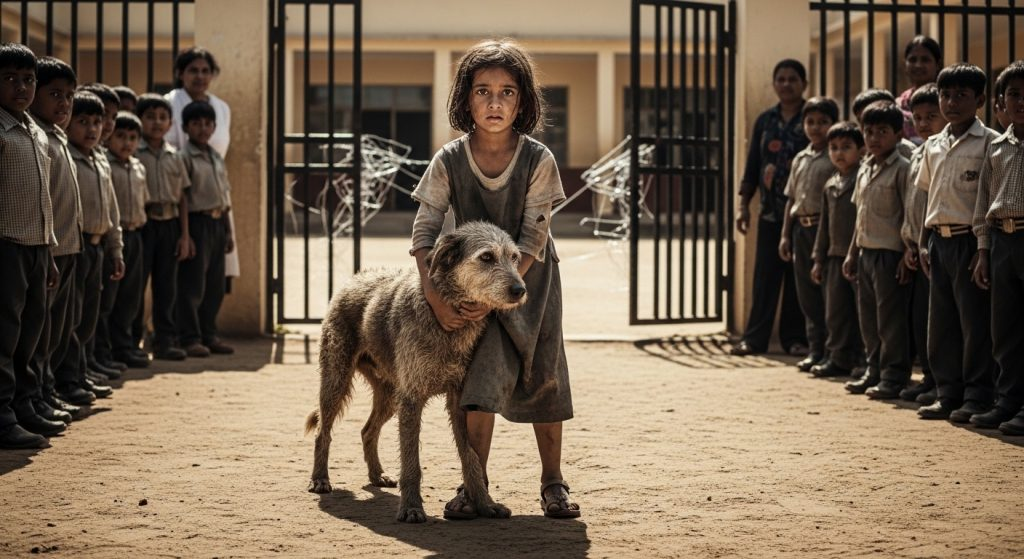
I’ve been an elementary school teacher in the same quiet Pennsylvania town for fourteen years, breaking up playground fights, tying shoelaces, and wiping away tears, but absolutely nothing could have prepared me for what I found inside the sleeve of a seven-year-old’s winter coat.
They tell you in teaching school to look out for the warning signs.
They give you checklists and pamphlets about changes in behavior, about bruised knees that don’t quite match the story of a bicycle fall, about kids who suddenly stop eating their lunches.
But they never tell you what to do when the warning sign comes from a filthy, aggressive-looking stray dog that refuses to leave a terrified child’s side.
We live in Oakhaven, a small, tight-knit working-class town where everyone knows everyone. It’s the kind of place where secrets are hard to keep, or so I thought.
The winters here are brutal. The kind of cold that seeps into your bones and turns the sky a permanent, depressing shade of gray from November all the way through March.
It was a Tuesday morning, right before the Thanksgiving break, and the air was so freezing that every breath looked like thick white smoke.
I was on morning recess duty, bundled up in my thickest parka, holding a steaming cup of coffee that had gone cold ten minutes ago.
The playground was a chaotic blur of screaming, energetic kids trying to burn off their sugar rushes before math class.
And then, there was Lily.
Lily was a second-grader in my homeroom class. She was a sweet, incredibly bright little girl with blonde hair that always seemed just a little unbrushed.
When the school year started in September, Lily was a firecracker. She was the first one to the swing set, the loudest laugher during storytime, and always eager to help me erase the chalkboards.
But over the last two weeks, a dark, heavy cloud seemed to have settled over her.
It started subtly at first.
She stopped volunteering to read aloud. She stopped playing tag with the other girls.
Then, she started wearing a massive, dark green winter coat. It was at least two sizes too big for her, drooping off her small shoulders and swallowing her tiny frame.
At first, I didn’t think much of it. Times were tough in Oakhaven. A lot of kids wore hand-me-downs from older siblings.
But then I noticed she never took it off. Not even when the classroom heater was blasting and the other kids were sweating in their t-shirts.
When I gently suggested she hang her coat in her cubby, she completely panicked.
Her eyes went wide, filled with a raw, unfiltered terror that made my stomach drop. She mumbled that she was just cold, her voice trembling so badly I decided not to push it.
I made a mental note to call her mother.
Lily’s mother was a single parent who worked double shifts at the diner out on the highway. I knew she was stressed, and I knew a few months ago, a new boyfriend had moved into their small duplex.
A man named Greg. I’d met him once at drop-off. He was a tall, imposing man who didn’t smile and didn’t make eye contact. He just stared straight ahead, gripping the steering wheel until his knuckles were white.
Something about him made the hairs on the back of my neck stand up, but you can’t report a parent to Child Services just because they give you a bad feeling.
You need proof. You need a reason.
I spent the next few days watching Lily like a hawk.
That’s when I noticed the absolute strangest detail of all.
It was her left hand. Or rather, the complete absence of it.
Lily was right-handed, so it wasn’t immediately obvious. But once I noticed it, I couldn’t unsee it.
She kept her left arm rigidly tucked against her ribs, the oversized sleeve of the green coat pulled down so far that it completely swallowed her hand.
When she carried her lunch tray, she awkwardly balanced it on her right forearm.
When she wrote in her workbook, her left arm stayed pinned behind her back, as if she was trying to hide it from the world.
If anyone bumped into her left side in the hallway, she would flinch so violently that she nearly collapsed, letting out a sharp, choked gasp before rushing away.
I knew something was terribly wrong. I knew it in my gut.
I had planned to pull her aside right after recess that Tuesday. I had already called the school counselor, and we had a meeting set up for 11:00 AM.
I was just waiting for the bell to ring.
But I never got the chance to have that meeting.
Because out of nowhere, the playground erupted into pure chaos.
I was standing near the jungle gym when I heard the first scream. It was a sharp, piercing shriek from one of the fifth-grade girls.
I spun around, spilling my cold coffee onto the freezing asphalt.
Coming out from the dense woods that bordered the edge of the school property was a dog.
But this wasn’t someone’s lost Golden Retriever.
This was a massive, terrifyingly muscular mix of pitbull and mastiff. It was covered in mud, its ribs poking through its matted, dirty brown fur.
It looked starved. It looked desperate.
And it was running at full speed directly onto the playground.
Panic exploded. Kids started screaming and scattering in every direction, dropping their basketballs and running toward the safety of the brick school building.
The other teachers and I immediately sprang into action, blowing our whistles and waving our arms, trying to herd the frantic children indoors.
“Get inside! Everyone inside now!” I screamed, my voice cracking in the freezing air.
I looked back at the dog, fully expecting it to chase the running children, driven by some predatory instinct.
But it didn’t.
It completely ignored the screaming kids. It ignored the teachers waving their coats.
It was locked onto a single target.
My blood ran completely cold when I saw where the beast was headed.
Lily.
In the chaos, Lily hadn’t run. She was sitting completely frozen on a wooden bench near the edge of the blacktop, her tiny body trembling.
She was huddled into a tight ball, her right arm wrapped protectively over her left side, burying herself into that massive green coat.
The massive stray dog was charging straight at her.
“Lily! Run!” I screamed at the top of my lungs, sprinting across the asphalt as fast as my boots would allow.
My heart was hammering against my ribs so hard I thought it would crack my chest open.
I was picturing the absolute worst. I was picturing this massive, starving animal tearing into this fragile little girl.
I grabbed a heavy wooden broom left near the janitor’s door, fully prepared to fight this beast to the death to protect my student.
But as I closed the distance, gasping for air, the scene completely defied logic.
The dog reached Lily, skidding to a halt right at her feet.
Lily squeezed her eyes shut and turned her head away, bracing for the bite.
But the bite never came.
Instead of attacking, the massive dog dropped its heavy head into Lily’s lap.
It let out a high-pitched, desperate whine that sounded almost human. A sound of pure, unadulterated distress.
I slowed my pace, raising the broom, completely confused.
“Hey! Get away from her!” I yelled, stepping closer.
The moment I raised my voice, the dog spun around to face me. It didn’t growl, and it didn’t bare its teeth.
But it positioned its massive, muscular body squarely between me and Lily, acting as a physical barricade.
Every time I took a step to the left, the dog shifted left. Every time I stepped right, it shifted right.
It was protecting her from me.
“It’s okay, I’m not going to hurt her,” I whispered, lowering the broom, my hands shaking violently from the adrenaline.
I looked at Lily. She was crying now, silent tears streaming down her pale cheeks, her eyes locked onto the dog.
Then, the dog did something that made my breath catch in my throat.
It turned back to Lily, ignoring me entirely. It began to urgently, frantically nudge its wet nose against her heavy green coat.
It wasn’t nudging her face or her chest.
It was obsessively sniffing and nudging her left arm. The arm she kept hidden.
“No, please,” Lily whimpered, trying to pull away. “Please don’t.”
But the dog was relentless. It whined louder, a heartbroken, anxious sound, and used its heavy snout to physically push her right hand out of the way.
Then, with incredible gentleness for such a massive animal, the dog grabbed the edge of the oversized green sleeve in its front teeth and pulled back.
Lily gasped and tried to yank her arm away, but she was too weak.
The thick coat sleeve slid up past her wrist.
I dropped the wooden broom. It hit the asphalt with a hollow clatter.
All the air rushed out of my lungs. The world around me completely stopped spinning.
The screaming of the other children faded into static. The freezing wind whipping against my face disappeared.
I stared at what had been hiding under that sleeve, my hand flying up to cover my mouth as a wave of pure nausea washed over me.
It was her hand.
But it didn’t look like a human hand anymore.
From the wrist down to her tiny fingertips, the flesh was swollen to nearly three times its normal size.
The skin was stretched completely tight, glossy and unnatural, colored in horrifying, sickening shades of deep violet, black, and a dark, putrid yellow.
It was grotesquely deformed, angled at a sharp, unnatural position that clearly indicated a massive, untreated break.
The swelling was so incredibly severe that the skin looked like it was about to split open. Deep, dark lines of what looked like infection were already traveling up her pale forearm, disappearing under the rest of the coat.
This wasn’t an accident. This wasn’t a fall off the monkey bars.
This was intentional. This was untreated trauma that had been festering for days, maybe even a week.
The dog looked back at me, letting out another desperate whine, crying out for help on behalf of the little girl who had been silenced.
I fell to my knees on the freezing asphalt right in front of her.
Lily looked at me, her eyes filled with absolute terror, her little chest heaving.
“Please,” she whispered, her voice cracking, completely broken. “Please don’t tell Greg. He said if I showed anyone, he would make it so I couldn’t use the other one.”
My blood turned to absolute ice.
CHAPTER 2
The freezing asphalt bit through the fabric of my slacks, sending a sharp, icy ache into my knees, but I couldn’t feel it.
I couldn’t feel anything except a suffocating, paralyzing horror.
“Greg,” I whispered, the name tasting like ash in my mouth.
Lily’s small, unwashed face was streaked with tears, her lower lip trembling so violently she could barely form the words.
“He… he said he would do the right one next,” she sobbed, her voice barely a squeak over the howling Pennsylvania wind. “He said if I cried at school, he would know.”
My stomach violently rebelled. I swallowed back a wave of nausea, forcing myself to take a deep, shaky breath.
I had to be strong. Right now, in this moment, I was the only thing standing between this little girl and the monster waiting for her at home.
“He’s not going to touch you ever again,” I said. My voice was low, shaking with an anger I had never experienced in my entire life. “I promise you, Lily. He is never, ever going to hurt you again.”
I reached into my heavy parka with trembling hands and pulled out my cell phone.
My fingers were stiff from the cold and the adrenaline, and I fumbled twice before finally dialing 911.
While the phone rang against my ear, I looked up.
The playground was mostly clear now. The other teachers had managed to herd the screaming children into the cafeteria, the heavy metal doors slamming shut behind them.
The only people left outside were me, Lily, the massive stray dog, and Principal Higgins, who was sprinting across the blacktop with a walkie-talkie clutched in his hand.
“Sarah! Get away from that animal!” Higgins yelled, his face red and breathless as he closed the distance.
The massive dog immediately snapped its head toward the principal. It let out a deep, rumbling growl that vibrated through the frozen ground beneath us.
It planted its large, muddy paws firmly over Lily’s shoes, lowering its heavy head and bearing its teeth in a clear warning.
“Stop!” I screamed at Higgins, holding up my free hand. “Don’t come any closer! He’s protecting her!”
Higgins froze, his eyes darting between me, the aggressive-looking dog, and the terrified little girl.
“911, what is your emergency?” the dispatcher’s voice cracked through the phone pressed to my ear.
“I need an ambulance at Oakhaven Elementary immediately,” I said, struggling to keep the panic out of my voice. “I have a seven-year-old female student. She has a severe, untreated traumatic injury to her left hand and arm. It looks like… it looks like advanced infection. Possibly necrotic. And I need police. Now.”
The dispatcher’s tone instantly shifted from routine to urgent. “Police and paramedics are en route. Is the child conscious?”
“Yes, she’s conscious, but she’s terrified,” I replied, my eyes locked on Lily’s grotesquely swollen, purple fingers. “And there’s a dog here. A large stray. It won’t let anyone near her.”
“Do not attempt to separate the dog if it is acting aggressively,” the dispatcher instructed. “Animal control will be dispatched with the officers.”
I hung up the phone and looked back at Lily.
She was shivering uncontrollably now, the adrenaline wearing off and the brutal November cold settling into her small bones.
“Lily, sweetie,” I said softly, ignoring the principal who was pacing nervously a few yards away. “How long has your hand been like this?”
She looked down at the muddy ground, a fresh wave of tears spilling over her eyelashes.
“Since Saturday,” she whispered.
My heart completely shattered.
Saturday. It was Tuesday.
This tiny child had been walking around for four solid days with a crushed, infected, dying appendage, suffering in absolute silence because she was too terrified to speak.
“How did he do it?” I asked, my voice barely a breath. I didn’t want to push her, but I needed to know. The doctors would need to know.
Lily swallowed hard, her good hand gripping the dog’s matted fur. The dog leaned into her touch, whimpering softly.
“Mommy was working the night shift at the diner,” she mumbled, the words tumbling out in a broken, exhausted rush. “I spilled my juice on the rug. Just a little bit. But Greg got really mad.”
She squeezed her eyes shut, the memory clearly replaying in her mind.
“He grabbed my arm,” she continued, her voice breaking. “He dragged me to the front door. He put my hand in the doorframe… and he slammed it.”
I squeezed my eyes shut, physical pain shooting through my own chest.
“It bounced open,” Lily whispered, a horrific, haunting detail that I will never forget for the rest of my life. “So he pushed it closed again. And he leaned his back against the door until I stopped screaming.”
A sickening silence fell over the playground, broken only by the howling wind and the distant, rising wail of sirens.
“And the dog?” I asked, desperately trying to change the subject before she completely shut down. “Where did he come from?”
Lily looked down at the massive, filthy animal resting its head in her lap. A tiny, heartbreaking smile flickered across her pale lips.
“I found him by the dumpsters behind my house on Sunday,” she whispered. “He was hungry. Like me. So I started bringing him my school lunches.”
The puzzle pieces snapped together with a devastating clarity.
That was why she had stopped eating her lunches. That was why she was always so hungry in the afternoons.
She was giving her food to this starving stray animal.
And in return, when she was sitting alone on the playground, hiding her agonizing pain from the world, this nameless, battered dog had recognized her suffering.
He had smelled the infection. He had sensed her absolute terror. And he had broken through a chain-link fence to protect the only human being who had shown him an ounce of kindness.
The blare of sirens grew deafening.
An ambulance tore into the school parking lot, its red and blue lights reflecting harshly off the frosted windows of the cafeteria.
It jumped the curb and drove straight onto the blacktop, followed closely by two Oakhaven police cruisers.
The doors flew open, and two paramedics jumped out, carrying a heavy orange trauma bag.
As they rushed toward us, the stray dog immediately stood up. The hair on its back stood straight up, and a vicious, deep-throated snarl ripped from its jaws.
“Whoa, hey now!” the lead paramedic yelled, skidding to a halt on the asphalt, putting his hands up.
“Buster, no,” Lily squeaked, using her good hand to weakly tug on the dog’s dirty ear. “It’s okay. They’re helping.”
In an instant, the aggressive beast melted. The growl stopped, its tail tucked between its legs, and it sat back down firmly against Lily’s legs, watching the paramedics with deep suspicion but allowing them to approach.
The lead paramedic, a burly guy with a thick mustache named Miller, knelt down beside me.
“What do we have?” he asked, completely professional, though his eyes were locked warily on the dog.
“Right here,” I said, pointing to the oversized green sleeve. “She’s been hiding it. It’s a crush injury. Four days old.”
Miller gently reached out. The dog let out a low rumble, but Lily shushed it again.
Carefully, Miller pulled back the heavy fabric of the coat.
I heard the paramedic physically gasp.
In the bright, harsh daylight of the open playground, the injury looked infinitely worse than it had just minutes ago.
The skin wasn’t just purple; it was turning a horrifying, necrotic black near the knuckles. The swelling was so intense that her fingers looked like overinflated balloons ready to burst.
Thick, angry red streaks were spider-webbing up her pale wrist, disappearing under the sleeve of her shirt.
“Jesus Christ,” Miller breathed, his professional demeanor slipping for a fraction of a second.
He immediately reached into his pocket and pulled out a pair of heavy trauma shears.
“Sweetheart, I’m going to cut this sleeve, okay?” he said to Lily, his voice remarkably gentle. “I need to see how far up this goes.”
Lily just nodded silently, her eyes glassy and unfocused. The shock was starting to set in deeply.
The thick fabric parted like butter under the shears. Miller cut all the way up to her shoulder, exposing her entire left arm.
The red streaks of infection reached all the way past her elbow.
“She’s septic,” Miller said to his partner, his voice tight. “Her skin is burning up. We need to move her right now. Get the stretcher.”
The second paramedic rushed back to the rig.
Miller looked at me, his eyes hard. “Did a parent do this?”
“Mother’s boyfriend,” I replied, my voice shaking. “She said he slammed it in a door. Purposely.”
Miller’s jaw clenched so tight the muscles bulged. He looked over his shoulder at the two police officers who were approaching.
“Officer Vance!” Miller yelled over the wind. “Get over here and get pictures of this before we wrap it. This is a crime scene.”
Officer Vance, a young cop I had seen around town, jogged over. When he saw Lily’s hand, he actually stopped dead in his tracks, his hand instinctively dropping to his utility belt.
He pulled out a digital camera and began snapping photos. The harsh flash illuminated the grotesque swelling, forever documenting the horrific cruelty inflicted on this child.
“Okay, sweetheart, we’re going to put you on this bed with wheels, okay?” Miller said as the stretcher was rolled over.
Lily panicked. She gripped the bench with her good hand, shaking her head wildly.
“No! No, Buster!” she cried, looking down at the dog. “I can’t leave him! They’ll take him away!”
The dog seemed to understand. It began to whine again, pacing nervously around her legs, bumping its massive head against her knees.
Officer Vance stepped forward. “Miss, animal control is on the way. They have to take the dog to the shelter.”
“No!” Lily screamed, a raw, piercing sound that tore right through me. “He saved me! Don’t let them take him!”
I looked at Vance. I looked at the dog, who was now licking the tears off Lily’s face.
“He rides with us,” I said, shocking myself.
“Ma’am, that’s entirely against protocol,” Miller said, shaking his head. “That’s a stray animal. It’s a biohazard in a sterile rig.”
“Protocol doesn’t matter right now!” I snapped, my protective instincts flaring into full-blown aggression. “Look at her! If you pull that dog away from her, her heart rate is going to skyrocket. She’s going into shock. That dog is the only thing keeping her tethered to reality right now.”
Miller hesitated, looking at Lily’s rapidly paling face, then down at the horrific infection spreading up her arm.
“Fine,” Miller grunted, making a split-second executive decision. “But you ride in the back and you hold its collar. If it snaps at me, I’m throwing it out the back doors on the highway.”
“Deal,” I said.
They lifted Lily onto the stretcher. The dog didn’t need to be told. It immediately jumped up and walked right beside the rolling bed, its eyes fixed on Lily’s face.
We loaded into the back of the freezing ambulance. The doors slammed shut, plunging us into the clinical, bright fluorescent lights of the rig.
The engine roared, the siren wailed to life, and we peeled out of the parking lot.
I sat on the jump seat, my hands firmly gripping the thick fur at the scruff of the dog’s neck. The animal didn’t fight me. It just sat on the metal floor of the ambulance, resting its heavy chin on the edge of Lily’s stretcher.
Miller wasted no time. He immediately started cutting away Lily’s shirt, exposing her tiny, fragile chest.
He applied cardiac monitors and blood pressure cuffs. The machine began to beep with a rapid, terrifying rhythm.
“Heart rate is 140,” Miller called out to his partner driving. “Pressure is dropping. 85 over 50. She’s hypotensive.”
He ripped open an IV kit.
“Lily, you’re going to feel a little pinch, okay?” he said.
Lily didn’t even flinch when the needle pierced the skin of her right arm. She was completely completely out of it, her eyes half-closed, staring blankly at the ceiling of the ambulance.
“Sarah,” she whispered, calling me by my first name for the first time ever.
“I’m here, sweetie,” I said, leaning closer, keeping one hand on the dog. “I’m right here.”
“Is Greg going to go to jail?” she asked, her voice slurring slightly as the fever continued to spike.
“Yes,” I promised her. I didn’t care if I was making promises I couldn’t keep. “He is never coming near you again.”
Miller hooked up a bag of clear fluids and pushed a heavy dose of broad-spectrum antibiotics directly into the line.
“We’re ten minutes out from Oakhaven General,” Miller said to me, his eyes glued to the monitor. “They have a pediatric trauma surgeon on standby. But I’m going to be straight with you, Sarah.”
He lowered his voice so Lily couldn’t hear over the siren.
“The circulation in those fingers is completely gone. The tissue is necrotic. If the infection reaches her bloodstream—which it looks like it already is doing—we’re looking at severe sepsis.”
“What does that mean?” I asked, though I already dreaded the answer.
“It means,” Miller said grimly, “they’re probably going to have to amputate. Tonight.”
The sterile walls of the ambulance seemed to close in on me. I looked down at Lily’s face, so innocent, so broken, and then down at the ruined, blackened flesh of her left hand.
Amputation. Seven years old, and she was going to lose her hand because a monster was annoyed about spilled juice.
The ambulance took a hard, fast turn, throwing me against the metal wall. The dog scrambled for footing but refused to leave Lily’s side.
We slammed to a halt. The back doors flew open, revealing the brightly lit ambulance bay of Oakhaven General Hospital.
A team of nurses and a doctor in blue scrubs were already waiting.
“Seven-year-old female, severe crush injury to the left extremity, four days old,” Miller shouted, rattling off medical jargon as they rapidly pulled the stretcher out into the freezing air. “Signs of advanced necrosis and sepsis. Vitals are crashing.”
“Let’s move! Trauma Room One!” the doctor yelled.
They sprinted down the hallway. I ran after them, the massive stray dog jogging right at my heels.
We burst through the double doors into the emergency department. It was organized chaos.
They pushed Lily’s stretcher into a massive glass-walled room. I tried to follow, but a heavy-set nurse stepped in front of me, throwing her hands up.
“Ma’am, you can’t come in here,” she said firmly. “And you absolutely cannot bring that animal into the ER.”
“I’m her teacher,” I argued, my voice frantic. “Her mother isn’t here. She has no one else.”
“The doctors are working on her. You need to stay out here. Security!” the nurse yelled.
Two large security guards jogged over.
I knew I had lost the battle. I knelt down and wrapped my arms around the filthy, smelly neck of the stray dog.
“Come on, buddy,” I whispered, tears finally breaking free and spilling down my cheeks. “We have to wait out here.”
The dog whined, scratching frantically at the glass door of the trauma room, watching the doctors swarm around Lily’s tiny body.
A security guard grabbed the dog’s makeshift collar. Surprisingly, the dog didn’t bite. It just slumped to the polished linoleum floor, letting out a long, mournful sigh that sounded like a human sob.
I collapsed into a hard plastic waiting room chair, burying my face in my hands.
My clothes were covered in mud and dog hair. I was freezing, exhausted, and emotionally destroyed.
About twenty minutes later, the heavy ER doors slid open.
Officer Vance walked in, accompanied by an older, hardened-looking man in a wrinkled brown suit.
They spotted me and walked straight over.
“Sarah?” the man in the suit asked, flashing a silver badge. “I’m Detective Hankins, Oakhaven PD. Vance here told me what happened at the school.”
I sat up straight, wiping my face with my dirty sleeve. “Have you found him? Have you found Greg?”
Hankins pulled a small notepad from his breast pocket. His face was a mask of cold, professional fury.
“We sent a squad car to the diner. The mother, Brenda, was there. She claims she had no idea about the injury. Said Lily kept her coat on and said she was cold. Claims she hasn’t seen the kid without the coat since Saturday.”
“She’s lying, or she’s dangerously negligent,” I spat, anger flaring hot in my chest.
“Probably both,” Hankins agreed. “Child Protective Services is already picking her up for questioning. But that’s not why I’m here.”
Hankins flipped a page in his notebook, his jaw tightening.
“We sent two units to the duplex to apprehend the boyfriend. Greg Miller.”
“And?” I demanded. “Did you arrest him?”
Hankins looked at me, a dark, unsettling shadow crossing his eyes.
“When my officers arrived at the property, the front door was wide open,” Hankins said slowly. “Greg Miller wasn’t there.”
“He ran?” I asked, panic rising in my throat. If he ran, he could come back. He could come to the hospital.
“No,” Hankins said, his voice dropping to a low, grim register. “His truck was still in the driveway. His keys were on the counter.”
Hankins leaned in slightly, looking down at the massive stray dog resting at my feet. The dog stared back, its yellow eyes completely unblinking.
“My officers found a massive amount of blood in the living room,” Hankins said quietly. “And a trail of drag marks leading out the back door, straight into the heavy woods behind the property.”
My blood turned to ice.
“What are you saying?” I whispered.
Hankins closed his notebook.
“I’m saying,” the detective replied, “that based on the evidence we just found, Greg Miller didn’t run away. Someone, or something, dragged him out of that house.”
CHAPTER 3
I stared at Detective Hankins, the harsh fluorescent lights of the emergency room buzzing loudly above us.
For a long, agonizing moment, my brain simply refused to process the words he had just spoken.
Dragged him out of that house.
I slowly lowered my gaze to the massive, filthy animal resting heavily across my muddy boots.
Buster.
He was resting his large, blocky head on his front paws, his eyes half-closed, chest rising and falling in a slow, rhythmic breath. He looked exhausted. He looked like a normal, beat-up street dog who had finally found a warm floor to sleep on.
But as I stared closer, my heart began to pound a frantic rhythm against my ribs.
I looked at his massive front paws. The nails were caked in thick, dark mud, but right above the nail beds, the fur was stained with a rusty, dark brown hue.
I looked at his muzzle, where the coarse hair met his black lips. It wasn’t just dirt clinging to his whiskers. There were tiny, dark, dried flakes clinging to the fur.
Flakes of dried blood.
A cold shudder violently ripped down my spine.
“Detective,” I whispered, my voice sounding hollow and distant to my own ears. “Are you… are you implying that this dog attacked a grown man and dragged him into the woods?”
Hankins followed my gaze, staring down at the sleeping beast. His expression was completely unreadable, a hardened mask carved from years of seeing the worst of humanity in this small, depressing town.
“I’m not implying anything yet, Sarah,” Hankins said quietly. “I’m telling you what the physical evidence at the scene suggests. There was a struggle in the living room. A violent one. The coffee table was smashed to splinters. A lamp was shattered. And there was a significant amount of arterial blood on the carpet.”
He paused, adjusting his stance, keeping a wary distance from the dog.
“Greg Miller is six-foot-two. He weighs over two hundred and twenty pounds,” Hankins continued, his voice dropping to a low murmur. “Whatever dragged him out the back door had to be immensely powerful. We found deep claw marks gouged into the hardwood floor near the threshold, like something was anchoring itself to pull dead weight.”
I swallowed hard, my throat as dry as sandpaper.
“You think Buster did it,” I said.
“I think,” Hankins replied, his eyes narrowing, “that dog is a very important piece of a very bloody puzzle.”
Just then, the heavy double doors of the ER entrance hissed open, and a blast of freezing November air swept into the waiting room.
Two men in heavy green canvas jackets walked in, carrying thick leather gloves and a metal catchpole with a heavy wire loop at the end.
Animal Control.
“Excuse me, we got a call from dispatch about a stray biohazard transport?” the taller of the two men asked the front desk nurse.
The nurse immediately pointed a pen directly at me. “Right over there. The big brown mix. He’s been sitting there for an hour.”
The two officers turned and locked eyes on Buster.
Instantly, the dog sensed the shift in the room. He didn’t just wake up; he snapped to attention.
Buster rose to his full height, his massive shoulders bunching under his matted fur. He stepped in front of me, planting his body like a brick wall between my chair and the approaching officers.
A low, terrifying rumble began to vibrate in his chest, so deep I could actually feel it in the soles of my shoes.
“Whoa, easy there, Cujo,” the tall officer said, unhooking the metal catchpole and stepping forward. “Ma’am, I need you to step away from the animal. He looks highly aggressive.”
“No!” I shouted, jumping to my feet. My exhaustion vanished, replaced by a sudden, fierce spike of pure adrenaline. “You are not taking him!”
The officers looked at me like I was insane. And maybe I was. I was a second-grade teacher, covered in mud and dog hair, screaming in the middle of a hospital waiting room to protect a stray dog that might have just murdered a man.
“Ma’am, it’s state law,” the second officer said, stepping to the side to try and flank the dog. “He broke into a school property, and he’s an unregistered stray. He has to go into a mandatory ten-day rabies quarantine, especially if there’s any chance he bit someone.”
“He didn’t bite anyone at the school!” I yelled back, stepping out from behind Buster and putting my own body between the dog and the catchpole. “He protected a little girl! He’s the only reason she’s alive right now!”
Buster let out a sharp bark, his lips pulling back to reveal massive, terrifying white canines. He was getting highly agitated, his eyes darting between the two men with the poles.
“Sarah, step back,” Hankins warned, putting a hand on my shoulder.
“Tell them to leave him alone, Detective!” I pleaded, turning to Hankins with tears stinging my eyes. “If they take him away, put him in a cage… when Lily wakes up, it’s going to destroy her. He is literally her only friend in the world right now.”
Hankins stared at me for a long, calculating moment. Then he looked at the dog, and finally at the two Animal Control officers.
Hankins reached into his suit jacket and pulled out his leather badge wallet, flipping it open so the silver star caught the fluorescent light.
“Hold on a second, boys,” Hankins said, his voice carrying an undeniable authority that immediately stopped the officers in their tracks. “Detective Hankins, Oakhaven PD. This animal is currently part of an active criminal investigation.”
The tall officer frowned, lowering the catchpole slightly. “Active investigation? Sir, dispatch just said it was a stray on a playground.”
“Situation’s changed,” Hankins lied smoothly, not missing a beat. “We have reason to believe this animal is tied to a missing persons case involving violent foul play. Until my crime scene unit finishes processing the primary location, this dog is considered material evidence. You try to impound him right now, you’re tampering.”
The two officers exchanged a confused, frustrated look.
“So what are we supposed to do with it?” the second officer asked. “We can’t just leave a massive, aggressive stray roaming a hospital waiting room.”
“He’s not roaming,” I snapped defensively. “He’s sitting perfectly still. He’s waiting for Lily.”
“I’ll take custody of the animal for now,” Hankins told the men. “I’ll transport him to the precinct kennel myself once we’re done here. You boys can head back to the depot. I’ll clear it with your supervisor.”
The officers didn’t look happy about it, but you don’t argue with a homicide detective in a town this small. They grumbled, packed up their poles, and walked back out into the freezing cold.
The moment the doors slid shut behind them, Buster immediately stopped growling. He let out a long breath, turned around in a tight circle, and flopped back down onto my boots.
I looked at Hankins, my chest heaving. “Thank you. Thank you so much.”
Hankins just grunted, pulling his notepad back out. “Don’t thank me yet, Sarah. If this dog tore a man to pieces in that house, he’s going to be put down by the county anyway. I just bought you a few hours.”
The brutal reality of his words hit me like a physical punch to the gut.
I sank back into the hard plastic chair, the sheer weight of the last three hours finally crashing down on my shoulders, crushing me.
We sat in silence. The minutes stretched into hours. The hospital waiting room slowly emptied out as the afternoon shifted into a dark, freezing evening.
The silence was only broken by the occasional beep of a pager or the low murmur of the nurses at the front desk.
Every time the heavy double doors of the surgical wing hissed open, I completely stopped breathing, my eyes locked on the hallway, praying for a doctor in blue scrubs.
At exactly 6:15 PM, the doors opened, and a man walked out.
He was wearing green surgical scrubs, a paper mask pulled down around his neck, and a blue cap covering his hair. He looked utterly exhausted, his shoulders slumped, and his eyes carried the heavy, dark bags of someone who had just fought a losing battle.
It was Dr. Aris, the pediatric trauma surgeon.
I sprang to my feet so fast my chair tipped over backward, crashing onto the linoleum. Buster jumped up beside me, his ears perked forward.
Dr. Aris walked over to us, peeling off his surgical gloves. He looked at Hankins’ badge, then down at me.
“You’re the teacher who brought her in?” he asked, his voice rough and raspy.
“Yes,” I choked out, my hands gripping the edge of the front desk so hard my knuckles turned white. “Sarah. How is she? Please, tell me she’s okay.”
Dr. Aris let out a long, heavy sigh. He ran a hand over his face, looking suddenly much older than he probably was.
“She’s alive,” he said quietly. “Her vitals are stabilized. The broad-spectrum antibiotics we pushed in the ambulance fought back the immediate threat of sepsis. We managed to save her arm.”
A massive, shuddering breath escaped my lips. I closed my eyes, thanking God, the universe, anything that was listening.
“But,” Dr. Aris continued, his tone instantly darkening.
My eyes snapped open.
“The localized tissue damage to the left hand was catastrophic,” the surgeon explained, his words methodical but laced with deep sadness. “The crush injury severely compromised the vascular flow. All the major blood vessels were crushed. For four days, the tissue from the middle knuckles down was completely starved of oxygen.”
He looked me dead in the eyes, refusing to sugarcoat the horror.
“Gangrene had fully set in. The necrosis was climbing past her wrist joints at a terrifying speed. If you had brought her in even six hours later, the infection would have hit her heart, and she would have been dead before midnight.”
“Her hand,” I whispered, the room starting to spin slightly. “Did you… did you have to…”
“We had absolutely no choice, Sarah,” Dr. Aris said softly. “We had to amputate. We removed all four fingers, her thumb, and the upper half of her palm. We managed to salvage the base of her wrist and a small portion of the lower palm to give her some semblance of a stump for future prosthetics, but… her hand is gone.”
I clamped my hands over my mouth to stifle the violent sob that tore itself from my throat.
Seven years old.
She was seven years old, and a grown man had permanently mutilated her over spilled juice.
Buster let out a sharp, anxious whine. He aggressively nudged his wet nose against my knee, trying to comfort me, sensing the overwhelming wave of grief radiating from my body.
“She’s in the pediatric intensive care unit (PICU) right now,” Dr. Aris continued, his voice gentle. “She’s heavily sedated, but she’s starting to wake up. We have her on a morphine drip for the pain.”
“Can I see her?” I pleaded, tears freely streaming down my face, ruining my collar. “Please. Her mother isn’t here. She’s completely alone.”
Dr. Aris looked down at Buster, who was now staring up at the surgeon with those intense, unblinking yellow eyes.
“Technically, only immediate family is allowed in the PICU,” Aris said. “And bringing a dog into a sterile recovery wing is an immediate fireable offense.”
He paused, looking back up at my tear-streaked face.
“But,” Aris added, a small, defiant smile touching the corner of his exhausted mouth, “I’ve been in surgery for four hours. I am going to take a fifteen-minute coffee break in the cafeteria. Whatever happens in Room 4B while I’m gone is completely out of my jurisdiction.”
I could have hugged him.
“Room 4B,” I repeated, nodding vigorously. “Thank you, doctor. Thank you.”
Aris turned and walked away.
Hankins put his hand on my arm. “Go see her, Sarah. I need to make some calls to my crime scene unit. I’ll be out here.”
I didn’t wait another second. I pushed through the heavy double doors into the sterile, brightly lit hallway of the surgical wing. Buster stayed glued to my right leg, his heavy paws making barely a sound on the polished floors.
We navigated the quiet, maze-like corridors until we reached the PICU.
Room 4B was at the end of the hall. The door was slightly ajar.
I pushed it open and stepped inside, the air immediately smelling strongly of rubbing alcohol, iodine, and clean linen.
The room was dark, illuminated only by the glow of the heart monitor and a small reading lamp over the bed.
Lily lay in the center of the massive hospital bed, looking impossibly tiny.
Her blonde hair was matted with sweat against the pillow. Her face was deathly pale, dark purple circles bruising the skin under her closed eyes. There was an oxygen tube resting under her nose, and an IV line taped to her right arm.
But it was her left arm that stole all the air from my lungs.
It was propped up on a stack of blue hospital pillows. From the elbow down, it was completely encased in thick, stark white bandages.
The bandages ended abruptly, flatly, right where her hand should have been.
It was a blunt, devastating visual of what had been stolen from her.
I walked over to the edge of the bed, my knees trembling so violently I thought I might collapse.
Buster walked right up to the bed rails. He didn’t jump up. He didn’t bark. He just stood on his hind legs, resting his massive front paws on the mattress, and gently pressed his wet nose against Lily’s pale cheek.
Lily stirred.
Her eyelashes fluttered, heavy with medication. She let out a small, confused groan, turning her head toward the cold, wet sensation on her face.
Her eyes slowly opened, glassy and unfocused.
She looked at the dog. A weak, heavily drugged smile spread across her face.
“Buster,” she mumbled, her voice raspy and dry.
She weakly raised her right hand and patted his thick, muddy head. The dog let out a soft, contented sigh, his tail thumping rhythmically against the metal bed frame.
Then, Lily’s eyes shifted, finding me standing in the shadows.
“Miss Sarah,” she whispered.
“I’m here, sweetie,” I said, stepping closer, desperately wiping the tears off my face. I needed to be strong for her. I couldn’t fall apart right now. “I told you I’d stay with you.”
She swallowed hard, her eyes slowly drifting down to her left arm.
She stared at the thick, flat mound of white bandages. She didn’t scream. She didn’t cry.
Instead, a look of profound, devastating acceptance washed over her tiny face—a look no seven-year-old child should ever possess.
“It’s gone,” she stated simply, her voice hollow. “The bad part.”
“I’m so sorry, Lily,” I choked out, reaching out and gently holding her right hand. “The doctors had to. It was making you too sick. You were so sick.”
“It’s okay,” she whispered, leaning her head back against the pillow, staring blankly at the ceiling tiles. “Greg said he would take it anyway. He said he would use his axe in the garage if I didn’t stop crying.”
A fresh wave of sickening horror rolled through my stomach.
“Lily,” I said softly, my thumb tracing the back of her good hand. “You don’t ever have to worry about Greg again. He’s gone. The police went to your house. He ran away.”
Lily slowly turned her head. Her glassy, medicated eyes locked onto mine.
“He didn’t run away,” she whispered.
The room suddenly felt ten degrees colder. The rhythmic beeping of the heart monitor seemed to echo violently off the walls.
“What do you mean, sweetie?” I asked, my voice trembling. “The police couldn’t find him.”
Lily looked back at Buster. The massive dog stared back at her, a silent, unspoken understanding passing between the broken child and the battered animal.
“Sunday night,” Lily began, her voice slurring slightly, the morphine keeping the physical pain at bay but allowing the traumatic memories to flood forward.
“Mommy went to work. My hand hurt so bad. It felt like it was on fire. I couldn’t stop crying. I was trying to be quiet, but it hurt so much.”
She took a shaky breath, her fingers tightening weakly around mine.
“Greg was drinking his special juice in the living room. He got really mad at the crying. He came into my room and told me to shut up. But then… he heard something outside.”
I leaned closer, the hair on the back of my neck standing straight up.
“What did he hear?” I asked.
“Buster,” Lily whispered. “Buster was scratching at the back door. He was whining. He knew I was hurt. He could smell it through the window.”
The dog let out a low, almost imperceptible rumble in his throat at the mention of his name.
“Greg got really angry,” Lily continued, a single tear escaping the corner of her eye and rolling down into her ear. “He said… he said he was going to kill that filthy mutt. He went to the closet and got his baseball bat. The metal one.”
My grip on Lily’s hand tightened. I pictured this massive, drunken monster stepping out into the freezing dark with a metal bat, intending to crush the skull of the only creature trying to comfort this child.
“He went out the back door,” Lily said, her voice dropping to a haunting, deadpan whisper. “I hid under my bed. I covered my ears because I didn’t want to hear him hit Buster.”
She stopped talking. The silence in the hospital room stretched out, suffocating and heavy.
“Lily,” I prompted gently, my heart hammering in my chest. “What happened next?”
Lily slowly turned her head back to me, her eyes widening slightly, capturing the faint glow of the reading lamp.
“I didn’t hear a dog get hit,” she whispered, her voice completely devoid of emotion. “I didn’t hear a dog cry.”
She swallowed.
“I heard Greg drop the bat on the porch. It made a loud clanging noise. And then… Greg started screaming.”
I felt all the blood drain rapidly from my face.
“He screamed really, really loud, Miss Sarah,” Lily said, her tiny body trembling slightly under the sterile white sheets. “He screamed like a monster got him. He was yelling for help. He was yelling for mommy.”
She looked at the dog again.
“There were loud crashing noises in the living room. Things breaking. And then… the screaming just stopped. It went completely quiet.”
I couldn’t speak. I couldn’t breathe. I just stared at the little girl, the horrifying reality of her words painting a bloody, gruesome picture in my mind.
“I stayed under my bed all night,” Lily finished, her eyes drooping heavily as the medication pulled her back under. “When the sun came up, I looked out my window. Buster was sitting in the yard. He was covered in mud. But he looked at me, and he wagged his tail. I knew he made the bad man go away.”
Her eyes fluttered closed. Her breathing deepened, returning to a slow, steady rhythm as she fell back asleep.
I stood completely frozen beside the bed, my mind racing a million miles an hour.
He screamed like a monster got him.
I slowly turned to look at the dog.
Buster had dropped back down to all fours. He was sitting by the door, watching me intensely.
He was a big dog. A massive dog, even. But could a starving street dog pull a two-hundred-and-twenty-pound man out of his house against his will?
Suddenly, the silence of the room was shattered by the sharp, jarring crackle of a police radio.
It wasn’t coming from the hallway. It was coming from outside the window.
I walked over to the thick glass, pulling back the sterile white blinds. Room 4B overlooked the hospital’s rear ambulance bay.
Two Oakhaven police cruisers were parked out back, their red and blue lights throwing chaotic shadows against the brick walls.
Detective Hankins was standing by the trunk of one of the cars, a heavy black walkie-talkie pressed tightly to his ear. Even from three stories up, I could see the rigid tension in his posture.
He listened for a few seconds, then violently slammed his fist against the roof of the cruiser, shouting something to the officer standing next to him.
I couldn’t hear the words through the thick hospital glass, but the panic in the detective’s movements was unmistakable.
Hankins turned on his heel and began sprinting back toward the emergency room doors.
I dropped the blinds, my pulse skyrocketing.
Something had happened.
I gave Lily one last glance, making sure she was deeply asleep, before rushing out of the room. Buster followed immediately, his heavy paws padding silently behind me.
I hit the waiting room doors at a dead run, bursting back into the reception area just as Hankins came sprinting through the main entrance.
His face was flushed, his tie crooked, and he was breathing heavily. The calm, hardened detective from twenty minutes ago was completely gone.
“Detective!” I yelled, running over to him. “What is it? What happened?”
Hankins stopped, bracing his hands on his knees for a second to catch his breath. He looked up at me, his eyes wide with a mixture of shock and profound disgust.
“They found him,” Hankins gasped, straightening up.
“They found Greg?” I asked, my stomach dropping. “Where? Is he alive?”
Hankins looked down at the floor, shaking his head slowly. He ran a trembling hand through his thinning hair.
“My search teams followed the blood trail into the woods behind the duplex,” Hankins said, his voice stripped of all its professional detachment. “They followed it for nearly two miles, deep into the ravine near the old logging road.”
He looked at me, his eyes dark and haunted.
“Sarah, whatever dragged him out of that house… it didn’t just kill him.”
The room seemed to tilt on its axis.
“What do you mean?” I demanded, the panic rising in my throat. “What did they find?”
Hankins looked past me, his gaze locking directly onto the massive, filthy stray dog sitting quietly by my side.
“They found pieces, Sarah,” the detective whispered, a tremor of genuine fear shaking his voice. “They found pieces of him scattered across a hundred yards of frozen dirt. It wasn’t an attack. It was an execution. And whatever did it… it possessed a level of strength that a dog simply shouldn’t have.”
CHAPTER 4
I stared at Detective Hankins, the harsh fluorescent lights of the hospital waiting room completely washing out the color in his face.
My brain violently rejected the words he had just spoken.
Pieces.
I looked down at Buster. The massive, filthy stray dog was sitting calmly by my leg. He wasn’t panting. He wasn’t agitated. He just looked like a tired, beat-up mutt who wanted to go to sleep.
“Detective,” I started, my voice trembling so badly I could barely form the syllables. “What are you saying? You think this dog… tore a grown man apart?”
Hankins rubbed his temples, his eyes bloodshot and wide with an exhaustion that went straight to his bones.
“Sarah, I’ve been a cop in this county for twenty-two years,” Hankins said, his voice dropping to a harsh, ragged whisper. “I’ve seen bear attacks. I’ve seen what a pack of starving coyotes can do to a deer in the dead of winter. But I have never, ever seen a scene like the one my deputies are securing right now.”
He stepped closer, instinctively keeping a wide berth from the dog.
“The blood trail started at the back door of the duplex,” Hankins explained, his eyes darting around the empty waiting room to make sure no one was listening. “But the drag marks… they weren’t consistent with a man being pulled by his ankle or his collar. The gouges in the frozen mud were massive.”
Hankins swallowed hard, clearly struggling to process his own crime scene.
“It looked like Greg Miller was driven backward into the woods,” Hankins continued. “Like something hit him with the force of a freight train, clamped onto his chest, and bulldozed him through the brush. We found his heavy winter coat shredded about a half-mile in. It was completely soaked through with arterial blood.”
My stomach churned violently. I had to grip the edge of the reception desk to keep my knees from buckling.
“And the rest of him?” I asked, dreading the answer.
“At the bottom of the old logging ravine,” Hankins said grimly. “It was an absolute slaughterhouse, Sarah. The medical examiner is already down there. He took one look at the femur bone and told me a dog couldn’t have done this.”
I let out a tiny, desperate breath of relief. “So it wasn’t Buster.”
“I didn’t say that,” Hankins interrupted, his eyes locking onto mine with terrifying intensity. “The ME said a normal dog couldn’t have done this. The bite force required to snap a human femur in half is astronomical. We’re talking about the jaw pressure of an adult grizzly bear.”
We both slowly looked down at the animal sitting at my feet.
Buster was huge, yes. A massive mix of pitbull and mastiff, easily weighing a hundred pounds even in his starved state. He had a blocky, muscular head and shoulders as wide as a fire hydrant.
But a grizzly bear? It was impossible.
“There were canine tracks everywhere,” Hankins whispered. “Massive paw prints pressed deep into the bloody mud around the body. Just one set of prints. One animal.”
Buster let out a low, soft sigh. He leaned his heavy head against my knee, his eyes closing completely.
“If Animal Control hears about this,” Hankins said, his voice tightening, “they won’t just quarantine him, Sarah. They will put a bullet in his head tonight. A dog that has killed and consumed human flesh is considered an apex threat to the public. State law mandates immediate euthanasia.”
“No,” I gasped, instantly dropping to my knees and throwing my arms around Buster’s thick, smelly neck.
The dog opened his eyes and gently licked a tear off my cheek.
“He didn’t do it because he’s a monster!” I fiercely whispered up at the detective, hot tears streaming down my face. “He did it to protect her! Greg was going out there with a metal baseball bat to beat him to death! Greg tortured a seven-year-old girl until her hand had to be amputated! If Buster did this… he executed a monster.”
Hankins looked at me. For a long, agonizing moment, the hardened detective didn’t say a single word. He just stared at the desperate teacher kneeling on a dirty hospital floor, clutching a potential man-eater.
“I know,” Hankins finally said, his voice softening just a fraction. “And strictly off the record, Sarah? Greg Miller got exactly what he deserved. The world is a much safer place tonight with him in pieces at the bottom of that ravine.”
He reached into his jacket and pulled out a two-way radio.
“But the law doesn’t see it that way,” Hankins continued. “The coroner is going to run dental molds on the bite marks. If they match this dog, I won’t be able to stop them from putting him down.”
Before I could even process the horror of that reality, the heavy sliding glass doors of the emergency room flew open with a violent crash.
A woman burst into the waiting room.
She was thin, wearing a stained waitress uniform under a cheap, thin puffer jacket. Her bleach-blonde hair was pulled back into a messy ponytail, and her makeup was heavily smudged around her eyes.
It was Brenda. Lily’s mother.
“Where is she?!” Brenda shrieked, her shrill voice echoing off the sterile walls and instantly drawing the attention of every nurse at the front desk. “Where is my daughter? They told me she was here! What did you people do to my kid?!”
A wave of pure, white-hot fury ignited in my chest.
I stood up slowly, Buster instantly rising to his feet right beside me. The hair on the back of his neck didn’t just stand up; it bristled like porcupine quills.
A deep, menacing rumble started in his chest, a sound so loud it sounded like an engine idling in the room.
Brenda stopped dead in her tracks, noticing me and the massive dog blocking the hallway to the surgical wing.
“You!” Brenda spat, pointing a shaking, acrylic-nailed finger at my face. “You’re that teacher! The one who’s always sticking her nose where it doesn’t belong! What the hell is going on? Child Services showed up at the diner and told me Lily was in surgery!”
“She is in the pediatric intensive care unit,” I said, my voice eerily calm, though my hands were shaking with rage. “She just got out of a four-hour surgery.”
“Surgery for what?!” Brenda demanded, trying to step past me. “Move out of my way!”
Buster snapped his jaws. It was a sharp, loud crack that echoed like a gunshot.
Brenda shrieked and jumped back, her eyes wide with terror.
“Get that absolute beast away from me!” she screamed. “I’m her mother! I demand to see her!”
“You don’t get to see her,” I said, stepping forward, forcing Brenda to take another step back toward the exit. “Not tonight. Not ever again.”
“Excuse me?!” Brenda scoffed, putting her hands on her hips, trying to recover her false bravado. “You can’t keep me from my kid! I didn’t do anything! I was at work!”
“Your daughter’s left hand was crushed in a doorframe on Saturday,” I said, my voice rising, completely uncaring of the hospital staff watching us. “It was crushed by your boyfriend, Greg. And for four days, she sat in your house, rotting from a necrotic infection, while you did absolutely nothing.”
Brenda’s face flushed a deep, ugly red. “I didn’t know! She wouldn’t take her coat off! Kids are weird, they do stupid things! Greg said she just slammed her finger in a drawer!”
“They had to amputate, Brenda,” I said, the words slicing through the air like a scalpel.
Brenda froze. The color drained from her face, leaving her sickly pale under the fluorescent lights.
“What?” she whispered.
“They cut off her hand,” I said, stepping even closer, tears of fury burning my eyes. “They removed her fingers, her thumb, and half of her palm to stop the gangrene from stopping her heart. She is seven years old, and she is permanently mutilated because you let a violent psychopath live in your house.”
Brenda’s mouth opened and closed like a fish out of water. She shook her head, taking a step backward.
“No,” she mumbled. “No, Greg wouldn’t… he was just strict. He just liked quiet.”
She suddenly looked around the room, panic setting in. “Where is he? Have you called him? Did the cops talk to him?”
Detective Hankins stepped forward, stepping into the space between me and Brenda.
“Greg Miller is dead, Brenda,” Hankins said flatly, pulling his handcuffs off his heavy leather belt.
Brenda gasped, her hands flying up to cover her mouth.
“We found his remains in the woods behind your property,” Hankins continued, his voice devoid of any sympathy. “He was killed attempting to flee the scene of his horrific child abuse.”
Hankins didn’t mention the animal attack. He didn’t mention the missing pieces. He just let the brutal reality of Greg’s death crash over her.
“Dead?” Brenda sobbed, though whether it was for Greg or for herself, I couldn’t tell.
“Brenda Miller,” Hankins said, grabbing her arm and spinning her around, clicking the heavy metal cuffs onto her wrists in one swift motion. “You are under arrest for severe felony child endangerment, criminal negligence resulting in bodily injury, and failure to protect a minor.”
“You can’t do this!” Brenda screamed, struggling against the detective’s iron grip. “I didn’t hurt her! It was him! I was at work!”
“You ignored a rotting, infected appendage on your own child for four days,” Hankins growled right into her ear. “You’re going to prison for a very, very long time. And if you ever try to contact that little girl again, I will personally make sure you never see daylight.”
Hankins forcefully marched the screaming, thrashing woman out the sliding glass doors, shoving her into the back of a waiting patrol car.
The emergency room fell into a stunned, deafening silence.
I stood there, my chest heaving, the adrenaline slowly leaving my body. I looked down at Buster.
He was watching the police car pull away through the glass doors. When the taillights disappeared into the freezing night, he looked up at me and let out a soft, low boof.
A nurse hesitantly stepped out from behind the front desk.
“Ma’am?” she asked quietly. “Dr. Aris said you could wait in the PICU family room. It’s… it’s more private.”
“Thank you,” I whispered.
I walked back down the long, sterile hallway, Buster following closely at my side.
When we reached Room 4B, the door was still cracked open. I peeked inside.
Lily was still deeply asleep, her breathing steady and rhythmic. The heavy stack of white bandages on her left arm looked like a cruel, twisted joke.
I sat down in the uncomfortable plastic recliner next to her bed. Buster immediately crawled under the chair, resting his chin on my muddy boots, his massive body taking up most of the floor space.
Hankins returned an hour later.
He walked into the dark room, pulling up a small stool and sitting across from me. He looked older than ever.
“She’s booked,” Hankins whispered, gesturing toward the hallway. “No bail. CPS has already taken emergency custody of Lily. They’ll be sending a social worker in the morning to assess the situation.”
“She’s not going into the system,” I said instantly, my voice hard and absolute.
Hankins raised an eyebrow.
“I’m a licensed teacher,” I continued, sitting up straighter. “I have a clean background check. I own a three-bedroom house with a fenced-in yard. I will take her. I will apply for emergency foster placement tomorrow morning.”
Hankins smiled, a genuine, tired smile that reached his eyes for the first time all night.
“I figured you’d say that,” he said softly. “I already gave your name to the CPS director. She’s a friend of mine. It’ll be fast-tracked.”
I let out a breath I didn’t know I was holding. “Thank you, Hankins. Really.”
“Don’t thank me yet,” he said, his expression sobering. He leaned forward, resting his elbows on his knees, looking down at the massive dog sleeping under my chair.
“I just got off the phone with the medical examiner at the morgue,” Hankins whispered.
My heart instantly hammered against my ribs. “The bite marks.”
Hankins nodded slowly.
“The ME took highly detailed molds of the deep punctures in Greg Miller’s remaining bones. He cross-referenced the spacing, the depth, and the jaw curvature.”
Hankins paused, looking me dead in the eyes.
“The ME is officially ruling the death a wild animal attack,” Hankins said quietly. “Specifically, an adult male black bear.”
I blinked, confused. “A bear?”
“There’s a significant black bear population in the Oakhaven woods,” Hankins continued, his tone perfectly rehearsed, as if he was reading from an official police report. “They get desperate and aggressive right before winter hibernation. Greg Miller went into the woods with a baseball bat, likely looking to chase off an animal, and he stumbled onto a starving bear.”
“But the canine tracks?” I asked, my voice barely a breath.
“The canine tracks,” Hankins said, a tiny smirk playing on his lips, “belong to a completely innocent stray dog who simply wandered into the woods hours later to scavenge the scene. A dog who has absolutely no history of unprovoked violence.”
A massive wave of relief washed over me so intensely I almost started crying again.
Hankins was covering for Buster. The detective and the medical examiner were intentionally altering the official narrative to protect the dog who had saved Lily’s life.
“You understand what this means, right?” Hankins asked softly.
“It means he’s safe,” I whispered.
“It means,” Hankins corrected, “that if you are going to take custody of this little girl, you are also taking custody of this animal. Because if Animal Control picks him up on the street again, he won’t be so lucky. He needs an owner. He needs a microchip. And he needs a very tall fence.”
I looked down at the massive, mud-caked beast. He had saved Lily from a monster. He had endured freezing temperatures, starvation, and an abusive man with a baseball bat, all to protect a little girl who gave him half a sandwich.
“I’ll take him,” I said without a second of hesitation. “He’s coming home with us.”
The next few months were the hardest, most grueling days of my entire life.
Lily’s physical recovery was agonizing. The phantom pains from her amputated hand kept her awake screaming in the middle of the night. The physical therapy to learn how to tie her shoes, brush her teeth, and write with her non-dominant hand was incredibly frustrating and exhausting for her.
There were days when she would just sit on the floor of my living room, staring at her rounded, scarred stump, and cry until she couldn’t breathe.
But every single time she cried, Buster was right there.
He had been scrubbed clean, his matted fur shaved down to reveal a beautiful, rich brindle coat. He gained thirty pounds of healthy muscle, turning into an absolute titan of a dog.
Whenever the night terrors hit, Buster would gently push my bedroom door open, climb onto Lily’s bed, and lay his massive, heavy body across her legs. The deep, rumbling vibration of his chest always grounded her, pulling her back from the traumatic memories.
Brenda pleaded guilty to avoid a trial. The judge threw the absolute maximum sentence at her. She was transferred to a state penitentiary on the other side of Pennsylvania, permanently stripping her of all parental rights.
Six months to the day after the incident on the playground, the final adoption papers were signed in a quiet courthouse in downtown Oakhaven.
Lily officially became my daughter.
It’s been a little over a year now since that freezing November Tuesday.
Today was a Saturday. The first real snow of the season had fallen overnight, blanketing Oakhaven in a thick, pristine layer of white.
I was standing at the kitchen sink, washing dishes and looking out the window into our large, fenced-in backyard.
Lily was outside, bundled up in a brand new, bright red winter coat. It fit her perfectly.
She was eight years old now. Her blonde hair was brushed and braided, and there was a bright, genuine light back in her eyes.
She was running through the deep snow, laughing hysterically, awkwardly trying to pack a snowball using her right hand and the crook of her left arm.
Right beside her, bounding through the snow like a massive, clumsy puppy, was Buster.
He was practically tackling her, playfully nudging her into the soft snowbanks, letting out deep, joyous barks that echoed through the quiet neighborhood.
I smiled, drying my hands on a towel.
People in town still talked about the horrific bear attack that killed Greg Miller. They still talked about the tragedy of the little girl who lost her hand.
But as I watched Lily throw a lopsided snowball at the giant, fearsome beast who had dragged a two-hundred-pound monster into the woods, I knew the real truth.
Sometimes, the universe doesn’t send angels to protect the innocent.
Sometimes, it sends a starving, mud-caked stray dog who refuses to look away.
And sometimes, the most dangerous beasts in the woods aren’t the wild animals. They are the ones who come running when a little girl whispers for help.

