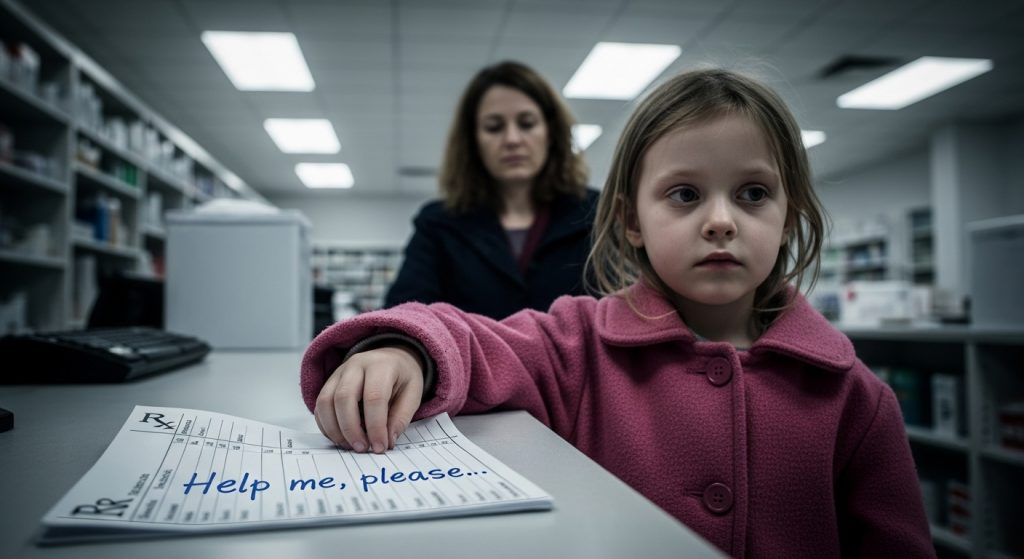
You never forget the exact moment your heart forgets how to beat, especially when it happens under the buzzing, sterile fluorescent lights of a suburban pharmacy on a rainy Tuesday night.
My name is David. For the past fifteen years, I’ve stood behind the raised counter at the corner of Elm and Maple in a quiet Ohio town, dispensing medication, offering sympathetic nods, and watching the parade of human frailty walk through those automatic sliding doors.
Being a pharmacist, especially on the night shift, means you become a reluctant witness to the secret struggles of your community.
I’ve seen the exhausted new mothers buying formula at 2:00 AM, tears of sheer exhaustion pooling in their eyes. I’ve seen the trembling hands of old men picking up pain meds for wives who are slowly fading away.
But nothing—absolutely nothing—could have prepared me for the little girl in the oversized yellow raincoat.
It was a miserable November evening. The kind of rain that doesn’t just fall, but seems to spit angrily against the glass, driven by a biting wind that strips the last of the dead leaves from the oak trees.
Inside, the pharmacy was a sanctuary of bright, artificial warmth.
Sarah, my pharmacy tech, was leaned against the back counter, loudly popping a bubble of cinnamon gum.
Sarah is twenty-four, a nursing student who treats this job as a minor inconvenience on her path to a scrub-wearing future. She’s loud, fast, incredibly efficient in a crisis, but entirely oblivious to the quiet tragedies that play out in front of her.
“Dr. C,” she mumbled around her gum, not looking up from her pharmacology textbook. “If this rain keeps up, the basement is going to flood again. You remember what happened to the adult diapers last time.”
I chuckled softly, my hand slipping instinctively into my white coat pocket to trace the smooth, cold edges of a tarnished silver locket.
It’s a habit I can’t break. A nervous tic I developed five years ago.
Inside that locket is a picture of my daughter, Maya. She would have been eight this year.
A sudden, aggressive form of leukemia took her from me right before her fourth birthday. Despite all my medical knowledge, despite standing behind a counter surrounded by thousands of pills meant to heal the world, I couldn’t save her.
That failure broke my marriage, emptied my soul, and left me voluntarily taking the graveyard shift, where the ghosts of my past are easier to manage in the quiet hours.
Then, the chime above the front door rang out, cutting through the low hum of the store’s HVAC unit.
I looked up.
A man and a little girl walked in, bringing a gust of frigid air and the smell of wet pavement with them.
My first instinct, born of thousands of hours of observation, was that they didn’t belong together. It wasn’t just a physical mismatch; it was the energy between them.
The man was in his late thirties, heavily built, wearing a faded canvas jacket that looked too thin for the weather. His hair was plastered to his forehead, and his eyes darted around the brightly lit store with the twitchy, restless energy of a cornered animal.
He smelled strongly of cheap, artificial pine cologne mixed with stale cigarette smoke. A scent meant to cover something else up.
But it was the little girl who caught my attention.
She looked to be about eight years old—the exact age Maya would be.
She was drowning in a bright yellow raincoat that was clearly several sizes too big, the sleeves rolled up in thick cuffs around her tiny wrists.
Her face was terrifyingly pale, her dark hair plastered to her cheeks in wet, disorganized strands.
She looked sick. That was my initial, professional assessment. Her eyes were sunken, shadowed with the kind of deep, bruised exhaustion you usually see in kids fighting a severe infection.
The man gripped her upper arm. It wasn’t the gentle, guiding touch of a parent keeping a child close in a public place. His fingers were dug into the fabric of her coat, a hard, controlling vise.
“Keep up,” I heard him hiss, his voice a low, gravelly rasp.
The little girl didn’t say a word. She just stumbled forward, her rain boots squeaking against the linoleum.
They made their way down the cough and cold aisle, heading straight toward the pharmacy counter.
I stood up straighter, my professional mask sliding into place. “Can I help you folks?” I asked, putting on my best, calming pharmacist voice.
The man stopped directly in front of the counter. Up close, his eyes were bloodshot, and the muscle in his jaw was ticking erratically.
“Need this filled,” he said, pulling a crumpled prescription pad from his pocket. He didn’t hand it to me. Instead, he shoved it into the little girl’s hands. “Give it to the man, Lily. Tell him what the doctor said.”
His voice was overly loud, strained with artificial sweetness that made the hairs on the back of my neck stand up.
The girl—Lily—stepped up to the counter. She barely reached the ledge.
She looked up at me, and for a split second, her eyes locked onto mine.
I expected to see the glassy, unfocused gaze of a child with a fever. Instead, I saw a piercing, wide-awake terror that punched the breath straight out of my lungs.
It was a look of pure, unadulterated desperation.
Her small, trembling hand slid the white paper across the laminated wood of the counter.
“Daddy says I need my medicine,” she whispered. Her voice was hoarse, barely audible over the pop of Sarah’s chewing gum behind me.
“Okay, let’s take a look, sweetheart,” I said gently, picking up the paper.
It was a standard prescription. Amoxicillin, 250mg, written by a doctor at an urgent care clinic two towns over. Standard issue for an ear infection or strep throat.
Nothing unusual. Nothing to trigger an alarm.
I was about to ask for her date of birth, to run it through the system, when I noticed the margin of the paper.
Down at the very bottom, in the empty white space beneath the doctor’s signature, there were letters.
They were written in a faint, blue ink. It wasn’t the heavy, flowing script of the doctor’s pen. It was the jagged, uneven block letters of a child pressing a ballpoint pen into paper while trying to hide what they were doing.
I squinted, adjusting my glasses.
The fluorescent lights glared off the paper, but as the letters came into focus, the blood in my veins turned to ice water.
Four words.
Written with a trembling hand.
HE IS NOT DADDY.
I stared at the words, the letters burning themselves into my retinas.
My pulse began to hammer in my ears, drowning out the sound of the rain outside. I felt the smooth metal of Maya’s locket pressing against my thumb in my pocket.
He is not daddy.
I forced my eyes to slowly move from the paper back to the little girl.
She was staring at me. A single tear broke free, mixing with the raindrops on her pale cheek. She gave a microscopic, pleading shake of her head.
“Well?” the man barked, his voice suddenly hard, dropping the artificial sweetness. He slammed his hand flat on the counter, making Sarah jump in the background. “How long is it going to take? We’re in a hurry.”
I looked up at him. His eyes narrowed, analyzing my face, looking for any sign of hesitation. His other hand was buried deep in the pocket of his jacket, and the shape bulging against the canvas was unmistakable.
I was standing three feet away from a kidnapper.
And if I made the wrong move right now, neither this little girl nor I were going to make it out of this pharmacy alive.
“Just a minor issue with the handwriting, sir,” I lied smoothly, my voice remarkably steady despite the hurricane of panic tearing through my chest. I tapped the keyboard. “Let me just verify this in the system.”
I didn’t open the prescription software.
I opened the silent alarm protocol on my terminal, praying to God that Officer Miller was doing his nightly patrol of the parking lot.
Chapter 2
The silent alarm button under the main pharmacy terminal is a small, unremarkable piece of textured plastic. It’s located exactly three inches to the left of my right knee. It was installed four years ago after a desperate guy with a crowbar and a bad Oxycontin habit decided to redecorate our front counters at three in the morning.
Since then, we’ve been told during every corporate security training that pressing it sends an immediate, silent ping directly to the county dispatch. No sirens in the store. No flashing strobe lights. Just a digital scream for help that takes, on average, four to seven minutes to answer.
Four to seven minutes.
When you’re microwaving a frozen dinner, four minutes is an annoyance. When you’re standing three feet away from a man with a concealed weapon who is currently holding the arm of an abducted eight-year-old girl, four minutes is an eternity. It is a vast, terrifying ocean of time where every second is a wave that could drag you under.
I kept my finger pressed against the button for three full, agonizing seconds to ensure the connection was made. My face, honed by fifteen years of delivering bad news about insurance co-pays and back-ordered heart medications, remained a mask of bland, apologetic customer service.
“System’s just running a little slow tonight,” I lied, my voice steady, though my heart was violently hammering against my ribs. I pulled my hand away from the keyboard and offered the man a sympathetic, practiced smile. “This rain must be messing with the satellite link to the insurance servers.”
The man—let’s call him the stranger, because the word ‘father’ felt like a blasphemy when applied to him—let out a sharp, exasperated hiss through his teeth.
“I’m paying cash,” he snapped. His hand, the one not gripping the little girl’s arm, shoved deeper into his canvas jacket pocket. I could see the distinct, heavy outline of a gun barrel pressing against the worn fabric, pointed vaguely in the direction of my stomach. “I don’t need insurance. Just put the pills in the bottle and let’s go.”
“I understand that, sir,” I said, keeping my tone strictly professional, pouring honey over the razor wire of the situation. “And I appreciate that. But state law requires me to log the script into the central database before I can dispense, cash or not. It tracks the prescribing doctor. It’ll just take a minute.”
I shifted my gaze down to the prescription pad still resting on the counter.
HE IS NOT DADDY.
The jagged, faint blue letters seemed to pulse under the harsh fluorescent lights. I casually slid a promotional flyer for flu shots over the bottom edge of the paper, hiding the girl’s desperate plea from his line of sight. If he looked down and saw what she had written, the fragile, tense peace of this pharmacy would shatter instantly.
I dared to look at Lily.
She was standing so incredibly still. It wasn’t the natural stillness of a quiet child; it was the paralyzed, rigid freeze of prey trying not to be noticed by a predator. Her small chest rose and fell in shallow, rapid breaths beneath the oversized yellow raincoat. Water dripped from the hem of the coat, creating a small, muddy puddle on the pristine linoleum floor.
Her eyes, dark and hollowed out by an exhaustion I couldn’t bear to think about, met mine again.
There was a profound, ancient sadness in those eyes that shouldn’t exist in an eight-year-old. It was the look of a child who had learned that adults were not protectors, but threats.
It was a look I knew. It was the same look my own daughter, Maya, had given me during her final weeks in the pediatric oncology ward at Seattle Children’s Hospital.
The memory hit me with the force of a physical blow, a sudden, suffocating wave of grief that threatened to break my composure.
I remembered the sterile smell of the hospital room, a sickening blend of rubbing alcohol, floor wax, and the metallic tang of fear. I remembered holding Maya’s tiny, bruising hand while the chemo machines hummed their indifferent, mechanical tune. Toward the end, when the pain became too much and the morphine stopped working, she would look at me with that exact same expression. A silent, pleading question: Daddy, why aren’t you making this stop? You fix things. Why aren’t you fixing this?
I couldn’t fix Maya. I was a pharmacist. I knew the molecular structure of the poisons they were pumping into her veins, I knew the half-lives of the painkillers, but I was utterly, uselessly powerless to save my own flesh and blood. When the flatline sounded, it broke something foundational inside me. It broke the man I was. My wife, Jessica, couldn’t look at me after the funeral without seeing the ghost of our child, and honestly, I couldn’t blame her. I couldn’t look in the mirror without seeing a failure.
I had spent the last five years existing in a numb, gray purgatory, voluntarily taking the graveyard shift because the night is quiet and the dead don’t ask you for favors.
But right here, right now, under the buzzing lights of Elm and Maple’s corner pharmacy, a little girl had pushed a piece of paper across a counter and asked me for a favor.
She had asked me to save her life.
My hand instinctively moved to my white coat pocket, my thumb brushing against the cold silver of Maya’s locket.
Not this time, a voice whispered fiercely in my mind. I am not failing this time.
“Hey, Dr. C?”
The loud, oblivious voice of Sarah, my pharmacy technician, shattered the tense bubble of silence.
I suppressed a flinch. I had completely forgotten she was there.
Sarah pushed herself off the back counter, snapping her cinnamon gum, and walked toward us holding a large, plastic bottle of adult multivitamins she was supposed to be restocking. She was looking at her phone, totally unaware of the lethal dynamic playing out just a few feet away.
“Did you approve the override on Mrs. Higgins’ statins?” she asked, finally looking up. She blinked at the stranger, then looked at me, completely misreading the room. “Oh, sorry. You’re busy. I can ring them up on the register over here if you want.”
The stranger’s head snapped toward Sarah. His eyes widened, and the muscle in his jaw clenched tight. The hand in his pocket twitched. He was calculating the risk. Two employees. One of him.
“No,” he growled, taking a half-step back, pulling Lily closer to his leg. “He’s doing it.”
Sarah frowned, her customer-service smile faltering at his aggressive tone. “Okay, geez. Just offering.”
“Sarah,” I said, my voice cutting through the air with a sharpness I rarely used. It was the tone of a commanding officer, not a friendly midnight pharmacist. “I need you to go to the back room right now. Check the inventory on the pediatric Codeine suspensions. The locked cabinet.”
She stared at me, confused. “What? We did that inventory on Sunday, Dr. C. It’s fine.”
“The numbers are off,” I lied, staring directly into her eyes, trying to beam the urgency of the situation into her brain through sheer force of will. “I need you to go to the back room. Unlock the cage. Count them again. Now.”
Sarah and I had worked together for two years. She knew I was easygoing. She knew I let her study on the clock and never raised my voice. The sudden authority, the cold command in my eyes—it finally registered.
She looked at me, then her gaze flicked briefly to the twitchy man, and then to the terrifyingly quiet little girl in the oversized coat.
I saw the exact moment the realization hit her. The blood drained from Sarah’s face, leaving her freckles standing out in stark relief. Her mouth opened slightly, and the chewing gum stopped.
“Right,” she swallowed hard, her voice suddenly small. “The back room. Counting the… the locked cabinet. I’m going.”
She backed away slowly, her eyes wide with sudden terror, before turning and practically jogging toward the reinforced steel door of the stockroom. I heard the heavy clack of the electronic lock engaging as she shut it behind her.
Good. She was safe. She had her cell phone. She’d be calling 911 right now, acting as a secondary confirmation to my silent alarm.
“What was that about?” the man demanded, his voice thick with suspicion. He took a step closer to the counter, leaning over the laminate. He smelled like damp earth, stale tobacco, and a sour, nervous sweat. “What is she doing?”
“State auditors are coming tomorrow,” I lied smoothly, turning my attention back to the computer screen. “If our controlled substance logs are off by even a single pill, they fine the store ten thousand dollars and suspend my license. It’s just bad timing, sir. Nothing for you to worry about.”
I grabbed the prescription pad, carefully sliding it off the flyer and folding it in half, keeping the bottom margin hidden. I slipped it into the breast pocket of my scrub shirt. I wasn’t going to let him have that piece of paper back. It was evidence.
“Alright, the system finally accepted it,” I said, forcing a cheerful tone. I looked at Lily. “Amoxicillin for the young lady. Now, since she’s a child, this comes in a powder form. I have to mix it with distilled water to create the liquid suspension. It takes about two minutes.”
“Just give me the damn powder, I’ll mix it at home,” he spat, his patience completely evaporating. “Give it to me.”
“I can’t do that, sir,” I said, turning around to face the shelves behind me. “It has to be measured precisely. Too much water and the antibiotic is diluted, and she won’t get better. Too little, and it’s an overdose that could damage her liver. State law says I have to compound it here.”
It was a complete fabrication. Any parent could mix it if they really had to, but he didn’t know that. And he couldn’t argue with ‘state law’ without making a scene.
I walked over to the compounding station, putting my back to him for a moment. It was a calculated risk. I needed to stretch this out.
Two minutes had passed since I hit the alarm. Dispatch would have routed the call to the sector cars. Jim Miller, the veteran cop who usually patrolled the commercial district on Tuesday nights, was likely already en route. Jim was a good man, a former Marine with a bad knee who drank his coffee black and talked about his grandkids too much. He knew this pharmacy. He knew me. If he got the call, he’d know it wasn’t a false alarm.
I grabbed a large plastic bottle of Amoxicillin powder from the shelf. I moved with agonizing slowness.
“So,” I called out over my shoulder, picking up a graduated cylinder to measure the distilled water. “What’s the young lady’s name? I didn’t see it on the script.”
There was a heavy pause.
“Lily,” he said, the lie rolling off his tongue with practiced ease. “Her name is Lily.”
“Lily,” I repeated, turning on the tap for the distilled water. It trickled out slowly. “That’s a beautiful name. My daughter’s name is Maya.”
“Fascinating,” he muttered sarcastically. “Can you hurry it up?”
“Kids catch everything this time of year, don’t they?” I continued, ignoring his hostility. I needed to keep him engaged. Keep him focused on me, not on the doors, not on the parking lot outside. “Maya had an ear infection that just wouldn’t quit when she was about Lily’s age. Woke up screaming at two in the morning. Had to hold her upright in a rocking chair until dawn.”
I poured the water into the cylinder, my hands remarkably steady.
“Yeah. Ear infection. Terrible,” he grunted. “Listen, buddy, I’m really not in the mood for a parenting chat. Mix the liquid and give it to me.”
“Almost done,” I promised.
I brought the cylinder and the bottle of powder back to the main counter, setting them down right in front of him. I wanted to be close. If he pulled that gun, I needed to be close enough to throw myself over the counter, or throw the heavy bottle at his face.
I looked down at Lily. She hadn’t moved an inch.
“You like strawberry, Lily?” I asked her, my voice softening. “This medicine tastes like fake strawberries. It’s not great, but it’s better than the bubblegum flavor.”
Lily didn’t answer. She just looked at my hands, watching me work.
“She’s shy,” the man interjected sharply. “She doesn’t talk to strangers.”
“That’s a smart rule,” I said, pouring a small amount of water into the powder and shaking the bottle vigorously.
Three minutes.
Where were the sirens? Where were the flashing lights?
I tapped the bottle against the counter, breaking up a clump of powder, then poured the rest of the water in.
“So, where are you folks headed in this awful weather?” I asked casually, printing out the label from the machine. “Tough night for a drive.”
The man’s eyes narrowed into angry slits. He leaned forward, his face inches from the Plexiglas shield that separated us.
“That’s none of your damn business, pharmacist,” he whispered, his breath fogging the glass. “You ask a lot of questions for a guy who just puts pills in a bottle. Now give me the medicine before I lose my temper.”
The threat was naked and absolute. The air in the pharmacy grew heavy, suffocating.
I had pushed him as far as I could. I was out of excuses. I was out of time.
“Of course, sir. I apologize,” I said, my voice flattening into submission. I slapped the label onto the bottle, placed it in a small white paper bag, and stapled the receipt to the top.
I picked up the bag.
This was the moment of transfer. Once he had the bag, he would leave. He would walk out those sliding doors with Lily, get into whatever car he had parked in the dark edges of the lot, and disappear into the night.
I couldn’t let that happen.
I held the bag out, but I didn’t push it across the counter. I held it firmly in my right hand.
He reached out with his left hand—his free hand—to grab it.
“That’ll be twelve dollars and fifty cents, sir,” I said, tightening my grip on the paper bag.
He swore under his breath, let go of the bag, and awkwardly reached into his back pocket to fish out a worn leather wallet. He pulled out a crumpled twenty-dollar bill and threw it on the counter.
“Keep the change,” he snarled. “Give me the bag.”
He reached for it again.
And then, the storm outside intervened.
A massive crack of thunder rattled the large glass windows at the front of the store, directly overhead. A split second later, the fluorescent lights above us flickered, buzzed violently, and died.
The pharmacy was plunged into absolute, pitch-black darkness.
For two terrible seconds, nobody breathed. The only sound was the torrential rain hammering against the roof and the frantic, heavy breathing of the man standing in front of me.
“Hey!” he shouted in the dark, his voice cracking with sudden, explosive panic. “Hey! What did you do?!”
“It’s just the storm!” I yelled back, my hands shooting out in the dark, grasping the edge of the counter, bracing myself. “The power went out! The backup generator will kick in! Just stay calm!”
“Give me the damn bag!” he roared. I heard the unmistakable sound of heavy canvas shifting, the terrifying, metallic clack of a slide being pulled back on a handgun.
He had drawn the weapon.
“Don’t move!” he screamed into the darkness. “Nobody move!”
In the pitch black, I couldn’t see him, but I could hear his boots scuffing violently against the linoleum. I could hear Lily let out a sharp, terrified squeak.
Then, with a heavy, mechanical hum, the pharmacy’s emergency backup generator roared to life.
It wasn’t the bright, overwhelming light from before. It was a series of dim, orange emergency bulbs spaced out along the ceiling, casting long, grotesque shadows across the aisles.
The dim light flickered on.
And the scene in front of me shifted from a tense standoff to a nightmare.
The man had backed away from the counter. He was standing in the center of the main aisle.
In his right hand, a black, snub-nosed revolver was pointed directly at my chest. His hand was shaking violently.
But it was his left arm that made the blood freeze in my veins.
He had wrapped it tightly around Lily’s chest, pulling her small back flush against his legs. He was using her as a human shield.
Lily’s eyes were wide, white circles of pure terror in the dim orange light. She was making a soft, choked whimpering sound, her little hands clawing uselessly at the thick, muscular arm trapping her.
“You think you’re smart?” the man spat, his eyes wild, darting toward the front doors. “You think I don’t know what you were doing? Stalling. Asking questions.”
He pointed the gun at the ceiling, then snapped it back down to aim at me.
“Where are they?” he screamed. “Did you call them?!”
I raised both my hands slowly, stepping back from the counter, showing him my empty palms. The white paper bag with the medicine lay abandoned on the floor.
“Nobody called anyone,” I lied, my voice trembling now. The sight of the gun, the sight of the little girl trapped against him, stripped away the last of my professional armor. I was just a terrified man. “The power just went out, man. Look outside. The streetlights are dead too.”
He kept the gun trained on me, but he turned his head slightly to look over his shoulder, toward the large glass windows at the front of the store.
It was a fatal mistake.
Because while the streetlights were indeed dead, the parking lot was no longer empty.
Through the rain-streaked glass, cutting through the absolute darkness of the night, two blindingly bright, blue-and-red LED light bars erupted into life, illuminating the front of the store in an aggressive, flashing strobe.
The police had arrived. And they hadn’t used their sirens. They had come in silent, just like the alarm.
I saw the silhouettes of two squad cars angled aggressively toward the front doors. I saw the dark shapes of officers stepping out into the rain, drawing their weapons, taking cover behind their open car doors.
The man saw them too.
He let out a sound that was half-sob, half-growl—the sound of a cornered animal realizing the trap had snapped shut.
He spun back to face me, the revolver shaking so hard in his grip I thought it might go off by accident. The blue and red lights washed over his sweaty, desperate face, making him look demonic.
“You dead man,” he whispered, the panic in his voice giving way to a cold, murderous resolve.
He tightened his grip on Lily, taking a step backward down the aisle, toward the darker recesses of the store. Toward the back room where Sarah was hiding.
“If any of them come through those doors,” he yelled over the sound of the rain, pressing the barrel of the gun against the side of Lily’s yellow raincoat, right over her ribs. “She dies first. And then you.”
Chapter 3
The flashing red and blue lights from the police cruisers sliced through the front windows of the pharmacy like violent, strobe-lit blades. They painted the sterile aisles in harsh, shifting colors, transforming the mundane displays of greeting cards and seasonal candy into a chaotic, terrifying carnival of shadows. Every rotation of the lightbars sent long, jagged silhouettes dancing across the linoleum, creating a dizzying, disorienting atmosphere that made the air feel impossibly thick.
“If any of them come through those doors,” the man had screamed, the barrel of the snub-nosed revolver pressed against the bright yellow plastic of Lily’s raincoat. “She dies first. And then you.”
The words hung in the air, heavier than the humidity brought by the thunderstorm outside. Time, which had already slowed to a painful crawl, suddenly fractured entirely. I didn’t experience the next few minutes as a continuous flow; instead, it came to me in sharp, hyper-focused fragments.
I saw the trembling of the man’s knuckles, white and strained as he gripped the gun. I saw the rusted cylinder of the revolver, a relic that looked like it hadn’t been cleaned or maintained in a decade, making it infinitely more dangerous in the hands of a panicked amateur. I saw the way Lily’s small, rain-soaked boots barely touched the floor as the man practically hoisted her upward, using her entirely as a fleshy, breathing shield.
And then, I saw her eyes.
Lily had stopped struggling. The quiet whimpers that had been escaping her lips ceased. She went entirely, limply still, her face freezing into a mask of hollow detachment. It was a terrifying psychological retreat, a survival mechanism kicking in when a child’s brain realizes that fighting is useless and pain is imminent. I knew that look. I had seen it a hundred times in the pediatric oncology ward. It was the face Maya made when the nurses brought in the long needles for her spinal taps. It was the look of a child vacating their own body to escape the unbearable reality of the present moment.
That look, more than the gun, more than the screaming man, shattered the last remaining vestiges of my fear.
The paralyzing terror that had gripped my lungs dissolved, replaced instantly by a cold, singular, and absolute clarity. The man I had been for the last five years—the grieving, hollowed-out ghost sleepwalking through the graveyard shift—died in that exact second. I was no longer a bystander. I was a father who had failed to save his own daughter, and the universe had just brutally placed another terrified little girl in front of me, demanding to know if I had learned anything from my suffering.
“Okay,” I said. My voice was no longer the soothing, practiced tone of a customer service representative. It was low, firm, and radiated an unnatural calm. “Okay. Nobody is coming through the doors. Look at them. They are staying behind their cars. You are in control here.”
“Shut up!” he barked, dragging Lily another step backward. His boots squeaked loudly against the wet floor. “Shut your mouth, pharmacist! You set me up! You hit a panic button!”
“I didn’t,” I lied smoothly, keeping my hands raised, palms open and empty. I needed to de-escalate his immediate panic before his trembling finger accidentally pulled that trigger. “Look at the weather. The lightning took out the transformer down the street. When the grid goes down, the store’s security system automatically defaults to an emergency ping to the local precinct. It’s an automated response, man. The cops outside? They don’t know you’re in here. They think they’re responding to a burglar alarm. They think the store is empty.”
It was a brilliant, desperate fabrication. It offered him a narrative where he hadn’t been outsmarted, where the cops weren’t actively hunting him, but were merely doing a routine building check.
He paused. The chaotic darting of his eyes slowed for a fraction of a second as his panicked brain processed the lie. He looked toward the front doors again. The police officers hadn’t approached the glass. They were huddled behind the engine blocks of their cruisers, rain pounding against their dark uniforms, waiting for backup or trying to assess the situation through the glare of the emergency lights.
“They don’t know?” he breathed, his grip on Lily loosening by perhaps a millimeter. “They don’t know we’re in here?”
“No,” I said, taking a slow, microscopic step out from behind the protective enclosure of the pharmacy counter. “They think it’s a false alarm caused by the power outage. If you stay calm, if you stay quiet, they’ll check the perimeter and leave. But if you panic, if you do something rash, they will storm this building.”
“Don’t move!” he snapped, raising the gun from Lily’s ribs to point directly at my forehead. “I told you to stay behind the counter!”
“I have to lock the register,” I said, improvising wildly. I kept moving, slowly, deliberately, putting my body fully in the open aisle. “If the cops come to the door and see the register open and me standing behind it, they’ll know someone is here. I’m trying to help you. I’m trying to get them to leave.”
He hesitated. The gun wavered between me and the little girl. He was a man running purely on adrenaline and fear, devoid of any actual plan. He was a reactionary creature, and right now, I was feeding him the only narrative that offered an escape.
“Hurry up,” he hissed, backing further down the aisle, toward the greeting cards and the cosmetics section.
My heart hammered against my ribs like a trapped bird. He was moving deeper into the store. He was moving toward the reinforced steel door of the stockroom.
Where Sarah was hiding.
If he reached that door and tried the handle, or if Sarah, hearing the commotion, decided to peek out, the situation would instantly degrade from a standoff into a massacre. I had to keep his attention entirely focused on me. I had to physically block his path to the back of the store without him realizing I was doing it.
“I’m coming,” I said, taking another slow step forward, mirroring his retreat. “What’s your name? You know my name, it’s David. You know Lily. What do we call you?”
“My name doesn’t matter,” he spat, his eyes darting frantically from the police lights outside to my face, then down the dark aisles. “It doesn’t matter who I am.”
“It matters to me, because we are the only three people in the world right now,” I said, my voice steady, projecting a false sense of intimacy in the cold, flickering light. “Look at her, man. Look at Lily. She’s exhausted. She’s terrified. You don’t want to hurt her. You’re just in a bad spot. We can fix this.”
“You can’t fix this!” he suddenly screamed, a wave of raw, emotional agony breaking through his aggressive facade. The sudden outburst made Lily flinch violently, her eyes squeezing shut. “Her bitch of a mother thought she could take her away! Thought she could just pack a bag and disappear to Ohio and I wouldn’t find them! I’m teaching her a lesson! Nobody leaves me!”
The truth poured out of him like venom from a lanced boil. He wasn’t a random kidnapper. He wasn’t a trafficker. He was an abusive ex-partner, a man whose fragile, bruised ego had driven him to commit an atrocity just to inflict pain on the woman who had dared to escape him. He had tracked them down, waited for his moment, and snatched the child.
“She left because she was scared, man,” I said softly, abandoning the lie about the police. I needed to keep him talking. Talking people don’t shoot. “And right now, you’re proving her right. You’re proving every terrible thing she ever thought about you.”
“Shut up!” he roared, the gun shaking violently again. “You don’t know anything about me! You don’t know what I’ve been through!”
“I know you’re holding a gun to an eight-year-old girl,” I countered, my voice gaining a harder, sharper edge. I took another step forward. I was now only ten feet away from him. The smell of his stale sweat and cheap cologne was overpowering. “I know that if you pull that trigger, your life is over. There’s no escaping a murdered child. The cops outside will tear you to pieces. Or you’ll spend the rest of your miserable life in a concrete box. Is that what you want? To die in a cage just to prove a point to your ex-girlfriend?”
Outside, the heavy, metallic squawk of a police bullhorn cut through the sound of the torrential rain.
“This is the Elmwood Police Department,” a distorted, booming voice echoed across the parking lot, vibrating against the glass windows of the pharmacy. It was Officer Miller. “We know there is someone inside the building. The perimeter is entirely secured. Come out with your hands visible and empty.”
The lie about the false alarm was dead.
The man let out a panicked, strangled cry. He spun around, completely disoriented, dragging Lily so hard she stumbled and fell to her knees. He yanked her back up by the fabric of her coat, a brutal, careless motion that made my blood boil.
“They know! They know we’re in here!” he shrieked, his eyes wide with absolute, primal terror. He pointed the gun wildly at the ceiling, then back at me. “You lied to me! You told them! You’re dead!”
He leveled the gun at my chest. I stared down the dark, empty void of the barrel. I didn’t blink. I didn’t brace for impact. I just kept my eyes locked onto his, channeling every ounce of paternal fury and unresolved grief I had harbored for five years into a single, piercing glare.
“Shoot me,” I said, my voice shockingly loud, echoing in the vast, empty pharmacy.
He froze. The command confused him.
“Shoot me,” I repeated, taking a heavy, deliberate step toward him. “Shoot the pharmacist. Add a federal murder charge to kidnapping and child endangerment. Do it. But know this: the second that gun goes off, the SWAT team outside is going to put thirty rounds of high-velocity ammunition through the front glass. They will turn you into pink mist before my body hits the floor. Is that how you want this to end? Bleeding out in the seasonal candy aisle?”
“Get back!” he screamed, backing up faster now, his boots slipping slightly on the wet linoleum. “Stay away from me!”
I took another step. I was closing the distance. I had positioned myself directly between him and the hallway that led to the stockroom door. He couldn’t get to Sarah without going through me.
“Let the girl go,” I demanded, my voice dropping to a dangerous, vibrating baritone. I wasn’t asking anymore. I was ordering. “Push her toward me, drop the gun, and lie flat on the floor. It’s the only way you survive tonight.”
Suddenly, the jarring, high-pitched ring of the pharmacy’s landline telephone shattered the tense standoff.
It echoed through the store, an ear-splitting, mechanical trill that sounded like a fire alarm in the absolute silence. The police were calling the store to establish contact.
The unexpected noise was too much for the man’s frayed, adrenaline-soaked nerves.
He let out a wordless scream of pure panic, whirled around, and fired the revolver.
BANG.
The sound of the gunshot inside the enclosed space was catastrophic. It was a physical force, a concussive wave of pressure that slammed into my chest and boxed my ears, leaving behind a high-pitched, ringing whine.
A shower of sparks and shattered plastic rained down from the ceiling as the bullet obliterated the overhead fluorescent fixture directly above the pharmacy counter. The phone abruptly stopped ringing.
Silence slammed back down onto the store, heavier and more terrifying than before.
The smell of burnt cordite, sharp and acrid, quickly filled the aisle, mixing with the damp smell of the rain.
Lily let out a piercing, high-pitched shriek—a sound of pure, unadulterated agony and terror. She collapsed against the man’s legs, covering her ears with her small hands, burying her face into his wet canvas jacket.
“Lily!” I yelled, my heart stopping in my chest, my eyes frantically searching her small body for blood. “Lily, are you hit? Are you okay?”
She didn’t answer. She just kept screaming, a continuous, breathless wail that tore at my soul.
The man stared at the smoking gun in his hand, his mouth hanging open in shock. He hadn’t meant to fire. It was a negligent discharge born of pure, unadulterated panic. But the reality of what he had done—firing a weapon in a hostage situation—finally crashed down on him.
“I… I didn’t…” he stammered, his eyes wide and unseeing.
Outside, the dynamic instantly changed. The sound of the gunshot was the point of no return. I heard the muffled, aggressive shouting of officers barking orders at each other. I saw the dark silhouettes moving rapidly from behind the cover of their cruisers, fanning out, taking up tactical positions around the perimeter of the building.
They were preparing to breach. They were going to come through the doors, and when they did, they would be coming in blind, looking for a threat, with their weapons drawn and their safeties off.
We had less than a minute before the front glass shattered and the pharmacy became a war zone.
“Listen to me!” I roared, abandoning all pretense of calm negotiation. I lunged forward, closing the distance between us to just five feet. “They are coming in! You have thirty seconds before they blow the doors off! Let her go!”
He looked at me, his eyes empty and devoid of reason. The man had completely mentally checked out. The cognitive dissonance of his actions had broken his brain. He was just a shell of panic holding a loaded weapon.
He tightened his grip on Lily’s coat and raised the gun, pointing it squarely at my face.
“We’re all dying tonight,” he whispered, a terrifyingly calm, dead smile stretching across his face. “If I can’t have her, nobody can.”
He cocked the hammer back. The metallic click was the loudest sound I had ever heard.
I didn’t think. I didn’t plan. I just reacted.
With a guttural roar that tore my throat, I threw myself forward, launching my entire body weight directly at him.
I didn’t aim for the gun. I aimed for his center of mass. I needed to knock him backward, to break his grip on the child.
As my feet left the ground, I saw his finger tighten on the trigger.
I saw the flash of muzzle flare illuminating his dead, empty eyes.
I felt the heat of the exhaust gases wash over my cheek.
And then, the world exploded into absolute, violent chaos.
Chapter 4
The human brain is a remarkable machine when it is convinced it is about to die. It doesn’t panic; it doesn’t scream. Instead, it alters the very fabric of time, stretching seconds into agonizingly long, granular moments of hyper-awareness. As my feet left the linoleum, propelling my body through the stale, cordite-laced air of the pharmacy, the world around me snapped into a terrifying, crystalline focus.
I saw the man’s finger, stained yellow from nicotine, depress the trigger.
I saw the hammer of the rusted revolver strike the firing pin.
I saw the blinding, stroboscopic flash of the muzzle flare, a jagged burst of orange and yellow fire that illuminated the terrified, hollow geometry of the man’s face. It was the face of a coward who had pushed himself past the point of no return.
The sound of the gunshot didn’t register as a noise. It registered as a physical force, a concussive shockwave that slammed into my eardrums and vibrated down the marrow of my bones. I felt the heat of the exhaust gases wash over my right cheek, a microsecond of searing intensity that smelled of sulfur, burnt carbon, and absolute finality.
But there was no pain. No sudden, life-ending impact.
The bullet had missed.
In his panic, his hand had jerked infinitesimally to the left as he fired. The heavy, .38 caliber slug screamed past my ear, the displacement of air ruffling my hair before it buried itself into the wooden framing of the cold and flu medicine display directly behind where I had just been standing. A cascade of shattered plastic bottles, colorful cardboard boxes, and cough syrup rained down upon the floor in a chaotic, clattering shower, but I barely registered the sound.
My shoulder connected with his chest, right below his sternum, with the brutal, sickening crunch of a high-speed collision.
All the momentum of my tackle transferred into his body. The breath exploded from his lungs in a wet, ragged gasp. The sheer force of the impact lifted him off his feet, his worn work boots pedaling uselessly in the air for a fraction of a second before gravity reclaimed us both.
We went down hard.
He hit the floor back-first, his skull bouncing against the unforgiving commercial linoleum with a heavy, hollow thud that echoed over the deafening ringing in my ears. I landed heavily on top of him, my knee driving viciously into his thigh.
The impact jarred the revolver loose. It clattered out of his trembling hand and skittered across the wet floor, spinning wildly until it disappeared underneath a low metal display of reading glasses, out of reach.
But he wasn’t finished. Driven by the primal, cornered-animal terror of a man who knew his life was effectively over, he fought back with a vicious, uncoordinated frenzy.
A heavy fist, fueled by pure adrenaline, clipped the side of my jaw. The blow was blinding. A constellation of white-hot stars exploded behind my eyelids, and the coppery taste of blood flooded my mouth. He bucked his hips violently, trying to throw my weight off him, his hands clawing frantically at my white pharmacist’s coat, tearing the fabric.
“Get off me!” he shrieked, the sound less human and more like a dying beast. He thrashed wildly, bringing his knee up to strike my ribs.
But five years of suppressed rage, five years of suffocating helplessness, and the immediate, overwhelming need to protect the little girl cowering somewhere behind us fueled me with a strength I didn’t know I possessed. I wasn’t just fighting an armed kidnapper; I was fighting the cancer that took Maya. I was fighting the universe that allowed bad things to happen to innocent children.
I grabbed a handful of his thick, damp canvas jacket with my left hand, pulling him up slightly to expose his face. With my right hand, I formed a tight fist and brought it down hard across his cheekbone.
Skin split. Bone shuddered. He let out a stunned, gargling cry, his head snapping to the side.
“Don’t move!” I roared, spit flying from my lips, my voice unrecognizable, deep and guttural. “Do not move a muscle!”
Before he could attempt another strike, the world outside the pharmacy decided to end the standoff.
The front doors didn’t slide open. They exploded.
A deafening, catastrophic crash of shattering safety glass ripped through the store as two heavily armored tactical officers breached the entrance. The heavy metal frames of the sliding doors buckled under the force of a battering ram.
Suddenly, the dim, orange emergency lighting of the pharmacy was obliterated by the blinding, sweeping beams of high-lumen tactical flashlights.
“POLICE! NOBODY MOVE! SHOW ME YOUR HANDS!”
The screaming voices of the officers layered over each other, a cacophony of disciplined, organized aggression. The heavy, syncopated stomping of combat boots charged down the center aisle.
“HANDS! LET ME SEE YOUR HANDS!”
I froze instantly. I knew the protocol. The men swarming into this building were hopped up on adrenaline, responding to a shots-fired call with a confirmed hostage. They were looking for a threat, and right now, I was a large man pinning another man to the ground. In the dark, in the chaos, mistakes happen in fractions of a second.
I threw myself off the kidnapper, rolling onto my back and thrusting my empty hands as high into the air as I possibly could.
“I am the pharmacist!” I screamed at the top of my lungs, keeping my hands spread wide, my fingers splayed. “I’m the pharmacist! He’s the shooter! The gun is under the reading glasses display!”
Three officers swarmed us. Two of them drove their knees brutally into the kidnapper’s back, pressing his face flat against the linoleum. He didn’t fight them. The fight had completely drained out of him the moment the glass shattered. He just lay there, whimpering softly, his nose bleeding profusely onto the floor. The ratcheting sound of heavy steel handcuffs locking around his wrists was the most beautiful sound I had ever heard.
A third officer, wearing a heavy Kevlar vest, stood over me, the blinding beam of his rifle-mounted flashlight trained directly on my chest.
“Don’t move, sir,” he ordered, his voice tight but controlled.
“The little girl,” I gasped, ignoring the order, my head swiveling frantically. My breath came in ragged, burning heaves. “Lily. Where is Lily?”
The officer lowered his flashlight slightly, panning the beam into the darker recesses of the aisle.
She was there.
Huddled against the bottom shelf of the greeting card aisle, entirely engulfed by the oversized yellow raincoat. She had pulled her knees tightly to her chest, burying her face into her arms, trying to make herself as small as humanly possible. She was trembling so violently that the cardboard boxes around her were vibrating.
I ignored the officer standing over me. I ignored the screaming, the radio chatter, the chaos. I scrambled to my hands and knees, ignoring the sharp pain radiating from my bruised ribs and the throbbing in my jaw, and crawled toward her.
“Sir, stay back!” the officer barked, though he didn’t raise his weapon. He could read the situation now.
“Lily,” I whispered, keeping my voice incredibly soft, pitching it below the noise of the arresting officers. I stopped two feet away from her, sitting back on my heels. I kept my hands visible, resting them on my thighs.
She didn’t look up. The whimpering was continuous now, a heartbreaking, breathless sound of sheer trauma.
“Lily, it’s David,” I said gently. “It’s the pharmacist. The bad man is gone. He’s in handcuffs. He can never, ever hurt you again.”
She flinched at the sound of my voice, curling tighter into her defensive ball. The yellow raincoat crinkled loudly.
“It’s over, sweetheart,” I continued, tears finally breaking free, hot and stinging as they tracked through the dust and blood on my face. “You did it. You were so brave. That note you wrote… you saved your own life, Lily. You saved us both.”
Slowly, agonizingly slowly, the top of her dark, wet head peeked out from the collar of the coat. One terrified, wide eye peered at me through the tangled mess of her hair.
She looked past me, toward the front of the store. She saw the men in uniforms. She saw the man who had taken her being hauled roughly to his feet, his hands bound behind his back, his face a bloody, defeated mess.
Then, she looked back at me.
The walls she had built to survive the last few hours crumbled all at once.
She let out a soul-shattering sob, scrambled out from under the bottom shelf, and threw herself at me.
I caught her. I wrapped my arms tightly around her small, trembling body, pulling her to my chest. The yellow raincoat was soaked with rain and the sweat of terror, but I held her as if she were the most precious thing on the earth. She buried her face into the crook of my neck, her tiny fingers clutching the torn fabric of my white coat with a desperate, white-knuckled grip.
She cried. It wasn’t the quiet whimpering from before. It was a loud, ragged, ugly weeping—the sound of a child finally allowing themselves to feel the sheer, overwhelming terror they had just survived.
I rested my chin on the top of her head, closing my eyes, and let my own tears fall.
“I’ve got you,” I whispered into her wet hair, rocking her gently back and forth on the cold linoleum floor. “I’ve got you. You’re safe now. I promise you, you’re entirely safe.”
I held her like that for a long time. The chaos of the police securing the scene, searching the aisles, and clearing the back room faded into background noise.
Somewhere in the distance, I heard the heavy click of the stockroom door unlocking. I heard Sarah’s voice, shaking and hysterical, talking to an officer. She was safe. She had called 911. She had done exactly what I asked her to do.
“David?”
I looked up. Officer Jim Miller was standing over us. The veteran cop looked older than usual, the deep lines around his eyes stark in the flashing emergency lights. He was holding his radio, but he wasn’t speaking into it. He was just looking down at us, a profound sadness and deep respect etched onto his weathered face.
“Paramedics are right outside, Dave,” Miller said softly, squatting down to eye level. “We need to let them look at her. And we need to look at you. You took a hell of a hit to the face.”
I nodded slowly, gently easing my grip on Lily.
“Lily,” I said softly, pulling back just enough to look into her tear-streaked face. “This is my friend, Jim. He’s a police officer. There are doctors outside who just want to make sure you aren’t hurt. Can we go see them?”
She sniffled, rubbing her eyes with the back of her dirty hand. She looked at Miller, then back at me. Her grip on my coat didn’t loosen.
“Will you come with me?” she whispered, her voice rough and raspy.
“I’m not going anywhere,” I promised, pressing a gentle kiss to her forehead. “I’m staying right beside you until your mom gets here.”
The mention of her mother brought a fresh wave of tears, but she nodded.
I stood up, my joints aching, my jaw throbbing in time with my pulse. I picked Lily up, carrying her in my arms, her head resting heavily on my shoulder.
We walked toward the front of the pharmacy. The place was a disaster zone. The front doors were completely obliterated, shards of thick safety glass sparkling on the wet floor like crushed diamonds. The overhead lights were still out, but the space was violently illuminated by the flashing lights of six police cruisers and two ambulances parked haphazardly in the lot.
The rain was still falling, a steady, cold drizzle that felt incredible against my hot, bruised face as we stepped out of the building.
I handed Lily over to a waiting female EMT, who immediately wrapped the little girl in a thick, warm foil blanket. But true to my word, I didn’t leave. I sat on the rear bumper of the ambulance while the medics checked her vitals, flashing penlights in her eyes and gently examining her ribs where the gun had been pressed.
Another EMT was working on me, shining a light into my eyes to check for a concussion, taping a butterfly bandage over the split skin on my cheekbone.
“You’re lucky, buddy,” the young medic said, wiping away the blood with a piece of gauze. “Half an inch lower and that guy would have broken your orbital bone. And considering there’s a bullet hole in the wall behind your counter, you’re the luckiest man in the state of Ohio tonight.”
“Yeah,” I muttered, my eyes fixed on Lily. She was sipping from a juice box the EMT had given her, her dark eyes tracking every movement in the parking lot. She looked exhausted, traumatized, but alive. “I guess I am.”
The police had taped off the entire perimeter. The kidnapper had been loaded into the back of a squad car, heavily guarded. Detectives were already pulling up, putting on raincoats, preparing to process the scene.
Officer Miller walked over to me, holding a clipboard. He offered me a grim, respectful smile.
“We ran his plates,” Miller said, taking a sip from a styrofoam cup of coffee someone had handed him. “The guy’s name is Thomas Vance. Warrants out of Kentucky for aggravated domestic assault and violating a restraining order. The mother took the kid and fled up here three weeks ago, trying to hide. He found them. Snatched the girl off the street while the mother was inside a gas station paying for fuel.”
I felt a cold rage knot in my stomach. The sheer audacity of the evil men do in this world never ceases to stagger me.
“Where is the mother now?” I asked, my voice tight.
“State troopers found her at the gas station an hour ago. She was hysterical. They’re rushing her down here right now. Should be here any minute.” Miller paused, looking at me intently. “Dave, Sarah told us what happened before the power cut. She said you forced her into the back room and locked the cage. You knew what he was doing before he pulled the gun. How?”
I reached into the breast pocket of my ruined scrub shirt and pulled out the folded, crumpled prescription pad.
I smoothed it out on my knee and handed it to Miller.
Miller took the paper, holding it up to the glare of the ambulance lights. He read the doctor’s messy scrawl, then his eyes dropped to the bottom margin.
HE IS NOT DADDY.
Miller let out a long, heavy breath, his shoulders dropping. He stared at the jagged, uneven letters for a long time.
“Christ,” Miller whispered, shaking his head. “She’s eight years old. To have the presence of mind to do that… while standing next to the monster who took her.”
“She’s a survivor,” I said, looking over at Lily. “She fought back the only way she could. All I did was read the note.”
“Don’t sell yourself short, Dave,” Miller said firmly, tapping the paper. “Nine out of ten people wouldn’t have noticed that. And ninety-nine out of a hundred wouldn’t have tackled a man holding a loaded .38. You saved her life tonight. You know that, right?”
Before I could answer, the screech of tires tore through the parking lot.
An unmarked state trooper vehicle slammed to a halt just outside the yellow police tape. The back door flew open before the car was completely stopped.
A woman tumbled out.
She was in her late twenties, wearing sweatpants and a frantic, disheveled t-shirt. She was soaking wet, her face a mask of absolute, paralyzing terror. She looked wildly around the sea of flashing lights, the armed officers, the shattered glass of the pharmacy.
“Lily!” she screamed, the sound tearing the fabric of the night. It was the primal, desperate roar of a mother looking for her cub. “Lily! Where is my daughter?! Let me through! Where is she?!”
The officers at the perimeter tried to gently hold her back, trying to calm her down, but she fought them like a wildcat, her eyes locked onto the ambulances.
Inside the back of the ambulance, Lily dropped her juice box.
“Mommy!” she shrieked.
She scrambled off the stretcher, leaving the foil blanket behind, and bolted out the back of the ambulance. She ran across the wet, dark asphalt on shaking legs, completely ignoring the rain.
“Let her go,” Miller barked into his radio, seeing the situation unfold. “Let the mother through.”
The officers stepped aside.
The woman hit the ground on her knees, the wet asphalt tearing at her sweatpants, and threw her arms open wide.
Lily collided with her.
They collapsed into a tangled, desperate pile on the wet pavement. The mother wrapped her entire body around the little girl, burying her face into her daughter’s neck, wailing with a grief and a relief so profound it felt invasive to even witness it. She rocked Lily back and forth, kissing her face, her hair, her hands, over and over again, babbling a frantic stream of assurances.
“I’ve got you, my baby, I’m here, Mommy’s here, you’re safe, oh God, you’re safe.”
I sat on the bumper of the ambulance, watching them.
The EMTs had stopped working. The police officers had stopped talking. The entire parking lot, filled with hardened professionals who had seen the worst the world had to offer, went entirely silent, giving the mother and daughter the space to reunite.
I watched the mother clutch her child, breathing in the scent of her, verifying that she was real, that she was alive.
And as I watched them, my hand slowly, instinctively drifted to my pocket.
My fingers traced the smooth, tarnished silver edge of Maya’s locket.
For five years, every time I touched that locket, it was a brand of failure. It was a reminder of the hospital room, the beeping machines, the flatline. It was a reminder that I was powerless. I was a man who stood behind a counter and dispensed pills, but couldn’t save the one person who mattered most. I had built a fortress of grief around myself, voluntarily working the graveyard shift to avoid the daylight, to avoid the living, to punish myself for surviving when she didn’t.
But as I looked at the little girl in the oversized yellow raincoat clinging to her mother, something inside me—something hard, cold, and calcified—finally broke.
I couldn’t save Maya. That was the tragic, brutal reality of the universe. Cancer doesn’t care about love, it doesn’t care about fairness, and it doesn’t negotiate.
But I had saved Lily.
When the universe presented me with another terrified child, another impossible situation, I hadn’t frozen. I hadn’t hidden behind the counter. I had stepped out into the open, I had taken the hit, and I had fought back.
A profound, shattering sense of peace washed over me, mixing with the cold rain on my face. The heavy, suffocating weight I had carried in my chest for half a decade didn’t disappear—grief never truly disappears—but it shifted. It changed shape. It was no longer an anchor dragging me to the bottom of the ocean.
I looked down at the locket in my hand. I popped the clasp with my thumb.
Inside, the picture of Maya smiled back at me. She looked so happy, so vibrant.
I did it, baby girl, I thought, the tears silently tracking down my bruised cheeks. I couldn’t fix it for us. But I fixed it for them.
I snapped the locket shut, the sharp click sounding incredibly loud in my own ears. But this time, I didn’t let it fall back to the bottom of my pocket. I unclasped the chain and secured it around my neck, letting the silver rest against my skin, right over my heart.
Where it belonged.
Later that night, after I gave my official statement to the detectives at the precinct, after Lily’s mother had tearfully hugged me so hard I thought my ribs would crack, I walked out of the police station and into the cool, pre-dawn air.
The storm had passed. The heavy rain had given way to a clear, crisp morning. The eastern horizon was bleeding a pale, beautiful pink, the first signs of the sun breaking through the darkness.
I pulled out my phone and dialed my district manager’s number. It went to voicemail, of course. It was 5:30 in the morning.
“Hey, Greg, it’s David,” I said, my voice steady, sounding clearer and stronger than it had in years. “Listen, the Elm Street store is going to be closed for a few days. You’ve probably seen the police reports by now. I’m okay. But I’m calling to give my notice regarding my schedule.”
I paused, looking up at the lightening sky.
“I’m done with the night shift, Greg. I need you to move me back to days. I want to see the sun again.”
Notes from the Author: The Philosophy of the Graveyard Shift
Trauma is a ghost that haunts the house of your mind, and grief is the lock you place on the front door to keep everyone else out.
For a long time, I believed that my failure to save my daughter defined my entire existence. I retreated into the shadows, taking the graveyard shift, thinking that if I just isolated myself enough, the world couldn’t hurt me anymore. But isolation doesn’t heal trauma; it merely preserves it in amber.
The truth is, the universe is inherently chaotic. It is brutal, unfair, and utterly indifferent to our suffering. Bad things happen to good people. Terrible things happen to innocent children. We cannot control the devastating storms that rip through our lives.
But what we can control is what we do when the storm forces us to make a choice.
Healing doesn’t come from time. Time just passes. Healing comes from action. It comes from the terrifying, vulnerable decision to step back into the arena, to care about the world again, even when you know how much it can hurt.
The little girl in the yellow raincoat didn’t just need me to save her life that night. The universe sent her to that pharmacy so she could save mine. She taught me that while we cannot rewrite the tragedies of our past, we can absolutely choose to be the protector in someone else’s present.
If you are carrying a weight that feels too heavy to bear, if you are hiding in the dark because the light hurts your eyes, know this: your pain does not disqualify you from making a difference. In fact, your pain is the very thing that gives you the empathy, the strength, and the desperate courage to stand up when everyone else remains seated.
You cannot save the people you have lost. But you can honor them by fighting like hell for the people who are still here.
Step out from behind the counter. Turn on the lights. The world needs you in the daytime.

