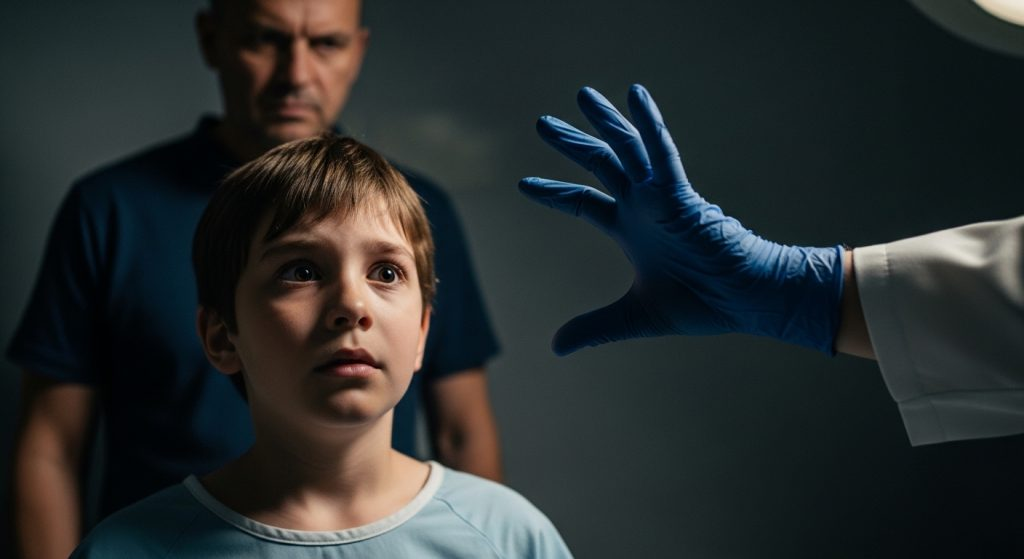
I’ve been a doctor for fifteen years. I’ve seen it all.
I’ve seen the aftermath of high-speed collisions, the silent tragedy of overdoses, and the miracles that happen in the dead of night.
But nothing, absolutely nothing, prepared me for Leo.
It was a Tuesday, around 3:00 AM. The kind of hour where the hospital air feels heavy and sterile.
The ER was unusually quiet, the only sound being the hum of the vending machines and the distant squeak of a nurse’s sneakers.
That’s when they walked in.
A man and a boy.
The man was tall, built like a wall, wearing a grease-stained flannel shirt. He looked exhausted, but his eyes were sharp, darting around the room.
The boy, Leo, couldn’t have been more than ten.
He was pale. Too pale for a kid his age. He was cradling his right arm against his chest like it was a fragile bird.
I watched them from the triage desk. Something felt… off.
Usually, when a kid is hurt, they’re crying. Or they’re looking to their parent for comfort.
Leo wasn’t doing either. He was staring at the floor, his lips pressed into a thin, white line.
“He fell,” the man said. His voice was a low growl, echoing in the empty lobby.
I stood up and walked toward them. “I’m Dr. Miller. What happened?”
The man didn’t look at me. He kept his eyes on the boy. “He was on his bike. Hit a curb. Landed hard on his wrist.”
Leo didn’t nod. He didn’t even blink.
“Let’s get you into a room, Leo,” I said, trying to keep my voice gentle.
As we walked, I noticed the way the man stayed close. Too close. He was almost crowding the boy, his hand resting heavily on Leo’s shoulder.
We got into Exam Room 4. I asked Leo to sit on the edge of the bed.
“Can I see that arm, buddy?” I asked.
Leo hesitated. He looked at the man. The man gave a short, curt nod.
Slowly, Leo unwrapped the makeshift bandage—a dirty kitchen towel—from his wrist.
My breath hitched.
The swelling was massive. It wasn’t the typical puffiness of a sprain or a break.
It was localized. A hard, angry-looking lump about the size of a golf ball, right on the underside of his wrist.
But it wasn’t blue or purple like a bruise. It was a dull, sickly grey.
“That looks painful,” I murmured, reaching for my gloves. “How long ago did this happen?”
“About an hour ago,” the father snapped. “Just fix it so we can go.”
I frowned. An hour? The inflammation looked days old. Maybe even weeks.
I leaned in closer. I could feel the tension in the room rising. It was thick, suffocating.
The nurse, Sarah, stood by the door, her hand on her hip. She caught my eye. She felt it too.
“Okay, Leo. I’m just going to touch it very lightly. I need to see if it’s a fracture.”
Leo’s eyes finally met mine. They were filled with a deep, haunting terror.
He didn’t say a word, but his gaze was screaming.
I reached out. My fingertips brushed the edge of the swelling.
It was hot. Feverishly hot.
But then, I pressed just a fraction harder.
My heart stopped.
Underneath the skin, there was no give. No soft tissue. No bone.
Instead, I felt something shift. Something mechanical.
Click.
It was a distinct, metallic sound. Small, but in the silence of that room, it sounded like a gunshot.
Then, the swelling did something no injury should ever do.
It pulsed.
Not with the rhythm of a heart, but with a rapid, steady vibration.
I looked at Leo. A single tear escaped his eye and rolled down his cheek.
“Don’t tell him,” the boy whispered, so low I almost didn’t hear it. “Please. If he knows I showed you, he’ll take it back.”
I felt the blood drain from my face. I looked up at the father.
He wasn’t looking at the wrist anymore. He was looking at me. And the look in his eyes wasn’t concern.
It was a threat.
“Is there a problem, Doctor?” the man asked, stepping forward.
I looked back down at the boy’s wrist. The “swelling” was glowing. A faint, rhythmic blue light was beginning to seep through the translucent skin.
My 15 years of experience meant nothing in that moment. I wasn’t looking at a broken bone.
I was looking at something that shouldn’t exist.
And then, I realized why the room had gone silent.
Because everyone—the nurse, the father, and even Leo—was waiting to see if I was brave enough to find out what was really under that skin.
CHAPTER 2
My mind raced, trying to process the impossibility beneath my fingertips.
A mechanical click. A vibration. A blue light.
This wasn’t a bone. This wasn’t a hematoma.
I pulled my hand back as if I’d touched a live wire, my eyes locking onto the man standing just feet away.
“Is there a problem, Doctor?” he repeated, his voice dropping an octave.
He took half a step forward. His work boots scuffed loudly against the linoleum.
I forced my face to remain completely neutral. In the ER, panic is a contagious disease, and I couldn’t afford to catch it.
“No problem,” I lied, my voice steady despite the adrenaline flooding my veins. “The swelling is just… unusually dense. I need an X-ray.”
“I told you, it’s just a bad fall,” the man growled, his jaw clenching. “Wrap it up. Give him some Motrin. We have a long drive ahead of us.”
A long drive? At 3:00 AM?
I glanced at Leo. The 10-year-old was staring at his knees, his good hand gripping the edge of the examination table so hard his knuckles were stark white.
He was absolutely terrified. But he was also completely silent.
“Sir,” I started, keeping my tone professional but firm. “Hospital protocol dictates we image any injury with this level of localized edema. I can’t let him leave without making sure the bone is intact.”
“I’m his father. I’m saying he doesn’t need it,” he snapped back.
“Actually, step-father,” Leo whispered softly, still not looking up.
The man whipped his head around, glaring at the boy with a look of pure venom. “Shut your mouth, Leo. You’ve caused enough trouble tonight.”
I felt a cold spike of anger hit my chest.
“Sarah,” I said, not taking my eyes off the stepfather. “Please prep Room 2 for a localized wrist series.”
Sarah, who had been watching the exchange with narrowed eyes, nodded. She knew the code. Room 2 was right next to the security desk.
“Right away, Dr. Miller,” she said, slipping out of the room.
The stepfather noticed. He crossed his arms, his massive biceps straining against the fabric of his flannel shirt.
“You docs are all the same. Trying to rack up the bill with unnecessary tests,” he scoffed.
I ignored the bait. Instead, I moved slightly, positioning my body between him and Leo. It was a subtle shift, a protective stance.
“What’s your name, sir?” I asked calmly.
“Mark,” he grunted. “Mark Davies.”
“Well, Mark, I appreciate your concern for the bill, but Leo’s health is my primary responsibility right now.”
I reached back to adjust the exam light, deliberately shining it a bit more directly onto Leo’s wrist.
The blue light was gone. The rhythmic vibration had stopped.
Had I imagined it?
No. The metallic click had been real. The heat radiating from the skin was real.
I looked at Leo again. He was deliberately pressing his injured wrist against his thigh, as if trying to smother whatever was inside it.
“Let’s go,” I said, gesturing toward the door.
Mark didn’t move. “I’m staying right here. You can do the X-ray in this room with a portable machine.”
He knew. He knew we couldn’t do a high-res image of whatever that was with a portable. Or maybe he just didn’t want to walk past the security desk.
“Portable won’t give us the resolution we need,” I replied smoothly. “It’s right down the hall.”
Mark glared at me for five agonizing seconds. I didn’t blink.
Finally, he let out a short, angry breath. “Fine. But I’m going with him.”
“Of course,” I said, though my stomach churned.
We walked down the long, sterile corridor. The silence was deafening.
Leo walked stiffly, keeping his distance from Mark. I walked on the other side of him.
As we approached the imaging room, I saw Officer Jenkins standing by the nurses’ station, sipping a coffee.
I caught Jenkins’ eye and gave a subtle, downward nod. A silent ‘stay alert’ signal we’d developed over years of night shifts together.
Jenkins straightened up, setting his coffee down.
We entered the X-ray suite. The room was freezing, the massive machinery humming quietly.
“Alright, Leo,” the technician, Dave, said cheerfully. “Let’s get a picture of that wing. Hop up here.”
Leo complied silently.
“Sir,” Dave said, turning to Mark. “I’ll need you to step behind the lead partition.”
Mark crossed his arms again. “I’m not leaving his side.”
“It’s just behind that glass,” Dave pointed. “You’ll see him the whole time. It’s for your own safety due to radiation.”
Mark hesitated, his eyes darting to the machine, then to Leo, then to me.
“Don’t pull any fast ones,” he muttered, finally stepping behind the thick lead-glass wall.
I stayed in the room, donning a heavy lead apron. I needed to see this image the second it popped up on the monitor.
“Okay, Leo, rest your arm right on this plate,” Dave instructed.
Leo moved his arm, but as his wrist touched the cold surface of the imaging plate, he gasped.
“Does it hurt?” Dave asked, pausing.
“No,” Leo whispered. “It’s just… cold.”
But I saw his jaw clench. He was lying. It hurt terribly.
Dave hurried back to the control booth next to where Mark was standing.
“Hold still, buddy,” Dave called over the intercom. “Taking the shot in three, two, one…”
The machine clicked. A loud, sharp sound.
Immediately, the main monitor in the room flashed on.
I stared at the screen. My heart sank.
“What the hell is that?” Dave muttered over the intercom.
The image was completely washed out. There was no bone structure visible.
Instead, exactly where the lump was, there was a massive burst of white static on the screen. It looked like a starburst, completely obscuring the wrist.
“Artifact,” Dave said, sounding confused. “Something interfered with the beam. Does he have metal on his wrist? A watch? A bracelet?”
“No,” I answered, staring intensely at the static burst.
Mark burst out from behind the partition.
“What did you do?” he demanded, pointing a thick finger at Dave.
“Nothing, sir,” Dave stammered. “The machine just… threw an error. It happens sometimes with thick clothing or metal.”
“He doesn’t have metal on!” Mark yelled, his face flushing red. “He fell off a damn bike!”
I stepped closer to the monitor. The static wasn’t uniform. In the center of the whiteout, there were faint, geometric lines.
It wasn’t an artifact from a watch. It was something internal interfering with the electromagnetic frequency of the X-ray.
“Let’s take another one,” I said quietly.
“No!” Mark shouted, grabbing Leo by the good arm and yanking him off the table.
Leo let out a sharp cry of pain as he stumbled.
“Hey!” I barked, stepping forward. “Let go of him.”
“We’re leaving,” Mark snarled, dragging the boy toward the door. “You people are incompetent. I’m taking him to the clinic across town.”
“Mark, stop,” I said, putting myself in the doorway. “You can’t leave with him like this. His wrist is severe—”
“Move, Doctor,” Mark warned, his free hand balling into a fist.
Just then, the door pushed open from behind me.
It was Dr. Evans, the night shift attending physician. He was older, pragmatic, and heavily focused on getting patients in and out.
“What’s all the shouting about?” Dr. Evans asked, looking back and forth between me, Mark, and the crying boy.
“This doctor is harassing us,” Mark immediately lied, his tone suddenly shifting to that of an aggrieved parent. “My son fell and hurt his wrist. We just wanted a simple checkup, but he’s running broken machines and scaring the kid.”
Dr. Evans looked at the monitor. He sighed.
“Miller, that’s just a digital artifact. The machine in Room 2 has been acting up all week. Look at the edges, it’s a sensor glitch.”
“Dr. Evans, I felt something in the tissue,” I started, trying to convey urgency without sounding crazy. “There’s severe, localized edema that doesn’t match a trauma profile.”
“He’s a kid who hit a curb,” Evans replied dismissively, pulling a pair of reading glasses from his pocket. “It’s a hematoma. Kids swell up like balloons. Wrap it, give him a splint, and refer him to ortho in the morning if it doesn’t go down.”
I stared at my superior in disbelief. “But the—”
“Miller,” Evans interrupted, his voice dropping to a warning whisper. “We have six people in the waiting room. Process the patient.”
Evans turned and walked out.
Mark smiled. A chilling, victorious smirk.
“You heard the boss,” Mark sneered. “Wrap it up.”
I felt completely cornered. If I pushed back now, Evans would pull me off the case entirely, and Mark would walk out the door with Leo.
I needed to buy time. I needed to know what was under that skin.
“Fine,” I said, swallowing my pride. “Let’s go back to the exam room. I’ll get a splint.”
Mark released his tight grip on Leo, looking incredibly smug. “That’s more like it.”
We walked back in silence. But this time, the dynamic had shifted. Mark felt he was in control.
I left them in Exam Room 4 and went to the supply closet.
Sarah slipped in behind me, closing the door softly.
“What happened?” she whispered urgently. “Jenkins is on standby.”
“Evans blew me off,” I said, grabbing a fiberglass splint roll. “He thinks it’s a sensor glitch on the X-ray. It wasn’t. There’s something metallic inside that boy’s arm, Sarah. And it’s active.”
“Active? Like a pacemaker?”
“I don’t know,” I admitted, my hands shaking slightly. “But the stepfather is desperate to hide it. And he’s willing to get violent to do so.”
“Do we call CPS?” Sarah asked.
“On what grounds?” I countered. “A misread X-ray and a swollen wrist? They won’t get here in time. He’s planning to leave in five minutes.”
I grabbed the medical shears and a roll of heavy athletic tape.
“I need a distraction,” I told Sarah. “I need Mark out of that room for exactly one minute.”
Sarah’s eyes widened. “What are you going to do?”
“I’m going to find out what Leo is hiding.”
“Miller, if you cut into that kid without consent, you lose your license,” she warned.
“I’m not going to cut him,” I said. “Just get Mark out of the room.”
Sarah took a deep breath and nodded.
I walked back into Exam Room 4. Mark was standing right next to Leo, hovering.
“Okay, let’s get this splint on,” I said, forcing a calm smile.
Suddenly, Sarah threw open the door. She looked frantic.
“Sir,” she said, looking directly at Mark. “Sir, your truck in the ambulance bay. A delivery truck just side-swiped it. You need to move it right now or it’s going to be towed.”
Mark’s face went purple. “Are you kidding me?!”
“It’s blocking the bay,” Sarah insisted. “The driver is out there with the police.”
Mark looked at Leo, then at me. He was torn. His truck or the boy.
“Don’t move,” Mark ordered the boy. “Say absolutely nothing. I’ll be back in two minutes.”
He sprinted out the door.
The second the door clicked shut, I turned to Leo.
The boy was hyperventilating, tears streaming down his face.
“Leo,” I said, dropping to my knees so I was at his eye level. “He’s gone. It’s just us.”
Leo violently shook his head. “He’s going to kill me. He told me he’d kill me if I let anyone see.”
“I’m not going to let him hurt you,” I promised, grabbing his uninjured hand. “But you have to tell me. What is inside your wrist?”
Leo sobbed, his small frame shaking.
“My mom…” he choked out. “My mom put it there.”
“Your mom?” I asked, confused. “Where is your mom?”
Leo looked at me, his eyes wide with a despair no child should ever carry.
“She’s been missing for three weeks,” Leo whispered. “He told everyone she ran away.”
I felt the blood freeze in my veins.
“But she didn’t run away,” Leo continued, his voice dropping to a terrifyingly calm pitch. “The night she disappeared, she made a cut on my arm. She pushed it inside and sewed it up.”
I looked at the swollen, grey lump.
“What is it, Leo?” I asked, my voice trembling.
Leo swallowed hard. “She said it was the only way to prove what he did to her. She said I had to keep it safe until I found someone who wouldn’t look away.”
Suddenly, the swelling on his wrist began to vibrate again.
And this time, the blue light wasn’t faint.
It shone brightly through his skin, illuminating the unmistakable shape of a high-capacity micro-USB drive.
But that wasn’t the worst part.
The worst part was the sound of heavy work boots sprinting back down the hallway, coming straight toward our door.
CHAPTER 3
The heavy, frantic thud of work boots echoed down the linoleum corridor, growing louder with every millisecond.
He was coming back.
I had less than five seconds before Mark walked through that door, and the blue glow from the USB drive under Leo’s skin was practically illuminating the dark examination room.
“Don’t move,” I hissed to Leo, my hands flying toward the tray of medical supplies.
I grabbed a thick roll of cotton padding and slapped it over the boy’s wrist, frantically wrapping it around the swollen, glowing lump.
Leo winced, a sharp intake of breath hissing through his teeth, but he didn’t pull away. He knew what was at stake.
I snatched the roll of rigid fiberglass casting tape just as the doorknob violently twisted.
The door slammed open, rebounding off the wall with a deafening crack.
Mark stood in the doorway, his massive chest heaving, his face flushed with a terrifying, crimson rage.
His eyes darted wildly around the room, instantly locking onto me, then snapping down to Leo.
“There was no delivery truck,” Mark said.
His voice wasn’t a yell. It was worse. It was a low, vibrating growl that made the hair on the back of my neck stand up.
“What?” I asked, forcing my voice to sound confused as I continued wrapping the white cotton around Leo’s arm. “Are you sure? The nurse said—”
“I said there was no damn truck,” Mark interrupted, taking a slow, heavy step into the room.
He closed the door behind him. The distinct click of the latch felt like a prison cell slamming shut.
“Somebody made a mistake,” I lied smoothly, not looking up from the boy’s wrist. “It happens. Let’s just finish splinting this up so you two can get on the road.”
Mark didn’t say a word. He just kept walking toward us, his boots slow and deliberate.
The air in the room felt thick, like breathing underwater. My heart was hammering against my ribs so hard I thought it might crack them.
“Step away from him,” Mark ordered.
“I just need to apply the fiberglass—”
“I said, step away from my son!” Mark roared, the sudden explosion of sound making both me and Leo flinch.
Before I could react, Mark lunged forward.
He shoved me backward with a massive hand. I stumbled, my hip slamming hard into the stainless steel medical counter. The sharp pain shot down my leg, but I ignored it.
Mark grabbed Leo’s injured arm.
“No!” Leo screamed, panic finally breaking through his silent terror.
“We are leaving. Now,” Mark snarled, his thick fingers digging into the cotton padding I had just wrapped.
“Stop!” I yelled, stepping forward. “You’re going to cause permanent nerve damage!”
Mark ignored me. He started ripping at the cotton, tearing it away in jagged strips.
He was looking for something. He wanted to see the swelling. He wanted to make sure his secret was still hidden.
“Don’t!” Leo sobbed, trying to pull his arm back, but Mark’s grip was like an iron vise.
As Mark tore the last layer of cotton away, my breath hitched.
The blue light was gone.
Thank God, the vibration and the light had stopped, leaving only the angry, grey, golf-ball-sized lump on the boy’s wrist.
Mark stared at it for a long second, his chest heaving. He let out a harsh breath of relief, convinced his horrific secret was still safely buried under the child’s skin.
“Get your coat,” Mark spat at Leo, yanking the boy off the exam table.
Leo stumbled, his knees buckling slightly, tears streaming down his pale cheeks.
I was out of time. I couldn’t let them walk out those doors. If they got in that truck, I knew with absolute certainty I would never see Leo again.
And neither would anyone else.
“Mark,” I said, my voice dropping to a deadly serious tone. “If you take him out of here right now, I am calling the police.”
Mark stopped. He slowly turned his head to look at me, a sickening smile creeping across his face.
“On what grounds, Doctor?” he sneered. “Because you’re bad at your job? Because you misread an X-ray?”
“Because of the severe, localized trauma that you refuse to let me treat,” I shot back, stepping between him and the door.
Mark let go of Leo’s arm. He squared his shoulders, stepping entirely into my personal space.
He was a good four inches taller than me, and outweighing me by at least eighty pounds of pure muscle.
“Move,” he whispered.
“I’m not moving.”
Mark’s hand curled into a fist. I braced myself for the impact, knowing that if he hit me, it would give security a reason to arrest him.
Suddenly, the door swung open.
“What in the hell is going on in here?”
It was Dr. Evans. Behind him stood Sarah, looking terrified, and Officer Jenkins, his hand resting casually near his utility belt.
I let out a breath I didn’t know I was holding.
But my relief lasted exactly two seconds.
“Dr. Evans!” Mark immediately cried out, completely changing his demeanor. His voice was suddenly pleading, the picture of an exhausted, harassed father.
“This man is out of control,” Mark continued, pointing a shaking finger at me. “He told me my truck was being towed to get me out of the room, and when I came back, he was manhandling my boy!”
Evans turned to me, his eyes blazing with fury. “Miller? Is this true?”
“Dr. Evans, listen to me,” I pleaded, keeping my eyes locked on the senior doctor. “There is something surgically embedded in this child’s arm. I felt it. I saw it.”
Evans stared at me like I had lost my mind.
“Embedded?” Evans repeated, his voice dripping with condescension. “You told me it was a hematoma twenty minutes ago.”
“I was wrong,” I insisted desperately. “It’s metal. It’s a device. He needs immediate surgery to extract it safely.”
Mark let out a theatrical sigh, pulling Leo close to his side. “The man is having a mental breakdown. I just want to take my son home.”
Evans rubbed the bridge of his nose. He looked at Jenkins, then at Sarah, then finally at me.
“Dr. Miller,” Evans said coldly. “You are relieved of duty. Go to the break room. Now.”
“You can’t do this,” I argued, my voice rising in panic. “If he leaves—”
“I am the attending physician!” Evans roared, stepping toward me. “You will go to the break room, or I will have Jenkins escort you off the premises. Do I make myself clear?”
I looked at Jenkins. The security guard looked apologetic, but he gave me a tiny shrug. He had to follow Evans’ orders.
I was completely boxed in.
I looked down at Leo.
The 10-year-old boy was staring at me, his eyes wide, swimming with a mixture of betrayal and absolute despair.
He thought I was giving up. He thought I was letting the monster win.
“I’m sorry, Leo,” I whispered, the words tasting like ash in my mouth.
I slowly walked past Mark, who flashed me a smug, victorious grin that chilled me to the bone.
I stepped out into the hallway. Sarah looked at me, tears welling in her eyes, but she couldn’t say anything.
“Come on, Leo,” I heard Mark say from inside the room. “Let’s go home.”
I stood in the hallway, watching as Mark dragged the boy out of Exam Room 4.
They started walking toward the sliding glass exit doors at the end of the ER.
Fifty feet.
Forty feet.
They were going to get away. The man who murdered his wife and hid the evidence inside his stepson’s body was about to walk out into the night, completely free.
My brain was spinning. I needed a medical reason. I needed something undeniable that even Evans couldn’t ignore.
And then, I saw it.
As they walked away, under the harsh fluorescent lights of the corridor, I looked at Leo’s hand dangling by his side.
The fingers on his right hand—the injured arm—weren’t pale anymore.
They were turning a sickly, mottled blue.
Cyanosis. The brutal way Mark had grabbed the boy’s arm, combined with the pressure of the hidden USB drive against the internal tissue, had cut off the arterial blood supply to the hand.
It was a textbook, undeniable medical emergency.
“Evans!” I screamed at the top of my lungs, sprinting down the hallway.
Everyone in the ER froze.
Mark spun around, his eyes wide.
I didn’t stop. I ran straight at them, diving to my knees right in front of Leo, grabbing his hand and holding it up for the entire room to see.
“Look at his hand!” I yelled, my voice echoing off the hospital walls.
Dr. Evans stepped out of the exam room, annoyed, but when he saw the boy’s fingers, his medical instincts finally overrode his ego.
“Good God,” Evans muttered, breaking into a run.
“Get your hands off him!” Mark screamed, trying to kick me away, but I held onto Leo’s hand like a lifeline.
“He has no pulse in his radial artery!” I shouted to Evans as he arrived. “Acute compartment syndrome. The swelling is crushing his blood vessels. He’s going to lose the hand in less than an hour.”
Evans pressed his fingers against Leo’s wrist. His face went pale.
“No pulse,” Evans confirmed, looking up at me in shock. “You’re right.”
Mark tried to yank Leo away again. “We’re going to our own doctor!”
“Sir, if you leave now, your son’s hand will die and need amputation,” Evans barked, his authoritative voice finally returning. “Sarah! Book Trauma Bay 1. Page the on-call vascular surgeon. Code blue response!”
The ER exploded into motion. Nurses ran from every direction.
“No!” Mark yelled, panic finally replacing his arrogant smugness. “No surgery! I forbid it!”
“You don’t have a choice,” Evans said, stepping in front of Mark. “It’s a life-or-limb emergency. Implied consent takes over.”
We hoisted Leo onto a rolling gurney. The boy was crying silently, but he didn’t fight us.
We rushed him down the hall, smashing through the double doors of Trauma Bay 1.
Mark followed right on our heels, his face a mask of absolute desperation.
“You are not cutting him open!” Mark screamed as we transferred Leo to the trauma bed.
“Sir, you need to step outside,” Jenkins said, appearing at the doorway, his hand firmly on Mark’s shoulder.
“Get off me!” Mark roared, shoving the security guard so hard Jenkins slammed into the wall.
Before anyone could react, Mark stepped completely into the Trauma Bay and slammed the heavy double doors shut.
Click. He hit the manual lockdown switch on the wall.
The red warning light above the door flashed on. We were locked in from the inside.
It was just me, Dr. Evans, Leo, and Mark.
Evans looked up, outraged. “What are you doing? Open that door immediately!”
Mark didn’t answer. He reached down to the ankle of his heavy work boot.
When his hand came back up, the harsh surgical lights glinted off six inches of serrated steel.
He was holding a hunting knife.
“Nobody,” Mark whispered, his eyes completely dead, “is cutting into that boy.”
The room went dead silent. Only the rhythmic, erratic beeping of Leo’s heart monitor filled the air.
I backed up slowly, my hands raised, realizing I had just trapped myself in a locked room with a murderer who had absolutely nothing left to lose.
And the USB drive under Leo’s skin began to throb, glowing blue once again.
CHAPTER 4
The room was dead silent. The only sound was the jagged, ragged breathing coming from Mark’s nose.
Everyone Thought the ER was the safest place in the city, surrounded by security cameras, nurses, and armed guards.
But looking at the six-inch serrated hunting knife in Mark’s massive hand, I knew we were entirely on our own.
Nobody Understood just how far this man was willing to go to keep his dark secret buried.
“Back up. Both of you. Against the wall,” Mark growled, waving the blood-stained blade toward me and Dr. Evans.
Dr. Evans, a man who usually commanded every room he entered with absolute authority, was shaking violently. He slowly raised his hands, stepping backward until his spine hit the stainless steel supply cabinets.
“Mark, listen to me,” I started, keeping my voice as steady and low as I could.
“Shut up!” Mark screamed, the thick veins in his neck bulging against his skin. “I told you to leave it alone! I told you it was just a bike fall!”
I Thought he was going to charge us right then, ready to use the knife.
But instead, he turned his full, terrifying attention to the 10-year-old boy shivering on the trauma bed.
Leo was paralyzed with fear. He Wouldn’t Stop staring at the cruel blade catching the harsh overhead surgical lights.
“Leo,” Mark said, his voice suddenly dropping to a sickeningly sweet, calm tone. “Hold your arm out.”
Leo pressed his small body backward against the mattress. He Refused to Let Mark anywhere near him, tucking his swollen, agonizing arm tight against his chest.
“I said, give me the arm,” Mark repeated, taking a heavy step closer. “I’m just going to take it out. Then we leave. Nobody else gets hurt.”
My blood ran ice cold.
He was going to cut it out himself. With a dirty, unsterilized hunting knife. Right here in the trauma bay.
“You’ll kill him,” I pleaded, taking half a step forward, putting myself slightly between Mark and the bed. “The swelling is crushing his radial artery. If you cut into that blindly, he will bleed out in three minutes.”
Mark glared at me, his eyes hollow and dead. “Then do it for me, Doctor. Grab a scalpel. Cut it out. Now.”
I looked at the sterile surgical trays. I looked at Evans, who was violently shaking his head ‘no’.
“No,” I said softly.
Mark’s jaw dropped slightly. “What did you say?”
“I’m not doing it. And I’m not letting you do it either.”
With a furious, animalistic roar, Mark Lunged at me.
I didn’t have time to dodge. He slammed into my chest, the sheer force of his two-hundred-pound frame throwing me backward off my feet.
We crashed into a rolling cart full of glass vials and bandages, sending a deafening shatter of medical equipment across the tile floor.
I hit the ground hard, all the air rushing out of my lungs. Before I could even gasp for breath, Mark was on top of me.
I was Pinned. The heavy smell of stale sweat, engine oil, and pure malice rolled off him as he pressed his thick forearm against my throat.
He raised the knife high into the air.
“Stop!” Dr. Evans screamed.
Out of the corner of my eye, I saw the senior attending physician grab a heavy metal IV pole and swing it like a baseball bat.
It connected solidly with the side of Mark’s head.
Mark grunted in shock and pain, his grip on my throat loosening just enough for me to twist my hips and roll away.
He Dragged himself up, blood trickling down his temple, turning his murderous rage toward Evans.
But that split-second of distraction was all I needed.
I scrambled to my feet, grabbed a heavy, portable defibrillator unit from the counter, and hurled it directly at Mark’s legs.
It clipped his knee with a sickening crunch. He stumbled, cursing loudly, his knife slicing blindly through the air and missing Evans’ face by mere inches.
Suddenly, a massive, thunderous crash echoed from behind the locked trauma bay doors.
Bang. Bang. Bang.
“Police! Open the door!” a muffled voice yelled.
Officer Jenkins had Came Back, and he brought heavily armed backup.
Mark froze. He looked at the heavy, reinforced metal doors, then back down at Leo.
He knew it was over. He couldn’t escape the hospital. But the pure, hateful fire in his eyes told me he wasn’t going to go down alone.
He turned back toward the boy on the bed.
“If I go to prison, this proof dies with him,” Mark snarled, raising the blade to plunge it directly into Leo’s chest.
I Stood Up and threw my entire body weight across the trauma bed, shielding the boy.
The knife sliced downward, tearing through my scrub top and biting deeply into my left shoulder.
White-hot pain exploded in my arm, but the adrenaline masked it. I grabbed Mark’s wrist with both hands, using every ounce of strength I had left to keep the blade away from the crying child.
Just then, the heavy double doors were blown completely off their hinges with a deafening crash.
Five armed police officers flooded into the room, their tactical flashlights cutting through the chaos.
“Drop the weapon! Drop it now!”
Mark hesitated for a fraction of a second, looking down at the red laser sights painting his chest.
He dropped the knife. The bloody metal clattered against the broken glass on the tiles.
Officers swarmed him, slamming him face-first onto the floor, cuffing his hands tightly behind his back.
I collapsed back against the trauma bed, clutching my bleeding shoulder, gasping for air.
“Dr. Miller!” Evans yelled, rushing to my side, his hands shaking as he pressed a towel to my wound.
“I’m fine, I’m fine,” I choked out, pointing to Leo with my good arm. “The boy. Save his hand. Do it now.”
The next forty minutes were a blur of intense, organized chaos.
Vascular surgeons rushed into the bay. Leo was immediately sedated and prepped for emergency surgery right there under the bright lights.
I refused to leave the room. I sat in a chair in the corner, letting Sarah stitch up my shoulder while I watched the surgical team work on the brave little boy.
They carefully sliced into the grey, mottled skin of Leo’s swollen wrist.
Until I Saw it with my own eyes under the magnification of the surgical lights, I couldn’t fully comprehend what Leo’s mother had actually done.
The surgeon used delicate forceps to extract a small, flat, rectangular object. It had been carefully wrapped in a thin, waterproof, biological membrane to prevent immediate tissue rejection.
It wasn’t just a USB drive.
It was a highly modified, custom-built GPS tracker, rigged with a micro-storage drive and a wireless transmitter.
What Was Underneath the boy’s skin wasn’t just a flash drive full of evidence. It was an active, high-tech distress beacon.
“He’s stable,” the lead vascular surgeon announced, stepping back as he closed the incision. “Blood flow is fully restored. He’s going to keep the hand.”
I let out a massive breath, letting my head fall back against the wall.
But the story wasn’t over. Not even close.
An hour later, a plainclothes detective walked into the trauma bay, holding a sealed, static-proof evidence bag containing the cleaned device.
“Doc,” the detective said, his face pale, looking completely bewildered. “You need to see this.”
He led me to a secure computer station in the hallway. They had plugged the device into an isolated terminal.
“We ran the data,” the detective said, pointing to the screen. “It’s full of audio files. Dozens of them. Hidden recordings of Mark Davies violently abusing his wife, confessing to major fraud, and threatening to kill her.”
“So she recorded him, hid the drive in Leo, and Mark murdered her,” I asked, a heavy, sick feeling settling deep in my stomach.
“That’s what Everyone Thought,” the detective replied, shaking his head slowly. “But look at this.”
He opened a second window on the monitor. It was a live satellite map of the city.
There was a blinking blue dot on the screen, pinging a location about twenty miles outside of the city limits, deep in an abandoned industrial district.
Then I Realized Why the device had been vibrating and glowing blue when I first touched it in my exam room.
“It’s a two-way distress beacon,” the detective explained, pure awe in his voice. “We looked up the mother’s background. She’s an aerospace engineer. She built this tracker from scratch. But it only activates and transmits its data when it connects to a secure, high-bandwidth Wi-Fi network.”
The puzzle pieces violently snapped together in my mind.
She knew Mark kept their rural house completely off the grid. She knew he wouldn’t let Leo near a cell phone or a computer.
She Was Hiding the device inside her son, knowing that the localized infection and severe swelling would eventually force Mark to take the boy to a hospital.
She Was Protecting him by making sure the device would automatically connect to the hospital’s guest Wi-Fi the moment they walked through the ER doors, instantly blasting the evidence to the cloud.
“And the blinking dot on the map?” I asked, my heart pounding in my ears.
“The device inside Leo isn’t just transmitting the audio files,” the detective smiled, tears brimming in his eyes. “It paired with the other half of the prototype. The half she kept on herself.”
The police raided the abandoned shipping yard indicated by the blinking dot less than forty minutes later.
Mark hadn’t killed her. He had locked her inside a soundproof, buried shipping container, leaving her there while he tried to figure out how to get the evidence out of the boy without raising suspicion.
She was severely dehydrated, bruised, and starved.
But she was alive.
Two days later, I was doing my morning rounds in the pediatric recovery ward. My shoulder was heavily bandaged, throbbing with a dull ache.
I slowly pushed open the door to Leo’s room.
He was sitting up in bed, his right arm in a clean white cast, happily eating a bowl of green Jell-O while watching cartoons.
He looked up at me, and for the very first time since he walked into my ER in the dead of night, a genuine, radiant, beautiful smile broke across his face.
Because sitting right next to him, holding his uninjured hand, was his mother.
She had Returned.
She had dark purple bruises on her face and an IV line in her arm, but the way she looked at her son was a picture of pure, unfiltered, victorious love.
She stood up when I walked in. She didn’t say a single word.
She just walked over, wrapped her arms around my neck, and hugged me fiercely, being careful of my injured shoulder.
“Thank you,” she whispered, her warm tears soaking into the collar of my scrubs. “Thank you for not looking away.”
I hugged her back, looking over her shoulder at the incredibly brave 10-year-old boy who had literally carried the weight of his mother’s life inside his own body.
I’ve been an emergency doctor for fifteen years. I’ve seen the absolute worst, most depraved sides of humanity.
But as I stood in that sunlit hospital room, watching Leo laugh with his mother, I realized I had also just witnessed the absolute best.

