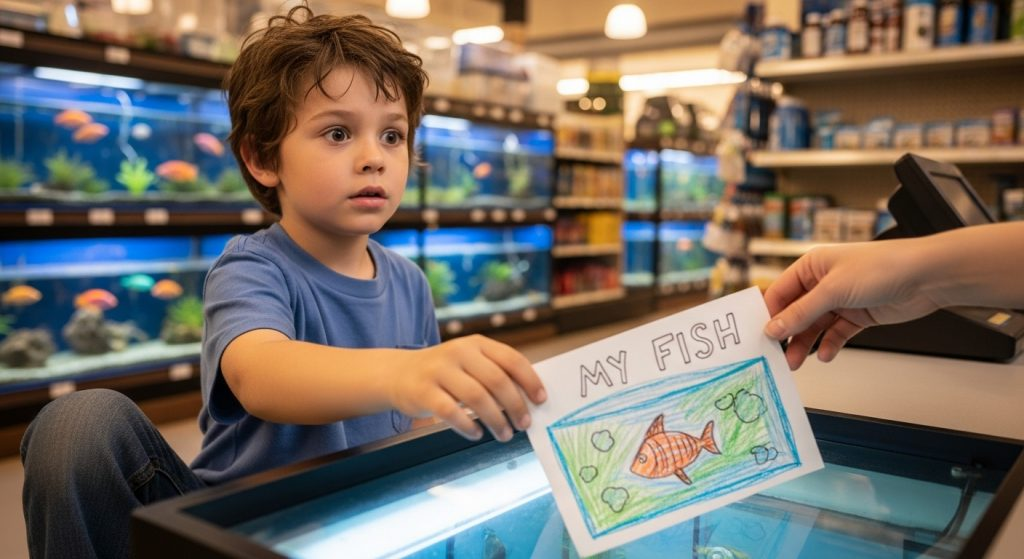
The paper was torn from a cheap spiral notebook, the edges jagged, frayed, and stained with something that smelled faintly of old rust and damp mildew.
I almost threw it away.
It was a Tuesday evening, five minutes to closing, and the neon “OPEN” sign in the window of my pet shop was already buzzing with that tired, flickering hum that meant the ballast was dying.
I was wiping down the front counter, my mind a million miles away, calculating whether I could afford to fix the commercial heater for the tropical freshwater tanks before the Ohio winter truly set in.
I didn’t notice the folded piece of paper at first. It was wedged deliberately beneath the heavy base of the receipt printer, tucked away like a desperate secret.
When I finally pulled it free and unfolded it, the air in my lungs just… vanished.
I am not a man who panics easily. I’ve spent thirty-four years on this earth, and the first eighteen of them were bouncing between six different foster homes across the Rust Belt.
I know what neglect looks like. I know the shape of fear. I built my life around order, around creating perfectly controlled, safe environments.
That’s what my store, Sanctuary Pets, is all about.
It’s an oasis of clean water, balanced pH levels, and precise temperatures. I control the environment because, for the first half of my life, I couldn’t control a damn thing.
But looking at this crude, frantic crayon drawing, the perfectly controlled walls of my reality began to crack.
The drawing wasn’t of a fish.
To understand why this shattered me, you have to understand the boy who left it.
He had been coming in for exactly eleven days.
I never knew his name. In my head, I called him “The Ghost” because of the way he moved. He didn’t walk; he drifted.
He looked to be about eight years old, but his eyes were ancient—hollowed out, wary, constantly scanning the aisles like a soldier waiting for an ambush.
He always wore the same oversized, mustard-yellow corduroy jacket. It swallowed his thin frame, the cuffs rolled up three times just so his dirty, bruised fingers could peek through.
The first time he walked into Sanctuary Pets, it was raining. A cold, miserable October downpour that turned the city sidewalks into slick black mirrors.
He didn’t look at the puppies. He didn’t stop by the colorful displays of plush toys or the bright, noisy parakeets.
He walked straight to the back of the store, past the bags of premium kibble, and stood perfectly still in front of the aquarium wall.
The glow from the tanks cast a rippling, blue light across his pale face.
I watched him from the register. I have a sixth sense for shoplifters, a leftover survival instinct from my own youth, but he didn’t have the nervous energy of a thief.
He was just… studying.
“Can I help you find something, buddy?” I had asked, stepping out from behind the counter.
He flinched. It was a microscopic movement, a tightening of the shoulders that most people would miss, but my stomach did a slow, painful flip. I knew that flinch. It was the physical reflex of a kid who expects loud noises to be followed by pain.
He didn’t turn around. He just pointed a small, trembling finger at a lone Betta fish, swimming lazily in a small, pristine cube of water.
“How long can he live?” the boy asked. His voice was a raspy whisper, like he hadn’t spoken out loud in days.
“A Betta? If you take good care of them, keep their water clean and warm, they can live for a few years,” I replied, keeping my voice soft, non-threatening.
The boy finally turned to look at me. His eyes were a pale, striking gray.
“What if the water isn’t clean?” he asked.
I frowned, stepping a little closer. “Well, they get sick. Fish breathe the water, just like we breathe the air. If the air is toxic, we get sick. Same for them.”
He looked back at the fish, his brow furrowed in intense concentration. “What if the water is brown? Like… really dirty. Can he survive if he stays very, very still?”
It was a strange question. Usually, kids ask if the fish will bite, or if they can put two of them together to fight.
“No, buddy,” I said gently. “Dirty water will eventually kill them. They need clean filters. They need care.”
The boy didn’t say another word. He just lowered his hand, turned, and walked out into the freezing rain, pulling the collar of his oversized jacket up over his ears.
I thought about him the rest of the night.
I almost mentioned him to Sarah the next morning, but I held back.
Sarah is my only employee. She’s a sixty-two-year-old retired ER trauma nurse who works here part-time just to be around the Golden Retriever puppies.
Sarah is a force of nature. She has short, steel-gray hair, a sharp tongue, and hands that are crippled by arthritis but can still gently syringe-feed a sick kitten with absolute precision.
Her husband of forty years dropped dead of a massive stroke in his garden three years ago. Since then, Sarah has poured all her fierce, motherly energy into this store, and into me. She is the closest thing to a mother I’ve ever had, though I would die before admitting that out loud.
Her only weakness is that she can’t let anything go. If she senses a wounded animal—or a wounded person—she will pry, push, and bulldoze her way into their life until she fixes them.
If I told Sarah about the boy in the yellow coat, she would have marched out into the streets to find him. And I, paralyzed by my own emotional cowardice and fear of getting involved in a messy system I barely survived myself, chose to stay quiet.
I told myself it was just a kid asking a weird question.
But three days later, he came back.
This time, Sarah was behind the register, arguing loudly on the phone with a vendor about a late shipment of cat litter. I was in the back, scrubbing algae off the glass of the cichlid tank.
I saw the flash of mustard yellow out of the corner of my eye.
He was standing in the exact same spot, staring at the same Betta fish.
I put down my sponge, dried my hands on my jeans, and walked over. I noticed this time that his sneakers were completely soaked through, and he smelled faintly of spoiled milk and ammonia.
“Hey again,” I said softly.
He didn’t jump this time, but he didn’t look at me either.
“What if the heater breaks?” he asked.
There was no “hello.” No greeting. Just an urgent, desperate hunger for data.
“For the fish?” I asked.
He nodded.
“Well, tropical fish need warm water. If it gets too cold, their bodies shut down. They stop moving. They stop eating.”
“How cold is too cold?” The boy turned to me, his gray eyes locking onto mine with an intensity that made my breath hitch. “What if there is no electricity? What if the house is freezing, and there are no blankets for the glass? How long before the fish stops moving?”
A cold bead of sweat trickled down the back of my neck.
“Where do you live, kid?” I asked, my voice dropping an octave. “Where are your parents?”
Instantly, the boy’s expression slammed shut. It was like watching a steel door slam down over a vault. The curiosity vanished, replaced by sheer, unfiltered panic.
He backed away from me, his eyes wide.
“Wait,” I reached out a hand. “I didn’t mean to scare you. I just—”
He turned and bolted. He ran so fast his wet sneakers squeaked violently against the linoleum. He pushed past Sarah, who dropped her clipboard, yelling out, “Hey! Slow down!”
The door chimed, and he was gone into the fading autumn afternoon.
“Who the hell was that?” Sarah asked, coming around the counter, her brow deeply furrowed.
“I don’t know,” I lied, rubbing the back of my neck. “Just a kid. Spooked him, I guess.”
Sarah narrowed her eyes at me. She always smelled faintly of peppermint and dog shampoo, a comforting scent, but her gaze was sharp enough to cut glass.
“He looked like he was running for his life, Mark. You sure he didn’t take anything?”
“He didn’t take anything,” I said firmly. But I knew, deep down, he had left something behind. He had left a heavy, suffocating weight in my chest.
Over the next week, the boy came in three more times.
He learned my routines. He only ever slipped in when Sarah was in the stockroom or when the store was crowded with the after-work rush.
He was incredibly stealthy. I would be ringing up a customer, look up, and he would just be there, standing by the tanks, bathing in the blue light.
And every time, he had a new question.
“Do fish make noise when they are scared?” he asked on a Tuesday.
“Can they survive in a bucket if you put a lid on it so the monsters don’t see them?” he asked on a Thursday.
Every question was a puzzle piece. And I, trapped by my own childhood trauma, was too terrified to put the picture together.
I knew the system. If I called Child Protective Services, they would send a cruiser. They would drag him out of whatever hell he was living in, strip him naked, catalog his bruises, and throw him into a sterile, terrifying group home.
I spent four years in a group home in Dayton. I still have the scar on my ribs where an older boy stabbed me with a broken broom handle over a piece of bread.
I thought I was protecting him by not calling the authorities. I thought I was being the cool, safe adult. I thought answering his weird questions about fish was giving him a moment of peace.
I was an idiot. I was a coward.
Because I wasn’t listening to what he was actually asking.
Which brings me back to tonight. Tuesday evening. Five minutes to closing.
The store was empty. The rain was lashing against the front windows. I hadn’t seen the boy all day.
I was wiping the counter, tired, stressed about the bills, completely unaware that my life was about to split into two distinct halves: before I found the drawing, and after.
I pulled the folded, oil-stained paper from under the receipt printer.
I opened it.
The drawing was done in heavy, furious black and blue crayons. The wax was pressed so hard into the cheap paper that it had torn in several places.
At the center of the page was a large rectangle. A glass tank.
But it wasn’t filled with water. It was filled with chaotic, swirling brown and black scribbles. “Dirty water.”
Inside the tank, at the very bottom, there wasn’t a fish.
It was a boy.
A stick figure wearing a yellow coat.
But that wasn’t what made the blood drain from my face. That wasn’t what caused a cold, paralyzing terror to grip my heart.
The boy in the drawing was holding something to his chest. A smaller bundle. A baby.
Outside the glass tank, the boy had drawn a towering, monstrous figure. It had no face, just jagged teeth and giant, heavy boots. The monster held a belt in one hand and a bottle in the other.
Above the tank, scrawled in desperate, uneven letters, were the words:
THE HEATER IS BROKE. THE WATER IS BLACK. SHE WONT STOP CRYING. THE MONSTER IS COMING. HOW LONG CAN WE HIDE UNDER THE HOUSE?
My hands started to shake. The paper rattled violently in my grip.
All the questions.
Can they live in brown water? What if it gets really cold and there’s no heater? Can they survive in a bucket if you put a lid on it?
He was never talking about fish.
He was talking about himself. And he was talking about a baby.
They were hiding in a flooded basement, or a crawlspace, submerged in freezing, filthy water, trying to hide from someone who was hunting them.
And the boy had realized the cold was setting in. He had realized the water was toxic. He was coming to me, the only adult he deemed safe, asking for the biological limits of survival.
He was asking me how long he and his baby sister had left to live.
“Oh, God,” I choked out, the silence of the pet store suddenly roaring in my ears.
The bell above the door chimed violently.
I whipped my head around.
Standing in the doorway, soaked to the bone, rain pouring off his broad shoulders, was Officer Reyes. He was the neighborhood beat cop, a cynical, overworked guy in his forties who usually came in to buy expensive wet food for a stray cat he pretended not to care about.
Reyes took off his soaked cap, looking pale and completely exhausted.
“Mark,” Reyes said, his voice unusually tight. He didn’t look at the cat food. He looked straight at me. “You’ve got cameras on the exterior of this building, right? Facing the alley?”
“Yeah,” I breathed, my hand instinctively crumpling the drawing against my chest. “Why?”
“We’ve got a situation two blocks down,” Reyes said, rubbing his face. “A domestic call turned into a nightmare. Guy went crazy on an incredibly bad batch of crystal. Tear-gassed the house, but when we got inside… the guy’s wife is in the ICU, and the guy is on the run.”
Reyes paused, swallowing hard.
“Mark, we can’t find the kids. A boy, about eight years old, and a six-month-old baby girl. The neighbors said they saw the boy running toward this alley about three hours ago. We think the father might be looking for them.”
The world tilted on its axis.
Three hours ago. The boy had slipped this note under the register three hours ago while I was in the back with Sarah.
HOW LONG CAN WE HIDE UNDER THE HOUSE?
I looked down at the crumpled paper in my fist. I looked at the dark, flooding rain outside the windows.
If I called it in, the sirens would blare. The father, if he was out there, would hear them.
But if I didn’t find them right now, the freezing water or the monster in the heavy boots would get to them first.
I grabbed my heavy flashlight from under the counter, my heart hammering a frantic, violent rhythm against my ribs.
I wasn’t a scared foster kid anymore.
“Reyes,” I said, my voice eerily calm as I walked around the counter. “Lock the door behind me. Call for backup. But do it quietly.”
“Mark, what are you doing?” Reyes demanded, stepping forward. “You can’t go out there, the guy is armed and highly unstable—”
“I know where they are,” I said, stepping out into the freezing storm. “And they’re running out of air.”
Chapter 2: The Red Clay and the Rising Tide
The moment I pushed through the heavy glass door of Sanctuary Pets, the cold hit me like a physical blow.
October in Ohio isn’t just a season; it’s a mood. It’s a damp, bone-chilling misery that seeps through your clothes and settles deep into your joints. Tonight, the rain was coming down in sheets, a torrential, blinding downpour that turned the neon reflections on the asphalt into smeared streaks of blood-red and sickly yellow.
I stood under the small awning for a fraction of a second, the heavy Maglite flashlight gripped so tightly in my right hand that my knuckles ached. The metal casing was freezing.
Behind me, the door chimed again. Officer David Reyes stepped out, his heavy boots splashing into a puddle. He had one hand resting instinctively on his duty belt, right over the holster of his service weapon. The other hand was holding his radio, the coiled wire stretching to the mic clipped to his shoulder.
“Mark, listen to me,” Reyes said, his voice struggling to compete with the roar of the rain hitting the pavement. “You are civilian. This is an active manhunt for a violent felony suspect. You walk down that alley, you are interfering with a police investigation, and I will arrest you myself.”
I turned to look at him.
David Reyes was forty-two years old, built like a linebacker who had let himself go slightly around the middle. I knew his coffee order. I knew he bought the expensive, grain-free salmon paté for a stray tortoiseshell cat that lived behind the precinct. I also knew, from the late-night conversations we’d had when he worked the graveyard shift and I was up treating sick fish, that he carried a heavy, suffocating guilt. Ten years ago, he was the first on the scene of a domestic dispute where a father had locked his kids in a burning car. Reyes had managed to get one out, but not the other. It was the defining failure of his life. His strength was his absolute, unshakeable loyalty to his badge; his weakness was a paralyzing fear of making the wrong call when children were involved.
“Arrest me later, David,” I said, my voice dead calm. It surprised even me. The panic that had gripped my heart inside the store had crystallized into something cold, hard, and terrifyingly focused. “You don’t know where they are. You don’t know what you’re looking for. I do.”
“You have a crayon drawing!” Reyes shouted, wiping the rain from his eyes. “You have a child’s scribble!”
“I have eleven days of him asking me exactly how long a body can survive in freezing, toxic water,” I shot back, stepping closer to him, ignoring the rain plastering my hair to my forehead. “He asked me if they could survive in a bucket with a lid. He asked me how long before a heart stops moving in the cold. He came to me, David. Not to the police. Not to a teacher. To the guy who sells fish, because he thought I knew how to keep things alive in a tank.”
Reyes stared at me, his jaw working silently. A burst of static crackled from his shoulder mic, followed by a dispatcher’s urgent, tinny voice reporting a possible sighting of the suspect, Jared Vance, three blocks west.
“He’s running out of time,” I said, my voice dropping to a harsh whisper. “The drawing says ‘under the house.’ He drew brown water. Dirty water. And his shoes…”
I closed my eyes, forcing my brain to scroll back through the mental Rolodex of the boy’s visits. The oversized mustard-yellow coat. The terrified gray eyes. The smell of ammonia. And the shoes. They were cheap, off-brand canvas sneakers, but the soles… the sides of the soles were always caked in thick, rust-colored mud.
“Red clay,” I said, my eyes snapping open.
Reyes frowned, the rain dripping off his nose. “What?”
“His shoes were always covered in red clay. Wet red clay. Where in this neighborhood is there exposed red clay?”
Reyes’s cop brain engaged, overriding his procedural panic. He looked down the street, mentally mapping the decaying grid of our rust-belt neighborhood. “Most of the west side is concrete and asphalt. The only place with exposed earth like that is the old demolition site on Miller Avenue. They tore down those Victorian row houses last year but ran out of funding to pour the new foundations. The heavy machinery dug up the deep soil. It’s all red clay down there.”
“And the houses that are still standing next to the lot?” I asked, my heart hammering against my ribs.
“They’re structurally compromised,” Reyes said, realization dawning on his face, turning his complexion a shade paler. “The demolition cracked their foundations. Every time we get heavy rain, the drainage systems back up. The basements and crawlspaces completely flood. It’s a hazard zone. The city condemned three of them, but squatters still use them.”
“That’s where he is,” I said, pointing the beam of my flashlight down the dark, rain-swept alley. “He’s hiding under one of those houses. And if the water is rising…”
I didn’t finish the sentence. I didn’t have to. The image from the drawing flashed in my mind—the stick figure submerged, holding the tiny bundle, asking how long they could survive.
I turned and started walking fast, my boots splashing through the ankle-deep water rushing down the gutters.
“Mark, damn it!” Reyes swore loudly, but I heard the heavy thud of his boots following me. He was breaking protocol. He was risking his badge. But the ghost of the child he couldn’t save ten years ago was pushing him forward just as hard as my own ghosts were pushing me.
We moved silently through the alleyways, cutting parallel to the main street to avoid the flashing blue and red lights of the cruisers setting up a perimeter blocks away.
The city felt different in the dark. My pet store was a sanctuary of light, warmth, and control. Out here, the world was chaotic, jagged, and merciless. The wind howled through the narrow spaces between the brick buildings, rattling chain-link fences and knocking over garbage cans.
Every shadow looked like a man with a weapon. Every sudden noise made my muscles coil tight.
I was terrified. I won’t lie about that. I grew up learning how to make myself invisible. In the group homes in Dayton, if you were seen, you were a target. If you stood out, you got hurt. I survived by being the quiet kid in the corner who never caused trouble, who never fought back, who just took the hits and waited for the clock to run out until I turned eighteen.
Walking toward a condemned house, knowing a violently unstable man high on crystal meth was likely hunting the same boy I was looking for, went against every survival instinct I had ever developed.
But I couldn’t stop. Because I knew exactly what it felt like to be that boy in the yellow coat. I knew the specific, suffocating terror of listening to heavy footsteps approaching in the dark, knowing no one was coming to save you.
I am coming, I thought fiercely, aiming my flashlight beam at the cracked pavement ahead. Hold on, kid. Just hold on.
It took us ten minutes to reach Miller Avenue. It felt like ten hours.
The street was a nightmare. The streetlights had been dead for months. On one side stood a row of crumbling, century-old Victorian houses, their paint peeling like dead skin, their windows boarded up with rotting plywood. On the other side was the demolition lot—a massive, gaping wound in the earth, filled with mountains of excavated red clay that had turned into a treacherous, slipping quagmire in the torrential rain.
The water runoff from the street was pouring directly into the lot, creating a muddy waterfall that cascaded toward the foundations of the remaining houses.
Reyes grabbed my shoulder, pulling me behind a rusted-out husk of an old Chevrolet parked on the curb.
“Lights out,” he hissed, his breath pluming in the freezing air.
I clicked off the Maglite. We were plunged into absolute, oppressive darkness, save for the occasional flash of distant lightning that illuminated the skeletal silhouettes of the dead houses.
“Look,” Reyes whispered, pointing a thick, gloved finger toward the third house in the row.
I squinted through the driving rain.
The house was leaning slightly to the left, groaning under the assault of the wind. The front door was missing entirely, leaving a gaping black maw. But what caught Reyes’s attention wasn’t the house itself; it was the access grate to the crawlspace at the base of the foundation.
The heavy iron grate, which should have been bolted shut, had been ripped entirely off its hinges. It lay in the mud a few feet away.
And next to the dark, rectangular opening leading beneath the house, the mud was heavily disturbed.
“Footprints,” I breathed.
“Two sets,” Reyes corrected, his voice tight. He unclipped his service weapon, holding it down by his thigh. “One set is small. Kid-sized. Leading in.”
“And the other?” I asked, though I already knew the answer.
“Large men’s work boots. Deep treads. Pacing back and forth in front of the hole.” Reyes swallowed hard. “He was here. The father was here.”
“Is he inside?” I asked, my blood turning to ice water.
Reyes shook his head slowly. “The gap is too narrow. A grown man couldn’t fit through there if he tried. He must have chased the boy here, saw him squeeze into the crawlspace, and realized he couldn’t follow.”
“Then where is he?”
A sudden, sharp sound shattered the rhythm of the rain. It was the sound of breaking glass, coming from the back of the house.
“He’s trying to find another way in,” Reyes said, his eyes going wide. “He’s trying to get into the main floor to rip up the floorboards. Mark, stay here. Do not move. I’m going to flank him around the back.”
“David, wait—”
“Stay here!” Reyes ordered, his voice shifting from a friend to a cop in a split second. “If he comes around the front, you run. Do you hear me? You run.”
Before I could argue, Reyes vanished into the darkness, moving with a surprising, fluid grace for a man his size.
I was alone.
The rain battered against my jacket. I crouched behind the rusted car, my eyes locked on the black, rectangular opening of the crawlspace.
THE HEATER IS BROKE. THE WATER IS BLACK. SHE WONT STOP CRYING.
The words from the drawing burned in my mind.
I looked at the water pouring from the street down into the red clay lot. The runoff was channeling directly toward the foundation of the house, funneling straight into that dark opening.
The crawlspace was flooding. Fast.
I couldn’t wait for Reyes. If the father didn’t get them, the water would.
I stood up, ignoring the agonizing cramp in my legs, and sprinted across the street. The mud grabbed at my boots, trying to suck me down. I slipped, my knee crashing onto the hard asphalt, tearing my jeans and taking a layer of skin with it. The pain flared, hot and sharp, but I scrambled up, pushing forward.
I reached the foundation of the house.
The smell hit me instantly. It was the exact smell of the boy’s jacket. Mildew, wet earth, and the sharp, toxic tang of stagnant, rotting water.
I clicked on my flashlight, holding my hand over the lens to muffle the beam, and aimed it into the crawlspace.
It was worse than I imagined.
The space was maybe three feet high, a claustrophobic tunnel of rotting wooden beams and crumbling brick. And it was filling with water. The muddy, red runoff was cascading into the hole, creating a churning, black soup of debris, dead leaves, and god knows what else. The water level was already halfway up the space.
“Hey,” I whispered into the dark, my voice shaking. “Hey, buddy. It’s me. From the fish store.”
Silence. Just the echoing gurgle of the rushing water.
I swept the muffled beam across the surface of the black water. Nothing.
Can they survive in a bucket if you put a lid on it?
He had to be hiding. He wouldn’t just sit out in the open.
I had to go in.
I took off my heavy winter coat, tossing it into the mud. It would only drag me down once it soaked through. I was left in a flannel shirt and jeans.
I lay down on my stomach in the freezing, red mud. The cold was an instant, vicious shock to my system. It seized my lungs, making me gasp.
I wedged my shoulders into the narrow opening. The broken brickwork tore at my shirt, scraping angry red lines across my back.
I slid forward, plunging waist-deep into the black water.
The temperature was paralyzing. It felt like being stabbed with a thousand tiny needles. My breath hitched in my throat, coming out in ragged, foggy bursts. The water smelled like sewage and rot. It was thick, resisting my movements.
“Kid?” I called out, a little louder this time. The acoustics in the crawlspace amplified my voice into a distorted, hollow boom.
Above me, the floorboards groaned.
I froze.
Thud. Thud. Thud.
Heavy, uneven footsteps pacing directly over my head.
The father was inside the house. He was right above us.
CRASH. Something heavy smashed against the wooden floorboards above, raining dust and splinters down onto my face, into the dark water. The man up there screamed something unintelligible—a raw, guttural roar of pure, chemically fueled rage.
He was looking for the trapdoor. He was looking for a way down.
Panic, pure and unadulterated, seized my chest. My heart hammered so hard I thought my ribs would crack. I wanted to scramble backward. I wanted to claw my way out of this freezing, claustrophobic tomb and run back to my clean, well-lit pet store.
But then I heard it.
It was so faint, so delicate, it was almost completely drowned out by the storm outside and the monster upstairs.
It was a whimper. A tiny, exhausted, watery hiccup.
A baby.
I pushed forward. I waded deeper into the crawlspace, the freezing water now cresting the center of my chest. I kept the flashlight low, sweeping it slowly through the forest of rotting wooden support pillars.
Debris bumped against my arms—empty plastic bottles, pieces of styrofoam, a dead rat. I gagged, swallowing back bile, forcing myself to keep moving.
“I’m here,” I whispered, my teeth chattering violently. “I’m not going to hurt you. Please. Show me where you are.”
I moved toward the back corner of the foundation, where the crawlspace narrowed even further.
The flashlight beam caught a flash of color.
Mustard yellow.
My breath caught in my throat. I pushed through the water, ignoring the scrapes and bruises as my knees hit unseen cinderblocks beneath the surface.
In the furthest, darkest corner of the space, tucked behind a thick, rotting wooden pillar, was an old, overturned plastic storage bin. It was propped up on two bricks, keeping it just barely above the rising waterline.
Sitting on top of the bin, wedged into a space so tight he couldn’t even lift his head, was the boy.
He was submerged up to his ribs in the freezing black water. His yellow coat was soaked through, plastered to his skeletal frame. His lips were blue. A terrifying, bruised purple-blue. He was shivering so violently that the water around him rippled continuously.
And in his arms, held desperately above the water, pressed tight against his chest to share what little body heat he had left, was a baby.
She couldn’t have been more than six months old. She was wrapped in a filthy, wet towel. Her eyes were closed, and her face was deathly pale. She was barely moving.
The boy stared at me. His gray eyes were wide, dilated with absolute terror. He looked like a wild, cornered animal. When the beam of my flashlight hit him, he didn’t call out. He didn’t ask for help.
He simply tightened his grip on his sister and pressed himself harder against the brick wall, trying to fuse with the shadows.
He thought I was the monster.
“Hey,” I breathed, clicking the flashlight to its lowest setting and pointing it at the ceiling so I wouldn’t blind him. “Hey, buddy. It’s me.”
I wiped the dirty water from my face so he could see me clearly.
The boy blinked, water dripping from his eyelashes. The recognition was slow, fighting through the haze of hypothermia and shock.
“The… the fish man?” he croaked. His voice was completely broken, barely a rasp.
“Yeah,” I said, a sob tearing its way up my throat. I forced it down. I had to be strong. “Yeah, buddy. It’s the fish man. I got your drawing. You did so good. You did so good, leaving that for me.”
I took a slow, agonizing step closer. The water was up to my armpits now. The cold was beginning to numb my extremities. I couldn’t feel my toes anymore.
“Is the water too dirty?” the boy whispered, his eyes locked on mine. A tear, hot and clear, carved a path down his muddy cheek. “I… I tried to keep her above it. But it keeps getting higher. And it’s so cold. I think… I think the heater is broke.”
The innocence of the metaphor shattered my heart into a million irreparable pieces. He was still speaking in the language of the pet store. He was still trying to figure out the science of survival.
“You did everything right,” I said, reaching out my hands. My fingers were trembling uncontrollably. “You kept her safe. But the water is too dirty now. And it’s too cold. I need to get you both out of the tank.”
Above us, the floorboards gave a sudden, terrifying groan. Dust rained down on us. The man upstairs had found a weak spot.
SMASH.
A heavy boot broke through the rotting wood directly over my head. A jagged hole appeared in the ceiling of the crawlspace, revealing the dim, yellow light of the room above.
“I know you’re down there!” a voice roared, a sound so full of venom and madness it made my blood curdle. “I hear you, you little rat! I’m coming down!”
The boy screamed—a raw, high-pitched sound of absolute despair. He curled his body over the baby, trying to shield her, trying to become a human shell.
“No time,” I said.
I lunged forward through the water. I didn’t care about being slow or gentle anymore. I reached the plastic bin and wrapped my freezing arms around the boy and the baby at the same time.
He thrashed against me. “No! No! He’ll get us! He’ll get her!”
“I’ve got you!” I yelled, pulling him off the bin and into the deep water against my chest. “I will not let him touch you. I promise you!”
I turned, clutching the two freezing children to my body, and looked toward the tiny rectangular exit thirty feet away. It looked like the end of a very long, very dark tunnel.
And then, a large, jagged piece of the floorboard above us ripped away.
A face appeared in the hole.
It was a nightmare of a face. Sunken eyes, sores on his cheeks, teeth gritted in a snarl. Jared Vance. He held a heavy iron crowbar in his right hand.
He locked eyes with me. He didn’t see a rescuer. He saw an obstacle.
“Mine!” he screamed, thrusting the crowbar down through the hole, aiming straight for the back of my head.
I twisted violently, throwing my shoulder forward to protect the kids.
The heavy iron bar missed my skull by an inch, slamming brutally into my left shoulder blade.
The pain was an explosion of white-hot agony. I heard a sickening crack, and my left arm instantly went completely dead, dropping limply into the water.
I screamed, my knees buckling. I plunged under the black water, dragging the boy and the baby down with me.
The water rushed into my nose, into my mouth. Toxic, freezing, choking blackness.
The tank was crashing down around us.
How long can a fish survive in dirty water?
Not long. Not long at all.
With one arm completely useless and the water rushing over my head, I realized with a terrifying clarity: I wasn’t just the fish man anymore. I was trapped in the tank with them.
And the monster was breaking the glass.
Chapter 3: The Weight of the Water
The human body has a fail-safe mechanism when it is plunged into freezing water. The shock forces a sudden, involuntary inhalation—a desperate gasp for oxygen before the cold shuts the system down.
When the heavy iron crowbar shattered my left shoulder blade and sent me plunging beneath the surface of the black water, that instinct betrayed me.
I gasped.
Filthy, freezing water rushed into my nose and down the back of my throat. It tasted of decayed leaves, rusted iron, and the sickening, metallic tang of raw sewage. It burned like battery acid in my lungs.
For a terrifying, chaotic second, there was nothing but darkness and the deafening roar of the water rushing in my ears. The pain in my left shoulder wasn’t just pain; it was a blinding, white-hot electrical storm that short-circuited my brain. My left arm was completely paralyzed, floating uselessly beside me like a dead appendage.
But I wasn’t alone in the dark.
I felt the frantic, panicked thrashing against my chest. The boy.
He was kicking wildly, his small hands clawing at my shirt, fighting the water, fighting the dark, fighting to keep the tiny bundle in his arms from slipping away.
In that subterranean darkness, submerged in the freezing mud of a condemned house, a memory flashed behind my eyes with blinding clarity. I was twelve years old, locked in a basement closet by two older boys in a foster home in Toledo. It had been pitch black. I had screamed until my throat bled, beating my fists against the door until my knuckles were raw meat, while they laughed on the other side. No one came. No one ever came. I learned that day that the world was a tank, and the strong ate the weak, and if you were trapped in the dark, you were on your own.
But as the freezing water choked me, a new, ferocious thought ignited in my chest, burning hotter than the pain in my shattered shoulder.
Not him. Not today. I planted my heavy boots into the slick, shifting red clay at the bottom of the crawlspace. With a guttural, water-choked scream that I felt more than heard, I pushed upward with every ounce of strength remaining in my legs.
We broke the surface.
The air in the narrow space was thick with dust and the smell of rot, but it was oxygen. I greedily sucked it in, violently coughing up the foul black water.
Beside me, the boy gasped, a horrible, ragged sound. He was coughing violently, his small body convulsing, but his arms were still locked in a death grip around the towel-wrapped baby.
“I got you! I got you!” I roared, spitting mud from my mouth. I clamped my right arm—my only working arm—around the boy’s waist, pulling him so tightly against my chest I thought I might crack his ribs.
I looked down. The baby’s face was exposed. She was impossibly pale, her lips tinged with a terrifying shade of blue. She wasn’t coughing. She wasn’t moving.
No. No, no, no. Before I could process the terror of her silence, the ceiling above us exploded.
Jared Vance was no longer just tearing at the floorboards; he was systematically destroying the barrier between us. A massive chunk of rotting wood, embedded with rusted nails, crashed into the water inches from my face, splashing foul water into my eyes.
The dim yellow light from the room above spilled through the jagged hole, illuminating the nightmare we were in.
Vance’s face appeared in the gap. In the light, he looked less like a man and more like a feral, starving wolf. His skin was stretched tight over his cheekbones, his eyes wide and unblinking, pupils dilated into massive black pits from the crystal meth surging through his veins. He was sweating profusely despite the cold, his jaw grinding so hard I could hear his teeth cracking together over the sound of the rain.
“You think you can take what’s mine?!” he screamed, his voice breaking into a high-pitched, hysterical shriek. He thrust the crowbar through the hole again, swinging it blindly in the narrow space. The heavy iron struck the brick foundation right next to my head, sending a shower of sharp stone shrapnel into my cheek.
“Move!” I yelled at the boy.
Using only my legs and my right arm, I began to drag us backward through the freezing water, away from the hole, toward the faint, gray rectangle of light that marked the exit grate thirty feet away.
Every time I moved my left shoulder, a sickening wave of nausea washed over me. The broken bone ground against itself, sending shooting stars across my vision. I was losing blood, though I couldn’t tell how much was washing away in the filthy water. Hypothermia was setting in rapidly. My legs felt like heavy, waterlogged tree trunks, and my teeth were chattering so violently I bit my own tongue, filling my mouth with the taste of fresh copper.
“He’s gonna kill us!” the boy sobbed, his voice echoing in the claustrophobic tunnel. He wasn’t looking at me; he was staring up at the jagged hole where his father’s face was disappearing and reappearing as Vance paced the room above, hunting for another weak spot in the floor. “He’s gonna kill my sister!”
“Look at me!” I commanded, my voice dropping the gentle ‘pet store guy’ facade. I needed him to focus. I needed him to be a soldier. “Look at my eyes, kid!”
He snapped his gaze to mine. His gray eyes were wide with pure, unfiltered trauma.
“I am the filter,” I said, gasping for air as I dragged us another few feet through the sludge. “You understand me? I am the glass. Nothing gets through me. You hold onto her. I hold onto you. We are getting out of this tank.”
Vance realized he couldn’t reach us with the crowbar. I heard him scream in frustration, a guttural roar of pure rage. Then, the heavy thud of his boots started moving away from the hole, rushing across the floorboards above us, heading toward the front of the house.
“He’s going outside,” I gasped, the realization hitting me like a physical blow. “He’s going to the grate. He’s going to wait for us at the exit.”
We were trapped. If we stayed in the crawlspace, the rising floodwaters from the red clay lot would drown us in minutes. The water was already cresting my collarbone when I crouched. If we went to the exit, a meth-fueled monster with an iron crowbar was waiting to cave my skull in.
Reyes, I thought desperately. Where the hell are you, David?
I didn’t have time to wait for a miracle. The water was rising too fast. The runoff from the storm was pouring into the space, turning the crawlspace into a churning, violent washing machine of debris.
I had to get them out. Now.
“Listen to me,” I told the boy, keeping my voice low, barely a whisper over the rushing water. We were ten feet from the exit. The gray light from the storm outside was bleeding through the opening, illuminating the torrential rain slashing across the mud. “When we get to the edge, I am going to push you out. You do not stop. You do not look back. You run toward the street. You find the police cars. You give them your sister. Do you understand?”
The boy shook his head frantically, burying his face into my wet chest. “No. No, I can’t run fast enough. The mud is too thick. He’ll catch me. He’ll take her.”
“He will not get past me,” I said.
I dragged us the final ten feet. The water near the opening was rushing inward, a relentless current fighting against us. My knees hit the concrete lip of the foundation.
I looked out into the storm. The wind was howling, driving the rain sideways. The heavy iron grate lay discarded in the red mud a few feet away.
There was no sign of Jared Vance.
But I knew he was there. The shadows outside were deep, and a predator doesn’t stand in the light.
“Okay,” I breathed, bracing my boots against the concrete lip. “Go. Now.”
With a massive surge of adrenaline, ignoring the agonizing scream of my shattered shoulder, I used my right arm to hoist the boy and the baby up and out of the black water, shoving them through the narrow opening and out into the torrential rain.
The boy tumbled into the red mud, instinctively curling his body around the baby to protect her from the impact.
I scrambled to follow, pulling myself up over the concrete ledge.
Before I could even get my knees under me, a shadow detached itself from the side of the house.
Jared Vance lunged.
He didn’t go for me. He bypassed me completely, his wild, dilated eyes locked onto the mustard-yellow coat of his son.
“Give her to me!” Vance roared, reaching down with a massive, dirt-caked hand, grabbing the collar of the boy’s jacket and violently hoisting him into the air. The boy screamed, dropping the towel-wrapped baby into the freezing mud to save her from being crushed.
Seeing that tiny, silent bundle drop into the cold mud triggered something primal and violent inside my brain. The carefully constructed, controlled version of Mark the pet store owner vanished. What was left was the street-hardened, survivor kid from the group homes.
I let out a feral roar.
I lunged forward from my knees, launching my body weight directly into Vance’s waist.
He was a big man, fueled by the impossible strength of narcotics, but he wasn’t expecting an attack from the guy with a dead arm. My shoulder drove directly into his abdomen.
The impact knocked the breath out of him in a sharp hiss. He stumbled backward, dropping the boy, but he didn’t fall.
Vance recovered with terrifying speed. He looked down at me, his face twisting into a mask of pure, homicidal fury. He raised the iron crowbar high above his head. The rain washed the dirt from the metal, making it gleam darkly in the ambient street light.
“You’re dead!” he spat, bringing the heavy iron down with bone-crushing force.
I threw myself to the right, rolling violently in the deep, slick red clay. The crowbar smashed into the mud exactly where my head had been, burying itself six inches into the earth.
Before he could rip it free, I reached to my belt. My heavy, aluminum Maglite was still clipped there. I unclipped it with my right hand. It wasn’t a crowbar, but it was three pounds of solid metal.
Vance yanked the crowbar free and turned, swinging it horizontally at my ribs.
I brought the heavy flashlight up, blocking the strike. The clang of metal on metal rang out over the storm, a sickening, sharp sound. The vibration shot up my right arm, nearly making me drop the light.
“Run!” I screamed at the boy, who was frozen in the mud, clutching his little sister. “Run!”
Vance kicked out, his heavy work boot catching me squarely in the chest.
I flew backward, the air exploding from my lungs, and crashed hard onto my back in the freezing mud. The pain in my broken left shoulder flared so brightly I briefly lost my vision, the world dissolving into a blur of static and shadows.
I couldn’t breathe. I couldn’t move.
Vance stood over me. He was panting heavily, rain pouring off his sunken face. He raised the crowbar, aiming the jagged, flattened end directly at my face.
This is it, I thought. The tank is broken.
“Hey, Vance!” a voice boomed through the storm.
It was a voice of absolute, unquestionable authority.
Vance froze, his head snapping toward the street.
Officer David Reyes stepped out from behind the rusted husk of the old Chevrolet. He had his service weapon drawn, gripped perfectly in a two-handed Weaver stance, the beam from his mounted tactical light blindingly bright as it hit Vance square in the face.
“Drop the weapon,” Reyes commanded, his voice cold, steady, and loud enough to cut through the thunder. “Drop it right now, or I swear to God I will drop you.”
Vance blinked against the blinding light. The meth in his system made him erratic, unpredictable. For a second, his grip tightened on the crowbar. He looked from Reyes, to me, and then to the boy huddled in the mud.
“She’s mine,” Vance hissed, a psychotic smile stretching across his face. He began to lower the crowbar, but not to drop it. He was shifting his weight. He was going to lunge for the baby.
Reyes saw the micro-movement.
“I said drop it!” Reyes roared.
But Reyes didn’t shoot. He knew the muddy ground, the rain, the proximity of the children. A ricochet or a missed shot could be fatal.
Instead, Reyes moved.
He holstered his weapon with terrifying speed and launched himself across the twenty feet of muddy terrain like a freight train.
Vance swung the crowbar wildly at the approaching cop. Reyes ducked beneath the swing, his momentum carrying his massive shoulder directly into Vance’s sternum.
The crack of the impact was sickening. Both men went down hard in the deep red mud, a chaotic tangle of limbs and violence.
Vance fought like a demon. He gouged at Reyes’s eyes, screaming obscenities, trying to bring the crowbar back into play. But Reyes was operating on ten years of repressed guilt and raw fury. He grabbed Vance’s wrist, twisted it violently until a loud pop echoed through the alley, and slammed Vance’s hand into the pavement until he dropped the iron bar.
Reyes rolled Vance onto his stomach, driving his heavy knee into the back of Vance’s neck, pinning his face into the freezing mud.
“Stay down!” Reyes roared, yanking a pair of heavy steel handcuffs from his belt and ratcheting them brutally tight onto Vance’s wrists. “Do not move!”
The fight was over. The monster was chained.
But the nightmare wasn’t.
The wail of approaching sirens suddenly filled the air, cutting through the sound of the rain. Flashing red and blue lights painted the surrounding brick walls in frantic, strobe-like bursts. Backup was arriving. Ambulances were right behind them.
I didn’t care about the cops. I didn’t care about Vance.
I scrambled through the mud on my hands and knees, dragging my broken, useless left arm, until I reached the boy.
He was sitting in the freezing muck, staring blankly ahead. He was in deep shock. The hypothermia was shutting his brain down.
In his lap lay the baby.
I fell to my knees beside them. The mud soaked through my jeans. I reached out with a trembling, blood-stained right hand and touched the baby’s face.
She was ice cold. Her skin was a horrifying, translucent gray. She wasn’t breathing. Her chest was completely still.
“No,” I whispered, the word tearing out of my throat like a sob. “No, please. You survived the water. You survived him. You don’t die now. You don’t die now!”
I didn’t know infant CPR. I was a guy who sold fish and adjusted pH levels. I had spent my life avoiding human fragility.
“Paramedic! We need a medic up here now!” Reyes bellowed, waving his flashlight toward the street as three police cruisers and an ambulance skidded to a halt, their tires throwing up walls of water.
Before the ambulance had even fully stopped, the back doors flew open.
A man vaulted out. He was big—maybe six-foot-three—wearing a heavy, high-visibility rain jacket over a dark blue uniform. He carried a heavy trauma bag in one hand. As he sprinted through the mud toward us, the strobing police lights illuminated his face. He had a thick, salt-and-pepper mustache, deep lines etched around his eyes, and a faded Marine Corps bulldog tattoo visible on his neck. His nametag read Miller.
I would later learn everyone in the ER just called him “Mack.” Mack was a twenty-year veteran of the city’s paramedic unit. He was the kind of man who had seen the absolute worst the world could offer—gunshot wounds, mangled bodies, the tragic, senseless loss of innocence—and had responded by becoming an immovable pillar of competence and calm.
Mack hit the mud on his knees next to me, sliding the last two feet. He didn’t ask questions. He didn’t look at Vance, who was being dragged away by two other officers. He looked only at the baby.
“Talk to me,” Mack barked, his voice a deep, gravelly baritone that instantly commanded the chaotic space. He unzipped his trauma bag with lightning speed.
“She was submerged,” I choked out, my teeth chattering uncontrollably. “Maybe in the crawlspace… freezing water… she’s not breathing. She’s cold. She’s so cold.”
“How long since she took a breath?” Mack asked, his massive, calloused hands moving over the tiny infant with shocking delicacy. He stripped away the filthy, wet towel, exposing her pale, lifeless chest.
“I… I don’t know,” I sobbed, feeling the last of my emotional control shatter. “A few minutes. Maybe more. Please. Fix her.”
Mack didn’t promise anything. Professionals never do. He just went to work.
“She’s bradycardic, profound hypothermia. No spontaneous respirations,” Mack yelled over his shoulder to his partner, a younger EMT who was rushing up with a backboard and oxygen gear. “Get me the infant BVM and prep for a line. Now!”
Mack placed two thick, steady fingers in the center of the baby’s tiny chest.
One, two, three, four… He began chest compressions. The sight of this massive, battle-hardened man performing CPR on a creature so impossibly small was jarring. His movements were precise, measured, yet filled with a desperate urgency.
“Come on, little one,” Mack murmured, his gravelly voice dropping to a low, rhythmic chant. “Don’t you quit. Not tonight. Come on back.”
The younger EMT handed him the Bag-Valve-Mask. Mack placed the tiny, clear plastic mask over the baby’s nose and mouth and gave two gentle puffs of oxygen.
Nothing. Her chest remained perfectly still.
I looked at the boy. He was staring at his sister, his gray eyes devoid of all light. He was watching his world end.
I reached out and grabbed the boy’s muddy, freezing hand. I squeezed it tightly. I wanted to tell him it would be okay, but I couldn’t lie. Not to him. I just needed him to know he wasn’t alone in the dark anymore.
“Push one of Epi,” Mack ordered, still doing compressions. The younger medic scrambled to draw the medication, his hands shaking slightly.
Mack paused compressions for a fraction of a second, pressing two fingers against the baby’s tiny neck to check for a pulse.
His jaw tightened. The deep lines around his eyes deepened.
He looked at me, just for a second. The look in his eyes was one I recognized. It was the look of a man staring at a fight he knew he was losing, but refusing to back down.
He resumed compressions. One, two, three, four… “Breathe for me, sweetheart,” Mack pleaded, the professional mask slipping just a fraction, revealing the immense emotional toll of a man who spends his life trying to cheat death. “Breathe.”
He gave her another puff of oxygen.
We waited. The rain beat down on us. The sirens wailed. The blue and red lights painted the mud. Time seemed to stop entirely. The universe shrank down to the tiny, pale chest of a six-month-old girl lying in the freezing red clay.
And then, it happened.
It wasn’t a dramatic gasp. It wasn’t a loud cry.
It was a tiny, microscopic twitch. Her chest hitched.
Mack froze, his hands hovering an inch above her.
A second later, water and thick, brown mucus bubbled out of her small mouth. She gave a weak, jagged cough.
And then, she cried.
It was a reedy, pathetic, exhausted wail. It sounded like a newborn kitten. But to me, in that moment, it was the loudest, most beautiful sound I had ever heard in my entire life. It was a symphony of survival.
Mack let out a breath he seemed to have been holding for a decade. He instantly scooped the crying infant up, wrapping her in a sterile, thermal foil blanket he pulled from his kit.
“We got her!” Mack yelled to his partner. “We got a pulse, we got respirations! Let’s move! Load and go! Code three to County General!”
The younger medic grabbed the backboard, but Mack ignored it. He cradled the silver-wrapped baby tightly to his chest, shielding her from the rain with his massive body, and sprinted through the mud toward the open doors of the ambulance.
“The boy!” I yelled, trying to stand, but my legs gave out. The adrenaline was leaving my system, leaving behind nothing but shock and blinding pain.
“I’ve got him,” Reyes said, suddenly appearing beside me. The big cop reached down and gently scooped the eight-year-old boy into his arms. The boy didn’t fight. He just buried his face into Reyes’s wet uniform, shivering violently.
“We need another bus for this guy!” Reyes shouted to a patrolman, pointing a finger down at me. “Suspected fractured clavicle, hypothermia, lacerations!”
“I’m fine,” I lied through my teeth, clutching my dead left arm. “I’m going with them.”
“You are going in your own ambulance, Mark,” Reyes said firmly.
“No,” I growled, looking up at him. “I am not leaving him. I promised him.”
Reyes looked at me. He saw the wild, desperate look in my eyes. He nodded slowly. “Help him up,” he ordered a nearby officer.
Two cops hauled me to my feet. Every movement was agony. They practically carried me through the mud to the back of the second ambulance, which had just pulled up behind Mack’s.
They loaded me onto the gurney. As they were strapping me in, I heard a commotion outside.
“He needs to go with his sister!” a police officer was arguing.
“His sister is critical, we need the room to work!” Mack’s voice boomed back. “Put the kid in the second unit. Now!”
A second later, the back doors of my ambulance opened, and a paramedic lifted the shivering boy inside, wrapping him in three heavy wool blankets.
They sat him on the bench across from my gurney. The doors slammed shut, cutting off the sound of the rain and the sirens. The engine roared, and we lurched forward, the siren blaring a deafening, urgent rhythm as we sped toward the hospital.
The back of the ambulance was blindingly bright, smelling of alcohol wipes and sterile plastic. It was a sharp, aggressive contrast to the dark, dirty world we had just escaped.
An EMT was hovering over me, cutting my ruined flannel shirt open with trauma shears to access my shoulder, asking me questions about my medical history that I was barely registering.
My eyes were locked on the boy.
He was huddled under the mountain of gray blankets, staring blankly at the metal floor of the ambulance. The violent shivering had subsided, replaced by a terrifying, silent stillness. He looked so small. So utterly broken.
He had done everything right. He had protected his sister. He had sought out knowledge to keep them alive. He was a hero in a mustard-yellow coat. But he was still just a child, and the trauma he had endured tonight would scar his soul forever.
I knew those scars. I wore them myself.
“Hey,” I whispered, my voice raspy and weak.
The boy slowly raised his head. His gray eyes met mine.
I reached out my right hand, pushing away the EMT who was trying to start an IV in my forearm. I extended my hand across the small gap between the gurney and the bench.
The boy stared at my hand for a long moment.
Then, slowly, he reached out from beneath the heavy blankets. His hand was freezing, his fingers still stained with the red clay.
He didn’t just take my hand. He gripped it with a desperate, crushing intensity, burying his face into the side of my mattress, and finally, for the first time since I had met him, he began to cry.
He wept with the heavy, gasping sobs of a child who has carried the weight of the world on his shoulders for far too long, and has finally found a safe place to put it down.
I held onto his hand, squeezing back, ignoring the blinding pain in my shoulder, ignoring the flashing lights and the chaos around us.
We are out of the dirty water, I thought, closing my eyes as the tears mixed with the mud on my own face. We are out of the tank.
But as the ambulance raced through the dark city streets toward the brightly lit emergency room, a new, terrifying reality began to settle over me.
Saving them from the crawlspace was only the first part of the fight.
Now, the system was going to take over. Child Protective Services. Foster care. Group homes. The exact same sterile, bureaucratic nightmare that had nearly destroyed me.
I had saved him from the monster in the heavy boots.
But as I lay there, feeling the terrified trembling of the little boy holding my hand, I realized I was going to have to save him from something much bigger.
Chapter 4: The Glass Sanctuary
Waking up in County General is an assault on the senses.
After the suffocating, freezing darkness of the crawlspace, the hospital was a blinding, sterile void. I opened my eyes to the harsh glare of fluorescent lights buzzing like angry hornets behind frosted plastic panels. The smell of the red clay and rotting water had been scrubbed away, replaced by the sharp, metallic tang of iodine, rubbing alcohol, and bleached linen.
I tried to sit up, but a wave of nausea so violent it blurred my vision slammed me back into the thin mattress.
My left shoulder didn’t just hurt; it felt as though someone had driven a railroad spike through the joint and left it there to rust. I looked down. My left arm was immobilized in a heavy, complex brace, completely strapped to my torso. An IV line snaked into the back of my right hand, dripping a cocktail of high-grade painkillers and broad-spectrum antibiotics directly into my bloodstream.
“Don’t move, tough guy,” a gruff voice echoed from the corner of the room.
I turned my head, fighting a wave of dizziness.
Officer David Reyes was slumped in an agonizingly uncomfortable plastic guest chair. He was no longer in his soaked uniform. He wore gray sweatpants and a faded police union t-shirt, but he looked like he had aged five years in a single night. His knuckles were wrapped in white medical tape, stained faintly pink from where he had battered Jared Vance in the mud. He was holding a styrofoam cup of terrible hospital coffee, staring at me with a mixture of profound exhaustion and reluctant respect.
“The kids,” I croaked. My throat felt like it was coated in broken glass. The memory of the freezing black water rushing into my mouth made me gag instinctively. “Where are they?”
“They’re alive,” Reyes said softly, leaning forward. He set the coffee down on the rolling tray table. “They’re both alive, Mark. The baby—Mia—she’s in the Neonatal Intensive Care Unit. They had to put her on a warming blanket and push some serious fluids, but Mack got her heart started in the mud. Her core temp is stabilizing. The doctors say it’s a miracle she didn’t suffer severe brain damage, but kids that age… they have a mammalian dive reflex. Their bodies shut down to preserve the vital organs in freezing water. She’s going to make it.”
A massive, shuddering breath escaped my lungs. A tear broke free, tracking hot and fast down the side of my face, soaking into the stiff hospital pillow. I didn’t try to wipe it away. I didn’t care.
“And the boy?” I asked, my voice trembling.
“He’s in the pediatric wing on the fourth floor,” Reyes replied, his expression darkening slightly. “Mild hypothermia, severe malnourishment, and some bruising. They treated him, gave him a warm bed. But Mark… he hasn’t said a single word since they pulled him out of the ambulance. Not to the nurses, not to the doctors. He’s completely shut down.”
I closed my eyes, the familiar ghost of my own childhood pressing heavy on my chest. Of course he shut down, I thought bitterly. His entire world just tried to kill him, and now he’s trapped in a bright room surrounded by strangers with needles and clipboards.
“And Vance?” I asked, opening my eyes, a cold anger replacing the relief.
Reyes’s jaw tightened. He looked down at his taped knuckles. “He’s locked in the secure ward downstairs, handcuffed to the bed with an armed guard at the door. He sustained a severe concussion, three broken ribs, and a fractured orbital bone.” Reyes paused, a dark, grim satisfaction flashing in his eyes. “He resisted arrest. Vigorously. He’s looking at attempted murder, aggravated assault on a police officer, child endangerment, and a laundry list of narcotics charges. He’s never breathing free air again.”
“Good,” I rasped.
Before Reyes could say another word, the heavy wooden door to my room flew open with the force of a detonating landmine.
Sarah stood in the doorway.
She looked magnificent and terrifying. She was wearing her oversized, green fleece gardening jacket, her steel-gray hair sticking up in frantic, static-charged directions. In one hand, she held a massive, faded canvas tote bag; in the other, she gripped her walking cane like a broadsword.
She took one look at me—pale, bruised, strapped to a bed with tubes running out of my arm—and her fierce, formidable exterior shattered entirely.
“You stupid, reckless, beautiful idiot,” she choked out, hobbling across the room as fast as her arthritis would allow.
She dropped the tote bag on the floor, shoved Reyes aside with a brutal hip-check, and threw her arms around my neck, being incredibly careful not to touch my left shoulder. She smelled of peppermint, dog kibble, and rain. It was the scent of home.
“I’m okay, Sarah,” I whispered, burying my face in her fleece jacket, my emotional dam finally breaking. I sobbed, the sound muffled against her shoulder. “I’m okay.”
“I got a call from the police at three in the morning telling me my boss was in emergency surgery for a shattered clavicle because he decided to play Batman in a condemned house,” she scolded, weeping openly, her gnarled hands stroking the back of my head. “I nearly had a heart attack, Mark. I closed the store. I fed the puppies, secured the tanks, and I came straight here.”
She pulled back, wiping her wet cheeks with the back of her hand, her eyes flashing with maternal fury. “You went into a flooded crawlspace with a meth addict on the roof. Are you out of your absolute mind?”
“He slipped me a note, Sarah,” I said, my voice thick. “The kid with the yellow coat. He slipped me a drawing. He asked me how long they could survive in dirty water. I couldn’t ignore it. I knew what it felt like to be in that dark.”
Sarah’s expression softened. She knew my history. She was the only person in the world who knew the truth about the scars on my ribs and the nightmares that sometimes kept me awake in the back office of the pet store.
She reached out and gently cupped my bruised cheek. “I know, honey. I know. You did good. You did so good.”
The tender moment was abruptly shattered by the sharp, authoritative click of sensible heels on the linoleum floor.
A woman walked into the room. She was in her late fifties, wearing a sharp, no-nonsense charcoal pantsuit. Her hair was pulled back into a tight, severe bun, and she carried a thick manila folder and a tablet. She had the exhausted, deeply cynical aura of a person who spends her life wading through the wreckage of broken families.
“Mark Davis?” she asked, her voice flat, devoid of any bedside manner.
“Yeah,” I said, instinctively tensing up.
“I’m Eleanor Higgins, Child Protective Services, Cuyahoga County,” she said, flipping open the manila folder. “I’m the caseworker assigned to Leo and Mia Vance.”
Leo. His name was Leo.
“How are they?” Sarah asked, instantly shifting into her protective stance, crossing her arms over her chest.
“Physically, they will recover,” Eleanor said briskly, tapping her pen against the tablet. “Medically, the infant will remain in the NICU for another week to monitor for secondary drowning and infection. The boy, Leo, is medically cleared for discharge by tomorrow.”
“Discharge to where?” I asked, my heart rate spiking. The heart monitor next to my bed began to beep faster, a rhythmic betrayal of my rising panic.
Eleanor sighed, a sound carrying the weight of a thousand hopeless cases. “The mother, Cynthia Vance, is currently in a medically induced coma in the ICU across the hall. Between the severe blunt force trauma and the acute methamphetamine toxicity in her system, neurology doesn’t expect her to wake up. Even if she does, she is facing severe criminal negligence charges. The father is in police custody. There are no registered grandparents, no aunts, no uncles. The children are officially wards of the state.”
The sterile hospital room suddenly felt as cold and dark as the flooded crawlspace. I knew exactly what those words meant. I had been a ward of the state. It was a sterile, bureaucratic term for being thrown into a meat grinder.
“So what happens to them?” Reyes asked, his cop persona returning, standing taller.
“The infant, Mia, will be placed into a specialized medical foster home once she is cleared,” Eleanor recited, not looking up from her tablet. “She requires high-level monitoring. As for Leo, given his age and the severe trauma he’s endured, he will be transferred to the St. Jude Emergency Assessment Center for Boys until a long-term group home placement can be found.”
“No,” I said.
The word left my mouth before my brain could even process it. It wasn’t a request. It was an absolute, fundamental rejection of reality.
Eleanor finally looked up, her eyebrows raised in mild annoyance. “Excuse me?”
“I said no,” I repeated, pushing myself up with my good arm, fighting the blinding wave of agony from my collarbone. Sarah tried to gently push me back down, but I shrugged her off. “You are not sending him to a group home. And you are absolutely not splitting them up.”
Eleanor offered me a tight, patronizing smile. It was the smile bureaucrats gave to naive civilians who didn’t understand how the machine worked.
“Mr. Davis, I understand you went through a traumatic ordeal tonight. You acted bravely. But you are not family. You are a civilian who intervened. The state takes over now. Group homes are our only option for emergency placement when there are no available kinship providers.”
“Group homes are holding pens!” I shouted, the raw, unfiltered fury of an eighteen-year-old orphan clawing its way up my throat. “They are warehouses for broken kids! You put an eight-year-old boy who just watched his father try to murder his baby sister into a system with fifty other traumatized, angry kids, and he will get eaten alive! I know! I lived in them!”
Eleanor stiffened, her professional veneer cracking slightly. “I assure you, our facilities are properly monitored—”
“I have a scar on my ribs where a fifteen-year-old stabbed me with a broom handle because I looked at him wrong in a ‘properly monitored’ facility in Dayton!” I snarled, my chest heaving. The IV monitor was blaring now. “You take him away from the only family he has left—his sister—and you put him in a concrete room, you might as well have left him in the dirty water!”
“Mark, calm down, you’re going to tear your stitches,” Sarah pleaded, grabbing my right hand tightly.
Eleanor closed her folder with a sharp, definitive snap. “Mr. Davis. Your personal history with the foster system is unfortunate, but it is entirely irrelevant to this case. You are a single, thirty-four-year-old man who lives in a one-bedroom apartment above a pet store. You have a shattered collarbone. You are not a licensed foster parent. You have zero legal standing here. Tomorrow morning, Leo Vance goes to St. Jude’s. That is the end of the discussion.”
She turned on her heel and marched out of the room, the door clicking shut behind her.
Silence fell over the room, heavy and suffocating.
I fell back against the pillows, gasping for air, the adrenaline leaving my system and leaving behind a hollow, terrifying despair. I had fought a monster in the mud and won, only to lose the war to a woman with a tablet.
“She’s right, Mark,” Reyes said softly, staring at the floor. “The system is rigid. They don’t just hand over kids to the guy who rescued them. It takes months of background checks, classes, home studies… by the time you even got into the system, they’d be gone.”
“I have to see him,” I whispered, staring blindly at the ceiling.
“Mark, you just got out of surgery—” Sarah started.
“Sarah, I swear to God, if you do not help me out of this bed, I will rip this IV out of my arm and crawl down the hallway myself,” I said, turning my head to look at her.
Sarah looked into my eyes. She saw the absolute, unbroken resolve. She sighed, a deep, weary sound, and reached for my good arm. “You are the most stubborn man I have ever met.”
With Reyes’s help, they managed to get me untangled from the monitors. Reyes unplugged the IV pole from the wall so I could roll it with my right hand. The pain in my shoulder was a living, breathing entity, gnawing at the bone with every step, but I forced it into the background.
It took us ten agonizing minutes to walk down the hall, take the elevator, and reach the pediatric wing on the fourth floor.
The pediatric ward was painted in bright, cheerful colors—soft yellows and calming blues—with cartoon murals on the walls. It was a desperate attempt to disguise the fact that it was a place of suffering.
A nurse pointed us toward Room 412.
Reyes and Sarah stayed by the nurses’ station, giving me space. I pushed my IV pole to the doorway and looked inside.
The room was dim, the blinds drawn tight against the morning sun.
Leo was sitting in the center of the large hospital bed. He was wearing an oversized hospital gown adorned with faded cartoon bears. His face was scrubbed clean, the red clay washed away, revealing the pale, bruised fragility of a child who hadn’t eaten a proper meal in weeks. The dark circles under his eyes made him look like a tiny, haunted ghost.
He had his knees pulled up to his chest, his arms wrapped tightly around them, rocking back and forth in microscopic, rhythmic movements. He was staring blankly at the wall, completely checked out of reality.
I took a deep breath, fighting back the tears, and stepped into the room.
“Hey, Leo,” I said softly.
He stopped rocking. He slowly turned his head. When his gray eyes locked onto mine, I saw a flicker of recognition, but it was buried beneath a mountain of trauma. He looked at my heavy arm brace, at the bandages on my face, and then down at his own clean hands.
“They took her,” his voice was a raspy, broken whisper. It sounded like dry leaves scraping across pavement. “The ladies in the scrubs. They took Mia. They put her in a glass box downstairs.”
“I know, buddy,” I said, dragging a plastic chair close to his bed with my right hand and sitting down heavily. “But the glass box is safe. It’s warm. It has clean air, and medicine. It’s like a good tank. They are fixing her.”
Leo looked back at the wall. “The lady with the tablet said I have to go away tomorrow. To a home with a lot of boys. She said I can’t take Mia.”
A fresh tear slipped down his cheek. He didn’t bother wiping it away.
“I tried,” he whispered, his voice cracking, thick with a guilt no eight-year-old should ever have to bear. “I tried to keep her above the dirty water. But I wasn’t strong enough. And now they’re splitting us up because I couldn’t protect her.”
My heart physically ached. It was a sharp, tearing pain in my chest that had nothing to do with my broken bones.
“Leo, look at me,” I commanded gently.
He didn’t move.
“Leo. Look at the fish man.”
Slowly, he turned his head back to me.
“You did everything right,” I said, leaning forward, my voice fierce and absolute. “You were the bravest person I have ever met. You held her in the freezing dark when the monster was coming. You survived. You didn’t fail her. You saved her life.”
“Then why are they taking me away?” he sobbed, his small shoulders shaking violently. “Where do we go now? We don’t have a tank anymore.”
I looked at this broken, beautiful little boy. I saw the echo of myself, thirty years ago, waiting for someone, anyone, to step into the dark and choose me. Nobody ever did. I had to build my own sanctuary from scratch.
But Leo wouldn’t have to.
“You aren’t going to a group home,” I said, my voice steady, vibrating with a promise that I knew would require me to wage war against the entire state of Ohio.
“The lady said—”
“I don’t care what the lady said,” I interrupted. I reached out with my right hand and gently placed it over his trembling fingers. “I know how to build a sanctuary. I know how to keep the water clean. And I am not going to let you go back into the dirty water. Do you understand me? You and Mia. You’re coming with me.”
Leo stared at me, his gray eyes widening, searching my face for the lie. When he didn’t find one, he let out a choked gasp, uncurled his legs, and threw himself across the bed, burying his face into my good shoulder, weeping with the absolute, profound relief of a child who has finally been found.
I held him, resting my chin on his head, staring over him at the blank hospital wall.
I had made a promise I had no legal right to make. But I knew, with absolute certainty, that I would burn the world down before I let them take this boy.
The next six months were a war. Not a war of crowbars and muddy alleys, but a war of attrition, paperwork, bureaucracy, and relentless, exhausting legal battles.
The morning after my promise to Leo, Eleanor Higgins arrived with two security guards to transfer him to the St. Jude facility.
She walked into Room 412 and found not just a terrified boy, but a barricade.
Sarah, Officer Reyes, and I were physically blocking the door.
Reyes, in full uniform, informed Eleanor that due to an “ongoing criminal investigation” regarding the assault, Leo was a material witness and could not be transferred to an unsecured facility without a judge’s direct sign-off. It was a complete legal fabrication, a stalling tactic that could have cost Reyes his badge, but he stood his ground, his hand resting on his duty belt, staring the CPS worker down.
While Reyes stalled, Sarah unleashed the full, terrifying power of a retired trauma nurse with too much time on her hands.
Within twenty-four hours, Sarah had hired the most vicious, relentless family law attorney in Cuyahoga County—a shark of a woman named Brenda who owed Sarah a favor for saving her golden retriever from parvo five years earlier.
We filed an emergency injunction for “Fictive Kinship” placement. In Ohio, a non-relative who has a pre-existing, significant relationship with a child can petition for emergency custody. I argued that my eleven days of answering Leo’s questions about fish constituted a significant bond. It was a massive stretch, but Brenda the lawyer battered the judge with emotional appeals, citing my heroism, Reyes’s police testimony, and Mack the paramedic’s sworn affidavit about the trauma bond forged in the mud.
The judge, an exhausted man with kind eyes, granted a temporary, 30-day injunction. Leo wouldn’t go to St. Jude’s. He would go into a temporary emergency foster home in the suburbs while I attempted the impossible: getting fully licensed, background-checked, and approved for a dual-sibling adoption placement as a single man with a criminal juvenile record and a pet store salary.
It was hell.
I spent my days running Sanctuary Pets with one arm, the sling chafing my neck raw, and my nights drowning in paperwork. I attended mandatory parenting classes meant for couples in the suburbs. I sat in sterile conference rooms while state psychologists grilled me about my violent past in the group homes, demanding to know if my trauma made me a risk.
“My trauma,” I told a panel of three skeptical social workers during my final psychological evaluation, “is exactly why I am the only person who can raise him. I know what it looks like when a kid is hiding. I know what the silence means. You put him with a nice family in the suburbs, and the first time he hoards food under his bed or flinches when a door slams, they’ll think he’s broken. I know he’s not broken. I know he’s just surviving.”
While I fought the state, Sarah mobilized the neighborhood.
My one-bedroom apartment above the pet store was legally insufficient for two children. I needed a second bedroom. I needed a nursery.
I didn’t have the money.
But the community I had quietly served for a decade stepped up. Officer Reyes organized off-duty cops to come to my building on weekends. They tore down a non-load-bearing wall, expanding the apartment into the unused storage attic next door. Mack, the paramedic, brought his brothers, who were licensed electricians, to rewire the space for free. Sarah painted the new walls a soft, calming ocean blue. They built a sanctuary above the sanctuary.
Every Wednesday and Sunday, I was allowed supervised visits with Leo at his temporary foster home. I brought him books about marine biology. I sat with him in the sterile visiting room, and we talked about the water.
He was quiet, withdrawn, terrified that the system would swallow his sister forever. Mia was still in medical foster care, recovering from pneumonia.
“Just hold your breath, Leo,” I told him every time I had to leave, pressing my forehead against his. “We’re almost at the surface. Just hold on.”
The final hearing took place in April, just as the Ohio winter was finally breaking, surrendering to the relentless push of spring.
The courtroom was paneled in heavy, dark oak. The air smelled of floor wax and old paper.
I sat at the petitioner’s table next to Brenda, my lawyer. I wore a cheap, off-the-rack suit that Sarah had forced me to buy. My left arm was finally out of the sling, though it still ached when it rained.
Eleanor Higgins sat at the opposing table, representing the state. She argued that while I had made admirable efforts, a single man with a modest income was not the ideal permanent placement for a severely traumatized boy and a medically fragile infant.
The judge, the same man who had granted the initial injunction, looked over his thick glasses at me.
“Mr. Davis,” the judge said, his voice echoing in the cavernous room. “The state makes a valid point regarding the logistical challenges you face. Why should I disrupt the state’s plan for these children to place them in your care?”
I stood up. My knees were shaking, but my voice was rock solid.
“Your Honor,” I said, looking not at the judge, but at Eleanor Higgins. “For the first eighteen years of my life, the state of Ohio was my parent. The state provided me with food, a bed, and a roof. The logistics were perfectly met. And in those eighteen years, I was stabbed, beaten, starved, and terrified every single day. The state knows how to build a cage. But it does not know how to build a home.”
I turned back to the judge.
“I run an aquarium store, Your Honor. People come to me every day wondering why their fish are dying in expensive, glass tanks. They tell me they bought the best food, the best gravel. But they don’t understand the water. If the water is toxic, the fish dies, no matter how pretty the tank is.”
I took a deep breath, the memory of the freezing red clay flashing behind my eyes.
“Leo Vance came to my store because he was drowning in toxic water. He was trying to figure out how to keep his sister alive in a world that was poisoning them. I can’t give them a mansion. I can’t give them a two-parent household with a white picket fence. But I can give them clean water. I can give them a place where nobody will ever raise a hand in anger. Where doors don’t lock from the outside. Where they are seen, and known, and fiercely loved. I am not asking for a favor, Your Honor. I am asking you to let me finish pulling them out of the mud.”
The courtroom was dead silent.
Sarah, sitting in the gallery behind me, was weeping quietly into a tissue. Officer Reyes, sitting next to her in his dress blues, cleared his throat thickly, staring straight ahead.
The judge looked down at the massive file before him. He picked up his pen. He didn’t say a word for a long, agonizing minute.
Then, he signed the paper.
“The petition for permanent kinship foster placement, with intent to adopt, is granted,” the judge said, the sharp crack of his gavel echoing like a gunshot, shattering the invisible chains that had bound Leo and Mia to the system. “Take your kids home, Mr. Davis.”
It was a Tuesday evening, five minutes to closing, when we finally arrived.
The neon “OPEN” sign in the window of Sanctuary Pets was buzzing with its familiar, comforting hum. The spring rain was falling softly outside, washing the city streets clean.
I unlocked the front door and pushed it open.
Leo stepped inside. He wasn’t wearing the oversized, dirty mustard-yellow coat anymore. He wore a clean, blue zip-up hoodie and brand-new sneakers.
In my right arm, resting perfectly against my chest, was Mia. She was ten months old now, plump, pink-cheeked, and wide awake. She was chewing happily on a brightly colored plastic teething ring, completely unaware of the absolute miracle of her own existence.
Leo stopped just inside the doorway. He looked at the rows of perfectly illuminated, pristine aquariums. He listened to the gentle, rhythmic hum of the filters and the soft bubbling of the aerators.
He looked up at me. His gray eyes, once ancient and haunted, were clear. They were the eyes of an eight-year-old boy.
“Is this our tank now?” he asked softly.
I shifted Mia in my arm, reached out with my left hand—the hand that was broken, healed, and stronger for it—and rested it gently on Leo’s shoulder.
“Yeah, buddy,” I smiled, feeling a profound, unshakeable peace settle over my soul for the very first time in my life. “This is our tank. And the water is crystal clear.”
IMPORTANT NOTES:
Philosophy & Advice: We spend so much of our lives believing that we are defined by the environments we are thrown into. We convince ourselves that if we are born into dirty water, we are destined to drown in it. But trauma is not a life sentence, and biology is not the only definition of family. Family is the people who jump into the freezing mud when the monsters are coming. Family is the people who sit with you in the dark until the light returns.
We cannot control the storms that rage outside, and we cannot undo the scars that the past has left on our skin. But we do not have to remain victims of the water we were given.
We have the power to become the filter. We have the power to break the cycle. With relentless love, fierce advocacy, and a refusal to look away when someone is drowning, we get to build the sanctuary. Keep the water clean for the people you love. The world is dark enough; be the light in the tank.

