Chapter 1
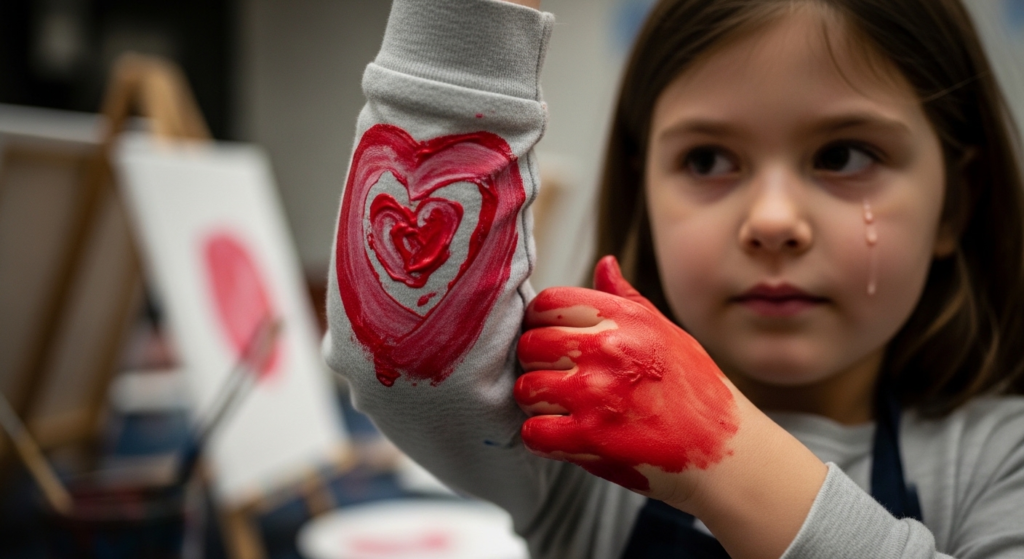
The red acrylic paint was drying under her tiny fingernails, thick and dark like congealed blood.
But it was the absolute, paralyzing terror in her seven-year-old eyes that made my heart slam violently against my ribs.
My name is Clara.
For the last three years, my life has been contained within the four exposed-brick walls of “The Painted Canvas,” a children’s art studio I opened in a quiet, leafy suburb of Oak Park, Illinois.
It was my sanctuary.
A place that smelled perpetually of lavender soap, wet clay, and turpentine.
It was also my hiding place.
Seven years ago, my daughter Maya was born sleeping.
The silence in that hospital delivery room was a heavy, suffocating blanket that eventually smothered my marriage to David.
He moved to Denver. I bought an art studio.
Every Saturday morning, I teach an open-studio workshop for kids aged five to ten.
It’s loud. It’s chaotic. It’s exactly the kind of mess I need to keep the ghosts in my head quiet.
And then there was Lily.
Lily had been coming to my Saturday morning sessions for exactly six weeks.
She was seven years old—the exact age Maya would have been.
Maybe that’s why I found my eyes drawn to her so often.
Or maybe it was because, in a room full of screaming, glitter-throwing children, Lily was practically a ghost herself.
She was a tiny thing, swallowed up in an oversized, faded plaid flannel shirt that she wore every single week, regardless of the warming May weather outside.
Her blonde hair was always just a little unbrushed, falling into her eyes like a protective curtain.
Today was the Saturday before Mother’s Day.
The studio was a hurricane of pastel construction paper, Elmer’s glue, and macaroni noodles.
My best friend and business partner, Sarah, was manning the drying racks.
Sarah is thirty-six, fierce, and entirely entirely too sharp for the suburbs.
She used to be a high-powered corporate litigator downtown until a massive panic attack in a courthouse elevator made her rethink everything.
Now, she wears paint-splattered overalls over designer turtlenecks, runs my pottery kiln, and handles the business finances with ruthless efficiency.
She also has a zero-tolerance policy for terrible parents.
“Range Rover alert,” Sarah murmured to me that morning, leaning over the front reception desk as the rain tapped gently against our front window.
I looked up.
Through the glass, I saw the sleek silver SUV idling illegally in the loading zone.
Marcus was stepping out of the driver’s seat, popping an umbrella open.
Marcus was Lily’s stepfather.
On paper, he was the picture of suburban perfection.
Impeccably tailored suits, even on a Saturday. Hair perfectly styled. A smile that looked like it belonged on a billboard for expensive dental veneers.
But there was something behind his eyes that always made the hair on my arms stand up.
It was a coldness. A completely flat, dead space where empathy should have been.
He opened the back door and pulled Lily out.
I say “pulled” because it wasn’t a gentle hand hold.
His fingers were wrapped tightly around her upper arm, right over the thick fabric of her flannel shirt.
He marched her to the front door of the studio.
The bell jingled cheerfully as he pushed her inside.
“Morning, Clara! Morning, Sarah!” Marcus announced, his voice booming and cheerful, completely disconnected from the tight grip he still had on Lily’s shoulder.
“Morning, Marcus,” I said, forcing a polite smile. “Ready to paint, Lily?”
Lily didn’t look at me. She just nodded, her eyes glued to the scuffed hardwood floor.
“She’s been a bit clumsy this morning,” Marcus said, chuckling loudly. “Tripped on the stairs and took a little tumble. Just keep an eye on her today, would you? Don’t want her ruining that nice shirt.”
The shirt was definitely not nice. It looked like it belonged to a lumberjack from the 1990s.
“We’ll take good care of her,” Sarah said from behind the desk, her tone clipped.
Sarah didn’t bother hiding her dislike for Marcus.
She later told me that his smile reminded her of the CEOs she used to depose—men who could ruin a life and then calmly order a latte.
Marcus patted Lily heavily on the head—a gesture that looked affectionate but felt heavy—and turned on his heel.
“Pick you up at noon, kiddo.”
The door jingled shut.
The moment his SUV pulled away from the curb, Lily seemed to exhale a breath she had been holding since she woke up.
Her small shoulders dropped.
“Alright, artists!” I clapped my hands, bringing the room of twelve children to attention. “Today, we are working on our secret Mother’s Day projects. We are doing handprint canvas trees!”
The room erupted in cheers.
Over in the corner, Mrs. Higgins, a sixty-something grandmother who always stayed to watch her chaotic grandson Leo, offered me a warm smile.
Mrs. Higgins was a fixture here.
She had bad arthritis but still knit violently fast whenever she was anxious.
Right now, she was working on a teal sweater, her needles clicking rhythmically.
“Brave woman, Clara,” Mrs. Higgins called out over the noise. “Giving seven-year-olds open access to wet paint.”
“It’s controlled chaos, Mrs. Higgins,” I laughed, walking over to distribute the blank canvases.
I handed a canvas to Lily.
“Here you go, sweetie. You can pick whatever colors you want for the leaves.”
Usually, Lily painted in tight, controlled strokes.
She favored pale yellows, soft pinks, and light blues. She never painted outside the lines.
But today, something was different.
She walked past the pastel station and went straight for the heavy-duty acrylics.
She picked up a large squeeze bottle of Alizarin Crimson—a deep, dark, visceral red.
I watched her from across the room as I helped Leo stop trying to eat the non-toxic glue.
Lily unscrewed the cap of the red paint.
She didn’t squirt it onto her palette.
Instead, she held the bottle awkwardly, her hand trembling.
Then, with a sudden, jerky movement, she squeezed the bottle directly over her left arm.
A thick, heavy dollop of dark red paint hit the cuff of her flannel shirt.
It didn’t stop there.
She deliberately smeared her hand through it, pushing the red paste deep into the fibers of the fabric, dragging it up her forearm.
It looked exactly like a severe, bleeding wound.
“Oh, Lily!” I gasped, dropping Leo’s glue stick and rushing across the room.
Acrylic paint ruins clothes once it dries. It bonds to the fabric like plastic.
“Hold on, honey, let me get a wet rag before that sets into your sleeve!”
I grabbed a damp terrycloth towel from the sink station and knelt beside her stool.
“It’s okay, accidents happen,” I soothed, reaching for her wrist. “Let’s just wipe this off…”
As my fingers brushed the wet, red fabric, Lily reacted with a violence that shocked me.
She didn’t just pull away.
She slammed her hand down over my wrist, pinning my hand to the table.
Her fingers were freezing cold.
Her wide, blue eyes darted frantically toward the glass front door of the studio, checking the street outside.
Then, she leaned in close to my face.
The smell of the metallic, wet acrylic paint hung heavy between us.
“Please,” she whispered.
Her voice was barely a breath, rough and shaking.
“Please don’t wash my sleeve yet.”
I froze. “Lily, sweetie, it’s going to stain—”
Her tiny fingernails dug into my skin.
“He needs to think I’m still bleeding.”
The words hung in the air, sucking all the oxygen out of my lungs.
I stared at her. The ambient noise of the classroom—the chattering kids, the clicking of Mrs. Higgins’ knitting needles, Sarah sweeping up glitter—seemed to mute into a low, underwater hum.
“What did you say?” I asked, my own voice dropping to a whisper.
“If he thinks the cut opened up again, he won’t take me home,” Lily breathed rapidly, tears finally welling up in her eyes. “He hates blood. It ruins his car seats. He’ll have to take me to the hospital. Mommy works triage at the hospital today.”
A cold sweat broke out down my spine.
I looked at the thick red paint smeared up her arm.
Gently, ignoring her flinch, I slid my thumb under the cuff of her flannel shirt and pushed the fabric back just a millimeter.
Beneath the wet red paint, on her pale skin, I saw it.
The dark, finger-shaped bruises wrapping around her fragile wrist. Yellowing at the edges, purple in the center.
And slightly higher up, a fresh, jagged cut that looked suspiciously like it had been made by the edge of a heavy ring.
My mind flashed to the massive gold college ring Marcus wore on his right hand.
“He pushed me down the stairs this morning,” Lily whispered, a single tear cutting a track through the dust on her cheek. “Because I didn’t fold my blanket right. Mommy wasn’t there. She left early for her shift.”
I felt physically sick.
The room spun.
I looked up and caught Sarah’s eye across the room.
Sarah had stopped sweeping. She was watching me, her lawyer’s instinct sensing that the atmosphere in the room had just violently shifted.
I gave her a look—a wide, desperate look.
Sarah immediately dropped the broom and started walking toward us.
But before she could reach my side, a sharp, aggressive sound cut through the studio.
Honk. Honk.
I snapped my head toward the front window.
The silver Range Rover was back in the loading zone.
It was only 11:15 AM. He was forty-five minutes early.
Marcus was standing right outside the glass door, holding a large, black umbrella to shield his expensive suit from the drizzle.
He wasn’t smiling anymore.
He tapped his gold watch with his index finger, staring directly at me through the glass.
Then, his eyes shifted to Lily.
Even from twenty feet away, through a rain-streaked window, I saw the exact moment Marcus realized what was on Lily’s arm.
His posture stiffened. His jaw clenched.
He reached for the handle of the studio door.
“He’s coming,” Lily sobbed quietly, curling into a tight, tiny ball on her stool. “Clara, please. Hide me.”
The bell on the front door jingled.
Chapter 2
The bell attached to the top of the glass door didn’t just jingle; it practically screamed.
To anyone else, it was the familiar, cheerful chime of “The Painted Canvas,” a sound that usually heralded the arrival of a smiling parent carrying a tray of iced lattes or a chaotic gaggle of siblings ready for a Saturday morning birthday party. But right then, in that specific fraction of a second, the sound was a jarring alarm tearing through the humid, paint-scented air of the studio.
Marcus stepped over the threshold.
He closed the heavy glass door behind him with a controlled, deliberate slowness that was far more terrifying than if he had slammed it. The rain outside was picking up, drumming a frantic, irregular rhythm against the front display windows. He stood on the commercial-grade welcome mat, shaking out his massive black golf umbrella. Water cascaded from the waterproof fabric, pooling around his expensive Italian leather loafers.
He didn’t immediately look at Lily. He didn’t look at me. Instead, he took his time, fastidiously wiping the soles of his shoes on the mat, his jaw set in a tight, rigid line.
I felt Lily’s entire body go rigid against my leg. She wasn’t just trembling anymore; she was vibrating, a high-frequency tremor born of pure, unadulterated survival instinct. Her small, paint-stained fingers were still clamped around my wrist like a vice, her nails biting into my skin with a strength I didn’t know a seven-year-old possessed.
“Clara,” she whimpered, the sound barely escaping her throat. It wasn’t a request; it was a prayer.
My heart was beating so hard it felt like it was going to crack my ribs. I had spent the last seven years of my life trying to feel nothing. When Maya died, a part of me—the soft, maternal, vulnerable part—had seemingly died with her. I had buried it in the frozen ground of a Chicago cemetery and built a wall of wet clay, acrylic paint, and business plans around myself. I didn’t get involved. I didn’t let things touch me.
But looking down at this tiny, blonde girl, swallowed by an old flannel shirt that was hiding a map of horrific violence, that frozen part of me violently shattered. A fierce, sudden, and terrifyingly hot wave of maternal instinct surged through my veins. It was a physical sensation, a rushing of blood to my ears, a tightening of my muscles.
I was not going to let this man take her.
I didn’t have a plan. I didn’t have a weapon. All I had was a room full of macaroni noodles, twelve oblivious children, and Sarah.
“Well, look at this mess,” Marcus announced.
His voice boomed through the studio, instantly commanding the attention of the room. It was that hearty, overly confident tone of a man who was used to dominating boardrooms and intimidating waitstaff. He forced a wide, blindingly white smile, but his eyes—pale blue and completely devoid of warmth—locked onto me like laser sights.
He began to walk toward us, his leather shoes squeaking faintly against the hardwood floor.
“I told you she was clumsy today, Clara,” Marcus said, chuckling. The sound was hollow, metallic. “Seems she couldn’t even make it to noon without causing a disaster. Come here, Lily. We’re leaving.”
He reached out a large, manicured hand toward her.
I didn’t think. I just moved.
I shifted my body weight, stepping squarely in front of Lily, breaking his line of sight to her. I kept my posture relaxed, fighting every instinct that told me to curl into a defensive crouch. I forced my lips into the brightest, most vapid customer-service smile I could muster.
“Marcus! Hi! You’re back so early!” I practically chirped, my voice sounding a full octave higher than normal. “We weren’t expecting you for another forty-five minutes!”
Marcus stopped about three feet away from me. His hand dropped to his side, but his fingers twitched. He did not like having his path blocked. He did not like being managed.
“My meeting ended early,” he said smoothly, though the smile was beginning to strain at the corners of his mouth. “And it looks like it’s a good thing it did. What did she do to herself?”
He leaned to the side, trying to look around my hips at Lily. I mirrored his movement, casually shifting my weight to block him again.
“Oh, it’s just a little paint accident!” I said, waving my free hand dismissively while keeping my other hand firmly behind my back, where Lily was holding onto it. “You know how it is. We were working on our Mother’s Day projects, and our heavy-duty acrylics can get a little wild. She just got a big glob of Alizarin Crimson on her sleeve.”
“Right. Paint,” Marcus said. His eyes narrowed. He looked at the floor, where a few stray drops of the dark red acrylic had splattered when Lily frantically rubbed it into her sleeve. In the dim lighting of the rainy morning, it looked disturbingly like a crime scene.
“Lily. Get your coat,” Marcus ordered. The fake, jovial tone was completely gone now. His voice was a flat, low command. It was the voice of a man who expected immediate, unquestioning obedience.
Behind me, Lily let out a tiny, stifled gasp. I felt her physically shrink, trying to make herself as small as possible behind my legs.
“Actually, Marcus,” a cool, authoritative voice sliced through the tension.
It was Sarah.
I hadn’t even heard her move, but suddenly my business partner was standing right beside me. Sarah was five-foot-ten in her bare feet, but in her thick-soled combat boots, she easily looked Marcus in the eye. She had her arms crossed over her paint-splattered overalls, holding a clipboard like a shield. Her dark hair was pulled back in a severe bun, and her expression was the same terrifyingly blank mask I had seen her wear in photos from her corporate litigation days.
“Actually,” Sarah repeated, her tone as smooth and cold as polished granite, “she can’t leave just yet.”
Marcus blinked, clearly taken aback by the direct challenge. He puffed out his chest, trying to reclaim his physical dominance of the space. “Excuse me? I’m her stepfather. I’m taking her home. Now.”
“And I respect that,” Sarah said, not giving an inch. “But as Clara mentioned, there’s been an incident with our heavy-duty, professional-grade acrylics. It’s a bio-resin compound we use for the older kids’ canvas work. It’s highly toxic if it makes prolonged contact with the skin before it cures.”
I stared at Sarah, desperately trying to keep my face neutral. A bio-resin compound? It was Crayola washable acrylic. It was about as toxic as a bowl of oatmeal. But Sarah was delivering the lie with the chilling conviction of an expert witness under oath.
“Toxic?” Marcus repeated, his brow furrowing. He looked down at the red splatters on the floor, a flicker of genuine hesitation crossing his face. For a man obsessed with appearances and control, the idea of a messy, uncontrollable chemical reaction on his pristine leather car seats was clearly a deterrent.
“Extremely,” Sarah lied seamlessly, tapping her pen against the clipboard. “It bonds to the epidermis and can cause severe chemical burns if not neutralized immediately with a specific solvent we keep in the back room. If she leaves now and gets that on the upholstery of your… is that a new Range Rover? It will eat right through the leather. Not to mention the liability we’d face if she developed a third-degree burn on our watch.”
Marcus looked at his car through the window, then back at us. His jaw worked furiously. He was weighing his options. He wanted his victim, but he didn’t want the inconvenience, the mess, or the potential questions from doctors about chemical burns that might lead to them discovering the other, older marks on her body.
“How long?” he snapped, checking his gold Rolex.
“Fifteen minutes. Twenty at the most,” Sarah said, checking her own bare wrist as if she had a watch on. “Clara needs to take her to the wash station in the back, apply the solvent, and let it neutralize. In the meantime, Marcus, since there was an ‘incident’ on our premises, our insurance requires the guardian on duty to fill out an incident report.”
Sarah unclipped a dense, multi-page document from her clipboard—which I instantly recognized as our lease agreement renewal—and thrust it toward him with a cheap plastic pen.
“Initial the bottom of pages one through four, sign and date page five, and fill out your emergency contact information on the back,” Sarah ordered, her tone brooking absolutely no argument. “Mrs. Higgins?”
Across the room, Mrs. Higgins paused her frantic knitting. She had been watching the entire exchange, her sharp, intelligent eyes darting between Marcus, Sarah, and me. Despite her grandmotherly appearance, Mrs. Higgins was a retired Chicago public school principal. She had spent forty years dealing with every kind of broken family, every kind of troubled child, and every kind of lying abuser.
She knew exactly what was happening.
“Yes, dear?” Mrs. Higgins asked, setting her knitting needles down in her canvas tote bag.
“Could you keep an eye on Leo and the rest of the canvas-painters for just a moment while Clara handles the solvent protocol in the back?” Sarah asked.
“Of course, Sarah,” Mrs. Higgins said. She stood up, her arthritic knees popping, and deliberately walked over to place herself right between Marcus and the hallway that led to the back rooms. It was a subtle, brilliant maneuver. She was an old woman, but right then, she was a human barricade. “Alright, children! Let’s see those trees! Who needs more green?”
“Come on, Lily,” I whispered, keeping my body between her and Marcus. I gently wrapped my hand over her uninjured shoulder. “Let’s go get cleaned up.”
Lily didn’t walk; she shuffled, keeping her head down, her small body trembling so violently I thought she might collapse. We moved toward the hallway. I could feel Marcus’s eyes burning a hole into my back.
“Twenty minutes, Clara,” Marcus called out, his voice sharp and menacing under the guise of casual conversation. “I have a tee time I can’t miss.”
“We’ll be quick!” I called back, pushing open the heavy wooden door that led to our employee breakroom and the supply closet, letting it click shut behind us.
The moment the door closed, cutting off the noise of the studio, the silence in the back room felt deafening. The air here smelled of damp clay and old coffee.
Lily immediately collapsed against the wall, sliding down the faded yellow drywall until she was sitting on the linoleum floor, her knees pulled tight to her chest. She buried her face in her good arm and began to hyperventilate. It wasn’t a loud, theatrical crying; it was the silent, agonizing panic of a child who has been taught that making noise only invites more pain.
“Lily,” I said softly, dropping to my knees beside her. I didn’t touch her. I knew better than to grab a terrified animal. “Lily, breathe with me. You’re safe here. He can’t come back here.”
She shook her head violently, her blonde hair flying around her face. “He’s going to kill me,” she gasped out between ragged breaths. “He said if I ruined the shirt, he was going to take me down to the basement again. Clara, he’s going to put me in the basement.”
My blood ran cold. The basement.
I took a deep breath, fighting the bile rising in my throat. I had to remain calm. If I fell apart, she would shatter completely.
“He is not taking you to a basement,” I said, my voice low, firm, and entirely steady. “I promise you. But Lily, I need you to trust me. I need to see your arm. The real cut. Not the paint.”
She hesitated, peering up at me through her tear-soaked bangs. She searched my eyes for a long moment, looking for the trap. Finding none, she slowly, agonizingly, uncurled her body.
She held out her left arm. The thick red acrylic was already beginning to dry on the flannel, stiffening the fabric.
“Okay. I’m going to be very gentle,” I whispered.
My hands were shaking as I reached for the buttons on the cuff of her oversized shirt. They were thick, plastic buttons, difficult to manipulate with trembling fingers. I finally popped the button loose and began to gently roll the stiff, paint-soaked sleeve up her thin forearm.
I had mentally prepared myself for something bad. I had seen the bruising earlier. I knew what to expect.
I was wrong. I wasn’t prepared at all.
As the flannel fabric slid past her elbow, the true, horrifying reality of Lily’s life was exposed under the harsh fluorescent light of the breakroom.
It wasn’t just a bruised wrist.
Her entire forearm, from the elbow down to the delicate bones of her wrist, was a canvas of suffering. There were bruises in every stage of healing. Faded, sickly yellow-green marks near the top. Deep, mottled purple contusions wrapping around the center. And there, just an inch above her wrist, was the fresh wound.
It was a deep, angry laceration, surrounded by swollen, inflamed tissue. It wasn’t a clean cut from a knife or a piece of glass; it was jagged, torn, as if something blunt and heavy had been dragged violently across her skin. It was still seeping a thin line of clear fluid mixed with dried, real blood. It desperately needed stitches. It needed antibiotics. It needed a doctor.
But worse than the cut were the other marks. Small, perfectly circular, blistered burns scattered near her elbow. Like someone had used her tiny arm as an ashtray.
A choked sob escaped my lips before I could stop it. I slapped my hand over my mouth, tears instantly blinding me.
My Maya. My beautiful, perfect baby girl. I had spent seven years grieving the fact that she never got to take a breath, never got to scrape her knee, never got to experience the world. And here was this beautiful, innocent child, drawing breath every single day in a world that was systematically torturing her.
“I’m sorry,” Lily whispered, misinterpreting my tears. She tried to pull her arm back, shame coloring her pale cheeks. “I’m sorry it’s ugly. I didn’t mean to make you cry.”
“No, no, baby, no,” I choked out, grabbing a clean towel from the stack on the counter and gently wrapping it around her arm, hiding the worst of the marks. “You didn’t do anything wrong. You hear me? You are beautiful. This… what he did to you… this is ugly. He is ugly.”
I pulled her into my chest. She was so small, so incredibly fragile. She smelled like wet acrylic and fear. For a second, she stayed rigid, unaccustomed to physical touch that wasn’t meant to hurt. Then, slowly, she melted into me, her small hands fisting the fabric of my apron.
“He said Mommy would leave me if she found out I was bad,” Lily sobbed into my shoulder. “He said I make him angry, and that makes Mommy sad, and she’ll send me away to a group home. I just want my Mommy, Clara. I just want my Mommy.”
“Where is your mom today, Lily?” I asked, stroking her tangled hair, my mind racing a million miles a minute.
“Oak Park Memorial,” she sniffled. “She works in the emergency room. She does the triage desk on Saturdays. She left at five this morning before I woke up. He… he came into my room after she left.”
Oak Park Memorial. It was less than two miles away.
I squeezed my eyes shut, a plan beginning to form in the chaos of my mind.
I couldn’t call Child Protective Services. Not yet. CPS takes hours to respond on a weekend. If I called the police directly to the studio, Marcus would put on his expensive lawyer charm. He would lie. He would say she fell. He would say the bruises were from soccer, or gymnastics, or a million other normal childhood things. He might even talk his way out of it, and if he did, he would put her in that SUV, take her home, and punish her for telling. I couldn’t risk it.
I needed a medical professional to document the injuries immediately. I needed her mother, the ER nurse, to see exactly what her husband had been doing while she was saving other people’s lives.
I needed to get Lily out of this building.
Bang. Bang. Bang.
The heavy wooden door of the breakroom rattled in its frame.
Lily screamed, a sharp, terrified sound, and buried her head in my lap.
“Clara!” Marcus’s voice was muffled through the wood, but the faux-polite veneer was entirely gone. It was a dark, venomous snarl. “Time’s up. Bring her out here right now, or I’m coming back there.”
I looked at the backdoor of the studio. It led to a narrow, paved alleyway where the garbage dumpsters were kept. My beat-up Honda Civic was parked right outside that door.
I looked down at Lily. Her eyes were wide with a terror so profound it broke whatever was left of my heart.
“Lily,” I whispered, grabbing her uninjured hand and squeezing it tightly. “I am going to get you to your mom. Do you trust me?”
She nodded, a jerky, desperate motion.
“Okay. Stand up. Don’t make a sound.”
I stood up and pulled my cell phone from my apron pocket. I quickly typed out a text message with trembling fingers.
To: Sarah. Delay him. 3 minutes. I’m taking her out the back. Call Mike Reynolds.
I hit send. I prayed Sarah had her phone in her pocket and the ringer on vibrate.
Outside the door, I heard Sarah’s voice, loud and aggressively calm.
“Marcus, you cannot go back there. It is an employee-only area, and if you breach that door, I will consider it a trespassing violation. Furthermore, you missed a signature on page three of the liability waiver. If you don’t sign it, our insurance requires me to call an ambulance to document the chemical exposure.”
“Get out of my way, you crazy bitch,” Marcus growled.
The sound of a heavy scuffle, the scraping of boots against hardwood.
“Mrs. Higgins!” Sarah yelled. “Call 911. Tell them we have a hostile intruder.”
“Already dialing, dear!” Mrs. Higgins called out cheerfully from the front of the room.
That was our window.
I grabbed my car keys from the hook on the wall. I hoisted Lily into my arms, ignoring the dull ache in my back. She wrapped her legs tightly around my waist and buried her face in my neck, clinging to me like a baby monkey.
I pushed the heavy metal bar of the back exit.
It swung open, letting in a rush of cold, damp air and the roar of the driving rain.
I stepped out into the alley, the heavy metal door clicking shut behind me, locking automatically from the outside.
The rain hit us instantly, soaking through my clothes and plastering my hair to my face. I didn’t care. I hit the unlock button on my key fob. The headlights of my old Civic flashed in the gloomy alley.
I yanked the passenger side door open and gently deposited Lily into the seat, pulling the seatbelt across her small body.
“Stay low,” I commanded, slamming the door shut.
I ran around the hood of the car, my sneakers slipping on the wet pavement. I threw myself into the driver’s seat, jammed the key into the ignition, and twisted.
The old engine sputtered, coughed, and roared to life.
As I threw the car into drive and slammed my foot on the gas pedal, I glanced in the rearview mirror.
The back door of the studio violently burst open.
Marcus stood in the doorway, the rain instantly soaking his pristine suit. His face was twisted into a mask of pure, unadulterated rage. He looked less like a human being and more like a predator that had just been robbed of its kill.
He lunged into the alley, running toward my car.
I floored it. The tires squealed against the wet asphalt, fish-tailing slightly before catching traction.
We tore out of the alleyway, merging recklessly onto the wet, busy streets of Oak Park, leaving the monster standing in the rain.
My hands gripped the steering wheel so hard my knuckles were white. The adrenaline was a roaring river in my ears, drowning out the sound of the windshield wipers.
“We’re going to the hospital, Lily,” I said, my voice shaking with a terrifying cocktail of fear and fierce determination. “We’re going to find your mom.”
Lily sat up slightly, peering over the dashboard into the rain-slicked streets. She reached out with her right hand and gently placed it over mine on the steering wheel.
“Thank you, Clara,” she whispered.
I didn’t answer. I couldn’t. I just drove, praying that the woman at the triage desk was ready for the absolute hurricane that was about to walk through her emergency room doors.
Chapter 3
The rain was coming down in thick, gray sheets, turning the familiar streets of Oak Park into a blurred watercolor painting. The windshield wipers of my old Honda Civic fought a losing battle against the deluge, slapping back and forth with a frantic, rhythmic squeak that sounded entirely too loud in the confined space of the car.
My hands were locked onto the steering wheel at ten and two, the knuckles completely white, my tendons aching from the sheer force of my grip. Every time a pair of headlights flashed in my rearview mirror, my heart would leap into my throat, slamming against my esophagus like a trapped bird. I expected to see the imposing grill of Marcus’s silver Range Rover barreling down on us, ready to run my little sedan off the slick, treacherous road.
But there was only the steady, Saturday morning traffic, oblivious to the fact that I had just kidnapped a child to save her life.
“Clara?”
The voice was so small, so fragile, it barely registered over the roar of the heater I had blasted to maximum capacity.
I glanced to my right. Lily was curled into a tight, miserable ball in the passenger seat. The oversized, paint-stained flannel shirt dwarfed her completely. She had her uninjured arm wrapped around her knees, and she was shivering violently. It wasn’t the cold of the air conditioning; it was the bone-deep, uncontrollable tremor of an adrenaline crash. The shock was beginning to wear off, and the reality of the pain in her left arm—and the terror of what she had just done by fleeing—was settling in.
“I’m right here, sweetie,” I said, forcing my voice to remain low, steady, and entirely calm. It was a fake calm, a carefully constructed facade, but I knew she needed an anchor. “I’m right here. We’re almost there.”
“Is Sarah going to get arrested?” Lily asked, her blue eyes wide and shining with unshed tears. “Marcus said he was going to call the police on her. He said she’s crazy.”
A harsh, entirely humorless laugh escaped my lips before I could stop it. “Oh, honey. Marcus has absolutely no idea who he just picked a fight with. Sarah used to tear apart billionaire CEOs for a living before she decided to play with clay. If he calls the police on her, she’ll probably end up owning his car, his house, and his golf clubs by Tuesday. Don’t you worry about Sarah.”
Lily processed this for a moment, her brow furrowing. It was a heartbreakingly adult expression on a seven-year-old face. “But… what about my mommy? What if he calls my mommy first? He always tells her stories before I can. He tells her I’m lying. He tells her I have an active imagination.”
The cruelty of it made my stomach churn, a bitter acid rising in my throat. This was the playbook of every abuser. Isolate the victim. Control the narrative. Make the mother think her child was just acting out, just being clumsy, just seeking attention. It was a psychological cage, far more effective than physical locks.
“He won’t have time to tell a story today,” I promised her, pressing my foot down a little harder on the gas pedal, the engine whining in protest as we sped past the local library. “Because we are going to show her the truth. And the truth doesn’t need an active imagination, Lily. The truth is right there on your arm.”
Lily looked down at the bulky, blood-and-paint-soaked towel I had wrapped around her forearm. She reached out with her good hand and gently touched the terrycloth, flinching slightly.
“She loves him, you know,” Lily whispered, looking out the rain-streaked window. Her voice sounded impossibly old. “Mommy, I mean. He bought her a beautiful house. He pays for her nursing school loans. She cries sometimes when she thinks I’m asleep, but when he comes home, she always smiles and tells him how grateful she is. If I ruin this… if I make him go away… she won’t have the nice house anymore.”
I felt a tear slip down my cheek, hot and fast. I reached across the center console and placed my hand firmly over her small, trembling shoulder.
“Lily, listen to me,” I said fiercely, locking eyes with her for a brief second before turning back to the road. “A house is just wood and glass. It means absolutely nothing if the people inside it aren’t safe. Your mother loves you more than any house, any car, any loan. She loves you more than she loves breathing. When a mother has a little girl, that little girl becomes her entire heart, walking around outside her body. Do you understand?”
As I said the words, a phantom pain ripped through my chest—a sharp, sudden agony in the exact shape of a baby girl named Maya who never got to walk, never got to paint, never got to hold my hand. The grief, which I had carefully managed and compartmentalized for seven years, threatened to rise up and swallow me whole. The hospital we were driving to—Oak Park Memorial—was the exact same hospital where David had driven me on that agonizing, silent night seven years ago. The night the ultrasound technician couldn’t find a heartbeat.
I was driving straight back into my darkest nightmare.
I took a deep, shuddering breath, violently pushing the memories down into the dark, locked boxes in my mind. Not today, I told the ghost of my grief. Today, we save this one.
“I understand,” Lily whispered, leaning her head against the cold glass of the window.
The sprawling, illuminated red ‘EMERGENCY’ sign of Oak Park Memorial cut through the gloomy, rain-swept morning like a beacon. I swerved the Civic into the curved driveway of the ER entrance, ignoring the glaring ‘AMBULANCES ONLY’ signs painted on the asphalt. I slammed the car into park right in front of the sliding glass doors, threw my hazard lights on, and killed the engine.
“Let’s go,” I said, unbuckling my seatbelt.
I grabbed my large canvas tote bag from the backseat, shoved my wallet and keys inside, and ran around the front of the car. I opened Lily’s door and scooped her up into my arms. She was so light, her bones feeling like brittle porcelain against my chest. She buried her face in my neck, shielding her eyes from the driving rain as we sprinted toward the entrance.
The sliding glass doors parted with a soft pneumatic hiss, and the smells hit me instantly.
Bleach. Iodine. Stale coffee. The faint, metallic tang of blood.
My knees actually buckled for a fraction of a second. The sensory overload was a time machine, instantly transporting me back to the worst night of my life. My chest tightened, the air suddenly feeling too thick to breathe. I could hear the phantom echo of a fetal heart monitor flatlining.
No. Stop it. Focus.
I bit the inside of my cheek hard enough to taste copper, using the physical pain to ground myself in the present. I tightened my grip on Lily, adjusting her weight on my hip, and marched into the chaotic, brightly lit expanse of the emergency room waiting area.
It was a typical Saturday morning in a suburban ER. A chaotic symphony of coughing, crying babies, the hum of fluorescent lights, and the blaring of a daytime soap opera on a wall-mounted television. Every plastic chair seemed to be filled with misery.
I bypassed the line of people waiting at the front desk and walked directly toward the secure, glass-enclosed triage booth.
Sitting behind the thick plexiglass, furiously typing on a keyboard while cradling a telephone receiver between her shoulder and ear, was a woman who could only be Emily.
The resemblance was striking. She had the same cascade of blonde hair as Lily, though hers was pulled back into a messy, utilitarian ponytail. She wore dark blue scrubs, a stethoscope draped around her neck, and heavy, dark circles under her eyes that spoke of twelve-hour shifts and chronic exhaustion. She was beautiful, but it was a faded, stressed beauty, like a flower that hadn’t seen the sun in weeks.
I walked right up to the glass.
“Excuse me,” I said loudly, tapping a quarter against the plexiglass.
Emily held up a single index finger, silently asking for a moment as she finished her phone call. “Yes, I understand, Dr. Miller, we have a bed waiting in bay four. Send them up. Thanks.” She slammed the phone down and looked up at me, her expression shifting to the polite, detached mask of a medical professional dealing with a pushy patient.
“Ma’am, you need to take a number and wait in the—”
Her voice abruptly stopped. Her eyes widened, locking onto the small, paint-stained flannel shirt draped over my shoulder.
“Lily?” Emily breathed, instantly pushing her rolling chair back and standing up. “Lily, what are you doing here? Oh my god, what happened?”
Emily practically ripped the side door of the triage booth open, rushing out into the waiting room. She reached out, her hands frantic, trying to pull her daughter from my arms.
“Mommy,” Lily sobbed, turning her head and reaching for her mother.
I let Emily take her, watching as the nurse expertly shifted her daughter’s weight, instantly checking her face, her temperature, her breathing. The maternal instinct was undeniable; Emily loved this child.
“Who are you?” Emily demanded, looking at me with a fierce, protective glare, her eyes tracking the dark red paint that was smeared across Lily’s clothing and my apron. “What is this? Is this blood? What did you do to my daughter?”
“My name is Clara,” I said, keeping my hands visible and my voice incredibly calm. I needed her to view me as an ally, not a threat. “I run ‘The Painted Canvas’ down on 4th Street. The art studio. She was at my workshop this morning.”
Emily’s face scrunched in confusion. “The art studio? Marcus just dropped her off there an hour ago. He was supposed to pick her up at noon. Why did he bring her to me? Where is he?”
“Marcus didn’t bring her here,” I said, taking a step closer, lowering my voice so the crowded waiting room couldn’t hear. “I brought her here. I fled the studio with her through the back alley because he came back early to take her away. The red stuff on her shirt is acrylic paint, Emily. She put it there on purpose.”
Emily stared at me as if I were speaking a foreign language. “On purpose? Why would she do that? What are you talking about?”
“She put the red paint on her arm,” I said, my voice dropping to a harsh, urgent whisper, “because she was terrified that if Marcus didn’t think she was actively bleeding, he wouldn’t bring her to the hospital to see you. She hid behind me and begged me to protect her from him.”
The color rapidly drained from Emily’s face. She looked down at Lily, who had buried her face in the crook of her mother’s neck, crying silently.
“That’s crazy,” Emily stammered, shaking her head, taking a step backward as if trying to distance herself from the words. “That’s… that’s insane. Marcus is a wonderful father. He can be strict, sure, but he would never… she must have just tripped. She’s so clumsy, she’s always tripping and falling—”
“Stop,” I interrupted, my voice cracking like a whip.
I couldn’t handle the denial. I couldn’t stand there and watch this woman recite the exact script her abuser had meticulously written for her.
“Emily, listen to me,” I said, stepping right into her personal space, forcing her to look at me. “I don’t know you. You don’t know me. But I know what a bruised child looks like. And I know what terror looks like. Do not write this off as clumsiness. Look at your daughter’s left arm. Under the towel.”
Emily swallowed hard, her throat clicking audibly. She looked at me, a desperate pleading in her eyes, silently begging me to be wrong. Then, her nurse’s training overriding her denial, she gently shifted Lily’s weight.
With trembling fingers, Emily reached for the thick, blood-and-paint-stained terrycloth towel I had wrapped around Lily’s forearm.
She slowly unwrapped it.
The harsh, unforgiving fluorescent lights of the emergency room illuminated the horror with clinical clarity.
Emily stopped breathing.
For ten agonizing seconds, there was absolute silence between the three of us, existing in a bubble of devastation amidst the noise of the ER.
Emily stared at the constellation of fading yellow bruises, the violent purple contusions, the circular cigarette burns, and the deep, jagged laceration right above the wrist that was still oozing clear plasma.
I watched Emily’s face shatter.
It was a terrifying thing to witness—the exact moment a mother’s reality violently collapses. The illusion of her safe, wealthy, suburban life disintegrated into dust. The truth hit her with the physical force of a freight train. Her knees buckled slightly, a horrible, high-pitched keening sound escaping her tightly closed lips.
“Oh my god,” Emily choked out, her entire body shaking so violently I had to step forward and grab her elbow to keep her from dropping Lily. “Oh my god, my baby. My baby. What did he do to you? Lily, why didn’t you tell me? Why didn’t you tell Mommy?”
“He said you’d leave me,” Lily sobbed, clutching her mother’s scrubs. “He said you liked the house more than me.”
Emily let out a shattered wail, burying her face in Lily’s hair, sobbing uncontrollably.
“Hey! Emily! We need a crash cart in Bay Two, now!” a voice yelled from down the hallway.
Emily snapped her head up, tears streaming down her face, her professional instincts warring with her personal nightmare.
“I need a doctor,” Emily gasped to me, ignoring the call down the hall. “I need Aris. Where is Dr. Thorne?”
Before I could answer, a tall, broad-shouldered man in a white coat over dark scrubs stepped out of the trauma bay corridor. He had silver hair at his temples, sharp, intelligent eyes, and an aura of absolute, unshakeable calm.
“Emily?” the doctor asked, walking briskly toward us. “I heard shouting. What’s going on?”
He stopped when he saw Emily crying. He looked at me, taking in my paint-splattered clothes and frantic expression, and then his eyes landed on Lily’s unwrapped arm.
The doctor’s expression didn’t change, but his eyes turned to chips of absolute ice.
“Trauma Bay Four is empty,” Dr. Thorne said, his voice dropping to a low, authoritative command. He didn’t ask questions. He didn’t need to. He was a pediatric trauma specialist; he had seen this horrific painting a thousand times before. “Emily, take her in there right now. Clara, is it? Follow them.”
He turned to the security guard standing near the metal detectors. “Gary. Lock down the front doors. If a man named Marcus—what’s his last name, Emily?”
“Vance,” Emily sobbed, carrying Lily toward the double doors of the treatment area. “Marcus Vance.”
“If a man named Marcus Vance tries to enter this hospital, you detain him. Call the police liaison. Tell them we have a suspected Code Adam and a 51A mandated reporter filing in progress.”
“Copy that, Doc,” the security guard said, immediately reaching for his radio.
I followed Emily and Dr. Thorne through the heavy double doors, leaving the chaotic waiting room behind. Trauma Bay Four was sterile, cold, and blindingly bright. Emily laid Lily gently on the paper-covered examination table.
Dr. Thorne snapped on a pair of purple nitrile gloves. “Emily, I need you to step back. You are her mother right now, not her nurse. Let me do this.”
Emily nodded numbly, backing up until she hit the wall, sliding down it slightly until she was leaning heavily against the stainless steel sink, her hands covering her mouth.
I stood near the head of the bed, holding Lily’s uninjured right hand, brushing the hair out of her sweaty forehead. “You’re doing so good, brave girl,” I whispered to her. “You are so safe now.”
Dr. Thorne moved with incredible gentleness and terrifying efficiency. He carefully examined the laceration, taking precise measurements. He called a nurse in to bring an evidence kit and a digital camera.
“I have to take some pictures, Lily,” Dr. Thorne said softly, his voice incredibly warm despite the clinical environment. “Is that okay with you? It’s just to show the police how much of a bully this man was to you.”
Lily nodded, sniffing.
Flash. Flash. Flash.
Every flash of the camera felt like a physical blow against the walls of my chest. Documenting the destruction of innocence.
Suddenly, my cell phone, buried deep in the pocket of my canvas tote bag, began to vibrate frantically against my hip. I pulled it out.
The caller ID read: Sarah.
I stepped out of the immediate trauma bay, moving a few feet down the quiet, sterile hallway, and answered.
“Sarah. Are you okay?” I asked immediately.
“I’m fine,” Sarah’s voice came through the speaker, crisp, fast, and radiating pure adrenaline. “But you need to listen to me carefully, Clara. Where are you?”
“Oak Park Memorial. ER Trauma Bay Four. We’re with Lily’s mom and a doctor. They’re documenting everything.”
“Good. That’s perfect. But Clara, things got completely out of hand here.”
My stomach dropped. “What do you mean?”
“When he realized you took her in your car, Marcus completely lost his mind,” Sarah said, her breath slightly ragged. “He tried to attack me. Mrs. Higgins hit him in the knee with a two-pound block of wet firing clay. It was magnificent. But he managed to shove past us. He got in his Range Rover and sped off. He hit a parked car on his way out of the alley.”
“Did you call the police?”
“Mike Reynolds is already here,” Sarah confirmed. “He dispatched a unit to Marcus’s house, but Clara… he’s not going home. He tracked Emily’s phone, or he just figured out the most logical place you would take a bleeding kid whose mother is an ER nurse.”
“He’s coming here,” I whispered, a chill washing over my skin.
“Mike is on his way to the hospital right now, lights and sirens,” Sarah urged. “But he’s coming from downtown Oak Park. He’s ten minutes out. Clara, Marcus is desperate. He knows if she gets evaluated by a doctor, his life is over. He will try to grab her. Do not let him near that child.”
“I won’t,” I swore, the protective fury igniting in my chest once again, burning hotter than before.
“Keep the doctors around you. Keep security close. I love you, Clara. Stay safe.”
The line went dead.
I shoved the phone back into my pocket and spun around to run back into Trauma Bay Four to warn Dr. Thorne.
But as I turned, a sound echoed from the far end of the emergency room corridor.
It was a loud, chaotic commotion. The sound of heavy double doors being shoved violently open. The shout of a security guard. The crash of a medical cart tipping over.
And then, a voice roaring over the noise, echoing off the linoleum floors and stainless steel walls.
“Where is my wife?! Where is my daughter?!”
It was Marcus.
My blood ran completely cold. I stepped out into the center of the hallway.
Fifty yards down the corridor, past the nurses’ station, Marcus Vance was tearing through the restricted area. He was completely soaked from the rain, his expensive suit ruined, clinging to his large frame. His hair was wild, plastered to his forehead. But it was his face that was truly terrifying. It was a mask of unhinged, violent desperation. He had knocked Gary, the security guard, to the ground and was storming past a group of terrified nurses.
He locked eyes with me standing outside Bay Four.
“You!” Marcus bellowed, pointing a thick, aggressive finger at me, his face turning an angry, mottled red. “You kidnapping bitch! I’m going to ruin you!”
He started sprinting down the hallway toward me.
I didn’t run. I didn’t hide. I planted my feet firmly on the linoleum floor, squaring my shoulders. I reached behind me, blindly feeling for the handle of the heavy wooden door to Trauma Bay Four, and pulled it firmly shut, locking it from the hallway side with a loud click.
I was standing alone in the corridor.
“Help!” I screamed at the top of my lungs, my voice echoing like a gunshot. “Code Black! Security!”
Marcus closed the distance in seconds. He didn’t slow down. He didn’t try to talk. He lunged at me, his hands reaching out to grab me by the throat, to throw me out of the way of the door.
I braced for the impact, throwing my arms up to protect my face, praying that Officer Reynolds was driving fast.
But the impact never came.
Instead, a blur of white and dark blue shot out from the adjacent room.
Dr. Aris Thorne, moving with a speed and ferocity that completely belied his calm demeanor, tackled Marcus Vance perfectly at waist height.
The two men crashed into the wall with a sickening thud, taking down a bulletin board and a tray of sterile instruments. They hit the linoleum floor in a tangle of limbs.
“Get your hands off her!” Dr. Thorne roared, pinning Marcus to the ground, his forearm pressing firmly against the back of the abuser’s neck.
Marcus thrashed wildly, screaming obscenities, fighting with the manic strength of a trapped animal. “She’s my daughter! Let me go! That woman kidnapped her! Emily! Emily, tell them!”
The door to Trauma Bay Four clicked unlocked and slowly opened.
Emily stepped out into the hallway.
She looked at her husband—the wealthy, powerful man she had allowed to dictate her life, the man who had bought her a house and tortured her child in its basement.
Marcus looked up at her from the floor, his face desperate. “Emily! Honey, help me! This crazy art teacher took Lily! She’s lying! Tell them I’m a good father!”
Emily stood completely still. Her hands were no longer shaking. Her tears had stopped. The exhausted, terrified, compliant nurse was gone. Standing in the hallway, bathed in the harsh hospital light, was a mother who had finally woken up.
Emily looked down at Marcus, her eyes utterly devoid of anything resembling love.
“You are a monster,” Emily said, her voice dropping to a low, chilling whisper that somehow carried over the chaos of the hallway. “And you will never, ever touch my daughter again.”
At that exact moment, the squeal of tires sounded outside the ambulance bay doors, followed instantly by the heavy, rhythmic pounding of tactical boots hitting the floor.
“Oak Park Police! Nobody move!”
Officer Mike Reynolds, accompanied by three other heavily armed officers, flooded into the corridor, their hands on their duty belts, bringing an overwhelming wall of blue authority into the hospital wing.
I slumped against the wall of the trauma bay, my legs finally giving out. I slid down to the cold floor, burying my face in my hands, gasping for air.
It was over. We had him.
But as the police hauled Marcus to his feet, slapping heavy steel handcuffs onto his wrists and reading him his rights, Marcus twisted his head around, fighting the grip of the officers. He didn’t look at his wife. He didn’t look at the cops.
He locked eyes with me.
Through the chaos, through the shouting, his gaze burned into me with a promise of pure, undiluted vengeance. He wasn’t panicked anymore. He was smiling. A cold, dead, terrifying smile.
“I’ll see you soon, Clara,” Marcus mouthed silently over the heads of the police officers as they dragged him away. “Very soon.”
A fresh wave of ice-cold terror washed over me, settling deep into my bones. The battle was won, but looking into the eyes of the monster being dragged out of the hospital, I knew the war was far from over.
Chapter 4
The doors to the emergency room slid shut behind the police officers, cutting off Marcus’s voice, but his final, silent promise of vengeance hung in the sterile hospital air like a toxic mist.
I stayed on the linoleum floor, my back pressed hard against the wall, my knees pulled up to my chest. The adrenaline that had fueled me for the past hour suddenly evaporated, leaving behind a profound, bone-deep exhaustion. I felt hollowed out, as if my very soul had been scraped clean by the sheer terror of the morning.
“Clara.”
A pair of heavy, black tactical boots appeared in my line of vision. I looked up. Officer Mike Reynolds was standing over me. He was a tall, burly man in his late forties, with a kind face that had seen entirely too much of the dark side of humanity. He was a close friend of Sarah’s—they had worked on opposite sides of several messy corporate embezzlement cases years ago, developing a mutual respect that transcended their different worlds.
He crouched down, his duty belt creaking, and handed me a small, plastic cup of tepid water from the waiting room dispenser.
“Drink,” he ordered gently. “You’re in shock.”
I took the cup with trembling hands, the water splashing over the rim and onto my paint-splattered apron. “Is he… is he gone?” I rasped, my throat raw from screaming.
“He’s in the back of a cruiser on his way to the precinct,” Mike confirmed, his voice a low, reassuring rumble. “He’s facing a mountain of charges, Clara. Aggravated child abuse, assault, battery, resisting arrest, and fleeing the scene of an accident. He’s not getting out anytime soon.”
“He looked at me,” I whispered, the memory of his dead, pale blue eyes sending a fresh shiver down my spine. “He said he’d see me soon. He’s rich, Mike. He has lawyers. He has connections. People like him… they don’t just go away.”
Mike’s expression hardened. “Wealth buys a lot of things in this world, Clara. But it doesn’t buy a jury when there are high-resolution photographs of a seven-year-old covered in cigarette burns and lacerations. And it certainly doesn’t buy him a way out of the fact that Dr. Thorne and his entire nursing staff just witnessed him assault you and a security guard in a pediatric trauma wing. He is done.”
I nodded slowly, trying to let the words anchor me.
Down the hall, the heavy door to Trauma Bay Four opened again. Emily walked out. She looked as though she had aged ten years in the span of thirty minutes. Her scrubs were wrinkled, her face was blotchy and pale, but her posture was entirely different. The cowering, anxious energy was gone. She walked with the stiff, fragile dignity of a survivor standing amidst the wreckage of her life.
She walked straight over to me. Mike stood up, giving us space.
Emily dropped to her knees right there on the hospital floor. Before I could stop her, she wrapped her arms around my neck, pulling me into a fierce, desperate embrace. She smelled of sterile alcohol wipes and tears.
“Thank you,” Emily sobbed into my shoulder, her voice breaking. “Thank you for seeing her. Thank you for not turning a blind eye. I was so blind, Clara. I was so stupid. I let him—”
“Stop,” I said gently, pulling back just enough to look her in the eyes. I grabbed her shoulders. “Do not do that. Do not carry his guilt. Abusers are master manipulators, Emily. They build invisible cages. They isolate you, they gaslight you, they make you doubt your own sanity. He used your demanding job and your love for your daughter against you. The only person responsible for what happened to Lily is the monster who put his hands on her.”
Emily squeezed her eyes shut, a fresh wave of tears spilling over her lashes. “I’m filing for an emergency order of protection. Dr. Thorne already connected me with a social worker. We aren’t going back to that house. I don’t care about the money. I don’t care about the mortgage. We are never going back there.”
“Good,” I said fiercely. “And if you need anything—a place to stay, money for a lawyer, anything at all—you call me.”
I stayed at the hospital for another two hours, giving a painstakingly detailed official statement to two detectives from the Special Victims Unit. I recounted every single moment, from the way Marcus gripped Lily’s arm when he dropped her off, to the exact shade of the Alizarin Crimson paint, to the cold, dead look in his eyes when he threatened me in the hallway.
By the time I finally walked out of the sliding glass doors of the ER, the rain had stopped. The late afternoon sun was breaking through the heavy gray clouds, casting a golden, bruised light over the wet streets of Oak Park.
My old Honda Civic was still parked illegally in the ambulance bay, adorned with a bright orange parking ticket. I pulled it off the windshield, crumpled it up, and threw it in the passenger seat. I didn’t care.
I drove back to the studio in complete silence. No radio. No heater. Just the sound of the tires on the wet asphalt.
When I pulled up to “The Painted Canvas,” the street was quiet. The front door was locked, the ‘CLOSED’ sign flipped outward.
I unlocked the door and stepped inside. The studio was immaculately clean. The chaotic mess of macaroni noodles, glue, and construction paper was gone. The floors had been mopped.
Sarah was sitting behind the reception desk. She had changed out of her paint-splattered overalls and was wearing a sharp, tailored black blazer over a white blouse. She had her laptop open, a stack of legal pads next to her, and she was rapidly typing, her reading glasses perched on the end of her nose.
She looked exactly like the terrifying corporate litigator I had met ten years ago.
She looked up when the bell jingled. Without a word, she closed her laptop, stood up, walked around the desk, and pulled me into a hug.
Sarah is not a hugger.
“Are you okay?” she asked softly.
“I’m exhausted,” I admitted, leaning into her for a second before pulling away. “Are the kids…?”
“Mrs. Higgins and I called all the parents. We told them there was a minor plumbing emergency in the back room and we had to close early,” Sarah explained, walking back to her desk. “Everyone was picked up safely. Marcus’s SUV was towed by the police an hour ago.”
I looked at the legal pads on her desk. “What are you doing?”
Sarah’s eyes glinted with a cold, terrifying light. “I am going to war, Clara. I called in a few favors from my old firm. I found out who Marcus’s defense attorney is likely to be, and I am preparing a preemptive strike. I am drafting civil suits for emotional distress, trespassing, and assault. I am making sure that even if he somehow manages to post bail, his assets will be frozen so fast his head will spin. He threatened you. He doesn’t get to threaten my people.”
Over the next few weeks, the reality of what we had uncovered ripped through the quiet suburb of Oak Park like a tornado.
Marcus Vance, the wealthy, charismatic executive, was denied bail. The judge, presented with the staggering photographic evidence from Dr. Thorne and my own sworn testimony, deemed him an extreme flight risk and a direct danger to his family.
The investigation revealed horrors that made the local evening news. When the police executed a search warrant on Marcus and Emily’s sprawling, five-bedroom house, they found the basement.
It wasn’t just a threat. He had built a tiny, windowless enclosure under the stairs. A solitary confinement cell for a seven-year-old girl. There were scratch marks on the inside of the door.
When Mike Reynolds called to tell me that, I had to pull my car over and throw up on the side of the road.
Marcus’s defense attorneys attempted to play dirty. They tried to paint me as a hysterical, interfering busybody. They sent private investigators to dig into my past. They found out about Maya. They tried to leak a narrative to the press that I was a grieving, unhinged mother who was projecting my trauma onto a wealthy family, “kidnapping” a child over a simple paint spill.
But they severely underestimated Sarah.
Sarah took the narrative and crushed it. She held a press conference on the steps of the courthouse, wearing her sharpest suit, and systematically dismantled Marcus’s reputation with cold, hard facts. She released the information about the basement. She rallied the community.
Mrs. Higgins, the retired principal, mobilized half the neighborhood. They organized a massive fundraiser for Emily’s legal and relocation fees. “The Painted Canvas” became a fortress of community support.
Marcus’s corporate board fired him within a week. His pristine image shattered into a million irreparable pieces.
Three months later, I was standing in the back room of the studio, loading clay into the kiln, when the bell on the front door jingled.
It was a sunny, brilliant Tuesday morning in August. The studio was technically closed for private lessons.
I wiped my dusty hands on my apron and walked out to the main floor.
Standing in the sunlight streaming through the front window was Emily. She looked different. She was wearing jeans and a simple cotton t-shirt. The heavy, dark circles under her eyes were gone. She looked rested. She looked alive.
And standing next to her, holding her hand, was Lily.
Lily wasn’t wearing an oversized, faded flannel shirt to hide her body anymore. She was wearing a bright yellow sundress with little daisies embroidered on the hem. Her blonde hair was braided neatly down her back.
Her left arm was exposed.
The bruises were completely gone. In their place, just above her wrist, was a thick, pink scar. It was a permanent mark of the trauma she had endured, but it was no longer a secret. It was healing.
“Hi, Clara,” Lily said, her voice clear and bright, lacking the terrified tremor that used to haunt it.
“Hi, Lily,” I smiled, feeling a sudden, overwhelming tightness in my throat. I crouched down to her eye level. “Look at you. You look beautiful.”
“We’re moving to Denver next week,” Emily said softly, stepping closer. “My sister lives there. I got a job at a pediatric clinic. We wanted to come say goodbye before we packed up the car.”
“Denver is beautiful,” I said, my mind flashing briefly to David, my ex-husband, who had moved there years ago. It felt like a lifetime away. “You’re going to love the mountains, Lily.”
“Mommy said I can take art classes there, too,” Lily said, looking around the familiar messy studio. “But I wanted to paint one last picture here. With you. If that’s okay?”
“Are you kidding?” I laughed, standing up and wiping away a rogue tear. “I would be honored. Let’s go get a canvas.”
I set Lily up at her favorite stool by the window. I laid out a fresh, pristine white canvas and a palette of paints.
I held my breath slightly as she reached for the squeeze bottles.
She bypassed the Alizarin Crimson entirely.
Instead, she grabbed Cerulean Blue, Cadmium Yellow, and Titanium White.
For the next hour, the studio was quiet, filled only with the soft, rhythmic swish of a brush against canvas. Emily sat in a chair nearby, watching her daughter with a look of such profound, peaceful love that it made my heart ache.
But it wasn’t the agonizing ache of grief anymore. It was something entirely different.
For seven years, I had believed that when Maya died, my capacity to be a mother died with her. I had built this art studio as a mausoleum for my maternal instincts, surrounding myself with other people’s children so I wouldn’t have to face the empty silence of my own life.
But watching Lily paint, watching her breathe without fear, I realized the truth.
Maya’s short, unseen life hadn’t destroyed my heart; it had expanded it. The fierce, terrifying love I had carried for my unborn daughter hadn’t vanished into the ether. It had stayed inside me, waiting, building strength, until the exact moment a little girl in a heavy flannel shirt needed someone to stand between her and a monster.
I couldn’t save Maya. But because of Maya, because of the devastating, world-altering power of a mother’s grief, I was strong enough to save Lily.
Lily finally set her brush down. “Done,” she announced proudly.
I walked over to look.
It wasn’t a tree. It wasn’t a house.
It was a brilliant, chaotic, abstract explosion of bright yellow sunbursts and deep blue oceans, swirling together in a beautiful, uncontrolled dance. It was messy. It was vibrant. It was the painting of a child who was finally allowed to make a mess without the fear of punishment.
Right in the center, painted in bright, bold white letters, were two words.
Thank You.
“It’s a masterpiece, Lily,” I whispered, kissing the top of her head.
Emily hugged me goodbye at the door, holding on tight. “You saved her life, Clara. You saved both of our lives.”
“No,” I smiled, looking at the little girl twirling in her yellow sundress on the sidewalk. “She saved mine.”
I watched them walk away, their hands clasped tightly together, bathed in the warm summer sun. I didn’t feel the need to hide in the studio anymore. I didn’t feel the ghosts.
I took a deep breath of the fresh, rain-washed air, turned the sign to ‘OPEN’, and unlocked the door for the rest of the world.
The darkest wounds don’t always destroy us; sometimes, they are the exact cracks that let the light back in.
Notes from the Author:
Advice and Philosophy:
We often view trauma as a permanent stain, a red mark on the canvas of our lives that ruins the entire picture. We try to cover it up, hide it under oversized layers, and pretend it isn’t bleeding. But silence is the greatest weapon an abuser has.
True healing doesn’t begin when we forget the pain; it begins when we bring the darkest secrets out into the harsh, unforgiving light. It requires immense, terrifying courage to speak up, whether you are the victim finding your voice, or the bystander choosing to step into the line of fire.
Remember this: Your intuition is not an “active imagination.” If you see a child shrinking, if you sense a coldness in a home that looks perfect on paper, do not turn away. The discomfort of interfering is nothing compared to the agony of a child waiting for a hero who never comes.
And for those carrying the heavy, invisible burden of grief—your loss is not the end of your capacity to love. The love you have for those you’ve lost does not evaporate. It transforms into a fierce, protective armor. Use it. Let your broken heart be the reason someone else’s is kept safe.