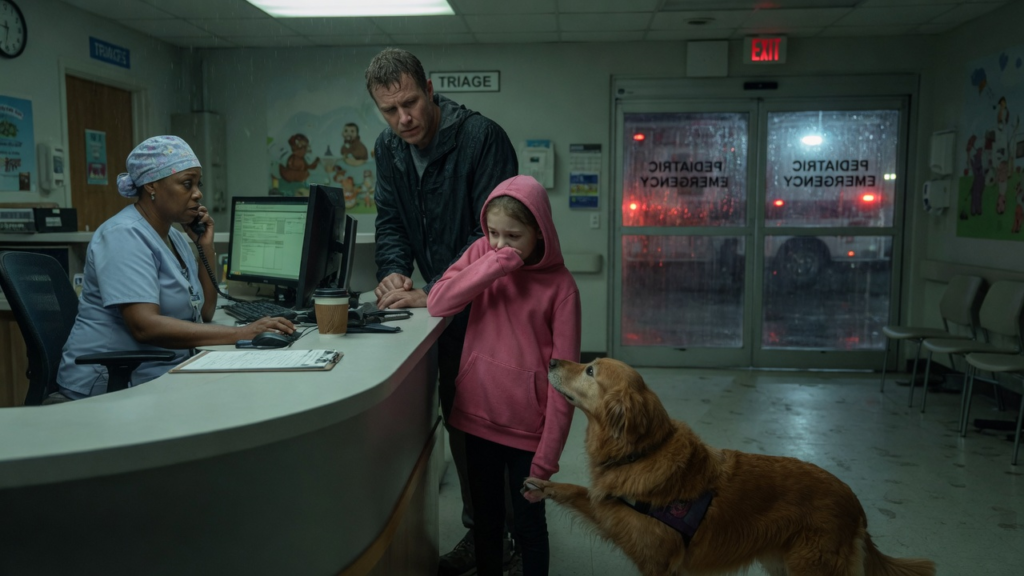
Working triage in a pediatric ER changes you.
After eight years behind the heavy plexiglass window, you stop seeing people and start seeing patterns.
You learn to tell the difference between a panicked parent and a guilty one.
A panicked parent rushes through the sliding glass doors, shouting for help, carrying their child like fragile glass.
A guilty parent walks in quietly, looking around at the security cameras before they look at the nurses.
It was a rainy Tuesday night in late November, the kind of night where the waiting room was mostly empty, save for the hum of the vending machine and the relentless ticking of the wall clock.
I was at the front desk, sorting through charts, drinking stale coffee that tasted like burnt copper.
Curled up under the window was Barnaby.
Barnaby wasn’t a standard therapy dog. He was a 70-pound rescue mutt—part Golden Retriever, part Great Pyrenees, missing half of his left ear from a past life he couldn’t talk about.
He was technically assigned to the pediatric ward to comfort kids after surgery, but on slow nights, his handler, Dave, let him sleep by my desk.
Barnaby had a gift. He was deeply, almost supernaturally empathetic.
He ignored the kids with scraped knees and stomach bugs. He slept right through the crying babies.
But if a child came in with a hidden trauma—something deep and unspoken—Barnaby would wake up.
He would pace. He would whine. He would anchor himself to them and refuse to leave.
I used to think it was just a coincidence.
Until the night the automatic doors slid open, letting in a gust of freezing rain.
A man walked in.
He was tall, maybe six-foot-two, broad-shouldered, wearing a dark green canvas jacket that was soaked through at the shoulders.
He didn’t look panicked. He looked annoyed.
His jaw was clenched tightly, his eyes darting immediately to the security camera mounted in the corner of the room.
That was my first red flag.
My second red flag was his right hand.
He was gripping the wrist of a little girl, pulling her along slightly faster than her short legs could comfortably walk.
She looked to be about seven years old.
She was wearing a faded pink hoodie that was at least two sizes too big for her.
But it wasn’t her clothes that made my stomach drop.
It was her posture.
She was hunched over, her shoulders curled inward, trying to make herself as small as possible.
And her left arm was raised, the oversized sleeve of her hoodie pulled tightly across her face, completely covering her mouth and nose.
“Name and date of birth,” I said, sliding the sign-in clipboard through the slot in the glass.
The man didn’t let go of her wrist.
“Lily Evans,” he said abruptly. His voice was gravelly, forced to be quiet. “March 14th.”
“What brings you in tonight, sir?” I asked, keeping my tone perfectly neutral.
“She fell,” he said quickly. Too quickly. “Tripped on the front steps. Hit her mouth on the concrete. Needs a doctor to look at it.”
I shifted my gaze to the little girl.
“Hi, Lily,” I said gently. “Can you drop your arm for me, sweetie? Let me see your face.”
The little girl flinched.
She didn’t just hesitate—she visibly recoiled, her fingers digging tighter into the fabric of her sleeve, pressing it harder against her mouth.
She didn’t look at me. She looked up at the man.
The man’s grip on her wrist tightened. I saw his knuckles turn white.
“She’s shy,” he snapped, his eyes flashing with a sudden, sharp anger. “And she’s bleeding. Can we just get a room?”
“Sir, I need to assess the injury to assign her priority,” I explained, my heart beginning to beat a little faster.
“I told you, she fell,” he repeated, leaning closer to the glass. “It’s a busted lip. That’s it.”
Under my desk, I heard a low, scraping sound.
It was Barnaby.
The massive dog had stood up.
He wasn’t stretching. He wasn’t looking for a pat.
His body was rigid, his ears pinned back. He was staring directly at the little girl through the lower half of the glass partition.
Dave, his handler, was at the vending machine down the hall.
Barnaby let out a sound I had never heard him make before.
It wasn’t a bark. It was a low, vibrating rumble deep in his chest. A sound of absolute distress.
The dog walked out from behind the desk, bypassing the swinging door, and stepped directly into the waiting room.
“Barnaby, stay,” I whispered urgently, not wanting to agitate the father.
But Barnaby ignored me.
He walked straight toward the man and the little girl.
The man noticed the dog and took a step back, pulling the girl roughly with him.
“Get that mutt away from us,” the man growled, his voice rising in volume.
“He’s a therapy dog, sir, he’s harmless,” I said, standing up from my chair.
Barnaby didn’t look at the man.
He walked right up to the little girl and sat down firmly in front of her.
He placed his heavy body between the girl and the man’s leg.
The girl froze. Her eyes, wide and completely terrified, stared down at the massive golden dog.
She was trembling so violently now that I could see the fabric of her oversized hoodie shaking.
“I said, get the dog away!” the man yelled, raising his heavy work boot as if to kick Barnaby.
“Sir, do not touch the dog!” I commanded, my voice sharp and authoritative, my hand hovering over the security panic button.
Barnaby didn’t even flinch at the raised boot.
He slowly lifted his large, heavy head.
He looked directly into the little girl’s eyes.
For a second, the whole waiting room seemed to stop breathing.
The rain stopped hitting the glass. The clock stopped ticking.
Barnaby let out a soft, high-pitched whine.
Then, very gently, the dog raised his front paw.
He didn’t paw at her aggressively. He simply rested his large, soft paw against her raised forearm.
The arm that was hiding her face.
The man yanked her wrist again. “Lily, let’s go, we’re going somewhere else.”
But Barnaby leaned his weight forward.
He nudged his cold, wet nose under her elbow.
He applied a gentle, steady downward pressure.
The little girl looked at the dog. A single tear broke free, tracking down her cheek, mixing with a faint smear of pink on her pale skin.
She let out a tiny, broken gasp.
And then, slowly, her resistance broke.
She let Barnaby push her arm down.
The oversized, soaked sleeve dropped away from her face.
I gasped out loud, my hand flying to my own mouth.
The man cursed violently, stepping back, dropping her wrist as if he had been burned.
The injury wasn’t a busted lip from falling on concrete.
The cut was perfectly straight, deep, and surgical, running from the corner of her mouth up toward her cheekbone.
But that wasn’t what froze the blood in my veins.
It was what was wrapped tightly around her neck, hidden just beneath the collar of the oversized hoodie, now visible as the fabric shifted.
A heavy, industrial zip-tie, pulled tight enough to leave dark, angry purple bruising against her windpipe.
She hadn’t been hiding her lip.
She had been trying to hide the fact that she couldn’t breathe.
I slammed my fist down on the security panic button under the desk.
The man spun around, sprinting for the automatic doors.
But before he could even take three steps, Barnaby moved.
The gentle therapy dog let out a deafening, terrifying roar and lunged.
CHAPTER 2
The impact sounded like a car crash.
Seventy pounds of muscle, fur, and pure protective instinct slammed into the man’s chest before his hand could even touch the sliding glass doors.
Barnaby didn’t bite. He didn’t use his teeth at all.
He hit the man like a linebacker, a solid, heavy collision that sent them both crashing onto the wet linoleum floor of the waiting room.
The man’s head cracked against the base of the metal magazine rack, scattering old issues of Highlights and Better Homes across the floor.
He let out a breathless, stunned grunt.
But Barnaby wasn’t finished.
The dog, usually so gentle that toddlers could pull his ears without him blinking, planted his massive front paws squarely on the man’s sternum.
He dropped his muzzle inches from the man’s face, pulling his lips back to reveal every single tooth in his head.
The growl that tore from Barnaby’s chest vibrated through the floorboards. It was primal. Terrifying.
I didn’t stay behind the glass.
I didn’t bother with the swinging security door.
I planted my hands on the triage counter and vaulted over it, my clogs skidding on the slick floor as I hit the ground.
My eyes weren’t on the man. They were entirely on Lily.
She hadn’t moved.
She stood frozen in the center of the room, her oversized pink hoodie hanging off her tiny frame, her eyes completely vacant.
She was staring at the wall, dissociated, her hands hanging limply at her sides.
I dropped to my knees in front of her, my hands shaking as I reached for the collar of her hoodie.
“Lily,” I said, my voice cracking. “Lily, look at me, honey. I’m going to help you.”
I pulled the fabric down, and my stomach violently hurled itself into my throat.
The zip-tie wasn’t just tight. It was embedded.
It was thick, heavy-duty black plastic—the kind construction workers use to bind heavy cables together.
It was pulled so tight around her throat that the skin above and below it was bulging, mottled with a horrifying, dusky purple hue.
Petechiae—tiny, burst blood vessels—were dotting her jawline and the whites of her eyes, a clear, undeniable sign of strangulation.
She wasn’t breathing in. She was sipping air.
Tiny, whistling gasps that barely moved her chest.
“Get this fucking dog off me!” the man screamed from the floor, his voice raw with panic.
He tried to buck his hips, tried to throw Barnaby off.
Barnaby snapped his jaws, the sound like a steel trap snapping shut, less than an inch from the man’s nose.
The man froze, throwing his hands up over his face, sobbing in terror.
I reached into the pocket of my scrubs, my fingers frantically searching for my trauma shears.
My heart was hammering against my ribs so hard it physically hurt.
I pulled out the heavy, curved scissors and brought them to Lily’s neck.
But there was a massive problem.
The plastic was pulled so tightly into her flesh that there was no gap.
There was absolutely no room to slip the bottom blade of the shears under the plastic without slicing directly into her carotid artery.
Her skin was cold. So incredibly cold.
“Help!” I screamed at the top of my lungs, my voice echoing through the empty halls. “Code Blue in the lobby! I need help NOW!”
Down the hall, a heavy door banged open.
Dave, Barnaby’s handler, came sprinting around the corner, two cans of Diet Coke slipping from his hands and exploding in a fountain of foam on the floor.
Behind him came Marcus and Stan, our two night-shift security guards, their heavy boots thudding against the linoleum.
They burst into the waiting room and stopped dead in their tracks.
The scene made absolutely no sense to them.
A bleeding man on the floor being mauled by the hospital’s beloved therapy dog.
And a triage nurse on her knees, holding a pair of heavy scissors to a little girl’s throat.
“Barnaby! NO!” Dave screamed, absolute horror painting his face.
He lunged forward, grabbing Barnaby by his red service vest, trying to haul the massive dog backward.
“Don’t hurt him!” the man on the floor wailed, pointing a shaking finger at me. “She’s crazy! The dog attacked me and the nurse is trying to cut my daughter!”
Marcus, the senior guard, instinctively dropped his hand to the taser on his hip.
“Sarah, step back!” Marcus barked, his voice carrying an authoritative edge I’d never heard him use before.
“No!” I screamed, not taking my eyes off the black plastic ring digging into Lily’s neck. “He’s lying! She’s being strangled! I can’t get the blade under!”
Dave was struggling with Barnaby.
The dog refused to back down. Even with his handler pulling him, Barnaby dug his claws into the linoleum, growling fiercely, trying to lunge back at the man.
“He’s out of control!” the man sobbed, rolling onto his side, curling into the fetal position. “I brought her here for help! She did this to herself!”
The words hit the room like a bomb.
Everyone froze. Even I paused for a fraction of a second, my shears hovering near Lily’s throat.
“What did you say?” Marcus demanded, stepping between the man and Barnaby.
“She’s sick!” the man cried, his voice breaking into a perfect, devastating sob. “She has severe behavioral issues. Pica. Self-harm.”
He pointed at the surgical cut on her cheek, which was now slowly leaking dark red blood down her pale skin.
“She got into my tool shed tonight,” he continued, speaking rapidly, desperately. “She found the zip-ties. She looped one around her neck and pulled it. I tried to stop her, but she fought me!”
He looked up at Marcus, tears streaming down his face.
“She cut her own face with a box cutter when I tried to take it away. I didn’t know what to do! I was afraid if I tried to cut the plastic, I’d slice her neck open! So I rushed her to the ER!”
It was a brilliant, terrifyingly plausible lie.
It explained the panic. It explained the bizarre injury. It explained why he was dragging her.
And sadly, working in a pediatric ER, I had seen children with severe psychiatric episodes do unimaginable things to themselves.
I saw the doubt flash across Marcus’s eyes.
I saw Dave look at Barnaby, wondering if his dog had just viciously attacked an innocent, terrified, overwhelmed father.
“Sarah,” Stan, the younger guard, said gently, stepping toward me. “Maybe you should put the scissors down. Let us get her into a room properly.”
“Stay back!” I snapped, my voice venomous.
I looked at Lily.
If she had done this to herself in a manic episode, she would be fighting me. She would be thrashing.
But she wasn’t.
She was standing like a marble statue, completely compliant, completely broken.
Her eyes shifted slightly, finally meeting mine.
They were the eyes of an old woman trapped in a seven-year-old’s body. They held a silent, desperate plea.
Don’t believe him.
I didn’t.
“Dave, hold that dog!” I yelled, turning my attention entirely back to the zip-tie. “Marcus, get over here and hold her head perfectly still! Now!”
Marcus hesitated for a second, torn between the crying father on the floor and my absolute certainty.
But he trusted me. We had worked together for four years.
He holstered his taser, dropped to his knees, and placed his large, warm hands on either side of Lily’s head, bracing her.
“Don’t move, sweetheart,” Marcus whispered.
I took a deep breath.
I angled the blunt tip of the trauma shears, pressing the flat metal down against her bruising flesh, forcing it under the hard edge of the plastic.
Lily let out a sharp, muted whimper of pain.
“I know, baby, I know, I’m so sorry,” I muttered.
The blade caught the edge of the plastic.
I squeezed the handles with both hands, putting all my upper body strength into the grip.
Industrial zip-ties are designed to hold hundreds of pounds of pressure. They don’t want to break.
The metal bit into the plastic. My hands cramped.
“Come on,” I hissed through my teeth.
With a loud, sharp CRACK that sounded like a gunshot in the tense room, the thick plastic snapped.
The heavy black band sprang open, immediately flying off her neck and clattering onto the floor.
Lily collapsed.
Without the rigid plastic holding her posture rigid, her knees buckled.
I caught her before she hit the floor, pulling her tiny, freezing body against my chest.
She took a breath.
It was a wet, ragged, horrible sound. The sound of crushed airways violently expanding.
She coughed, a harsh, barking sound, and buried her face into the shoulder of my scrubs, finally starting to cry.
It wasn’t a normal child’s cry. It was silent, shaking sobs that wracked her entire body.
“Get a stretcher out here!” I yelled at Stan. “Call Dr. Evans, tell him we have a strangulation protocol!”
Stan sprinted back through the swinging doors.
On the floor, the man was sitting up, wiping a small smear of blood from his forehead where he had hit the magazine rack.
He was watching me hold Lily.
The panic and the tears had instantly vanished from his face.
His expression was perfectly blank. Cold. Calculating.
“I want her chart,” he said, his voice completely level now, dropping the hysterical father act.
Marcus turned to look at him, confused by the sudden shift in tone.
“Excuse me?” Marcus said.
“I am her biological father,” the man said, reaching slowly into his jacket pocket.
Barnaby, who was still being held back by Dave, growled again, lunging forward.
“Hey, hands where I can see them!” Marcus ordered, putting his hand back on his taser.
The man pulled out a leather wallet using only two fingers.
He tossed it onto the floor. It slid across the linoleum and hit Marcus’s boot.
“My ID is in there. Along with a copy of my sole custody court order,” the man said calmly.
He slowly climbed to his feet, brushing the dirt off his damp knees.
“She is my daughter,” he repeated, staring directly into my eyes. “She has severe psychiatric issues. You, your hospital, and that violent animal just assaulted me.”
He pointed a finger at Dave.
“I’m going to have that dog put down by tomorrow morning. And I’m suing this hospital into bankruptcy.”
The room went dead silent again, save for Lily’s ragged breathing against my neck.
He was incredibly confident.
Abusers usually run when they are caught. They panic.
This man wasn’t panicking. He was settling in. He knew the system. He knew his rights.
And he knew how to play the victim perfectly.
“Now,” the man said, taking a step toward me. “Give me back my daughter. We are leaving.”
“She needs medical attention,” I said, tightening my grip on the little girl.
“I’ll take her to a different hospital. One that doesn’t let rabid dogs roam the halls,” he sneered.
Marcus looked down at the wallet, then back at me. I could see the conflict in the guard’s posture.
Legally, if this man was her sole guardian, and he was refusing medical care to take her elsewhere… our hands were incredibly tied.
Without police intervention, we couldn’t legally hold a child hostage against a custodial parent’s will unless we could prove immediate, life-threatening intent by the parent.
And he had just provided a perfectly plausible alibi for her injuries.
“Sarah,” Marcus whispered, stepping closer to me. “If he’s got the paperwork…”
“Look at her neck, Marcus!” I hissed. “You think a seven-year-old pulled a military-grade zip-tie that tight on herself?”
“Kids do crazy things, Sarah,” Marcus whispered back, looking pained. “We have to call the cops and let them sort it out. We can’t just steal his kid.”
The man smiled. It was a tiny, triumphant smirk.
He took another step forward, reaching his hand out toward Lily.
“Come on, bug,” he said, his voice dropping into a sickeningly sweet, paternal tone. “Daddy’s going to get you cleaned up. Let’s go.”
Lily stopped crying.
Her body went entirely rigid against mine.
She slowly lifted her head from my shoulder.
She didn’t look at the man. She didn’t look at me.
She reached her small, trembling hand down toward the oversized pocket of her pink hoodie.
The man saw the movement.
His smirk instantly vanished. His face went chalk white.
“Lily, don’t,” he snapped, his voice cracking with genuine, unadulterated fear.
It was the first time I had heard real panic in his voice since he walked through the doors.
“Lily, take your hand out of your pocket right now,” he commanded, stepping forward aggressively.
Barnaby broke free.
Dave lost his grip on the collar, and the massive dog put himself entirely between me and the man, barking loud enough to rattle the glass in the windows.
Stan burst back through the doors, pushing a stretcher, accompanied by the on-call doctor.
But I ignored them all.
I looked down at Lily’s trembling hand as it disappeared into the dark fabric of the pocket.
“What is it, honey?” I whispered. “What do you have?”
She pulled her hand out.
Her tiny fingers were curled tightly around an object.
It wasn’t another zip-tie. It wasn’t a toy.
It was something cold, metallic, and heavy.
She uncurled her fingers, dropping the object onto the linoleum floor.
It hit the ground with a heavy, metallic clink that cut through the chaos of the room.
I stared down at it, my brain refusing to process what I was seeing.
Marcus gasped, taking a giant step backward.
The man turned and bolted for the doors.
Because the object Lily had been hiding in her pocket changed absolutely everything.
CHAPTER 3
The silence that followed the metallic clink on the floor was more deafening than the man’s screaming had been.
It wasn’t a gun. It wasn’t a knife.
It was a heavy, silver shield-shaped badge.
A police badge.
But it wasn’t just any badge. It was tarnished, the edges worn smooth from years of being carried in a pocket, and engraved across the center was the word: SERGEANT.
Below that, a name was etched into the silver: THOMAS EVANS.
The man on the floor, who had just claimed his name was Evans and that he was the biological father, didn’t move toward the badge.
He moved away from it.
He scrambled backward on all fours, his eyes blown wide with a terror that surpassed anything I had seen from Lily tonight.
“She stole that!” he shrieked, his voice hitting a glass-shattering pitch. “She stole that from a crime scene! I told you she’s disturbed!”
But his lie was rotting in real-time.
Lily didn’t look at him. She looked at Marcus, the security guard.
Then, with a hand that still shook like a leaf in a storm, she reached back into her other pocket.
She pulled out a small, laminated photo.
She held it up.
It was a picture of a man in a crisp blue police uniform. He was laughing, holding a much smaller Lily on his shoulders. He looked strong. He looked kind.
He looked absolutely nothing like the monster currently trying to claw his way out of our hospital lobby.
“That’s not him,” Lily whispered.
It was the first time she had spoken more than two words. Her voice was a rasp, a broken vibration of air through a damaged throat, but it carried the weight of a mountain.
“He’s not my daddy,” she choked out, her eyes filling with fresh, hot tears. “He… he took me from the park. He said he was a friend of my daddy’s. He said my daddy was hurt.”
The air in the room vanished.
Marcus didn’t wait for another word.
He didn’t reach for his taser this time. He lunged across the floor, his 220-pound frame pinning the man against the automatic doors before they could even slide open.
“Stan! Handcuffs! Now!” Marcus roared.
The man fought like a cornered rat. He bit, he kicked, he screamed obscenities that no child should ever hear.
“I have rights!” he yelled, his face pressed against the glass. “I have the papers! You’re kidnapping a minor!”
“Shut up,” Marcus hissed, ratcheting the metal cuffs onto the man’s wrists so hard the clicking sound echoed off the walls.
I didn’t watch the arrest.
I looked at the badge on the floor.
I picked it up. It felt ice-cold in my palm.
I turned it over.
On the back, taped with a small piece of clear scotch tape, was a phone number and a blood type.
And a date: In case of emergency, call my wife, Elena.
My heart stopped.
I knew that name.
I looked at the “father” on the floor. He was sobbing now, but they weren’t the tears of a parent. They were the tears of a predator who knew the game was over.
“Dr. Evans!” I yelled, turning toward the doctor who had just arrived with the stretcher.
Dr. Robert Evans was the head of our ER. He was sixty years old, a man who had seen every tragedy imaginable.
He walked over, his face pale as he looked at the little girl.
“Sarah, what is going on?” he asked, his voice trembling.
I handed him the badge.
The doctor looked at the name. He looked at the serial number.
Then he looked at the man pinned to the glass by our security guards.
“This badge belongs to Thomas Evans,” the doctor whispered. “He’s a Sergeant over in the 4th Precinct.”
He paused, his eyes darting to the little girl.
“Thomas was reported missing forty-eight hours ago,” the doctor said, his voice dropping to a terrifying low. “He disappeared during a routine traffic stop. They found his cruiser empty on the side of the highway. Blood on the driver’s seat. No sign of him. No sign of his daughter who was supposed to be in the car with him.”
The room tilted.
The “father” on the floor stopped screaming.
He went perfectly still.
He looked at Dr. Evans, and a slow, hideous grin spread across his face.
“He’s in the cellar,” the man whispered. “If you want him, you better hurry. The zip-ties on his wrists were a lot tighter than the one on her neck.”
Marcus slammed the man’s head back against the glass. “Where? Where is he?”
But the man just laughed. A dry, rattling sound that made my skin crawl.
Barnaby, the dog, began to bark again.
He wasn’t barking at the man this time.
He was barking at the exit. He was pacing back and forth near the doors, his tail tucked, his eyes fixed on the darkness of the rainy parking lot outside.
“He’s not alone,” Dave, the dog handler, whispered. “Barnaby smells something else.”
Suddenly, the automatic doors—the ones Marcus was leaning against—struggled to open.
Something was blocking them from the outside.
A dark, heavy shape was leaned against the glass.
We all froze.
The rain was coming down in sheets, blurring the world outside into a grey smudge.
But through the condensation, we saw it.
A black SUV had pulled up onto the ambulance ramp. Its lights were off. The engine was idling, a low, ominous thrum that we could feel in our teeth.
The passenger door opened.
A second man stepped out.
He was wearing a high-visibility yellow rain slicker, the kind construction workers wear.
He walked up to the glass doors, ignored the man being pinned by security, and looked directly at Lily.
He didn’t have a weapon in his hand.
He had a phone.
He held the phone up to the glass.
On the screen was a live video feed.
It showed a dark, damp basement. A man in a torn police uniform was slumped against a wooden pillar, his mouth duct-taped, his eyes bruised shut.
Around his neck was a heavy, black zip-tie.
The man in the rain slicker tapped on the glass with a heavy ring.
He pointed at the man Marcus was holding.
Then he pointed at the exit.
He was offering a trade.
The Sergeant’s life for the man in handcuffs.
“Sarah,” Dr. Evans whispered, his hand on my shoulder. “Call the police. Get everyone in the back. Now.”
“We can’t let him go,” I said, my voice shaking as I held Lily tighter.
“If we don’t,” the doctor said, looking at the video feed on the phone through the glass, “Thomas Evans is dead in sixty seconds.”
The man in the rain slicker held up a small, black remote.
He didn’t say a word.
He just thumbed the button.
Inside the hospital, every light in the lobby suddenly went black.
The backup generators didn’t kick in.
The electronic locks on the doors clicked.
And in the pitch black of the ER waiting room, I heard the sound of the sliding doors finally grinding open.
Lily screamed.
Barnaby lunged.
And the darkness swallowed the room.
CHAPTER 4
The darkness wasn’t empty.
It was alive with the sounds of a nightmare.
The heavy sliding doors groaned as they were forced open by hand. The wet, rhythmic thrum of the SUV’s engine outside seemed to vibrate through my very bones.
I didn’t think. I acted on pure, maternal instinct.
I scooped Lily up—she felt like she weighed nothing, just a bundle of wet fabric and trembling limbs—and I dived behind the heavy steel triage desk.
“Stay down,” I hissed, pressing her back against the cold metal. “Don’t make a sound. No matter what you hear, do not move.”
She didn’t nod. She just stared at me, her eyes reflecting the faint, ghostly glow of the emergency exit signs that were the only things still lit in the entire wing.
In the lobby, the chaos was visceral.
I heard the wet slap of boots on linoleum. I heard the sound of a heavy struggle—the grunts of Marcus and Stan as they tried to maintain their hold on the first man in the pitch black.
Then, a voice.
It wasn’t the frantic screaming of the “father” on the floor. It was a cold, modulated tone. Calm. Professional.
“Let him go,” the voice said. It was the man in the rain slicker. He was inside.
“Get back!” Marcus shouted. I heard the crackle of his taser, the blue spark illuminating the room for a micro-second, casting long, terrifying shadows against the walls.
In that flash, I saw the man in the rain slicker.
He wasn’t a panicked kidnapper. He moved like a soldier. He held a suppressed handgun, the long barrel pointed directly at Marcus’s chest.
“The girl,” the man in the slicker said. “And my partner. Give them to me, and the Sergeant lives for another hour. Keep them, and everyone in this room dies right now.”
My heart was beating so hard it felt like it was going to bruise my ribs.
I reached out and felt for the heavy metal stapler on the desk. It was a pathetic weapon, but it was all I had.
Beside me, Lily reached out and grabbed my hand. Her fingers were ice cold.
“He’s going to kill him anyway,” she whispered. Her voice was barely a ghost of a sound. “He told my daddy… he told him he was going to make him watch.”
I closed my eyes for a second, a wave of nausea rolling over me.
This wasn’t just a kidnapping. This was an execution.
Suddenly, a low, vibrating growl started somewhere to my left.
Barnaby.
The dog hadn’t run. He hadn’t hidden.
I saw him in the faint red light of the exit sign. He was stalking through the shadows, his belly low to the ground, his eyes fixed on the man with the gun.
He looked like a wolf.
“Barnaby, no,” I breathed, but I knew he wouldn’t listen.
A therapy dog is trained to absorb stress. To provide comfort. To be a calm anchor in a storm.
But Barnaby was a rescue. No one knew what his life had been before the hospital.
Tonight, we were finding out.
The man in the slicker turned toward the sound of the growl. He shifted his aim away from Marcus.
That was the opening.
“Now!” I screamed at the top of my lungs.
I didn’t throw the stapler. I grabbed the heavy, industrial-sized bottle of hand sanitizer from the counter and hurled it with everything I had at the man’s head.
It missed his face but smashed against his shoulder, dousing his yellow slicker in flammable alcohol gel.
At the same moment, Barnaby launched himself.
He didn’t bark. He was a silent, golden streak of fury.
He hit the man’s arm, his jaws locking onto the thick fabric of the rain slicker.
The gun went off—a muffled phut-phut sound.
A pane of glass behind me shattered, showering Lily and me in crystalline shards.
“Stan! The lights!” Marcus roared.
I heard Stan scrambling toward the manual override cabinet behind the desk.
The man in the slicker was trying to shake Barnaby off, slamming the dog against the wall, but Barnaby was a dead weight, his teeth sunk deep into the man’s forearm.
The “fake father” on the floor saw his chance. He bit Marcus’s hand, breaking skin, and wrenched himself free.
He didn’t run for the door. He ran for the desk. He ran for Lily.
I saw him coming—a dark shape silhouetted against the rain outside.
I stood up, stepping in front of Lily, my hands clawed.
“Touch her and I’ll kill you!” I shrieked.
He laughed—a horrible, jagged sound—and lunged across the counter.
His fingers caught the collar of my scrubs, yanking me forward. I felt the fabric tear.
Then, the world exploded into white.
The emergency lights didn’t just flicker on—they roared to life as Stan hit the bypass.
The sudden glare blinded everyone.
The man holding me recoiled, shielding his eyes.
I didn’t hesitate. I grabbed the heavy metal oxygen tank that was sitting in the corner of the triage bay and swung it like a battering ram.
It caught him squarely in the ribs. I heard the sickening thud of bone breaking.
He collapsed, gasping for air, clutching his side.
In the center of the lobby, the man in the rain slicker had managed to throw Barnaby off, but the dog had torn the sleeve of his jacket to ribbons.
The man raised his gun to finish the dog.
“DROP IT!”
The command didn’t come from Marcus or Stan.
It came from the automatic doors.
A wall of black tactical gear and blue light flooded the room.
The real police. The 4th Precinct.
They hadn’t just arrived—they had breached.
Twenty officers, their rifles leveled, their faces grim with a rage that only comes when one of their own is taken.
The man in the slicker looked at the line of rifles. He looked at the dog, who was standing over the fallen “father,” baring his teeth.
He dropped the gun.
“Clear!” a voice shouted.
Officers swarmed the room. The two men were tackled, cuffed, and dragged out into the rain within seconds.
I didn’t look at them.
I turned and pulled Lily into my arms, holding her so tight I was afraid I’d break her.
“It’s okay,” I sobbed into her hair. “It’s over. You’re safe. You’re safe.”
But Lily was looking past me.
She was looking at the black SUV idling on the ramp.
Two officers were at the back of the vehicle, their weapons drawn. One of them used a crowbar to jemmy the trunk lock.
The lid popped open.
I held my breath. The entire ER seemed to go silent.
A man rolled out of the trunk.
He was bound in zip-ties—wrists, ankles, and a thick black band around his throat.
His face was a mask of blood and bruises. His police uniform was shredded.
He hit the pavement and didn’t move.
“MEDIC!” Marcus yelled.
Dr. Evans was already moving, sprinting out into the rain with a trauma kit.
Lily broke away from me. She ran.
She ran faster than I thought a child could move, her pink hoodie flapping in the wind, her bare feet hitting the wet asphalt.
“DADDY!”
I followed her, my heart in my throat.
We reached the SUV just as Dr. Evans sliced the zip-tie from the man’s throat.
Thomas Evans took a massive, rattling breath—the same sound Lily had made only minutes before.
He opened his eyes. They were unfocused, clouded with pain, but as they landed on the little girl kneeling over him, they cleared.
“Lily,” he wheezed.
He reached out a shaking, blood-stained hand and touched her face.
She didn’t pull away. She leaned into his palm, sobbing, the terror finally leaving her body in a Great Flood of tears.
“I got your badge, Daddy,” she whispered, reaching into her pocket and pressing the silver shield into his hand. “The dog helped me. He helped me show them.”
Thomas Evans looked up at the hospital doors.
Barnaby was standing there.
The dog was panting, his fur matted with rain and gel, a small cut over his eye from the struggle.
The Sergeant didn’t say anything. He just closed his fingers around the badge and gave the dog a single, slow nod of respect.
Two weeks later, the hospital felt different.
The lobby had been repaired. The glass was replaced. The blue-grey tint of the lights seemed warmer somehow.
I was sitting at the triage desk, drinking coffee that actually tasted okay for once.
The “fake father” and his partner were in federal custody, facing life sentences for the kidnapping and attempted murder of a police officer and the abduction of a minor. It turned out they were part of a cartel-linked crew that Thomas Evans had been investigating.
They had intercepted his car, planning to use Lily as leverage to make him talk.
They never expected a 70-pound rescue dog to be the one to break their plan.
The automatic doors slid open.
A man walked in. He walked with a slight limp, and his neck was still wrapped in a light bandage, but his eyes were bright.
Beside him walked Lily.
She wasn’t wearing an oversized hoodie anymore. She was wearing a bright yellow sundress, and her hair was tied back in neat braids.
The split lip was now just a thin, fading pink line—a badge of her own survival.
She wasn’t hiding her mouth. She was smiling.
And in her hand, she held a leash.
At the end of that leash was a massive, brand-new bag of premium organic beef jerky treats.
Barnaby, who had been sleeping under my desk, didn’t even wait for a command.
He stood up, his tail wagging so hard it thwacked against the metal desk like a drumbeat.
Lily ran to him, throwing her arms around his neck.
“Hi, Barnaby,” she whispered.
The dog licked her face, his entire body wiggling with joy.
Thomas Evans walked up to the desk. He looked at me, then at the dog, then back at me.
“We came to say thank you,” he said. His voice was still a bit gravelly, but it was strong.
“You don’t owe us anything, Sergeant,” I said, feeling a lump form in my throat. “We were just doing our jobs.”
“No,” he said, shaking his head. “You listened. Most people see a crying kid and a frustrated dad and they look the other way. You didn’t.”
He reached out and shook my hand.
“And him,” Thomas said, looking down at Barnaby. “I’ve worked with K9s for fifteen years. I’ve seen dogs trained for war and dogs trained for drugs. But I’ve never seen a dog do what he did.”
He reached into his pocket and pulled something out.
It wasn’t a badge. It was a small, brass collar tag.
It was engraved with Barnaby’s name on one side.
On the other side, it said: HOSPITAL HERO — PROTECTOR OF LILY.
“The precinct wanted him to have this,” Thomas said.
Lily clipped the tag onto Barnaby’s collar. The brass caught the light, shining like a tiny sun.
They stayed for an hour. Lily played with Barnaby in the corner, feeding him treats and telling him secrets that only a dog could understand.
When they left, the waiting room felt quiet, but it wasn’t the heavy, oppressive silence of that rainy Tuesday night.
It was the silence of a place that had seen a miracle.
I looked down at Barnaby, who had settled back into his spot under the window.
He looked at me, gave a long, satisfied sigh, and closed his eyes.
He wasn’t a K9. He wasn’t a soldier.
He was just a dog who knew when a little girl was hiding a secret behind her sleeve.
And in this building, that made him the most important doctor on the staff.
I took a sip of my coffee and looked at the clock.
My shift was almost over.
But for the first time in eight years, I didn’t feel tired.
I felt like I was exactly where I was supposed to be.