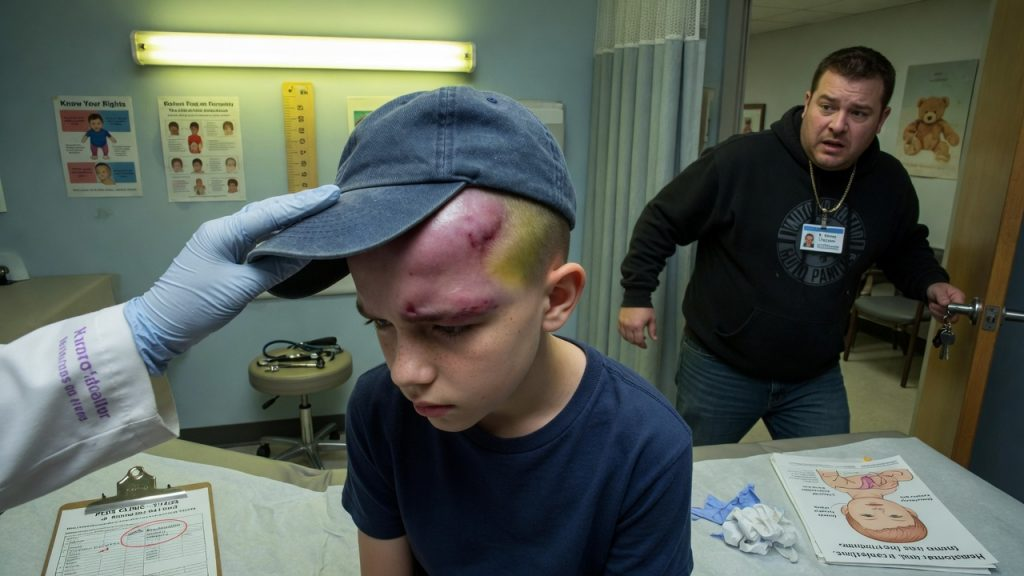
The moment my fingertips brushed the frayed edge of the seven-year-old’s Cincinnati Reds baseball cap, the air in Exam Room 3 seemed to instantly evaporate.
I didn’t even have to lift it all the way. Just a fraction of an inch.
Just enough to see the unnatural, purple-black bulge pushing against the boy’s hairline, radiating heat and an unspoken terror.
Behind me, the rhythmic tapping of a man’s work boot abruptly stopped.
I heard the sharp intake of breath.
Then, the distinct, frantic jingle of car keys, followed by the heavy scrape of a chair being pushed back as the boy’s stepfather suddenly realized the walls of his lies had just caved in.
He was making a break for the door.
But I am not the same nurse practitioner I was three years ago. I don’t freeze anymore.
My name is Sarah Evans. I’ve worked at the Oak Creek Pediatric Clinic for eight years. This clinic sits right on the fault line between a wealthy suburban enclave and a forgotten, rust-belt industrial park. We see everything here. We see the scraped knees of prep-school kids, and we see the quiet, malnourished children of parents working three factory shifts just to keep the heat on.
You learn to read the room before you ever look at a medical chart. You learn to read the silences.
And today, the silence coming from the little boy sitting on the crinkly paper of my exam table was deafening.
His chart said his name was Leo. Seven years old. Presenting complaint: “Flu symptoms, lethargy.”
But Leo didn’t look like a kid with the flu. He looked like a soldier trapped behind enemy lines.
He was small for his age, practically swallowed by an oversized gray hoodie. And then there was the hat. A faded red baseball cap, pulled down so low it practically rested on the bridge of his nose.
When I first walked into the room, he hadn’t even looked up. He just sat perfectly rigid, his small hands gripped tightly around his knees, staring at the linoleum floor as if trying to drill a hole through it with his mind.
Sitting in the corner chair, taking up entirely too much space, was Marcus.
Marcus was listed as the mother’s boyfriend, currently acting as the guardian for the visit.
On paper, Marcus looked like a stand-up guy. He was dressed in clean, high-vis construction gear. He had a rugged, easy-going smile that he flashed the moment I opened the door. He was handsome, in a rough, practiced way.
“Hey there, Doc,” he had said, standing up to offer a firm handshake. He smelled of cheap peppermint gum, heavily applied drugstore cologne, and underlying stale sweat. “Sorry to bring him in on a Friday afternoon. Kid’s just been under the weather. Mother’s working a double at the diner, so I stepped up to bat.”
“That’s no problem at all. That’s what we’re here for,” I had replied, forcing a polite smile.
But my instincts were already screaming.
It’s a specific kind of sixth sense you develop in pediatric care. You start to notice the microscopic details.
I noticed that Marcus answered every single question before Leo even had a chance to open his mouth.
I noticed the way Marcus’s eyes darted around the room, taking inventory of the medical equipment, the exits, the computer monitor.
And most importantly, I noticed that Marcus had a nervous tell. Whenever I asked a specific medical question, his right leg would bounce, and he would unconsciously jingle the heavy ring of keys clipped to his belt loop.
Jingle. Bounce. Smile.
It was a performance. And I have seen enough performances in my career to know that when an adult is trying this hard to be charming in a doctor’s office, they are usually hiding something terrible.
“So, Leo,” I said, rolling my stool a little closer to the exam table. I pitched my voice low, soft. The voice I use for frightened things. “Your stepdad says you haven’t been feeling well. Can you tell me what hurts?”
Leo didn’t move. He didn’t even blink. He just sat there, breathing shallowly.
“He’s got a sore throat,” Marcus chimed in immediately from the corner. Jingle. “And a fever. Been sleeping all day. You know how kids are. Probably picked up a bug at school. I keep telling his mom she needs to pump him full of Vitamin C, but you know women.” He chuckled, trying to draw me into his casual misogyny.
I didn’t laugh.
“Leo?” I asked again, completely ignoring Marcus. “Is your throat sore, buddy?”
Leo gave a microscopic nod.
“Okay. Can I take a listen to your heart and lungs?”
Another tiny, almost imperceptible nod.
I reached for my stethoscope. As I leaned in, I noticed it. The faint, yellowish-green fading edge of a bruise on his left wrist, peaking out just beneath the cuff of his oversized hoodie.
It wasn’t a playground bruise. Playgrounds leave scrapes on knees and elbows. They leave jagged marks.
This was a thumbprint.
A wave of cold nausea washed over me.
Three years ago, I missed a thumbprint. It was on the arm of a five-year-old girl named Maya. Her mother told me Maya had tripped on the stairs. I documented it, treated her ear infection, and sent them home. Three weeks later, Maya was in the ICU with a fractured skull. She survived, but the guilt of that miss is a permanent, heavy stone sitting at the bottom of my stomach.
It is my greatest weakness—the lingering trauma of that mistake. It makes me hyper-vigilant. It makes me overstep boundaries. It makes me suspicious of everyone.
But I will never, ever let a child walk out of my clinic in danger again. That is my vow.
I took a slow, deep breath, reigning in my spiking heart rate. I had to play this smart. If I accused Marcus outright, he would snatch the boy and run. I needed evidence. I needed to separate them.
“Well, his heart sounds strong,” I lied smoothly, pulling the stethoscope from my ears. “But I’m going to need to do a full workup. Maggie!” I called out toward the slightly cracked door.
Maggie appeared in the doorway almost instantly.
Maggie is my anchor in this clinic. She’s a veteran medical assistant who has been doing this longer than I’ve been alive. She has sharp, intelligent eyes, a cynical sense of humor, and a heart of absolute gold hidden beneath a gruff exterior. She knows every family in a ten-mile radius, knows all the local gossip, and possesses an uncanny ability to spot a lie from fifty paces.
And right beside her, limping happily into the room, was Barnaby.
Barnaby is Maggie’s three-legged rescue Golden Retriever. He’s the clinic’s unofficial therapy dog. He lost his leg to a car accident years ago, which makes him the perfect companion for scared kids. They see a dog who is broken but still smiling, and it immediately puts them at ease.
“You rang, boss?” Maggie asked, leaning against the doorframe. Her eyes swept the room, taking in Marcus, Leo, and me in one calculating glance. I saw the imperceptible tightening of her jaw. She felt it too. The bad energy.
“Yes. Leo here is feeling a bit under the weather. I was wondering if Barnaby might want to keep him company while I get his vitals?”
Barnaby didn’t wait for permission. He hobbled right over to the exam table, sat down heavily, and rested his large, soft chin gently on Leo’s dangling knee. He let out a low, empathetic whine.
For the first time since I walked into the room, Leo reacted.
His rigid posture broke, just a fraction. A small, trembling hand crept out from the sleeve of his hoodie and laid gently on Barnaby’s golden head. The dog leaned into the touch, his tail giving a soft thump, thump against the cabinets.
“Hey now, we don’t need the mutt,” Marcus said, his voice suddenly sharp, the charming facade slipping for a millisecond. He stood up. “Kid’s fine. Just give us a script for some antibiotics and we’ll get out of your hair.”
“I’m sorry, Marcus,” I said, my voice dripping with professional authority. “But standard protocol for these symptoms requires a full physical. Maggie, can you take Marcus out to the front desk to update Leo’s insurance forms? It seems our system crashed and lost the latest file.”
It was a blatant lie.
Maggie didn’t miss a beat. “Sure thing. Right this way, sir. Only take a minute.”
Marcus hesitated. He looked at me, then at Leo, then at the door. The keys on his hip jingled aggressively. He was calculating the risk of refusing. But he wanted to play the role of the cooperative, concerned stepdad.
“Fine,” Marcus muttered, his jaw clenched. He pointed a thick, calloused finger at Leo. “You be good for the doctor, you hear me? Don’t cause trouble.”
It sounded like advice. It felt like a threat.
Leo’s hand froze on Barnaby’s head. He shrank back into his hoodie.
As soon as Maggie led Marcus out and pulled the door shut with a solid click, the atmosphere in the room shifted. The oppressive weight lifted slightly, though Leo remained a tight ball of anxiety.
“It’s just us now, Leo,” I said softly, pulling my stool closer. “Just us and Barnaby. You know, Barnaby is a very good listener. And he loves keeping secrets.”
Leo kept his head down. The bill of the Cincinnati Reds cap completely obscured his eyes.
“Can you look at me, Leo?” I asked.
He slowly shook his head.
“Okay. That’s okay,” I murmured. I needed to move slowly. I needed to build trust in minutes, something that usually takes months. I reached over to my desk and picked up a glass jar.
It was filled with hundreds of mismatched buttons. Big plastic ones, tiny metal ones, glittery ones, plain ones. A former patient of mine, an autistic boy who struggled with severe anxiety, used to sort them by color to calm down. I kept them on my desk ever since.
I shook the jar gently. It made a pleasant, rain-like sound.
“Do you like to sort things, Leo?” I asked, unscrewing the lid and pouring a small pile of colorful buttons onto the crinkly paper next to him.
Leo’s eyes flicked down to the buttons. He didn’t speak, but his left hand—the one without the fading bruise—reached out. With painstaking precision, he separated a large red button from the pile. Then another.
“Red,” I observed quietly. “Like your hat.”
He nodded once.
“Are you a big baseball fan?”
Silence. He moved a blue button.
“Leo,” I said, dropping my voice to a whisper. “I’m a doctor. My whole job in the world is to make sure kids are safe. When you’re in this room, nothing bad can happen to you. Do you understand?”
He stopped sorting. His breathing hitched. Barnaby whined softly and nudged Leo’s leg with his wet nose.
“Does your throat really hurt?” I asked.
Slowly, agonizingly, Leo shook his head. No.
“Does something else hurt?”
He hesitated. A tear escaped from beneath the shadow of his cap, tracing a clean line through the dirt on his cheek, before dropping onto a yellow button.
He nodded. Yes.
“Can you show me where?”
Leo’s hand rose, trembling violently. He didn’t point to his stomach, or his arm, or his leg.
He pointed to his head. Right underneath the baseball cap.
My blood ran cold.
“Okay, sweetheart,” I said, keeping my voice steady even though my heart was hammering against my ribs. “I need to take a look, okay? I’m going to be very, very gentle.”
He cringed away, his shoulders hunching up to his ears. “He… he said I can’t take it off,” Leo whispered. His voice was raspy, unused, terrified. “He said he would… he would make me sleep outside again if anyone saw the bad haircut.”
The bad haircut.
The excuse. The lie they fed him to explain the cover-up.
“Marcus isn’t here,” I promised him, moving my stool closer. “And Marcus doesn’t get to make the rules in my room. You are safe here.”
I reached out slowly. I gave him every opportunity to pull away. I telegraphed my movements, keeping my hands visible.
My fingers brushed the frayed fabric of the cap. I felt the sweat-soaked band.
Gently, I lifted the brim.
I didn’t need to take the hat all the way off to see the horror underneath.
Right along his hairline, extending up into his scalp, was a massive, swollen contusion. It wasn’t just a bump. It was a fresh, angry injury. The skin was tight, glossy, and stained a horrific mixture of deep purple and sickly yellow.
But it wasn’t the swelling that made my breath catch in my throat.
It was the shape of it.
It wasn’t a round bump from falling against a wall. It had a distinct, rectangular outline. A geometric impression stamped brutally into the boy’s fragile skin.
It was the exact size and shape of a heavy, metal belt buckle.
In that split second, a barrage of medical knowledge and pure, primal rage flooded my brain. Subdural hematoma. Concussion. Traumatic brain injury.
This child wasn’t lethargic from the flu. He was lethargic because he had a serious head trauma. He was suffering from neurological suppression.
I carefully pulled the hat back down, not wanting to cause him any more pain.
“Leo,” I said, fighting to keep the tremor out of my voice. “You are incredibly brave. I am so proud of you for showing me that.”
Just then, the door handle rattled.
I spun around just as the door was pushed open. Marcus barged back in, Maggie trailing closely behind him with a stormy look on her face.
“Insurance is fine,” Marcus snapped, glaring at me. The charming facade was completely gone now. He looked agitated. He looked like a cornered animal. “We’re done here. Let’s go, Leo.”
He took a step toward the exam table.
Barnaby, the sweet, three-legged golden retriever who wouldn’t hurt a fly, suddenly stood up. The fur on his back rose. He let out a low, rumbling growl that vibrated through the small room, positioning his body directly between Marcus and the boy.
Marcus stopped, startled by the dog.
“Call off the mutt, Doc,” Marcus sneered. “We’re leaving.”
“Actually, Marcus,” I said, standing up. I didn’t step back. I stepped forward, placing myself right next to the exam table, shielding Leo with my body. “You’re not going anywhere. And neither is Leo.”
Marcus’s eyes narrowed. “What are you talking about? I’m his guardian. I say we leave.”
“You said he had flu symptoms,” I said, my voice ringing with a cold, hard authority I didn’t know I possessed. “But flu symptoms don’t cause massive, buckle-shaped hematomas on a child’s skull.”
The silence in the room was instantaneous and absolute.
Maggie gasped softly from the doorway.
I watched Marcus’s face. I watched the progression of emotions flicker across his features in real-time. First, shock. Then, a terrifying flash of violent rage. And finally, the cold, calculating panic of a coward who knows he’s been caught.
He didn’t look at Leo. He didn’t offer an excuse. He didn’t try to say he fell.
His eyes darted to the phone on the wall. Then to my computer. Then to the door, which Maggie was currently blocking.
His hand dropped to his side. The keys on his belt jingled.
He took a step backward.
“You’re crazy,” Marcus stammered, his voice lacking any conviction. “You don’t know what you’re talking about.”
“I am a mandated reporter,” I said, my voice raising, filling the room. “And I am officially detaining this child for emergency medical treatment and child protective services evaluation.”
Marcus looked at me. He looked at the determination in my eyes, the fierce stance of the dog, and the unyielding presence of Maggie in the doorway.
He realized he had lost control of the narrative.
He didn’t fight for the boy. He didn’t argue.
Instead, Marcus lunged.
Not toward me. Not toward Leo.
He lunged toward the doorway, shoving Maggie hard against the doorframe to clear his path.
“Hey!” Maggie shouted, stumbling but staying upright.
Marcus burst out into the clinic hallway. I heard his heavy work boots pounding against the linoleum. I heard the frantic, echoing jingle of his keys as he bolted for the emergency exit at the back of the building.
He was running.
The heavy metal door of the fire exit slammed open, triggering the harsh, blaring wail of the building’s security alarm. The sound tore through the quiet clinic, chaotic and deafening.
I didn’t run after him. I didn’t care about him right now.
I turned immediately back to the exam table.
Leo was curled into a tight fetal position on the paper, his hands clamped over his ears to block out the blaring alarm, his small body shaking violently. Barnaby was pressing himself against the boy’s side, whimpering in solidarity.
“Maggie!” I yelled over the alarm. “Call 911! Tell them we have a fleeing suspect, suspected child abuse. Then get me an ice pack, a neuro-kit, and call the pediatric ER at St. Jude’s. Tell them we have a Code Yellow incoming!”
Maggie didn’t hesitate. She was already on her radio, her voice crisp and professional despite the chaos. “On it, Sarah.”
I knelt down so I was eye-level with the terrified child. I reached out and gently laid my hand over his trembling ones.
“Leo,” I said, speaking clearly, making sure he could hear me over the wailing siren. “It’s over. He’s gone. He ran away.”
Leo peeked out from under his arms. His eyes were wide, flooded with a mixture of disbelief and utter terror.
“He… he’s coming back,” Leo sobbed. “He always comes back.”
“No,” I said fiercely, squeezing his little hand. “He is never coming back. I promise you. You are never going back to that house.”
As I looked into the broken eyes of this seven-year-old boy, I knew that the real fight hadn’t even begun. Marcus running away was just the start. Now, we had to find out where Leo’s mother was. We had to navigate the broken system of social services. We had to keep Marcus from retaliating.
But right now, in this room, with the alarm blaring and the therapy dog standing guard, I had done my job. I hadn’t missed the signs this time.
I gently reached up and, this time, I completely removed the battered Cincinnati Reds cap from his head.
“Let’s get you fixed up, Leo,” I whispered.
Chapter 2
The security alarm finally died, cut off mid-wail by Maggie’s frantic fingers at the front desk control panel.
The silence that rushed into Exam Room 3 to replace it was thick, heavy, and suffocating. It smelled of cheap peppermint cologne, rubbing alcohol, and the sharp, coppery scent of sheer terror.
I stayed on my knees in front of the exam table. My hands were still hovering near Leo, though I dared not touch him again without warning. The battered Cincinnati Reds cap lay discarded on the floor near the biohazard bin, a tragic little artifact of a child’s desperate attempt to hide the unforgivable.
Without the hat, the full extent of the brutality was laid bare beneath the harsh, fluorescent clinic lights.
The contusion along his hairline was grotesque. It was a massive, swollen plain of purple and black tissue, the skin stretched so taut it looked like it might split. The distinct, geometric outline of a heavy metal belt buckle was stamped into his flesh, a brand of ownership and rage. The surrounding skin was mottled with the sickly yellowish-green of older, healing bruises, telling a story of sustained, agonizing violence that had been going on long before today.
Leo was hyperventilating. His tiny chest heaved under the oversized gray hoodie. He had his arms wrapped tightly around his knees, making himself as small as humanly possible, instinctively protecting his vital organs.
“Leo,” I whispered, keeping my voice as level and steady as a flatline. Inside, my heart was a runaway freight train. “I need you to breathe with me, buddy. Can you do that? In through the nose. Out through the mouth.”
He didn’t look up. His eyes remained fixed blindly on the linoleum floor.
Beside him, Barnaby shifted. The three-legged golden retriever let out a sound that was half-whine, half-growl, entirely directed at the empty doorway where Marcus had fled. Then, the dog turned his massive, blocky head back to Leo. Barnaby didn’t ask for permission. He simply rested his heavy jaw squarely on Leo’s trembling thigh, offering the solid, immovable weight of his presence.
Leo let out a broken, ragged sob. His small, pale hand reached out and buried itself in the thick, golden fur behind Barnaby’s ears. The dog leaned into the grip, a silent guardian anchoring the boy to the earth.
“Maggie!” I called out, not turning my head.
“Right here,” Maggie’s voice came from the doorway, breathless but steel-edged. She stepped into the room, her arms loaded with a pediatric trauma kit, two instant ice packs, and a clipboard. “Cops are three minutes out. Paramedics are right behind them. ER at St. Jude’s is on standby for a pediatric head trauma.”
Maggie looked past me to the boy. I saw her sharp, cynical eyes land on the buckle-shaped contusion.
For a fraction of a second, the hardened medical assistant—a woman who had seen gunshot wounds, horrific car wrecks, and the worst of human nature in this rust-belt town—faltered. Her face drained of color. She swallowed hard, her jaw clicking shut.
“Jesus, Mary, and Joseph,” she breathed, almost too quiet to hear. Then, the professional armor slammed back into place. She stepped forward, cracking an instant ice pack, the chemical pop loud in the quiet room.
“We need to get the swelling down,” I said, rising slowly from the floor. “He’s showing signs of lethargy and neurological suppression. I’m worried about a subdural bleed.”
“I’ve got the vitals monitor,” Maggie said, moving with practiced efficiency. She approached Leo with the slow, deliberate movements one uses with a wild, cornered animal. “Hey there, tough guy. I’m Maggie. I’m going to put this cold pack on your head, okay? It’s going to feel like a winter snowball.”
Leo flinched violently as the cold plastic touched the edge of the swelling, letting out a sharp cry.
“I know, honey, I know it hurts,” Maggie murmured, her voice dripping with a maternal ache. She held the pack gently in place, using her other hand to slip a pediatric pulse oximeter onto his index finger. “Barnaby, you hold him steady, okay?”
The dog thumped his tail once against the cabinets.
I grabbed my penlight from my pocket. “Leo, I need to shine a bright light in your eyes for just a second. I need to check your pupils.”
It was a struggle to get him to look up, but when he finally did, the fear in his wide, hazel eyes nearly broke me in half. I flicked the light across his retinas.
Right pupil, sluggish but reactive. Left pupil… blown. Dilated and slow to respond.
Ice water flooded my veins.
“Maggie, what’s his pulse ox?” I asked, my voice tight.
“Eighty-nine percent and dropping,” she read from the glowing red numbers on the monitor. “Heart rate is one-forty. He’s tachycardic.”
“He’s decompensating,” I said. The lethargy Marcus had dismissed as the flu was the boy’s brain swelling inside his skull, pressing against his cognitive functions. “Where the hell is that ambulance?”
As if on cue, the heavy wail of sirens cut through the afternoon air outside the clinic, growing rapidly louder until they died abruptly in our parking lot. Tires screeched. Doors slammed.
A moment later, the clinic doors burst open. Heavy boots pounded down the hallway.
“In here!” I shouted.
Dave pushed through the exam room door, a massive oxygen bag slung over his shoulder. Dave was a veteran paramedic, a guy who had been pulling bodies out of the wreckage of this county for twenty years. He had salt-and-pepper hair, a permanent slouch from a bad back, and the weary, deeply lined face of a man who had seen too much. But beneath the exhaustion was a razor-sharp intellect and a surprisingly gentle soul. He always carried cherry lollipops in his breast pocket for the kids.
His partner, a younger EMT carrying the backboard and collar, squeezed in behind him.
“Talk to me, Sarah,” Dave commanded, dropping the heavy bag to the floor with a thud. His eyes swept the room, taking in me, Maggie, the dog, and finally, the boy on the table.
“Seven-year-old male. Presenting with severe blunt force trauma to the cranium,” I rattled off rapidly. “Suspected abuse. The guardian fled the scene on foot when confronted. Patient has a massive hematoma, left pupil is blown, oxygen saturation is dropping, and he’s showing signs of severe neurological suppression.”
Dave didn’t waste time with pleasantries or shock. He stepped up to the table.
“Hey, buddy. I’m Dave,” he said, his voice a low, gravelly rumble that was instantly calming. “We’re going to give you a little oxygen, okay? Give your brain a little boost.”
He pulled a pediatric non-rebreather mask from his bag. Leo thrashed backward, terrified of the plastic contraption coming toward his face. He pressed himself against the wall, his hands flying up to protect his face.
“No, no, no,” Leo whimpered, his voice reedy and weak.
“Whoa, okay, slow down,” Dave said, immediately pulling the mask back. He looked at me, then down at Barnaby, who was still pressing his body against the boy’s leg. Dave let out a heavy sigh, running a hand through his graying hair. He reached into his breast pocket, pulled out a cherry lollipop, and set it carefully on the edge of the exam table.
“Look, Leo,” Dave said softly. “I’m not gonna force you. But your brain needs some air. How about we just hold it near your face? Just like a cool breeze.”
Leo looked at the lollipop, then at Dave, then at Barnaby. Slowly, agonizingly, he lowered his hands.
“Maggie, grab the portable O2 tank,” Dave instructed without taking his eyes off the boy. “Sarah, you’re riding with us.”
“I am?” I asked, startled. Clinic protocol usually meant I handed the patient off and stayed to deal with the police and the paperwork.
“Yeah, you are,” Dave said firmly, locking eyes with me. “He’s terrified. You and this dog are the only things keeping him from a full-blown panic attack, which will spike his intracranial pressure and kill him. Grab the dog. You’re both in the rig.”
Maggie didn’t argue. She unclipped Barnaby’s leash from the wall hook and handed it to me. “I’ll handle the cops. I’ll print the charts. Go.”
We moved as a synchronized unit. Dave and his partner carefully secured a cervical collar around Leo’s small neck, a process that made the boy cry out in fresh terror. They transferred him to the stretcher. Barnaby trotted faithfully beside the wheels, his limp pronounced but his focus entirely on the crying child.
We burst out of the clinic and into the blinding Friday afternoon sunlight. The flashing red and blue lights of the ambulance washed over the cracked pavement of the parking lot. Two police cruisers were already pulling in, kicking up dust.
We loaded Leo into the back of the rig. I climbed in after him, pulling Barnaby up with me. The dog immediately curled up beneath the stretcher, resting his chin on my sneaker. Dave slammed the back doors shut, plunging us into the claustrophobic, brilliantly lit interior of the ambulance.
“Drive!” Dave yelled to his partner through the cab window. “Lights and sirens. Smooth and fast. St. Jude’s.”
The ambulance lurched forward, the siren screaming to life.
I sat on the narrow bench seat, my knees pressed against the metal rails of Leo’s stretcher. I reached through the bars and took his small, cold hand in mine.
“You’re doing great, Leo,” I told him, raising my voice to be heard over the siren and the rattle of medical equipment. “We’re going to a big hospital. They have doctors there who are going to make your head stop hurting.”
Leo’s eyes were half-closed now. The lethargy was winning. The blown pupil was a screaming alarm bell in my medical brain. Blood was pooling inside his skull, crushing delicate brain tissue. Every minute that ticked by was a roll of the dice against permanent brain damage, or worse.
Maya.
The name echoed in the metal box of the ambulance, unbidden and agonizing.
Three years ago, Maya had sat on my exam table. She had a bruise shaped like a thumbprint on her bicep. She had an ear infection. Her mother, a sweet-talking, exhausted-looking woman, said Maya had tripped on the playground stairs and she had grabbed her arm to stop the fall.
I had believed her. I had wanted to believe her because believing her meant I didn’t have to navigate the nightmare of the foster care system. It meant I didn’t have to ruin a family. I treated the ear infection. I gave them a sticker. I sent them home.
Three weeks later, Maya arrived at St. Jude’s in the back of an ambulance just like this one. She was in a coma. Her mother’s boyfriend had thrown her against a wall. The skull fracture was catastrophic. She survived, but she would never walk or speak normally again.
I carry Maya’s chart in my mind every single day. I carry her ghost in every room I enter. It’s a heavy, jagged stone in my chest that makes me a difficult colleague, an overbearing practitioner, and a miserable date.
But looking down at Leo’s fading face, feeling the faint, rapid flutter of his pulse beneath my thumb, I knew I would carry a thousand heavy stones if it meant this boy lived to see tomorrow.
“Pressure’s dropping,” Dave called out from his seat near Leo’s head. He was squeezing a bag-valve mask, manually breathing for the boy as Leo’s own respiratory drive began to fail. “Sarah, get a line in him. We need fluids, now.”
I grabbed an IV kit from the wall. The ambulance swayed sharply as we took a hard corner, throwing me against the cabinets. Barnaby whined, shifting his weight to brace against my leg.
“Hold him steady, Dave,” I said, snapping a tourniquet around Leo’s frail, bruised arm. Finding a vein in a dehydrated, tachycardic child while hurtling down a pothole-ridden avenue at seventy miles an hour is a nightmare.
I took a breath, letting the chaotic noise of the rig fade into the background. I felt for the spongy bounce of a vein.
“Got it,” I muttered, sliding the needle in. A flash of dark blood confirmed the placement. I secured it with tape and hooked up a bag of saline, opening the valve wide.
“Three minutes out,” the driver yelled from the front.
Leo’s hand twitched in mine. His eyes fluttered open, glassy and unfocused. He looked past me, staring at the bright fluorescent light on the ceiling of the rig.
“Mom?” he whispered, his voice a dry, desperate rasp.
The word hit me like a physical blow.
“We’re going to call her, Leo,” I promised, leaning in close. “We’re going to find her.”
“Don’t tell him,” Leo mumbled, his eyes sliding shut again. “Please don’t tell him about the hat. He’ll get so mad.”
“He’s never going to hurt you again,” I said, my voice thick with a sudden, violent emotion. “I swear to God, Leo. He’s done.”
The ambulance slammed on the brakes, throwing us all forward. We had arrived.
The back doors flew open before we even fully stopped, revealing the chaotic, brightly lit loading bay of St. Jude’s Pediatric Emergency Department.
A trauma team was already waiting.
“Let’s move, let’s move!” a voice barked.
I jumped out, pulling Barnaby with me, as Dave and the nurses grabbed the stretcher and practically sprinted through the automatic sliding doors into Trauma Room 1.
Waiting for us at the head of the bed was Dr. Aris Thorne.
Dr. Thorne was a legend at St. Jude’s, though not always for the right reasons. He was a brilliant pediatric emergency attending, a man who possessed an almost terrifying diagnostic intuition. But he was also notoriously abrasive, chronically sleep-deprived, and openly despised hospital administration, insurance companies, and any parent who endangered a child. He was tall, gaunt, and always seemed to be vibrating with excess, nervous energy.
Right now, he was clicking a metallic silver pen repeatedly, his dark, shadowed eyes fixed on the incoming stretcher.
“Talk to me,” Dr. Thorne demanded, his voice cutting through the noise of the trauma room like a scalpel.
“Seven-year-old male, blunt force trauma to the head, massive subdural hematoma likely,” I reported, stepping back to let the trauma nurses swarm the boy. “Left pupil is blown. GCS is dropping rapidly. He’s bradycardic and his breathing is shallow.”
Thorne didn’t look at me. He leaned over Leo, his long fingers gently probing the edges of the buckle-shaped contusion.
“Intubate him. Now,” Thorne ordered, abandoning the clicking pen. He moved with sudden, blinding speed. “Get him on a vent. I want a stat CT scan, full body skeletal survey, and get neurosurgery down here five minutes ago! Call Dr. Patel. Tell her I have a head that needs opening.”
The room exploded into organized chaos. Nurses barked orders. Monitors beeped wildly. Scissors cut away the oversized gray hoodie, revealing a torso mapped with fading yellow and green bruises.
“Who’s the guardian?” Thorne snapped, finally looking at me.
“Mother’s boyfriend,” I said. “He fled the clinic when I confronted him. Police are looking for him.”
Thorne’s jaw clenched. A muscle ticked near his temple. He looked down at the bruised, broken body of the small boy.
“Coward,” Thorne muttered, the word laced with pure venom. He looked back up at me, noticing Barnaby sitting quietly at my side for the first time. “What the hell is the dog doing in my trauma bay?”
“He’s a therapy dog from my clinic,” I said, lifting my chin, ready for a fight. “He’s the only thing keeping this kid anchored. I’m not leaving, and neither is the dog.”
Thorne stared at me for a long, heavy second. He looked at my face, read the absolute refusal to back down, and then looked at Barnaby, who gave a single, respectful tail thump.
“Fine,” Thorne growled, turning back to the monitors. “Just keep him out of the sterile field. Let’s move him to CT! Go, go, go!”
They unhooked Leo from the wall monitors and began to roll the bed out of the room. I followed closely behind, Barnaby sticking to my leg like glue.
The journey to the CT scanner felt like a march to the gallows. The long, sterile white hallways of the hospital were a stark contrast to the gritty reality of the streets outside. We were in the wealthy wing of the county now, a place of gleaming machines and pristine floors, far removed from the crumbling industrial parks where Marcus and Leo lived.
We waited in the lead-lined control room while Leo was rolled into the massive, donut-shaped scanner.
Through the thick glass, he looked impossibly small. The breathing tube taped to his mouth was a violent intrusion.
Dr. Thorne stood next to the radiologist, his arms crossed over his chest, his pen clicking furiously again. Click. Click. Click.
The first images flashed onto the glowing screens.
Even from ten feet away, my heart sank.
I didn’t need to be a radiologist to read the scan. The bright, crescent-shaped wash of white spreading across the left hemisphere of Leo’s brain was a massive bleed. It was a subdural hematoma, and it was pushing the midline of his brain terrifyingly far to the right.
“Damn it,” Thorne swore softly, the clicking of his pen stopping instantly. He leaned closer to the monitor. “He’s herniating. The pressure is crushing his brainstem.”
He hit a button on the wall intercom. “Patel! Where are you?”
“Getting scrubbed in, Aris. I see the scans,” a calm, female voice crackled back over the speaker. “Bring him straight to OR 4. We need to drill burr holes and evacuate that clot immediately, or he’s not going to wake up.”
“Moving now,” Thorne said.
They pulled Leo out of the scanner. As they rushed him past me toward the elevators that led to the surgical floor, I reached out and let my fingers brush against his small, cold hand one last time.
“Fight, Leo,” I whispered into the chaotic rush of air. “Please fight.”
The elevator doors closed, swallowing him, Dr. Thorne, and the trauma team.
Suddenly, I was alone in the quiet hallway outside Radiology. Just me and Barnaby.
The adrenaline that had been keeping me upright for the last hour suddenly evaporated, leaving behind a hollow, trembling exhaustion. My knees gave out. I slid down the cool tiled wall until I was sitting on the floor, pulling my knees to my chest.
Barnaby lay down beside me, resting his chin heavily on my lap. I buried my face in his golden neck and let out a single, shuddering breath.
I didn’t have time to cry.
“Excuse me? Are you Sarah Evans?”
I looked up.
Standing in the hallway was a woman holding a battered leather briefcase and a man in a police uniform.
The woman was in her late forties, wearing a sensible, wrinkled beige trench coat over a faded floral dress. She had the tired, heavily lined face of a woman who had spent her entire career wading through the darkest, ugliest parts of humanity. She was carrying a massive, overstuffed tote bag from which the edge of a manila file and a half-eaten granola bar were protruding.
“I’m Helen Vance,” she said, her voice dry and raspy, like she had smoked a pack of cigarettes before breakfast. “Child Protective Services. This is Officer Miller. We got a call about a Code Yellow from Oak Creek Clinic.”
Officer Miller, a young, fresh-faced rookie who looked like he hadn’t started shaving yet, shifted uncomfortably in his uniform. He held a small notepad, clicking his pen nervously—a stark contrast to Dr. Thorne’s angry clicking.
I pushed myself off the floor, dusting off my scrubs. Barnaby stood up with me, placing himself slightly in front of my legs.
“Yes,” I said, my professional mask sliding back into place, though my voice still shook slightly. “I’m the referring nurse practitioner. The patient is Leo. Seven years old.”
“Where is the child now?” Helen Vance asked, pulling a crumpled notepad from her tote bag.
“He’s in emergency neurosurgery,” I said bluntly. “He has a massive subdural bleed caused by blunt force trauma to the skull. He is currently fighting for his life.”
Officer Miller winced, his face paling slightly.
Helen Vance didn’t even blink. She just wrote it down. It was a terrifying testament to what she saw every single day.
“And the alleged abuser?” she asked without looking up.
“Marcus,” I said. “I don’t know his last name. He’s the mother’s boyfriend. He fled the clinic when I confronted him about the head injury. Maggie, my medical assistant, has the clinic surveillance footage for the police.”
“We’ve got units at the clinic and units dispatched to their listed address,” Officer Miller chimed in, trying to sound authoritative. “He won’t get far on foot.”
“He’s not stupid,” I said, a cold anger rising in my chest. “He took his keys. He has a truck. You need to put out an APB.”
“We’re handling the law enforcement side, Ms. Evans,” Miller said, slightly defensive.
“Where is the mother?” Helen Vance interrupted, cutting through the tension. “Chloe Jenkins. She wasn’t at the clinic?”
“Marcus said she was working a double shift at a diner,” I replied. “I don’t know which one.”
“It’s Rosie’s Diner out on Route 9,” Helen said, flipping a page in her notepad. “I recognized the family name when the call came in. I’ve had dealings with Chloe Jenkins before. An older daughter was placed in foster care five years ago. Different father. Chloe has a history of bad choices and looking the other way.”
The casual dismissal in Helen’s voice ignited a spark of fury in my gut.
“She is a victim too,” I snapped, taking a step toward the CPS worker. “Do not write her off before you even speak to her. Marcus is violent. He terrified that little boy into silence. God knows what he’s done to her.”
Helen Vance finally looked up from her notepad. She looked at me with a profound, bone-deep exhaustion.
“Ms. Evans,” Helen said slowly. “I appreciate your passion. Truly, I do. We need more people who care. But in my line of work, ‘looking the other way’ is a form of abuse. If she knew about that buckle mark and let him put that hat on the boy to hide it, she goes down with Marcus.”
“She might not have known,” I argued, though a cold dread pooled in my stomach. Could a mother really miss a massive, skull-crushing injury on her own child?
“We’ll find out,” Helen said pragmatically. “Officer Miller has dispatched a cruiser to the diner to pick her up. She should be arriving any minute.”
As if summoned by the words, the heavy double doors at the end of the long hallway burst open.
A woman ran through them, frantic, wild-eyed, and gasping for air.
She was thin, almost dangerously so, her blonde hair pulled back in a messy, grease-stained ponytail. She was still wearing a pale pink diner uniform, a stained white apron tied tightly around her waist. Her hands were covered in flour and dishwater, and she was clutching a crumpled tissue.
“Where is he?” she screamed, her voice echoing shrilly off the sterile hospital walls. “Where is my baby? Where is Leo?”
It was Chloe.
She spotted the police uniform on Officer Miller and sprinted toward us.
“Are you the police? Did you bring him here?” Chloe demanded, grabbing Miller’s arm with desperate strength. “A cop came to the diner. He said Leo was hurt. He said Marcus ran away. Where is my son?”
Officer Miller gently but firmly detached her hands from his uniform. “Ma’am, you need to calm down.”
“Calm down? My son is in the hospital!” she sobbed, looking wildly between the three of us. Her eyes landed on me, taking in my scrubs. “Are you his doctor? Please. Tell me he’s okay. Marcus said he just had the flu. He promised me he was just taking him to get some antibiotics.”
I looked at Chloe Jenkins. I looked at the dark circles under her eyes, the sheer exhaustion etched into her young face, and the terrified, desperate plea in her voice.
Part of me wanted to unleash my fury on her. Part of me wanted to grab her by her stained apron and scream, How could you not know? How could you let that monster into your home?
But another part of me—the part that had sat on the floor with Barnaby just minutes ago—saw a woman who was drowning in a life she couldn’t control, tethered to a man who was pulling her under.
“Chloe,” I said softly, stepping forward. Barnaby moved with me, his presence a calming anchor in the chaotic hallway. “My name is Sarah. I’m the nurse practitioner from the clinic. Leo is in surgery right now.”
Chloe stopped breathing. The color drained completely from her face. She swayed on her feet, looking like she might collapse.
“Surgery?” she whispered, the word barely escaping her lips. “For the flu?”
“He didn’t have the flu, Chloe,” I said, holding her gaze steadily. I needed to see her reaction. I needed to know the truth. “He has a massive bleed in his brain. It was caused by severe blunt force trauma to the head.”
Chloe stared at me. Her mouth opened, but no sound came out.
“Someone hit him, Chloe,” Helen Vance stepped in, her voice devoid of empathy, cutting straight to the brutal facts. “Someone hit him very, very hard with a heavy metal belt buckle. It left an imprint on his skull. Did you know about this?”
Chloe’s eyes widened to impossible proportions. She took a staggering step backward, shaking her head violently.
“No,” she gasped, her hands flying up to cover her mouth. “No, no, no. He… he told me he fell off his bike. He said he hit his head on the curb. He said it was just a bump.”
“A bump?” I asked, my voice tightening. “Chloe, his entire forehead was purple. His skin was splitting.”
“I didn’t see it!” she screamed, tears finally spilling over her cheeks, cutting tracks through the flour and grease. “He wouldn’t take his hat off! Marcus told him to leave the hat on because… because he gave him a bad haircut and he was embarrassed. I was working a double yesterday. I barely saw him this morning before I left. Marcus said he would handle it. He said he would take care of him.”
She collapsed against the wall, sliding down exactly as I had done minutes earlier, burying her face in her hands. Deep, agonizing sobs ripped through her thin frame.
“He promised me,” she wailed into her hands. “He promised me he wouldn’t hit him anymore.”
The words hung in the air, a damning confession that sucked the oxygen from the hallway.
Anymore.
Helen Vance’s pen stopped scratching against her notepad. She looked up, her tired eyes suddenly sharp and predatory.
“Anymore?” Helen repeated quietly.
Officer Miller’s hand instinctively drifted toward his utility belt.
I felt a cold shiver run down my spine. The truth was out. The dam had broken.
Chloe looked up from her hands, realizing what she had just admitted. The terror in her eyes deepened, shifting from fear for her son to fear for herself.
Before anyone could say another word, the heavy double doors at the end of the hallway burst open again.
But it wasn’t a doctor. And it wasn’t the police.
Standing in the doorway, chest heaving, his high-vis jacket torn, and his eyes burning with a cornered, violent desperation, was Marcus.
And in his right hand, he was holding a heavy, steel tire iron.
Chapter 3
The heavy hospital doors slammed against the walls with a deafening crack, the sound echoing down the sterile corridor like a gunshot.
Marcus stood in the threshold. He was a terrifying portrait of cornered desperation. His high-vis jacket was torn at the shoulder, revealing a dark, tribal tattoo underneath. His face was flushed a violent, mottled red, slick with sweat and grease. His chest heaved with ragged, heavy breaths.
But it was his eyes that froze the blood in my veins. They were wide, wild, and entirely devoid of reason. He had crossed the invisible line between a man trying to hide his sins and a predator backed into a corner, ready to tear apart anything in its path.
In his right hand, gripped so tightly his knuckles were bone-white, was a heavy, rusted steel tire iron.
“Marcus!” Chloe shrieked, the sound tearing from her throat—a primal, terrified noise that seemed to vibrate in the floorboards. She scrambled backward, her hands slipping on the polished linoleum, trying to put distance between herself and the man she lived with.
“Shut your mouth, Chloe!” Marcus roared, his voice cracking with exertion and rage. He took a heavy, menacing step into the hallway. “You stupid, useless bitch! You led them right to me!”
Time seemed to instantly fracture, slowing down to a molasses-thick crawl.
Officer Miller, the young, fresh-faced rookie who just minutes ago had looked like a kid playing dress-up in a police uniform, suddenly transformed. The nervous clicking of his pen stopped. Training kicked in.
“Drop the weapon!” Miller shouted, his voice dropping an octave, ringing with sudden, booming authority. He dropped into a wide, stable stance, his hand sweeping back to his duty belt. In one fluid, practiced motion, he unholstered his Glock 19, pointing it squarely at Marcus’s chest. “I said drop it! Now!”
Marcus didn’t even flinch at the sight of the gun. He was too far gone, blinded by the adrenaline and the catastrophic collapse of his world.
“You think you can take him from me?” Marcus spat, swinging the tire iron in a short, vicious arc that sliced through the air with a terrifying whoosh. He locked his manic gaze on me. “You think you can just step into my life and take what’s mine, you stuck-up clinic bitch? I’m his father!”
“You are nothing to him!” I yelled back. The words tore out of me before I could stop them. I wasn’t acting like a medical professional anymore. I was acting like a human being standing between a monster and the child he had broken. I stepped in front of Chloe, shielding her trembling body with my own.
Beside me, Barnaby reacted. The three-legged golden retriever didn’t cower. He didn’t run. He planted his one front paw firmly on the tile, bared his teeth, and unleashed a continuous, deep-chested, guttural snarl that sounded like a revving chainsaw. It was a terrifying sound coming from a dog known for licking the tears off children’s faces.
“Shoot him!” Helen Vance yelled, her raspy voice sharp and urgent. The CPS worker hadn’t moved an inch. She stood her ground, her hand gripping the handle of her battered leather briefcase like a shield. “Miller, he’s advancing!”
“Marcus, I swear to God, take one more step and I will put you on the ground!” Miller warned, his finger tightening on the trigger. I could see a bead of sweat tracing the line of the young officer’s jaw. He didn’t want to shoot. He was a kid from the suburbs who probably wrote speeding tickets all day. He had never taken a life.
Marcus saw the hesitation. He smelled the fear.
“He’s my kid!” Marcus bellowed, and he lunged.
He didn’t come for me. He bypassed Miller entirely. He lunged directly at Chloe, raising the heavy steel tire iron high above his head, aiming to crush the one person who could testify to his daily atrocities.
“No!” I screamed, throwing my arms back to push Chloe to the floor.
BANG.
The sound was absolute, catastrophic violence in the enclosed space. It deafened me, leaving a high-pitched ringing ringing in my ears.
But it wasn’t a gunshot.
Before Miller could pull the trigger, a massive blur of dark blue uniform slammed into Marcus from the side.
It was Hank, the hospital’s head of security. I knew Hank. He was a retired Marine, a man in his late fifties with a bad left knee, a gentle smile, and an uncanny ability to de-escalate screaming psych patients without ever raising his voice. He had been a medic in Fallujah. He possessed the quiet, terrifying competence of a man who had survived hell.
Hank had sprinted down the cross-corridor and hit Marcus with the force of a runaway freight train.
The two men crashed into the drywall with a sickening crunch. The tire iron flew from Marcus’s hand, clattering noisily across the tiles and sliding all the way to my feet.
Marcus roared, twisting his body, trying to throw a wild punch at the security guard’s head.
But Hank was already moving. He pinned Marcus’s arm against the wall with his knee, ignoring the obvious pain it caused him, and wrapped his thick forearm around Marcus’s throat.
“Settle down, son,” Hank growled, his voice deathly calm, in stark contrast to the chaos. “Or I’m gonna put you to sleep right here on the floor.”
Officer Miller was there a second later, his gun holstered, ripping his heavy metal handcuffs from his belt.
“Give me his other arm!” Miller yelled, grabbing Marcus’s wrist and twisting it violently behind his back.
Marcus fought like a rabid animal. He thrashed, cursed, and kicked, his heavy work boots leaving black scuff marks all over the pristine hospital walls. He spit a mouthful of blood and saliva onto the floor.
“You’re dead!” Marcus screamed, his face pressed painfully against the drywall. He locked his crazed eyes on Chloe, who was sobbing uncontrollably on the floor behind me. “You hear me, Chloe?! You’re dead! I’m gonna kill you and I’m gonna finish the job on that little bastard!”
The words hung in the air, a chilling, undeniable confession broadcasted to a hallway full of witnesses.
Finish the job.
“That’s enough out of you,” Miller snapped, finally clicking the steel cuffs shut around Marcus’s wrists.
With Hank’s help, they dragged Marcus to his feet. He was still struggling, still screaming obscenities, but the fight was effectively over. Two more hospital security guards and three heavily armed city police officers burst through the double doors, weapons drawn, completely swarming the area.
“We got him! Suspect is in custody!” Miller yelled over the din, out of breath, his uniform rumpled.
They practically carried Marcus down the hallway, dragging him toward the elevators. His screams faded into a muffled echo, until finally, the heavy doors slid shut, and he was gone.
The silence that rushed in to replace him was terrifying.
The adrenaline crash hit me like a physical blow to the chest. My knees turned to water. I braced my hand against the wall to keep from collapsing. Barnaby immediately pressed his heavy body against my leg, whimpering softly, his protective fury melting back into pure, anxious empathy.
I looked down.
Chloe was curled into a tight ball on the floor, her face buried in her grease-stained apron, rocking back and forth. She was hyperventilating, emitting short, jagged gasps that sounded like a dying bird.
Helen Vance stepped forward. The CPS worker casually nudged the heavy steel tire iron out of the way with the toe of her sensible shoe. She looked down at Chloe, her expression unreadable.
“Ms. Evans,” Helen said to me, her raspy voice completely devoid of the panic we had all just experienced. “Is there a private consultation room nearby? We need to get her off the floor. And I need to do my job.”
I nodded numbly, pointing down the hall. “Room 4. Just past the vending machines.”
“Come on, Chloe,” Helen said. She didn’t offer a hand. She didn’t offer a comforting touch. She simply delivered an undeniable command. “Get up. We have a lot to talk about.”
It took ten minutes to get Chloe into the small, windowless consultation room. The room was designed for doctors to deliver bad news to families. It had a small round table, a box of tissues, and cheap, uncomfortable chairs.
I sat next to Chloe. Barnaby laid his head on her feet.
Helen Vance sat across the table, pulling a fresh legal pad from her massive tote bag. She set a small, black digital voice recorder on the table between them and pressed the red button.
“This is Helen Vance, Child Protective Services, interviewing Chloe Jenkins regarding case file 884-B. Present is Sarah Evans, Nurse Practitioner. Date and time are noted.” Helen looked up, her tired eyes locking onto Chloe’s ruined face. “Chloe, you understand you are not under arrest at this exact moment, but anything you say is being recorded for an official investigation into the severe physical abuse of your son, Leo.”
Chloe nodded weakly. She looked destroyed. The adrenaline had left her hollowed out, nothing but a shell of flour, cheap pink fabric, and terror.
“Let’s go back to what you said in the hallway before Marcus arrived,” Helen began, her voice methodical, a surgeon making the first cut. “You said, ‘He promised me he wouldn’t hit him anymore.’ I need you to explain the word anymore.”
Chloe squeezed her eyes shut. Fresh tears leaked out, tracking through the dirt on her face. “I… I can’t. If he finds out I talked…”
“Marcus is going to a concrete cell, Chloe,” Helen interrupted flatly. “He assaulted a police officer. He assaulted hospital security. And he admitted to attempting murder in front of six witnesses. He is never coming back to your house. But you are sitting on a knife’s edge. Your son is having his skull drilled open right now because of a man you let into his bedroom. If you want any chance of ever seeing your boy again, you will tell me everything. Start from the beginning.”
It was brutal. It was unfeeling. And it was exactly what Chloe needed to hear to break the final seal on her silence.
The story poured out of her in broken, fragmented, agonizing pieces.
She had met Marcus a year ago. He was charming at first. He had a good job in construction, he bought her groceries when she was struggling to make rent, and he played catch with Leo. He felt like a lifeboat for a single mother drowning in debt.
“But then he lost his job,” Chloe whispered, twisting her apron strings around her raw, red fingers. “He hurt his back. They let him go. He started drinking. Cheap vodka. Just a little at first, then all day. He stopped looking for work. He took my debit card.”
“When did the violence start?” I asked gently, unable to keep quiet.
“Six months ago,” Chloe choked out. “Just… small things at first. Shoving him. Calling him names. Marcus hated how much Leo looked like his real dad. He said Leo was soft. He said he needed to be toughened up.”
I felt sick. The familiar, crushing weight of the ‘Maya’ stone in my chest grew heavier. I knew this script. I knew every terrible, predictable line of it.
“Why didn’t you leave?” Helen asked. It wasn’t a judgment; it was an evidentiary question.
“I tried!” Chloe cried out, slamming her hands on the table. “I packed a bag three months ago while he was passed out. We made it to the bus station. But my card was declined. He had drained the account. I had twelve dollars. Where was I supposed to go? The shelters were full. He found us sitting on a bench. He dragged me into the truck by my hair.”
She looked at me, pleading for understanding. “He told me if I ever tried to run again, or if I told the cops, he would call CPS himself. He knew about my older daughter, Hailey. She got taken away when I was nineteen, living with a junkie. Marcus said he would tell them I was back on drugs. He said they would put Leo in the system, in a group home, and I would never see him again. He said it was better to be with him than to let Leo be destroyed by the system.”
“So you let him use your child as a punching bag to avoid a foster home,” Helen summarized, her pen scratching relentlessly across the paper.
“He promised it was just discipline!” Chloe sobbed. “I worked doubles so I wouldn’t have to be there. I paid the rent so he wouldn’t get angry. I thought if I just kept the lights on and the fridge full, he would leave Leo alone.”
“And the buckle mark?” I asked, my voice tight, forcing myself to ask the hardest question. “The head injury. When did that happen?”
“Thursday night,” Chloe whispered, her gaze dropping to the floor. “I came home late. Marcus was drunk. Leo was crying in his room. Marcus said Leo knocked over his beer. He said he ‘gave him a swat’ to teach him a lesson. When I tried to check on him, Marcus shoved me against the wall. He told me he cut Leo’s hair as a punishment and it looked awful, so he made him wear the hat. He told me not to look at it, or he’d give me a matching mark.”
She looked up, her hazel eyes—Leo’s eyes—wide with an agony that transcends physical pain. “I was a coward. I am a coward. I just wanted to survive.”
Silence stretched in the small room, thick and suffocating.
I looked at Chloe, and the fury I had felt earlier dissolved into a complex, bitter tragedy. She wasn’t an evil woman. She was deeply flawed, chronically terrified, and broken by a system that preys on the poor. She had made impossible, horrific choices in the name of survival, and her son had paid the ultimate price.
Before Helen could ask another question, a sharp knock on the door startled us all.
The door opened slowly.
Standing in the doorway was Dr. Aris Thorne.
The brilliant, abrasive pediatric surgeon looked like he had aged ten years in the last two hours. He was still wearing his blue surgical scrubs, a disposable paper cap pulled tight over his dark hair.
The front of his gown was sprayed with a terrifying amount of bright, arterial blood.
Chloe let out a whimpering gasp and covered her mouth.
I stood up immediately. My medical brain scanned Dr. Thorne’s body language. His shoulders were slumped. His hands, usually vibrating with nervous energy, hung loosely at his sides. He wasn’t clicking his pen.
“Dr. Thorne?” I asked, my voice barely a whisper. “Is he…”
Thorne looked at me, then at Chloe, and finally at Helen Vance. He let out a long, ragged exhale, pulling off his surgical mask to reveal a pale, exhausted face.
“He’s alive,” Thorne said.
The breath rushed out of Chloe in a massive, shuddering sob of relief. She collapsed forward onto the table, weeping openly.
But I didn’t sit down. I knew the tone of a surgeon who had just barely pulled someone back from the ledge. “But?” I prompted.
Thorne stepped fully into the room, leaning his back against the closed door.
“But it was a massacre in there,” Thorne said bluntly, stripping away the gentle bedside manner he despised. He looked directly at Chloe. “Your son had a massive acute subdural hematoma. The blood was accumulating so fast it was physically pushing his brain against his skull. He was actively herniating when we got him on the table.”
Chloe looked up, her face tear-streaked and horrified. “What does that mean?”
“It means his brain was being crushed to death,” Thorne stated coldly. He wasn’t going to spare her the reality of what her boyfriend had done. “We had to perform an emergency craniotomy. We removed a section of his skull—a bone flap—to allow the brain room to swell, and we evacuated the blood clot. The surgery was successful in relieving the immediate, life-threatening pressure.”
“Thank God,” Chloe wept, clutching her hands to her chest. “Thank God.”
“Don’t thank Him yet,” Thorne interrupted, his voice sharp. “He isn’t out of the woods. The trauma to his frontal lobe is severe. We’ve placed an intracranial pressure monitor inside his skull to watch for secondary swelling. He is currently in a medically induced coma to minimize his brain’s metabolic demand while it tries to heal.”
“When will he wake up?” I asked, asking the question Chloe was too terrified to voice.
Thorne looked at me, a flicker of professional respect crossing his exhausted features. He knew I understood the gravity of the situation.
“I don’t know,” Thorne admitted softly. The arrogance was gone. “Maybe tomorrow. Maybe next week. Maybe never. If he does wake up, I cannot guarantee what cognitive state he will be in. The human brain is a fragile thing, and he took a blow meant to kill a grown man. The next twenty-four to forty-eight hours are absolutely critical.”
He pushed himself off the door. “He’s being moved to the Pediatric Intensive Care Unit now. Room 412.”
“I want to see him,” Chloe said immediately, scrambling to stand up, wiping her dirty hands on her apron. “I need to be with my baby.”
“No,” Helen Vance said, her voice dropping like an anvil.
Chloe froze. “What?”
Helen stood up, packing her voice recorder back into her tote bag. She looked at Chloe with a cold, absolute finality.
“Chloe Jenkins, based on your own recorded admission of gross negligence, failure to protect a minor, and knowing concealment of severe physical abuse, I am officially executing an emergency removal order,” Helen said, reciting the legal jargon with terrifying ease. “You no longer have legal custody of Leo. He is now a ward of the state.”
“No!” Chloe screamed, a sound of pure, unadulterated heartbreak. She lunged toward Helen, but I caught her arm, holding her back. “You can’t do that! I’m his mother! I told you the truth! I told you everything!”
“And the truth is exactly why he is no longer yours,” Helen replied, unflinching. “Officer Miller is waiting outside. You are going to be escorted to the precinct for further questioning regarding child endangerment charges.”
“Please! Please, just let me see him!” Chloe begged, dropping to her knees on the hard floor, clutching at the hem of Helen’s coat. “Just let me hold his hand! Please! I didn’t know how bad it was!”
Helen looked down at the weeping woman. For a fraction of a second, the armor cracked. The hardened CPS worker let out a tiny, imperceptible sigh, a fleeting glimpse of the soul-crushing weight she carried every day.
Helen looked at Dr. Thorne.
Thorne crossed his arms, his face impassive. “Ten minutes. Supervised. He’s heavily sedated. He won’t know she’s there.”
“Fine,” Helen agreed softly. She looked down at Chloe. “Ten minutes, Chloe. Then you go with the officers.”
The journey to the PICU was a silent, funeral march.
The Pediatric Intensive Care Unit is a world unlike any other in the hospital. It operates on a different frequency. The lights are kept low to protect sensitive, healing brains. The air is cold and smells intensely of chlorhexidine and rubbing alcohol. The only sounds are the rhythmic, mechanical hisses of ventilators, the steady beep of heart monitors, and the soft, urgent squeak of nurses’ shoes on the floor.
We stopped outside the glass doors of Room 412.
Inside, waiting for us, was Brenda.
Brenda was the senior PICU charge nurse. She was a woman in her late fifties, built like a fire hydrant, with short, steel-gray hair and eyes that missed absolutely nothing. She had been working in this unit for thirty years. Legend had it she had lost her own teenage son to leukemia decades ago, and had spent every day since fiercely guarding the broken children who came through her doors. She was notoriously tough on doctors, terrifying to administrators, and possessed a touch so gentle it could calm a seizing infant.
Brenda was standing over Leo’s bed, adjusting an IV line.
I looked through the glass, and my heart shattered all over again.
Leo was swallowed by the massive hospital bed. He looked like a broken doll. A thick, white bandage wrapped entirely around his head, stained with a small bloom of fresh red over his left temple. A thick plastic endotracheal tube was taped securely to his mouth, attached to a corrugated blue hose that hissed and clicked, breathing for him. IV lines snaked from both arms, pumping a cocktail of sedatives, paralytics, and antibiotics into his small veins.
“Go in,” Helen told Chloe quietly. “Ten minutes.”
Chloe pushed open the glass door. She walked on trembling legs, approaching the bed as if she were approaching an altar.
Brenda looked up. The experienced nurse took one look at Chloe—the dirty diner uniform, the tear-streaked face, the hovering police officer behind her—and she understood the entire story without a single word being spoken.
Brenda didn’t judge. She simply took a step back, making room at the bedside.
Chloe reached the railing. She didn’t touch his head. She didn’t touch the tubes. She reached out with a trembling hand and gently, agonizingly gently, laid her fingers over Leo’s small, bruised hand.
“Oh, my sweet boy,” Chloe whispered, her voice breaking into a thousand pieces. She rested her forehead against the cold metal railing of the bed. “I am so sorry. I am so, so sorry. Mommy was so scared. I should have protected you. I should have been brave.”
She stood there for ten minutes, weeping quietly, apologizing to a boy locked deep inside a medically induced sleep, unable to hear a single word of her desperate repentance.
When the time was up, Officer Miller stepped into the room. He touched Chloe’s shoulder gently. “It’s time, ma’am.”
Chloe didn’t fight. She didn’t scream. The fight had been completely hollowed out of her. She kissed Leo’s hand, placed it gently back on the blanket, and turned away. She walked out of the PICU, flanked by the police officer and the CPS worker, leaving her son behind in a room full of strangers and machines.
I stood in the hallway, watching them walk away until the elevator doors swallowed them.
I was alone again.
I pushed open the glass door to Room 412. Barnaby limped in beside me, his nails clicking softly on the floor.
Brenda looked up from charting on the computer. She saw me, saw the scrubs from a clinic she recognized, and saw the utter exhaustion in my posture.
“You the one who caught it?” Brenda asked, her voice a low, gravelly whisper.
I nodded, walking to the chair beside the bed and collapsing into it. “Yeah. I caught it.”
“You did good, honey,” Brenda said softly, moving over to check the pressure monitor on Leo’s skull. “Most people would have bought the flu story. You saved his life today.”
“He’s not saved yet,” I murmured, staring at the rhythmic rise and fall of Leo’s chest, dictated entirely by the machine.
I reached out and took the small hand Chloe had just released. It was cold.
Barnaby sat on the floor beside the chair, resting his chin on my knee, his dark eyes fixed intensely on the sleeping boy.
“No, he’s not,” Brenda agreed softly, dimming the lights above the bed even further. She pulled a warm blanket from a nearby warmer and draped it over my shoulders. “Now comes the hard part. Now, we wait.”
I leaned back in the chair, feeling the heavy, jagged stone in my chest. Maya was still there. But right now, there was only Leo.
I wasn’t leaving. I wasn’t going back to the clinic. I was going to sit in this cold, dark room, listening to the hiss-click of the ventilator, and I was going to hold the line until this boy woke up.
Because Marcus had promised he wouldn’t hit him anymore.
And it was my job to make sure that was the only promise that monster ever kept.
Chapter 4
The first twenty-four hours in the Pediatric Intensive Care Unit did not pass like normal time. In Room 412, time was not measured by the sun rising or setting beyond the thick, tinted windows of the hospital. It was measured in the microscopic, terrifying fluctuations of the glowing green numbers on Leo’s intracranial pressure monitor.
It was measured in the rhythmic, mechanical hiss and click of the ventilator breathing for him. It was measured in the soft, deliberate squeak of Brenda’s rubber-soled shoes as the charge nurse moved methodically around the bed, adjusting IV drips of propofol, fentanyl, and hypertonic saline.
I didn’t leave the chair beside his bed.
The adrenaline that had fueled my confrontation with Marcus had long since evaporated, leaving behind a hollow, aching exhaustion that settled deep into my marrow. My scrubs were still stiff with dried sweat. My muscles cramped in the hard, plastic hospital chair. But every time I thought about standing up, every time my eyes began to droop, I looked at the massive white bandage wrapped around the seven-year-old boy’s head, and I rooted myself right back down.
I owed him this vigil. I owed it to the boy who had been terrifyingly brave in my exam room. And, in a darker, more secret part of my soul, I owed it to Maya.
Barnaby had not moved from my side. The three-legged golden retriever lay on the cold linoleum floor, his heavy golden head resting squarely on my feet. Every hour or so, Brenda would step over him, occasionally dropping a small, plain hospital cracker near his nose. Barnaby would eat it gently, thump his tail once against the floor in gratitude, and return to his silent, protective watch. He understood the assignment. Animals, especially those who have survived their own traumas, possess a profound, instinctual understanding of broken things. He knew the boy in the bed was shattered, and he was offering the only medicine he had: his unwavering, immovable presence.
At 3:00 AM on the second night, the heavy glass door to Room 412 slid open with a soft whoosh.
The hallway light spilled into the dim room, casting long, stark shadows across the floor. I blinked away the grit of sleep deprivation and looked up.
Dr. Aris Thorne stood in the doorway. He looked worse than he had after the surgery. The brilliant neurosurgeon was still wearing scrubs, though they were clean now, and a faded gray fleece jacket was zipped up to his chin. The dark circles under his eyes looked like bruises. He held a steaming styrofoam cup of terrible hospital coffee in one hand and a thick manila file in the other.
He didn’t say a word at first. He walked to the foot of the bed, his dark eyes scanning the monitors, reading the digital story of Leo’s fragile brain.
“His ICP is holding steady at twelve,” Thorne murmured, his voice a low, gravelly rasp that didn’t disturb the quiet of the PICU. “Cerebral perfusion pressure is optimal. He’s tolerating the sedation well.”
“Is that a victory?” I asked, my voice cracking from disuse.
Thorne finally looked at me. The harsh, abrasive arrogance that defined his daytime persona was stripped away in the quiet hours of the night. Here, in the trenches of the PICU, he was just a man desperately trying to keep the reaper at bay.
“In neurosurgery, Ms. Evans, we don’t celebrate victories. We celebrate the absence of catastrophes,” Thorne said, taking a slow sip of his coffee. He grimaced at the taste. “The fact that his brain hasn’t swelled further, that the midline shift is stabilizing… it means the immediate, life-ending crisis has passed. But the true test is yet to come.”
He pulled up a rolling stool and sat down across the bed from me, resting his elbows on his knees.
“We’ve completed the full skeletal survey,” Thorne continued, his tone shifting into something clinical, yet undeniably heavy. He opened the manila folder. “The buckle mark on his skull was the event that nearly killed him. But it was far from the first insult.”
I braced myself. I knew this was coming. I had seen the fading bruises on his arms, the way he flinched at sudden movements. But hearing the clinical documentation of a child’s systemic torture is a unique kind of hell.
“He has three healed rib fractures, likely dating back several months,” Thorne recited, his jaw tightening. “A hairline fracture in his left ulna that healed poorly, suggesting he threw his arm up to block a strike and never received medical attention. And the soft tissue contusions on his back and thighs are too numerous to accurately date. They overlap. A mosaic of trauma.”
The room felt suddenly devoid of oxygen. I looked at Leo’s pale, small face, partially obscured by the plastic tape holding his breathing tube in place. A mosaic of trauma. The phrase was horribly poetic and entirely devastating.
“How does a child survive that?” I whispered, tears hot and sharp in the corners of my eyes. “How does he just keep walking around with broken ribs and a fractured arm?”
“Because children are horrifyingly resilient,” Thorne said, snapping the folder shut. He looked down at his coffee cup, his expression dark. “They normalize the monster in the house. They learn to breathe shallowly so the ribs don’t hurt. They learn to use their right arm instead of their left. They adapt to the nightmare because they have no other choice. Until the monster hits them with a piece of steel and shatters the illusion of survival.”
Thorne stood up. He walked over to my side of the bed and looked down at Barnaby, who was awake now, watching the surgeon with intelligent, amber eyes.
“The police found the belt,” Thorne said quietly.
I looked up at him, startled.
“Officer Miller called me an hour ago,” Thorne elaborated. “They executed a search warrant on the apartment. They found a heavy, square steel belt buckle in the master bedroom. It had traces of blood and hair on it. They matched the dimensions to the contusion on Leo’s skull perfectly.”
“Good,” I breathed, a fierce, protective fire flaring in my chest. “I want them to have every single piece of evidence they need to bury that man beneath the prison.”
“They have enough,” Thorne agreed. “Marcus is being held without bail. Attempted murder, aggravated child abuse, assault on a police officer. He’s going away for a very long time.”
Thorne paused, his hand resting on the metal railing of the bed. He looked at me, a rare expression of genuine empathy crossing his sharp features. “You need to go home, Sarah. You’ve been sitting in this chair for nearly forty-eight hours. The boy is stable. You are not.”
“I told him he was safe,” I argued weakly, shaking my head. “I told him I wouldn’t let anyone hurt him again. I have to be here when he wakes up. I have to prove to him that it wasn’t a lie.”
“You already proved it,” Thorne said firmly. “You stepped between him and the man trying to kill him. You bought him the time he needed to get to my operating table. If you collapse from exhaustion, you won’t be any good to him when he actually needs you to help him navigate the wreckage of his life.”
He was right. I knew he was right. My vision was blurring at the edges, and a persistent, dull ache throbbed at the base of my skull.
“Go home,” Thorne repeated softly. “Take a shower. Sleep in a real bed. Brenda will call you the second his intracranial pressure changes. I give you my word.”
I looked at Brenda, who gave me a stern, uncompromising nod from the doorway.
Slowly, agonizingly, I stood up. My joints popped in protest. I reached down and gave Barnaby’s leash a gentle tug. The dog stood up, stretching his three legs, letting out a soft, rattling yawn.
I leaned over the bed one last time. I didn’t touch the tubes or the wires. I just let my fingertips hover over the soft, unbruised skin of his cheek.
“I’ll be right back, Leo,” I whispered. “Keep fighting.”
The drive home was a blur of empty, rain-slicked suburban streets. The contrast between the high-stakes, life-or-death environment of the PICU and the quiet, mundane reality of my neighborhood was jarring. People were sleeping in their warm houses. Sprinklers were turning on. The world was spinning on its axis, completely oblivious to the war being waged inside the skull of a seven-year-old boy in Room 412.
I slept for ten hours. It was a dark, dreamless, heavy sleep, the kind that feels more like a biological necessity than rest.
When I woke up, the late afternoon sun was streaming through my bedroom window, casting long, golden bars of light across the floor where Barnaby was softly snoring. I checked my phone immediately. No missed calls from the hospital. No news was good news.
I showered, the hot water washing away the smell of the hospital, the metallic scent of fear, and the lingering residue of cheap peppermint cologne that had haunted my senses since Marcus first walked into my exam room. I changed into fresh clothes, fed Barnaby a massive bowl of kibble, and headed back to St. Jude’s.
When I stepped out of the hospital elevator onto the fourth floor, the atmosphere had shifted. The oppressive, heavy silence of the critical first forty-eight hours had lifted slightly.
I found Helen Vance sitting on a bench in the hallway outside the PICU.
The CPS worker looked exactly the same as she had two days ago. Same wrinkled beige trench coat, same massive tote bag, same expression of bone-deep exhaustion. She was eating a stale-looking blueberry muffin out of a plastic wrapper and reading a thick stack of legal documents.
“Ms. Evans,” Helen said, not looking up from her paperwork. “I was wondering when you’d be back. Dr. Thorne told me he practically had to drag you out of here by your ear.”
I sat down on the bench next to her. Barnaby sat at my feet, leaning his weight against Helen’s leg. Surprisingly, the hardened social worker reached down and absentmindedly scratched the dog behind the ears.
“How is the case progressing?” I asked, cutting straight to the chase.
Helen sighed, closing the file and resting it on her lap. “It’s moving fast. Faster than usual, because of the severity of the injuries and the amount of witnesses. The District Attorney is not playing games. They are throwing the entire book at Marcus.”
“And Chloe?” I asked. The question felt heavy in my mouth. I had spent the last two days wrestling with my feelings about Leo’s mother. The anger was still there, hot and righteous, but it was tempered by the pathetic, broken image of her weeping at the side of his bed.
Helen stopped petting Barnaby. Her face hardened into an emotionless mask.
“Chloe Jenkins accepted a plea deal this morning,” Helen said flatly. “Child endangerment, failure to report abuse, and accessory after the fact. In exchange for her full cooperation and testimony against Marcus, she’s looking at three to five years in a state facility.”
I let out a slow breath. Three to five years. It felt simultaneously like too much and not nearly enough.
“She signed over her parental rights,” Helen continued, her voice devoid of judgment. It was just a fact. “Voluntarily. She said she couldn’t protect him, and that he deserves better than a mother who let a monster into his home. It was the only genuinely maternal thing I’ve seen her do.”
“So what happens to him now?” I asked, looking through the glass doors of the PICU toward Room 412. “When he wakes up. He has no father, and now he has no mother. Does he just go into the system? After everything he’s been through, does he just become a file number in a group home?”
Helen turned her head and looked at me. Her sharp, cynical eyes studied my face for a long, uncomfortable moment.
“Usually, yes,” Helen said bluntly. “That is the tragic, broken reality of my job. We pull them out of the fire, and we drop them into the frying pan of the foster system. There are never enough good homes. Especially for children with profound medical needs and severe psychological trauma.”
She paused, adjusting the collar of her trench coat.
“But,” Helen said, the word hanging heavily in the air. “I’ve been doing this a long time, Sarah. I know when a kid is going to get swallowed whole by the system. And I know when people are willing to step up.”
She reached into her massive tote bag and pulled out a different manila folder. She handed it to me.
“What is this?” I asked, taking the file.
“That is an application for emergency medical foster placement,” Helen said. “It requires the applicant to have medical training, a stable living environment, and the financial means to support a child undergoing extensive physical and psychological rehabilitation.”
I stared at the thick stack of papers. My heart began to hammer a frantic, staccato rhythm against my ribs.
“Helen…” I started, my voice failing me.
“I ran a preliminary background check on you while you were sleeping,” Helen interrupted smoothly, taking another bite of her muffin. “No criminal record. Steady income. You own a three-bedroom house in a good school district. You are a licensed pediatric nurse practitioner. And you have a three-legged therapy dog that the child already trusts.”
She looked at me, her eyes completely serious now. “You told him you wouldn’t let him go back to that life. You made him a promise. I am offering you the legal framework to keep it. The state will fast-track the certification process given the extraordinary circumstances.”
I looked down at the application. My hands were shaking.
This was madness. I was a single woman obsessed with her career. I carried the ghost of a child I had failed like a physical weight. I wasn’t a mother. I had no idea how to raise a boy, let alone a boy whose mind had been fractured by unimaginable violence.
But then I thought of the buckle mark. I thought of the way Leo had painstakingly sorted the colored buttons on my exam table, trying to find order in a terrifying world. I thought of the way his small, trembling hand had buried itself in Barnaby’s fur.
I thought of Maya. I couldn’t save Maya. She was gone, locked away in a damaged body in a long-term care facility. I would never be able to undo that mistake.
But Leo was here. He was breathing. He was fighting.
And if I let him walk out of this hospital into the cold, bureaucratic arms of the state, I would be failing him just as profoundly as his mother had.
“I’ll fill it out tonight,” I said, my voice barely above a whisper, but ringing with absolute certainty.
Helen Vance gave a single, sharp nod. “Good. Now get in there. Dr. Thorne is dropping the sedation. They’re going to see if he can wake up.”
I practically sprinted through the PICU doors.
Room 412 was crowded. Dr. Thorne was at the head of the bed, his eyes fixed intensely on the monitors. Brenda was on the left side, managing the complex array of IV pumps. Dave, the paramedic who had driven us to the hospital, was standing quietly in the corner, holding his oxygen bag, a silent show of solidarity.
I pushed through to the right side of the bed. Barnaby slipped in right beside me, sitting tall, his ears perked forward.
“We’ve discontinued the propofol and the paralytics,” Thorne announced to the room, though his eyes never left Leo’s face. “The intracranial pressure is stable at ten. The swelling has subsided significantly. Now, we wait for his brain to process the signals and wake up.”
The tension in the room was a physical, suffocating presence. This was the moment of truth. The surgery had saved his life, but this moment would reveal what kind of life he had left. The brain is a notoriously unpredictable organ. Sometimes it heals miraculously. Sometimes, the damage is permanent and catastrophic.
Minutes ticked by, feeling like hours. The only sound was the mechanical breathing of the ventilator.
“Come on, Leo,” Brenda whispered, her experienced hands hovering over his IV lines. “Time to rise and shine, tough guy.”
Nothing. No movement. No twitch.
Panic began to ice my veins. What if he was locked in? What if the blow had severed the delicate neural pathways that controlled his consciousness?
“Dr. Thorne?” I asked, my voice tight with fear.
“Give it time,” Thorne said, his jaw clenched so tightly the muscles jumped. “The medications take time to clear his system. His brain suffered a massive trauma. It’s rebooting. It’s going to be slow.”
I reached out and gently rested my hand on Leo’s arm, right below the fading yellow bruise. “Leo, it’s Sarah. From the clinic. You’re in the hospital, buddy. You’re safe. The bad man is gone. He can’t ever hurt you again. But I need you to open your eyes for me. Can you do that?”
Silence.
Barnaby let out a soft, high-pitched whine. He stood up on his three legs, stretched his neck out, and gently, deliberately, licked Leo’s knuckles.
And then, a miracle occurred.
It started small. A microscopic twitch in his right index finger.
Brenda gasped softly. “There. Motor response.”
Then, his brow furrowed slightly, a tiny ripple of movement across his forehead, stopping just beneath the thick white bandage. His heart rate on the monitor picked up, increasing from a steady eighty to one hundred and ten. He was registering stimuli. He was waking up.
“Leo,” Thorne said sharply, adopting his commanding, authoritative medical voice. “Leo, can you hear me? Squeeze my hand if you can hear me.”
Thorne placed his large fingers into Leo’s left hand.
We all held our breath.
Slowly, agonizingly, Leo’s small fingers curled inward. It wasn’t a strong grip. It was weak, trembling, and hesitant. But it was intentional.
“Good boy,” Thorne breathed, a massive, shuddering sigh of relief escaping his lips. “Excellent. Motor function on the left side is intact. Now open your eyes, Leo. Look at me.”
Leo’s eyelids fluttered. They were heavy, weighed down by days of artificial sleep and the lingering trauma of the injury. He groaned softly around the plastic breathing tube taped to his mouth.
“He’s fighting the vent,” Brenda noted, quickly moving to adjust the settings. “He’s trying to breathe on his own.”
“Let him,” Thorne commanded. “Let’s see what he can do.”
Finally, after what felt like an eternity, Leo’s eyes peeled open.
They were glassy, unfocused, and confused. He stared blankly at the ceiling tiles above the bed. His chest heaved against the mechanical rhythm of the ventilator. Panic began to swell in his hazel eyes as he realized he couldn’t speak, couldn’t swallow, and was surrounded by harsh lights and strangers.
He started to thrash weakly, his arms coming up to pull at the tube in his mouth.
“Hold him gently,” Thorne ordered. “Don’t let him pull the tube. We need to extubate him properly.”
I leaned directly into his line of sight, blocking out the harsh lights and the clinical machinery. I made sure my face was the only thing he could focus on.
“Leo, look at me,” I said, my voice projecting calm, steady authority. “Look at my eyes. It’s Sarah. You’re safe. You have a tube in your mouth helping you breathe. It’s going to feel scary, but we’re going to take it out right now. Do not pull it. I promise you’re safe.”
He stopped thrashing. His glassy eyes locked onto mine. Recognition flickered in the depths of his pupils. He remembered me. He remembered the clinic.
“Okay, Brenda,” Thorne said, stepping in with a syringe. “Deflate the cuff. On three, Leo, I want you to cough as hard as you can. One. Two. Three. Cough!”
Leo gagged, a horrific, choking sound, and Thorne smoothly pulled the long plastic tube from his throat.
Leo took a massive, shuddering, ragged gasp of unassisted air. He coughed violently, his small body shaking, bringing up mucus and the lingering irritation of the tube. Brenda was there instantly with a suction wand, clearing his airway with practiced efficiency.
“Breathe, buddy,” Dave said from the corner, his deep, rumbling voice instantly soothing. “Just breathe normal.”
Leo fell back against the pillows, exhausted by the effort. His eyes darted around the room, taking in the monitors, the IV poles, the stark white walls. The panic was still there, vibrating beneath his skin. He was a trapped animal who had woken up in a strange cage.
“Where…” Leo rasped. His voice was incredibly weak, a dry, broken whisper that tore at my heart. “Where is he?”
He wasn’t asking for his mother. He was asking for the monster. He was terrified that Marcus was lurking in the shadows of the hospital room, waiting for the adults to leave so he could finish the job.
“He is in a jail cell, Leo,” I said, leaning in close, making sure he heard every single syllable. “He is locked in a cage, and the police have the key. He is never, ever coming near you again. I swear it on my life.”
Leo stared at me. The words took a long time to process through his traumatized, healing brain. He looked at Dr. Thorne, who gave him a firm, reassuring nod. He looked at Brenda, who smiled warmly.
And then, he looked down.
Barnaby had rested his chin on the very edge of the mattress. The dog was perfectly still, his amber eyes locked onto the boy’s face, projecting an aura of absolute, immovable safety.
Leo’s lower lip began to tremble. The tough, hardened exterior of a child who had learned to hide his pain simply shattered.
He reached out his right hand. It shook violently. He laid it flat on top of Barnaby’s golden head.
“You brought the dog,” Leo whispered, a tear finally escaping the corner of his eye, tracking down his cheek and soaking into the crisp hospital pillowcase.
“I brought the dog,” I confirmed, my own vision blurring with tears I could no longer hold back. “And we’re not leaving. Not tonight, not tomorrow. We’re staying right here.”
Leo closed his eyes. The tension finally, truly, drained from his small body. He didn’t go back to sleep, but he rested. He was breathing on his own. He was conscious. He was safe.
The road ahead of us was going to be unimaginably difficult.
The healing process for a traumatic brain injury is not a straight line. It is a grueling, frustrating marathon of physical therapy, occupational therapy, and intense psychological counseling. There would be days of terrible headaches, moments of intense, explosive anger, and nights plagued by nightmares of a heavy steel belt buckle swinging in the dark.
He would have to learn how to be a child again. He would have to learn that a dropped glass didn’t mean a broken bone. He would have to learn that an adult raising their voice didn’t mean violence was imminent.
And I would have to learn how to be a mother. I would have to navigate the complex, infuriating bureaucracy of the foster system. I would have to transform my quiet, orderly house into a sanctuary for a broken boy and a three-legged dog.
But as I sat in the PICU, watching the rhythmic rise and fall of Leo’s chest, I knew that the heaviest stone I had been carrying had finally been lifted.
Maya’s memory would always be with me. It was the scar tissue that made me vigilant. It was the trauma that had trained my eyes to see the thumbprint on the wrist, to recognize the microscopic bounce of a liar’s leg, to demand the hat be removed.
Maya’s tragedy had prepared me for Leo’s survival.
I reached out and rested my hand gently over Leo’s, right above where Barnaby was sleeping.
The boy kept his baseball cap pulled low to hide the darkness. But we had lifted the brim, and we had let the light in.
And the light, I realized, was going to be enough.
Notes at the end of the article:
We live in a society that often teaches us to look away. We are conditioned to mind our own business, to respect the privacy of the family unit, and to assume that the bruises we see are simply the result of childhood clumsiness. We are taught to accept the charming smile and the easy excuse.
But true courage requires us to be inconvenient. It requires us to ask the uncomfortable questions. It requires us to lift the brim of the hat, even when we are terrified of what we might find underneath.
The monsters in this world do not always lurk in dark alleyways or wear terrifying masks. Most often, they wear high-vis jackets, chew peppermint gum, and charm the receptionists at the local clinic. They hide their violence behind closed doors and rely on the silence of their victims and the apathy of society to maintain their control.
If your instincts are screaming that something is wrong, listen to them. Do not let the fear of being wrong stop you from potentially saving a life. Be the person who refuses to accept the lie. Be the person who stands in the doorway and refuses to move.
Because somewhere out there, right now, there is a child sitting in a quiet room, waiting for an adult brave enough to ask them where it hurts.
Be that adult.
(End of Story)