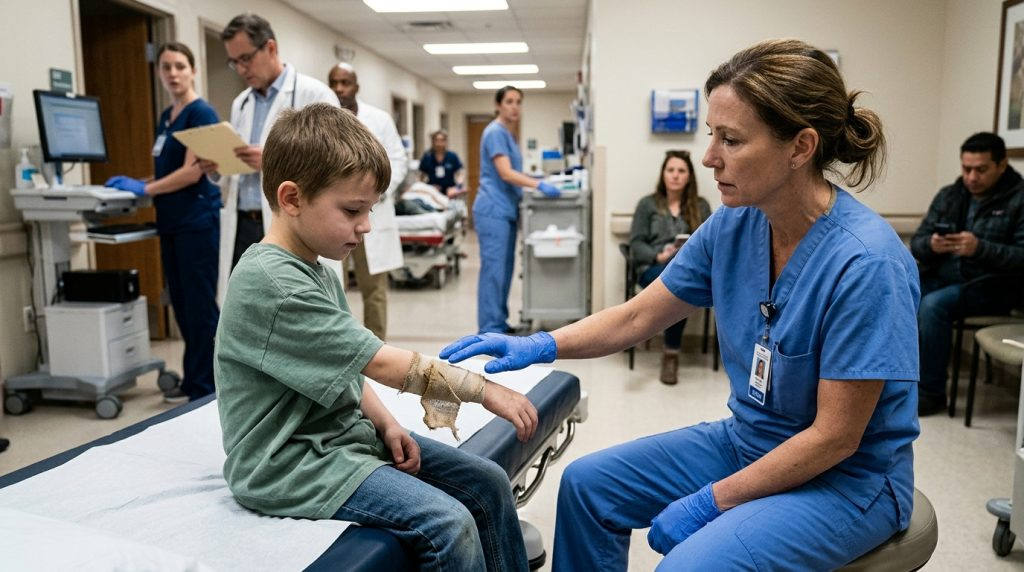
I have been an emergency room nurse at Mercy General Hospital in Chicago for twelve years. Over a decade of 12-hour night shifts has shown me just about everything a human being can do to another human being.
I thought my capacity to be shocked had completely burned out somewhere around year five. I was wrong. Absolutely nothing could have prepared me for what I found under that little boy’s bandage on a freezing Tuesday night in November.
It was one of those nights where the rain felt like ice hitting the windows, and the ER waiting room was packed with the usual chaotic mix of winter flu cases, minor car accidents, and exhausted night-shift workers.
I was four hours into my shift, running on stale coffee and pure adrenaline. The fluorescent lights overhead always gave the triage area a harsh, washed-out look, making everyone appear sicker than they actually were.
I was at the main desk charting a patient’s vitals when the automatic sliding doors hissed open. The cold wind rushed in, scattering a few loose papers off the reception desk.
I looked up.
A man walked through the doors dragging a young boy by his uninjured arm. The man was tall, heavily built, and wearing a damp flannel shirt. He looked to be in his late thirties, with a rough, unshaven face and a nervous energy that instantly put me on edge.
But it was the boy who caught my attention and held it.
He looked no older than six. He was small for his age, with messy blonde hair plastered to his forehead by the rain. He was wearing a faded oversized t-shirt that hung off his thin frame, shivering violently in the cold air of the hospital.
His face was completely pale, almost ghost-like. But the most unsettling thing was his silence. Most kids that age in an emergency room are crying, complaining, or clinging to their parents.
This boy was doing none of that. He was completely silent, his wide, terrified blue eyes staring straight ahead at nothing in particular.
His left arm was cradled against his chest. Wrapped around his forearm was a thick, crude bandage made out of what looked like an old, dirty hand towel, secured with shiny silver duct tape. Dark, rusty stains seeped through the rough fabric.
Every instinct I had developed over twelve years in trauma care flared up at once. Something was incredibly wrong here.
I stepped out from behind the desk and approached them.
“Hi there,” I said, keeping my voice as calm and gentle as possible. “I’m Sarah. I’m one of the nurses. What happened here?”
The man immediately stepped in front of the boy, blocking my view of him.
“He fell,” the man said quickly. His voice was gruff, defensive. “He was climbing the fence in the backyard and slipped. Scraped his arm up real bad on some rusty metal. It wouldn’t stop bleeding, so I wrapped it up and brought him in.”
I nodded, keeping my expression neutral, though my mind was racing. The story didn’t match the heavy, soaked appearance of the makeshift bandage. A scrape, even a deep one, rarely required that much pressure or bled that heavily through a thick towel.
“Okay,” I said. “Let’s get him back to a room and take a look. Are you his father?”
“Uncle,” the man corrected quickly, almost too quickly. “I’m watching him for the week. My name is Greg. His name is Tommy.”
I looked down at the boy. “Hi, Tommy. We’re going to get you fixed up, okay?”
Tommy didn’t look at me. He didn’t blink. He just stared at the white linoleum floor, pulling his injured arm a little tighter against his chest.
We walked back to Bay 4, a small, curtained-off trauma room near the nurses’ station. I asked Greg to lift Tommy onto the examination bed. When Greg grabbed the boy by the waist to hoist him up, Tommy didn’t make a sound, but his entire body tensed up like a coiled spring.
“I’m going to need to get his vitals first,” I told Greg, pulling the blood pressure cuff from the wall.
“Just fix the arm,” Greg said, pacing the small space of the room. He kept looking out past the curtain into the main hallway. “We don’t have insurance, so we don’t need all the extra stuff. Just clean it, stitch it if you have to, and we’ll get out of your hair.”
“It’s hospital policy, Greg,” I said firmly. “I need to make sure his blood pressure and heart rate are stable, especially if he’s lost blood.”
Greg let out an annoyed sigh and crossed his arms, leaning against the wall, watching my every move.
I gently wrapped the pediatric cuff around Tommy’s uninjured right arm. His skin was freezing cold. His heart rate was through the roof—over 130 beats per minute. He was in a state of sheer panic, but his face remained completely blank.
“Tommy,” I whispered softly while the machine whirred. “Can you tell me where it hurts?”
“I already told you, he cut his arm on the fence,” Greg snapped from the corner.
“I need to hear it from him, sir,” I replied, maintaining a professional but firm tone. “Tommy, does it hurt anywhere else?”
Tommy slowly raised his eyes. For the briefest second, he looked at me. The sheer volume of fear in that child’s eyes hit me like a physical blow to the chest. He glanced nervously toward his uncle, then looked back down at the floor, pressing his lips tightly together.
He was terrified of the man standing in the room.
My heart pounded in my ears. I knew I had to get the bandage off, and I knew I had to get Greg out of the room.
“Alright,” I said, putting the blood pressure cuff away. “I’m going to need to clean the wound now. Greg, I’m going to ask you to step out to the waiting room and fill out the registration paperwork.”
“I can fill it out right here,” Greg said immediately, pushing off the wall.
“You can’t. The registration desk is up front, and I need space to work. The doctor will be in shortly, and we can’t proceed until his chart is started.”
Greg stared at me for a long, hard moment. I held his gaze, refusing to back down. Finally, he muttered a curse under his breath.
“Don’t take too long,” he warned, pointing a finger at me. Then he looked at Tommy. “Be quiet and let the lady work. I’ll be right back.”
The moment the curtain slid shut behind Greg, the atmosphere in the room changed. It was as if the air had been sucked out.
I turned my attention back to the boy.
“He’s gone, Tommy,” I said softly. “It’s just you and me. I’m going to help you, I promise.”
Tommy still didn’t speak, but he began to tremble. Not just a slight shiver from the cold, but violent, full-body shakes.
“I need to take this off now,” I said, gesturing to the duct-taped towel on his arm. “I’m going to be very, very gentle.”
I reached out my hands.
Before my fingers even grazed the edge of the towel, Tommy flinched.
It wasn’t a normal flinch. He threw his entire upper body backward, slamming into the wall behind the hospital bed, pulling his knees up to his chest in a defensive crouch. He let out a sharp, choked gasp, the first sound he had made since entering the hospital.
“Shh, it’s okay, it’s okay,” I quickly reassured him, taking a step back with my hands raised in surrender. “I won’t hurt you. I just need to see.”
I noticed something else then. The smell.
As I stood closer to him, the sharp, metallic scent of blood was overpowered by something else. Something foul, sweet, and rotting. It was the unmistakable smell of severe infection, of dead tissue.
Whatever happened to this boy’s arm, it didn’t happen an hour ago on a backyard fence. It had been festering for days.
“Tommy,” I said, my voice barely above a whisper. “Did the fence do this?”
He shook his head frantically, his eyes wide with absolute terror. He looked at the curtain, terrified his uncle would walk back in.
With his good hand, he reached out and grabbed the sleeve of my scrubs. His grip was surprisingly strong. He pulled me closer, his trembling lips parting as he finally forced out a whisper.
“Don’t let him take it,” Tommy breathed, a tear finally breaking loose and sliding down his pale cheek. “He’s going to kill it.”
I froze.
“Kill what, sweetheart?” I asked, my blood running cold.
Tommy didn’t answer. He just let go of my sleeve and slowly, agonizingly, extended his injured left arm toward me. He offered it to me.
My hands were shaking as I reached into my pocket and pulled out my trauma shears. I carefully slid the blunt edge of the scissors under the thick, silver duct tape wrapped around his small forearm.
I cut through the tape. The sound seemed deafening in the quiet room.
Then, I began to unwrap the towel.
One layer. Two layers. The fabric was stiff with dried blood on the outside, but wet and warm underneath.
Three layers.
Two other nurses, Emily and Mark, walked past Bay 4 and peeked their heads in through the gap in the curtain to see if I needed help.
I peeled back the final layer of the towel.
The moment the cloth fell away, I stopped breathing. The blood rushed out of my head. I stared at the boy’s arm, my mind completely unable to process the horrific, impossible reality of what I was looking at.
Emily dropped the clipboard she was holding. It clattered loudly against the linoleum floor. Mark stopped dead in his tracks, his mouth falling open.
The entire emergency room floor seemed to go dead silent.
Because underneath that dirty, blood-soaked towel, Tommy didn’t have a scrape. He didn’t have a cut.
What he had hidden against his arm was something that shattered my heart into a million pieces and made me realize that Greg wasn’t just an abusive uncle. He was a monster.
<Chapter 2>
I stared at the small, trembling mass nestled against the inside of Tommy’s pale forearm. My brain, trained for over a decade to instantly identify lacerations, fractures, and burns, completely short-circuited.
It wasn’t a wound. It wasn’t human tissue.
Pressed tightly against the boy’s skin, bound to him by the bloody towel to absorb his body heat, was a puppy.
It was incredibly small, perhaps no more than four weeks old. A tiny, fragile pitbull mix, its fur matted with dried blood and dirt. The poor creature was so still, so impossibly quiet, that for a split second, I thought it was dead. But then, I saw the faintest, shallow rise and fall of its minuscule ribcage.
The blood that had soaked through the heavy towel wasn’t entirely Tommy’s. A significant portion of it belonged to the puppy. There was a jagged, cruel gash along the animal’s hind leg, crusted over but severely infected, radiating that sweet, rotting smell I had noticed earlier.
But Tommy was bleeding, too.
Now that the bulky towel was removed, I could see the boy’s actual injuries. My stomach violently dropped. His left arm, the one he had used as a makeshift incubator and shield for the puppy, was covered in dark, blooming bruises in the shape of adult fingers. The skin around his wrist was raw and stripped, as if someone had violently tried to pry his arms apart while he held on for dear life.
Worse still, as Tommy shifted, his oversized faded t-shirt slipped off his shoulder. Across his collarbone and chest were deep, ugly purple contusions. Defensive wounds. The kind of injuries a child sustains when they curl into a tight ball to protect something precious from the heavy blows of a grown man.
He hadn’t been shielding his own body. He had been shielding the puppy.
Emily, standing frozen by the curtain, let out a shaky, strangled gasp. Mark, the toughest triage nurse on our floor, looked visibly sick. He took a step backward, running a hand over his face, his eyes darting from the battered boy to the tiny, broken animal in his lap.
“Oh my god,” Emily whispered, her voice breaking. “Sarah… is that…?”
“Don’t let him hear you,” I hissed, my voice sharp and commanding, though my hands were shaking so hard I could barely hold the trauma shears. “Keep your voices down. Mark, close that curtain tight. Do not let Greg see inside.”
Mark snapped out of his shock. He stepped quickly to the edge of the bay, pulling the heavy fabric curtain shut until it overlapped, plunging us into a more isolated, stifling enclosure.
I looked back down at Tommy. The boy was crying now. It wasn’t loud, noisy crying. It was the silent, agonizing weeping of a child who has been taught that making a sound brings severe punishment. Huge tears spilled over his lower lashes, carving clean tracks through the grime on his hollow cheeks.
He looked at the puppy, then looked up at me, his chest heaving with silent sobs.
“He found the box under the porch,” Tommy whispered, the words tumbling out in a rushed, terrified stream. “He was mad because they were crying. He put them in a heavy bag. He took them to the creek behind the house.”
The words hit me like physical punches to the gut. I felt a cold, hard knot of pure rage form in the center of my chest.
“I tried to stop him,” Tommy continued, his small voice trembling so violently I had to lean in to hear him over the ambient noise of the ER. “He hit me. He told me to stay in the dirt. But after he threw the bag in the water and walked away… I ran in. The water was so cold.”
Tommy’s good hand gently stroked the puppy’s head with a tenderness that broke my heart.
“I could only find him,” Tommy sobbed quietly. “The bag was too heavy. I could only pull him out. He was cut by the glass in the bag. I hid him in my shirt. But Uncle Greg saw the blood. He said he was going to finish it. He said he was going to take him away.”
I closed my eyes for a fraction of a second, forcing myself to breathe, forcing back the tears that threatened to blind me. Over a decade in the ER, I had treated gunshot wounds, catastrophic car wrecks, and the worst diseases imaginable. But looking at this six-year-old boy, who had endured a brutal beating and plunged into freezing water to save a helpless animal, I felt an entirely new level of devastation.
He hadn’t fallen off a fence. The duct tape and the towel weren’t an emergency bandage applied by a caring uncle. They were a desperate, makeshift hiding place created by a terrified child. Tommy had wrapped the puppy against his own skin, binding his arm tight to conceal the animal beneath the oversized t-shirt, enduring the pain of his own injuries and the crushing fear of discovery just to keep the tiny creature alive.
“Tommy,” I said, my voice thick with emotion. I placed my hands gently over his trembling ones. “You are the bravest boy I have ever met in my entire life. Do you hear me? What you did was incredibly brave.”
He looked at me, his blue eyes searching mine for any sign of a lie. “You won’t let him take him?”
“I swear to you on my life,” I whispered fiercely. “That man is never touching you, or this puppy, ever again.”
I turned to Emily. The shock on her face had been replaced by the same cold, focused anger that was currently burning through my own veins.
“Emily, go to the break room,” I ordered quietly, maintaining a steady, authoritative tone. “Get the heating pad we use for the warming blankets. Grab some sterile saline, pediatric gauze, and the smallest neonatal oxygen mask we have in supply. Hide them under a blanket when you walk back in.”
She nodded sharply, not hesitating for a second. She slipped through a narrow gap in the curtain and disappeared into the chaotic hallway.
“Mark,” I said, looking at the male nurse. “I need you to go to the front desk right now. Find security. Find Officer Miller if he’s doing rounds. Tell them we have a severe child abuse situation in Bay 4, and the perpetrator is currently in the waiting room.”
Mark’s jaw clenched tight. “I’ll get him detained.”
“No,” I warned, grabbing Mark’s forearm before he could leave. “Don’t tip Greg off. If he realizes we know, he might bolt, or worse, he might try to force his way back in here to get Tommy. Tell security to quietly position themselves between the waiting room doors and this hallway. Lock the triage doors from the inside.”
Mark nodded, his eyes grim. “Consider it done.”
As Mark slipped out, leaving me alone with Tommy, the heavy reality of the situation settled over the small room. The clock on the wall ticked relentlessly.
I turned my full attention to the tiny life resting on Tommy’s battered arm.
“Okay, buddy,” I said softly, grabbing a pair of fresh, warm gloves from the wall dispenser. “I need to look at his leg, and I need to look at your chest. We’re going to fix both of you up.”
“His name is Barnaby,” Tommy whispered, his small fingers still resting protectively on the puppy’s back.
“Barnaby is a very strong name,” I smiled, though it didn’t reach my eyes. “Can I lift Barnaby up? Just for a second? I need to clean his leg so the bad germs don’t make him sicker.”
Tommy hesitated. The trauma of the last few days had hardwired him to trust no one. But he looked at my face, then at the gentle way I was holding my hands out. Slowly, agonizingly, he nodded.
I reached out and carefully lifted the tiny pitbull mix. The puppy weighed practically nothing. It let out a pathetic, breathy whimper as I moved it, its tiny paws paddling weakly in the air. The gash on its hind leg was deep, angry red, and oozing a yellowish fluid. The infection was spreading fast. If Tommy hadn’t kept the puppy pressed against his own warm skin, the cold and the infection would have killed it hours ago.
I placed Barnaby on a sterile blue chux pad on the rolling tray table beside the bed. I grabbed a warm, damp washcloth and began to gently clean the dried blood from the puppy’s face and paws.
“He’s very cold,” Tommy said, his voice laced with panic as he watched me work. “He needs to stay warm.”
“My friend Emily is bringing a special warm blanket just for him,” I reassured him. “Now, Tommy, I need to see your ribs. Can you lift your shirt for me?”
He flinched at the request, instinctively crossing his good arm over his chest.
“I won’t touch,” I promised. “I just need to look.”
Slowly, he pulled the hem of the faded shirt up to his collarbone.
I had to bite the inside of my cheek so hard I tasted copper to keep from gasping out loud. The bruising was extensive. Deep, yellow-green and purple marks painted a horrifying map of violence across his fragile ribcage. Some of the bruises were days old, fading at the edges. Others were fresh, dark, and swollen.
This wasn’t a one-time incident. Greg had been hurting this child for a while.
“Does it hurt to breathe deep?” I asked, keeping my voice incredibly steady.
Tommy shook his head slightly. “Only when I cough.”
“Okay. I’m going to get a doctor to take some special pictures of your chest, just to make sure everything inside is safe.”
Just then, the curtain rustled. I spun around, my heart leaping into my throat, instinctively stepping between the doorway and the bed.
But it was only Emily. She slipped inside, carrying a bundle of supplies hidden beneath a heavy, heated hospital blanket.
“Got it,” she breathed, setting the supplies on the counter. She unwrapped the heated blanket and immediately draped it over the shivering puppy. Barnaby let out a tiny sigh, leaning into the artificial heat.
Emily quickly attached a small, soft pediatric oxygen mask to the wall unit, turning the flow on low. She positioned the cup gently over the puppy’s snout. Within seconds, the tiny creature’s breathing seemed to ease, the rapid, shallow pants slowing down to a more rhythmic pace.
“He’s beautiful,” Emily whispered to Tommy, offering him a warm, encouraging smile. “You took such good care of him.”
A tiny, fragile ghost of a smile touched the corners of Tommy’s mouth. For the first time, some of the tension began to leave his narrow shoulders.
I turned to the sink to wet some sterile gauze with saline to clean the puppy’s infected wound. I was just pouring the liquid when a sound echoed from the hallway that made the blood freeze in my veins.
It was a loud, heavy fist banging against the thick glass of the locked triage doors.
“Hey!” a muffled, aggressive voice shouted from the other side. “Hey, open the damn doors! How long does it take to clean a scrape?”
Tommy violently flinched, letting out a sharp gasp. He scrambled backward on the hospital bed, pressing his small back against the wall, pulling his knees up to his chest in that terrifyingly familiar defensive crouch. His eyes went wide with pure, unadulterated panic.
“He’s going to come in,” Tommy whimpered, his hands gripping his hair. “He’s going to find us.”
Emily immediately moved to the bed, placing her hands gently but firmly on Tommy’s shoulders. “No, he’s not. You are safe here, Tommy. We locked the doors.”
“You don’t know him!” Tommy cried softly, his voice cracking. “He gets so angry. He breaks things!”
I dropped the gauze and stepped to the edge of the curtain, peering through a tiny gap into the main hallway.
Through the corridor, I could see the heavy double doors that separated the emergency room floor from the waiting area. Standing on the other side of the reinforced glass was Greg.
His face was red, his jaw clenched tight in fury. He was pacing back and forth like a caged animal, glaring through the glass directly at the nurses’ station.
Mark was standing by the desk, a phone pressed to his ear, his eyes locked on Greg. Two security guards were jogging quietly down the adjacent hallway, moving into position just out of Greg’s line of sight.
“Hey!” Greg yelled again, slamming his heavy palm against the glass. The sound echoed loudly down the corridor. “Where’s the nurse? Where’s the kid?”
I watched as the triage nurse at the front desk, a veteran named Barb, approached the doors. She didn’t open them. She spoke through the intercom system.
“Sir, you need to step back and lower your voice,” Barb said firmly. “The doctor is examining your nephew. It’s going to take some time.”
“I don’t have time!” Greg roared, his facade of the concerned uncle completely shattering. His eyes were wide, manic. He knew something was wrong. He knew it was taking too long for a simple bandage change. “Let me in there right now! He’s my kid!”
“He is not your kid,” I muttered under my breath, my hands balling into fists at my sides.
“Sir, if you don’t step back, I will have security remove you from the premises,” Barb warned, her voice devoid of any emotion.
Greg stopped pacing. He stood perfectly still, his chest heaving under his damp flannel shirt. He stared through the glass, his eyes scanning the empty hallway, searching the closed curtains of the trauma bays.
And then, his gaze locked directly onto Bay 4.
Even from thirty feet away, even through the gap in the curtain, I felt a jolt of sheer terror shoot down my spine. He couldn’t see me, but he knew. Like a predator sensing a trap, he knew exactly where we were hiding.
Greg took a step back from the doors. For a second, I thought he was going to comply and return to the waiting room.
Instead, he turned to his left, grabbed a heavy metal chair from the waiting area, and raised it high above his head.
“I’m taking him home!” Greg screamed, his voice raw and violent.
And with terrifying force, he swung the metal chair directly into the reinforced glass of the triage doors.
The deafening crash echoed through the entire hospital floor.
<Chapter 3>
The sound of the heavy metal chair hitting the reinforced triage glass was unlike anything I had ever heard. It wasn’t just a crash; it was a concussive boom that rattled the sterile instruments on the metal trays and vibrated through the soles of my clunky nursing shoes.
For a fraction of a second, time seemed to completely suspend itself in the emergency room.
Then, the screaming started.
The reinforced safety glass didn’t shatter into a million flying projectiles. Instead, a massive, opaque spiderweb of deep white cracks exploded across the double doors, completely obscuring Greg’s face. But I could still see his massive silhouette on the other side, stepping back, raising the chair to swing again.
“Code Gray! Code Gray to the Main Triage Lobby!” Barb’s voice echoed over the PA system. Her usually calm, steady voice was pitched an octave higher, laced with raw panic. “Security, we need immediate assistance at the front doors!”
The second impact hit the glass. BOOM.
A large chunk of the weakened safety glass buckled inward, showering the linoleum floor of the secure hallway with heavy, dull cubes of broken material.
Inside Bay 4, absolute pandemonium broke loose.
Tommy didn’t just flinch this time. He let out a blood-curdling, high-pitched scream that tore at the very fabric of my soul. It was the sound of a child who believed, with every fiber of his being, that he was about to be murdered.
He scrambled off the examination bed with a frantic, uncoordinated desperation. He didn’t care about his bare feet hitting the cold floor. He didn’t care about the IV pole he knocked over, which crashed into the rolling tray table.
His only instinct was survival. And his only goal was protecting Barnaby.
Before I could even reach out to grab him, Tommy had snatched the shivering puppy from under the heated blanket. He clutched the tiny, bleeding pitbull mix tightly against his bruised chest, curling his small body around the animal as a human shield.
He dove under the heavy metal frame of the examination bed, pushing himself into the furthest, darkest corner against the wall. He squeezed his eyes shut, rocking back and forth, sobbing so violently that his small frame convulsed with every breath.
“Tommy!” I yelled over the chaotic din of the ER, dropping to my hands and knees on the cold floor. “Tommy, look at me! He can’t get in! You are safe!”
But he couldn’t hear me. He was completely lost in a traumatic flashback, a dark, terrifying place where adults only brought pain and the world was a cold, violent nightmare. He just kept whispering into the puppy’s fur, “I’m sorry, I’m sorry, don’t let him take you.”
“Sarah!” Emily shouted, grabbing my shoulder and pulling me back slightly. “Look!”
I snapped my head toward the gap in the curtain.
Through the shattered hole in the triage doors, a thick, muscular arm covered in a damp flannel shirt pushed its way through. The jagged edges of the broken safety glass ripped through his sleeve, slicing deep into his forearm, but Greg didn’t even seem to notice the pain. He was operating on pure, psychotic adrenaline.
His large, bloody hand flailed blindly on the inside of the door, desperately searching for the heavy metal push-bar to force the locked doors open from the inside.
“Get away from the door!” Mark yelled. He had dropped his clipboard and was sprinting down the hallway toward the doors, placing his own body between the breaching point and the trauma bays.
Barb had already retreated from the front desk, barricading herself behind the heavy concrete pillar near the medication room.
“Where is he?!” Greg roared. His voice was no longer human; it was a guttural, terrifying bellow. His hand found the metal push-bar. He slammed his weight against it.
The magnetic lock groaned in protest.
My heart hammered against my ribs like a trapped bird. If those doors opened, there was nothing standing between a two-hundred-pound enraged abuser and a terrified six-year-old boy hiding under a bed.
I turned back to Tommy. I crawled entirely under the bed with him, ignoring the dust and the cold floor. I wrapped my arms around his shaking, bruised body, pulling him and the puppy tightly against my chest.
“I’ve got you,” I whispered fiercely directly into his ear, resting my chin on top of his messy blonde hair. “I’ve got you, Tommy. I am not going to let him touch you. I promise.”
Tommy buried his face into my scrub top, his tears soaking through the fabric. He was shaking so hard his teeth were chattering. Barnaby let out a weak, pathetic whine, squeezed between us.
“Open the damn door!” Greg screamed again. The metal bar clicked. The doors pushed open about two inches.
And then, chaos descended on the other side.
“Police! Get on the ground! Do it now!”
The booming, authoritative voice of Officer Miller echoed from the waiting room.
I couldn’t see the takedown, but I heard every terrifying, violent second of it. I heard the sickening thud of bodies slamming against the waiting room chairs. I heard Greg roaring in fury, shouting obscenities, fighting with the feral desperation of a cornered animal.
“Stop resisting! Put your hands behind your back!” another officer shouted.
“Get your hands off me! That’s my kid in there! They’re trying to steal him!” Greg screamed, his voice muffled as he was clearly driven into the floor.
Through the gap in the curtain, I saw Mark holding the triage doors shut with his entire body weight, just in case the struggle spilled over into the secure area.
The sound of the scuffle seemed to last for an eternity. The squeaking of tactical boots on linoleum, the heavy grunts of men exerting maximum physical force, the crash of a plastic waiting room table being overturned.
And then, the sharp, metallic ratcheting sound of heavy steel handcuffs clicking shut.
“Suspect is secured,” Officer Miller’s voice rang out, breathless but completely in control. “Get medical out here, he’s bleeding from his arm.”
The heavy, suffocating tension that had gripped the emergency room instantly shattered. It was over. The monster was in cages.
I closed my eyes and let out a long, shuddering breath, the adrenaline slowly beginning to drain from my system, leaving me feeling weak and nauseous.
“He’s caught, Tommy,” I whispered, my voice thick with unshed tears. I gently stroked the boy’s back, being incredibly careful to avoid the deep bruises painting his ribcage. “The police have him. He’s going to jail. He can never, ever hurt you again.”
Tommy didn’t move for a long time. He stayed curled in my lap under the hospital bed, his small fists gripping my scrub shirt so tightly his knuckles were completely white. His breathing was ragged, catching in his throat with sharp little hiccups.
“Is he… is he really gone?” Tommy asked, his voice so quiet and fragile it broke my heart all over again.
“He’s really gone,” I promised. “You are completely safe. And Barnaby is completely safe.”
Slowly, hesitantly, Tommy loosened his grip on my shirt. He pulled back just enough to look at my face. His blue eyes were red-rimmed and bloodshot, swimming with a mixture of absolute exhaustion and a tiny, fragile spark of hope.
“Come on,” I coaxed gently, scooting backward out from under the heavy metal frame of the bed. “Let’s get back up. We still need to help Barnaby’s leg, remember? He needs his warm blanket.”
I held out my hand. Tommy looked at it for a moment. Then, clutching the puppy carefully against his chest with his uninjured arm, he took my hand.
I helped him stand up. His legs were shaking so badly I had to support most of his weight to get him back onto the examination bed.
Emily was already there, pulling a fresh, warm blanket from the heating cabinet. She wrapped it around Tommy’s shoulders, cocooning both him and the tiny puppy in the soft, artificial heat.
“You did so great, Tommy,” Emily said, her own eyes glistening with tears. “You were so brave.”
Just then, the curtain to Bay 4 was pulled back.
Dr. Evans, our lead pediatric emergency physician, stepped into the room. He was a tall, older man with a gentle face and a reputation for being fiercely protective of his pediatric patients. He took one look at the shattered glass in the hallway, then looked at Tommy sitting on the bed with a bleeding pitbull puppy in his lap, and his expression hardened into pure, professional steel.
“Sarah,” Dr. Evans said quietly, his eyes never leaving the boy. “Status?”
I quickly wiped my eyes with the back of my arm and slipped right back into my role as an ER nurse.
“Patient is a six-year-old male, identified as Tommy,” I reported, keeping my voice steady and professional. “Presented with a makeshift bandage on the left forearm. Under the bandage, we discovered severe defensive bruising on the left wrist and forearm, as well as extensive, multi-stage contusions across the chest and ribcage. Patient was also concealing a young puppy with a severely infected laceration on the hind leg. The adult male who brought him in, identified as his uncle Greg, is currently in police custody in the waiting room.”
Dr. Evans jaw clenched tight. He nodded slowly.
“Alright,” Dr. Evans said, softening his voice immediately as he approached the bed. He pulled a rolling stool over and sat down, bringing himself down to eye level with Tommy. “Hello, Tommy. My name is Dr. Evans. Sarah tells me you’ve had a very, very hard night.”
Tommy looked at the doctor with deep suspicion, pulling the puppy a little closer.
“It’s okay, buddy,” Dr. Evans said, holding up his hands. “I’m not going to do anything you don’t want me to do. I just want to make sure you’re not hurting anywhere inside. And we need to get a vet over here to look at your little friend. Does he have a name?”
“Barnaby,” Tommy whispered.
“Barnaby,” Dr. Evans repeated with a warm smile. “That’s a strong name for a strong dog. Sarah, can we get animal control or the on-call emergency vet on the line? Tell them we have a VIP patient in Bay 4.”
“Already on it,” Emily said, slipping out of the room to make the call.
Over the next hour, the chaotic energy of the ER slowly settled into a heavy, focused quiet. The police took Greg away in handcuffs. The maintenance crew came to tape up the shattered triage doors.
Inside Bay 4, we worked meticulously.
Dr. Evans carefully ordered a portable X-ray machine to the room. He didn’t want to make Tommy walk through the busy hospital corridors. We discovered two hairline fractures in Tommy’s left wrist—the exact spot where Greg had violently grabbed him, trying to pry his arms apart to get to the puppy.
His ribs, miraculously, were not broken, but the deep tissue bruising was severe. We ordered pain medication and set up a gentle IV line to rehydrate him, as he was severely malnourished and dehydrated.
Through it all, Tommy never let go of Barnaby.
An emergency vet tech arrived about thirty minutes later. She was a kind, soft-spoken woman named Clara who didn’t bat an eye at the strange situation. She set up a small station right next to Tommy’s bed.
She carefully cleaned Barnaby’s deep laceration, flushing out the severe infection with warm saline. The puppy was so weak it barely protested. Clara applied a strong antibiotic ointment, wrapped the tiny leg in a bright blue bandage, and started the puppy on a sub-cutaneous fluid drip to bring its strength back.
“He’s going to be okay, Tommy,” Clara smiled, packing up her kit. “You saved his life. If he had stayed in that cold water, or if you hadn’t kept him warm against your body, he wouldn’t have made it. You are his hero.”
Tommy looked down at the sleeping puppy, now breathing easily under the warm oxygen mask, its tiny bandaged leg resting softly against Tommy’s hospital gown. A single, silent tear rolled down the boy’s cheek.
“I couldn’t leave him,” Tommy whispered, his voice cracking. “It was so dark in the water.”
I sat down on the edge of the bed, gently holding Tommy’s good hand. The adrenaline had completely left my body, leaving behind a profound sense of sorrow and a burning desire for justice.
“Tommy,” I said softly. “Where are your mom and dad?”
The monitor next to the bed beeped steadily. The ER outside the curtain hummed with its usual low-level activity.
Tommy didn’t answer right away. He kept his eyes fixed on Barnaby. He reached out and gently stroked the soft, floppy ears of the sleeping pitbull.
“My mom went to sleep a long time ago,” Tommy finally said, his voice completely hollow. It was the voice of a child who had been forced to understand concepts far too heavy for his age. “Uncle Greg said she was sick in her head and took too much medicine. He told the judge he would take care of me. That he was a good man.”
My heart sank. The pieces of the puzzle were falling into place, and the picture they formed was utterly tragic. A mother lost to addiction or mental illness. An abusive relative who manipulated the foster or family court system to gain custody, likely for the monthly stipend, only to turn the child into a punching bag behind closed doors.
“He locked me in the basement when the social worker lady came,” Tommy continued, the words spilling out now that the dam of fear had broken. “He said if I made a noise, he would put me in the dark box. He said nobody wanted me anyway.”
“That is a lie,” I said fiercely, squeezing his hand. “That is the biggest lie anyone has ever told you. You hear me?”
Tommy looked up at me. “But he’s coming back. He always comes back. When the police leave, he always comes back.”
“Not this time,” Dr. Evans said, stepping back into the room. He had a thick chart in his hand and a very grim expression on his face. Behind him stood Officer Miller and a woman in a sharp business suit holding a clipboard—a caseworker from Child Protective Services.
“Tommy,” Dr. Evans continued gently. “This is Ms. Davis. She’s here to help you. And Officer Miller has some very good news for you.”
Officer Miller stepped forward, removing his heavy uniform hat. He looked at the battered boy and the sleeping puppy, his jaw tightening slightly.
“Your Uncle Greg isn’t coming back, son,” Officer Miller said softly. “He’s going to jail for a very, very long time. I promise you, on my badge, he will never step foot near you again.”
Tommy looked from the police officer, to the doctor, to the caseworker, and finally to me. The heavy, suffocating blanket of terror that he had been wearing since he walked through those automatic doors finally began to lift.
For the first time all night, Tommy let out a long, deep breath. He leaned his head against my shoulder, his small body finally relaxing into the mattress.
But as Ms. Davis stepped forward to begin her interview, she opened her clipboard, and the color completely drained from her face.
She looked at Tommy, then looked at Dr. Evans, her eyes wide with shock.
“Dr. Evans,” Ms. Davis said, her voice shaking violently. “This boy… this isn’t Greg’s nephew. I know this child.”
I sat up straight, a cold chill washing over me.
“What do you mean?” I asked.
Ms. Davis turned the clipboard around. Pinned to the top of her paperwork was a missing child flyer. It was faded, and the picture was of a slightly younger, healthier boy, but the bright blue eyes were identical.
“His name isn’t Tommy,” Ms. Davis whispered, staring at the boy in absolute disbelief. “This is Liam Miller. He was abducted from his front yard in Ohio three years ago.”
The entire room went dead silent.
I looked down at the boy leaning against my shoulder. The child who had endured unimaginable abuse. The child who had risked his life to save a drowning puppy.
The boy who had been missing for three years.
v<Chapter 4>
The silence in trauma Bay 4 was so absolute, so heavy, that it felt like all the oxygen had been vacuumed out of the room.
I stared at the faded, crumpled piece of paper clipped to Ms. Davis’s board. The bold black letters at the top screamed “MISSING.” Beneath it was a photograph of a chubby-cheeked, smiling three-year-old boy sitting in a pile of autumn leaves.
The boy in the picture had bright, sparkling blue eyes. He looked completely carefree. He looked deeply, profoundly loved.
I slowly turned my head to look at the broken, bruised, terrified six-year-old leaning against my shoulder. His cheeks were hollow. His skin was pale and marked with the cruel, dark fingerprints of a monster.
But the eyes were exactly the same.
“Are you absolutely certain, Martha?” Dr. Evans asked, his voice barely a raspy whisper. He took the clipboard from the caseworker’s shaking hands, holding it up to the harsh fluorescent lights of the hospital room.
“Look at the second page,” Ms. Davis said, swiping a tear from her cheek. “Under identifying marks. It mentions a small, distinct birthmark shaped like a crescent moon just behind his left ear.”
My heart stopped beating.
I didn’t even have to look. I had seen it earlier when I was gently brushing his messy, damp blonde hair away from his face to check his temperature. I hadn’t thought anything of it at the time. It was just a birthmark.
“He has it,” I whispered, my voice trembling so violently I barely recognized it. “He has the mark.”
Officer Miller didn’t say a single word. He took one long, hard look at the missing poster, looked at the boy on the bed, and immediately turned on his heel. He pushed out of the room and sprinted down the hallway, grabbing his police radio.
He didn’t use the standard dispatch channel. I heard him demand an immediate, secure line to the FBI field office in Chicago.
I turned my attention back to the boy in my arms. He was watching us with wide, confused eyes. He was clutching the warm hospital blanket around his shoulders, making sure the tiny, sleeping form of Barnaby the puppy was entirely covered.
He was completely oblivious to the fact that the entire universe had just shifted on its axis.
“Tommy,” I said softly, crouching down slightly so I was completely at his eye level. I needed to keep my voice perfectly steady, but tears were already blurring my vision. “Do you know a boy named Liam?”
He shrank back slightly, a flicker of fear returning to his eyes. He shook his head. “No. Uncle Greg said my name is Tommy. He said I shouldn’t talk about before.”
“What about before, sweetheart?” Ms. Davis asked gently, stepping a little closer. “Do you remember anything from before Uncle Greg?”
The boy thought for a long time. His brow furrowed in deep concentration. The trauma and the abuse had built a thick, heavy wall over his early childhood memories. Greg had systematically brainwashed him, isolated him, and terrified him into forgetting who he really was.
“I remember a house with yellow walls,” he whispered finally. “And a big dog. A nice dog. Not like the ones Uncle Greg had in the yard.”
“Do you remember your mom?” I asked, my throat tightening.
He looked down at Barnaby. “She smelled like vanilla. She used to sing a song about a boat. And she called me… she called me Little Bear.”
Ms. Davis let out a choked sob and covered her mouth with her hands. She turned around, completely unable to hold her composure.
I looked at the clipboard still in Dr. Evans’ hand. At the very bottom of the missing poster, under a section labeled “Notes for public,” was a single line of text.
Responds to the nickname ‘Little Bear’.
It was him.
The man sitting in handcuffs in our waiting room wasn’t an abusive uncle trying to game the foster system. He was a kidnapper. He was a predator who had snatched a three-year-old boy from a front yard in Ohio, driven him across state lines, and locked him in a nightmare for a thousand days.
“Okay, Little Bear,” I said, the tears finally spilling over my eyelashes and running down my cheeks. I didn’t care about being professional anymore. I pulled him into a tight, fierce hug, burying my face in his damp hair. “You did so good. You held on for so long. But you’re going home now.”
The next four hours were a blur of chaotic, high-stakes activity.
The emergency room was essentially locked down by federal agents. Two FBI agents in dark suits arrived to take over the crime scene. They interviewed Barb, Mark, Emily, and myself. They took the bloody towel and the silver duct tape as primary evidence.
Greg—whose real name turned out to be Arthur Vance, a man with a long, violent criminal history—was transferred to a maximum-security federal holding facility. He was no longer facing simple assault charges. He was facing federal kidnapping, severe child abuse, and a slew of other felonies that would ensure he never saw the outside of a prison cell again.
But inside Bay 4, time seemed to stand completely still.
We moved Liam—I had to constantly remind myself of his real name—to a quiet, private pediatric recovery room on the third floor. He refused to be put in a wheelchair unless he could hold Barnaby.
Clara, the incredible emergency vet tech, had gotten special permission from the hospital administrator to let the puppy stay in the room, provided he remained in a sterile crate next to the bed.
Liam fell asleep around 3:00 AM. He was exhausted down to his very bones. His small hand was draped through the metal bars of the crate, his fingers resting gently against Barnaby’s soft, bandaged leg. The puppy was sleeping just as deeply, finally warm, finally safe, finally loved.
I sat in a chair by the window, refusing to end my shift. I wasn’t leaving until I saw this through.
At 6:15 AM, the door to the pediatric wing burst open.
I stood up immediately. Down the hallway, escorted by Officer Miller and the lead FBI agent, was a couple.
The man was tall, his face pale and drawn, his clothes wrinkled as if he had thrown them on in a blind panic.
But it was the woman who caught my attention. She was practically sprinting down the corridor. She was crying so hard she couldn’t breathe, her hands clamped over her mouth, her eyes darting frantically to every room number.
They had been flown in on a chartered FBI jet from Ohio the moment the identification was confirmed. For three years, they had lived every parent’s worst nightmare. They had printed thousands of flyers. They had done hundreds of interviews. They had stared at an empty bedroom, wondering if their baby was hungry, or cold, or even alive.
Officer Miller stopped in front of Liam’s door. He looked at the parents, his own eyes shining with unshed tears.
“He’s asleep,” Officer Miller warned them gently. “He’s been through a lot. He has some injuries. But he’s safe. He’s right in here.”
The mother didn’t even wait for him to finish. She pushed the door open.
I stepped back into the corner of the room, completely holding my breath.
The woman stopped dead at the foot of the hospital bed. She stared at the sleeping boy. Her legs gave out completely. Her husband caught her, wrapping his arms around her waist as they both sank to their knees on the linoleum floor, sobbing with a sound so raw and primitive it shattered my heart completely.
The noise woke Liam up.
His eyes fluttered open. He immediately pulled his arm back, his body tensing in that horrible, defensive instinct he had learned over the last three years. He looked terrified. He didn’t know these people. He didn’t recognize the weeping strangers on the floor.
“Liam,” the mother whispered, crawling toward the side of the bed. She didn’t reach out to grab him. She just rested her head against the mattress, looking at his face as if he were a miracle she was terrified to wake up from. “My beautiful boy. My Little Bear.”
Liam froze.
He stared at the woman. He looked at her eyes. He looked at her hair.
Then, he leaned forward slightly, his nose twitching.
“Vanilla,” Liam whispered, his voice trembling.
The mother let out a gasp that was half-laugh, half-sob. “Yes. Yes, baby. It’s Mommy. Mommy’s here. I looked for you everywhere. I never stopped looking.”
The wall inside Liam’s mind finally broke. The brainwashing, the fear, the abuse—it all washed away in an instant. He remembered.
He threw himself forward off the pillows, ignoring the pain in his bruised ribs, and collapsed into his mother’s arms.
She wrapped around him like a shield, burying her face in his neck, rocking him back and forth on the hospital bed. His father was right behind her, wrapping his massive arms around both of them, burying his face in his wife’s shoulder and weeping uncontrollably.
I had to leave the room. I stepped out into the hallway, leaning against the cold wall, and finally let myself cry. I cried for the horror that boy had endured, and I cried for the absolute, beautiful miracle that he was finally going home.
It took an hour for the family to calm down enough to even speak.
When I finally knocked and re-entered the room to check his vitals, Liam was sitting up in bed, completely sandwiched between his parents. He looked like a completely different child. The terror was gone from his eyes.
His father was sitting on the edge of the bed, gently stroking Liam’s hair, when he noticed the plastic crate on the rolling table.
“What’s this?” the father asked, looking down at the sleeping puppy.
“That’s Barnaby,” Liam said immediately, his voice completely clear. He looked up at his dad, suddenly anxious. “I saved him. He was in the freezing water. The bad man hurt him. We have to take him with us. We have to.”
The father looked at me. I walked over and quietly explained exactly what Liam had done. I told them about the dirty towel. I told them about the duct tape. I told them how Liam had used his own battered body as a shield to protect the tiny, dying animal.
The father looked at his son, his eyes filling with a fresh wave of tears. He leaned down and kissed Liam’s forehead.
“He’s coming home with us, Little Bear,” his father said firmly, his voice thick with emotion. “Barnaby is family now. Whatever he needs, we’ll get it. He’s coming to Ohio.”
Liam smiled. It was the first real, genuine smile I had seen on his face. It lit up the entire room.
Two days later, Liam was discharged.
He walked out through the main doors of Mercy General Hospital holding his mother’s hand. His father was walking right beside them, carefully carrying Barnaby in a padded travel carrier. The puppy’s leg was healing beautifully.
The entire ER staff lined the hallway to watch them leave. Mark, Barb, Emily, Dr. Evans, and myself. We didn’t clap or cheer. We just stood there, smiling, watching a miracle walk out into the sunlight.
Before he reached the automatic doors, Liam stopped. He let go of his mother’s hand and ran back over to where I was standing.
He didn’t say anything. He just wrapped his uninjured right arm around my waist, hugging me tight.
“Thank you for locking the door,” Liam whispered.
I knelt down and hugged him back, closing my eyes. “Have a wonderful life, Little Bear.”
It has been exactly one year since that freezing Tuesday night in November.
Arthur Vance—the monster who called himself Greg—pled guilty to federal kidnapping and child abuse charges to avoid a lengthy trial. He was sentenced to life in a federal penitentiary without the possibility of parole. He will never hurt another child again.
I am still working the night shift at Mercy General. The fluorescent lights still wash everyone out. The waiting room is still packed with the usual chaos.
But my locker in the breakroom looks a little different now.
Pinned to the inside of the metal door is a photograph that came in the mail a few weeks ago.
It shows a bright, happy seven-year-old boy standing in a huge backyard in Ohio. He is completely healthy. He is smiling a massive, carefree smile, missing one of his front teeth.
Standing right next to him, leaning heavily against his leg, is a massive, incredibly healthy, gray pitbull mix. The dog looks happy, strong, and fiercely protective of the boy.
Written on the back of the photo in messy, child-like handwriting are five words that I read every single time I clock in for a shift.
Barnaby and me are safe.