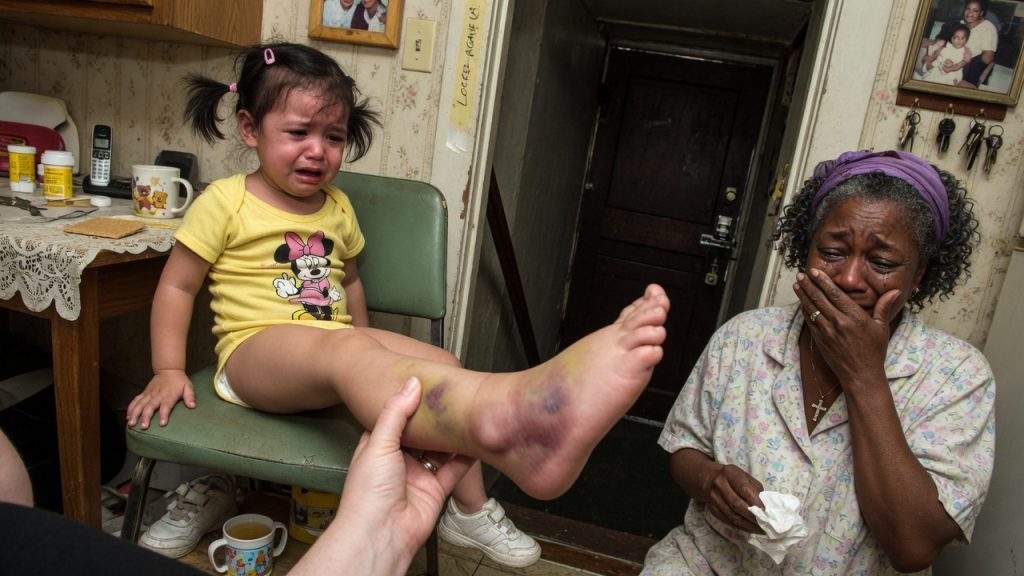
The human body is a terrible liar, but the stories people invent to cover up its bruises are even worse.
As a pediatric emergency room physician at Mercy General in Chicago, I’ve heard every variation of the same desperate scripts.
“He fell off his bike.”
“She tripped going down the porch steps.”
“They were just roughhousing.”
Usually, the parents are frantic, hovering, their guilt over a genuine accident spilling out in endless apologies to the crying child.
But there is a different kind of quiet that sometimes walks through those sliding glass doors. A suffocating, heavy silence.
The kind of silence that doesn’t belong in a room full of brightly colored toys and cartoon decals.
It was 11:45 PM on a freezing Tuesday in November when Evelyn and little Lily brought that silence into my shift.
The ER was running on its usual chaotic hum. Fluorescent lights buzzed overhead, smelling faintly of industrial bleach and burnt cafeteria coffee.
I was at the nurses’ station, rubbing the bridge of my nose, trying to blink away the exhaustion of a twelve-hour shift.
Six months ago, I had lost my own pregnancy at twenty weeks. Since then, the hospital had become my hiding place.
I poured myself into the broken bones and fevers of other people’s children so I wouldn’t have to go home to an empty nursery.
My charge nurse, Chloe, nudged my arm.
Chloe is a force of nature. She wears mismatched, obnoxiously bright cartoon scrubs—tonight it was SpongeBob tops and Paw Patrol bottoms—because she says it confuses the kids enough to make them stop crying when she puts in an IV.
She has a heart the size of a minivan, which is her greatest strength, but also her fatal flaw. She takes the job home with her. I’ve caught her crying in the supply closet more times than I can count.
“Room Four,” Chloe said, her voice dropping an octave. The playful energy she usually carried was entirely gone.
“What do we have?” I asked, grabbing the tablet.
“Three-year-old female. Lily. Brought in by the maternal grandmother, Evelyn. Chief complaint is a swollen right ankle. Grandmother says she took a bad step off the bottom of the stairs.”
“Vitals?”
“Stable. But Sarah…” Chloe hesitated, biting her bottom lip. “Something’s off. The vibe is wrong. The kid isn’t making a sound. And the grandma looks like she’s about to jump out of her own skin.”
I nodded, my professional mask sliding firmly into place. “I’ll go check them out.”
Before I reached Room Four, I bumped into Marcus Vance, our hospital social worker.
Marcus is a ten-year veteran of the child welfare system. He’s brilliant, impossibly calm under pressure, and knows the labyrinth of state laws better than most judges.
He also chain-smokes on his breaks and carries a deep, biting cynicism about human nature. He pulled a silver pocket watch from his vest—a gift from his late father—and checked the time. In quiet rooms, you can hear it ticking.
“Long night, Doc?” Marcus asked, his deep voice a low rumble.
“About to find out,” I said. “Chloe has a bad feeling about Room Four.”
Marcus stopped winding the watch. The metallic clicking ceased. His dark eyes locked onto mine. “Chloe’s feelings are usually right. Page me if the shadows look too dark in there.”
“Will do.”
I pushed open the heavy wooden door of Room Four.
The room was bathed in the harsh, unforgiving light of the exam lamp.
Sitting on the edge of the crinkling paper of the exam table was a tiny, fragile-looking girl. Lily.
She had a head of messy, tangled blonde curls and was wearing a faded pink puffer jacket that looked two sizes too small.
She was clutching a gray stuffed rabbit that was missing a button eye.
Beside her stood Evelyn.
The grandmother looked to be in her late fifties, but the deep, exhausted lines etched into her face made her look a decade older.
She wore a worn wool coat and clutched a cheap faux-leather purse to her chest like a shield. Her knuckles were white.
When I walked in, Evelyn flinched. An actual, physical flinch, as if the opening of the door was a physical blow.
“Hi there,” I said, keeping my voice soft, a gentle, practiced melody. “I’m Dr. Jenkins. And who is this brave girl?”
Lily didn’t look at me. She kept her large, hollow blue eyes fixed on the linoleum floor.
She didn’t cry. She didn’t seek comfort. She just sat perfectly still.
That is the first red flag. Children in pain cry. They reach for their caregivers.
When a three-year-old in a strange, bright room with a swollen ankle sits like a stone statue, it means they have learned that crying does not bring help. It means they have learned to make themselves invisible.
“This is Lily,” Evelyn said. Her voice trembled. It was a dry, raspy sound. “I’m her grandmother. Evelyn.”
“It’s nice to meet you, Evelyn. Let’s take a look at this ankle, okay?”
I pulled up a rolling stool and sat down in front of the exam table, putting myself below Lily’s eye level to appear less threatening.
“Hi, Lily,” I whispered. “I like your bunny. Does he have a name?”
Lily blinked slowly, clutching the rabbit tighter against her chest, but she remained entirely mute.
“She’s… she’s just shy,” Evelyn stammered quickly, stepping closer, nervously twisting the strap of her purse. “And tired. It’s past her bedtime.”
“That’s completely okay,” I smiled reassuringly. “Let’s get her feeling better so she can go to sleep. You said she fell?”
“Yes,” Evelyn swallowed hard. Her eyes darted to the closed door, then back to me. “She was at… at her dad’s house. My son-in-law. She was walking down the porch stairs and missed the bottom step. Twisted it bad. I picked her up for my weekend visit an hour ago and saw it was swollen, so I brought her straight here.”
It was a plausible story. Toddlers are clumsy. Gravity is their greatest enemy.
But Evelyn’s body language was screaming a different narrative.
She was sweating despite the chill of the room. Her eyes were darting rapidly. She was reciting the story, not remembering it.
“Okay, let’s take a look,” I said softly.
I reached out and gently removed Lily’s right sneaker. It slid off easily.
Then, I pulled down the thin, white cotton sock.
The moment the skin was exposed, the air in the room seemed to evaporate.
I stopped breathing for a fraction of a second.
My eyes, trained by thousands of hours of trauma rotations, instantly analyzed the canvas of the child’s skin.
The ankle was indeed swollen. But the swelling wasn’t centralized around the joint, as it would be in a typical sprain from a misstep.
The discoloration was brutal.
It was a deep, mottled purple, fading out into an angry, toxic yellow at the edges.
But it wasn’t just a random contusion.
It was a pattern.
There were four distinct oval bruises grouped together on the front of her lower leg, just above the ankle.
On the back of her calf, perfectly opposite to the four marks, was a single, larger bruise.
Thumb and fingers.
A handprint.
Someone had grabbed this tiny child by the ankle. Hard.
They hadn’t just grabbed her; the bruising indicated a severe, violent pulling motion.
The kind of force required to drag a struggling weight across a floor.
I felt a cold dread pool in my stomach, a familiar, sickening sensation that I hated more than anything else in my profession.
My mind flashed back to my own empty nursery. To the pristine crib that had never held a baby.
I pushed the intrusive thought away, locking my grief in a mental box. I couldn’t be a grieving mother right now. I had to be a doctor. I had to be Lily’s shield.
I traced my fingers ever so lightly over the edges of the bruising.
Lily finally reacted. A tiny, muffled gasp escaped her lips, and she pulled her leg back a fraction of an inch, burying her face into the one-eyed rabbit.
“I’m sorry, sweetie,” I whispered. “I know that hurts. I’m done touching it for now.”
I sat back on my stool and looked up at Evelyn.
The grandmother was staring at the bruised ankle as if she was seeing a ghost. A tear finally broke free from her eyelash and traced a slow path down her weathered cheek.
“Evelyn,” I said. My voice was no longer the soft, melodic tone of a pediatrician. It was low, steady, and anchored in absolute certainty.
“Yes, doctor?” she whispered, her voice cracking.
“I’ve been an ER doctor for a long time,” I began, choosing my words with surgical precision. “I’ve seen hundreds of toddlers who have fallen down stairs.”
Evelyn’s hands began to shake violently.
“When a child falls and twists an ankle, the bruise blooms around the bone,” I continued, pointing a pen at the injury without touching it. “But this… Evelyn, look at the shape.”
I stood up slowly, bringing myself closer to the grandmother, effectively blocking the door.
“There are four fingerprints on the front, and a thumbprint on the back. This isn’t a fall. Someone grabbed her leg, very hard, and dragged her.”
The room was so quiet I could hear the hum of the fluorescent lights and the faint, rhythmic ticking of Marcus’s pocket watch echoing in my memory.
Evelyn squeezed her eyes shut. Her entire body seemed to deflate, the tension holding her together suddenly snapping.
“Please,” she sobbed, a pathetic, broken sound. “Please, he’ll kill my daughter. He told me he would.”
“Who, Evelyn? Who did this to Lily?”
The grandmother fell into the hard plastic visitor’s chair, burying her face in her trembling hands.
“Her stepfather,” Evelyn wept, the dam finally breaking. The truth spilled out of her in a rush of terrified agony. “My daughter works the night shift. He watches Lily. I went to pick her up early because I had a bad feeling.”
Evelyn looked up at me, her eyes wild, raw, and desperate.
“I let myself in with the spare key,” she whispered, her voice trembling so violently I could barely make out the words. “The house was perfectly quiet.”
She paused, gasping for air, the memory clearly terrorizing her.
“I thought they were asleep. But then I heard a sound from the hallway. A scratching sound.”
I felt my heart pounding against my ribs. “What was it, Evelyn?”
The grandmother pointed a shaking, arthritic finger at the little girl on the table. Lily was staring at the wall, completely detached from the conversation, lost in whatever dark coping mechanism her mind had built.
“I found her on the cold cement floor,” Evelyn broke down, the words tearing out of her throat. “The bruise… the way he dragged her down there… Doctor, the basement door was locked again.”
Again.
The word hung in the air like a drop of poison.
This wasn’t a one-time loss of temper. This was a system of torture.
A locked door in the dark. A three-year-old child trapped in the cold.
I looked at Lily’s tiny hands. The fingernails on her right hand were jagged, broken down to the quick.
The scratching sound.
My blood turned to ice, and then, instantly, boiled into a blinding, protective rage.
I didn’t break eye contact with Evelyn. I reached blindly for the wall phone behind me.
“Chloe,” I said into the receiver, my voice stripped of all emotion, cold and sharp as a scalpel. “I need you in Room Four with an ice pack and some children’s Tylenol.”
I paused, feeling the weight of what I was about to do. I was about to blow this family’s life apart. I was about to start a war.
“And Chloe?” I added.
“Yeah, Doc?”
“Page Marcus Vance immediately. Tell him the shadows in Room Four are pitch black.”
Chapter 2
The receiver of the wall phone felt heavy, coated in the sterile, plastic coldness that defined everything in Mercy General. I hung it up, the plastic click echoing in the sudden, suffocating silence of Room Four.
Evelyn was rocking back and forth in the hard plastic visitor’s chair. It was a microscopic, rhythmic movement. The universal human physical manifestation of a mind trying to soothe itself when the world has entirely shattered. Her hands were pressed over her mouth, muffling the jagged, torn sounds of her weeping.
On the examination table, Lily remained perfectly still.
I looked at her. Really looked at her.
The overhead fluorescents in the room cast harsh, unforgiving shadows across the little girl’s face. I reached up and adjusted the examination lamp, angling the intense beam away from her eyes, creating a softer penumbra. I let the clinical light focus solely on the bruised canvas of her ankle. I wanted the shadows to recede. I wanted her to feel, even subconsciously, that the spotlight was off her face.
She was still clutching that gray stuffed rabbit with the missing button eye. Her small fingers dug into the worn plush fabric. The bunny was a shield. A silent companion that knew all the secrets of the dark basement.
“Evelyn,” I said, my voice barely above a whisper. I didn’t want to startle the child. “I need you to breathe with me. Can you do that? In through your nose. Out through your mouth.”
The older woman shook her head frantically, her eyes wide and terrified. “He’s going to know. He’s going to know I brought her here. If the hospital calls the police… David will kill Sarah. He swore to God he would.”
David.
The monster had a name.
“Nobody is killing anyone,” I said. I stepped forward, crouching down so I was at eye level with Evelyn, blocking her view of the closed door. I needed to be her anchor. I needed to be the immovable object in the room. “You are in a hospital, Evelyn. You are safe here. Lily is safe here. I am not going to let anyone take this child out of these doors tonight. Do you understand me?”
Before she could answer, the heavy wooden door pushed open.
Chloe stepped in first. True to her word, she had a pediatric ice pack—the kind shaped like a smiling penguin—and a small plastic cup holding cherry-flavored liquid Tylenol.
But it was the man who stepped in behind her that instantly changed the barometric pressure of the room.
Marcus Vance.
Marcus was a large man, standing six-foot-three, with broad shoulders that strained against his tweed vest. He had a neatly trimmed salt-and-pepper beard and eyes that had seen the very worst of humanity for two straight decades. He carried a battered leather notepad and his silver pocket watch.
He didn’t wear a white coat. He wore soft, neutral colors. Earth tones. He knew that to a traumatized child, clinical white was a trigger.
Marcus took one look at me, read the rigid set of my jaw, and then looked at the little girl on the table. He didn’t rush in. He didn’t make any sudden movements.
He stopped a few feet from the exam table and simply sank down into a low crouch, leaning his back against the wall. He made himself small.
“Hey there,” Marcus said. His voice was a deep, resonant rumble, like distant thunder, but completely devoid of threat. “That’s a pretty cool bunny. Looks like he’s seen some adventures.”
Lily didn’t look at him. She stared at the floor tiles.
Marcus didn’t push. He looked at me, then at the ankle.
From his distance, the angry purple and yellow handprint on the child’s pale skin was stark and undeniable. I saw Marcus’s jaw tighten. Just a fraction of an inch. A microscopic clenching of muscle. It was the only tell he ever gave when he was looking at pure evil.
“Dr. Jenkins,” Marcus said, keeping his eyes on Lily. “Chloe mentioned we had a fall.”
“The grandmother, Evelyn, brought her in,” I replied, keeping the clinical mask firmly in place, speaking the language that Marcus and I had developed over years of working these cases together. “Initial report was a misstep on porch stairs. However, upon examination, the contusion pattern is completely inconsistent with a sprain or a blunt force impact.”
“I see,” Marcus murmured.
“The bruising indicates a forceful, high-velocity pull. Four digits on the anterior, thumb placement on the posterior,” I continued, making sure the medical terminology insulated the horror of what I was actually saying. “There are also broken, jagged fingernails on the patient’s right hand. Evelyn has informed me that the child was found on the floor of a locked basement.”
Chloe let out a sharp, ragged breath. I saw her knuckles turn white as she gripped the smiling penguin ice pack. She had a five-year-old at home. These were the cases that sent Chloe into the supply closet to cry.
“Okay,” Marcus said softly. He finally stood up, moving with slow, deliberate grace. He walked over to Evelyn. “Evelyn? My name is Marcus. I’m a social worker here at the hospital. My entire job, my only job, is to make sure kids and their families are safe.”
Evelyn looked up at him, her chest heaving. “Are you going to call child services? Because if you do, Sarah is dead. You don’t know David. He’s… he’s a vice president at the regional bank. He golfs with the chief of police. People listen to him. He’s charming. They’ll never believe us.”
Ah. There it was. The architecture of domestic terror.
The most dangerous abusers aren’t the ones screaming in public. They are the ones wearing tailored suits, shaking hands at community fundraisers, hiding their sadism behind a veneer of middle-class respectability. They isolate their victims. They build a fortress of public trust so that when the victim finally screams, nobody believes them.
“Evelyn,” Marcus said, pulling up a chair and sitting directly across from her. He didn’t take out his notepad. He just gave her his complete, undivided attention. “I don’t care who he golfs with. I care about the handprint on your granddaughter’s leg. I need you to tell me exactly what you saw tonight. From the moment you unlocked that front door.”
While Marcus engaged the grandmother, I turned my attention back to Lily.
“Chloe,” I whispered. “Let’s get the ice on her.”
Chloe nodded, forcing a bright, wobbly smile onto her face. “Okay, sweetie pie. This penguin is going to give your ankle a big cold hug. It might feel a little chilly, but it’s going to make the bad owie feel better.”
Chloe gently wrapped the ice pack around the swollen joint.
Lily flinched at the cold, her breath hitching, but she didn’t cry out. She just squeezed her eyes shut and buried her face deeper into the one-eyed rabbit.
“You’re doing so good, Lily,” I murmured, stroking her tangled blonde hair. “You’re the bravest girl in the whole hospital.”
I needed to know the full extent of the damage. A handprint on the ankle was enough to trigger a mandatory CPS report and police involvement, but in my experience, a man who locks a toddler in a basement doesn’t start with the ankle.
The ankle was just the mistake he made when he got sloppy.
“Chloe, I need a full skeletal survey. STAT,” I ordered quietly. “Call down to Radiology. Tell Dr. Thorne I need him to read the films the second they hit the system.”
“A full skeletal?” Chloe asked, her eyes widening.
“Yes. Head to toe. Every bone.”
A skeletal survey is an agonizing process. It involves taking dozens of X-rays of a child’s entire body to look for hidden fractures, old breaks that healed incorrectly, and signs of chronic, sustained physical abuse. It’s the ultimate lie detector test for the human skeleton. Bone doesn’t forget. Bone holds the history of every impact.
I turned back to the corner of the room. Evelyn was speaking in a rapid, hushed, frantic whisper to Marcus.
“Sarah works the night shift at St. Jude’s nursing home,” Evelyn was saying, tears streaming down her face. “She’s a good mother. She is. But she’s terrified of him. David moved them out to the suburbs six months ago. Away from the city. Away from me. He took her car keys. He manages all the money. She’s trapped.”
“And the basement, Evelyn?” Marcus prodded gently. “How often does he put Lily down there?”
“I don’t know,” she sobbed. “Sarah tries to hide it from me. She wears long sleeves in the summer. But Lily… Lily stopped talking a month ago. She used to sing. She used to babble all the time. Now she just holds that rabbit and stares at the wall. Tonight, I just… I couldn’t sleep. I drove over. I let myself in.”
Evelyn shuddered, a full-body tremor.
“The house was dark. David was asleep in the master bedroom with the door open. I crept down the hall to Lily’s room. Her bed was empty. That’s when I heard the scratching. Like a little mouse. Coming from the kitchen.”
She looked at Marcus, her eyes begging him to understand the horror of that moment.
“The basement door is in the kitchen. It has a deadbolt on the outside. A deadbolt on the outside, Mr. Vance. Who puts a deadbolt on the outside of a basement door?”
My stomach turned over. I felt a cold sweat prickling the back of my neck.
“I slid the bolt back,” Evelyn whispered. “I opened the door. It was pitch black down there. The bulb was burned out. I shined my phone flashlight down the wooden stairs. She was at the bottom. Curled up on the freezing concrete, wearing nothing but her pajamas. She was scratching at the bottom step. Trying to climb up. When I picked her up, she couldn’t walk.”
Marcus remained completely still. He absorbed the story like a sponge absorbing toxic waste.
“You did the right thing, Evelyn,” Marcus said, his voice a steady, grounding force. “You saved her tonight.”
“But what about tomorrow?” she cried. “What happens when Sarah comes home from her shift at 6 AM and finds the house empty? He’ll wake up. He’ll realize we’re gone. He has cameras, Mr. Vance. Ring cameras on the porch. He’ll see me carrying her out. He’ll come looking for us.”
“Let him come,” I said.
The words left my mouth before I could filter them.
Marcus shot me a warning glance. As a doctor, I was supposed to remain objective. I was supposed to treat the medical emergency and let the authorities handle the criminal element.
But I was done being objective.
Six months ago, I had held a perfectly formed, lifeless son in my arms. I knew what it felt like to have the universe strip a child away from you through no fault of your own. The grief had almost killed me. It had hollowed me out, leaving behind a shell of a woman who only knew how to work and sleep.
Looking at Lily, looking at this tiny, breathing, beautiful child who was being systematically tortured by a man who was supposed to protect her… something inside me snapped. The hollow space filled with a blinding, white-hot fury.
I wasn’t just a physician anymore. In this room, bathed in the glow of the examination light, the white coat felt like armor. The stethoscope was a weapon of truth. I was standing between this little girl and the dark, and I would burn this hospital to the foundation before I let that man take her back.
“I’m taking her to Radiology,” I said abruptly. “Chloe, get a transport wheelchair.”
“Doctor, wait,” Evelyn panicked, standing up. “Where are you taking her? I can’t leave her.”
“You aren’t leaving her,” I said smoothly, forcing my tone back to reassuring professional. “You’re going to stay right here with Marcus. He’s going to make a few phone calls. I’m taking Lily down the hall to take some pictures of her bones. It won’t hurt. We just need to see exactly what’s going on under the skin.”
“I’ll stay with you, Evelyn,” Marcus said, pulling out his phone. “We need to contact the police precinct in your daughter’s jurisdiction. We need to request a welfare check on Sarah right now, before David wakes up.”
I scooped Lily up from the table. She was incredibly light. Way too light for a three-year-old. Her little body was rigid, her muscles tense and coiled, expecting pain.
I settled her into the transport wheelchair Chloe had rolled in. I tucked a warm hospital blanket around her shoulders.
“Alright, little bird,” I said gently. “Let’s go take some pictures.”
I pushed the wheelchair out of Room Four and into the chaotic, brightly lit hallway of the ER. The contrast was jarring. Nurses were running with IV bags, an elderly man was coughing aggressively in a bed parked against the wall, a trauma team was rushing past with a bloody gurney.
Lily squeezed her eyes shut against the noise and the light, pressing the rabbit to her cheek.
I navigated the labyrinth of hallways, pushing her away from the emergency department and into the quiet, sterile, and heavily air-conditioned corridors of the Radiology wing.
The lights here were dimmer. The floors were polished linoleum that squeaked under my rubber-soled shoes.
I pushed her through the heavy double doors of X-Ray Room B.
Dr. Aris Thorne was already waiting.
Thorne was a brilliant, eccentric radiologist who practically lived in the dark rooms of the hospital. He had pale skin, a shock of unruly dark hair, and wore thick-rimmed glasses that magnified his intense, analytical eyes. He drank an ungodly amount of espresso and listened to classical music while he worked.
He was also one of the few people in the hospital who knew about my miscarriage. He had been the one to read the final ultrasound. We shared a silent, terrible bond.
“Jenkins,” Thorne said, his voice a low drawl. He paused the Bach concerto playing on his computer speakers. He looked at the tiny girl in the wheelchair. “Skeletal survey?”
“Full body,” I nodded. “Ankle is the chief complaint. Patterned bruising. Suspicion of non-accidental trauma. High velocity pull.”
Thorne’s expression didn’t change, but his eyes hardened. “Understood. Put her on the table.”
For the next forty-five minutes, I stayed in the lead-lined room with Lily. We positioned her, took the image, repositioned her, took another.
Through it all, she didn’t make a sound. She was a ghost in her own body.
When it was over, I wrapped her back in the warm blanket and wheeled her out to the holding bay just outside Thorne’s reading room. Chloe had followed us down and sat with her, giving her a cherry popsicle.
I walked into the dark room where Thorne sat in front of four glowing, high-definition monitors.
The room smelled of ozone and stale coffee. The only light came from the stark black and white images of Lily’s bones illuminating the screens.
“What do we have, Aris?” I asked, crossing my arms, dreading the answer.
Thorne didn’t look away from the screens. He was using his mouse to zoom in on a specific section of the ribcage.
“The right ankle is fractured,” Thorne said quietly. “A spiral fracture of the distal tibia. Consistent with a severe twisting and pulling motion. The grandmother was right. Someone grabbed her by the leg and dragged her hard enough to twist the bone until it snapped.”
I closed my eyes. The image of the dark basement flashed in my mind.
“But that’s not the worst of it,” Thorne continued, his voice devoid of its usual sarcastic edge. It was deadly serious.
He clicked a button, bringing up a series of images of Lily’s torso and arms.
“Look here,” Thorne pointed a laser pointer at the screen. The red dot danced over the white outline of her tiny ribs. “Posterior rib fractures. On the left side, ribs four, five, and six. They are in the healing stage. Callus formation indicates they are roughly three to four weeks old.”
“Posterior ribs,” I breathed out.
“Yes. That doesn’t happen from a fall. That happens when an adult wraps their hands around a child’s chest and squeezes with immense pressure. It’s a classic indicator of child abuse.”
Thorne clicked again, bringing up an image of her left forearm.
“Look at the ulna. See this little bump here? A healed nightstick fracture. Probably two months old. She raised her arm to block a blow.”
He leaned back in his ergonomic chair, rubbing his tired eyes under his glasses.
“This isn’t an isolated incident, Sarah,” Thorne said, using my first name, which he rarely did. “This child has been a punching bag for months. The skeletal survey is a map of systematic torture.”
The white-hot fury in my chest crystallized into cold, hard steel.
The physical proof was here. The bone didn’t lie. David could play golf with the police chief. He could wear a thousand-dollar suit to the bank. He could charm the whole damn town. But he couldn’t erase the microscopic architecture of healing bone.
“Print the report, Aris. Sign it. Send it straight to my tablet,” I said.
“Already done,” he said softly.
I walked out of the reading room. Chloe was sitting with Lily, softly singing a cartoon theme song while Lily painted her lips red with the melting cherry popsicle. It was a fleeting, heartbreaking moment of normal childhood amid a nightmare.
My pager buzzed at my hip.
It was a code from Marcus.
URGENT. RETURN TO ER BAY. MOTHER IS HERE.
I frowned. Sarah? The mother wasn’t supposed to be off her shift until 6 AM. It was only 1:30 in the morning.
I grabbed the handles of the wheelchair. “Let’s go, Chloe. We’re heading back up.”
We hurried through the corridors. As we pushed through the double doors back into the chaotic noise of the main Emergency Department, I heard the shouting before I saw the source.
A woman’s voice, hysterical, panicking.
“Where is she? Where is my daughter? My mother stole her!”
I rounded the corner to the main waiting area, just outside the secured automatic doors of the treatment bays.
A young woman was standing at the triage desk. She looked exactly like an older, exhausted version of Lily. Tangled blonde hair, pale skin. She was wearing teal nursing scrubs from St. Jude’s. She looked terrified, her eyes darting wildly around the room. This was Sarah.
But my eyes didn’t stay on her.
They locked onto the man standing right behind her.
He was tall, impeccably groomed, wearing a tailored wool overcoat over a crisp button-down shirt. His hair was perfectly styled. He looked like he had stepped off the cover of a corporate magazine.
But his hand was wrapped tightly around Sarah’s upper arm. A vice grip disguised as a comforting touch.
He leaned down and whispered something into Sarah’s ear. Her shoulders flinched.
This was David.
Marcus was standing between the couple and the locked doors of the treatment area. Two hospital security guards were flanking him.
“Ma’am, I need you to lower your voice,” Marcus was saying calmly. “Your daughter is receiving medical care.”
“I want to see her right now!” Sarah cried, trying to push past, but David’s grip held her firmly in place.
“Of course you want to see her, sweetheart,” David said. His voice was smooth, resonant, dripping with perfectly calibrated concern. He looked at Marcus with an expression of polite frustration. “I apologize for my wife, sir. We woke up to find our front door open and our three-year-old missing. Her grandmother has a history of mental instability. We just want to take our little girl home.”
He lied with the effortless grace of a sociopath.
I parked Lily’s wheelchair behind the nurses’ station, out of sight.
“Chloe, stay with her,” I commanded. “Do not let anyone near this child.”
I took a deep breath, feeling the weight of the X-ray report in my pocket. I smoothed down my white coat, adjusted my stethoscope around my neck, and walked out into the lobby to meet the monster.
Chapter 3
The distance from the secure double doors of the treatment bay to the triage desk was exactly thirty-two steps.
I counted every single one of them.
It was an old grounding technique I had learned during my residency, a way to keep my heart rate steady when the trauma bay was soaked in blood and the monitors were screaming.
But tonight, the blood wasn’t on the floor. It was hidden beneath the skin, mapped out in the microscopic fractures of a three-year-old’s bones.
I pushed through the swinging doors, my white coat billowing slightly behind me, my hands buried deep in my pockets to hide the way they were trembling.
Not from fear. From absolute, unadulterated rage.
The ER waiting room was a theater of misery. The fluorescent lights hummed their relentless, sickly yellow tune. The smell of industrial floor cleaner tried and failed to mask the scent of stale coffee, damp wool, and human anxiety.
In the center of it all stood the monster.
David didn’t look like a monster. He looked like a regional bank vice president. He looked like the kind of man who bought the expensive cookies at the neighborhood bake sale and waved at the crossing guards.
He was wearing a charcoal grey wool overcoat, perfectly tailored, draped over a crisp, pale blue button-down shirt. His dark hair was styled with effortless precision, catching the harsh hospital light.
His face was arranged in a mask of agonizing, helpless concern. It was a masterpiece of emotional forgery.
“I just want my daughter,” David was saying to Marcus. His voice was a rich, soothing baritone, the kind of voice that commanded boardrooms and negotiated mortgages. “You have to understand, my mother-in-law, Evelyn… she’s not well. She has episodes. Delusions. Waking up and finding her gone with our little girl… we were terrified.”
Beside him stood Sarah.
If Lily was a ghost, her mother was the haunted house.
Sarah wore the faded teal scrubs of St. Jude’s nursing home. She looked entirely hollowed out. Her blonde hair, the exact same shade as Lily’s, was pulled back in a messy, desperate knot. Dark, bruised shadows hung heavily beneath her pale blue eyes.
But it was her posture that screamed the loudest.
Sarah was standing slightly behind David, her shoulders hunched inward as if trying to minimize her physical footprint in the world.
David’s hand was resting on the back of her neck.
To the untrained eye, it looked like the comforting touch of a protective husband supporting his terrified wife.
But I had spent over a decade analyzing human anatomy and the mechanics of violence. I saw the way his thumb dug into the soft tissue just below her occipital bone. I saw the rigid tension in his forearm.
It wasn’t a caress. It was a leash.
He was controlling her micro-movements, a silent physical threat broadcast directly into her nervous system.
“Excuse me,” I said. My voice cut through the heavy air of the waiting room like a scalpel. It wasn’t loud, but it possessed a cold, absolute authority that silenced the space immediately.
David turned to look at me. His handsome face smoothed out into a relieved smile.
“Oh, thank God. Are you the doctor treating Lily?” He took a step toward me, his hand dropping from Sarah’s neck to gracefully extend toward me. “I’m David. This is my wife, Sarah. Please tell me our little girl is okay.”
I stopped six feet away from him. I did not look at his hand. I did not extend mine.
“I am Dr. Jenkins. I am the attending pediatric physician,” I said, keeping my gaze locked on his eyes.
For a fraction of a second, the charismatic smile faltered. A flicker of cold, calculating annoyance darted across his pupils. It was the look of a predator realizing the prey wasn’t going to play dead.
He slowly lowered his hand, slipping it into the pocket of his expensive coat.
“Dr. Jenkins,” David said, his tone shifting imperceptibly from relieved father to patronizing professional. “I appreciate your diligence. Truly. But there has been a terrible misunderstanding. My mother-in-law took Lily from her bed without our permission. Lily took a nasty tumble down the porch steps earlier today. We were monitoring her at home. I need to take my family home now.”
“No,” I said.
Just one word. A complete sentence. A brick wall built entirely of vowels and consonants.
Sarah let out a small, strangled gasp. Her hands flew to her mouth, her eyes widening in a mixture of terror and desperate, pleading hope.
David’s jaw tightened. The muscles corded beneath his jawline.
“I’m sorry?” he said, letting a hint of sharp ice bleed into his baritone. “I don’t think you understand, Doctor. I am her legal guardian. I am withdrawing my consent for treatment. We are leaving.”
He reached back and grabbed Sarah’s wrist, pulling her forward. She stumbled slightly, her worn sneakers squeaking against the linoleum.
“You aren’t going anywhere,” Marcus Vance’s voice rumbled from my right. The social worker stepped smoothly between David and the locked doors of the treatment bay. Marcus didn’t raise his hands, but his wide, solid frame became an immovable barrier.
“This is kidnapping,” David snapped, the veneer of the polite executive finally beginning to crack. He turned his glare onto Marcus. “I know my rights. I know the law. You cannot hold my child against my will.”
“Actually, Mr. Vance and I have already invoked protective custody under state statutes regarding suspected non-accidental trauma,” I said evenly.
I watched the words hit Sarah like physical blows. Suspected non-accidental trauma.
Her knees buckled slightly, but David’s iron grip on her wrist kept her upright.
“Non-accidental?” David scoffed, letting out a sharp, incredulous laugh that echoed off the plastic chairs. He looked around the waiting room, attempting to draw the few late-night patients into his performance. “Are you accusing me of something? She fell down the stairs! Kids fall down the stairs every day.”
“They do,” I agreed calmly. “But they don’t sustain spiral fractures of the distal tibia from a simple fall. A spiral fracture requires immense, twisting torque. The kind of torque applied when a thirty-pound child is violently dragged by the ankle across a floor.”
Silence fell over the room. Heavy. Suffocating.
The elderly man coughing in the corner stopped. The triage nurse froze with her hand hovering over a ringing telephone.
Sarah stared at me, her mouth opening and closing silently. Tears began to spill over her eyelashes, tracking through the exhaustion on her face.
David’s face flushed a deep, ugly red. The mask was gone. The monster was looking right at me.
“You listen to me, you arrogant bitch,” David hissed, dropping his voice to a venomous whisper, stepping into my personal space. “I am going to sue this hospital into bankruptcy. I am going to have your medical license revoked. I play golf with the Chief of Police. Do you have any idea who you are dealing with?”
“I know exactly who I am dealing with,” I replied, not breaking eye contact, not stepping back an inch. “I’m dealing with a coward who puts a deadbolt on the outside of a basement door.”
David flinched. It was a microscopic physical reaction, but in the glaring light of the ER, it was a neon sign of guilt. He knew that Evelyn had told me. He knew his secret architecture of torture had been discovered.
Before he could respond, the heavy glass automatic doors of the emergency entrance slid open with a mechanical whoosh.
Two uniformed police officers walked in. Rainwater dripped from their dark jackets.
The lead officer was a tall, broad-shouldered man in his late forties with a buzz cut and a face heavily lined with fatigue. His name tag read MILLER.
“What’s the situation here?” Officer Miller asked, his hand resting casually on his utility belt, his eyes scanning the tense circle we had formed.
David instantly pivoted. The transformation was sickening to watch. The venom vanished, replaced immediately by the aggrieved, respectable citizen.
“Greg! Thank God,” David said, exhaling a deep, shaky breath, letting go of Sarah’s wrist to extend both hands toward the officer. “Greg, it’s a nightmare. Evelyn lost her mind again. She broke into the house, took Lily, and brought her here. And now this doctor is refusing to let us see our daughter.”
Officer Miller blinked, clearly surprised to see a familiar face.
“David?” Miller frowned, looking from the immaculate executive to me, then back to David. “What are you doing here, man? We had a tee time at Oak Hills on Thursday.”
My stomach plummeted. Evelyn had warned me. He golfs with the police chief. People listen to him.
The tentacles of David’s carefully constructed social power were already wrapping around the room.
“I know, Greg, I know,” David sighed, running a hand through his perfectly styled hair, playing the exhausted, long-suffering patriarch to perfection. “It’s Evelyn. She’s completely unhinged. She’s spinning lies, telling these doctors God-knows-what to justify kidnapping Lily. You know Sarah and I. You know we’d never hurt our girl.”
Officer Miller nodded slowly, his posture relaxing a fraction. He turned to me, his expression hardening into professional skepticism.
“Dr. Jenkins, is it?” Miller asked. “Look, I know this family. Mr. Sterling is an upstanding guy in this community. If the grandmother took the kid without permission, that’s a custodial issue. You need to release the child to her legal parents.”
I felt the familiar, burning ghost of my grief flaring in my chest.
Six months ago, I had begged the universe for a child. I would have given my own life, traded my own heartbeat, just to hear my son take one breath in that pristine nursery.
And here was this man, this hollow, violent sociopath, using his country club connections to drag a broken three-year-old back into the dark.
Not on my watch.
“Officer Miller,” I said, my voice rising just enough to command the space. “With all due respect to your golf schedule, Mr. Sterling’s standing in the community has zero bearing on the medical evidence currently sitting on my tablet.”
Miller bristled, his hand tightening on his belt. “Excuse me, Doc?”
I pulled my hospital tablet from the deep pocket of my white coat. I didn’t hand it to him. I held it up, turning the screen so the harsh light of the digital X-rays was visible.
“I am the attending physician,” I stated clearly, citing the protocol Marcus and I relied on. “I have examined the three-year-old patient. I have discovered a severe spiral fracture of the right tibia, accompanied by distinct, patterned contusions consistent with a violent, non-accidental grabbing force. Furthermore…”
I tapped the screen, pulling up Dr. Thorne’s horrifying map of Lily’s ribs.
“A full skeletal survey has revealed three posterior rib fractures in the healing stages, roughly a month old, and a healed nightstick fracture on the left ulna. This child has been systematically abused over a prolonged period.”
Sarah let out a sound that I will never forget for the rest of my life.
It wasn’t a scream. It was the sound of a human soul tearing in half.
It was a guttural, wretched wail that ripped out of her throat. She collapsed forward, her knees hitting the hard linoleum floor with a sickening thud.
“No… no, no, no,” Sarah sobbed, wrapping her arms around her own stomach, rocking back and forth on the floor. “He said she fell off the bed. He said the bruises were from the park. Oh my God. Lily. My baby.”
David looked down at his wife. For a split second, there was no pity in his eyes. Only cold, calculating rage that his property was malfunctioning in public.
He reached down, grabbing Sarah roughly by the shoulder of her scrubs, trying to haul her back to her feet.
“Get up, Sarah. Stop making a scene,” he hissed through clenched teeth. “She’s lying. These doctors are lying to you.”
“Get your hands off her!” I shouted.
Marcus moved instantly. The social worker crossed the distance in two massive strides, knocking David’s hand away from Sarah’s shoulder with a sharp, practiced block.
“Step back, Mr. Sterling,” Marcus rumbled, his voice low and dangerous. “Do not touch her again.”
David stumbled back a step, shocked by the physical intervention. He looked to Officer Miller, his eyes wild with furious indignation.
“Greg! Are you going to let them assault me? Arrest this man!”
Officer Miller was staring at Sarah, who was sobbing violently on the floor, clutching her own hair. He looked at the stark white fractures glowing on my tablet screen. The camaraderie of the golf course was evaporating under the crushing weight of the evidence.
Miller held up a hand toward David, stepping between the executive and Marcus.
“David, back up,” Miller ordered, his voice finally taking on the authoritative bark of a cop. He turned to his partner, a younger, quiet officer who had been standing by the door. “Reynolds, escort Mr. Sterling to Interview Room A. Now.”
“You cannot do this!” David screamed, his face contorting into a mask of pure, ugly rage. The civilized veneer had completely shattered. “She is my daughter! That is my wife! You are stealing my family!”
“Walk, David,” Officer Miller said, resting his hand firmly on his service weapon. “Right now.”
Officer Reynolds grabbed David’s elbow. For a moment, it looked like David was going to swing at the young cop. His fists were clenched, his chest heaving. But the cowardice that allowed him to torture a three-year-old won out. He wouldn’t fight an armed police officer.
He shot me a look of absolute, murderous hatred, a promise of future violence, before allowing himself to be led down the hall.
The silence that followed was broken only by Sarah’s jagged, hyperventilating sobs.
I knelt down on the floor next to her. I didn’t care about the dirt on the linoleum. I didn’t care about the stains on my white coat.
“Sarah,” I whispered, keeping my voice gentle, the same tone I used with Lily. “Sarah, look at me.”
She couldn’t. She was lost in the horrifying realization of her own blindness. The architecture of her denial had just been carpet-bombed by a skeletal survey.
“I didn’t know,” Sarah choked out, her voice raw and shredded. “I swear to God, I didn’t know. I work the night shift. I sleep during the day. He’s always the one watching her. He’s so good with her when people are around. He bought her a swing set.”
“Abusers are actors, Sarah,” Marcus said softly, kneeling on her other side. “They build cages out of nice things.”
“The basement,” she wept, looking up at me with terrified, bloodshot eyes. “My mother called me from the police station… she said the basement door was locked. He told me the deadbolt was to keep the drafts out.”
I reached out and gently placed my hand over hers. Her skin was freezing cold. Her fingernails were bitten down to the quick, exactly like her daughter’s. The physical manifestations of living in a state of perpetual terror.
“We need to get you off this floor,” I said. “We have a private family room in the back. Away from the waiting area. Away from him. Will you come with me?”
Sarah nodded weakly. Marcus and I helped her to her feet. She leaned heavily against Marcus, her energy entirely depleted.
We led her through the secure double doors, leaving Officer Miller standing at the triage desk, calling for a detective and a child abuse investigator.
The family room was small, painted a soothing, muted green, furnished with soft chairs and a box of tissues. It was the room where I usually had to tell parents that the chemotherapy wasn’t working, or that the car accident had been fatal.
It was a room built for the end of the world.
I settled Sarah onto the small sofa. Marcus handed her a cup of water, which she held with trembling, two-handed desperation.
“Where is she?” Sarah begged, her eyes pleading with me. “Can I see her? Please, let me see my baby.”
I took a deep breath. This was the razor’s edge of my profession.
“You will see her, Sarah,” I said carefully. “But right now, Lily is in an incredibly fragile psychological state. When a child has been traumatized by a caregiver in their home, their entire concept of safety is shattered. If she sees you right now, she might associate you with him. We need to go slowly.”
Sarah buried her face in her hands, her shoulders shaking with silent, agonizing grief. “I failed her. I’m her mother, and I let a monster into her house. I let him break her bones.”
“You did not break her bones,” Marcus said firmly, his deep voice leaving no room for argument. “David broke her bones. The responsibility for violence rests solely on the person throwing the punch. He isolated you. He controlled you. That is how this works. But right now, we have to focus on Lily.”
“What does she need?” Sarah asked, looking up, a spark of fierce, protective motherly instinct finally cutting through the fog of her trauma. “Whatever she needs, I’ll do it. I’ll leave him. I’ll testify. I don’t care. Just tell me how to fix her.”
“I need to go back and check on her,” I said, standing up. “Marcus will stay with you. The police detectives will need to take a formal statement from you. You need to tell them everything, Sarah. Every bruise he explained away. Every time he took your car keys. Every time he locked that basement door.”
“I will,” she swore, her voice dropping to a low, determined whisper.
I left the family room, my heart pounding a heavy, relentless rhythm against my ribs.
I navigated the maze of the ER corridors, heading back toward the secure holding area behind the nurses’ station where I had left Chloe and Lily.
The chaos of the emergency department blurred around me. The alarms, the rushing footsteps, the metallic clatter of medical trays—it all faded into white noise.
My mind was hyper-focused on the little girl sitting in the transport wheelchair.
When I rounded the corner, I found Chloe sitting cross-legged on the floor in front of the wheelchair.
Chloe, the force of nature who wore SpongeBob scrubs to confuse the crying kids, was completely silent. Tears were streaming freely down her cheeks, ruining her mascara, but she wasn’t making a sound.
Lily was still sitting perfectly upright in the wheelchair, the warm blanket draped over her shoulders. The smiling penguin ice pack was still strapped to her fractured, bruised ankle.
And in her hands, clutched with white-knuckled desperation, was the gray stuffed rabbit with the missing button eye.
“Hey, Chloe,” I whispered, crouching down beside my favorite nurse. “How is she doing?”
Chloe wiped her eyes roughly with the back of her sleeve. “She hasn’t moved, Doc. She hasn’t blinked. I tried offering her another popsicle. I tried putting on cartoons on my phone. Nothing. It’s like she’s turned herself off.”
Dissociation.
When the human mind cannot escape the physical torture of a locked, freezing basement, it builds an escape hatch inward. It detaches the consciousness from the body. It is a brilliant, tragic survival mechanism.
“Okay,” I murmured. “You take a break, Chloe. Go wash your face. I’ve got her.”
Chloe nodded, squeezing my shoulder before standing up and walking away, her brightly colored scrubs a stark contrast to the heavy sorrow in the air.
I pulled up a rolling stool and sat down directly in front of Lily.
I made sure I was slightly below her eye level, removing any physical dominance from my posture. I didn’t try to touch her. I didn’t try to force eye contact.
I looked at the rabbit.
It was an old toy. The gray plush was matted and worn from years of being hugged, dragged, and cried into. The remaining button eye was scratched plastic. The other eye was just a frayed hole where the threads had snapped.
This rabbit was a protective archetype. It was the only thing that had gone into the dark basement with her. It was the only witness.
If I wanted to reach Lily, I couldn’t talk to the traumatized girl. I had to talk to the guardian.
“That is a very brave rabbit,” I said softly, keeping my voice steady, almost conversational.
Lily didn’t move her head, but her gaze shifted downwards, focusing intensely on the toy in her lap.
“I know a lot about brave things,” I continued, leaning my elbows on my knees. “Working in a hospital, I see brave people all day. But I think your rabbit might be the bravest of them all.”
Silence stretched between us. The hum of the hospital continued around our little bubble of quiet.
“Does he have a name?” I asked gently.
I waited. One second. Ten seconds. Thirty seconds.
I was about to ask another question when I saw her small, jagged, broken fingernails twitch against the plush fur.
Lily slowly, deliberately, lifted the rabbit up so its one good eye was looking at me.
She didn’t open her mouth. She didn’t speak.
But she tapped the rabbit’s ear. Once. Twice.
It was a microscopic movement, but it was a tectonic shift in the room. She was communicating.
“He’s a very good listener,” I observed, mirroring her calm, careful energy. “And he’s missing an eye. You know, I think that makes him special. It means he can see things that other people can’t. He can see the secrets in the dark.”
Lily’s breath hitched. A tiny, almost imperceptible intake of air.
She pulled the rabbit back to her chest, burying her chin between its long, floppy ears.
“When you were in the dark,” I whispered, leaning in just a fraction, “did the rabbit keep you safe from the scratching sounds?”
Her wide, hollow blue eyes finally snapped up to meet mine.
The sheer volume of terror held in that gaze nearly knocked the breath out of my lungs. It was an ancient, primal fear. It was the look of a prey animal that knows the wolf is right outside the door.
Lily didn’t speak, but she slowly nodded her head. Just once.
“The rabbit kept you safe,” I validated her, letting the truth anchor her in the present moment. “But you don’t have to be in the dark anymore, Lily. Do you know why?”
She stared at me, unblinking.
“Because my job,” I said, pointing a finger firmly at my own chest, at the stethoscope hanging around my neck, “is to be the biggest, fiercest monster-hunter in this whole city. And I promise you, on my life, that the man who locked that door is never, ever going to come near you again.”
For the first time since she had arrived at 11:45 PM, a change rippled across the little girl’s face.
The rigid, statue-like tension in her jaw trembled. Her lower lip quivered.
The dam of dissociation was cracking.
“You’re safe,” I whispered fiercely. “You and the rabbit. You are safe here.”
A single tear spilled over her eyelid, cutting a clean path down her pale cheek.
And then, she reached out.
It was a hesitant, agonizingly slow movement. Her tiny, uninjured left hand uncurled from the rabbit. She reached across the empty space between us and grabbed the edge of my white coat.
Her fingers gripped the cotton fabric with astonishing strength.
She was holding on to the anchor. She was holding on to the shield.
“I’ve got you,” I said, placing my hand gently over hers. “I’ve got you, little bird.”
Suddenly, the heavy, muffled thud of a physical altercation echoed from down the hallway.
It was coming from the direction of Interview Room A.
I heard a man roaring in anger. A crash of furniture. The sharp, commanding shout of Officer Miller.
“Get him on the ground! Reynolds, cuff him!”
The sound of violence violently shattered the fragile peace we had just built.
Lily shrieked. It was a high, piercing, terrifying sound that tore at my eardrums.
She violently pulled her hand away from my coat, throwing her arms over her head, curling her body into a tiny, tight ball in the wheelchair, trying to make herself as small as possible. Trying to disappear before the monster found her again.
“No, Lily, it’s okay!” I cried, trying to shield her with my body, my heart hammering in my throat.
But she wasn’t hearing me anymore. The ghost was back in the haunted house.
And down the hall, the sound of boots running on linoleum grew louder.
The monster had broken out of his cage.
Chapter 4
The sound of those heavy, frantic footsteps hitting the hospital linoleum was the sound of a nightmare breaking the boundaries of reality.
I didn’t think. I didn’t calculate the risk to my own life, or my medical license, or the hospital’s liability.
Instinct, ancient and maternal, hijacked my central nervous system.
I threw myself forward, wrapping my arms around Lily and twisting my body so my back was entirely exposed to the open hallway. I became a human shield over the wheelchair, burying the child beneath the thick cotton of my white coat and the desperate, hammering cage of my own ribs.
“I’ve got you,” I screamed over the chaos, pressing my cheek to the top of her tangled blonde hair. “I’ve got you, he cannot touch you!”
Lily was a vibrating knot of sheer terror beneath me. She didn’t cry out again; she simply vanished inside herself, gripping the one-eyed rabbit so hard her tiny knuckles must have ached.
“Sarah! Where is she?!”
The roar tore through the Emergency Department. It wasn’t the smooth, calculated baritone of David the bank executive anymore. It was the feral, unhinged bellow of a predator who had just realized the trap had sprung shut.
I squeezed my eyes shut, bracing for the physical impact.
It came a second later.
Fingers, rigid as iron claws, dug into the fabric of my shoulder, tearing through the coat and biting into my muscle.
“Get off her!” David snarled, his hot, sour breath hitting the side of my neck. He yanked backward with terrifying force, trying to physically rip me away from the wheelchair.
Pain flared across my collarbone, but I anchored my feet around the wheels of the chair and clamped my arms tighter around Lily. I would let him dislocate my shoulder before I surrendered an inch of space.
“Security! Code Gray! ER Bay!” someone shrieked from the nurses’ station.
Before David could wrench me backward a second time, the air pressure in the hallway shifted dramatically.
A massive shadow fell over us.
Marcus Vance hit David like a freight train.
There was no negotiation. There was no professional de-escalation. The social worker, a man who had spent twenty years wading through the darkest, most depraved swamps of human cruelty, unleashed two decades of righteous, protective fury.
The impact sounded like a car crash.
David’s grip on my shoulder was violently severed as Marcus drove his shoulder directly into the executive’s chest, launching him backward.
I spun around, keeping myself positioned firmly between the chaos and the wheelchair.
David slammed into a heavy metal cart loaded with IV saline bags. The cart tipped, crashing to the floor in an explosion of plastic and sterile water.
David hit the ground hard, slipping on the pooling water, his expensive charcoal overcoat soaked and ruined. But the monster was running on pure adrenaline and narcissistic rage. He scrambled to his hands and knees, spitting blood from where he had bitten his own tongue.
“I’ll kill you!” David screamed at Marcus, his eyes wide, white-rimmed, and completely devoid of sanity. “I will end your pathetic life!”
He lunged upward, throwing a wild, desperate punch at Marcus’s jaw.
Marcus didn’t even flinch. He sidestepped the blow with terrifying grace, grabbed David by the lapels of his ruined coat, and swept his leg out from under him.
David went down again, this time flat on his back, the back of his skull bouncing off the linoleum with a sickening crack.
Before he could even draw breath to scream, Marcus dropped his full weight down, pinning David’s chest beneath his knee.
“You are done,” Marcus rumbled. His voice wasn’t a yell. It was a low, seismic growl that vibrated through the floorboards. “You will never hurt another living soul.”
“Get off me! Greg! Arrest this animal!” David shrieked, thrashing wildly under the social worker’s weight, still blindly clinging to the illusion of his social power.
But Officer Miller was already there.
Miller burst around the corner, his face flushed, his service weapon holstered but a heavy yellow Taser drawn and aimed directly at David’s chest. Officer Reynolds was half a second behind him, breathless and bleeding from a scratch on his cheek where David had hit him during his escape from the interview room.
“Do not move, David! I swear to God, I will light you up!” Miller bellowed, his voice cracking with betrayal and fury.
The sight of the weapon, the realization that the police chief’s golf buddy was about to electrocute him in front of twenty witnesses, finally broke through David’s blind rage.
He froze, his chest heaving, staring up at the barrel of the Taser.
“Roll over. Now,” Miller ordered.
Marcus shifted his weight just enough to allow David to comply, but kept his hand firmly pressed against the back of David’s neck as the executive sluggishly rolled onto his stomach.
The sound of the heavy metal handcuffs clicking shut around David’s wrists was the most beautiful symphony I had ever heard.
“David Sterling, you are under arrest,” Miller panted, dropping his knee into the center of David’s back to secure him as Reynolds double-locked the cuffs. “For assault on a police officer, resisting arrest, and felony child abuse.”
David pressed his cheek against the wet floor. The fight drained out of him, leaving only the pathetic, hollow shell of a coward.
“You’re making a mistake, Greg,” David whimpered, his voice dropping back to a manipulative, trembling whisper. “She fell. I told you, she fell.”
“Shut up,” Miller snapped, hauling David to his feet by the chain of the handcuffs. David groaned in pain.
As they dragged him down the hallway toward the police cruisers, David locked eyes with me one last time. The facade was gone forever. There was no charm, no wealth, no respectability. Just a small, vicious man being dragged out of the light.
The heavy double doors closed behind them, cutting off his voice entirely.
Silence rushed back into the ER bay, heavy and vibrating with leftover adrenaline.
Nurses cautiously stepped out from behind their stations. The security guards lowered their radios.
I turned back to the wheelchair.
Lily had not moved. She was still curled into a microscopic ball, the blanket pulled over her head.
I dropped to my knees in the puddle of spilled saline, my white coat soaking up the cold water. My shoulder throbbed with a dull, burning agony, but I ignored it.
“Lily,” I whispered, my voice shaking violently. I took a deep breath, forcing the tremor out of my lungs, forcing myself to become the steady anchor again. “Lily, it’s over.”
I gently peeled the blanket back.
She looked up at me, her blue eyes wide, waiting for the blow.
“He’s gone,” I promised her, tears finally blurring my vision. “The monster-hunters took him away. He is never coming back.”
I pointed to the one-eyed rabbit clutched to her chest.
“You survived,” I told her, and told the silent guardian in her arms. “You were so brave in the dark. But you get to stay in the light now.”
Slowly, agonizingly slowly, the rigid tension in her little shoulders began to melt. She uncurled her legs. She let out a long, shuddering exhale that sounded like it had been trapped in her lungs for a month.
Down the hallway, the secure doors burst open again.
Sarah came running, barefoot, having kicked off her heavy sneakers to move faster. Evelyn was right behind her, sobbing uncontrollably.
“Lily!” Sarah screamed, sliding to her knees beside me, her hands hovering over her daughter, terrified to touch her, terrified to break her further. “Oh God, Lily. I’m so sorry. Mommy is so sorry.”
Lily looked at her mother.
This was the moment of truth. The moment that would define the rest of their lives.
Trauma is a thief. It steals trust, it steals language, it steals the fundamental bond between parent and child. Sarah’s home had become a torture chamber, and Sarah, however unwittingly, had been the warden holding the keys to the front door.
Lily didn’t reach for her mother. She didn’t cry.
She shrank back slightly, pressing her shoulder against the armrest of the wheelchair, seeking the safety of the inanimate object over the safety of her mother’s arms.
Sarah’s face crumpled. A fresh wave of agony washed over her as she realized the true depth of the damage.
“It’s okay,” I said softly, reaching out and resting my hand on Sarah’s shaking back. “She’s not rejecting you, Sarah. She’s just navigating a minefield right now. You have to let her set the pace. You have to earn the trust back, one centimeter at a time.”
Sarah swallowed hard, nodding through her tears. She wiped her face with the back of her hands and forced a tremulous, desperate smile onto her lips.
She didn’t try to hug Lily. Instead, she sat back on her heels, making herself smaller.
“Hi, baby,” Sarah whispered. “Mommy is here. And Grandma is here. We aren’t going anywhere. We are going to stay right here until you’re ready.”
Evelyn knelt behind Sarah, wrapping her arms around her daughter, both women forming a protective, waiting circle around the broken child.
We stayed like that on the floor of the ER for twenty minutes.
Nobody rushed us. The nurses stepped around us. The chaos of the hospital gave us a wide, respectful berth.
Finally, after an eternity of silence, Lily shifted.
She lifted the gray, one-eyed rabbit. She extended her small, trembling arm, and pushed the plush toy against Sarah’s knee.
It wasn’t a hug. It wasn’t a declaration of forgiveness.
It was a test. A cautious, fragile bridge being extended across an ocean of pain.
Sarah let out a choked sob, gently resting her hand on the rabbit’s worn ears, careful not to touch Lily’s fingers.
“Thank you, sweetie,” Sarah wept quietly. “He’s a very brave bunny.”
I looked up and caught Marcus’s eye. The giant man was leaning against the wall, rubbing his jaw where David had tried to strike him. He looked exhausted, his tie askew, his vest wrinkled.
He gave me a slow, solemn nod.
The battle for tonight was over. The war for healing was just beginning.
Two Years Later.
The sun was shining brightly through the large, bay windows of the physical therapy clinic, catching the dust motes dancing in the air.
I sat on a padded bench, a cup of lukewarm coffee in my hands, watching the scene unfold across the room.
The hospital was miles away, both geographically and emotionally. I was here on my day off, a promise I had made and kept for twenty-four months.
Lily was five years old now.
She was balancing on a brightly colored foam beam, her arms out to her sides like a tightrope walker. She wore pink leggings and a shirt with a sparkly unicorn on it.
Her right ankle, once a canvas of purple and yellow bruises, moved flawlessly. The spiral fracture had healed perfectly under Dr. Thorne’s meticulous monitoring. Children’s bones are remarkably resilient; they are designed to grow, to bridge the gaps, to overwrite the trauma with fresh, solid calcium.
“Okay, Lily, hop down on one foot!” the physical therapist encouraged.
Lily giggled—a loud, bright, ringing sound that filled the room—and jumped off the beam, landing solidly on her left foot, wobbling only slightly before throwing her arms up in triumph.
“I did it, Aunt Sarah!” Lily shouted, looking directly at me, her blue eyes shining with life.
My heart swelled, a physical ache of pure, radiant joy.
“You nailed it, little bird!” I called back, raising my coffee cup in a salute.
Sarah walked over from the reception desk, carrying a small backpack. The dark shadows under her eyes were gone. She looked healthy, grounded, and fiercely strong. She had left her night shift job, moved back to the city to live with Evelyn, and gone back to school for pediatric nursing.
The legal battle with David had been brutal, but short.
He had tried to fight. He had hired expensive lawyers who tried to paint Evelyn as crazy and Sarah as negligent. They tried to claim the broken ribs were from CPR, the ankle from a fall, the arm from roughhousing.
But bone does not lie.
Dr. Aris Thorne had taken the stand in family court. He had projected the X-rays onto a ten-foot screen and methodically, mercilessly dismantled every single one of David’s lies with the cold, irrefutable geometry of skeletal trauma.
The country club abandoned him. The bank fired him. The judge, disgusted by the deadbolt on the outside of the basement door, sentenced him to fifteen years in a state penitentiary without the possibility of early parole.
David Sterling was locked in a concrete box. He was finally in the dark.
“She’s doing so well,” Sarah said, sitting down next to me on the bench, watching Lily run to grab a sticker from the therapist.
“She’s a miracle,” I agreed.
Sarah looked at me, her expression softening into deep, unwavering gratitude. “She’s a miracle because you didn’t let him take her out of that hospital. You and Marcus. You stood in the doorway.”
“It’s what we do,” I said simply.
Lily came running over, practically vibrating with energy, holding up a shiny gold star sticker on her forehead.
“Look!” she demanded.
“Very professional,” I nodded solemnly.
Lily climbed up onto the bench between Sarah and me, unzipping her small backpack.
“He needs to see the star too,” Lily announced.
She reached into the bag and pulled out the gray stuffed rabbit.
He was still worn. He was still matted. But there was a bright, mismatched blue button securely sewn onto his face where the missing eye used to be.
Sarah and Evelyn hadn’t bought her a new toy. They understood that the rabbit wasn’t just a toy; he was the veteran of the basement. He was the protector. To replace him would be to erase the history of what they had survived together. Instead, they had helped Lily sew a new eye onto him, a symbol of seeing the world in a new, brighter way.
Lily held the rabbit up so its mismatched eyes could admire her sticker.
I looked at the rabbit, then at the little girl, and finally, I felt the tight, agonizing knot in my own chest begin to loosen.
For two years, the door to my empty nursery at home had remained firmly closed. The grief over the son I had lost was a heavy, suffocating blanket that I dragged with me everywhere. I had poured all my love, all my maternal desperation, into saving Lily, believing it was the only way I could balance the scales of the universe.
But watching Lily laugh, watching her thrive in the sunlight, I finally understood the truth.
I hadn’t saved Lily to replace my son.
I had saved Lily because my son had made me a mother.
The love I had for him hadn’t died when his heart stopped. It had merely transformed. It had sharpened into a fierce, protective weapon. It had turned me into the shield that Lily needed on the darkest night of her life.
My son’s brief existence had not been a tragedy of nothingness. His legacy was the life of the little girl sitting beside me.
“Are we getting ice cream now?” Lily asked, looking between her mother and me with calculating, adorable manipulation.
“I think a gold star definitely requires ice cream,” Sarah laughed, ruffling her daughter’s curls.
“Strawberry,” Lily declared, hugging the rabbit tightly.
I stood up, slinging my purse over my shoulder, the lingering ache in my collarbone a phantom reminder of the monster we had defeated.
“Strawberry it is,” I smiled.
As we walked out of the clinic and into the bright, warm afternoon, I realized something profound.
When I went home tonight, I was going to open the door to the nursery. I was going to let the air in. I was going to pack away the pristine blankets and the empty crib.
It was time to stop hiding in the hospital. It was time to live in the light.
The human body is a terrible liar when it comes to bruises, but it tells the absolute truth when it comes to healing. The bones knit back together, thicker and stronger at the break.
We had all been shattered. But looking at the three of us walking down the sidewalk—the mother who found her courage, the doctor who found her purpose, and the little bird who found her voice—I knew we were finally whole.
Notes from the Author:
The darkness of domestic abuse thrives on silence, isolation, and the illusion of respectability. Predators often wear the masks of perfect citizens, using their social standing to build invisible cages around their victims. They rely on the world looking away.
But trauma leaves a map. It leaves a map on the body, in the bones, and in the sudden, silent withdrawal of a child’s spirit.
If you see the signs—a child who shrinks from touch, a partner who controls every social interaction, a story about an injury that defies the laws of physics—do not look away. Do not let the illusion of a perfect family deter you from asking the hard questions.
You do not need to be a doctor or a social worker to be a protector. You just need to be the person willing to stand in the doorway and refuse to let the darkness win. Healing is brutal, and trust is built one centimeter at a time, but the human capacity to survive and rebuild is the most powerful force on earth.
There is always a way back to the light.