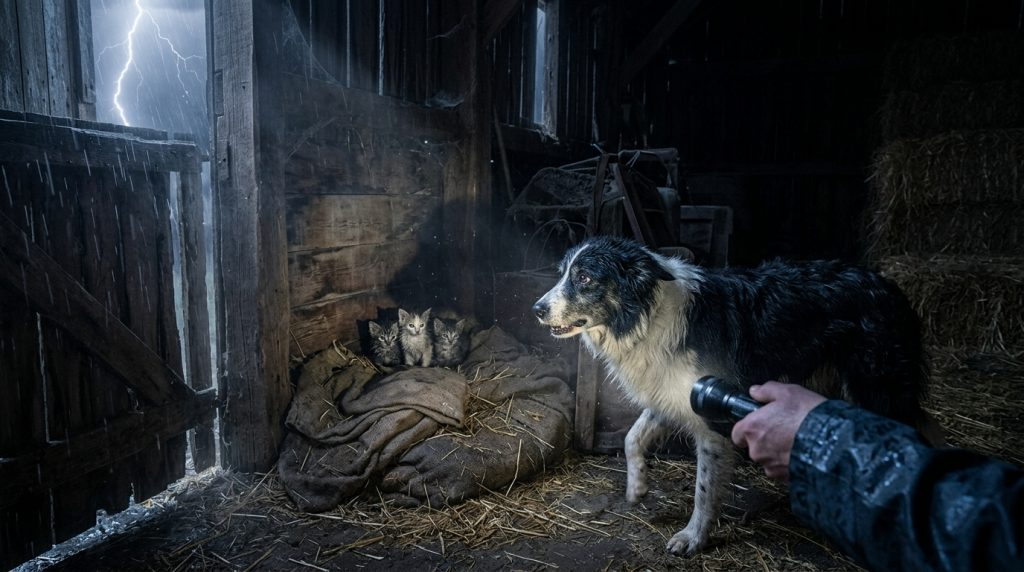
I’ve lived alone on this isolated Ohio farm for twenty years, but nothing could have prepared me for what I found trembling in the dark corner of my barn during the worst storm of the decade.
My name is Thomas. I am sixty-two years old, and for the last ten years, it has just been me and my Golden Retriever, Cooper.
We live at the end of a long, unpaved dirt road in rural Ohio. The nearest neighbor is almost seven miles away. It’s the kind of quiet life you either love or you hate. For me, after my wife passed away, the silence of the farm was exactly what I needed.
Cooper was my shadow. I adopted him from a local county shelter five years ago. He was a stray, found wandering along the highway, and he had always been a quiet, cautious dog.
He rarely barked. He never chased the mail truck. He just liked to sleep on the rug by the fireplace and follow me around while I did my daily chores.
But last Tuesday night, everything changed.
The local news stations had been warning us about the storm for three days. They called it a massive pressure system, the kind that brings straight-line winds, flash floods, and power outages that can last for weeks.
I spent the entire afternoon preparing. I chopped extra firewood. I filled the bathtub with water. I made sure the old generator in the shed had enough gas.
By six in the evening, the sky turned a bruised, sickening shade of purple. The air felt heavy, thick enough to choke on.
When the first drop of rain hit the tin roof of the porch, it sounded like a gunshot. Within minutes, the storm was fully upon us.
The wind howled through the old oak trees in the front yard, a high-pitched, screaming sound that made the entire farmhouse groan.
I locked the doors, drew the heavy curtains, and started a fire in the living room. Cooper was pacing.
Normally, during a thunderstorm, Cooper would just curl up under the dining room table and sleep through the noise. He wasn’t afraid of thunder.
But tonight, he was acting completely out of character.
He kept walking to the back door, the one that leads out to the mudroom and faces the old barn. He would stand there, his nose pressed against the cold glass, staring out into the absolute pitch-black night.
“It’s just the wind, buddy,” I told him, trying to sound calm. I patted my leg. “Come sit down.”
He ignored me.
He let out a low, urgent whine. Then, he started scratching at the door. He scratched so hard I thought his claws were going to tear through the wood.
At 8:15 PM, the power went out.
The house was plunged into sudden, suffocating darkness. The only light came from the flickering orange glow of the fireplace.
The wind was blowing so hard now that the walls were physically vibrating. I grabbed my heavy-duty flashlight from the kitchen counter and clicked it on.
Cooper let out a sharp, loud bark.
I jumped. I had not heard him bark like that in years. It wasn’t a bark of fear. It was a bark of desperate warning.
He slammed his front paws against the back door, looking back over his shoulder at me. He was telling me we needed to go outside.
“You’re crazy, Coop,” I muttered, shining the flashlight out the window.
I couldn’t see anything. The rain was coming down in thick, gray sheets, completely obscuring the yard. The barn, which sat about two hundred feet from the back porch, was completely invisible in the storm.
But Cooper wouldn’t stop. He started pacing in tight circles, whining loudly, bumping his head against my knee, and running back to the door.
A heavy knot of anxiety started to form in my stomach. Dogs know things. They hear things we can’t. They sense danger long before human eyes can see it.
Was the barn roof peeling off? Did a tree come down on the tractor? Was there a wild animal trying to get out of the floodwaters?
I couldn’t ignore him anymore.
I walked into the mudroom and pulled on my thick rubber boots. I grabbed my heavy yellow raincoat and pulled the hood up over my head.
“Alright,” I said, my voice trembling slightly. “Let’s go look. But we stay close together.”
I turned the deadbolt and pushed the door open.
The wind hit me like a physical punch to the chest. It nearly knocked me backward into the kitchen. Cold, biting rain lashed against my face, stinging my skin.
Cooper didn’t hesitate. He pushed past my legs and bolted out into the mud, his nose pointed straight toward the barn.
“Cooper! Wait!” I shouted, but the wind swallowed my words instantly.
I gripped the heavy flashlight and stepped off the porch. The mud in the yard was already ankle-deep. Every step was a struggle.
The darkness was absolute, save for the beam of my flashlight cutting through the heavy rain.
I kept the light trained on Cooper. He was moving with intense purpose, his tail tucked slightly, fighting against the heavy gusts of wind.
It took us almost three full minutes to cross the two hundred feet to the barn. By the time I reached the large, sliding wooden doors, I was completely soaked, and my lungs were burning from the cold air.
The barn is an old structure. I built it with my father over forty years ago. It has a heavy metal padlock on the front, but the lock has been broken for months. I usually just keep the doors pulled shut with a heavy iron latch.
Cooper was standing right at the crack between the two massive doors, his nose sniffing the air furiously.
I reached out with a trembling hand and grabbed the wet iron latch. I pulled it up.
I grabbed the edge of the heavy wooden door and threw my body weight backward. The door groaned loudly and slid open about three feet.
The inside of the barn was pitch black. The smell of old hay, motor oil, and damp wood rushed out to meet me.
Before I could even step inside, Cooper squeezed through the gap and disappeared into the darkness.
“Cooper, stay close!” I yelled, stepping into the dry, dusty air of the barn.
I pulled the heavy door shut behind me just enough to block out the worst of the wind and the rain. The sudden silence inside the barn was eerie. The storm outside sounded muffled, like a distant ocean roaring.
I raised my flashlight.
The beam swept across the familiar interior. My old green John Deere tractor sat in the middle. Stacks of hay bales lined the left wall. Dusty workbenches and rusty tools covered the right side.
Everything looked normal.
“Cooper? Where are you, boy?” I called out.
I heard a soft shuffling sound coming from the very back of the barn. It came from the old horse stalls. I hadn’t kept horses in over fifteen years. The stalls were just used for storing junk and old tarps.
I slowly walked down the center aisle, my boots crunching on the dirt floor. My heart was pounding in my chest.
I swung the flashlight beam toward the last stall on the right.
Cooper was standing there. He wasn’t barking. He wasn’t growling.
He was standing perfectly still, his tail wagging in a slow, gentle rhythm. He was looking down at a large pile of old, dark green canvas tarps in the corner of the stall.
I gripped the flashlight tighter and stepped closer.
The tarps were moving.
It was a slow, subtle movement. A rising and falling motion.
Someone was breathing underneath them.
My mouth went completely dry. We were miles away from anyone. The roads were completely flooded. No one should be out here. No one could possibly be out here.
“Hello?” I called out. My voice cracked.
The movement stopped instantly. The tarps grew completely still.
Cooper stepped forward and gently nudged the edge of the canvas with his wet nose. He let out a soft, comforting whimper.
I took a deep breath, stepped into the stall, and reached out. I grabbed the corner of the heavy, dusty tarp and pulled it back.
The beam of my flashlight illuminated the corner.
I gasped and stumbled backward, nearly dropping the heavy flashlight.
Huddled in the corner, pressing herself desperately against the cold wooden wall, was a little girl.
She looked no older than six or seven. She was wearing a thin, soaked pink cotton dress that was covered in dark mud and dirt. Her bare arms were covered in scratches, and she was shivering so violently her teeth were visibly chattering.
She had long, tangled brown hair plastered to her pale face. Her eyes were wide, filled with a level of absolute terror that no child should ever know.
I stood there, frozen in shock. My mind simply could not process what I was looking at.
How did a little girl get into my locked barn in the middle of a catastrophic storm? Where were her parents? Where did she even come from?
“Hey,” I whispered, slowly lowering the bright beam of the flashlight so it wouldn’t blind her. “Hey there, sweetheart. It’s okay. I’m not going to hurt you.”
She didn’t speak. She didn’t make a sound. She just pulled her knees tighter to her chest and stared at me like a trapped animal.
I slowly dropped down to one knee. I tried to make myself look as small and unthreatening as possible.
“My name is Thomas,” I said gently. “You’re safe now. It’s too cold out here. Let me take you inside the house.”
She shrank further back against the wooden planks. She was terrified of me.
That was when Cooper made his move.
He didn’t look at me for permission. He slowly walked forward, closing the distance between us and the shivering little girl.
I tensed up, ready to grab his collar, but I stopped myself.
Cooper lowered his head. He approached her with a strange, deliberate caution. He stopped right in front of her muddy bare feet.
He let out another soft whimper, then slowly lowered his heavy body onto the dirt floor, laying down right beside her.
He rested his large, golden head on his front paws and looked up at her with big, soulful brown eyes.
The girl stared at the dog. For a moment, the terror in her eyes seemed to lessen.
Slowly, with a trembling, mud-caked hand, she reached out. She gently placed her small fingers on Cooper’s wet head.
Cooper closed his eyes and let out a deep sigh, leaning into her tiny hand.
I watched in pure astonishment. Cooper was a good dog, but he was always aloof with strangers. He never approached people he didn’t know. Yet here he was, acting like he had known this child his entire life.
“He likes you,” I said softly. “His name is Cooper.”
The girl looked up at me. Her lips were blue from the cold.
She finally opened her mouth to speak. Her voice was raspy, barely more than a broken whisper over the sound of the storm outside.
“No,” the little girl whispered, her eyes locking onto mine.
I frowned, confused. “No? What do you mean?”
She looked down at the dog resting his head on her knees.
“His name isn’t Cooper,” the little girl whispered, her voice trembling. “His name is Barnaby.”
The flashlight slipped from my hand and hit the dirt floor with a heavy thud.
The air in my lungs vanished. The blood in my veins turned to ice.
Barnaby.
That was the name on the old, faded shelter paperwork I received five years ago. It was a name I had never used. A name I had never spoken out loud to anyone. A name that was buried in a file cabinet inside my locked house.
I stared at the shivering little girl, my mind spinning into a terrifying freefall.
How could she possibly know that?
The flashlight rolled slightly on the uneven dirt floor, casting long, distorted shadows against the barn walls.
I just stared at the little girl, my breath caught in my throat.
The wind howled outside, rattling the heavy wooden doors of the barn, but all I could hear was the echo of that single name.
Barnaby.
My mind raced, frantically searching for a logical explanation. There had to be one. People don’t just magically know the secret, forgotten names of stray dogs.
When I adopted Cooper from the Tri-County Animal Shelter five years ago, the paperwork stated he was a stray found wandering near Interstate 70. The shelter staff had temporarily named him “Barnaby” on his intake form.
I hated the name. The very first day I brought him home to the farm, I looked at his golden coat and decided he looked like a Cooper.
I never told anyone the shelter name. Not the vet, not the feed store clerk, no one. The adoption papers were sitting in a locked metal filing cabinet in my office at the back of the house.
Yet here was a strange child, sitting in the mud in my barn, calling him by a name that no one in this county knew.
“How…” I started, my voice failing me. I cleared my throat, trying to sound calm, though my hands were shaking. “How do you know that name, sweetheart?”
The little girl didn’t look at me. Her dark, terrified eyes remained fixed on the dog.
She gently stroked his wet golden fur. Cooper—Barnaby—let out a soft, contented sigh and rested his chin heavier against her muddy knees.
“Because he’s mine,” she whispered. Her voice was incredibly weak, trembling with cold and exhaustion.
A cold shiver ran down my spine that had nothing to do with the freezing rain outside.
I looked at the girl. She couldn’t be older than seven.
I adopted Cooper five years ago. He was estimated to be around two years old at the time. If this dog truly belonged to her, she would have been an infant when he went missing. It made absolutely no sense.
“Okay,” I said softly, deciding not to press the issue right now. The reality was, this child was freezing, soaked to the bone, and shivering so hard her lips were turning a dangerous shade of blue.
Hypothermia was a very real threat. The questions could wait. Her safety could not.
“We need to get you out of here,” I said, slowly reaching down and picking up my flashlight. “It’s freezing in this barn. My house is just across the yard. It has a warm fire, and I can get you some dry clothes.”
She immediately pulled her hand away from the dog and shrank back against the wooden wall of the stall. The absolute terror returned to her eyes.
“No,” she whimpered, pulling her muddy pink dress down over her knees. “No, I can’t go. He said I have to wait.”
I paused. The hair on my arms stood up.
“He?” I asked, shining the light slightly to the side so I could see her face clearly. “Who is ‘he’, sweetheart? Did someone bring you here?”
She shook her head violently, her wet hair slapping against her pale cheeks. She pressed her lips together tightly, looking around the dark corners of the barn as if expecting someone to step out of the shadows.
“I can’t tell,” she whispered, her voice barely audible. “He’ll be mad. He said if I make a sound, he’ll find me again.”
My stomach dropped. A wave of protective anger washed over me.
Whoever “he” was, he had left a little girl alone in a dilapidated barn during the worst storm this county had seen in a decade.
“Listen to me,” I said, keeping my voice as steady and gentle as possible. I took off my heavy yellow raincoat. “I promise you, no one is going to hurt you. I won’t let anyone come near you. But if you stay out here, you’re going to get very, very sick.”
I held out the heavy coat. It was dry on the inside and lined with thick fleece.
“Let me wrap you in this,” I offered. “We’ll run straight to the house. Cooper will come right beside us. Won’t you, boy?”
At the sound of his name, Cooper stood up. He shook the cold water from his fur and took a step toward the barn door, then stopped and looked back at the girl, letting out an encouraging whine.
The girl looked at the dog, then at the heavy, dry coat in my hands.
The violent shivering seemed to override her fear. Slowly, tentatively, she uncurled her arms from her knees.
I stepped forward and gently wrapped the large yellow coat around her tiny shoulders. It swallowed her completely, trailing down past her bare, muddy feet.
“Okay,” I said, lifting her up. She weighed almost nothing. She felt as light as a bundle of dry kindling. “Hold on tight.”
She wrapped her thin arms tightly around my neck and buried her cold, wet face into my flannel shirt.
“Let’s go, Coop,” I said.
I pushed the heavy barn door open just enough for us to slip through. The moment we stepped outside, the storm hit us with terrifying force.
The wind had intensified. It was a deafening roar that made my ears pop. The rain felt like small pebbles hitting my face.
The two hundred feet between the barn and the back porch suddenly felt like two miles. The mud sucked at my heavy rubber boots with every step, trying to pull me down.
I kept my head down, shielding the little girl from the worst of the driving rain. Cooper stayed glued to my right side, his body pressing against my leg to keep his balance in the powerful gusts of wind.
By the time we reached the wooden steps of the back porch, my legs were burning, and I was gasping for air.
I kicked the mudroom door open, rushed inside, and quickly slammed it shut behind us, throwing the heavy deadbolt.
The sudden quiet of the house was a massive relief. The power was still out, and the kitchen was pitch black, but the air was significantly warmer.
I carried the girl into the living room. The fireplace was still burning brightly, casting a warm orange glow across the hardwood floors and the old leather sofa.
I gently set her down on the thick rug right in front of the hearth.
“Stay right here by the fire,” I told her. “I’m going to get some towels and something dry for you to wear.”
She didn’t answer. She just sat there, wrapped in my oversized yellow raincoat, staring blankly at the dancing flames.
Cooper immediately walked over and lay down right next to her. He rested his heavy head gently against her leg. She absently reached out a hand from the folds of the coat and began petting his ears.
I grabbed my flashlight and hurried down the hall to the bathroom. I grabbed two large, clean bath towels. Then, I went into my bedroom.
I opened my dresser and dug through the bottom drawer. I found an old, thick gray sweatshirt. It would be massive on her, but it was warm and clean.
When I returned to the living room, she hadn’t moved an inch.
“Here,” I said, kneeling beside her. “Let’s get that wet dress off and get you dried off.”
She looked at me, a flicker of hesitation in her eyes, but the warmth of the fire seemed to have thawed some of her panic.
She let me help her out of the heavy, wet raincoat. Underneath, the thin pink dress was plastered to her skin. It was covered in dark mud, grass stains, and what looked like motor oil.
I handed her the large towel and turned my back to give her privacy.
“Wrap the towel around yourself, take the wet dress off, and put this sweatshirt on,” I instructed gently. “Take your time.”
I listened to the rustle of the fabric over the crackling of the fire.
“I’m done,” a small voice whispered a few minutes later.
I turned around. She was drowning in the gray sweatshirt. The sleeves hung down past her hands, and the hem pooled on the rug around her feet. I used the second towel to gently dry her long, tangled hair.
Now that she was in the light, I could see her face more clearly.
She was a beautiful child, with large, expressive hazel eyes and a smattering of freckles across her nose. But there were dark circles under her eyes, and her cheeks were hollow, as if she hadn’t eaten a proper meal in days.
Her arms and legs were covered in scratches. Some looked fresh, while others were older, healing with faint scabs.
“Are you hurt anywhere?” I asked, my voice filled with concern. “Did you fall down out there?”
She looked down at her scratched arms and slowly shook her head. “No. The woods are just sharp.”
The woods.
My farm is surrounded by over two thousand acres of dense, unforgiving state forest. It’s easy for experienced hunters to get lost in those woods, let alone a small child.
“My name is Thomas,” I said, sitting cross-legged on the floor a few feet away from her so I wouldn’t crowd her. “Can you tell me your name?”
She pulled the oversized sleeves of the sweatshirt over her hands and rubbed her thumbs together nervously.
“Maya,” she said quietly.
“Maya. That’s a very pretty name,” I smiled reassuringly. “Do you know your last name, Maya?”
She frowned slightly, her brow furrowing. She looked down at Cooper, who was now sleeping peacefully beside her.
“Just Maya,” she said softly.
I decided not to push it. She was safe, she was warm, and she was calming down. That was the priority.
“Well, Maya, it is very nice to meet you. I’m going to go to the kitchen and make us some hot soup. I have a little camp stove that runs on gas. Does chicken noodle sound good?”
She nodded slowly. For the first time, a tiny hint of a smile touched her lips.
I walked into the dark kitchen, using my flashlight to navigate. I pulled a can of soup from the pantry and set up my small camping stove on the counter.
As the soup began to simmer, my mind went back to work, trying to piece together the impossible puzzle sitting in my living room.
A little girl named Maya. Lost in the dense woods during a massive storm. Hiding in my barn. Terrified of a mysterious “he.”
And most disturbing of all, she knew the secret shelter name of my dog.
I walked back to the living room doorway and stood in the shadows, just watching them.
Maya was leaning against Cooper’s side, her head resting on his golden back. She was humming a soft, quiet melody.
It was a lullaby.
I recognized the tune instantly. My late wife, Martha, used to hum the exact same melody when she was gardening in the backyard. It was an old folk song from the Appalachian Mountains.
How did this child know it?
I poured the hot soup into a large ceramic mug and brought it over to her, along with a sleeve of saltine crackers.
“Careful, it’s very hot,” I warned, handing her the mug.
She took it with both hands, wrapping her cold fingers around the warm ceramic. She took a small sip and closed her eyes, letting out a soft sigh of relief.
“Thank you, Mr. Thomas,” she said politely.
“You can just call me Thomas,” I said, sitting in the old leather armchair next to the fireplace.
I watched her eat. She was starving. She devoured the soup and the entire sleeve of crackers in a matter of minutes.
When she was finished, I set the empty mug on the coffee table. The color was slowly returning to her pale cheeks.
“Maya,” I started gently, leaning forward and resting my elbows on my knees. “I need to ask you a few important questions. I need to know how to help you. Do you know where your mom and dad are?”
The warmth in the room seemed to vanish instantly.
Maya’s small body tensed up. She pulled her knees to her chest again, a defensive posture. The fear rushed back into her hazel eyes.
“They’re gone,” she whispered, staring into the flickering flames.
“Gone? What do you mean gone?” I asked softly. “Did you get separated from them in the woods? Were you in a car?”
She slowly shook her head. Her long brown hair fell across her face, hiding her expression.
“They went to sleep a long time ago,” she said, her voice completely devoid of emotion. “They didn’t wake up.”
My heart broke. I closed my eyes for a second, taking a deep breath. She was an orphan. That explained why she was wandering around alone. But it didn’t explain the immediate situation.
“I’m so sorry, Maya,” I said softly. “Who looks after you now? Who were you with before you came to my barn?”
She reached out and dug her fingers deep into Cooper’s thick fur. The dog didn’t mind; he just shifted his weight and leaned closer to her.
“The tall man,” she whispered.
“The tall man?” I repeated, my pulse quickening. “Is he the one you were hiding from in the barn? The one who told you to wait?”
She nodded slowly, a single tear escaping her eye and rolling down her cheek.
“He took me from my house after my mom and dad went to sleep,” she said, her voice shaking now. “He said he was going to take me to a special place. A place where I had to be very quiet.”
A cold sweat broke out on my forehead. I was dealing with an abduction.
This little girl had been kidnapped. And whoever took her was out there, somewhere in the storm.
“Maya, this is very important,” I said, trying to keep the rising panic out of my voice. “How did you get away from him? How did you end up here?”
She looked at me, her eyes wide and serious.
“His truck got stuck in the mud on the dark road,” she explained, pointing a small finger toward the front window. “He got really mad. He started hitting the steering wheel. He got out to push the truck.”
She paused, swallowing hard.
“He told me to stay in the seat. He said if I moved, he would hurt me. But I saw the big red barn through the trees. And I knew…”
She stopped talking and looked down at the dog.
“You knew what, sweetheart?” I prompted gently.
She looked back up at me, her hazel eyes locking onto mine with an intensity that made me uncomfortable.
“I knew Barnaby was here,” she said simply.
I stared at her, completely speechless.
“Maya,” I said, my voice barely a whisper. “I’ve had this dog for five years. He was found wandering on a highway miles from here. How could you possibly know he was in my barn?”
She reached her small hand into the oversized pocket of the gray sweatshirt.
“Because he never left me,” she said softly.
She pulled her hand out of the pocket and held it out toward me. She uncurled her fingers.
Resting in the palm of her small, pale hand was an object.
I leaned forward, my eyes narrowing in the dim light of the fireplace to see what she was holding.
The air in my lungs turned to ash.
It was a dog collar.
It was made of thick, faded red nylon, heavily frayed at the edges from years of wear. Attached to the D-ring was a small, tarnished brass tag.
Even in the low light, I could clearly read the deep engraving on the brass tag.
BARNABY. If found, please call 555-0198.
My hands began to shake uncontrollably. I felt dizzy, like the floor was tilting beneath my chair.
I knew that collar.
I recognized the frayed stitching. I recognized the tarnished brass tag.
It was the exact collar Cooper was wearing when I picked him up from the Tri-County Animal Shelter five years ago.
I hated the collar just as much as I hated the name. On our second day together, I drove to the county dump. I stood by the massive trash compactor and personally threw that faded red collar into a pile of garbage. I watched it get crushed.
I bought him a brand new blue leather collar from the hardware store that same afternoon.
My mind screamed in protest. It was impossible. It defied every law of reality.
How did this six-year-old girl, who was wandering in the woods tonight, have a collar that I personally destroyed in a trash compactor five years ago?
I looked from the faded red collar in her tiny hand up to her pale, serious face.
Before I could even form a question, a loud, heavy thud echoed through the house.
It didn’t come from the wind outside.
It came from the heavy wooden front door.
Someone was standing on my porch.
And they were trying to turn the handle.
The heavy brass handle of the front door turned slowly to the left.
Click. It hit the lock mechanism, stopped, and then slowly twisted back to the right.
Click. My breath completely vanished from my lungs. The sound was so quiet compared to the roaring storm outside, but in the silence of my living room, it was deafening.
I sat frozen in my leather armchair, the faded red dog collar still resting in the palm of my hand.
Someone was out there.
Standing on my porch, in the pitch-black darkness, in the middle of a catastrophic storm.
And they were trying to get inside.
I slowly turned my head to look at Maya.
She was staring at the front door. The tiny bit of color that had returned to her cheeks after eating the soup was gone. She was as pale as a ghost, her hazel eyes wide with a terror so profound it made my own chest ache.
She didn’t scream. She didn’t cry.
Instead, she did something much more heartbreaking. She pulled her knees up to her chin, wrapped her arms around her legs, and made herself as physically small as possible. She was trying to disappear.
Cooper felt it too.
The gentle, sleeping dog vanished. He stood up from the rug, his muscles tense, the fur along his spine standing straight up. He didn’t bark, but a low, vibrating growl started deep in his chest. It sounded like an engine idling.
He placed himself directly between Maya and the front door, his eyes locked on the entryway.
Thud. Thud. Thud. A heavy fist pounded against the solid oak wood of the door.
The entire frame rattled.
“Hello in there!” a voice shouted. It was muffled by the thick wood and the howling wind, but it was deep, rough, and demanding. “I know someone’s inside! I can see the firelight through the curtains!”
My heart hammered against my ribs.
I lived at the end of a private, dead-end dirt road. There was no accidental traffic out here. Anyone who came down my driveway did it on purpose.
“Open the door! My truck broke down on the main road! I need to use your phone!”
The voice sounded frantic, but there was a sharp edge to it. A demanding tone that sent a primal warning signal straight to my brain.
I looked at Maya. She was violently shaking her head back and forth, her small hands covering her ears.
“It’s him,” she mouthed silently, her eyes pleading with me. “It’s the tall man.”
Every protective instinct I possessed flared to life in an instant. I wasn’t just a lonely old farmer anymore. I was the only thing standing between a helpless child and whatever monster was on my porch.
I quietly slipped the faded red dog collar into my pocket.
I stood up, raising a finger to my lips to signal Maya to be completely silent. I pointed to the hallway that led to the bedrooms and the back of the house.
I needed to get her out of the living room. The large front windows, even with the curtains drawn, made us too vulnerable. If he had a flashlight and looked through a gap in the fabric, he would see us instantly.
I walked over to the fireplace, grabbed the cast-iron fire poker, and carefully used it to smother the flames with ash.
Within seconds, the warm orange glow died out.
The living room plunged into absolute, suffocating darkness. The only light left was the faint, terrifying flashes of lightning bleeding through the curtain fabric.
“Maya,” I whispered, kneeling beside her on the rug. I couldn’t see her clearly, but I could feel her trembling. “I need you to be incredibly brave right now. Stand up and hold my hand.”
She slipped her tiny, cold hand into mine. I gripped it tightly.
“Cooper, with me,” I whispered.
We moved slowly and silently through the dark house. We walked past the kitchen and down the long hallway toward my bedroom. The floorboards creaked softly beneath my boots, a sound I had never noticed before tonight.
At the end of the hallway was a small storage closet. It was built under the staircase that led to the unfinished attic.
When my wife Martha was alive, she used it to store her winter coats, old quilts, and holiday decorations. Since she passed, it had mostly been empty, just a dark, dusty space hidden behind a solid wood door.
I opened the closet door. It smelled faintly of cedar and old fabric.
“Maya, listen to me very carefully,” I whispered, crouching down so I was at her eye level in the dark. “I want you to go into the very back of this closet. There are some old heavy blankets on the floor. I want you to bury yourself under them.”
She gripped my hand tighter, her nails digging into my skin. “Please don’t leave me,” she sobbed quietly.
“I’m not leaving you,” I promised, my voice fierce but hushed. “I am going to make sure that man goes away. But I need to know you are safe while I do it. I need you to stay absolutely silent. Do not make a sound, no matter what you hear. Do you understand?”
She sniffled in the dark, but she nodded. Her small head bumped against my shoulder.
“Cooper,” I commanded softly.
The Golden Retriever stepped forward.
“Get in there, buddy. Protect her.”
Cooper didn’t hesitate. He walked into the dark closet, circled once, and lay down heavily on the floor, letting out a soft sigh. Maya crawled in right behind him, wrapping her arms around his thick neck.
I reached into my pocket, pulled out a small penlight I kept on my keychain, and clicked it on.
“Take this,” I whispered, handing it to her. “Keep it turned off unless you absolutely need it. If you get too scared in the dark, click it on, but keep it hidden under the blankets.”
“Okay,” she whispered back.
“I’ll be back for you,” I promised.
I slowly closed the closet door until it clicked shut.
The moment the latch caught, the reality of the situation crashed down on me. I was a sixty-two-year-old man, alone in the dark, without power, miles away from help, and a predator was outside my house.
I didn’t have a phone that worked.
The fierce wind had definitely taken down the old telephone poles on the county road. My cell phone had been sitting on the kitchen counter with zero bars of service since the storm started.
I was completely on my own.
I turned away from the closet and walked into my bedroom. I went straight to the tall wooden gun cabinet in the corner of the room.
I fumbled with the small brass key in the dark, my hands shaking so badly I dropped it twice. I finally got it into the lock and pulled the glass door open.
I reached in and grabbed my Remington 870 pump-action shotgun.
The heavy, cold steel of the barrel felt incredibly reassuring in my hands. It was a tool of absolute finality. I hadn’t fired it in years, mostly just keeping it around for coyotes that got too close to the barn, but I knew exactly how to use it.
I opened the bottom drawer of my nightstand and pulled out a heavy cardboard box of 12-gauge buckshot.
I loaded the heavy red plastic shells into the tubular magazine under the barrel.
Clack. Clack. Clack. Clack.
Four rounds. That was all it held. I chambered the first round with a loud, aggressive racking motion.
Shuck-chuck.
The sound echoed through the silent bedroom. If the man outside managed to get in, that sound would be his final warning.
I gripped the shotgun tightly and walked back out into the hallway.
BANG! BANG! BANG!
He was back at the front door. The pounding was harder this time, more violent. He was using the side of his fist or maybe a heavy object.
“Hey! Open up!” he screamed. All pretense of a friendly stranded motorist was gone. His voice was angry, impatient, and vicious. “I know you’re in there! I saw you put the fire out! Open the damn door or I’ll kick it in!”
I walked down the hallway, keeping my back pressed against the wall. I moved into the living room, keeping low so my silhouette wouldn’t be visible if lightning flashed.
I positioned myself behind the heavy leather sofa, giving me a clear line of sight to the front door. I raised the shotgun, resting the barrel on the back of the couch, pointing it squarely at the center of the heavy oak wood.
My heart pounded so hard I could hear it in my ears, competing with the roar of the storm.
“I’m armed!” I shouted at the top of my lungs. My voice sounded deeper, harsher than I expected. “I have a shotgun aimed directly at the door! If you try to break it down, I will shoot you! Turn around and walk away!”
The pounding stopped instantly.
A heavy, suffocating silence fell over the front porch. The wind continued to scream through the trees, but the human threat had suddenly gone quiet.
I waited. I kept my finger hovering just outside the trigger guard, staring at the brass doorknob, expecting it to twist again or for the wood to splinter under the force of a heavy boot.
Nothing happened.
One minute passed. Then two.
My arms started to burn from holding the heavy shotgun in position, but I didn’t dare lower it.
Did he leave? Did my warning scare him off?
I desperately wanted to believe that, but the sickening feeling in my gut told me otherwise. Predators don’t just walk away when they know their prey is trapped inside. They look for a weaker point of entry.
I slowly stood up, keeping the shotgun leveled. I needed to see where he was.
I crept toward the front window, keeping my body pressed flat against the wall. I reached out with two fingers and carefully moved the edge of the heavy curtain back just a fraction of an inch.
Lightning flashed, illuminating the front yard in a stark, blinding white light for a split second.
The porch was empty.
I scanned the yard, looking past the old oak tree and down the muddy driveway.
There he was.
He was walking away from the front porch, heading toward the side of the house.
The brief flash of lightning was enough to burn his image into my brain.
Maya hadn’t been exaggerating. He was massive. Easily six-foot-four or taller, with broad shoulders hidden under a long, dark, heavy raincoat. The hood was pulled up, obscuring his face, but his posture was terrifying. He didn’t walk like a man struggling against a storm. He walked with long, deliberate, heavy strides. He looked completely unbothered by the violent wind and freezing rain.
He was heading for the back of the house. He was heading for the mudroom door.
“Dammit,” I hissed under my breath.
The mudroom door was solid wood, but it had a large pane of frosted glass in the upper half. It was the weakest entry point in the entire house.
I turned away from the window and rushed toward the kitchen.
The layout of my farmhouse meant I had to pass through the kitchen to get to the short hallway that led to the mudroom.
I stepped onto the cold linoleum floor of the kitchen just as another massive crack of thunder shook the house.
I stopped dead in my tracks.
I could hear him.
He was on the back porch. I could hear his heavy boots dragging against the wooden floorboards.
Scrape. Thump. Scrape. Thump.
He was pacing back and forth in front of the mudroom door, testing it, looking for a way in.
I raised the shotgun, aiming it down the short hallway at the mudroom door. The door was closed, but I knew he was just on the other side of it.
I waited for the sound of shattering glass. I waited for the heavy thud of a boot against the wood.
But instead, I heard something far worse.
I heard a soft, metallic scraping sound.
Click… scratch… click.
He was picking the lock.
Panic seized my chest. This wasn’t a desperate man breaking in. This was someone who came prepared. Someone who knew exactly what he was doing.
I didn’t have time to wait for him to open the door. If he got inside, the close quarters of the mudroom would give him an advantage.
“I told you I’m armed!” I roared, my voice echoing through the dark kitchen. “Get away from the door!”
The scraping sound stopped.
I held my breath, waiting.
Then, a voice came from the other side of the door. It wasn’t shouting this time. It was loud enough to be heard over the storm, but it was calm. Coldly, terrifyingly calm.
“Thomas,” the deep voice said.
My blood froze in my veins.
He knew my name.
“Thomas,” the voice repeated, a cruel, mocking edge to it. “You’re making a big mistake, old man. You don’t know what you’ve let into your house.”
I gripped the shotgun tighter, my knuckles turning white. “I know a kidnapped little girl when I see one!” I yelled back. “The police are already on their way!”
It was a bluff, but it was all I had.
A low, deep chuckle vibrated through the heavy wooden door.
“The phone lines are down, Thomas. The cell towers are flooded out. No one is coming for you. And as for the girl…”
The man paused. I could hear him leaning closer to the door, his voice lowering into a menacing growl.
“She isn’t who you think she is. And neither is that dog.”
My mind flashed back to the faded red collar burning a hole in my pocket. The impossible collar.
“What the hell are you talking about?” I demanded, my hands shaking so badly the barrel of the shotgun was trembling.
“Think about it, Thomas,” the voice sneered. “Think about the timeline. You threw that collar in the dump five years ago. I watched you do it.”
I gasped. I stumbled back a step, nearly tripping over a kitchen chair in the dark.
He watched me do it? Five years ago?
“Who are you?” I whispered, my voice cracking with pure terror.
“I’m the one trying to fix a mistake,” the man said smoothly. “Now, unlock the door, Thomas. Let me take her, and I’ll walk away. You can go back to your quiet, miserable life. But if you make me come in there… I will tear this house apart, and I will kill you.”
He wasn’t bluffing. I could hear the absolute certainty in his voice.
I stood in the dark kitchen, the heavy shotgun in my hands suddenly feeling useless.
My mind was spinning out of control.
How did he know about the collar? How did he know about the dump? And if he was watching me five years ago, what did that mean for Maya? If she was holding a collar that hadn’t existed for half a decade, who was sitting in my closet?
Before I could even try to process the impossibility of his words, a loud, violent crash shattered the silence.
The frosted glass pane in the mudroom door exploded inward.
Thousands of shards of thick glass rained down on the tile floor inside.
The wind howled through the broken window, bringing a shower of freezing rain directly into the house.
He had smashed the window with something incredibly heavy.
Through the jagged hole in the door, a massive, black-gloved hand reached inside.
He was reaching for the deadbolt on the inside.
“Stop!” I screamed, raising the shotgun to my shoulder and aiming directly at the center of the door. “I will shoot!”
The black-gloved hand found the heavy brass deadbolt.
Click.
He unlocked the door.
The doorknob turned.
The mudroom door swung open with a violent slam, hitting the interior wall so hard the plaster cracked.
Lightning flashed outside, silhouetting the massive figure standing in the doorway.
He was huge. He stepped over the broken glass, entering my home. The heavy dark raincoat dripped water onto my floor.
I pulled the shotgun tight against my shoulder. I had no choice. He was inside. He was coming for the little girl.
I put my finger on the trigger.
“Last warning!” I shouted.
The man slowly reached up with his black-gloved hands and pulled the heavy hood of his raincoat back.
Another flash of lightning tore through the sky, illuminating his face for just a fraction of a second.
I gasped, my finger freezing on the trigger.
The shotgun suddenly felt ten times heavier. My knees buckled slightly.
I stared at the face illuminated in the darkness, my brain utterly rejecting the visual information my eyes were sending it.
It was impossible. It was a nightmare. It was a complete fracturing of reality.
I knew the man standing in my mudroom.
I knew the deep lines around his eyes. I knew the shape of his jaw. I knew the small, faded scar on his left cheek.
Because I had looked at that exact face in the bathroom mirror every single morning for the last sixty-two years.
The man standing in the doorway… was me.
I stood there, trembling, the shotgun shaking in my hands. The man in the doorway—the mirror image of me—didn’t raise a weapon. He didn’t attack. He just stood there, dripping water onto my floor, his chest heaving with exhaustion.
He was older. His face was etched with deeper, harsher lines, and his gray hair was longer, unkempt. But the eyes—those tired, haunted blue eyes—were undeniably mine.
“You…” I stammered, the word feeling like ash in my throat. “Who… what are you?”
He sighed, a sound that carried the weight of a thousand sleepless nights. He didn’t look at the gun. He looked past me, toward the dark hallway, toward the closet where Maya and Cooper were hidden.
“I’m you, Thomas,” he said, his voice raspy, like he hadn’t used it in years. “Or, at least, I’m the version of you that kept waiting.”
“Waiting for what?” I demanded, my heart hammering against my ribs. “What is this? Is this some kind of sick prank? Did someone hire you to come here and—”
“Five years ago,” he interrupted, his voice cutting through the sound of the storm. “We were driving home from the hospital. The rain was just like this. The roads were slick with oil and water.”
I froze. A sudden, sharp pain flared behind my eyes. Driving. The hospital. The lights. “Stop it,” I whispered.
“The truck hydroplaned,” he continued, ignoring my plea. He took a step forward, into the kitchen. I didn’t pull the trigger. I couldn’t. It felt like trying to shoot a reflection in a mirror. “It rolled three times. We hit the embankment by the old bridge.”
“I said stop!” I screamed, the sound tearing at my throat.
“Martha died instantly,” he said, his voice devoid of emotion, a flat, terrifying monotone. “But you… you crawled out of the wreckage. You looked for them. You looked for Maya. But she was gone, Thomas. She was thrown from the truck.”
The world seemed to tilt on its axis. The kitchen walls began to blur.
“No,” I whispered. “She’s in the closet. She’s right there. She’s alive.”
He shook his head slowly. “You couldn’t handle the silence of the house. You couldn’t handle the truth. So, you fractured. You created this place. You created this version of the farm, where the storm never ends, where the past never dies, and where you get to pretend—just for a little while—that you saved her.”
“You’re lying!” I shouted, though my conviction was crumbling like dry earth.
He reached into his pocket and pulled out an object. He tossed it onto the kitchen table.
It was a small, plastic keychain. A cartoon pony. I remembered buying it at a gas station for Maya on her sixth birthday.
“You’ve been holding onto her,” the man said. “For five years, you’ve been trapped in this loop. Every time the storm hits, you find her in the barn. You bring her inside. You feed her. And then, when the sun rises, she disappears, and you forget. You start the cycle all over again.”
“And the dog?” I whispered, my voice breaking. “Cooper?”
“Barnaby died in the crash too, Thomas,” he said softly. “He was in the backseat with her.”
The shotgun slipped from my numb fingers. It clattered to the linoleum floor, but I didn’t care. I fell to my knees, the reality of his words hitting me like a physical blow.
The memories—the buried, agonizing memories—came flooding back. The screech of tires. The shattering glass. The sound of Martha’s voice fading into the darkness. The desperate, clawing hands of the search and rescue teams. The funeral. The long, agonizing months of living in a house that felt like a tomb.
I hadn’t adopted a stray. I had been living in a waking dream, a manifestation of my own fractured psyche, trying to rewrite the worst night of my life.
“Why?” I sobbed, clutching my head. “Why are you here now?”
The older version of me knelt in front of me. He looked at me with a mixture of pity and resolve.
“Because you’re dying, Thomas,” he said.
I looked up at him, confused.
“The storm… it’s not outside,” he said. “It’s inside. Your heart is failing. You’ve been holding on so tight to this memory, to this little girl, that you’re killing yourself. I’m here to tell you that it’s okay to let go.”
“I can’t,” I whispered. “If I let her go, she’s really gone. She’s gone forever.”
“She was always gone,” he said gently. “But the love… the love is still real. It doesn’t have to be a cage.”
From the hallway, I heard the closet door creak open.
I turned my head. Maya was standing there.
She wasn’t shivering anymore. She looked calm. Ethereal. A soft, pale light seemed to emanate from her, bathing the hallway in a gentle, golden glow.
Cooper walked beside her. He looked at me, not with the confusion of a dog, but with a deep, knowing peace.
Maya looked at the man who claimed to be me, then she looked at me.
She walked forward, her small, bare feet silent on the floorboards. She stopped in front of me and reached out, touching my cheek with a warm, steady hand.
“It’s okay, Daddy,” she whispered.
The name—Daddy—shattered what was left of my defenses.
I broke down. I pulled her into my arms, sobbing into her hair. She smelled like summer grass and old books. She smelled like everything I had lost.
“I’m sorry,” I wailed. “I’m so, so sorry I couldn’t save you.”
“You didn’t have to save me,” she said, pulling back to look into my eyes. Her hazel eyes were bright, clear, and full of a love that was ancient and unending. “You just had to love me. And you did. You loved me enough to build this whole world just to say goodbye.”
I looked at Cooper. He wagged his tail once, a slow, gentle sweep.
The man—my future self—stood up and stepped back. He began to fade, his edges blurring into the darkness of the house.
“It’s time, Thomas,” he said, his voice sounding like a whisper on the wind.
The house began to dissolve. The walls of the kitchen, the living room, the farm—everything was turning into mist. The roar of the storm outside faded into a profound, peaceful silence.
Maya took my hand. She didn’t let go.
“Come on,” she said. “Barnaby wants to go for a run.”
I stood up. I looked at the farm one last time—the place I had lived, the place I had died, the place I had finally found my way home.
I squeezed Maya’s hand.
“Okay,” I said.
We walked forward, into the light that was growing brighter and brighter, swallowing the darkness, the grief, and the storm.
The paramedics found me three hours later.
The storm had passed. The morning sun was streaming through the windows of the old farmhouse, illuminating the dust motes dancing in the air.
I was sitting in my favorite leather armchair, a peaceful smile on my face.
My heart had stopped sometime during the night.
They checked the house for signs of a break-in, but there was nothing. No broken glass in the mudroom. No muddy footprints on the floor.
Just a quiet, empty house.
And, tucked away in the corner of the attic, they found an old, faded red dog collar.
They thought it was just a piece of junk left behind by the previous owners. They threw it into a trash bag, and it was hauled away, forgotten, like so many other things in this world.
But out in the yard, near the barn, the grass seemed a little greener, a little more vibrant than the rest of the field.
And if you listen closely, on a quiet, summer evening, you might just hear the faint, happy bark of a dog, chasing a little girl through the tall grass, free at last.
The story of the little girl and the dog wasn’t just a mystery. It was a bridge.
And sometimes, that’s all we need.
A bridge home.