I’ve been a pediatric emergency physician at Seattle’s Harborview Medical Center for nine grueling years, and if there is one thing this job teaches you, it’s that the most dangerous sounds in a hospital aren’t the screaming alarms.
They are the silences.
When a child comes into the ER wailing, thrashing, and fighting the nurses, I can breathe a small sigh of relief.
Noise means fight. Noise means energy. Noise means life.
It’s the quiet ones that make the hair on the back of my neck stand up.
It was a Tuesday evening in late October, the kind of miserable, relentless Pacific Northwest night where the rain doesn’t just fall; it assaults the pavement.
The waiting room was a damp, chaotic symphony of coughing toddlers, exhausted parents smelling of wet wool, and the harsh, antiseptic sting of industrial floor cleaner.
I was at the end of a fourteen-hour shift.
My feet throbbed inside my clogs, and my mind was clouded with the kind of bone-deep fatigue that only black coffee and pure adrenaline can momentarily pierce.
I was sitting at the charting station, snapping an unsharpened pencil between my fingers—a nervous habit I developed three years ago after losing a young patient to a sudden, unpredictable sepsis crash.
That was my old wound. The ghost that haunted my stethoscope.
Since that day, I never rushed a chart. I never ignored a gut feeling.
And my gut was about to scream at me.
Nurse Elias walked over to my station and dropped a manila folder onto the keyboard, blocking my screen.
Elias is a former Army combat medic. He’s six-foot-four, heavily tattooed, with a thick beard and the gentlest hands I’ve ever seen on a human being.
He always smells faintly of peppermint and stale breakroom coffee.
In a chaotic trauma center, Elias is the anchor. He doesn’t panic, he doesn’t rush, and he never, ever exaggerates.
“Room 3,” Elias said. His voice was low, barely a rumble over the background noise of the monitors.
I looked up at him. “What have we got?”
“Seven-year-old male. Name on the intake is Leo. Father brought him in. Says the kid has had a fever for three days and took a bad spill on the playground.”
I frowned, stretching my neck. “Sounds standard. Flu swab, check for concussions, maybe an X-ray. Why the long face, Elias?”
Elias didn’t smile. He leaned down, placing his massive hands flat on the desk, bringing his face closer to mine.
“Because the father is sweating bullets in a sixty-degree room, Doc,” Elias whispered. “And the kid… the kid looks like he’s trying to disappear into the drywall. He hasn’t made a single sound. Not one.”
My fatigue vanished. The pencil in my hands snapped with a sharp crack.
“Anything else?” I asked, standing up and grabbing the chart.
“Yeah,” Elias said, his eyes narrowing. “The kid is wearing a filthy Seattle Mariners baseball cap. I asked him to take it off to get a baseline temperature. The dad answered for him, said the kid has sensory issues and throws a fit if the hat comes off. But Doc…”
Elias paused, looking toward the hallway that led to Room 3.
“The kid didn’t look like he was going to throw a fit. He looked terrified. His hand is glued to the brim of that hat like his life depends on it.”
I nodded, feeling the familiar, icy prickle of adrenaline flooding my veins. “I’ll handle it. Stand by in the hall, Elias. Don’t go too far.”
“Wouldn’t dream of it,” he muttered.
I took a deep breath, pasted on my warmest, least-threatening pediatrician smile, and pushed open the heavy wooden door to Examination Room 3.
The room was bathed in the harsh, unflattering fluorescent light of the clinic.
Sitting on the edge of the crinkly paper covering the examination table was the boy. Leo.
He was incredibly small for a seven-year-old. His legs dangled off the edge of the table, clad in faded denim jeans that were frayed at the hems and clearly two sizes too big.
He wore an oversized, dark grey hoodie that swallowed his thin frame.
And just as Elias had said, sitting low on his head was a navy-blue baseball cap, stained with grease and dirt.
His right hand—small, pale, and trembling slightly—was clamped aggressively over the brim, pulling it down so far that it shadowed his eyes completely.
Standing in the corner of the room, as far from the boy as physically possible while still being inside the four walls, was the man who claimed to be his father.
I assessed him in a fraction of a second.
He was a tall, gaunt man in his late thirties. He wore a heavy Carhartt jacket over a flannel shirt, completely inappropriate for the stuffy heat of the exam room.
His eyes were darting rapidly from the sink, to the medical posters on the wall, to the door, to me.
He was shifting his weight from foot to foot, chewing aggressively on the inside of his cheek.
“Hi there,” I said, my voice soft and lyrical. “I’m Dr. Jenkins. And you must be Leo.”
The boy didn’t move. He didn’t nod. He didn’t even shift his gaze from his own dangling sneakers.
His fingers only tightened on the brim of the cap. His knuckles were bone-white.
“He doesn’t talk much to strangers,” the man blurted out.
His voice was entirely too loud for the small room. It was sharp, grating, and edged with a frantic energy.
I turned my polite smile toward him. “And you are?”
“Arthur,” the man said quickly. “I’m his dad. Arthur.”
“Nice to meet you, Arthur,” I said, moving slowly toward the sink to wash my hands. I kept my back to them, watching their reflection in the stainless steel paper towel dispenser.
“So, tell me what brings you guys in out of the rain tonight?”
“Like I told the nurse,” Arthur snapped, his boots scuffing impatiently against the linoleum. “Fever. Three days. Tylenol ain’t working. And he fell down yesterday. Tripped over a root in the yard. Banged his head.”
“I see,” I said, drying my hands. I pulled my stethoscope from my shoulders. “Where did he hit his head?”
Arthur waved a hand vaguely toward the boy. “Just… his head. You know how kids are. Clumsy. I just want some antibiotics or something to break the fever.”
I stepped closer to the examination table. “Well, antibiotics don’t work for viral fevers, Arthur. But let me take a good look at him, and we’ll figure out exactly what he needs.”
I lowered myself onto the rolling stool, adjusting the height so I was exactly eye-level with the boy.
“Hey, Leo,” I whispered.
Up close, the boy’s breathing was shallow and rapid. I could see the pale, sickly pallor of his skin under the harsh lights.
But what struck me the most was the smell.
It wasn’t just the smell of an unwashed child. It was the sharp, metallic scent of iodine, mingled with something sweet and rotting.
The smell of an infected wound.
My heart hammered against my ribs, but I kept my breathing even.
“Leo, I’m going to listen to your heart now, okay? It’s going to be a little cold.”
The boy didn’t move.
I reached out with my stethoscope. As I slipped the metal bell under the hem of his oversized hoodie, I felt his entire body go rigid.
His heart was racing like a trapped bird. Tachycardia. Over 130 beats per minute.
That wasn’t just a fever. That was a body in severe distress. Or pure, unadulterated terror.
“Heart sounds good and strong,” I lied smoothly. “Can you take a deep breath for me?”
He didn’t. He just sat there, frozen, his hand still death-gripping the baseball cap.
“Arthur,” I said, not taking my eyes off the boy. “When did you say he fell?”
“Yesterday,” Arthur answered immediately. Too immediately. Like a rehearsed line. “Morning. Around ten.”
“Did he lose consciousness? Throw up?”
“No. No, nothing like that. Just cried a bit.”
I nodded slowly. “Okay. Leo, buddy, I need to check your pupils. Make sure that fall didn’t scramble your brain, okay? I need you to look up at me.”
The boy’s chin trembled, but he kept his head down.
“Hey,” Arthur barked, taking a sudden step forward. “The doctor’s talking to you. Look up.”
The tone of Arthur’s voice made my blood run cold. It wasn’t the exasperated tone of a tired parent. It was the sharp, venomous crack of a whip.
Leo flinched so hard his shoulder hit the wall.
“It’s okay, Arthur,” I intervened quickly, raising a hand. “I don’t want to force him. Hospitals are scary places. I get it.”
I rolled my stool an inch closer to the boy.
“Leo,” I whispered, so softly that Arthur couldn’t hear me over the hum of the air conditioner. “I have a secret.”
For the first time, the boy stopped looking at his shoes. He tilted his chin up just a fraction of an inch.
Beneath the shadow of the brim, I saw a pair of striking, intelligent, terrified green eyes.
“I hate hospitals too,” I whispered. “They smell like bleach and old soup. If you let me look at your eyes, I’ll go to the special fridge in the back and get you a blue popsicle. The good kind. Deal?”
Leo stared at me. His eyes darted toward Arthur, then back to me.
Slowly, agonizingly slowly, the boy lowered his left hand from his lap. He didn’t release the hat with his right hand, but he tilted his head up just enough for me to shine my penlight into his eyes.
Pupils were equal and reactive. No obvious signs of a severe concussion.
But as the beam of my penlight swept across his face, I noticed something else.
A faint, yellowish-green bruise along his jawline. It looked like a finger mark.
I clicked the penlight off.
“Okay, buddy. You did great,” I said warmly. “Now, I just need to feel where you bumped your head. Can we take the hat off for just one second?”
Instantly, the boy’s whole demeanor changed.
He let out a sharp, breathless gasp and slammed his left hand up to join his right, clutching the hat with both fists.
He curled his knees to his chest, shrinking away from me, shaking his head violently from side to side.
“No,” he whimpered. It was the first word he had spoken. His voice was hoarse, raspy from disuse. “No, no, no.”
“Look, I told the nurse!” Arthur shouted, stepping away from the wall, his hands balling into fists. “He has sensory issues! You don’t need to take the damn hat off! Just give us some medicine and we’ll leave!”
I stood up, pushing my stool back. I faced Arthur directly.
“Arthur, as a physician, I cannot legally or ethically discharge a child who has suffered head trauma without examining the site of the injury,” I said, my voice dropping into a firm, authoritative register. “It’s hospital policy. If he has a laceration under there, it might need stitches. If it’s infected, he needs IV antibiotics.”
“It’s not infected!” Arthur yelled, a bead of sweat tracing down his gaunt cheek. “It’s just a bump! Don’t touch his hat!”
“If you refuse a medical examination for a head injury, Arthur, I am required by state law to contact Child Protective Services,” I said evenly, crossing my arms.
It was a bluff. A hard one. But I was leaning on the weight of my white coat, praying the authority would force his hand.
Arthur froze. His eyes widened, and for a split second, I saw a flash of genuine, cornered-animal panic.
He looked at the closed door, then at me.
“Fine,” Arthur spat out, his voice trembling with suppressed rage. “Take the damn hat off. But make it quick.”
He turned his back to us, facing the wall, running a shaking hand through his greasy hair.
I turned back to Leo.
The boy was sobbing quietly now, his tears tracking through the grime on his cheeks. He was clutching the hat so tightly his fingers looked bruised.
“Leo,” I said, my voice breaking slightly. “I promise you. I am not going to hurt you. I just need to help you. Let go.”
I reached out and gently laid my hands over his small, cold knuckles.
I didn’t pull. I just waited.
We stayed like that for ten excruciating seconds. The only sound in the room was Arthur’s heavy, ragged breathing behind me, and the soft patter of rain against the clinic window.
Slowly, the tension in the boy’s fingers gave way.
He released his grip. His hands fell to his lap, limp and defeated.
He squeezed his eyes shut, bracing himself as if expecting a blow.
I reached for the brim of the faded Mariners cap.
I lifted it up, and gently pulled it off his head.
The smell of rotting flesh and iodine hit me like a physical punch to the throat. I actually had to swallow back a surge of bile.
But the smell wasn’t the worst part.
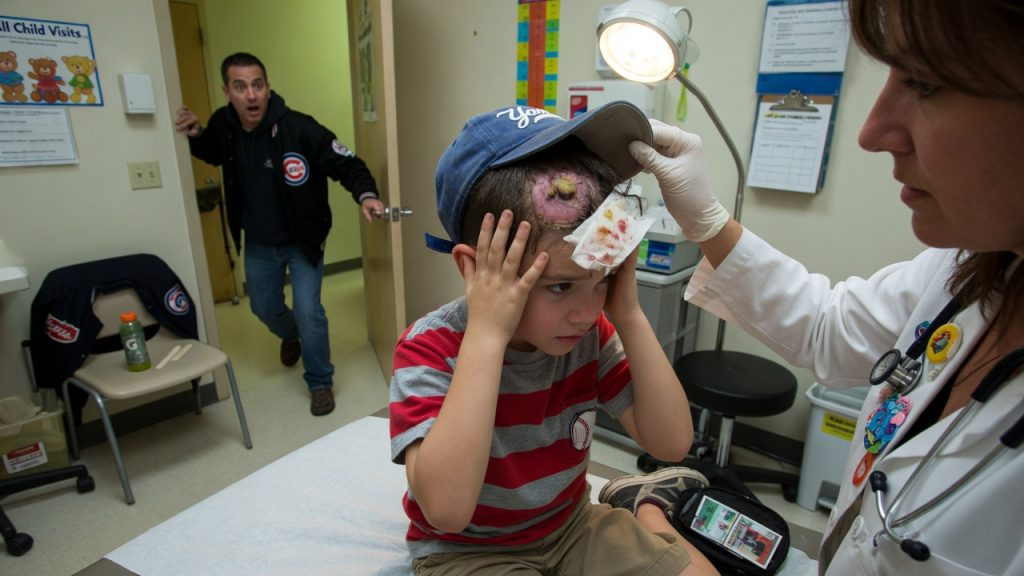
The right side of the boy’s head had been crudely shaved. The hair was hacked away in jagged, uneven patches, leaving the scalp exposed.
And on his temple, just above his right ear, was a wound.
It wasn’t a bump from a fall. It wasn’t a scrape.
It was a severe, deep-tissue burn.
The edges were angry, blistered, and weeping yellow pus. The center of the flesh was charred and raw.
My medical brain instantly categorized it: A third-degree thermal burn. Made by something flat and incredibly hot. An iron, or a heated piece of metal.
It was a fresh injury, no more than forty-eight hours old.
But it was what lay underneath the burn that made my lungs stop working.
The burn had been inflicted intentionally. Specifically.
Whoever did this was trying to obliterate something. They were trying to burn away a mark on the child’s skin.
But they hadn’t burned deep enough.
Visible through the raw, weeping tissue, untouched by the worst of the searing heat, was a highly distinct, deeply pigmented birthmark.
It was shaped perfectly like a crescent moon, wrapping slightly around the top of the ear.
My mind violently snapped back to the bulletin board in our staff breakroom.
To the Amber Alert poster that had been pinned there for three agonizing months.
MISSING: Julian Vance. Age 7. Last seen in Portland, Oregon. Identifying marks: Distinct crescent-moon birthmark on right temple.
The poster had offered a fifty-thousand-dollar reward. The case had dominated national news. The child had been abducted from his own driveway.
I stared at the crescent moon.
I stared at the little boy who called himself Leo.
The air in the room evaporated.
I didn’t gasp. I didn’t scream. I just stood frozen, holding the dirty baseball cap in my hand, staring at the irrefutable proof of a living nightmare.
Behind me, Arthur turned around.
He looked at the boy’s exposed head. Then he looked at my face.
He didn’t need me to say a word. He saw the recognition explode in my eyes. He saw the exact moment the puzzle pieces clicked together in my head.
“Hey,” Arthur said. His voice was no longer frantic. It was dead. Hollow.
I slowly turned my head to look at him.
Arthur didn’t lunge at me. He didn’t try to grab the boy.
He simply dropped the clipboard he had been holding. It hit the linoleum floor with a sharp, plastic clatter that sounded like a gunshot.
Before I could even open my mouth to yell for Elias—
Arthur spun on his heel, slammed his shoulder into the heavy wooden door, and sprinted out of the exam room, bolting straight for the emergency exit.
The plastic clipboard hit the linoleum with a sharp, violent crack that seemed to shatter the frozen air in Examination Room 3.
Before my brain could fully process the kinetic reality of what was happening, Arthur was already moving. He didn’t just run; he exploded into motion with the desperate, chaotic energy of a cornered predator. His heavy boots dug into the floor, his shoulder dropping as he slammed his entire body weight into the heavy wooden door.
“Elias!” I screamed.
The sound tore out of my throat, raw and unrecognizable. It wasn’t my standard, authoritative doctor’s voice. It was a primal, terrified shriek.
The door banged open, rebounding off the rubber wall stop with a sickening thud. Arthur burst into the hallway, a blur of dark Carhartt canvas and frantic motion.
Nurse Elias had been standing just outside, exactly as I had asked him to. But Elias was a massive man, built for stability, not sudden, lateral acceleration. Arthur hit him blindside.
I watched the collision in what felt like brutal slow motion. Arthur’s shoulder caught Elias right in the sternum. The big former combat medic grunted, staggering backward, his rubber-soled clogs skidding squeakily against the freshly waxed floor.
“Hey!” Elias bellowed, his deep voice rattling the glass of the nearby charting station.
But Arthur was already past him. He was sprinting down the stark, brightly lit corridor, his boots pounding a frantic rhythm toward the glowing red EXIT sign at the end of the hall.
“Code Purple! ER South!” Elias roared into the hallway, grabbing his walkie-talkie from his hip before launching his massive frame into a sprint, chasing the man down. “Suspect fleeing, white male, brown jacket, heading for the ambulance bay doors!”
Alarms immediately began to blare. The harsh, pulsing strobe lights of the hospital’s lockdown system activated, bathing the sterile white walls in violent, rhythmic flashes of crimson. The sudden shift in lighting transformed the familiar pediatric ward into a high-contrast battleground, shadows stretching and warping across the floor like reaching fingers.
I took one step toward the door, my instinct screaming at me to follow, to help Elias, to tackle the man who had burned this child.
But a sudden, sharp intake of breath stopped me dead in my tracks.
I spun around.
Julian.
The seven-year-old boy sitting on the crinkly paper of the examination table was completely deteriorating.
With Arthur gone, the invisible tether of terror that had kept the boy frozen had snapped. Julian was hyperventilating, his small chest heaving in rapid, jagged spasms. His hands were clawing frantically at his own face, his eyes wide and unseeing, locked on the empty doorway.
He thought he was dead.
In the twisted, horrific logic of a captive child, the absolute worst thing that could happen wasn’t being burned. It was displeasing his captor. It was being left behind in a strange place after breaking the rules.
“No, no, no, no,” Julian gasped, his voice a breathless, raspy chant. He scrambled backward on the table, trying to press himself through the drywall.
I abandoned the doorway. The chase was Elias’s job. This boy was mine.
I moved slowly, keeping my hands visible, fighting to keep my own breathing steady despite the adrenaline absolutely flooding my system.
“Julian,” I said firmly, but softly, intentionally using his real name.
He didn’t register it. He was lost in the dark labyrinth of his own trauma. He grabbed the edges of his oversized grey hoodie, pulling it over his face, curling his knees up to his chest, trying to make himself as small as physically possible.
“Please,” he whimpered from beneath the fabric. “I’m sorry. I didn’t mean to. I didn’t tell. I didn’t tell.”
My heart physically ached. It was a sharp, piercing pain behind my ribs. The psychological mechanics of abuse are deeply predictable and universally devastating. He was preemptively apologizing to the man who had tortured him, terrified of the retribution he believed was coming.
“Julian, look at me,” I said, stepping right up to the edge of the table.
I placed both of my hands firmly over his small, trembling knees. I applied deep, grounding pressure.
“Julian Vance. That is your name. You are Julian Vance, and you are in Harborview Medical Center. You are safe.”
He stopped chanting, though his breathing remained ragged. Slowly, he lowered the collar of the hoodie just enough to peer over the edge. His striking green eyes were swimming with tears, reflecting the harsh, blinking red emergency lights flashing through the frosted glass of the exam room door.
“He’s going to come back,” Julian whispered, his voice trembling so violently his teeth chattered. “He said if I ever took the hat off, the bad men would come. He said he would burn the other side.”
Bile rose hot and acidic in the back of my throat. I forced it down.
“He is never, ever coming back,” I said, locking my eyes onto his. I poured every ounce of absolute certainty I possessed into my voice. I needed to be his anchor in a world that had been spinning out of control for three months. “Do you hear me? He is gone. There are two dozen security guards out there, and they are locking all the doors. He cannot get to you. You are Julian, and you are going home.”
At the word “home,” a violent sob tore out of the boy’s chest. He collapsed forward.
I didn’t hesitate. I wrapped my arms around his small, frail body and pulled him against my chest. He was so light. He felt like a bundle of hollow bird bones wrapped in a dirty sweatshirt. He buried his face in my scrub top, his tears soaking instantly through the thin cotton, his small hands gripping the fabric of my shirt like it was the edge of a cliff.
I held him, resting my chin gently on the top of his uninjured head, careful to avoid the raw, weeping burn on his right temple.
Over the boy’s quiet sobbing, I could hear the absolute chaos erupting in the hallway. Walkie-talkies crackling. Boots running. The heavy steel fire doors of the ward automatically slamming shut, magnetically locking to seal the perimeter.
Ten minutes later, the door to Exam Room 3 opened.
I looked up, instinctively tightening my grip on Julian.
It was Elias.
He was breathing hard, his broad chest rising and falling beneath his scrubs. He was completely soaked. Rainwater dripped from his thick beard and plastered his hair to his forehead. There was a dark, angry bruise already forming on his jawline.
He looked at me, then at the boy huddled against my chest. The big medic’s eyes softened, but his jaw was clenched so tight the muscles twitched.
“He made it out the ambulance bay doors,” Elias said, his voice a low, furious rumble. “Hit the wet pavement. He had a car waiting in the lower garage. An old, beat-up silver Honda Civic. No plates. I tried to grab the door handle, but he sideswiped a concrete pillar and nearly took my arm off. He’s gone, Doc.”
I closed my eyes for a fraction of a second, feeling a crushing weight settle onto my shoulders.
“Are the police here?” I asked.
“Seattle PD just rolled up. Three cruisers. They’re setting up a perimeter, locking down the surrounding blocks. Detectives are on the way. They’re pulling the hospital security footage right now.” Elias paused, looking at the exposed, blistered wound on the side of Julian’s head. “Jesus Christ, Doc. Is that…”
“It’s Julian Vance,” I said quietly.
Elias let out a long, heavy breath, leaning back against the doorframe. He ran a massive hand down his wet face. “The Amber Alert kid from Portland.”
“Yes.”
“I’ll get the burn kit,” Elias whispered, his voice thick with an emotion he was desperately trying to suppress. “And I’ll call the social worker.”
An hour later, the pediatric ward had been transformed from a chaotic medical floor into a heavily secured fortress.
Uniformed police officers stood at every set of double doors. The waiting room had been cleared of non-essential patients. The air was thick with tension, the smell of wet wool uniforms, and the crackle of police radios.
Julian was still sitting on the examination table. I had managed to get him to drink half a cup of apple juice, but he hadn’t spoken another word since he collapsed against me. He just stared blankly at the far wall, his hands resting limply in his lap.
The door opened, and Detective Marcus Thorne walked in.
If there was ever a man who looked like he carried the weight of a broken city on his back, it was Thorne. He was a veteran of the Seattle PD’s Special Victims Unit, a man in his late forties with salt-and-pepper hair, deep lines etched around his eyes, and the permanent, exhausting posture of someone who spent his life looking at the darkest corners of human nature.
He wore a dark, tailored suit under a trench coat that was shedding rainwater onto my linoleum floor.
I knew Thorne. We had worked together before, on cases that neither of us ever talked about outside these walls.
Thorne possessed a razor-sharp deductive mind and an unyielding, almost terrifyingly relentless pursuit of justice. It made him a brilliant detective, but it also made him a ghost in his own life. I knew from the nurses’ station gossip that his obsession with his work had cost him his marriage, and left him estranged from his own teenage daughter. He was a man driven by a profound, agonizing need to save everyone else’s children because he felt he had failed his own.
As he walked into the room, I noticed the familiar, rhythmic flash of silver in his right hand. He was endlessly rolling a heavy, silver half-dollar coin across his knuckles—a nervous tic he employed whenever he was trying to control a spike of rage.
Thorne looked at Julian. The coin stopped moving.
He didn’t step too close. He knew better than to crowd a traumatized victim.
“Hello, Julian,” Thorne said. His voice was shockingly gentle, a low, gravelly baritone. “My name is Marcus. I’m a police officer. I’m here to make sure no one ever hurts you again.”
Julian didn’t blink. He just stared at the wall.
Thorne looked at me, giving a subtle tilt of his head toward the hallway.
I gave Julian’s knee a gentle squeeze, then stepped out into the hall with the detective. The heavy wooden door clicked shut behind us.
The moment we were alone, the gentle demeanor vanished from Thorne’s face. His jaw set like granite. He resumed rolling the silver coin across his knuckles, faster now.
Clink, clink, clink.
“Tell me everything, Jen,” Thorne demanded, his eyes burning into mine. “Every word he said. The make of his boots. The smell of his jacket. Whatever you got.”
I crossed my arms, shivering slightly as the damp chill of the hallway seeped through my scrubs.
“He called himself Arthur. Late thirties, gaunt, around six-foot-one. Wearing a brown Carhartt over a flannel. Smelled like stale cigarettes and cheap motor oil. He claimed the kid had sensory issues to keep the hat on. When I forced the issue, he bolted.”
“Elias said he drove a silver Honda. Mid-2000s model. No plates,” Thorne muttered, staring down the hallway. “We’ve got units pulling traffic cam footage for a ten-mile radius, but the rain is making visibility absolute garbage. The security cameras in the garage caught a partial profile through the windshield. We’re running facial recognition now, cross-referencing with known sex offenders and kidnappers in the Pacific Northwest.”
“He’s not just a kidnapper, Marcus,” I said, my voice dropping to an angry whisper. “Look at the boy’s head.”
“I saw the burn,” Thorne said, his jaw clenching tightly.
“He used an iron, or a heated pipe,” I explained, the clinical detachment failing me, my voice shaking with fury. “He tried to burn the birthmark right off the kid’s skull to keep him from being recognized. It’s a third-degree thermal injury. It’s infected. The pain the kid must have been in… Marcus, he’s been living with that agonizing pain for days, and he didn’t make a single sound in the waiting room. He’s been completely psychologically broken.”
Thorne stopped rolling the coin. He gripped it tightly in his fist.
“Portland PD is on the line with the parents,” Thorne said, his voice tight. “They’re putting them on a State Patrol helicopter right now. They’ll be here in two hours. But I need to talk to the boy, Jen. I need to know where this ‘Arthur’ kept him. If he has a house, a basement, a trailer… I need a location before this bastard disappears into the woods.”
“You can’t interrogate him right now, Marcus,” I fired back, stepping into his personal space. “He is catatonic. His heart rate is still elevated, he’s dangerously dehydrated, and he’s terrified. If you start firing questions at him, he is going to completely shut down.”
“I don’t have time to wait for him to warm up to me!” Thorne hissed, his frustration cracking his professional veneer. “We have a two-hour window before this guy dumps the car and steals another one. If I lose his trail tonight, we might never find him. He could have other victims, Jen. Guys like this rarely stop at one.”
“I know,” I said. “But you pushing him isn’t going to work.”
Before Thorne could argue, the heavy double doors at the end of the hallway swung open.
“That’s why I’m here, Detective,” a calm, feminine voice echoed down the corridor.
We both turned.
Walking toward us was Sarah Higgins, Harborview’s lead pediatric social worker.
Sarah was a woman who radiated an unshakeable, foundational calm. She was in her early fifties, wearing comfortable corduroy pants, a thick, mustard-yellow cardigan, and sensible walking shoes. She had kind, tired eyes and a reputation for being fiercely protective of her patients. She was an insomniac, known to take the trauma of these children home with her, spending her nights pacing her living room, unable to shake the ghosts of the ER.
But tonight, Sarah wasn’t alone.
Walking faithfully by her side, his heavy paws padding softly against the linoleum, was Barnaby.
Barnaby was a massive, 110-pound Golden Retriever and English Mastiff mix. He had the thick, golden coat of a retriever, but the broad, powerful chest and heavy, sorrowful jowls of a mastiff. He wore a red vest that read: THERAPY K-9 – DO NOT PET UNLESS INVITED.
Barnaby was a legend in the hospital. He was a retired search-and-rescue tracking dog who had blown out a knee searching rubble a few years back. Now, he served as an emotional anchor for the most severely traumatized children who came through our doors. He possessed an uncanny, almost supernatural ability to sense human anxiety and absorb it.
“Sarah,” I breathed a sigh of relief.
Sarah walked up to us, her hand resting gently on Barnaby’s massive head.
“Detective Thorne,” Sarah said, offering a polite but firm nod. “Dr. Jenkins briefed me on the way in. You need information, but you can’t break the boy to get it. Let me and Barnaby go in.”
Thorne looked skeptically at the massive dog, who was currently sitting perfectly still, panting softly, his deep brown eyes looking up at the detective.
“A dog?” Thorne asked, raising an eyebrow. “I need an address, Sarah. Not a petting zoo.”
“You need him to feel safe,” Sarah corrected smoothly, reaching into the pocket of her cardigan and pulling out a small vintage tin. She retrieved a dog treat and handed it to Barnaby. “Right now, Julian views every adult human as a potential threat. Because an adult human broke him. But Barnaby isn’t human. He’s a protector. Let us do our job.”
Thorne looked at me. I nodded firmly.
“Ten minutes,” Thorne relented, running a hand through his graying hair. “I need something, Sarah. Anything. A street name. A landmark. Anything.”
“Come on, buddy,” Sarah whispered to the dog.
I opened the door to Room 3, and Sarah walked in, Barnaby right at her heels.
Julian was exactly where I had left him. Still, silent, staring into the void.
Sarah didn’t walk up to the table. She didn’t speak to him immediately. She simply sat down on my rolling stool, leaving several feet of space between them.
“Go to work, Barnaby,” Sarah whispered softly.
Barnaby didn’t rush. The massive dog took three slow, deliberate steps toward the examination table. He stopped right at Julian’s dangling feet.
He didn’t bark. He didn’t jump.
Barnaby simply let out a long, heavy sigh through his jowls, and rested his massive, heavy head directly on top of Julian’s frayed denim knees.
Julian flinched at the sudden weight. He looked down, his green eyes widening in shock.
Barnaby looked up at the boy with eyes that held centuries of quiet, uncomplicated sorrow. The dog pushed his broad nose gently under Julian’s trembling hand, forcefully nudging the boy’s palm until it rested on top of his golden head.
Then, Barnaby leaned his entire 110-pound body weight against Julian’s legs.
It’s a technique called deep pressure therapy. For a nervous system that is locked in a perpetual state of ‘fight or flight’, the sudden, grounding weight of a massive, calm animal acts like a physical circuit breaker. It forces the brain to register safety in the immediate environment.
I watched from the doorway, holding my breath.
For a long moment, Julian just stared at the dog. His fingers hovered nervously over the thick fur.
Then, slowly, Julian buried his fingers into the soft fur behind Barnaby’s ears.
The dog let out a low, rumbling groan of contentment, leaning harder into the boy’s legs.
Julian’s chest hitched. He let out a shaky breath.
And then, the dam broke.
Julian didn’t sob this time. He just leaned forward, burying his face into the thick fur of the dog’s neck, wrapping his thin arms around Barnaby’s massive head. Barnaby didn’t move an inch. He just stood there like a furry statue, absorbing the child’s terror like a sponge.
“His name is Barnaby,” Sarah said softly, her voice carrying the gentle, melodic rhythm of a lullaby. “He’s very brave. And he makes sure nobody bad comes into this room. As long as Barnaby is here, you are perfectly safe.”
Julian kept his face buried in the dog’s neck. “He’s heavy,” the boy whispered, his voice muffled by the fur.
“He is,” Sarah agreed, smiling warmly. “He likes you, Julian.”
At the sound of his name, Julian didn’t flinch. The dog’s presence was working.
“Julian,” Sarah continued, her voice never changing its soothing cadence. “The doctors here need to clean the owie on your head. They have to make sure it doesn’t get sick. It might sting a little bit. Will you let Dr. Jenkins fix it, if Barnaby stays right here with you?”
Julian hesitated. His fingers gripped the dog’s fur tighter. Finally, he gave a tiny, almost imperceptible nod.
I stepped into the room, pulling a pair of sterile purple nitrile gloves from the wall dispenser. The snap of the latex made Julian jump, but Barnaby let out a soft whine and nudged his chin against the boy’s chest, bringing his focus back down.
I moved to the stainless steel tray where Elias had left the burn kit. I opened the sterile packages: sterile saline, silver sulfadiazine cream, non-adherent gauze, and medical tape.
I rolled my stool up to the right side of the boy.
Up close, under the bright exam light I pulled from the wall, the burn was even more horrific. The smell of charred, necrotic tissue and active infection was overpowering. The crescent-moon birthmark peeked out from beneath the weeping yellow blisters, a defiant mark of identity that Arthur had failed to erase.
“Okay, Julian,” I murmured, my voice steady and clinical to project competence. “I’m going to clean it now with some water. Just focus on Barnaby.”
I soaked a piece of sterile gauze in the saline and gently, agonizingly slowly, began to dab at the edges of the burn, clearing away the dried blood and weeping pus.
Julian hissed through his teeth, his entire body going rigid. His knuckles turned white as he gripped the dog.
“I know, buddy. I know,” I whispered. “You’re doing incredibly well.”
“Arthur said…” Julian gasped, tears springing fresh to his eyes. “He said if I cried when he did it, he would use it on my eyes next.”
My hand stopped mid-air. I felt a cold, murderous fury spike through my chest. Behind me, I heard Sarah’s breath hitch.
“Well, Arthur is a liar,” I said, my voice hardening just a fraction. “And Arthur isn’t here. You can cry all you want, Julian. In fact, I want you to cry if it hurts.”
I applied a thick layer of the silver sulfadiazine cream to the non-adherent dressing. The white cream was a powerful topical antibiotic designed specifically for severe thermal burns. It would immediately begin fighting the infection and provide a soothing, cooling barrier over the exposed nerve endings.
I gently pressed the dressing over the burn, securing it tightly with medical tape, making sure to wrap it securely around the curve of his head so it wouldn’t slip.
“There,” I said, leaning back and pulling off my gloves. “All done. The medicine will make it start feeling better very soon.”
Julian slumped forward, exhausted, resting his chin back on Barnaby’s head. The dog licked his hand affectionately.
Sarah leaned forward slightly.
“Julian,” she said softly. “The man outside the door… his name is Marcus. He’s a policeman. His job is to catch Arthur and put him in a timeout forever so he can’t hurt anyone else. But Marcus needs your help.”
Julian squeezed his eyes shut. “I don’t want him to find me.”
“He won’t find you,” Sarah promised. “But we want to find him. Do you remember anything about where Arthur took you? Was it an apartment? A house?”
Julian was quiet for a long time. The only sound in the room was Barnaby’s steady panting.
“It smelled like fish,” Julian whispered into the fur.
Sarah and I exchanged a quick look. Seattle was a port city. Half the town smelled like fish on a windy day. We needed more.
“Fish,” Sarah encouraged. “Okay. Did you hear anything? Cars? Airplanes? Boats?”
“No airplanes,” Julian said, his voice stronger now, anchored by the dog. “Just rain. And bells.”
“Bells?” I asked, stepping closer. “Like church bells?”
“No,” Julian said, lifting his head slightly to look at me. “Loud bells. And horns. Big horns that made the walls shake. And I could hear water hitting the wood under the floor.”
My eyes widened. I looked at Sarah, and I could see the exact moment the realization hit her too.
Water hitting the wood under the floor. Smells like fish. Big horns and loud bells.
Arthur wasn’t keeping the boy in a house. He wasn’t in an apartment in the suburbs.
He had been keeping him in a boathouse. Or on a derelict fishing vessel moored somewhere along the vast, industrial docks of the Puget Sound or the ship canal.
I didn’t wait. I spun around, pushed the heavy door open, and stepped back into the hallway where Thorne was pacing violently, still rolling his silver coin.
He stopped and looked at me, his eyes wide with anticipation.
“Docks,” I said, my voice sharp and urgent. “He’s been holding him on the water, Marcus. A boat or a pier house. The kid heard foghorns, buoy bells, and water under the floorboards.”
Thorne’s eyes lit up with a dangerous, predatory fire. He pocketed the silver coin.
“The silver Honda,” Thorne said, his mind moving at lightspeed. “He hit Elias and bolted out of the bay. He’s going back to his base to clear out his stuff before he skips town.”
Thorne pulled his radio from his belt.
“Dispatch, this is Detective Thorne. I need all available units to converge on the marinas and industrial docks along the Lake Washington Ship Canal and Harbor Island. We are looking for a silver mid-2000s Honda Civic, heavy front-end damage. Suspect is white male, armed and dangerous. Move on my mark.”
Thorne looked at me, the grim reality of the hunt settling over his features.
“We’ve got him, Jen,” Thorne said grimly, turning toward the exit. “I’m going to tear the waterfront apart until I find this son of a bitch.”
As Thorne sprinted down the hallway, the red emergency lights continued to flash, casting long shadows against the walls. Inside Room 3, Julian Vance was finally safe, anchored by a massive golden dog.
But the night wasn’t over. The hunt had just begun.
Chapter 2
The heavy wooden door to Room 204 hadn’t even clicked shut before the silence in the classroom shattered.
It wasn’t a sudden explosion of noise, but a collective, fractured gasp from thirty terrified seventh graders. The air in the room, already suffocatingly thick with the ninety-two-degree heat, seemed to curdle. Dust motes hung suspended in the harsh, slanted beams of late-morning sunlight piercing through the cracked window blinds, catching the sheer physical tension vibrating in the space.
I was on the linoleum floor, my knees aching against the hard tile, clutching an unconscious eleven-year-old boy whose skin felt like a furnace left on high.
And my eyes were locked on the doorframe where Uncle Marcus had just vanished.
He walked backward.
The thought echoed in my mind, rhythmic and terrifying. People don’t walk backward away from a fainting child unless the thing they are looking at terrifies them more than the child’s potential death.
Marcus hadn’t been looking at me. He had been looking at the angry, raised flesh carved behind his nephew’s ear.
The “M.”
“Miss Miller?”
The voice was tiny, trembling. It was Chloe, standing half out of her desk in the front row, her hands clasped over her mouth. Her wide eyes flicked from the doorway down to Leo’s limp body in my arms, and then to Barnaby.
Barnaby.
My ninety-pound Golden Retriever had completely abandoned his usual docile therapy-dog demeanor. His posture was rigid, his golden coat bristling along his spine. He stood directly between me and the doorway, his broad chest squared off against the empty hall. He wasn’t barking. He was emitting a continuous, low-frequency rumble from deep within his chest—a sound that vibrated right through the floorboards and into my kneecaps.
It was the ultimate protective archetype kicking in. Barnaby was drawing a line in the sand. Nothing else comes through that door.
“Jenny!” I screamed.
The raw volume of my own voice shocked me. It tore through the stagnant air, carrying out into the hallway.
Seconds later, the door banged open. Barnaby let out a sharp, single bark, stepping forward to block the intruder, but stopped when he recognized the bright yellow cardigan.
Jenny Vance, the seventh-grade science teacher from across the hall, froze in the doorway. She was twenty-six, barely three years out of her teaching credential, and usually possessed an infectious, nervous energy that the kids loved. But right now, the color drained entirely from her face.
“Sarah? Oh my god. What happened? Is he breathing?” Jenny dropped the stack of grading rubrics she was holding. Papers scattered like white doves across the floor, catching the harsh overhead fluorescent light.
“He’s having a heatstroke,” I said, my voice shaking. I adjusted my grip on Leo. His head lolled back against my forearm. His skin was dangerously pale, slick with cold sweat, yet radiating an unnatural, terrifying heat. “Call the nurse. Tell Evelyn to get the ice packs ready. And Jenny…”
I looked up at her, my eyes wide and frantic.
“Lock the door.”
Jenny didn’t ask questions. She saw the sheer panic in my face. She stepped inside, slammed the heavy oak door shut, and I heard the solid snick of the deadbolt turning.
“Call Evelyn,” I repeated, my attention snapping back to Leo.
I needed to cool him down. Now. I couldn’t wait for the nurse. The boy was cooking from the inside out in this heavy, fleece-lined fortress.
My fingers fumbled with the thick metal zipper of his hoodie. It was jammed at the collar. I yanked it down, the teeth of the zipper screaming in protest. Underneath, he was wearing a faded, threadbare t-shirt that clung to his ribs. He was so incredibly thin. The kind of thin that spoke of missed meals and quiet, persistent hunger.
As I pulled the heavy fleece away from his shoulders, the right side of his head was fully exposed to the harsh, unforgiving light of the classroom.
Jenny, still holding her cell phone to her ear, gasped. It was a sharp, involuntary intake of breath that sounded like she had been physically struck.
“Sarah…” she whispered, the phone slipping slightly from her ear. “What… what is that?”
“I don’t know,” I lied.
I knew exactly what it was. I had grown up in the shadow of violence. I knew the difference between a tragic accident and deliberate cruelty. The edges of the scar were too perfect. The lines were too deliberate. It was a brand. Someone had taken a piece of superheated metal, shaped it into a letter, and pressed it into the soft, vulnerable flesh behind an eleven-year-old child’s ear.
“Evelyn?” Jenny said into the phone, her voice cracking. “We need you in Room 204. Now. Bring a wheelchair. And ice. Lots of ice.”
Barnaby broke his defensive stance at the door and circled back to us. He didn’t lick Leo’s face. He knew better. Instead, the massive dog wedged himself tightly against Leo’s right side, laying his heavy head directly over the boy’s racing heart. Deep pressure therapy. Even with the boy unconscious, Barnaby was trying to regulate his nervous system, using his own steady heartbeat as an anchor.
Two minutes later, a sharp, authoritative knock hammered on the locked door.
Jenny practically threw herself at the deadbolt.
Dr. Evelyn Thorne pushed through the frame, a folding transit wheelchair maneuvering effortlessly in her hands. Evelyn was a force of nature. In her mid-fifties, with a sharp salt-and-pepper bob and a pronounced limp from a horrific car accident a decade ago, she ran the school clinic with the precision and stoicism of a combat triage unit. She had spent fifteen years as a trauma nurse in Philadelphia before seeking the supposed “quiet life” of a middle school.
Her eyes swept the room. They registered the heat, the thirty terrified students pressed against the back wall, the locked door, the growling dog, and finally, the unconscious boy on the floor.
“Let me in,” Evelyn ordered, dropping to her knees with surprising agility despite her bad leg.
She pressed two cool, professional fingers against the carotid artery on the left side of Leo’s neck. Her face gave away absolutely nothing.
“Pulse is thready. Heart rate is easily pushing one-forty. Skin is hot and dry.” Evelyn unslung a canvas bag from her shoulder. She ripped open three instant cold packs, the chemical pop loud in the quiet room. “Sarah, lift his head. We need these under his armpits and on the back of his neck.”
I did as I was told. The moment my fingers brushed his skin, Leo let out a soft, broken moan.
“He’s coming around,” Evelyn said. She shifted her position to get a better angle to place the ice pack behind his neck.
That was when she saw it.
Evelyn’s hands stopped. The seasoned ER nurse, the woman who had seen gunshot wounds and terrible accidents, simply froze. Her eyes traced the cruel, red “M” carved into the boy’s skin.
The lighting in the room suddenly felt entirely too bright, exposing a secret that was never meant to survive the dark.
For three agonizing seconds, nobody breathed.
“Evelyn,” I whispered, snapping her out of it.
She blinked, her jaw clenching so hard the muscles in her cheek jumped. The professional mask slammed back into place, but the eyes behind it were burning with a cold, terrifying fury.
“Get him in the chair,” Evelyn commanded, her voice dropping an octave. “Jenny, keep the kids in here. Nobody leaves. Sarah, you’re with me. Barnaby, heel.”
We hoisted Leo’s dead weight into the chair. His head slumped forward. Evelyn didn’t wait for me. She spun the chair around and pushed it out into the hallway, her bad leg dragging slightly as she practically sprinted toward the clinic.
I followed closely, Barnaby right at my hip.
The hallway was a blur of institutional beige tiles and blue lockers. The air outside my classroom was marginally cooler, but it still felt heavy with the impending storm of what we had just uncovered.
We burst through the double doors of the clinic. The air conditioning in here worked perfectly. The blast of frigid air hit me like a physical wall, chilling the sweat that soaked my blouse.
“Door. Lock it,” Evelyn barked, maneuvering the chair beside the single examination bed.
I turned the lock and pulled the privacy blinds down over the glass window.
Together, we lifted Leo onto the crinkly paper of the exam table. Evelyn immediately went to work, her hands moving in a blur of practiced efficiency. She stripped off his damp shoes and socks. She placed cool, wet towels over his forehead and chest.
“Call Arthur,” Evelyn said, not looking up from her work. She was shining a penlight into Leo’s slightly open, unseeing eyes. “Tell the Principal we need police and EMS. In that order.”
“Arthur won’t want police,” I said, my voice hollow. I remembered my conversation with Principal Davis just yesterday. His obsession with optics. His fear of the school board.
“I don’t give a damn what Arthur wants,” Evelyn snarled, the trauma nurse finally breaking through the school employee. She pointed a trembling finger at the side of Leo’s head. “Look at that, Sarah. Really look at it. You think a child gets a third-degree brand on his skull by accident? You think his uncle just ‘forgot’ to mention it? Call the police. Now. Or I will.”
I pulled my cell phone from my pocket. My hands were shaking so violently I dropped it on the floor.
Before I could pick it up, Leo gasped.
It was a sharp, jagged sound, like a drowning victim breaking the surface of the water.
His eyes snapped open. They were a pale, striking hazel, but right now, they were entirely blown out, the pupils dilated with pure, unadulterated terror.
He didn’t know where he was. He felt the cold air, the wet towels, the unfamiliar room.
And instantly, he realized the hood was gone.
“No!” Leo screamed.
It was a sound that will haunt me for the rest of my life. It wasn’t the cry of a child in pain. It was the primal shriek of an animal that realizes the trap has closed.
He scrambled backward on the examination table, his back hitting the wall with a loud thud. He pulled his knees to his chest, his hands flying up to cover the sides of his head, frantically trying to recreate the barrier of the heavy fleece that we had taken from him.
“Leo, it’s okay,” I said, taking a step forward, my hands raised in a gesture of surrender. “You’re safe. You’re in the nurse’s office.”
“Where is it?!” he sobbed, his eyes darting wildly around the room. He was hyperventilating, his thin chest heaving. “Where’s my jacket? Give it back! Please! He’ll see! He’s going to know!”
“Who is going to know, sweetie?” Evelyn asked softly, her voice miraculously changing from a drill sergeant’s bark to a mother’s gentle coo. She didn’t move an inch toward him.
“The man!” Leo cried, burying his face in his knees. “He said if anyone saw it, he’d know. He’d always know!”
I felt a cold dread settle in my stomach.
Uncle Marcus had come to the door. He had seen the scar. And he had run.
He’s going to know.
“Leo, look at me,” I said gently.
He peeked out from behind his arms. His eyes were wide, bloodshot, and filled with tears.
“I have something that can help you hide right now,” I said. “But you have to let him up.”
I snapped my fingers twice, pointing at the small space on the examination bed next to Leo.
“Barnaby, up.”
The massive Golden Retriever didn’t hesitate. He hopped onto the paper-lined bed with surprising grace. He didn’t approach Leo aggressively. Instead, Barnaby walked to the far end of the bed, turned his back to the wall, and deliberately laid his ninety-pound body across Leo’s outstretched legs.
He curled his golden head over Leo’s lap, effectively pinning the boy in place with a blanket of warm, living weight.
Deep pressure. It was a sensory trick. A way to tell an overstimulated, terrified brain that it was grounded. That it was anchored to the earth and not floating away in panic.
Leo stopped scrambling.
His ragged breathing hitched. He stared down at the massive dog draped across him. Slowly, tentatively, a small, trembling hand reached out and buried its fingers in the thick, soft fur behind Barnaby’s ears.
Barnaby let out a long, heavy sigh, resting his chin on Leo’s knee.
The boy’s shoulders dropped an inch. The hyperventilation slowed to a stuttering sob.
“He’s got you,” I whispered, moving to the edge of the bed. I kept my eyes on Leo’s face, deliberately avoiding looking at the angry red scar. “Barnaby’s an expert at hiding people. He won’t let anyone see you.”
Leo didn’t answer, but his grip on the dog’s fur tightened.
A sharp, demanding knock rapped against the clinic door, shattering the fragile peace we had just built.
“Sarah! Evelyn! Open this door!”
It was Principal Arthur Davis. His voice was muffled through the wood, but the authoritative irritation was unmistakable.
Evelyn shot me a dark look. She walked to the door, unlocked it, and pulled it open just enough to step her body into the frame, blocking Arthur from entering.
“Arthur, keep your voice down,” Evelyn hissed. “We have a medical emergency.”
“I have thirty unsupervised seventh graders across the hall and a panic spreading through the C-wing!” Arthur shot back. He was a tall man, balding, impeccably dressed in a tailored suit that cost more than my monthly salary. He ran the school like a corporation, and he absolutely loathed anything that disrupted his spreadsheets. “Jenny Vance is hyperventilating in the hallway talking about brands and scars. What the hell is going on in here?”
“Arthur,” I said, stepping up behind Evelyn. “Leo collapsed. Heatstroke. When we removed his sweatshirt to cool his core temperature…”
I swallowed hard. The words tasted like ash.
“Someone branded him, Arthur. Someone carved a letter into the side of his head.”
The color drained from Arthur Davis’s perfectly tanned face. He stopped pushing against the door.
“Branded?” he repeated, the word sounding foreign in his mouth. “Are you… are you sure? Maybe it’s a birthmark. A severe rash.”
“I was an ER trauma nurse in Philly for fifteen years, Arthur,” Evelyn said coldly. “I know what a third-degree thermal burn looks like. It’s an ‘M’. It’s deliberate. And based on the tissue granulation, I’d say it’s barely a month old.”
Arthur ran a hand over his bald head. I could see the liability calculations running behind his eyes.
“Did his uncle do it?” Arthur asked, his voice dropping to a harsh whisper. “The front office said Marcus was here to pick him up.”
“Marcus came to my door,” I said. The cinematic replay of the event looped in my mind. The harsh lighting. The dust motes. The squeak of the steel-toed boots. “Leo passed out. The hood fell back. Marcus saw the scar… and he ran.”
“He ran?” Arthur asked, incredulous.
“He backed away like he had just seen a ghost, and he bolted down the hallway,” I confirmed.
Arthur closed his eyes. “Okay. Okay. Protocol. We need to call Child Protective Services. We need to document everything. Nobody talks to the press.”
“We need the police, Arthur,” Evelyn snapped. “CPS takes hours. A man who brandishes a hot iron on a child is currently fleeing the scene. Call the police.”
“I already did.”
The new voice came from the hallway, just behind Arthur.
Arthur jumped, startled, and spun around.
Standing there was Detective Mike Vargas.
Vargas looked exactly the way he had ten years ago when I first met him, only infinitely more tired. He was in his mid-forties, wearing a rumpled grey suit that looked like he had slept in it. He carried the heavy, weary aura of a man who had seen the absolute worst of humanity and somehow still decided to wake up every morning to look at it again. He had dark, sharp eyes that missed absolutely nothing, and a slight, permanent slouch from carrying a badge that weighed too much.
We had crossed paths a decade ago. His nephew, Mateo, had been a student in my first year of teaching—a brilliant kid on the wrong path. Vargas and I had tag-teamed to keep Mateo out of juveli. We won that battle, but the war of their neighborhood eventually claimed Mateo anyway. Neither of us ever really got over it.
“Detective Vargas,” Arthur said, quickly recovering his bureaucratic poise. “We were just about to call your precinct.”
“The front desk clerk already hit the panic button when a guy in steel-toed boots sprinted out of the front doors and almost ran down a crossing guard with his truck,” Vargas said in a low, gravelly voice. His eyes flicked past Arthur, landing on me. A brief flicker of recognition, a silent acknowledgment of our shared history, passed between us.
“Sarah,” he said softly.
“Mike,” I replied, my voice tight.
“Heard we got a medical emergency. And a runner.” Vargas stepped past Arthur, gently but firmly pushing the Principal aside to enter the clinic.
His eyes swept the room. They didn’t linger on Evelyn or me. They went straight to the examination bed.
To Leo. And to Barnaby.
Barnaby let out a low rumble, not a growl of aggression, but a warning tone. Tread lightly.
Vargas stopped dead in his tracks. He didn’t approach the bed. He knew better than to corner a frightened animal, human or canine.
He slowly reached into his breast pocket, pulled out a small, battered notepad, and a click pen.
“Hey there, buddy,” Vargas said to Leo. His voice was incredibly soft, a sharp contrast to his rugged appearance. “That’s a good-looking dog you got there. Keeps the bad guys away, huh?”
Leo didn’t answer. He had buried his face entirely in Barnaby’s golden flank. Only the unscarred side of his head was visible.
Vargas didn’t push. He turned back to me and Evelyn.
“Alright. Walk me through it. Minute by minute.”
For the next ten minutes, under the hum of the fluorescent lights and the quiet, steady breathing of the therapy dog, I told Detective Vargas everything. I told him about the heatwave, the hoodie, the silence. I told him about the flinching. The pacing of the dog. And finally, the moment the heavy fleece fell back.
When I described the brand, Vargas stopped writing.
He didn’t show shock. He didn’t gasp like Jenny or glare like Evelyn.
Instead, a profound, chilling darkness settled over his features. The bags under his eyes seemed to deepen.
“An ‘M’,” Vargas repeated quietly. “Capital letter?”
“Yes,” I said. “Block lettering. Like a cattle brand.”
Vargas closed his notebook with a soft snap. He looked at me, his sharp eyes drilling into mine.
“And you’re sure about the uncle’s reaction?” Vargas asked. “Marcus. You’re sure he was terrified?”
“He looked like he was staring at a monster,” I said, remembering the absolute void of color in the man’s weathered face. “He didn’t try to take Leo. He didn’t even check if the kid was alive. He just ran.”
Vargas rubbed his jaw. The stubble made a raspy sound in the quiet room.
“That’s the part that bothers me, Sarah,” Vargas said slowly, his mind clearly working a puzzle none of us could see yet.
“Why?” Arthur asked, leaning against the doorframe, still trying to control the narrative. “The man is clearly a monster. He branded his nephew, realized the jig was up, and fled to avoid arrest.”
“Because, Mr. Davis,” Vargas said, turning to the Principal with a look of exhausted patience, “if Marcus is the one who held a branding iron to this kid’s skull… why would he be terrified of his own handiwork?”
The room went dead silent.
The implication hung in the cold, air-conditioned air, heavier than the ninety-two-degree heat outside.
If Marcus didn’t do it… who did?
And more importantly, if Marcus was running in absolute terror from the sight of that brand… what exactly did that ‘M’ mean?
Suddenly, Vargas’s police radio, clipped to his belt, crackled to life in a burst of static.
“Unit 4 to Dispatch. We have eyes on the suspect vehicle. Gray Chevy pickup, partial plate Bravo-Charlie-Niner. Vehicle is abandoned.”
Vargas snatched the radio from his belt. “Vargas here. Location?”
“Off Route 9. Edge of the old quarry woods. Detective…” The patrol officer’s voice hesitated, cracking slightly over the radio frequency. “You’re gonna want to get down here. The truck is empty. But there’s blood on the steering wheel. A lot of it. And the driver’s side door looks like it was torn right off the hinges.”
Vargas lowered the radio.
He looked at me. I looked at Evelyn.
The terrifying truth was no longer just in my classroom. It was bleeding out into the world.
Leo whimpered from the bed, his small fingers digging deeper into Barnaby’s fur.
The boy hadn’t been hiding from his uncle.
He and his uncle had been hiding from something else.
Something that had just caught up to them.
The plastic clipboard hit the linoleum with a sharp, violent crack that seemed to shatter the frozen air in Examination Room 3.
Before my brain could fully process the kinetic reality of what was happening, Arthur was already moving. He didn’t just run; he exploded into motion with the desperate, chaotic energy of a cornered predator. His heavy boots dug into the floor, his shoulder dropping as he slammed his entire body weight into the heavy wooden door.
“Elias!” I screamed.
The sound tore out of my throat, raw and unrecognizable. It wasn’t my standard, authoritative doctor’s voice. It was a primal, terrified shriek.
The door banged open, rebounding off the rubber wall stop with a sickening thud. Arthur burst into the hallway, a blur of dark Carhartt canvas and frantic motion.
Nurse Elias had been standing just outside, exactly as I had asked him to. But Elias was a massive man, built for stability, not sudden, lateral acceleration. Arthur hit him blindside.
I watched the collision in what felt like brutal slow motion. Arthur’s shoulder caught Elias right in the sternum. The big former combat medic grunted, staggering backward, his rubber-soled clogs skidding squeakily against the freshly waxed floor.
“Hey!” Elias bellowed, his deep voice rattling the glass of the nearby charting station.
But Arthur was already past him. He was sprinting down the stark, brightly lit corridor, his boots pounding a frantic rhythm toward the glowing red EXIT sign at the end of the hall.
“Code Purple! ER South!” Elias roared into the hallway, grabbing his walkie-talkie from his hip before launching his massive frame into a sprint, chasing the man down. “Suspect fleeing, white male, brown jacket, heading for the ambulance bay doors!”
Alarms immediately began to blare. The harsh, pulsing strobe lights of the hospital’s lockdown system activated, bathing the sterile white walls in violent, rhythmic flashes of crimson. The sudden shift in lighting transformed the familiar pediatric ward into a high-contrast battleground, shadows stretching and warping across the floor like reaching fingers.
I took one step toward the door, my instinct screaming at me to follow, to help Elias, to tackle the man who had burned this child.
But a sudden, sharp intake of breath stopped me dead in my tracks.
I spun around.
Julian.
The seven-year-old boy sitting on the crinkly paper of the examination table was completely deteriorating.
With Arthur gone, the invisible tether of terror that had kept the boy frozen had snapped. Julian was hyperventilating, his small chest heaving in rapid, jagged spasms. His hands were clawing frantically at his own face, his eyes wide and unseeing, locked on the empty doorway.
He thought he was dead.
In the twisted, horrific logic of a captive child, the absolute worst thing that could happen wasn’t being burned. It was displeasing his captor. It was being left behind in a strange place after breaking the rules.
“No, no, no, no,” Julian gasped, his voice a breathless, raspy chant. He scrambled backward on the table, trying to press himself through the drywall.
I abandoned the doorway. The chase was Elias’s job. This boy was mine.
I moved slowly, keeping my hands visible, fighting to keep my own breathing steady despite the adrenaline absolutely flooding my system.
“Julian,” I said firmly, but softly, intentionally using his real name.
He didn’t register it. He was lost in the dark labyrinth of his own trauma. He grabbed the edges of his oversized grey hoodie, pulling it over his face, curling his knees up to his chest, trying to make himself as small as physically possible.
“Please,” he whimpered from beneath the fabric. “I’m sorry. I didn’t mean to. I didn’t tell. I didn’t tell.”
My heart physically ached. It was a sharp, piercing pain behind my ribs. The psychological mechanics of abuse are deeply predictable and universally devastating. He was preemptively apologizing to the man who had tortured him, terrified of the retribution he believed was coming.
“Julian, look at me,” I said, stepping right up to the edge of the table.
I placed both of my hands firmly over his small, trembling knees. I applied deep, grounding pressure.
“Julian Vance. That is your name. You are Julian Vance, and you are in Harborview Medical Center. You are safe.”
He stopped chanting, though his breathing remained ragged. Slowly, he lowered the collar of the hoodie just enough to peer over the edge. His striking green eyes were swimming with tears, reflecting the harsh, blinking red emergency lights flashing through the frosted glass of the exam room door.
“He’s going to come back,” Julian whispered, his voice trembling so violently his teeth chattered. “He said if I ever took the hat off, the bad men would come. He said he would burn the other side.”
Bile rose hot and acidic in the back of my throat. I forced it down.
“He is never, ever coming back,” I said, locking my eyes onto his. I poured every ounce of absolute certainty I possessed into my voice. I needed to be his anchor in a world that had been spinning out of control for three months. “Do you hear me? He is gone. There are two dozen security guards out there, and they are locking all the doors. He cannot get to you. You are Julian, and you are going home.”
At the word “home,” a violent sob tore out of the boy’s chest. He collapsed forward.
I didn’t hesitate. I wrapped my arms around his small, frail body and pulled him against my chest. He was so light. He felt like a bundle of hollow bird bones wrapped in a dirty sweatshirt. He buried his face in my scrub top, his tears soaking instantly through the thin cotton, his small hands gripping the fabric of my shirt like it was the edge of a cliff.
I held him, resting my chin gently on the top of his uninjured head, careful to avoid the raw, weeping burn on his right temple.
Over the boy’s quiet sobbing, I could hear the absolute chaos erupting in the hallway. Walkie-talkies crackling. Boots running. The heavy steel fire doors of the ward automatically slamming shut, magnetically locking to seal the perimeter.
Ten minutes later, the door to Exam Room 3 opened.
I looked up, instinctively tightening my grip on Julian.
It was Elias.
He was breathing hard, his broad chest rising and falling beneath his scrubs. He was completely soaked. Rainwater dripped from his thick beard and plastered his hair to his forehead. There was a dark, angry bruise already forming on his jawline.
He looked at me, then at the boy huddled against my chest. The big medic’s eyes softened, but his jaw was clenched so tight the muscles twitched.
“He made it out the ambulance bay doors,” Elias said, his voice a low, furious rumble. “Hit the wet pavement. He had a car waiting in the lower garage. An old, beat-up silver Honda Civic. No plates. I tried to grab the door handle, but he sideswiped a concrete pillar and nearly took my arm off. He’s gone, Doc.”
I closed my eyes for a fraction of a second, feeling a crushing weight settle onto my shoulders.
“Are the police here?” I asked.
“Seattle PD just rolled up. Three cruisers. They’re setting up a perimeter, locking down the surrounding blocks. Detectives are on the way. They’re pulling the hospital security footage right now.” Elias paused, looking at the exposed, blistered wound on the side of Julian’s head. “Jesus Christ, Doc. Is that…”
“It’s Julian Vance,” I said quietly.
Elias let out a long, heavy breath, leaning back against the doorframe. He ran a massive hand down his wet face. “The Amber Alert kid from Portland.”
“Yes.”
“I’ll get the burn kit,” Elias whispered, his voice thick with an emotion he was desperately trying to suppress. “And I’ll call the social worker.”
An hour later, the pediatric ward had been transformed from a chaotic medical floor into a heavily secured fortress.
Uniformed police officers stood at every set of double doors. The waiting room had been cleared of non-essential patients. The air was thick with tension, the smell of wet wool uniforms, and the crackle of police radios.
Julian was still sitting on the examination table. I had managed to get him to drink half a cup of apple juice, but he hadn’t spoken another word since he collapsed against me. He just stared blankly at the far wall, his hands resting limply in his lap.
The door opened, and Detective Marcus Thorne walked in.
If there was ever a man who looked like he carried the weight of a broken city on his back, it was Thorne. He was a veteran of the Seattle PD’s Special Victims Unit, a man in his late forties with salt-and-pepper hair, deep lines etched around his eyes, and the permanent, exhausting posture of someone who spent his life looking at the darkest corners of human nature.
He wore a dark, tailored suit under a trench coat that was shedding rainwater onto my linoleum floor.
I knew Thorne. We had worked together before, on cases that neither of us ever talked about outside these walls.
Thorne possessed a razor-sharp deductive mind and an unyielding, almost terrifyingly relentless pursuit of justice. It made him a brilliant detective, but it also made him a ghost in his own life. I knew from the nurses’ station gossip that his obsession with his work had cost him his marriage, and left him estranged from his own teenage daughter. He was a man driven by a profound, agonizing need to save everyone else’s children because he felt he had failed his own.
As he walked into the room, I noticed the familiar, rhythmic flash of silver in his right hand. He was endlessly rolling a heavy, silver half-dollar coin across his knuckles—a nervous tic he employed whenever he was trying to control a spike of rage.
Thorne looked at Julian. The coin stopped moving.
He didn’t step too close. He knew better than to crowd a traumatized victim.
“Hello, Julian,” Thorne said. His voice was shockingly gentle, a low, gravelly baritone. “My name is Marcus. I’m a police officer. I’m here to make sure no one ever hurts you again.”
Julian didn’t blink. He just stared at the wall.
Thorne looked at me, giving a subtle tilt of his head toward the hallway.
I gave Julian’s knee a gentle squeeze, then stepped out into the hall with the detective. The heavy wooden door clicked shut behind us.
The moment we were alone, the gentle demeanor vanished from Thorne’s face. His jaw set like granite. He resumed rolling the silver coin across his knuckles, faster now.
Clink, clink, clink.
“Tell me everything, Jen,” Thorne demanded, his eyes burning into mine. “Every word he said. The make of his boots. The smell of his jacket. Whatever you got.”
I crossed my arms, shivering slightly as the damp chill of the hallway seeped through my scrubs.
“He called himself Arthur. Late thirties, gaunt, around six-foot-one. Wearing a brown Carhartt over a flannel. Smelled like stale cigarettes and cheap motor oil. He claimed the kid had sensory issues to keep the hat on. When I forced the issue, he bolted.”
“Elias said he drove a silver Honda. Mid-2000s model. No plates,” Thorne muttered, staring down the hallway. “We’ve got units pulling traffic cam footage for a ten-mile radius, but the rain is making visibility absolute garbage. The security cameras in the garage caught a partial profile through the windshield. We’re running facial recognition now, cross-referencing with known sex offenders and kidnappers in the Pacific Northwest.”
“He’s not just a kidnapper, Marcus,” I said, my voice dropping to an angry whisper. “Look at the boy’s head.”
“I saw the burn,” Thorne said, his jaw clenching tightly.
“He used an iron, or a heated pipe,” I explained, the clinical detachment failing me, my voice shaking with fury. “He tried to burn the birthmark right off the kid’s skull to keep him from being recognized. It’s a third-degree thermal injury. It’s infected. The pain the kid must have been in… Marcus, he’s been living with that agonizing pain for days, and he didn’t make a single sound in the waiting room. He’s been completely psychologically broken.”
Thorne stopped rolling the coin. He gripped it tightly in his fist.
“Portland PD is on the line with the parents,” Thorne said, his voice tight. “They’re putting them on a State Patrol helicopter right now. They’ll be here in two hours. But I need to talk to the boy, Jen. I need to know where this ‘Arthur’ kept him. If he has a house, a basement, a trailer… I need a location before this bastard disappears into the woods.”
“You can’t interrogate him right now, Marcus,” I fired back, stepping into his personal space. “He is catatonic. His heart rate is still elevated, he’s dangerously dehydrated, and he’s terrified. If you start firing questions at him, he is going to completely shut down.”
“I don’t have time to wait for him to warm up to me!” Thorne hissed, his frustration cracking his professional veneer. “We have a two-hour window before this guy dumps the car and steals another one. If I lose his trail tonight, we might never find him. He could have other victims, Jen. Guys like this rarely stop at one.”
“I know,” I said. “But you pushing him isn’t going to work.”
Before Thorne could argue, the heavy double doors at the end of the hallway swung open.
“That’s why I’m here, Detective,” a calm, feminine voice echoed down the corridor.
We both turned.
Walking toward us was Sarah Higgins, Harborview’s lead pediatric social worker.
Sarah was a woman who radiated an unshakeable, foundational calm. She was in her early fifties, wearing comfortable corduroy pants, a thick, mustard-yellow cardigan, and sensible walking shoes. She had kind, tired eyes and a reputation for being fiercely protective of her patients. She was an insomniac, known to take the trauma of these children home with her, spending her nights pacing her living room, unable to shake the ghosts of the ER.
But tonight, Sarah wasn’t alone.
Walking faithfully by her side, his heavy paws padding softly against the linoleum, was Barnaby.
Barnaby was a massive, 110-pound Golden Retriever and English Mastiff mix. He had the thick, golden coat of a retriever, but the broad, powerful chest and heavy, sorrowful jowls of a mastiff. He wore a red vest that read: THERAPY K-9 – DO NOT PET UNLESS INVITED.
Barnaby was a legend in the hospital. He was a retired search-and-rescue tracking dog who had blown out a knee searching rubble a few years back. Now, he served as an emotional anchor for the most severely traumatized children who came through our doors. He possessed an uncanny, almost supernatural ability to sense human anxiety and absorb it.
“Sarah,” I breathed a sigh of relief.
Sarah walked up to us, her hand resting gently on Barnaby’s massive head.
“Detective Thorne,” Sarah said, offering a polite but firm nod. “Dr. Jenkins briefed me on the way in. You need information, but you can’t break the boy to get it. Let me and Barnaby go in.”
Thorne looked skeptically at the massive dog, who was currently sitting perfectly still, panting softly, his deep brown eyes looking up at the detective.
“A dog?” Thorne asked, raising an eyebrow. “I need an address, Sarah. Not a petting zoo.”
“You need him to feel safe,” Sarah corrected smoothly, reaching into the pocket of her cardigan and pulling out a small vintage tin. She retrieved a dog treat and handed it to Barnaby. “Right now, Julian views every adult human as a potential threat. Because an adult human broke him. But Barnaby isn’t human. He’s a protector. Let us do our job.”
Thorne looked at me. I nodded firmly.
“Ten minutes,” Thorne relented, running a hand through his graying hair. “I need something, Sarah. Anything. A street name. A landmark. Anything.”
“Come on, buddy,” Sarah whispered to the dog.
I opened the door to Room 3, and Sarah walked in, Barnaby right at her heels.
Julian was exactly where I had left him. Still, silent, staring into the void.
Sarah didn’t walk up to the table. She didn’t speak to him immediately. She simply sat down on my rolling stool, leaving several feet of space between them.
“Go to work, Barnaby,” Sarah whispered softly.
Barnaby didn’t rush. The massive dog took three slow, deliberate steps toward the examination table. He stopped right at Julian’s dangling feet.
He didn’t bark. He didn’t jump.
Barnaby simply let out a long, heavy sigh through his jowls, and rested his massive, heavy head directly on top of Julian’s frayed denim knees.
Julian flinched at the sudden weight. He looked down, his green eyes widening in shock.
Barnaby looked up at the boy with eyes that held centuries of quiet, uncomplicated sorrow. The dog pushed his broad nose gently under Julian’s trembling hand, forcefully nudging the boy’s palm until it rested on top of his golden head.
Then, Barnaby leaned his entire 110-pound body weight against Julian’s legs.
It’s a technique called deep pressure therapy. For a nervous system that is locked in a perpetual state of ‘fight or flight’, the sudden, grounding weight of a massive, calm animal acts like a physical circuit breaker. It forces the brain to register safety in the immediate environment.
I watched from the doorway, holding my breath.
For a long moment, Julian just stared at the dog. His fingers hovered nervously over the thick fur.
Then, slowly, Julian buried his fingers into the soft fur behind Barnaby’s ears.
The dog let out a low, rumbling groan of contentment, leaning harder into the boy’s legs.
Julian’s chest hitched. He let out a shaky breath.
And then, the dam broke.
Julian didn’t sob this time. He just leaned forward, burying his face into the thick fur of the dog’s neck, wrapping his thin arms around Barnaby’s massive head. Barnaby didn’t move an inch. He just stood there like a furry statue, absorbing the child’s terror like a sponge.
“His name is Barnaby,” Sarah said softly, her voice carrying the gentle, melodic rhythm of a lullaby. “He’s very brave. And he makes sure nobody bad comes into this room. As long as Barnaby is here, you are perfectly safe.”
Julian kept his face buried in the dog’s neck. “He’s heavy,” the boy whispered, his voice muffled by the fur.
“He is,” Sarah agreed, smiling warmly. “He likes you, Julian.”
At the sound of his name, Julian didn’t flinch. The dog’s presence was working.
“Julian,” Sarah continued, her voice never changing its soothing cadence. “The doctors here need to clean the owie on your head. They have to make sure it doesn’t get sick. It might sting a little bit. Will you let Dr. Jenkins fix it, if Barnaby stays right here with you?”
Julian hesitated. His fingers gripped the dog’s fur tighter. Finally, he gave a tiny, almost imperceptible nod.
I stepped into the room, pulling a pair of sterile purple nitrile gloves from the wall dispenser. The snap of the latex made Julian jump, but Barnaby let out a soft whine and nudged his chin against the boy’s chest, bringing his focus back down.
I moved to the stainless steel tray where Elias had left the burn kit. I opened the sterile packages: sterile saline, silver sulfadiazine cream, non-adherent gauze, and medical tape.
I rolled my stool up to the right side of the boy.
Up close, under the bright exam light I pulled from the wall, the burn was even more horrific. The smell of charred, necrotic tissue and active infection was overpowering. The crescent-moon birthmark peeked out from beneath the weeping yellow blisters, a defiant mark of identity that Arthur had failed to erase.
“Okay, Julian,” I murmured, my voice steady and clinical to project competence. “I’m going to clean it now with some water. Just focus on Barnaby.”
I soaked a piece of sterile gauze in the saline and gently, agonizingly slowly, began to dab at the edges of the burn, clearing away the dried blood and weeping pus.
Julian hissed through his teeth, his entire body going rigid. His knuckles turned white as he gripped the dog.
“I know, buddy. I know,” I whispered. “You’re doing incredibly well.”
“Arthur said…” Julian gasped, tears springing fresh to his eyes. “He said if I cried when he did it, he would use it on my eyes next.”
My hand stopped mid-air. I felt a cold, murderous fury spike through my chest. Behind me, I heard Sarah’s breath hitch.
“Well, Arthur is a liar,” I said, my voice hardening just a fraction. “And Arthur isn’t here. You can cry all you want, Julian. In fact, I want you to cry if it hurts.”
I applied a thick layer of the silver sulfadiazine cream to the non-adherent dressing. The white cream was a powerful topical antibiotic designed specifically for severe thermal burns. It would immediately begin fighting the infection and provide a soothing, cooling barrier over the exposed nerve endings.
I gently pressed the dressing over the burn, securing it tightly with medical tape, making sure to wrap it securely around the curve of his head so it wouldn’t slip.
“There,” I said, leaning back and pulling off my gloves. “All done. The medicine will make it start feeling better very soon.”
Julian slumped forward, exhausted, resting his chin back on Barnaby’s head. The dog licked his hand affectionately.
Sarah leaned forward slightly.
“Julian,” she said softly. “The man outside the door… his name is Marcus. He’s a policeman. His job is to catch Arthur and put him in a timeout forever so he can’t hurt anyone else. But Marcus needs your help.”
Julian squeezed his eyes shut. “I don’t want him to find me.”
“He won’t find you,” Sarah promised. “But we want to find him. Do you remember anything about where Arthur took you? Was it an apartment? A house?”
Julian was quiet for a long time. The only sound in the room was Barnaby’s steady panting.
“It smelled like fish,” Julian whispered into the fur.
Sarah and I exchanged a quick look. Seattle was a port city. Half the town smelled like fish on a windy day. We needed more.
“Fish,” Sarah encouraged. “Okay. Did you hear anything? Cars? Airplanes? Boats?”
“No airplanes,” Julian said, his voice stronger now, anchored by the dog. “Just rain. And bells.”
“Bells?” I asked, stepping closer. “Like church bells?”
“No,” Julian said, lifting his head slightly to look at me. “Loud bells. And horns. Big horns that made the walls shake. And I could hear water hitting the wood under the floor.”
My eyes widened. I looked at Sarah, and I could see the exact moment the realization hit her too.
Water hitting the wood under the floor. Smells like fish. Big horns and loud bells.
Arthur wasn’t keeping the boy in a house. He wasn’t in an apartment in the suburbs.
He had been keeping him in a boathouse. Or on a derelict fishing vessel moored somewhere along the vast, industrial docks of the Puget Sound or the ship canal.
I didn’t wait. I spun around, pushed the heavy door open, and stepped back into the hallway where Thorne was pacing violently, still rolling his silver coin.
He stopped and looked at me, his eyes wide with anticipation.
“Docks,” I said, my voice sharp and urgent. “He’s been holding him on the water, Marcus. A boat or a pier house. The kid heard foghorns, buoy bells, and water under the floorboards.”
Thorne’s eyes lit up with a dangerous, predatory fire. He pocketed the silver coin.
“The silver Honda,” Thorne said, his mind moving at lightspeed. “He hit Elias and bolted out of the bay. He’s going back to his base to clear out his stuff before he skips town.”
Thorne pulled his radio from his belt.
“Dispatch, this is Detective Thorne. I need all available units to converge on the marinas and industrial docks along the Lake Washington Ship Canal and Harbor Island. We are looking for a silver mid-2000s Honda Civic, heavy front-end damage. Suspect is white male, armed and dangerous. Move on my mark.”
Thorne looked at me, the grim reality of the hunt settling over his features.
“We’ve got him, Jen,” Thorne said grimly, turning toward the exit. “I’m going to tear the waterfront apart until I find this son of a bitch.”
As Thorne sprinted down the hallway, the red emergency lights continued to flash, casting long shadows against the walls. Inside Room 3, Julian Vance was finally safe, anchored by a massive golden dog.
But the night wasn’t over. The hunt had just begun.
Chapter 3
The torrential Pacific Northwest rain didn’t just fall; it felt like a deliberate, punishing weight pressing down on the city of Seattle.
Inside Harborview Medical Center, the storm was nothing more than a rhythmic, muffled drumming against the reinforced glass of the pediatric ward. But for Detective Marcus Thorne, currently pushing his unmarked Ford Interceptor to ninety miles an hour down Interstate 5, the rain was a physical adversary. It slicked the pavement, distorted the glare of the streetlights, and threatened to wash away the only trail he had.
In Examination Room 3, the atmosphere had shifted from acute terror to a heavy, exhausting stillness.
Julian Vance was fast asleep.
It was the sudden, overwhelming crash that always follows prolonged trauma. Once the brain registers that the immediate threat of death has passed, the adrenaline abruptly shuts off, leaving the body entirely depleted.
He was lying on his side on the examination table, covered in three warmed hospital blankets. But the most crucial anchor keeping him tethered to the waking world wasn’t the medical care. It was Barnaby.
The massive Golden Retriever-Mastiff mix hadn’t moved an inch from his post. Barnaby was stretched out along the edge of the table, his broad back pressed firmly against Julian’s chest. Even in his sleep, Julian’s small, bruised hand was woven deeply into the thick fur of the dog’s neck.
Every time the boy stirred, every time a nightmare threatened to pull him back into the dark, Barnaby would let out a low, rhythmic rumble—not a growl, but a deep, vibrating purr of reassurance. The dog’s specialized training allowed him to sense the microscopic spikes in Julian’s heart rate before the boy even opened his eyes, intercepting the panic attack with an immediate shift in body weight.
I sat on my rolling stool a few feet away, nursing a cup of breakroom coffee that had gone cold hours ago. My eyes were locked on the steady rise and fall of Julian’s chest.
Sarah Higgins, the lead pediatric social worker, was sitting quietly in the corner chair, typing furiously on her tablet, coordinating with the state police and child services.
“His parents just boarded the State Patrol helicopter in Portland,” Sarah whispered, not looking up from her screen. Her voice was barely a breath, terrified of waking the boy. “Flight time is roughly fifty minutes, weather permitting. They’re landing directly on our helipad on the roof.”
I nodded slowly, taking a sip of the bitter, cold coffee. “Have they been told about… the condition he’s in?”
“The police briefed them,” Sarah replied, finally looking up. Her kind, tired eyes were bright with unshed tears. “They know he’s alive. They know he’s safe. But I don’t think any parent can truly prepare themselves for what they are going to see when they walk through that door. The physical trauma is one thing, Jen. But the psychological conditioning… Arthur broke him down to the studs.”
I looked at the thick, white bandage wrapped around the right side of Julian’s head, covering the horrific, weeping burn that Arthur had inflicted to hide the boy’s identity.
My mind drifted back to the pencil I had snapped in half earlier that night. To the ghost of the young patient I had lost to sepsis three years ago. The guilt of that loss had driven me, molded me into a physician who never ignored a gut feeling. Tonight, that hyper-vigilance had saved a life. But as I looked at Julian, I knew the hardest part of his journey wasn’t the physical healing. It was the terrifying, jagged road of learning to trust the world again.
“He’s resilient,” I whispered fiercely, more to convince myself than Sarah. “Look at him. He held onto his sanity for three months in the dark. He survived.”
Barnaby let out a soft huff, as if agreeing with me, his heavy tail thumping once, softly, against the crinkly paper of the exam table.
Ten miles away, the air tasted like diesel exhaust, salt, and decaying kelp.
Detective Thorne slammed the Ford Interceptor into park, the tires screeching against the wet, broken asphalt of Pier 91. The industrial docks of the Lake Washington Ship Canal were a sprawling, chaotic labyrinth of rusting shipping containers, towering cranes, and rows of derelict fishing vessels that looked like the rotting ribs of ancient leviathans.
This was the underbelly of Seattle. The place where things, and people, went to disappear.
Thorne stepped out into the freezing rain, instantly soaked to the bone despite his heavy trench coat. He slammed the car door shut, the metallic sound swallowed instantly by the roaring wind and the deep, mournful groan of a passing freighter’s foghorn.
Loud horns that made the walls shake. Julian’s words echoed in Thorne’s mind. Water hitting the wood under the floor.
He pulled his service weapon from its shoulder holster, checking the chamber in the dim amber glow of a single, flickering streetlight. He slid it back, leaving the thumb break unsnapped.
Two Seattle PD cruisers pulled up silently behind him, their sirens cut, their lightbars dark. Four uniformed officers stepped out, rain lashing against their tactical vests.
“Spread out,” Thorne barked over the wind, his voice a gravelly command. “We’re looking for a silver Honda Civic, mid-2000s, heavy front-end damage on the passenger side. Check the alleys between the warehouses, check the dry docks. Do not engage if you spot him. Radio it in. This guy has nothing to lose.”
As the officers dispersed like shadows into the rain, Thorne turned toward the harbormaster’s office—a dilapidated, corrugated steel shack perched precariously on the edge of the pier.
Sitting on a rusted folding chair under the meager awning was Captain ‘Mac’ MacAllister.
Mac was a fixture of the Seattle waterfront, a man who looked like he had been carved out of driftwood and left to harden in the salt air. He was in his late sixties, with a thick, unruly white beard and a permanent scowl. He wore a heavy yellow slicker and chewed aggressively on an unlit, waterlogged cigar. Mac knew every inch of the harbor, every undocumented squatter, and every rusted-out hull that was taking on water.
He was also a man who understood grief. Years ago, Mac had lost his own son to the opioid epidemic that swept through the dockworkers. Since then, he had appointed himself the unofficial, ruthless guardian of the pier.
“You’re making a hell of a lot of noise for a Tuesday night, Thorne,” Mac grunted, not standing up as the detective approached.
“I don’t have time for the grumpy sailor routine tonight, Mac,” Thorne said, stepping under the awning, water pouring off the brim of his coat. “I’m looking for a ghost. White male, tall, gaunt. Drives a beat-up silver Honda. He’s been keeping a seven-year-old boy chained up in a boat or a shack out here for the last three months.”
Mac stopped chewing on his cigar. The cynical, hardened glint in his eyes vanished, replaced instantly by a cold, sharp fury.
He stood up. Despite his bad knees, Mac towered over Thorne.
“A kid?” Mac asked, his voice dropping an octave.
“He tortured him, Mac,” Thorne said, his jaw tight. “Burned him. The boy described the smell of fish, foghorns, and water slapping against floorboards. He’s out here. And he’s on the run. If he gets to his boat, he’ll sink the evidence and disappear.”
Mac spat the unlit cigar onto the wet concrete.
“Pier 4,” Mac said, his voice hard as iron. “End of the line. There’s a section of condemned slips. City cut the power to it two years ago. Mostly junkers and meth heads. But about three months ago, a guy matching your description rented out a rotting trawler at the very end of the dock. Paid in cash. Kept to himself. Walked with a heavy slouch. Used to carry flats of bottled water and cheap groceries down the gangway late at night.”
“Does the trawler run?” Thorne demanded.
“Barely,” Mac replied, grabbing a heavy, industrial Maglite flashlight from a crate beside his chair. “Engine sounds like it’s gargling rocks. But it’ll get him out into the Sound if he pushes it. And Thorne?”
Thorne paused, looking back at the old harbor captain.
“You need to be careful,” Mac warned, his eyes narrowing. “The wood on Pier 4 is rotten through. One wrong step and you’re in the water. The current under those docks is a meat grinder.”
“I’m not worried about the wood,” Thorne said flatly.
He keyed his shoulder mic. “All units, converge on Pier 4. Condemned slips. Approach on foot, complete silence.”
Thorne and Mac moved through the storm, navigating the labyrinth of rusting containers and overflowing dumpsters. The smell of decaying fish and engine oil grew overpowering, exactly as Julian had described. The rain masked their footsteps, but the darkness was absolute.
As they rounded the edge of a massive, corrugated iron warehouse, Thorne threw up a hand, signaling Mac to stop.
There it was.
Hidden behind a stack of rotting wooden pallets, shielded from the main road, was the silver Honda Civic. The passenger-side fender was violently crumpled, exactly where Arthur had sideswiped the concrete pillar in the hospital ambulance bay.
The hood of the car was still ticking, radiating a faint wave of heat into the freezing rain.
He had just arrived.
Thorne drew his weapon. He looked at Mac, communicating silently. Stay back.
Mac nodded, his grip tightening on the heavy flashlight, ignoring the detective’s silent order and falling into step right behind him.
They stepped onto the wooden planks of Pier 4. Mac had been right; the wood was spongy and decaying, groaning softly under their weight. Below them, the black water of the canal churned violently against the pilings.
At the very end of the pier, isolated from the rest of the derelict fleet, sat the trawler.
It was a nightmare of rust and peeling white paint, listing heavily to its port side. The windows of the wheelhouse were covered in thick, black plastic garbage bags, duct-taped from the inside.
But from a tiny gap in the plastic covering the lower cabin window, a faint, flickering amber light spilled out into the darkness.
He was inside.
Thorne’s heart rate began to climb. His hand instinctively reached for his pocket, his fingers grazing the silver half-dollar coin he kept there. He needed to keep his rage in check. He needed Arthur alive. He needed a confession.
Thorne motioned for two uniformed officers, who had silently materialized out of the shadows, to flank the rear of the vessel.
He took a deep breath, letting the icy rain clear his mind, and stepped onto the rusted, metal gangway connecting the pier to the trawler. It squeaked in protest.
Thorne didn’t pause. He crossed the gangway in three rapid strides, his boots hitting the fiberglass deck of the boat. He stacked himself against the outer wall of the main cabin, his back pressed tight to the freezing metal, his gun drawn and held close to his chest.
Through the thin aluminum door of the cabin, Thorne could hear frantic, chaotic movement.
The sound of drawers being violently yanked open. The shatter of glass. The frantic, heavy breathing of a man who knew the walls were closing in.
Arthur wasn’t trying to start the engine. He was trying to destroy the evidence of the nightmare he had built.
Thorne looked at the lock on the aluminum door. It was a cheap, rusted padlock.
He stepped back, raised his right leg, and drove his heavy boot directly into the lock mechanism with the explosive force of a battering ram.
The metal snapped with a sound like a gunshot. The door flew open, violently crashing against the interior wall.
“Seattle Police! Drop it!” Thorne roared, pouring every ounce of his commanding authority into the small space, stepping into the threshold with his weapon leveled squarely ahead.
The interior of the trawler’s cabin was a scene of absolute, horrifying squalor.
The floor was littered with empty soup cans, soiled clothing, and cheap medical supplies. The air was thick and foul, smelling strongly of ammonia and stale sweat. In the corner of the room, bolted directly to the floor, was a heavy iron ring. A thick, steel chain was attached to it, leading to a thin, filthy mattress shoved against the hull.
Next to the mattress was a cheap, electric hot plate. Sitting on top of the coiled burner was a heavy iron pipe.
It was the torture chamber.
And standing in the center of the room, holding a red plastic gasoline canister, was Arthur.
He looked worse than he had at the hospital. His gaunt face was pale and slick with sweat. His eyes were wide, bloodshot, and completely unhinged. He was backed into the corner, like a cornered rat trapped in the bilge.
The moment the door smashed open, Arthur froze, the heavy gas canister slipping slightly in his trembling hands.
“I said drop it!” Thorne barked, moving one step further into the cabin, keeping his weapon trained directly on the center of Arthur’s chest. “Take your hands off the can and put them behind your head. Now!”
Arthur didn’t move to comply. Instead, a twisted, desperate smile broke across his face. It was the smile of a man who had already accepted his own destruction, but was determined to take everything down with him.
“You’re too late,” Arthur hissed, his voice raw and ragged. “It doesn’t matter. You got the kid, but you’ll never get the rest of it. It all burns tonight.”
With a sudden, violent jerk, Arthur twisted the cap off the gasoline canister and began wildly sloshing the fuel across the cabin. It splashed against the walls, soaked into the filthy mattress, and pooled dangerously close to the still-plugged-in electric hot plate.
The overpowering fumes of high-octane gasoline instantly filled the cramped space, burning Thorne’s eyes and throat.
“Don’t do it!” Thorne yelled, stepping forward, his finger tightening incrementally on the trigger. “Arthur, you drop that can right now, or I swear to God I will put a hollow-point through your chest!”
“Do it!” Arthur screamed back, laughing hysterically, his eyes wild. “Shoot me! The muzzle flash will ignite the fumes! We all go up together, Detective! We all burn!”
Arthur was right. The cabin was a sealed bomb. A single spark—a gunshot, the click of a taser, even static electricity from the carpets—would turn the trawler into a localized inferno.
Thorne was trapped in a lethal standoff. He couldn’t shoot. He couldn’t retreat without letting Arthur destroy the crime scene.
Arthur dropped the empty red canister. It clattered against the floor. He reached into the pocket of his heavy Carhartt jacket and pulled out a cheap, plastic disposable lighter.
His thumb hovered over the spark wheel.
“Tell the kid,” Arthur sneered, his finger trembling over the lighter, “tell him I’ll be waiting for him.”
Thorne braced himself, preparing to dive forward, knowing he couldn’t possibly cross the ten feet of distance before Arthur struck the flint.
But before Arthur’s thumb could move, a massive shadow filled the doorway behind Thorne.
It was Mac.
The old harbor captain didn’t say a word. He didn’t hesitate. He simply stepped past Thorne, raising the heavy, industrial Maglite high above his head, and launched it like a missile across the room.
The heavy aluminum cylinder sailed through the air, perfectly bypassing Thorne’s line of sight, and struck Arthur directly in the center of his forehead with a sickening crack.
The impact snapped Arthur’s head back violently. The unlit lighter flew out of his hand, clattering harmlessly into the corner. Arthur’s eyes rolled back in his head, and he collapsed like a marionette with its strings cut, hitting the gasoline-soaked floorboards in a crumpled heap.
Thorne exhaled a sharp breath, lowering his weapon.
Mac stood in the doorway, chest heaving, rain dripping from his white beard. He looked at the unconscious kidnapper, then looked at Thorne.
“Told you,” Mac grunted, his voice steady despite the adrenaline. “You make too much noise, Detective.”
Thorne didn’t smile, but he holstered his weapon. He stepped over the pool of gasoline, grabbed Arthur by the collar of his jacket, and hauled the unconscious man onto his stomach, violently securing his wrists behind his back with steel handcuffs.
“Unit 4,” Thorne coughed into his radio, the gasoline fumes burning his lungs. “Suspect is in custody. I need Hazmat down here immediately, we have a massive fuel spill on the trawler. And get the Crime Scene Unit out here. I want this boat dismantled piece by piece. I want to know exactly what this monster has been doing for the last three months.”
Thorne hauled Arthur to his feet, dragging the limp, heavy weight of the man out of the toxic cabin and onto the freezing, rain-slicked deck of the trawler.
The hunt was over.
Thorne looked out across the black water of the canal, feeling the exhaustion finally begin to seep into his bones. He reached into his pocket, his fingers wrapping tightly around the silver half-dollar coin. He squeezed it until the edges dug into his palm.
He had won. He had caught the monster.
But as the wail of approaching fire engines and police sirens began to echo across the harbor, Thorne knew that catching the monster was only half the battle.
Back at Harborview Medical Center, the hardest part was just beginning.
Dr. Jenkins stood in the center of the hospital’s rooftop helipad, fighting against the brutal, deafening downdraft of the massive State Patrol helicopter as it touched down on the painted red cross.
The side door of the chopper slid open.
Two figures stepped out into the blinding glare of the hospital searchlights. A man and a woman, clutching each other, their faces pale masks of pure, absolute terror and desperate hope.
Julian’s parents had arrived.
And as Dr. Jenkins walked forward to meet them, her heart heavy with the impossible task of explaining the horrors their son had endured, she knew that the true intervention—the long, agonizing process of bringing Julian Vance back to the light—was about to begin.
Chapter 4
The downdraft from the Washington State Patrol helicopter was a physical assault. It whipped across the rooftop helipad of Harborview Medical Center, stinging my cheeks with icy rain and the sharp, chemical stench of aviation fuel.
I stood near the reinforced access doors, my white coat snapping violently around my legs. Beside me stood two armed hospital security guards, their faces grim and impassive in the sweeping glare of the chopper’s searchlights.
The heavy side door of the aircraft slid open.
A State Trooper stepped out first, extending a hand back into the darkened cabin.
Then, they emerged.
David and Elena Vance.
They didn’t look like the polished, smiling couple from the Amber Alert photos that had been plastered across every television screen and grocery store bulletin board for the last ninety days. Those people were gone. The couple stepping onto the wet tarmac looked like they had aged ten years in three months.
David Vance was a man built for stability—a structural engineer by trade, a man who understood how to bear weight. But right now, his broad shoulders were hunched, his posture completely shattered. He held onto his wife with a grip so tight his knuckles were stark white under the harsh lights.
Elena was trembling so violently she could barely stand. She was a middle-school science teacher, a woman whose life had been defined by order, lesson plans, and the nurturing of children. The abduction of her only son had hollowed her out. Her eyes were wide, darting frantically around the rooftop, wild with a terrifying mixture of desperate hope and paralyzing dread.
They had been told their son was alive. They had been told he was secure.
But every parent knows that “alive” is a vast, terrifying spectrum in a trauma center.
I stepped forward into the howling wind, closing the distance between us. I didn’t offer a polite smile. There was no room for standard medical pleasantries here.
“Mr. and Mrs. Vance,” I yelled over the deafening roar of the rotors. “I’m Dr. Jenkins. I’m your son’s attending physician.”
Elena lunged forward, grabbing my forearms with a strength that shocked me. Her nails dug through the sleeves of my coat.
“Where is he?” she screamed, her voice tearing right through the mechanical noise of the helicopter. “Is he whole? Please tell me he’s whole!”
“He is safe,” I answered, projecting my voice to carry over the wind, making sure to maintain absolute, unblinking eye contact. “He is downstairs in a locked ward. He is breathing on his own, and his heart is strong.”
David let out a fractured, agonizing sob, his legs briefly giving out before he caught himself. He buried his face in his free hand.
I gently wrapped my hands over Elena’s trembling fingers. “Let’s get out of the cold. We have to talk before you go into that room.”
I guided them off the helipad, swiping my badge to unlock the heavy steel doors leading to the stairwell. The moment the doors clicked shut behind us, the roaring chaos of the storm was instantly silenced, replaced by the sterile, humming quiet of the hospital.
The sudden silence seemed to amplify the Vances’ terror.
Elena leaned against the painted cinderblock wall, gasping for air as if she had forgotten how to use her lungs. David wrapped his arms around her, burying his face in her wet hair.
“We need a minute,” David choked out, his voice cracking. “Just… give us a minute. It’s been ninety-two days. Every time the phone rang, I thought it was the coroner. I thought…” He couldn’t finish the sentence.
I gave them their minute. I stood quietly on the landing, giving them the dignity of their breakdown.
This is the hardest part of emergency medicine. It isn’t the blood, or the frantic chest compressions, or the chaos of a multi-car pileup. The hardest part is being the bridge between a family’s darkest nightmare and their new, permanent reality.
When Elena finally lifted her head, she wiped her face with the back of her sleeve. Her eyes locked onto mine. The frantic energy was gone, replaced by the terrifying, hyper-focused intuition of a mother.
“You didn’t answer my question on the roof, Dr. Jenkins,” Elena whispered, her voice dropping to a trembling rasp. “I asked if he was whole. And you said he was safe.”
I took a slow, deep breath.
“Elena. David,” I said gently, stepping closer so they wouldn’t have to strain to hear me. “Julian survived something unimaginable. He is fundamentally physically stable. But I need to prepare you for what you are about to see.”
David stiffened, his jaw clenching. “What did that animal do to my boy?”
“The man who took him kept him in isolation,” I explained, keeping my tone steady, clinical, yet steeped in empathy. “He used severe psychological intimidation to keep Julian silent. Julian is currently exhibiting signs of profound trauma. He is highly reactive to sudden movements and loud noises. When you walk in, you cannot rush him. You cannot overwhelm him. You have to let him come to you.”
Elena covered her mouth with both hands, a fresh wave of tears spilling over her cheeks.
“There is something else,” I continued, my heart aching as I delivered the final, heavy blow. “In an attempt to conceal Julian’s identity… the abductor intentionally inflicted a severe thermal burn to the right side of Julian’s head. He was trying to destroy the birthmark.”
David slammed his fist against the cinderblock wall. The hollow thud echoed violently down the stairwell.
“I’ll kill him,” David snarled, his voice a low, terrifying vibration of pure, unfiltered rage. “I swear to God, I will tear him apart with my bare hands.”
“The police already have him in custody, David,” I said firmly, refusing to back away from his anger. “Detective Thorne caught him at the docks an hour ago. He is never touching your son again. But right now, Julian doesn’t need vengeance. He needs his father. He needs his mother. He needs you to be stronger than your anger.”
David squeezed his eyes shut, his chest heaving as he fought a brutal internal war to suppress the violence bubbling in his blood. Slowly, he nodded.
“The burn is bandaged,” I said softly, looking back at Elena. “We’ve started him on strong IV antibiotics and pain management. But he looks different. He’s very thin. He’s wearing an oversized sweatshirt that doesn’t belong to him. When you see him… you have to hold it together. If he sees you panic, he will panic. Do you understand?”
Elena nodded, her face pale as a ghost, but a fierce, maternal steel was finally setting in her eyes. “Take me to my baby.”
We took the elevator down to the pediatric ward.
The floor was still in complete lockdown. Two uniformed Seattle PD officers stepped aside as we approached Examination Room 3.
I paused with my hand on the doorknob. I looked at David and Elena one last time, giving them an encouraging, silent nod, and then pushed the door open.
The room was dimly lit; I had turned off the harsh overhead fluorescents earlier, leaving only the soft, ambient glow of the charting lamps.
Julian was still lying on his side on the examination table, buried under a pile of warmed hospital blankets.
And standing right beside him, an immovable mountain of golden fur and quiet strength, was Barnaby.
The massive therapy dog had barely moved in the last two hours. His heavy head was still resting squarely on the mattress, mere inches from Julian’s face. Julian’s small, pale hand was tightly woven into the thick fur around the dog’s collar.
Sarah Higgins, the social worker, was sitting quietly in the corner. When we walked in, she stood up, offering a gentle, reassuring smile to the parents, and stepped back to give them space.
Elena stopped dead in her tracks the moment she crossed the threshold.
She let out a sound—a fractured, suffocated whimper that sounded like a physical wound tearing open.
David wrapped his arm tightly around her waist, physically holding her up. He stared at the small lump under the blankets, his eyes locking onto the stark white bandages wrapped around his son’s shaven, battered head.
Tears streamed silently down David’s stoic face, soaking into his collar.
Julian stirred.
The heavy, metallic click of the door closing had broken through his exhausted sleep. His small shoulders tensed under the blankets. He instinctively curled tighter into a ball, his breathing instantly accelerating, his fingers gripping Barnaby’s fur with white-knuckled desperation.
Barnaby felt the spike in anxiety. The massive dog immediately shifted his weight, pressing his broad shoulder firmly against Julian’s back, letting out a low, soothing rumble in his chest.
“Julian,” I said softly, my voice calm and lyrical. “You’re safe, buddy. Barnaby is right here.”
Julian slowly lowered the edge of the blanket, peeking out with one terrified, bloodshot green eye.
He didn’t look at me. He looked past me.
He saw the two figures standing frozen in the middle of the room.
For a span of three agonizing seconds, the universe simply stopped breathing. The hum of the air conditioner faded. The patter of rain against the glass disappeared.
Julian stared at the woman with her hands clamped over her mouth. He stared at the man with tears ruining his shirt.
The psychological conditioning Arthur had drilled into him was deep. If you cry out, the bad men come. If you make a sound, I will burn the other side.
Julian’s chin began to quiver violently. He looked down at the dog.
Barnaby turned his massive head, looking calmly at David and Elena. Then, the dog let out a soft, welcoming huff, his heavy tail thumping once against the side of the table. The dog was assessing the room, and telling the boy: These are the good ones. The perimeter is secure.
“Mom?”
The word was so small, so fragile, it sounded like it might break in half before it reached her.
Elena couldn’t hold the dam anymore.
She dropped to her knees right there on the hard linoleum floor. She didn’t rush him. She remembered what I said. She stayed low, making herself small, holding her arms out.
“Oh, my sweet boy,” Elena sobbed, her voice a devastated melody of pure love. “My beautiful, brave boy. I’m right here. Mama’s right here.”
Julian didn’t hesitate anymore.
He scrambled out from under the heavy blankets, sliding off the high examination table. His bare feet hit the cold floor. He didn’t care about the IV line taped to his hand, he didn’t care about the oversized grey hoodie swallowing his frame.
He ran.
He collided with his mother so hard they both rocked backward. Elena wrapped her arms around his frail, trembling body, burying her face into his uninjured neck, inhaling the scent of iodine, stale sweat, and the unmistakable, miraculous reality of her living child.
David fell to his knees right beside them, wrapping his massive arms around both his wife and his son, enveloping them in a desperate, impenetrable shield. He pressed his face against the top of Julian’s bandaged head, weeping openly, his massive shoulders shaking with the force of a grief that was finally being allowed to leave his body.
“I’m sorry,” Julian sobbed into his mother’s shoulder, his little fingers twisting violently into her sweater. “I’m sorry, I wanted to go home, I wanted to come home…”
“You have nothing to be sorry for, my love,” Elena wept, rocking him fiercely. “Nothing. You are so brave. We have you. We have you, and we are never, ever letting you go again.”
I stepped backward, moving silently toward the door.
I looked at Sarah. She was wiping her eyes with a tissue, a soft, heartbroken smile on her face.
I looked at Barnaby. The massive dog had quietly stepped down from the table. He walked over to the huddled family on the floor, sat down heavily beside David, and gently rested his massive golden chin on David’s shaking knee, standing guard over their reunion.
I slipped out of the room, pulling the door shut behind me, leaving them in the sacred, private space of their own resurrection.
I walked down the quiet hallway, leaning my back against the wall next to the nurses’ station.
Nurse Elias walked over, handing me a fresh, steaming cup of coffee. He didn’t say anything. He just looked at my face, read the absolute exhaustion and the quiet victory written there, and gave my shoulder a gentle, heavy squeeze.
I took a sip of the coffee, closing my eyes, feeling the warmth spread through my chest.
Three years ago, I had lost a child in this very ward. The ghost of that failure had haunted my stethoscope every single day since. It had made me terrified of the silence. It had made me cynical.
But tonight, the silence hadn’t won.
Tonight, my gut had been right. Tonight, we pulled a boy out of the abyss.
I knew the ghost was finally gone.
Across the city, inside the sterile, windowless interrogation room of the Seattle Police Department’s First Precinct, there was no emotional reunion.
There was only cold, absolute reckoning.
Arthur sat handcuffed to the heavy steel table. The angry, purple bruise in the center of his forehead—a courtesy of Captain MacAllister’s flashlight—was swelling rapidly. He looked pathetic. Stripped of his heavy Carhartt jacket, shivering in a thin grey t-shirt, the smell of gasoline still clinging stubbornly to his skin.
The heavy steel door swung open.
Detective Marcus Thorne walked in. He didn’t carry a file folder. He didn’t bring a notepad. He simply carried a stack of high-resolution, 8×10 glossy photographs.
Thorne pulled out the metal chair opposite Arthur, but he didn’t sit down. He stood looming over the table.
Arthur refused to look up. He stared fiercely at his own handcuffed wrists.
“You have the right to remain silent,” Thorne said, his voice dropping into a deadly, quiet register. He wasn’t rushing. He was savoring the dismantling of the monster. “In fact, Arthur, I sincerely hope you do. Because I don’t need your voice. I don’t need your confession. You are already buried.”
Thorne tossed the first photograph onto the table.
It was a close-up of the rusted iron ring bolted to the floor of the trawler.
“My crime scene unit is tearing your boat apart as we speak,” Thorne continued, his voice echoing off the concrete walls. “We have the chain. We have the padlock. We have the DNA on the filthy mattress.”
Thorne tossed a second photograph.
It was the heavy iron pipe sitting on the electric hot plate.
Arthur flinched violently, squeezing his eyes shut, turning his head away from the photo.
“Look at it,” Thorne commanded, slamming his palms flat onto the metal table, the sound violently cracking through the room like a whip.
Arthur jumped, his eyes darting back to the table in sheer panic.
“You like to burn things to hide what you’ve done,” Thorne whispered, leaning across the table until he was inches from Arthur’s face. “You thought you could burn the identity off a seven-year-old boy. You thought you could burn your boat and walk away. But here is the reality of your situation, Arthur.”
Thorne reached into his pocket and pulled out his heavy silver half-dollar coin. He set it carefully on top of the photographs.
“You are going to federal prison,” Thorne stated, his eyes burning with an icy, merciless fire. “Kidnapping across state lines is a federal offense. Torture. Child abuse. You are going to be locked in a concrete box for the rest of your natural life. And in that box, Arthur, there are men who have children of their own. Men who read the newspapers. Men who do not take kindly to cowards who torture seven-year-old boys.”
Arthur began to hyperventilate. The arrogant, suicidal smirk he had worn on the boat was completely gone. The reality of the absolute, inescapable destruction of his life was finally crashing down on him.
“He… he wouldn’t stop crying when I first took him,” Arthur stammered, his voice pathetic and shrill, desperately trying to justify the unjustifiable. “He was too loud. I just wanted him to be quiet…”
“He’s not quiet anymore,” Thorne said, standing up straight, straightening the lapels of his trench coat.
Thorne turned his back on the broken man and walked toward the door.
“Detective,” Arthur croaked, panic gripping his throat. “Wait. What… what are they going to do to me in there?”
Thorne paused at the door. He didn’t look back.
“Exactly what you deserve,” Thorne said.
He opened the door and stepped out into the bustling precinct, leaving Arthur alone in the suffocating silence of the interrogation room. Justice wasn’t always clean, and it rarely undid the damage that had been inflicted. But tonight, it was absolute.
Six weeks later.
The relentless Pacific Northwest rain had finally broken, surrendering to a crisp, brilliantly clear afternoon. The Olympic Mountains stood like jagged white teeth against a sharp blue sky.
I was sitting in the hospital cafeteria, nursing a cup of tea, looking out the large plate-glass windows at the sweeping view of the Puget Sound.
My pager buzzed softly on my hip.
I checked the screen. It wasn’t an emergency code. It was a message from Sarah Higgins.
Front lobby. They wanted to say goodbye before the flight.
I smiled, tossing my empty cup into the recycling bin, and made my way down to the main entrance.
The lobby was flooded with natural sunlight.
Standing near the revolving doors were David and Elena Vance. They looked remarkably different than they had on that stormy night on the roof. The dark, hollow circles under their eyes were fading. David was wearing a comfortable sweater, holding a small duffel bag. Elena was holding two coffees.
And standing between them, holding his father’s hand, was Julian.
He had gained weight. The pallor of his skin had been replaced by a healthy, childhood flush. He was wearing brand new jeans and a bright red jacket.
The thick, white bandages were gone from his head.
The right side of his scalp was still shaved, and the jagged, red scar of the burn was clearly visible. It would likely be there for the rest of his life. But nestled right below the angry scar tissue, untouched and whole, was the crescent-moon birthmark.
It wasn’t a mark of victimization anymore. It was a badge of survival.
When Julian saw me walking toward them, he let go of his father’s hand.
He didn’t run, but he walked briskly across the lobby floor, stopping right in front of me. He looked up, his bright green eyes locking onto mine without a trace of the paralyzing fear that had clouded them weeks ago.
“Hi, Dr. Jenkins,” Julian said. His voice was clear and strong.
“Hi, Julian,” I said, crouching down to his eye level. “You look incredibly sharp today. Is that a new jacket?”
He nodded proudly. “Mom got it. We’re going to the airport. We get to fly home today.”
“I heard,” I smiled. “I am so happy for you.”
Julian hesitated for a moment, shifting his weight. Then, he reached into the pocket of his new red jacket and pulled something out.
It was a small, folded piece of construction paper. He held it out to me.
“This is for you,” he mumbled, suddenly shy. “And… and can you give the other one to Barnaby?”
I took the paper and opened it.
Inside was a crayon drawing. It was chaotic, bright, and wonderfully messy. It depicted a tall woman in a white coat, and next to her, an absolutely massive, lopsided yellow dog. At the top of the page, written in shaky, seven-year-old handwriting, it read: Thank you for the safe room.
A lump formed instantly in my throat. I blinked rapidly, fighting back the tears.
“I love it, Julian,” I whispered, carefully folding the paper and placing it securely in the breast pocket of my scrub top, right next to my heart. “And I promise you, I will make sure Barnaby gets his half. He’s going to be very proud of you.”
Julian smiled—a real, genuine smile that reached all the way to his eyes.
Without warning, he stepped forward and wrapped his small arms around my neck, giving me a tight, fierce hug.
I hugged him back, closing my eyes, breathing in the scent of normal kid—laundry detergent and faint traces of peanut butter. The smell of iodine and terror was gone forever.
He pulled away, ran back to his parents, and grabbed his father’s hand.
David and Elena both offered me a wave and a look of profound, silent gratitude. I stood in the lobby and watched as they walked through the revolving doors, stepping out into the bright Seattle sunshine, finally going home.
I turned around and walked back toward the elevators, the chaotic, beautiful hum of the hospital rushing up to meet me.
The pager on my hip buzzed again.
Trauma incoming. ETA 4 minutes.
I didn’t hesitate. I didn’t feel the phantom weight of old ghosts pulling me down. I just started walking faster, my clogs clicking rhythmically against the linoleum, ready to face whatever came through the doors next.
Because the world is full of broken things. But it is also full of people, and dogs, and mothers, and harbor captains, who refuse to let those things stay broken.
Author’s Note:
Trauma has a terrifying way of convincing us that the darkness is permanent. It whispers that our wounds make us unrecognizable, and that the silence we are forced into is the only safety left. But the truth about the human spirit is that it is infinitely resilient when met with genuine, unyielding compassion.
We are not defined by the scars inflicted upon us by the cruelty of others. We are defined by the courage it takes to trust the light again. Whether you are the one carrying the wound, or the one trying to help heal it, remember this: True protection isn’t just about fighting off the monsters. It’s about sitting quietly in the dark with someone until they realize the monster is finally gone. Be the anchor for someone’s storm today. You might just save their life.