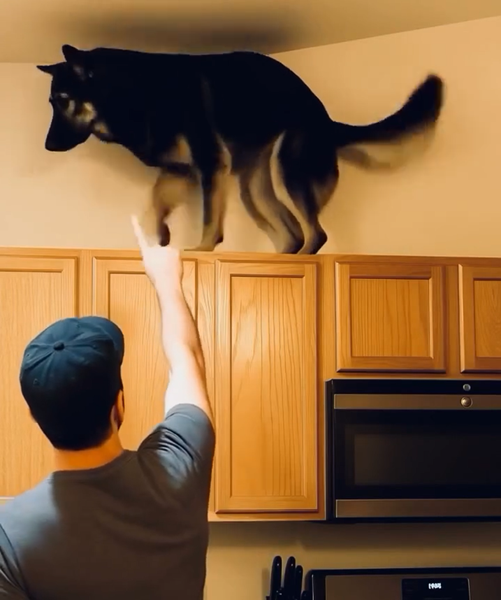
At first, I chalked it up to nothing more than one of his quirky canine behaviors. Dogs are strange creatures, capable of fixation over invisible noises, shifting shadows, or the smallest, fleeting movements we humans can’t perceive.
Rick was no exception. He had always had a penchant for odd behaviors: tilting his head at the hum of the refrigerator, staring at empty corners of the living room, barking at air currents that didn’t exist—or at least that I couldn’t see.
But this particular behavior felt different. It began subtly, almost unnoticeable at first. His gaze lingered longer than usual, his ears perked rigidly, and his low growls under his breath were almost imperceptible. Then, over the course of a week, the behavior intensified.
It started during the day, with short, intermittent barks whenever I walked through the kitchen or glanced up at the ceiling. I rationalized it. “Dogs see things we don’t,” I told myself. “Maybe a spider.
Maybe a bat got in somewhere.” I inspected every corner of the apartment thoroughly, checking cupboards, vents, and ceilings, finding nothing. Rick’s behavior didn’t diminish, and that’s when I noticed the nights were different.

After I’d gone to bed, the quiet hours were filled with sharp, urgent barks aimed squarely at the kitchen cupboards—or more specifically, the area near the ventilation duct that ran along the ceiling.
The sound was distinct from his usual barking: it was insistent, almost purposeful, as if he were trying to tell me something, but I had no idea what.
One night, after several consecutive evenings of this behavior, I realized I wasn’t just tired; I was beginning to feel anxious. My mind raced through every conceivable scenario. Was it an animal trapped in the vent?
A structural issue I had overlooked? Or was my dog simply acting up again? Every time I leaned in to investigate, Rick’s barking intensified, and he refused to be distracted.
He didn’t bark at me, at other sounds, or at shadows on the walls. It was always the same spot. It was as if he knew something I didn’t.
The tipping point came when Rick’s barking grew louder and more frantic in the dead of night. My heart was pounding, my stomach in knots. I couldn’t sleep.
I kept replaying every strange event from the past few days in my mind, now noticing patterns I’d ignored: small things missing from the kitchen drawers, the faint smell of dirt lingering in the air even after cleaning, and the subtle scuff marks on the floor near the duct.
Each observation, trivial in isolation, now combined into a growing unease I could no longer ignore.
I grabbed a flashlight, my pulse quickening with each step, and moved cautiously into the kitchen. Rick followed closely, his eyes wide, ears forward, body tense.
The beam of the flashlight cut through the darkness, sweeping across the cabinets, the countertops, the duct above.
My breathing was shallow, and I could feel my hands trembling as I prepared to investigate the vent. It seemed impossible, implausible even, that anyone—or anything—could be hiding in there. The idea felt paranoid, absurd. Yet Rick’s insistence made the fear tangible.
I climbed carefully onto a chair, balancing with one hand on the counter and the other gripping the flashlight. The beam illuminated the edges of the vent cover, and then—movement.
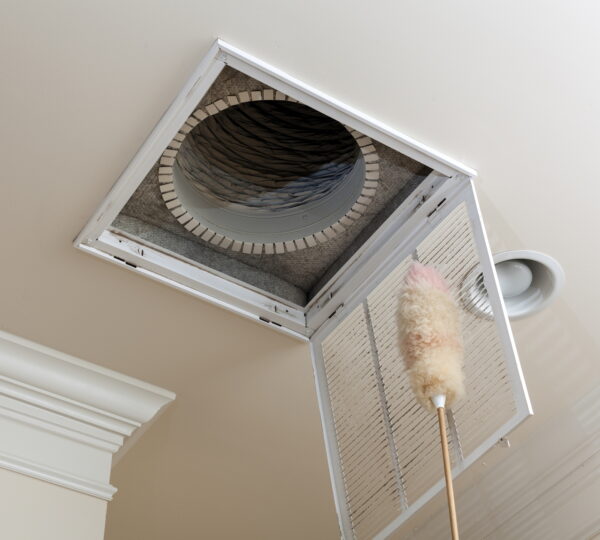
My stomach sank. A filthy hand appeared, clutching the edge of the duct opening. I froze. My mind refused to process what I was seeing. Then, slowly, a face emerged. A man.
I didn’t scream. I couldn’t. The sound lodged in my throat. His eyes were wide, almost animalistic in their intensity, darting rapidly as if he were trying to assess the threat while remaining hidden.
Dirt streaked his face, and his clothes clung to him with sweat and dust, evidence of the tight crawl through narrow ducts and sustained effort over time. In his shaking hands, I could see the unmistakable glint of objects that didn’t belong to us: a phone, a wallet, keys—items clearly stolen from someone, somewhere.
The metallic echo of Rick’s barking reverberated through the kitchen, intensifying the already surreal scene.
I backed away slowly, my fingers fumbling to dial 911, numb and trembling. Rick remained between me and the man, barking relentlessly but with clear purpose, each growl and bark seeming to assert the boundary of our space.
The man seemed aware of our presence but did not immediately flee. He paused, as though trying to assess the risk, his breathing ragged, his body pressed against the duct walls in a contorted position that made any sudden movement impossible.
Within minutes, though it felt like hours, the police arrived. Their presence was firm but measured, voices calm as they tried to coax the man from the duct.
I remember their commands echoing through the apartment: “Come out slowly. Hands visible. We just want to get you down safely.” He did not resist violently but collapsed as soon as he reached the floor, weak and blinking against the sudden light.
His apologies were fragmented, half-coherent, a mix of relief and exhaustion. Dirt and sweat caked his clothes, and the reality of the situation began to settle over all of us.
Later, the officers explained what had been happening. The man had been using the building’s ventilation system to move between apartments for weeks.
He had taken small items, unnoticed at first: keys, wallets, phones, and other valuables that wouldn’t be immediately missed.
It was a methodical, quiet, invisible theft—a type of criminal activity that relied on remaining unseen, exploiting the hidden spaces most residents never think to check. Rick had, unknowingly, exposed weeks of theft by refusing to ignore the ceiling.
I sank to the floor beside Rick, still shaky, still listening to his low, satisfied whines as if he had personally triumphed. He lay at my feet, finally calm, the crisis now contained by flashing lights and law enforcement presence.
That night, I learned, perhaps more than any moment in recent memory, the importance of paying attention to subtle signals from those around us. Rick’s instincts had saved me, saved our home, and likely prevented further theft from other apartments in the building.
The aftermath was both surreal and grounding. The police recovered the stolen items and documented the unusual entry method.
My neighbors, alerted by the commotion and the officers’ explanations, were equally stunned to learn that someone had been moving through the ventilation system, unnoticed for so long.
Discussions began about security upgrades: better locks, vent covers, and increased awareness of what might lurk unseen in the shadows of a building.
Rick, for his part, returned to normal dog behavior slowly over the next several days. He would glance occasionally at the ceiling, ears twitching, but the constant, frantic barking ceased. He had done his job.
Reflecting on the incident, it became clear that the danger had been hidden in plain sight. Ventilation ducts are not typically considered entry points for intruders, yet in buildings with older infrastructure or lax security, they can provide access that is both inconspicuous and difficult to detect.

The man had exploited a combination of structural opportunity and resident inattention, illustrating how critical vigilance can be in everyday life.
Rick’s acute sensory perception—the same qualities that make dogs remarkable companions—had highlighted what we humans often overlook.
The situation also underscored the bond between humans and their pets, and the ways in which animals contribute to our safety and awareness.
Dogs, with their heightened senses of smell, hearing, and intuition, can detect threats before humans even recognize them. Rick had sensed movement, scent, and presence that I could not, reacting with the intensity and clarity required to prevent a potentially dangerous situation.
His actions were instinctual but profoundly protective, demonstrating the silent, sometimes invisible, contributions pets make to our security and wellbeing.
Over the weeks that followed, we implemented additional safety measures in the apartment building. Vent covers were reinforced, locks checked, and residents encouraged to remain vigilant about small but unusual signs: missing items, unexplained noises, or disturbances in common areas.
While the police continued their investigation into other potential thefts, the immediate threat to our apartment had been neutralized, thanks to a combination of quick response, instinct, and a dog’s vigilance.
Rick’s behavior became a story retold among friends and neighbors, illustrating the unexpected ways that everyday vigilance can save lives.
What had initially seemed like a minor oddity—barking at the ceiling—proved to be a warning, a signal of hidden danger that we might have ignored if not for his persistence.
The incident reminded us that sometimes what appears strange or irrational may, in fact, be evidence of something real and pressing.
In the months after the event, Rick resumed his normal routines, though the bond he had established with me that night deepened.
Each glance at the ceiling carried a subtle acknowledgment of shared experience, a mutual understanding of the seriousness of vigilance, instinct, and trust.
I found myself paying closer attention to my environment, appreciating the ways in which subtle signals—whether from people, pets, or surroundings—can alert us to threats and guide our response.
The man, once apprehended and processed by law enforcement, received consequences appropriate to the offenses committed.
He reportedly admitted to moving through ventilation systems in multiple buildings, a pattern that had been difficult to detect without the persistent signals of attentive residents and, in our case, a remarkably perceptive dog.
Rick’s actions were, without exaggeration, heroic in their simplicity and effectiveness: a reminder that even small beings can have an outsized impact on safety and security.
Looking back, that night remains vivid in memory. The combination of fear, uncertainty, and the almost surreal nature of seeing a man emerge from a ventilation duct created a tension I had never experienced before.
Yet amidst the panic, the grounding factor was Rick’s steadfast presence. His vigilance, barking, and refusal to ignore the anomaly had forced action, ensured protection, and prevented further loss.
He had transformed instinct into action, intuition into tangible safety, and in doing so, had become more than a pet: he had become a guardian.