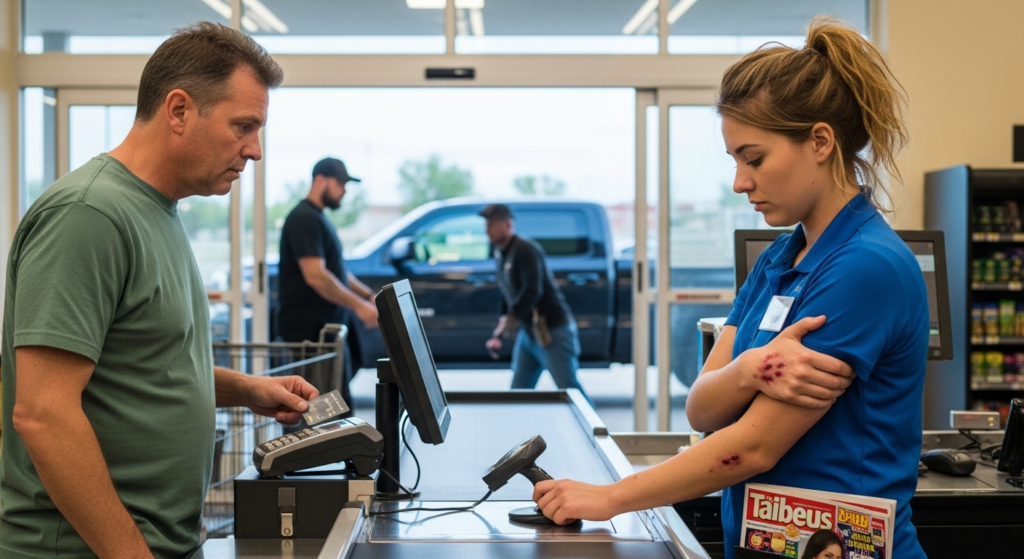
Blood is a strange thing; it doesn’t always look red under the harsh, flickering fluorescent lights of a grocery store.
Sometimes, it just looks like a dark, heavy shadow seeping into the cheap gray fabric of an oversized hoodie.
That was the first thing I noticed when the girl stepped up to register four.
It was a Tuesday evening, 8:45 PM. The kind of dreary, rain-soaked November night in suburban Ohio where the only people out are the ones who have nowhere better to be, or the ones who are running out of time.
I’m the shift manager at Miller’s Market. I’ve been here for eight years.
In eight years, you learn to stop looking at what people buy, and you start looking at how they buy it.
I know that Mrs. Gable buys pre-chopped onions when her arthritis is flaring up. I know the high school kids steal the cheap makeup, not the expensive stuff, because it fits better in their palms.
And I know fear when it’s standing right in front of me.
She looked to be about nineteen. Thin. Too thin.
Her hair was a messy knot of dirty blonde, damp from the rain outside. She was trembling, though the heater above the automatic doors was blasting on high.
On the conveyor belt, she placed her items with agonizing care: a three-pack of cheap ramen, a generic brand of baby wipes, and a single, heavily bruised Gala apple.
“Did you find everything okay tonight, sweetie?” I asked. My voice is naturally raspy, a remnant of a heavy smoking habit I kicked five years ago. I tried to soften it.
She didn’t look up. Her eyes remained glued to the scuffed linoleum floor.
“Yes, ma’am. Thank you.”
Her voice was barely a whisper. It sounded like it hadn’t been used in days.
I scanned the ramen. Beep. The wipes. Beep. The apple.
I weighed it, my eyes drifting back to her.
That was when I saw her left arm.
She was clutching it tightly against her ribs, her right hand clamped over her left forearm as if trying to hold herself together.
The sleeve of her hoodie was pushed up just a fraction of an inch.
Just enough for me to see the dark, purplish-yellow contusions wrapping around her pale wrist.
Four distinct, oval-shaped marks on one side. One larger mark on the other.
A handprint.
A violent, crushing, desperate handprint.
And just above it, the fabric of her sleeve was damp. The dark shadow I had noticed earlier wasn’t dirt. It was fresh blood, slowly blooming through the cotton.
My heart slammed against my ribs.
I felt a sudden, phantom weight in my own pocket. My hand twitched toward the apron I wore, where a worn silver locket rested.
It belonged to my younger sister, Emily.
Emily, who used to wear long sleeves in the dead of July. Emily, who tripped down the stairs. Emily, who walked into doorknobs.
Emily, who didn’t survive her last “clumsy” accident six years ago.
I took a deep, shaky breath, forcing the memory back down into the dark box in my mind where I kept it.
“That’ll be four dollars and eighty-two cents,” I said, keeping my tone as neutral as possible.
The girl reached into her pocket with her good hand. She pulled out a crumpled wad of one-dollar bills and a handful of loose change.
Her fingers were shaking so badly that a quarter slipped from her grasp. It hit the metal counter and bounced onto the floor, rolling under the candy display.
“I’m sorry,” she gasped. Panic—pure, unadulterated panic—flashed across her face. “I’m so sorry. I’m just… I’m just clumsy.”
She dropped to her knees, scrambling under the rack to retrieve the coin.
When she reached out, her hoodie sleeve snagged on a metal hook. It pulled the fabric halfway up her forearm.
I stopped breathing.
The handprint on her wrist was nothing compared to the rest of it.
Her arm was a canvas of old fading yellow bruises and fresh, angry purple ones. There was a shallow, jagged laceration near her elbow, the edges inflamed and weeping. It looked like it had been caused by broken glass.
She yanked her arm back, her breath hitching in a stifled sob, and frantically pulled the sleeve down.
She stood up, slamming the dusty quarter onto the counter. Her eyes met mine for a fraction of a second.
They were a striking, pale blue. But they were completely hollow.
“I’m just clumsy,” she repeated, her voice trembling violently. “I fell against the radiator. I… I lose my balance sometimes.”
I had heard that exact sentence before. Word for word. Six years ago, sitting in my sister’s kitchen while she stared at her coffee cup, refusing to look at me.
A cold sweat broke out on the back of my neck.
I didn’t process the transaction right away. I just looked at her.
“Honey,” I said, my voice dropping an octave, pitching so low only she could hear it over the store’s soft rock radio. “Radiators don’t leave fingerprints.”
Her breath hitched. She took a step back, her eyes widening in sheer terror.
“I… I have to go,” she stammered. “Keep the change. Please, just give me the bag.”
“Wait,” I said, leaning over the counter. I wasn’t going to let this go. Not again. Not another Emily.
But before I could say another word, a heavy, rhythmic thumping vibrated through the store’s front windows.
Outside in the rain-slicked parking lot, a massive, matte-black pickup truck had aggressively hopped the curb, parking illegally in the fire lane directly in front of the glass doors.
The engine was roaring. The headlights cut fiercely through the dark, blinding me for a second.
The girl froze.
If she was trembling before, she was entirely paralyzed now.
Every muscle in her thin body locked up. The color drained completely from her already pale face.
She stared at the truck like a deer caught in the sights of a hunter’s rifle.
“Is that him?” I asked, my voice tight.
She didn’t answer. She didn’t have to.
Marcus, our sixty-year-old security guard, shuffled over from his station near the lottery machine.
Marcus is a giant of a man, a retired cop with terrible knees and a habit of doing the Sunday crossword in pen. He lost his wife to cancer two years ago and uses a dry, cynical humor to mask the fact that he’s the loneliest man in Ohio.
“Hey, Sarah,” Marcus grunted, leaning heavily on his good right leg. He nodded toward the window. “You want me to tell this clown to move his monster truck out of the fire lane?”
“No, Marcus,” I said sharply. “Stay right here.”
Marcus blinked, surprised by my tone. He looked at me, then looked at the girl. His eyes narrowed as his old police instincts kicked in. He saw the way she was holding her arm. He saw the sheer terror radiating off her.
The driver’s side door of the truck swung open.
A man stepped out into the rain.
He was tall, broad-shouldered, wearing a fitted leather jacket and heavy boots. Even through the rain-streaked glass, I could see his face.
He was handsome in a sharp, cruel sort of way. He walked with a terrifying sense of entitlement, completely ignoring the rain as he strode toward the automatic doors.
“He’s coming in,” the girl whispered, her voice cracking. “Oh God, I took too long. The line was too long. He’s going to be so mad.”
“What’s your name?” I demanded, my hands moving swiftly.
“Chloe,” she choked out.
“Chloe, listen to me,” I said, grabbing a blank receipt roll and a pen from beneath my register.
The automatic doors hissed open.
A blast of cold, damp air swept into the store, bringing with it the sharp scent of stale cigarette smoke and an expensive, suffocating cologne.
I scribbled my personal cell phone number on the back of the receipt paper. Underneath it, I wrote one word: SAFE.
“Take this,” I commanded, grabbing her single plastic grocery bag. I shoved the piece of paper deep inside, wedging it between the baby wipes and the ramen so it wouldn’t be immediately visible.
“If he looks in the bag…” she panicked, tears finally spilling over her lashes.
“He won’t care about baby wipes,” I said fiercely, thrusting the bag into her good hand. “Hide it when you get to the bathroom. If you ever need out. If you ever think you aren’t going to wake up the next morning. You call me. Do you understand?”
Heavy boots echoed on the linoleum.
“Do you understand me, Chloe?” I hissed.
“Yes,” she whimpered, snatching the bag.
“Hey.”
The voice was loud, booming, and laced with an underlying threat.
I looked up.
He was standing at the end of my register lane.
Up close, Travis—though I didn’t know his name yet—was even more intimidating. His jaw was clenched so tight the muscles twitched. His dark eyes darted from me, to Marcus, and finally landed on Chloe.
When he looked at her, his expression shifted entirely. The anger vanished, replaced by a chilling, manufactured mask of concern.
“There you are, babe,” he said smoothly, taking a step toward her. “I was getting worried. You know how my anxiety gets when you’re out of my sight for too long.”
He reached out and wrapped his large hand around her left arm.
Right over the laceration. Right over the bruises.
Chloe let out a sharp, suppressed gasp, her knees buckling slightly.
He didn’t let go. His grip tightened, his knuckles turning white as he pulled her flush against his chest.
“She okay?” he asked, looking directly at me. He smiled, but it didn’t reach his eyes. “She’s so clumsy, this one. Always tripping over her own two feet.”
I felt Marcus shift his weight behind me, his hand resting casually near his heavy Maglite flashlight.
I looked Travis dead in the eyes. I didn’t smile back.
“She slipped trying to get a quarter,” I said evenly, keeping my voice deadpan. “Might want to get that arm looked at. Looks painful.”
Travis’s smile faltered for a microsecond. A flash of pure, violent rage ignited in his pupils.
“We’ve got it handled,” he said softly.
He turned, dragging Chloe with him. She stumbled trying to keep up with his long strides, her head bowed, clutching the plastic grocery bag like it was a life preserver.
“Hey, pal!”
Marcus’s voice boomed through the quiet store.
Travis stopped, halfway to the door, and slowly turned around.
“You’re parked in a fire lane,” Marcus said, pulling a vintage silver pocket watch from his vest, checking the time. “You have exactly fifteen seconds to move that oversized piece of junk before I call the local precinct to have it towed. And the boys on the night shift are bored tonight.”
Travis stared at Marcus. Marcus stared back, unflinching, his sixty-year-old frame suddenly looking like a brick wall.
“We’re leaving,” Travis spat.
He shoved Chloe through the automatic doors and out into the rain.
I stood behind my register, my hands gripping the metal edge so tightly my knuckles ached. I watched him throw her into the passenger seat, slam the door, and speed out of the parking lot, tires squealing against the wet asphalt.
“You saw her arm?” Marcus asked quietly, stepping up beside me.
“I saw it,” I said, my voice shaking now that the adrenaline was fading.
“I got his license plate,” Marcus grunted, pulling a notepad from his pocket. “Just in case.”
“Thanks, Marcus.”
I reached into my apron pocket and let my fingers brush against Emily’s silver locket.
I had given Chloe my number. But as I stared out into the empty, black parking lot, a heavy dread settled in the pit of my stomach.
I knew the statistics. I knew the psychology.
It takes a victim an average of seven attempts to leave an abuser before staying away for good.
I just had to pray that Chloe survived long enough to make her first attempt.
And that when she called, I wouldn’t be too late.
Chapter 2: The Echoes We Can’t Outrun
The rest of my shift that Tuesday night felt like a fever dream. I went through the mechanical motions of scanning barcodes, bagging groceries, and nodding at regulars, but my mind was miles away, trapped in the cab of that matte-black pickup truck hurtling down the rain-slicked highway.
Every time the automatic doors hissed open, my chest seized. I kept expecting him to come back. I kept expecting Travis to storm through the entrance, dragging Chloe by her hair, demanding to know why a grocery store cashier had slipped a phone number into her bag.
But the doors only parted for tired night-shift nurses buying frozen dinners and teenagers grabbing energy drinks.
By the time 11:00 PM rolled around and I locked the front registers, my nerves were frayed to the point of snapping. Marcus helped me pull the heavy metal security grate down over the storefront. He didn’t say much, but he didn’t have to. The heavy silence between us was weighted with the shared knowledge of what we had just witnessed—and our terrifying inability to stop it.
“You driving straight home, Sarah?” Marcus asked, his gruff voice cutting through the hum of the store’s dying refrigeration units. He was leaning on his cane, the yellow parking lot lights casting long, tired shadows across his weathered face.
“Yeah, Marcus. Straight home.”
“You lock your doors,” he said. It wasn’t a suggestion. Coming from a retired cop with thirty years on the force, it was a directive. He tapped his breast pocket where he had stashed the notepad with Travis’s license plate number. “I’m going to run this through a buddy of mine at the DMV tomorrow. Off the books. Just to get a name and an address. I don’t like the look in that kid’s eyes. He’s a powder keg.”
“Thank you,” I whispered, the exhaustion finally hitting the back of my knees.
The drive back to my apartment was a blur of smudged streetlights and the rhythmic, metronomic squeak of my old Honda’s windshield wipers. The rain hadn’t let up. If anything, it was coming down harder, washing the suburban streets of Ohio into a gray, featureless soup.
I lived on the third floor of a walk-up complex that had seen better days in the late nineties. It was the kind of place where you could hear your neighbors arguing through the drywall and the smell of stale cooking oil lingered perpetually in the hallways. It wasn’t glamorous, but it was cheap, and after Emily died, I didn’t care much about granite countertops or hardwood floors. I just needed a place with a deadbolt where I could hide from the world.
When I finally unlocked my door and stepped inside, the silence of my apartment hit me like a physical blow.
I didn’t turn on the overhead lights. I walked straight into the small kitchen, the glow of the microwave clock casting a pale green hue across the linoleum, and filled the kettle. My hands were still shaking.
I reached into my apron, which I hadn’t even bothered to take off, and pulled out the silver locket.
The metal was warm from being pressed against my chest all night. I traced the intricate, worn floral engraving on the front with my thumb. It was a habit. A nervous tic I’d developed over the last six years.
I pressed the tiny clasp, and it popped open.
Inside was a small, slightly faded photograph of my younger sister, Emily. It was taken at Myrtle Beach in 2012. She was twenty-one, her face turned toward the sun, laughing at something just out of frame. Her blonde hair was a tangled mess of saltwater and wind. She looked so alive. So untouchable.
Four years later, I was picking out a closed casket for her.
I collapsed into the cheap wooden chair at my kitchen table, the memory rising up like bile in my throat. I squeezed my eyes shut, but it didn’t help. The dark box in my mind had been pried open tonight by a girl named Chloe with a handprint on her wrist, and now, all of Emily’s ghosts were pouring out.
Emily’s boyfriend had been a guy named Greg. He was a local real estate agent, charming, wore expensive suits, drove a spotless BMW. To the outside world, he was the catch of the century.
But I saw the cracks early on.
I remembered the first time I noticed a bruise on Emily. We were at a family Fourth of July barbecue. She was wearing a long-sleeved flannel shirt despite the suffocating ninety-degree humidity. When she reached for a paper plate, the sleeve rode up, revealing a nasty, greenish-yellow mark on her bicep.
“I’m just clumsy, Sarah,” she had laughed, though her eyes darted nervously toward where Greg was holding court by the grill. “I walked right into the edge of the kitchen island. You know me. Two left feet.”
I had believed her. Or rather, I chose to believe her because the alternative was too ugly to confront.
Then came the twisted ankle she blamed on a curb. The split lip she blamed on a rogue cabinet door. The time she showed up to Thanksgiving dinner in heavy foundation, refusing to make eye contact with anyone, jumping every time Greg spoke her name.
I tried to intervene. I really did. I cornered her in the bathroom one night and begged her to tell me the truth. But abusers like Greg—and like Travis—are master manipulators. They don’t just isolate their victims physically; they isolate them mentally. They convince them that they are worthless, that the abuse is their own fault, and that no one else will ever love them.
Emily looked at me with those hollow, terrified eyes—the exact same eyes I had seen in Chloe tonight—and defended him. She told me I was crazy. She told me I was jealous. She pushed me away to protect him, or maybe to protect herself from the reality of her own life.
The kettle began to whistle, a sharp, piercing shriek that jolted me back to the present.
I snapped the locket shut and buried my face in my hands. The tears came then, hot and fast, soaking into my palms.
“I’m sorry, Em,” I sobbed into the empty kitchen. “I’m so sorry.”
I had failed my sister because I didn’t push hard enough. I let polite society and the boundary of “minding my own business” stop me from kicking Greg’s door off its hinges and dragging her out of there.
By the time she finally realized she needed to leave, by the time she finally packed a bag and tried to sneak out the back door while he was sleeping, he woke up.
The police report called it a “domestic altercation resulting in fatal trauma.” The neighbors said they heard screaming, but nobody called 911 because they “didn’t want to get involved in a couples’ spat.”
I didn’t sleep that night. I sat at my kitchen table, drinking cup after cup of black coffee, staring at my cell phone.
I willed it to ring. I prayed to a God I hadn’t spoken to in six years to let the screen light up with an unknown number.
But it remained dark and silent.
The next few days at Miller’s Market were agonizing.
I felt like I was walking underwater. Every customer interaction was strained, every sudden noise made me jump. I found myself staring out the large front windows of the store, my eyes scanning the parking lot for a matte-black truck.
Brenda, the daytime floor manager, noticed immediately.
Brenda is a force of nature. She’s forty-five, a mother of three rowdy teenage boys, and runs on a mixture of Diet Coke and pure, unadulterated grit. She’s the kind of woman who will let a struggling mother slide on a few dollars at the register but will brutally run down a shoplifter in the parking lot without dropping her cigarette.
We were in the cramped, fluorescent-lit breakroom on Thursday afternoon. I was staring blankly into a lukewarm cup of coffee when she slammed a clipboard onto the table, making me flinch.
“Alright, spill it,” Brenda said, crossing her arms over her red Miller’s Market polo.
“Spill what?” I deflected, rubbing my temples. A dull headache had been throbbing behind my eyes for three days.
“You look like you haven’t slept since the Bush administration, Sarah,” she said, pulling out a chair and sitting across from me. “You miscounted your till by forty dollars yesterday—which, by the way, I fixed before corporate flagged it—and you’ve been jumping out of your skin every time the PA system crackles. What’s going on? Is it the anniversary?”
Brenda knew about Emily. She was one of the few people who did.
“No,” I sighed, realizing there was no point in lying to her. “It’s not the anniversary. It’s a customer.”
I told her everything. I told her about Chloe’s trembling hands, the blood seeping through the hoodie, the violent handprint on her wrist. I told her about the truck jumping the curb, and the terrifying, cold-blooded way Travis had grabbed her lacerated arm and smiled.
As I spoke, Brenda’s tough exterior hardened even further. Her jaw set, and her eyes darkened.
“You gave her your number,” Brenda stated. It wasn’t a question.
“Slipped it into her grocery bag on a receipt,” I confirmed.
“Jesus, Sarah,” Brenda breathed, leaning back in her chair. She ran a hand through her dyed auburn hair. “That was incredibly brave, but it was also incredibly dangerous. If a guy like that finds a stranger’s phone number hidden in her things, he’s not going to assume she’s cheating. He’s going to know she tried to reach out. He’ll punish her for it.”
“I had to do something, Brenda. I had ten seconds. I couldn’t just let her walk out of here with nothing.”
“I know,” she said softly, her tone shifting to one of deep maternal empathy. “I know why you did it. But you need to prepare yourself for the very real possibility that she might never call.”
“I am prepared,” I lied.
Just then, the breakroom door pushed open, and Officer Dave Miller walked in.
Dave is a local beat cop for the county. He’s twenty-eight but looks forty, carrying the heavy, exhausted demeanor of a man who sees the worst of humanity on a daily basis. He stops by the market every Tuesday and Thursday for our terrible drip coffee because we give it to him for free.
“Ladies,” Dave said, tipping his uniform cap, his duty belt jingling slightly as he moved toward the coffee pot. “Tell me you made a fresh pot. The stuff out on the floor tastes like battery acid.”
“It is battery acid, Dave,” Brenda joked, though her smile was tight. “Builds character.”
I looked at Dave, then looked at Brenda. She gave me a subtle nod.
“Dave, can I ask you a hypothetical question?” I asked, sitting up straighter.
Dave paused, pouring the dark liquid into his styrofoam cup. He turned to me, his cop instincts instantly overriding his fatigue. “Hypothetical. Right. Shoot.”
“If a civilian happens to see an active domestic abuse situation… but the victim refuses to say anything. And the civilian manages to get the abuser’s license plate. Can the police do anything with that?”
Dave sighed, a long, tired sound. He walked over to the table and sat down next to Brenda, resting his forearms on the cheap laminate.
“Hypothetically?” he asked.
“Hypothetically,” I repeated.
“Hypothetically, my hands are tied with industrial-grade zip ties,” Dave said, his expression grim. “Here’s the harsh reality of the law, Sarah. A license plate gives me a registered owner. It gives me an address. But if I knock on that door, and the victim answers and says, ‘I tripped down the stairs, everything is fine,’ I have to turn around and walk away. Unless I actively witness the assault, or the victim files a formal report, I have zero probable cause to make an arrest or enter the premises. In fact, if I show up based on a third-party tip and leave without doing anything, I usually just end up making it much, much worse for the victim once the door closes.”
My stomach plummeted. “So, you just wait until they end up in the ICU? Or the morgue?”
Dave flinched. He knew my history. “It’s a broken system, Sarah. I hate it as much as you do. I’ve sat in my cruiser outside houses where I knew what was happening inside, and I couldn’t kick the door in because of the Fourth Amendment. But if this… hypothetical victim ever reaches out to you. If she ever says the words ‘I need help.’ You call me directly. Not dispatch. Me. I don’t care if it’s 3 AM on my day off.”
He pulled a business card from his breast pocket and slid it across the table to me.
“I will,” I said, pocketing the card.
“Good,” Dave said, standing up. He looked deeply troubled. “Watch your back, Sarah. Guys who do that kind of thing… they don’t like outsiders interfering with their property. And they view these women as property.”
With that terrifying parting thought, Dave left the breakroom.
A week passed.
Seven days of agonizing silence.
I checked my phone so often the battery kept dying. I took it into the bathroom with me. I slept with it clutched in my hand. But Chloe didn’t call.
By the following Tuesday, a heavy, suffocating resignation began to settle over me. Brenda was right. I had to accept that my ten-second intervention had failed. Chloe was either too terrified to use the number, or Travis had found it. The thought of the latter kept me up at night, staring at the ceiling, wondering if I had inadvertently signed her death warrant.
It was 8:30 PM. Rain was drumming against the store’s glass front again, a gloomy repeat of the week before.
The store was dead. Marcus was at his usual post by the lottery machine, doing the crossword. I was wiping down the conveyor belt of register four with antibacterial spray, lost in my own dark thoughts.
The automatic doors hissed open.
I didn’t look up immediately. I was too busy scrubbing a stubborn sticky spot where someone had spilled a soda.
Heavy, rhythmic footsteps echoed on the linoleum. Boot steps.
They didn’t head down the aisles. They walked with deliberate, predatory slowness straight toward the front registers.
The hairs on the back of my neck stood up. The air in the store suddenly felt ten degrees colder. The sharp, suffocating scent of expensive cologne hit my nose before I even raised my head.
I froze, the rag clutched tightly in my hand.
I slowly lifted my eyes.
Standing on the other side of my register, not three feet away, was Travis.
He was alone.
He was wearing a dark raincoat, the water beading off the shoulders. His hands were shoved deep into his pockets. He wasn’t looking at the candy displays or the magazines. He was looking dead at me.
My heart slammed against my ribs so violently I thought it might crack my sternum. The primal, instinctual part of my brain screamed at me to run, to duck under the counter, to yell for Marcus.
But I forced my feet to stay planted. I forced my spine to straighten. I was not going to let this monster see me bleed.
“Can I help you?” I asked. My voice sounded remarkably steady, despite the adrenaline flooding my veins.
Travis didn’t answer right away. He took a long, agonizing moment to simply look at me. His dark eyes roamed over my face, taking in my Miller’s Market apron, my nametag, the tension in my shoulders. He was studying me. Assessing the threat.
Slowly, deliberately, he pulled his right hand out of his pocket.
He placed a single item on the conveyor belt.
It was a package of generic brand baby wipes.
The exact same brand Chloe had bought a week ago.
He didn’t need them. He had come here specifically to show me that he remembered me. To show me that he knew exactly who I was, and where I worked. It was a calculated act of psychological warfare.
“Just this,” he said. His voice was smooth, deep, and entirely devoid of emotion.
I didn’t break eye contact. I reached out, my hand trembling just slightly, and pulled the wipes across the scanner.
Beep.
“Two dollars and forty-nine cents,” I said.
Travis reached into his wallet. He didn’t pull out a card. He pulled out a crisp, hundred-dollar bill and laid it on the counter.
He was forcing me to make change. He was forcing me to stand there, in front of him, for as long as possible.
I opened the till. My fingers were clumsy as I counted out the twenties, the tens, the singles. I could feel his gaze burning into the top of my head. The silence between us was deafening, heavier than the rain pounding on the roof.
I gathered the bills and the loose change. I held it out to him.
He didn’t take it from my hand. He let me stand there, my arm extended, for three excruciating seconds.
Then, he leaned in.
He leaned over the metal counter, invading my personal space, bringing that sickening cologne right up to my face. His eyes locked onto mine, completely dead and utterly terrifying.
“You know,” Travis whispered, his voice so low that Marcus, standing thirty feet away, couldn’t possibly hear him. “My girlfriend had the strangest thing happen to her last week.”
My blood ran to ice. I stopped breathing.
“She found a piece of trash in her grocery bag,” he continued, his tone conversational, but laced with lethal poison. “A piece of receipt paper. With a bunch of random numbers scribbled on it. Must have fallen in by accident.”
He reached out and slowly took the change from my hand. His fingers brushed against mine. His skin was ice cold.
“I threw it away for her,” he said, a slow, terrifying smile spreading across his face. “We wouldn’t want her holding onto things that don’t belong to her. Right, Sarah?”
He read my nametag. He said my name like it was a threat.
I couldn’t speak. My throat had completely closed up.
Travis took his pack of baby wipes, turned, and walked out of the store. He moved with the casual, relaxed gait of a man who owned the world and everything in it.
I stood paralyzed at the register, watching him get into his truck and drive away.
He knew.
He had found the note.
The horror of that realization crashed over me like a tidal wave. If he had found the note, what had he done to Chloe? My attempt to throw her a lifeline had likely just wrapped a noose around her neck.
“Sarah?”
Marcus was beside me. He had noticed the interaction. His hand was resting on the butt of his flashlight.
“Was that him?” Marcus asked, his voice low and dangerous.
“Yeah,” I choked out, my knees suddenly giving way. I gripped the counter to keep from collapsing. “Marcus… he found the number. He knows I gave it to her.”
Marcus cursed under his breath. He looked out into the empty parking lot, his jaw tight. “You’re not walking to your car alone tonight. Or any night. You hear me?”
I nodded numbly.
The rest of the shift was a blur of pure panic. I felt physically ill. The guilt, the exact same crushing guilt I had felt the night Emily died, was suffocating me. I had tried to play hero, and I had likely gotten a nineteen-year-old girl killed.
When I got home that night, I didn’t even bother turning on the lights. I locked the deadbolt, slid the security chain into place, and collapsed onto my cheap sofa in the dark.
I pulled my knees to my chest and cried. I cried for Emily. I cried for Chloe. I cried for my own stupid, reckless arrogance.
Dave the cop was right. I was an outsider who had interfered, and now, the consequences were playing out in a house I couldn’t see, behind a door I couldn’t unlock.
I didn’t sleep. I just sat in the dark, listening to the rain, waiting for the sun to come up so I could go to the police station and beg Dave to do something, anything, even if it cost me my job.
Hours passed. The luminous green numbers on my microwave clock shifted from 1:00 AM, to 2:00 AM, to 3:00 AM.
At exactly 3:14 AM, the silence of my apartment was shattered.
My cell phone, sitting on the coffee table next to me, began to vibrate violently against the wood.
The screen lit up the dark room with a harsh, glaring white light.
I jumped, my heart leaping into my throat.
I scrambled forward and grabbed the phone.
The Caller ID didn’t show a name. It didn’t even show a number.
It just read: UNKNOWN.
My hand was shaking so badly I could barely swipe the screen to answer.
I pressed the phone to my ear. I didn’t say hello. I just listened.
For three seconds, there was nothing but the sound of jagged, desperate, wet breathing.
Then, a voice whispered through the receiver. It was so faint, so broken, it barely sounded human.
“Sarah?”
It was Chloe.
“Chloe?” I gasped, springing up from the sofa. “Chloe, is that you? Where are you?”
“He… he fell asleep,” she sobbed, her voice hitching with sheer terror. “He drank a lot. He’s passed out. But Sarah…”
“I’m here, honey. I’m right here. What is it?”
“He found the note yesterday,” she whimpered, and the sound of her crying broke my heart into a million jagged pieces. “He was so mad. He locked me in the bathroom. He… he hurt me really bad, Sarah. I can’t see out of my left eye. I think my ribs are broken.”
“Oh, God,” I breathed, tears streaming down my face. I ran to my front door and began ripping my coat off the hook. “Chloe, listen to me. I’m coming to get you. I’m calling the police, and I’m coming to get you. Do you know your address?”
“No, no, no police!” she panicked, her voice rising in pitch. “If he wakes up and sees cop cars, he’ll kill me. He said he would kill me. He has a gun, Sarah. He keeps it under the mattress.”
The blood drained from my face. A gun.
“Okay. Okay, no cops yet,” I lied smoothly, my mind racing. I had Dave’s direct cell number in my pocket. “Where are you, Chloe? Tell me where you are.”
“We live at the end of Sycamore Drive. Number 442. It’s the house with the dead oak tree in the front.” She paused, coughing wetly into the phone. “Sarah?”
“I’m here.”
“I’m so scared,” she whispered, sounding exactly like a lost child in the dark. “If I try to leave and he wakes up… he’s going to kill me. But if I stay… I don’t think I’m going to survive the night.”
“You are going to survive tonight,” I said fiercely, my hand gripping the doorknob. The ghost of my sister was standing right beside me, fueling the fire in my blood. “I am leaving right now. I’ll be there in fifteen minutes. Do not hang up this phone. Do you understand me? Keep me on the line.”
“Okay,” she breathed.
I threw open my apartment door and ran out into the rainy night. I didn’t know what I was walking into. I didn’t have a plan. I just knew that I was not going to let another girl die on my watch.
Not tonight.
Chapter 3: The Dead Oak Tree
My old Honda Civic had a starter motor that had been threatening to die since the previous winter. Most mornings, it required a delicate, patient turn of the key, a gentle coaxing to get the engine to turn over.
Tonight, I didn’t have patience. I slammed the key into the ignition and twisted it violently, praying to whatever forces were listening. The engine sputtered, coughed, and finally roared to life, the entire dashboard vibrating with a ragged hum.
“I’m in the car, Chloe,” I said loudly, tossing the phone onto the passenger seat and jabbing the speakerphone button. “I’m pulling out of my complex right now. Sycamore Drive is only about ten miles from here, across the interstate. I’m going to be there in less than fifteen minutes.”
“Okay,” her voice floated through the tinny speaker, sounding impossibly small. It was a wet, ragged sound, punctuated by sharp intakes of breath that told me just how badly her ribs were hurting. “Okay. Please hurry. Please, Sarah.”
“I am,” I promised, throwing the car into reverse. The tires squealed against the wet asphalt as I backed out, ignoring the blinding glare of a streetlight reflecting off my rain-streaked windshield. I slammed the shifter into drive and punched the gas.
“Chloe, listen to me,” I called out over the roar of the car’s ancient heater and the relentless drumming of the rain. “I need you to stay awake. You said you can’t see out of your left eye. Did he hit you in the head?”
There was a long, terrifying silence. Just the sound of static and the faint, rhythmic sound of rain hitting a windowpane on her end.
“Chloe!” I yelled, panic rising in my throat.
“I’m here,” she gasped. “I’m here. Yes. He… he threw me against the wall in the hallway. The back of my head hit the doorframe. It’s bleeding. It feels warm.”
“Okay, you probably have a concussion,” I said, my heart sinking. “That means you cannot go to sleep. Do you hear me? You have to keep talking to me. Tell me about where you are right now. Where are you hiding?”
“The downstairs bathroom,” she whispered, her voice trembling so violently the words were barely decipherable. “I locked the door. But it’s just a flimsy little lock. He could kick it in with one hit. He’s done it before. Last month, he kicked it so hard the wood splintered.”
“Is he upstairs?”
“Yes. In the master bedroom. He drank half a bottle of bourbon. He yelled until he… until he just fell over on the bed. But he’s a light sleeper, Sarah. If he hears the front door open, he’ll wake up. The alarm chimes when the front door opens.”
I merged onto the interstate, pushing the old Honda up to eighty miles an hour. The steering wheel shook in my grip. The road was practically empty, a desolate ribbon of black asphalt slicing through the Ohio darkness.
“Does the back door chime?” I asked, my mind racing.
“No. We disabled the sensor on the sliding glass door in the kitchen because the dog kept setting it off.”
“You have a dog?” I asked, hoping the conversation would keep her anchored to consciousness.
“We did,” Chloe said, and the sudden, devastating sorrow in her voice made my breath catch. “A golden retriever mix. His name was Buster. Travis… Travis took him for a ride a few weeks ago after Buster growled at him. He came back alone. He told me he dropped him at a shelter, but… but he was smiling when he said it. I don’t think Buster is at a shelter, Sarah.”
The sheer, casual cruelty of it made me physically nauseous. It was the classic abuser playbook. Strip the victim of their support system. Isolate them from friends. Cut off their family. And when all the humans are gone, take away the pets. Leave them with absolutely nothing in the world to love, nothing to cling to, except the monster holding the leash.
“I’m so sorry, Chloe,” I whispered.
“Sarah?” she asked, her voice dropping to a terrified, breathy plea. “Am I going to die tonight?”
“No,” I said fiercely, my knuckles turning white on the steering wheel. “You are not going to die tonight. I am going to pull up to your house, we are going to walk out the back door, and you are never, ever going to see him again. Do you understand me? You’re going to come home with me.”
“I’m so tired,” she slurred slightly.
“Keep talking to me!” I commanded, my voice cracking with desperation. “Don’t you close your eyes, Chloe. Tell me what you see in the bathroom. Read the labels on the shampoo bottles. Anything.”
While she began faintly reading the ingredients of a bottle of mouthwash, I grabbed my phone with my right hand, keeping my eyes glued to the slick road.
I navigated to my recent contacts and found Officer Dave Miller’s direct cell number.
I couldn’t call him—it would disconnect Chloe—so I opened a text message thread. My thumb fumbled over the wet screen, making three typos before I finally managed to pound out the message:
DAVE. ITS SARAH FROM MILLERS MARKET. ACTIVE DOMESTIC ASSAULT. 442 SYCAMORE DR. VICTIM CONFINED. SUSPECT ARMED WITH FIREARM AND INTOXICATED. I AM ARRIVING AT THE HOUSE NOW.
I hit send. I didn’t wait to see if it delivered. I tossed the phone back onto the passenger seat.
“I’m taking the Sycamore exit right now,” I announced.
“Okay,” Chloe breathed. “Okay. The house is white brick. At the very end of the cul-de-sac. It’s the only one with no porch lights on. He likes to keep the house dark.”
I turned off the highway and onto the sweeping, tree-lined suburban roads of Sycamore Drive. The transition was jarring. One minute I was in the gritty, neon-lit sprawl of the commercial district, and the next, I was winding through a wealthy, manicured subdivision. Large, cookie-cutter McMansions sat back from the street on sprawling, perfectly landscaped lawns. Iron-wrought streetlamps cast pools of warm, inviting yellow light onto the wet pavement.
It looked like the quintessential American dream. The kind of neighborhood where people worried about Homeowner Association fees and lawn care, not violent crime.
But I knew better. I knew that the darkest, ugliest secrets often hid behind the most expensive front doors. Greg, the man who killed my sister, had lived in a neighborhood exactly like this one. He had driven a BMW. He had waved to his neighbors. He had paid his taxes.
And he had beaten Emily to death on a kitchen floor made of imported Italian marble.
A fresh wave of adrenaline, hot and sharp, spiked through my veins. The ghost of my sister was practically sitting in the passenger seat beside me, her presence a heavy, undeniable weight. Don’t be too late, Sarah, her memory seemed to whisper. Don’t let her be another Emily.
I slowed the car, turning the headlights completely off as I approached the end of the cul-de-sac. I rolled through the darkness, navigating by the ambient light of the streetlamps alone.
At the end of the circular drive sat Number 442.
Just as Chloe had said, it was a massive, two-story white brick house. And it was pitch black. No porch lights. No interior lights spilling through the curtains. It looked like a dead, hollow tooth at the end of the street.
In the front yard, silhouetted against the dark sky, was a massive, dead oak tree. Its leafless, twisted branches reached out like skeletal fingers.
And parked perfectly in the center of the concrete driveway, gleaming wetly in the rain, was the matte-black pickup truck.
I pulled my Honda over to the curb two houses down, hiding it behind a tall row of thick cedar hedges. I didn’t want Travis to see a strange car out front if he happened to look out the window.
I threw the car into park and killed the engine. The sudden silence in the cabin was deafening, broken only by the sound of my own harsh breathing and the rain pelting the roof.
“I’m here, Chloe,” I said softly, picking up the phone and pressing it to my ear. “I’m two houses down. I’m getting out of the car right now.”
“Be careful,” she sobbed. “Please, God, be careful. If the gravel in the driveway crunches too loud, he’ll hear it.”
“I’ll walk on the grass,” I said. “Where is the sliding glass door?”
“Around the left side of the house. Through the wooden gate. It leads straight into the kitchen. I’m in the hallway just past the kitchen.”
“I’m coming. Stay on the line.”
I opened the car door and stepped out into the freezing November rain. The cold hit me like a physical blow, instantly soaking through my thin Miller’s Market polo shirt and my light jacket. The mud on the edge of the manicured lawn sucked at my sneakers.
I crept forward, staying tight to the shadows of the hedges. My heart was a frantic bird trapped in my ribcage, beating so hard it hurt.
I reached the edge of Travis’s property. The lawn was impeccably maintained. I stepped off the concrete sidewalk and onto the soggy grass, avoiding the gravel driveway completely. I kept my eyes glued to the dark, second-story windows, waiting for a light to flick on, waiting for a curtain to twitch.
Nothing moved. The house was entirely still.
I slipped down the left side of the house. The narrow walkway between the white brick wall and the neighbor’s wooden fence was completely devoid of light. I had to feel my way forward, my left hand brushing against the cold, wet brick to guide me.
My fingers found the latch of a wooden privacy gate. It was cold iron. I pressed the phone between my ear and my shoulder and carefully lifted the latch. It groaned—a sharp, metallic squeal that sounded as loud as a gunshot in the dead of night.
I froze, sucking in a breath, my eyes darting up toward the roofline.
I waited ten seconds. Fifteen.
No lights. No shouts.
I pushed the gate open just enough to squeeze my body through, slipping into the sprawling, fenced-in backyard.
The sliding glass door was exactly where she said it would be, leading onto a large, paved patio.
“I’m at the glass door, Chloe,” I whispered into the phone. “I’m looking into the kitchen. It’s completely dark.”
“I’m coming,” she replied.
Through the glass, I could barely make out the shapes of an expensive kitchen—a massive island, stainless steel appliances, hanging pendant lights.
A moment later, a shadow detached itself from the deeper darkness of the hallway.
It was Chloe.
She was hunched over, clutching her left side, moving with an agonizing, shuffling limp. Even in the gloom, I could see the severe angle of her posture, the way her body was trying to curl in on itself to protect her shattered ribs.
She reached the glass door. She didn’t turn on a light. She simply reached up with a trembling hand and threw the heavy metal latch.
I grabbed the handle and slid the door open.
The smell hit me first. The suffocating stench of stale bourbon, metallic blood, and that same expensive, sickening cologne Travis had worn in the grocery store. It was the scent of violence.
Then, my eyes adjusted, and I saw her face.
I had to bite down on my own tongue to stop myself from screaming.
The left side of her face was unrecognizable. Her eye was swollen completely shut, the skin a horrifying, shiny plum color that extended down into her cheekbone. Her lower lip was split in two places, crusted with dark, dried blood. The oversized gray hoodie she was wearing was torn at the collar, and through the rip, I could see the stark, black-and-blue mottling of deep tissue bruising spreading across her collarbone and neck.
But it was her eyes—or rather, her one good eye—that broke me.
The hollow, dead look I had seen in the grocery store was gone. It had been replaced by the raw, primal, hunted terror of an animal that knows it is about to be slaughtered.
“Oh, sweetie,” I choked out, stepping over the threshold into the kitchen.
I reached out and gently wrapped my arms around her shoulders, mindful of her ribs. She collapsed against my chest, burying her face in my damp jacket, shaking so violently her teeth were chattering.
“We have to go,” she sobbed softly into my collarbone. “We have to go right now. If he wakes up…”
“We’re going,” I said, my voice tight with a murderous rage I had never experienced before. I pulled my own jacket off and draped it over her shivering frame. “My car is down the street. Can you walk?”
“I think so. My ankle is twisted, but I can walk.”
“Lean on me,” I instructed, hooking my arm around her uninjured waist. “I’ve got you. Let’s get out of here.”
We turned back toward the open sliding glass door. The rain was blowing onto the expensive hardwood floor, pooling near the threshold. Freedom was less than ten feet away. The cold, wet Ohio night looked like heaven.
We took one step.
Then two.
CREAK.
The sound didn’t come from us.
It came from the ceiling directly above the kitchen.
The heavy, unmistakable groan of a floorboard under a massive amount of weight.
Chloe stopped dead.
Every muscle in her battered body instantly locked into rigid paralysis. Her breath hitched in her throat, a sickening, wet gasp of sheer horror. She squeezed my arm so hard her fingernails dug painfully through my shirt.
THUD. THUD. THUD.
Heavy footsteps. Moving across the master bedroom floor. Moving with purpose. Moving toward the staircase.
“He’s awake,” she whispered, the words barely making it past her bloodied lips. “Sarah, he’s awake.”
“Go,” I hissed, shoving her forcefully toward the sliding glass door. “Get out into the yard! Run to the gate!”
“I can’t run!” she panicked, her legs refusing to move. “He’ll catch me. He always catches me. He’s going to kill us both!”
“Move!” I practically screamed in a whisper, grabbing her shoulder and physically pulling her toward the rain.
But it was too late.
The house suddenly flooded with blinding, agonizing light.
Someone had hit the master switch at the top of the stairs, illuminating the hallway, the living room, and the kitchen in harsh, artificial brilliance.
I spun around, blinking rapidly against the sudden glare, throwing myself in front of Chloe to shield her from the entryway.
The heavy, rhythmic thud of boots descended the wooden staircase.
He didn’t sound drunk anymore. He didn’t sound groggy. The footsteps were measured, terrifyingly calm, and precise.
He stepped into the archway connecting the hallway to the kitchen.
Travis.
He was wearing a white undershirt and dark jeans. He wasn’t wearing shoes; I had been wrong about the boots. The heavy thudding was just the sheer weight and force of his bare feet hitting the wood.
His hair was disheveled, but his face… his face was perfectly, chillingly composed. There was no rage. There was no frantic energy. There was only the cold, calculating detachment of an executioner who had just found a rat in his basement.
He looked at me. His dark eyes slowly drifted over my wet clothes, my face, and the protective stance I had taken in front of his girlfriend.
A slow, terrifying smile spread across his face.
“Well,” Travis said, his voice dropping an octave, echoing through the pristine, bloody house. “If it isn’t the Good Samaritan from the grocery store. Sarah, isn’t it?”
I didn’t answer. I slowly reached my right hand into my pocket, my fingers searching frantically for my phone, praying Dave had seen my text.
But I had left the phone in the car.
A wave of cold dread washed over me. I had dropped it on the passenger seat when I pulled up. I was completely unarmed, without communication, standing in the lion’s den.
“You’ve got a lot of nerve, Sarah,” Travis continued, taking a slow, deliberate step into the kitchen. He cocked his head to the side, studying us like bugs under a microscope. “Breaking and entering. Trespassing. I could shoot you right here on my imported Italian tile, and the law would shake my hand for defending my property.”
As if to punctuate his point, he raised his right hand.
My stomach completely dropped out.
He was holding a matte-black, semi-automatic handgun. It looked impossibly large in his grip. His finger was resting casually on the side of the trigger guard.
Behind me, Chloe let out a whimpering, high-pitched noise, like a dying animal. She pressed her face into my back, trembling uncontrollably.
“Put it down, Travis,” I said. To my absolute astonishment, my voice didn’t shake. The terror had bypassed panic and settled into a cold, diamond-hard resolve. I was looking at the man who had killed my sister, disguised in a different face, in a different house. And I was not going to let him win again.
“Put it down?” Travis laughed. It was a sharp, barking sound devoid of humor. “You break into my house, in the middle of the night, trying to steal my girl, and you’re giving me orders?”
He took another step forward. The gun barrel drifted, pointing casually toward my chest.
“She’s not your property,” I spat, my hands balling into fists at my sides. “Look at her! Look at what you did to her face! You’re a coward, Travis. A pathetic, weak coward who has to lock women in bathrooms to feel like a man.”
The smile instantly vanished from his face.
I had hit the nerve. I had stripped away the facade of power he so desperately relied on. The calculated calmness shattered, replaced by the violent, unhinged rage I had seen a flash of in the grocery store.
His jaw clenched. His eyes went completely black.
“Step away from her, Sarah,” he growled, raising the gun until it was aimed directly between my eyes.
“No.”
“I said, step away from her!” he roared, the sheer volume of his voice vibrating the crystal wine glasses in the cabinets.
“Sarah, please,” Chloe begged from behind me, her voice muffled against my wet shirt. “Just go. Just leave me. He’ll kill you. Please, just run.”
“I’m not leaving you, Chloe,” I said, never breaking eye contact with Travis. “If you want her, you’re going to have to shoot me, Travis. You’re going to have to murder a civilian, point-blank, in your kitchen. And I promise you, I’ve left a trail. The police already know I’m here.”
It was a bluff. A desperate, Hail Mary bluff. I had no idea if Dave had even seen the text message. For all I knew, Dave was asleep, his phone on silent, and no one in the world knew where I was except the monster holding the gun.
Travis hesitated. Just for a fraction of a second. His eyes darted toward the dark window, then back to me.
“You’re lying,” he sneered, but a flicker of doubt had entered his voice. He took another step forward, closing the distance between us to less than six feet. “You’re a stupid, minimum-wage cashier who watches too much television. No one is coming for you.”
He raised his left hand and grabbed my shoulder, his fingers digging into my collarbone like iron talons. He ripped me to the side with terrifying strength, throwing me against the kitchen island.
My hip crashed into the granite countertop. Pain exploded up my side, knocking the wind out of my lungs. I crumpled to the floor, gasping for air.
“Sarah!” Chloe screamed.
Travis didn’t even look at me. He lunged forward, grabbing Chloe by the throat with his left hand, slamming her brutally against the stainless steel refrigerator.
Chloe gagged, her hands flying up to claw desperately at his thick wrist. Her one good eye bulged with terror as her feet scrambled against the slick hardwood floor, trying to find purchase.
“You thought you could leave me?” Travis hissed, pressing the barrel of the gun against her temple. “You thought you could sneak out like a little rat in the night? After everything I’ve done for you?”
“Stop!” I wheezed, fighting to push myself off the floor. The world was spinning, black spots dancing in the corners of my vision.
“I told you what happens if you try to leave, Chloe,” Travis whispered, his voice dangerously soft now. “I told you I’d put you in the ground. Did you think I was joking?”
He pulled the hammer of the gun back.
The metallic click was the loudest sound I had ever heard in my life. It cut through the sound of the rain, cut through Chloe’s frantic choking, and echoed in my skull like a death knell.
I scrambled to my knees, frantically searching the floor for anything—a knife, a heavy pan, a bottle—but the pristine kitchen was perfectly clean.
I was too late. I had failed again.
I closed my eyes, bracing for the deafening roar of the gunshot.
But instead of an explosion, a different sound shattered the night.
It wasn’t a gun.
It was the heavy, catastrophic crash of the wooden privacy gate outside being kicked violently off its hinges.
And then, a voice—loud, authoritative, and backed by the heavy weight of the law—boomed from the darkness of the patio.
“MILLER’S COUNTY SHERIFF! DROP THE WEAPON! DROP IT RIGHT NOW!”
Dave.
Travis froze, his head snapping toward the open sliding glass door.
In the span of a single heartbeat, the power dynamic in the room entirely inverted. The predator had suddenly become the prey, and the flashing red and blue lights reflecting off the wet patio tiles confirmed it.
The cavalry had arrived. But as Travis’s dark eyes whipped back toward Chloe, his finger tightening on the trigger, I knew the deadliest part of the night had just begun.
Chapter 4: The Light in the Driveway
Time didn’t just slow down; it shattered into a million jagged, slow-motion fragments.
Through the open sliding glass door, the rain blew sideways, carrying with it the sudden, terrifying, and beautiful sound of a pump-action shotgun chambering a round.
Officer Dave Miller stood in the threshold, completely drenched, his police-issued slicker plastered to his broad shoulders. He wasn’t holding his standard sidearm. He was holding a Remington 870, the barrel leveled directly at the center of Travis’s chest. The flashing red and blue strobe lights from Dave’s cruiser, parked on the lawn out back, painted the pristine, terrifying kitchen in alternating washes of crimson and sapphire.
“I am only going to say this one time,” Dave’s voice was a low, guttural roar that seemed to vibrate the floorboards. “Drop the firearm. Drop it now, or I will put a hole in you so big God himself won’t be able to patch it.”
Travis froze.
The hammer of his handgun was still pulled back. The barrel was still pressed so hard against Chloe’s temple that the skin around it was turning white.
I watched the muscles in Travis’s jaw jump. I watched the terrifying calculus happening behind his dark, dead eyes.
This is the secret about men who beat women, a secret I had learned the hard way six years ago: they are, at their very core, absolute cowards. They thrive on the power imbalance. They feed on fear when they know their victim is smaller, weaker, and trapped.
But when that imbalance shifts—when they are suddenly faced with an equal or greater force, when the playing field is suddenly bathed in the harsh, unforgiving light of consequences—they crumble.
Travis wasn’t a gangster. He wasn’t a hardened criminal prepared to die in a blaze of glory. He was just a pathetic, insecure bully who used a heavy hand to make himself feel tall.
And right now, looking down the cavernous barrel of Dave’s shotgun, Travis looked very, very small.
“Hey,” Travis said, his voice suddenly losing its menacing bass, pitching up into a reedy, nervous register. “Hey, man, let’s just calm down. This is a misunderstanding. She’s my girlfriend. She was trying to steal from me.”
“Drop the weapon,” Dave repeated, taking one slow, methodical step into the kitchen. The rain tracked in with his heavy boots. “Three. Two…”
Travis blinked. The facade completely broke. The arrogant, untouchable monster who had swaggered into Miller’s Market vanished, replaced by a terrified, cornered rat.
He uncocked the hammer with his thumb, his hand shaking violently now. He lowered the gun from Chloe’s head, holding it by the grip with two fingers, and let it clatter onto the imported Italian tile.
“Kick it away,” Dave barked.
Travis nudged the gun with his bare foot, sending it skittering under the stainless steel refrigerator.
“Now let her go and get on your knees! Hands behind your head! Fingers interlocked!”
Travis released his grip on Chloe’s throat. He backed away slowly, his hands going up, his knees hitting the floor with a heavy thud.
The moment his hand left her, Chloe’s knees buckled entirely. She collapsed like a puppet with its strings cut.
I lunged forward, ignoring the screaming pain in my bruised hip, and caught her before her head hit the counter. I pulled her down to the floor with me, wrapping my arms completely around her trembling, battered body. I buried her face in my shoulder, shielding her from the sight of him.
“I’ve got you,” I sobbed into her wet, dirty-blonde hair. “I’ve got you, Chloe. It’s over. It’s over.”
She didn’t speak. She just gripped the fabric of my jacket with a desperation that broke my heart, letting out a long, wailing cry that sounded like a dam finally breaking after years of pressure.
“Dispatch, this is Unit 4,” Dave’s voice crackled into the radio clipped to his shoulder. “Suspect is disarmed and compliant. I need EMTs to my location immediately. Be advised, we have a female victim with severe trauma.”
Dave moved with terrifying efficiency. He holstered the shotgun on its sling, drew his handcuffs, and grabbed Travis by the back of his white undershirt. He slammed the man face-first into the hardwood floor. Travis let out a muffled grunt of pain, but he didn’t fight back.
The metallic snick-snick of the handcuffs locking into place was the most beautiful sound I had ever heard in my entire life.
“Sarah,” Dave called out, his knee planted firmly between Travis’s shoulder blades. He looked over at me, his eyes softening despite the adrenaline coursing through the room. “You okay?”
“Yeah,” I gasped, tears streaming down my face. “Yeah, Dave. We’re okay.”
The next two hours were a chaotic blur of flashing lights, static-filled radios, and the sterile, sharp smell of medical supplies.
The cul-de-sac, previously a quiet, wealthy tomb, was now completely illuminated by three police cruisers and a massive fire department ambulance. Neighbors were standing on their porches in their bathrobes, clutching umbrellas, whispering to each other in horrified, voyeuristic tones.
I sat on the bumper of the ambulance, a heavy gray wool blanket wrapped around my shoulders. The rain had finally slowed to a dismal, freezing drizzle.
I watched as two EMTs wheeled Chloe out the front door on a stretcher. They had put a cervical collar around her neck and started an IV in her right arm—her good arm. Her left eye was completely swollen shut now, a grotesque mound of purple flesh, but her right eye found me through the crowd of uniforms.
She lifted her good hand, her fingers trembling, and reached out toward me.
I stood up, letting the blanket fall to the wet pavement, and jogged over to the stretcher.
“You’re going to the hospital,” I told her, grabbing her small, cold hand. “They’re going to fix your ribs. They’re going to make sure your head is okay.”
“Are you coming?” she whispered, her voice raspy from where he had choked her.
“I’m going to follow right behind the ambulance,” I promised, squeezing her fingers. “I’m not leaving you. I told you that.”
She squeezed back, a tiny, exhausted smile pulling at her split lip. “Thank you,” she breathed. “You saved my life.”
“No,” I said softly, brushing a wet strand of hair off her unbruised forehead. “You saved your own life. You made the call. I just drove the car.”
The EMTs loaded her into the back of the rig, the heavy doors slamming shut. As the ambulance pulled away, its sirens wailing into the night, I felt a heavy presence step up beside me.
It was Dave.
He was holding a cup of terrible, lukewarm coffee from a thermos in his cruiser. He handed it to me without a word.
“Thanks,” I mumbled, taking a sip. It tasted like ash, but the heat felt good on my freezing hands.
“You broke about four different laws tonight, Sarah,” Dave said quietly, staring out at the dead oak tree in the front yard. “Trespassing. Breaking and entering. Interfering with an active crime scene.”
I looked at him, my jaw setting. “Are you going to arrest me, Dave?”
He turned his head, looking down at me with a tired, profound respect. “No. I’m going to pretend the back gate was blown open by the wind, and that you arrived exactly five seconds after I did. Because if you hadn’t gone in there… if you hadn’t distracted him…”
Dave didn’t finish the sentence. He didn’t have to. We both knew the statistics. We both knew how this story usually ended.
“He found the note,” I said, my voice trembling as the adrenaline finally began to drain from my system, leaving behind a bone-deep exhaustion. “Travis. He came into the market. He bought the exact same baby wipes she bought, just to show me he knew. I thought I got her killed, Dave.”
“But you didn’t,” Dave said firmly, turning to fully face me. “Listen to me, Sarah. You can’t control what a monster does. You can only control what you do. You threw a rope into the dark, and she grabbed it. That’s the only thing that matters.”
Down the driveway, a pair of uniformed officers were escorting Travis out of the house.
He was no longer the imposing, terrifying figure who had commanded the room. His hands were cuffed behind his back. His head was down. The rain plastered his undershirt to his chest, making him look frail.
As they walked him past the bumper of the ambulance, Travis lifted his head. His dark eyes locked onto mine.
There was no threat left in them. There was only a boiling, impotent hatred.
I didn’t look away. I didn’t flinch. I stared right back into the eyes of the man who had tried to break a girl to pieces, and I let him see exactly who had beaten him. A grocery store cashier. A woman he thought was nothing.
I didn’t realize my hand had drifted to my chest until I felt the cold silver of Emily’s locket beneath my fingertips.
I got this one, Em, I thought into the dark sky. I didn’t let this one go.
Travis was shoved roughly into the back of a squad car, his head pushed down by a deputy. The door slammed shut, severing our eye contact.
“Go to the hospital, Sarah,” Dave said gently, patting my shoulder. “I’ll be there in a few hours to take her official statement. And tell her… tell her she doesn’t have to go back to that house ever again. We’ve got victims’ advocates lining up resources right now.”
“I will,” I said.
I walked back down the street, slipping through the shadows of the cedar hedges where I had parked my old Honda. The car started on the first try, the engine humming steadily as I turned the heater on high and followed the fading sound of the ambulance sirens toward the county hospital.
The emergency room waiting area at 5:00 AM is a purgatory of fluorescent lights, ancient magazines, and the collective anxiety of people waiting for their worlds to either end or begin again.
I sat in a hard plastic chair, my damp clothes clinging uncomfortably to my skin, staring blankly at a muted television playing a morning news broadcast.
“Sarah.”
I blinked, pulling myself out of a daze.
Standing in front of me was Brenda. She was wearing a massive parka over her pajamas, her auburn hair thrown into a messy bun. She was holding two large, steaming cups of coffee from the diner down the street.
“What are you doing here?” I asked, my voice raspy.
“Dave called me,” Brenda said, sitting down in the chair next to me and handing me a cup. “Said you might need a friendly face and some caffeine that doesn’t taste like hospital sludge. Also, I already called corporate. I told them you’re taking the rest of the week off, paid, for a family emergency. If they argue, I’ll threaten to unionize the cashiers.”
I let out a weak, breathy laugh that quickly turned into a sob. I covered my face with my hands, the tears coming fast and hot again.
Brenda didn’t offer platitudes. She didn’t tell me it was going to be okay. She just wrapped her arm around my shoulders and pulled me against her thick parka, letting me cry it out in the middle of the waiting room.
“You did it, kid,” Brenda whispered into my hair. “You broke the cycle.”
A little after 6:30 AM, a doctor in pale blue scrubs pushed through the double doors. He looked exhausted, scanning the sparsely populated room until his eyes landed on me.
“Family of Chloe Adams?” he called out.
I stood up instantly, my joints popping in protest. “I’m here. I’m with her.”
The doctor walked over, pulling a stethoscope from around his neck. “She’s stable. She took a severe beating. Two fractured ribs on the left side, a hairline fracture of the orbital bone, a grade-two concussion, and extensive deep tissue bruising. But there’s no internal bleeding, and her brain scans are clear. She’s going to hurt for a long time, but she’s going to live.”
A massive, crushing weight lifted off my chest. I swayed slightly, and Brenda grabbed my elbow to steady me.
“Can I see her?” I asked.
“She’s asking for you,” the doctor nodded. “Room 4. Keep it brief. She needs sleep.”
I walked through the double doors, leaving the bright waiting room for the dim, quiet corridors of the ER. I found Room 4 and pushed the heavy wooden door open.
Chloe was lying in the hospital bed, propped up on a mound of pillows. The harsh overhead lights were off, the room illuminated only by the soft glow of the heart monitor.
She looked so small surrounded by all the white linens and medical equipment. Her face was heavily bandaged on the left side, and a brace was secured around her ribs.
But as I walked into the room, she turned her head to look at me, and her right eye was bright. It was exhausted, pain-filled, and bloodshot, but it was alive.
“Hey,” I whispered, pulling a chair up to the side of the bed.
“Hey,” she rasped back.
I gently took her right hand, being careful of the IV line. Her skin was warm now. The violent trembling had finally stopped.
“You’re safe,” I told her, my thumb tracing circles on the back of her knuckles. “Dave arrested him. He’s in jail. The doctor says you’re going to make a full recovery.”
Chloe looked up at the ceiling, a single tear slipping from her good eye, rolling down her bruised cheek, and soaking into the pillow.
“I didn’t think I would ever get out,” she whispered, the raw honesty in her voice breaking the quiet of the room. “He made me believe that the whole world was against me. He made me believe that if I left, no one would care. No one would help me.”
“That’s how they keep you,” I said softly, the memory of my sister rising up, no longer a source of agonizing guilt, but a source of profound clarity. “They shrink your world until they are the only thing in it. But it’s a lie, Chloe. The world is so much bigger than him. And there are people out here who will fight for you.”
“Why did you?” she asked, turning to look at me. “Why did you risk your life for a stranger at a cash register?”
I reached into my pocket. I pulled out the silver locket.
I pressed the clasp, popping it open, and held it out so she could see the faded photograph of Emily laughing on the beach.
“Her name was Emily,” I said, my voice thick with emotion, but steady. “She was my younger sister. She had a boyfriend a lot like Travis. He was charming, he had money, and he hit her where people couldn’t see. I knew it was happening, but I was too scared to push. I thought I was respecting her boundaries. I thought she would leave when she was ready.”
I closed the locket with a soft snap.
“She waited too long. He killed her six years ago.”
Chloe gasped softly, her hand tightening around mine. “Oh, Sarah. I’m so sorry.”
“I spent six years walking around like a ghost, Chloe. Hating myself. Wondering what I could have done differently. When you walked up to my register and told me you were just clumsy… I didn’t see you. I saw her. And I promised myself I wasn’t going to stand by and watch it happen twice.”
Chloe reached out, her fingers brushing against the cold silver of the locket resting in my palm.
“You didn’t,” she whispered. “You saved us both.”
And sitting there in that quiet hospital room, watching the morning light slowly begin to filter through the blinds, I realized she was right. I hadn’t just rescued Chloe from that house. I had finally rescued myself from the crushing, suffocating guilt I had carried for over two thousand days.
The cycle was broken.
The wheels of justice are notoriously slow, and they often grind victims to dust before they ever see a courtroom. But sometimes, when the evidence is undeniable and the right people push hard enough, the system works.
Two weeks after the night in the kitchen, I sat in the polished wooden pews of the county courthouse. Dave was sitting on my right, wearing his class-A dress uniform. On my left sat Chloe.
She looked different.
The swelling in her face had gone down, leaving behind a fading canvas of yellow and green bruises. She was wearing a tailored black blazer and a simple blouse provided by the victims’ advocacy group. Her posture was straight. She wasn’t trying to make herself small anymore.
A heavy set of double doors near the judge’s bench swung open, and a bailiff led Travis into the room.
He was wearing a bright orange county jumpsuit. His wrists and ankles were shackled, the heavy chains rattling against the floorboards with every step. Without his expensive leather jacket, his perfectly styled hair, and his matte-black truck, he looked remarkably ordinary. He looked weak.
He took his seat next to his public defender. As he sat down, he turned his head and looked out into the gallery.
His eyes found Chloe.
He tried it one last time. He tried to give her that look—the cold, dead, terrifying stare that had controlled her every waking moment for two years. He tried to project the illusion of power.
I felt Chloe tense beside me. Her breath hitched.
I reached out and grabbed her hand, squeezing it firmly.
Chloe didn’t look away. She sat up a fraction of an inch taller. She stared right back at him, her chin raised, her expression utterly unreadable. She didn’t flinch. She didn’t cower. She looked at him as if he were nothing more than a bad memory locked in a cage.
Travis blinked first. He swallowed hard, breaking eye contact, and turned his face forward toward the judge.
The illusion was shattered forever. He had no power here.
The arraignment was brief. Given the severity of the charges—kidnapping, aggravated assault with a deadly weapon, and felony terroristic threats—coupled with Dave’s airtight police report and my eyewitness testimony, the judge was merciless.
“Bail is denied,” the judge banged his gavel, the sound echoing like a gunshot in the silent room. “The defendant is remanded to county custody pending trial.”
As they led Travis away, his chains rattling, Chloe let out a long, shuddering breath.
“It’s over,” Dave said quietly, leaning over. “He’s looking at fifteen to twenty years, minimum. He’s never going to hurt you again.”
We walked out of the courthouse and into the bright, crisp afternoon sun. The November gloom had finally broken, giving way to a stunning, clear blue sky.
As we stood on the concrete steps, Dave pulled his radio off his belt. He looked at Chloe with a strange, secretive smile.
“Hey, Chloe. I have a buddy who works animal control two counties over. I asked him to pull the intake records from the week you said your dog went missing.”
Chloe froze, her eyes widening. “Buster?”
“Travis didn’t take him to a shelter,” Dave explained, his voice softening. “He dumped him at a gas station off the interstate. Probably hoping he’d get hit. But a trucker picked him up and dropped him at a rescue in the next county. They scanned his microchip yesterday.”
Dave pointed down the steps to the courthouse parking lot.
Standing next to Dave’s cruiser was a young female officer, holding a leash.
At the end of the leash was a massive, goofy, golden retriever mix. His tail was wagging so hard his entire back half was shaking.
Chloe let out a sound that was half-sob, half-laugh. She practically flew down the courthouse steps, her black blazer flapping in the wind.
Buster let out a sharp bark, recognizing her instantly. He strained against the leash, dragging the officer forward, and practically tackled Chloe to the pavement.
She fell to her knees, burying her face in the dog’s thick golden fur, crying uncontrollably as Buster aggressively licked the tears off her cheeks, his tail thumping wildly against the asphalt.
I stood at the top of the steps, watching them. The sheer, unadulterated joy radiating from that reunion was the most beautiful thing I had ever witnessed.
“Good work, Dave,” I murmured.
“You too, Sarah,” Dave replied, tipping his uniform cap. “You too.”
A month later, the first real snow of the season began to fall over Ohio. It was a gentle, quiet snow, covering the muddy lawns and bare trees in a blanket of pristine white.
I stood in front of Emily’s grave. The headstone was simple gray granite. I had wiped the snow off the engraved letters, tracing her name with my gloved finger.
I wasn’t alone.
Chloe stood next to me. She was bundled up in a thick winter coat, a bright red scarf wrapped around her neck. The bruises on her face were completely gone, leaving behind only a faint, pale scar near her hairline. Buster was sitting patiently at her feet, his breath pluming in the freezing air.
Chloe had moved into a small apartment on the other side of town. She had gotten a job working the front desk at a veterinary clinic. She was going to therapy twice a week. She was rebuilding her life, brick by agonizing brick, but she was doing it on her own terms.
“She would have liked you,” I said softly, looking at the headstone. “She loved dogs. She used to foster puppies in college.”
“I wish I could have met her,” Chloe replied, her voice quiet and respectful. She reached down and scratched Buster behind the ears. “I wish she had someone like you standing behind her.”
“Me too,” I admitted. The grief was still there—it would always be there—but it was no longer a jagged, bleeding wound. It was a scar. It was a reminder.
I reached into my coat pocket and pulled out the silver locket.
I held it in my palm for a long moment, feeling the weight of it. Then, I turned to Chloe.
“I want you to have this,” I said, holding it out to her.
Chloe looked at the locket, her eyes widening in surprise. “Sarah… no. I can’t take that. That’s Emily. That’s your sister.”
“I know,” I said, stepping forward and gently taking her gloved hand, pressing the silver metal into her palm. “I’ve carried it every day for six years to remind me of what I lost. But I don’t need to be reminded of the loss anymore. I want you to carry it to remind you of what you survived.”
Chloe looked down at the locket in her hand, tears welling up in her bright, clear eyes. She carefully unclasped the chain and draped it over her own neck, the silver resting perfectly against her bright red scarf.
“Thank you,” she whispered, stepping forward and wrapping her arms tightly around my neck.
I hugged her back, feeling the solid, steady, unbroken beat of her heart against my chest.
We stood there in the quiet cemetery, two women bound by the ghosts of the past, watching the snow fall gently over the earth, finally knowing that the longest, darkest night of our lives was behind us.
Some wounds never fully heal, but when you stop hiding them in the dark and choose to fight back, you realize that the scars left behind aren’t signs of weakness—they are the roadmap to your survival.
Notes at the end of the article:
Advice and Philosophy:
If you are reading this and you feel trapped in a dark house, walking on eggshells, believing that you are clumsy, or stupid, or worthless because someone who claims to love you told you so—please know that you are being lied to. Abuse is not love; it is control. It is a calculated theft of your light.
The hardest step is the first one. The terror of leaving is often paralyzing because abusers isolate you, making you feel entirely alone in the world. But you are not alone. There are people, organizations, and strangers who will fight for you when you are ready to reach out. You do not have to endure the storm forever.
For those on the outside looking in: pay attention. Stop accepting the “clumsy” excuses. Stop minding your own business when your gut tells you something is terribly wrong. A single moment of intervention, a single question asked in a safe space, or a single lifeline thrown in the dark can be the difference between a tragic obituary and a powerful story of survival. Be brave enough to see what is hidden in plain sight.

