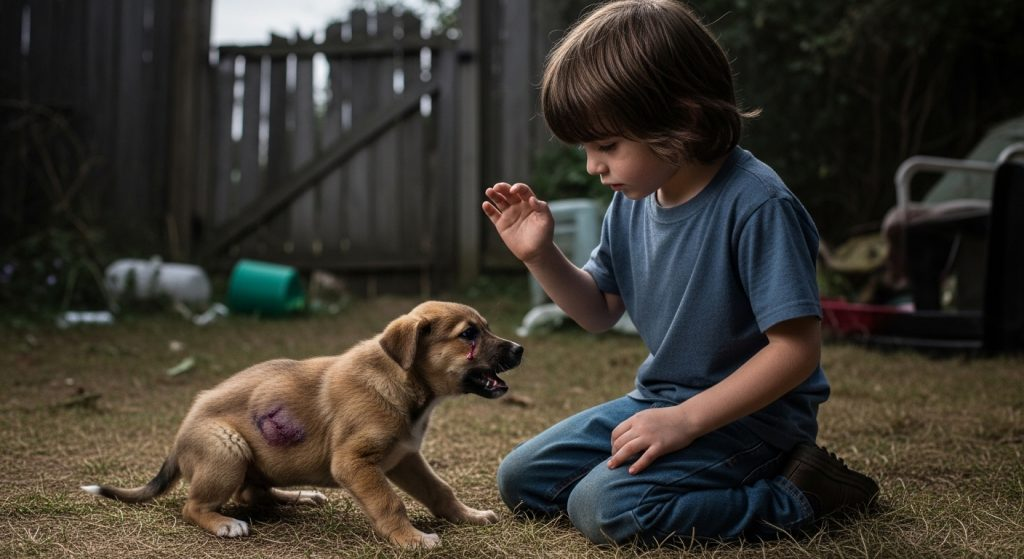
I’ve been fostering rescue dogs in Ohio for almost twelve years, but absolutely nothing could have prepared me for the sickening truth hiding beneath a stained blue fleece blanket.
My name is Sarah. In my time working with the county animal control, I’ve seen it all. I’ve taken in dogs that were abandoned on highways, dogs left tied to fences in the freezing midwestern winter, and dogs that were simply given up because they got too old. I thought my heart had built up a thick callus. I thought I knew exactly how cruel the world could be.
But I was wrong.
It all started on a rainy Tuesday afternoon. The county shelter called me about an emergency placement. They had just brought in a golden retriever mix puppy, barely four months old. They found him dumped in a cardboard box behind a local strip mall. The shelter manager, a woman named Diane who usually had nerves of steel, sounded genuinely shaken on the phone.
“Sarah, you need to come get this one,” she told me, her voice trembling slightly over the line. “He’s in bad shape. He’s got severe bruising along his ribs and abdomen. But the strangest part is… he won’t lie down. He just stands there, shivering, crouched over. The vet thinks it’s extreme soft tissue trauma from being kicked, but he needs a quiet home right now to decompress. The shelter environment is making him panic.”
I didn’t even hesitate. I grabbed my keys, threw on a heavy coat to block out the freezing October rain, and drove straight to the shelter.
When I first laid eyes on the puppy, my heart shattered into a million pieces. They had named him Barnaby. He was a scruffy, golden-haired little thing, but his spirit was completely broken. His left side was a canvas of dark purple and mottled yellow bruises. He was standing in the corner of his kennel, his back arched in a highly unnatural, tense posture. Just like Diane had said, he refused to sit or lie down. He just hovered there, fighting exhaustion, his little legs shaking from the effort of holding himself up.
I brought him home, setting up a quiet, safe space in the corner of my living room. I laid out a thick orthopedic dog bed and covered it with a soft, blue fleece blanket. I thought that maybe, once he realized he was safe in a warm house with soft bedding, he would finally collapse and get some much-needed sleep.
But he didn’t.
For the first two days, Barnaby just stood over that blue blanket. If he got too tired, he would lean his weight against the drywall, his eyes drooping closed, but he would stubbornly refuse to let his stomach touch the floor. It was heartbreaking to watch. I spent hours sitting on the floor a few feet away, tossing him high-value treats, speaking to him in the softest voice I could muster, trying to convince him that the floor wasn’t going to hurt him.
During this time, I was also watching my nephew, Leo.
Leo is nine years old. My sister was going through an incredibly ugly and messy divorce, and she needed somewhere for Leo to stay for a few weeks while she finalized the housing situation. Leo was a quiet boy. The divorce had hit him hard, making him withdrawn and sometimes unpredictable. He didn’t talk much, preferring to sit on the couch with his iPad, lost in his own world.
I had given Leo strict instructions regarding Barnaby. “He is very hurt, buddy,” I had told him on the first day, looking him right in the eye. “He needs lots of space. We cannot touch him right now because his body is very sore. You can look at him, but you cannot pet him. Do you understand?”
Leo had just nodded silently, not looking up from his screen. I trusted him. He had never been a violent kid. He was just deeply sad.
On the third afternoon, the rain had finally stopped, leaving the Ohio sky a heavy, oppressive gray. I was in the kitchen, standing at the counter and chopping carrots for a stew. From where I stood, I had a clear line of sight into the living room.
Barnaby was in his usual spot, standing tensely over the blue blanket on his bed, his head hanging low with exhaustion.
Leo was sitting on the living room rug, a few feet away from the dog. He didn’t have his iPad. He was just watching Barnaby.
I smiled a little, thinking it was a sweet moment. Maybe the boy and the dog could find some quiet comfort in each other. I turned my attention back to the cutting board.
Then, I heard it.
A sharp, high-pitched yelp of pain.
I froze, the knife pausing mid-air. It was a sound that instantly sent a spike of adrenaline straight into my bloodstream. I quickly wiped my hands on a towel and took a quiet step toward the doorway, peering into the living room.
What I saw made my blood run absolutely cold.
Leo was on his knees, right next to Barnaby. The boy slowly raised his right hand, extending his index finger. He carefully aimed for the darkest, ugliest purple bruise on the puppy’s exposed ribs.
And then, he firmly tapped it.
Barnaby flinched violently, his whole body violently jerking sideways, and let out another pathetic, agonizing yelp. The puppy didn’t bite or snap; he just cowered, trembling harder, his tail tucked so far between his legs it was touching his stomach.
My breath caught in my throat. I couldn’t believe what I was seeing. My sweet, quiet nephew was hurting an already broken animal.
“Leo…” I whispered to myself, paralyzing confusion gripping my chest. Why would he do that? Was he acting out because of his parents’ divorce? Was he projecting his own pain onto this defenseless creature?
I was about to storm into the room and yell, but something made me stop. I stayed hidden behind the doorframe, watching. I needed to understand what was happening.
Leo didn’t look angry. He didn’t look malicious. His face was completely blank, intensely focused. He waited a few seconds, letting the puppy settle back into his rigid stance.
Then, he raised his finger again.
Tap. Another yelp. The sound echoed in the quiet house, breaking my heart all over again.
I couldn’t take it anymore. Anger flared up inside me, hot and blinding. I stepped out from the kitchen, my heavy boots thudding loudly against the hardwood floor.
“Leo! What on earth are you doing?!” I yelled, my voice cracking with emotion.
Leo jumped, startled by my sudden appearance. He quickly pulled his hand back, his eyes wide as he looked up at me.
“I… I wasn’t doing anything,” he stammered, his cheeks flushing red.
“I saw you!” I rushed over, dropping to my knees and immediately positioning myself between the boy and the dog. Barnaby was shaking so hard his teeth were practically chattering. I gently placed a protective hand in front of the puppy, glaring at my nephew. “I saw you hitting him! Why would you hurt him, Leo? You know he’s already in pain!”
“I wasn’t trying to hurt him!” Leo yelled back, tears instantly welling up in his eyes. He pointed a trembling finger down at the dog bed. “I was trying to make him move! He needs to move away from it!”
I paused, my anger suddenly hitting a wall of confusion. “Move away from what?” I asked, my voice lowering.
Leo wiped a tear from his cheek, his breathing heavy. “The blanket, Aunt Sarah. Whenever he tries to lower his head to look at the blanket, he cries. He can’t lie down because of what’s under it.”
I stared at Leo, completely bewildered. “What are you talking about? I laid that blanket down myself. It’s just a dog bed.”
“No, it’s not,” Leo insisted, his voice dropping to a frightened whisper. “Something is moving under there. I saw it pushing up against his stomach. That’s why he won’t lie down. I poked his side so he would move away from it so I could look.”
A deep, unsettling chill washed over me, starting from the back of my neck and traveling all the way down my spine. I looked down at Barnaby. The puppy was staring intently at the bunched-up blue fleece blanket beneath his paws.
For the first time, I looked closely at the fabric.
It wasn’t just bunched up. The center of the blanket was slightly elevated. And as I stared at it, holding my breath in the quiet living room, I saw it.
A tiny, almost imperceptible shift in the fabric.
Something was underneath the blanket.
My heart began to hammer violently against my ribs. I looked at Leo, who was watching me with wide, terrified eyes. I looked back at the blanket. Barnaby let out a low, nervous whine.
My hands began to tremble as I slowly reached out toward the edge of the blue fleece. I didn’t know what to expect. A snake? A rodent? What could possibly have gotten into my living room and hidden perfectly under the dog’s bed?
I grabbed the corner of the fabric. I held my breath, bracing myself.
And then, I pulled it back.
CHAPTER 2
The world seemed to slow down to an agonizing crawl as my fingers gripped the edge of the blue fleece blanket.
My heart was hammering a frantic rhythm against my ribs, echoing loudly in my ears. The silence in the living room was deafening, broken only by the sound of the rain lashing against the windowpanes outside and the ragged, shallow breathing of the battered golden retriever puppy standing over the fabric.
I didn’t know what I was going to find. A part of my mind, fueled by years of watching true crime documentaries and seeing the worst of humanity in animal rescue, imagined the most horrific scenarios. Was it a trap? Was it a mechanical device left by his abusers? Was it a venomous snake that had somehow slithered into my home seeking warmth?
I squeezed my eyes shut for a fraction of a second, gathered every ounce of courage I possessed, and yanked the blanket back.
It wasn’t a trap.
It wasn’t a snake.
At first glance, it looked like a discarded piece of dirty, wet trash. It was a tiny, irregular lump, dark gray and matted, resting in the very center of the orthopedic dog bed.
I stayed frozen on my knees, staring at it. My brain struggled to process the visual information.
Then, the lump moved.
It was a tiny, subtle shift, a weak expansion and contraction.
Breathing.
I leaned in closer, my hands trembling so violently I had to press them flat against the hardwood floor to steady myself. The metallic, sour smell of infection and old blood hit my nose, making my stomach churn.
As my eyes adjusted to the dim light of the rainy afternoon, the agonizing shape of the lump came into focus.
It was a kitten.
But it was so incredibly small, so emaciated and broken, that it barely resembled a living creature. It couldn’t have been more than three or four weeks old. Its fur was completely caked in dried mud and something dark and sticky.
But that wasn’t the sickening truth that made the blood drain entirely from my face. That wasn’t what made a cold, terrifying sweat break out across the back of my neck.
It was what was wrapped around the kitten’s lower half.
Someone—some absolute monster of a human being—had taken a thick, industrial-grade black zip tie and fastened it tightly around both of the kitten’s fragile back legs, binding them together.
The plastic band was pulled so tight that it was cutting deeply into the tiny animal’s skin. The tissue around the zip tie was swollen, purple, and angry. The kitten couldn’t move its lower body at all. It was completely paralyzed by the cruel plastic restraint, left to drag itself forward on its tiny front paws.
“Oh my god,” I gasped, the words tumbling out of my mouth as a breathless, horrified whisper. I covered my mouth with both hands, hot tears instantly springing to my eyes and blurring my vision.
Beside me, Barnaby let out a low, mournful whine.
The puppy, despite his own agonizing bruised ribs and battered body, slowly lowered his heavy head. His legs were shaking terribly from the effort of standing for so long, but he completely ignored his own pain. He stretched his neck out and gently, so incredibly gently, nudged the tiny bound kitten with his wet nose.
The kitten let out a microscopic, raspy mewl in response.
In that single, heartbreaking moment, all the puzzle pieces suddenly snapped together in my mind.
The cardboard box behind the strip mall. The shelter manager telling me Barnaby refused to lie down. His weird, rigid, arched stance in his kennel. The way he had stood over this exact spot in my living room for two straight days, refusing to sleep, refusing to let his stomach touch the floor.
Barnaby had brought the kitten with him.
Golden retrievers are bred to have what is called a “soft mouth.” They can carry birds or eggs in their jaws without leaving a single tooth mark.
When Barnaby was dumped in that cardboard box, whoever left him there had dumped the bound kitten with him. And when the loud, terrifying animal control officers had arrived to grab him, the terrified puppy had done the only thing he could think of.
He had scooped the tiny, helpless kitten up into his mouth.
He had hidden it.
He carried the kitten in his mouth through the chaotic transport to the shelter. Because he was in so much pain, the staff hadn’t pried his mouth open to examine his teeth. They had just put him in a kennel. And there, he had dropped the kitten and stood over it, acting as a living, breathing shield to protect it from the strange people.
He had done the same thing when I brought him to my car, and finally, into my house. When I had laid the blue fleece blanket over his bed, he must have tucked the kitten underneath it to keep it warm and hidden from me.
For forty-eight hours, this beaten, battered puppy had endured absolute physical agony. He had forced himself to stand on exhausted, shaking legs, refusing to lie down, because he knew that if he collapsed, his heavy body would crush the fragile life he was trying to save.
He was enduring torture just to be a protector.
“Aunt Sarah?”
Leo’s small, frightened voice broke through my swirling thoughts. I looked over at my nine-year-old nephew. He was still sitting on the rug, his face pale, his eyes darting between me, Barnaby, and the tiny creature on the bed.
“Is… is it dead?” Leo whispered, his voice trembling.
“No,” I choked out, furiously wiping the tears from my cheeks. I had to pull myself together. Now was not the time to break down. Now was the time for action. “No, Leo, it’s alive. But it’s hurt. It’s hurt really bad.”
Leo slowly crawled forward on his hands and knees. He didn’t try to touch the dog or the kitten. He just looked at the thick black zip tie cutting into the tiny legs.
I saw a profound shift in my nephew’s eyes. The blank, disconnected stare he had carried since his parents’ messy divorce vanished completely. It was replaced by a deep, shattering empathy.
“He wasn’t trying to be mean to me,” Leo said softly, his voice cracking. He looked up at Barnaby with pure awe. “He wasn’t ignoring you, Aunt Sarah. He was being a hero. He was saving the baby.”
“He is a hero, Leo,” I agreed, my voice thick with emotion. “But right now, they both need our help.”
I forced myself to stand up. My knees popped loudly in the quiet room. The adrenaline was hitting my bloodstream in massive, crashing waves, making my fingertips tingle and my heart race.
“Leo, I need you to go to the front door and put your shoes on right now,” I commanded, shifting into full emergency mode. “Then, I need you to grab the thickest, softest towels you can find from the bathroom cabinet. Run!”
Leo didn’t hesitate. He scrambled to his feet and sprinted down the hallway, his socks slipping slightly on the hardwood.
I spun around and sprinted into the kitchen. I threw open the drawers, frantically searching. Regular scissors wouldn’t work. The industrial zip tie was too thick, and the kitten’s legs were too fragile. I needed precision. I needed strength.
My fingers finally closed around a pair of heavy-duty trauma shears I kept in my emergency first-aid kit.
I ran back into the living room and dropped to my knees beside the dog bed. Barnaby flinched as I approached, instinctively shifting his bruised body to block my access to the kitten. He let out a low, warning growl deep in his chest.
“I know, buddy, I know,” I cooed softly, keeping my voice as calm and steady as humanly possible. I slowly extended my hand, letting him sniff my knuckles. “I’m not going to hurt it. I promise you, Barnaby. I’m going to help. You don’t have to protect it alone anymore.”
Whether he understood my words or just sensed the change in my energy, Barnaby’s growl slowly faded. He let out a long, exhausted sigh, his eyes drooping. He was at the absolute end of his physical limits. He slowly took one painful step back, allowing me access to the kitten.
I leaned over the tiny gray lump. The smell was overpowering up close, a clear sign that the restricted blood flow had caused a severe infection.
My hands were shaking, which was dangerous. I took a deep, shuddering breath, holding it in my lungs to steady my nerves. I carefully slid the blunt lower blade of the trauma shears between the harsh plastic of the zip tie and the kitten’s swollen, bruised skin.
It was an impossibly tight fit. The plastic had deeply embedded itself into the tissue. The kitten let out a sharp, agonizing shriek as the cold metal touched its raw skin.
“I’m sorry, I’m sorry, I’m so sorry,” I chanted under my breath, sweat beading on my forehead.
I squeezed the handles of the shears with all my strength.
SNAP.
The thick plastic cleanly severed.
The relief was instantaneous. As the rigid zip tie fell away, the kitten’s tiny back legs slightly uncurled. A rush of dark fluid seeped from the deep indentations left by the plastic. The little creature let out a long, shaky exhale, its head dropping completely flat against the bed.
“I got the towels!” Leo yelled, sliding back into the living room with a stack of clean white bath towels in his arms. He was wearing his oversized rain boots, his jacket halfway zipped.
“Perfect,” I said, my voice tight. “Bring them here.”
I took the softest towel and carefully, delicately scooped the tiny kitten up into the fabric. It weighed absolutely nothing, like holding a handful of dry leaves. I wrapped the towel around it, leaving only its tiny face exposed, trying to preserve whatever little body heat it had left.
“Okay,” I said, looking at Leo. “We are going to the emergency vet clinic on Highway 4. Right now.”
“What about Barnaby?” Leo asked, looking down at the puppy.
With the kitten safely in my arms, the mission Barnaby had assigned himself was finally over. The intense adrenaline that had kept him standing for two days suddenly vanished.
Right before our eyes, the golden retriever’s front legs buckled. He let out a soft groan and finally, heavily, collapsed onto the blue fleece blanket. He was asleep before his head even hit the floor.
“We’re taking him too,” I said firmly.
I handed the towel-wrapped kitten to Leo. “Hold this. Hold it gently against your chest. Keep it warm. Do not squeeze.”
Leo took the small bundle with the utmost care, cradling it against his winter jacket as if it were made of fragile glass. His face was a mask of pure determination.
I knelt down and carefully slid my arms under Barnaby’s bruised body. He whimpered in his sleep as I lifted him, but he didn’t wake up. He was completely dead weight, a furry bag of exhausted bones.
We rushed out the front door and into the pouring Ohio rain. The cold wind whipped across the porch, chilling me to the bone, but I didn’t care. I kicked the back door of my SUV open and gently laid Barnaby across the back seat.
“Get in, Leo,” I ordered, gesturing to the seat right next to the dog.
Leo climbed in, sitting rigidly, holding the kitten against his chest. I slammed the door shut, ran to the driver’s side, and fired up the engine.
The drive to the emergency clinic felt like a blur of sheer panic and intense focus. The rain was coming down in sheets, turning the highway into a slippery, dangerous gray smear. The windshield wipers slapped violently back and forth, fighting a losing battle against the downpour.
My knuckles were white as I gripped the steering wheel, my eyes locked on the taillights of the semi-truck in front of me.
The silence in the car was heavy. The only sounds were the roaring heater blowing hot air into the cabin and the rhythmic thump-thump of the wipers.
My mind was racing a mile a minute. I couldn’t stop thinking about the absolute depravity required to do what had been done to those animals. To beat a four-month-old puppy until his ribs were black and blue. To take an innocent, newborn kitten and bind its legs tightly with industrial plastic, ensuring it would die a slow, agonizing death.
To throw them both away like garbage.
Anger, pure and unadulterated, burned a hole in my chest. I had seen cruelty before, but this felt personal. This felt like encountering pure evil.
I glanced in the rearview mirror.
Leo was sitting in the back, entirely illuminated by the passing streetlights. He had unzipped his jacket slightly to keep the kitten closer to his own body heat. His head was bowed, his forehead resting gently against the bundle of towels.
With his free hand, he was slowly, methodically stroking Barnaby’s sleeping head.
“It’s going to be okay,” I heard Leo whisper into the dark car, his voice remarkably steady for a nine-year-old boy. “You’re safe now. You don’t have to hide anymore. We’re going to fix it.”
Tears pricked my eyes again. My sister’s divorce had made Leo feel completely powerless. He had been tossed around between lawyers, arguments, and shifting living situations. He knew exactly what it felt like to have your world torn apart by adults you were supposed to trust.
In this broken dog and this paralyzed kitten, Leo had found a mirror to his own trauma. And instead of shutting down, he had stepped up to be their guardian.
Fifteen agonizing minutes later, the glowing red neon sign of the ’24/7 Animal Emergency Center’ cut through the rain ahead.
I pulled my SUV hard into the parking lot, not even bothering to park straight between the yellow lines. I slammed the shifter into park, killed the engine, and practically jumped out of the driver’s seat.
I threw open the back door. “Let’s go, Leo!”
I scooped the heavy, sleeping Barnaby back into my arms, gritting my teeth against the strain on my back. Leo slid out, clutching the kitten tightly to his chest. We ran through the driving rain and burst through the double glass doors of the clinic lobby.
The bright, sterile fluorescent lights of the waiting room were blinding.
“Help!” I yelled, my voice echoing off the tile floors. “I need help right now! I have a severely beaten puppy and a bound kitten with restricted blood flow!”
The receptionist behind the front desk took one look at us—a soaking wet woman carrying an unconscious, bruised dog, and a young boy holding a blood-stained towel—and immediately hit a button on her phone.
“Code red to the lobby. Dr. Evans, code red to the lobby,” her voice blared over the clinic intercom.
Within seconds, a pair of veterinary technicians burst through the swinging doors leading to the treatment area. They were wheeling a stainless steel gurney.
“Put him here,” the male tech ordered, gesturing to the table.
I gently laid Barnaby down. He didn’t even twitch.
The female tech turned to Leo. “What do you have there, sweetheart?”
Leo looked up at her, his eyes wide, and carefully opened the folds of the towel. The technician gasped, her professional composure breaking for a split second when she saw the deep, raw indentations on the tiny kitten’s legs.
“I cut the zip tie off about twenty minutes ago,” I explained rapidly, stepping in front of Leo to shield him from the chaos. “Barnaby, the dog, was hiding it. He stood over it for two days. The kitten’s legs were bound.”
“Jesus,” the male tech muttered, already hooking a stethoscope into his ears. “Okay, we’ve got them. We’re taking them back immediately.”
They spun the gurney around. The female tech took the towel from Leo with practiced care. In a flash of scrubs and swinging doors, they were gone, leaving Leo and me standing completely alone in the silent, freezing waiting room.
The adrenaline crash hit me like a physical blow.
My knees wobbled, and I practically collapsed into one of the stiff, plastic waiting room chairs. I buried my face in my wet hands, my breathing ragged and uneven. The rain water dripped from my hair, soaking into the collar of my shirt.
Leo quietly walked over and sat in the chair next to me. He didn’t say anything. He just reached out and slipped his small, cold hand into mine, gripping my fingers tightly.
We sat there for what felt like an eternity.
The clock on the wall ticked loudly. Every time the phone rang at the front desk, I jumped. Every time a door opened, my head snapped up. The smell of clinical antiseptic mixed with the lingering scent of wet dog in my nose.
I prayed. I prayed to whoever was listening to spare that brave, loyal puppy and the tiny life he had sacrificed so much to protect.
Nearly an hour passed. The rain outside finally began to slow down to a light drizzle.
Then, the swinging doors at the back of the clinic slowly pushed open.
Dr. Evans walked out. He was a tall man in his late fifties, usually armed with a warm smile and a comforting demeanor. I had known him for years through my rescue work.
But right now, he wasn’t smiling.
He looked completely exhausted. His green surgical scrubs were stained, and his face was grim. He reached up, pulled his wire-rimmed glasses off his face, and rubbed his eyes heavily with his thumb and forefinger.
My stomach plummeted straight to the floor. The air in my lungs turned to ice.
I stood up slowly, my hand still holding Leo’s.
“Dr. Evans?” I asked, my voice barely a whisper. “Are they… are they going to make it?”
Dr. Evans looked at me, then down at Leo, and then back up at me. His jaw was set in a tight, rigid line.
“Sarah,” he said softly, his voice echoing in the quiet lobby. “We managed to stabilize the kitten’s body temperature. And Barnaby is on strong IV pain medication…”
He paused, taking a deep, hesitant breath.
“But we have a very serious situation. The abuse Barnaby suffered… it was far worse than the shelter initially realized. When we shaved his belly to check for internal bleeding…”
Dr. Evans stopped talking and looked away for a second, swallowing hard.
“You and Leo need to come to the back right now. There is something else you need to see.”
<CHAPTER 3>
The heavy, metal-plated swinging doors of the treatment area pushed open with a soft, pneumatic hiss.
Stepping out of the quiet, waiting room and into the back of the emergency clinic felt like crossing the threshold into an entirely different universe. The bright, sterile fluorescent lights overhead were harsh, buzzing with a low, constant electrical hum.
The air back here was noticeably colder, thick with the sharp, chemical scents of bleach, rubbing alcohol, and the faint, unmistakable metallic odor of blood.
I kept my hand firmly wrapped around Leo’s small, trembling fingers. I could feel the rapid pulse in his wrist. He was terrified, but he was trying incredibly hard to be brave. He walked close to my side, his oversized rain boots squeaking slightly against the pristine white linoleum floor.
Dr. Evans walked a few paces ahead of us. His broad shoulders, usually relaxed and welcoming, were tense and hunched. He didn’t look back. He just led us down a long, narrow hallway lined with glass-fronted recovery cages and stainless steel medical carts.
With every step, my dread deepened.
In my twelve years of fostering, I had been in the back rooms of veterinary clinics dozens of times. Usually, a vet brings you back here to say goodbye. They bring you back when the injuries are too severe, when the illness has progressed too far, and they want you to be with the animal in its final moments.
My throat felt like it was lined with sandpaper. I desperately wanted to ask Dr. Evans to stop walking, to just turn around and tell me what was going on, but my voice completely failed me.
We reached the end of the hallway and turned into the main trauma bay.
The room was large, dominated by three large stainless steel examination tables under intense, focused surgical lights. Two veterinary technicians were rushing around the far side of the room, speaking in low, urgent voices as they prepared syringes and adjusted IV fluid bags.
In the center of the room, under the brightest light, was Barnaby.
My breath hitched in my chest.
The four-month-old golden retriever puppy looked impossibly small on the cold metal table. He was laying on his side, completely unconscious. A thick, clear plastic oxygen mask covered his snout, fogging up rhythmically with his shallow breaths. Wires snaked across his chest, connecting him to a heart monitor that was beeping with a steady, high-pitched blip… blip… blip.
But that wasn’t what made me stop dead in my tracks.
To properly clean his wounds and assess the tissue damage, the veterinary staff had shaved the fur off Barnaby’s entire left side, his belly, and his chest. Without his fluffy golden coat to hide the reality of his condition, the visual was absolutely devastating.
His skin was a horrific canvas of dark, mottled purple, angry red, and sickly yellow bruising. It looked as though he had been hit by a car.
“Oh, Barnaby,” I whispered, the words slipping out as a broken sob. I brought my free hand up to cover my mouth, fighting the overwhelming urge to break down entirely.
Leo squeezed my hand hard. I looked down at him. The nine-year-old boy was staring at the puppy, his eyes wide and completely heartbroken. Tears were silently tracking down his cheeks, dropping off his chin and landing on the collar of his wet jacket.
“We had to heavily sedate him just to touch him,” Dr. Evans said softly, stepping up to the side of the metal table. He looked down at the sleeping puppy with deep, profound sadness. “The pain he was enduring while standing in your living room… it’s medically incomprehensible to me that he didn’t go into severe shock. His heart rate was through the roof when he came through those doors.”
“You said the abuse was worse than the shelter thought,” I managed to say, my voice trembling. “You said there was something I needed to see.”
Dr. Evans nodded slowly. He didn’t look at Barnaby’s bruised skin. Instead, he turned toward a computer station mounted on the wall next to the trauma table.
“When we shaved him, we noticed something that the shelter staff missed under his matted fur,” the vet explained, his tone shifting into a tight, clinical professionalism that barely masked his underlying anger. “The bruising wasn’t just from blunt force trauma. It wasn’t just from being kicked or beaten. The bruising was masking localized puncture wounds.”
My stomach performed a sickening flip. “Puncture wounds? Like dog bites? Was he used as a bait dog?”
It was a horrible thought, but a common one in animal rescue. Illegal dog fighting rings often used stolen or stray puppies to train their aggressive dogs, letting the poor creatures get mauled.
“No,” Dr. Evans said, shaking his head. “Not dog bites.”
He reached out and clicked the mouse on the computer station.
A large, high-definition monitor mounted on the wall suddenly flickered to life. The bright white light of an X-ray image illuminated the dimly lit trauma bay.
I stared at the screen, my mind struggling to process the black and white skeletal image of the puppy.
I could see the delicate curve of his spine, the fragile cage of his ribs, the outline of his small skull. But scattered all across his side, his abdomen, and his chest were tiny, perfectly round, bright white dots.
There were dozens of them.
They looked like small, glowing stars scattered across a dark sky. They were clustered heavily around his ribs, with a few stray dots near his back legs and one frighteningly close to his neck.
I stared at the image, utterly confused. “What… what are those?” I asked, pointing a shaking finger at the monitor. “Are those microchips? Did he swallow something?”
Dr. Evans turned to look at me, his eyes dark with a mixture of sorrow and burning fury.
“Sarah,” he said, his voice dropping to a heavy, serious register. “Those are lead pellets. Birdshot and BBs.”
The words hung in the cold, sterile air for a long moment before my brain finally translated them.
When it hit me, all the air rushed out of my lungs in a painful gasp. My knees felt suddenly weak, and I had to lean heavily against the edge of a nearby counter to keep from collapsing.
Someone hadn’t just beaten this puppy.
Someone had used a defenseless, four-month-old golden retriever as target practice.
They had stood over him, or perhaps tied him up, and repeatedly shot him with a pellet gun at close range. The force of the small metal projectiles hitting his body had caused the massive, horrific bruising. Some of the pellets had penetrated his skin and lodged deep into his muscle tissue, dangerously close to his vital organs.
“They shot him,” Leo whispered, his voice cracking with disbelief.
The boy let go of my hand and slowly walked closer to the computer monitor. He stared at the bright white dots on the X-ray, his small face illuminated by the glow of the screen.
“Why would someone shoot a baby dog?” Leo asked, turning to look at Dr. Evans. There was no anger in his voice yet, just a profound, innocent confusion that broke my heart into a million more pieces. “He’s just a baby. He couldn’t hurt anyone.”
Dr. Evans let out a long, heavy sigh, running a hand through his graying hair. “I don’t know, Leo. I’ve been a veterinarian for almost thirty years, and I still don’t understand how people can do things like this. There is a kind of cruelty in the world that just doesn’t make sense.”
“Can you take them out?” I asked, my voice rising in panic. I looked back at Barnaby, imagining those cold metal beads resting inside his tiny body. “You have to take them out. They’ll cause an infection, right? Lead poisoning?”
“It’s complicated,” Dr. Evans explained, moving back to the surgical table and gently checking the puppy’s IV line. “The pellets are embedded deep in the muscle tissue. Going in surgically to remove all forty-seven of them right now would cause more trauma than leaving them in. His body has already been through hell. If I put him under deep, prolonged anesthesia for a massive surgery today, his heart won’t take it.”
He pointed to the monitor. “Fortunately, none of the pellets penetrated the chest cavity. His lungs and heart are clear. For now, the safest course of action is heavy antibiotics to fight the infection from the puncture wounds, pain management, and letting his body rest. Once he’s stronger, we can reassess removing the pellets that are causing the most discomfort.”
I looked down at the brave little dog. He had endured being shot, beaten, and thrown away in a cardboard box in the freezing rain.
And despite all of that unimaginable agony, his only thought had been to save an even smaller, more defenseless creature. He had carried that bound kitten in his mouth, taken the pain, and stood guard over it for two days.
“What about the kitten?” I asked, suddenly remembering the tiny, fragile bundle Leo had carried in. “Where is it? Is it alive?”
Dr. Evans managed a small, tired smile. “The kitten is a fighter. Just like her protector.”
He gestured for us to follow him. We walked past Barnaby’s table and moved toward the far corner of the trauma bay, where a row of specialized pediatric incubators lined the wall.
Dr. Evans stopped in front of the middle unit. Inside, resting on a heated pad and surrounded by soft, clean white towels, was the tiny gray kitten.
The mud and dried blood had been carefully washed away, revealing a beautiful, fluffy, smoke-gray coat. She was incredibly small, looking completely lost in the large plastic box. A tiny, clear tube was providing her with supplemental oxygen.
She was fast asleep, her tiny chest rising and falling in a steady, reassuring rhythm.
“She’s a female,” Dr. Evans said softly, looking through the clear acrylic door. “Severely malnourished, severely dehydrated, and she has a nasty upper respiratory infection. But her biggest hurdle is going to be her back legs.”
I leaned in closer, my heart aching. The thick black zip tie was gone, but the damage remained. Her tiny back legs were heavily bandaged in soft white gauze.
“Did the plastic cut off the circulation permanently?” I asked, dreading the answer. “Will she lose her legs?”
“That was my primary concern when the technician brought her back,” Dr. Evans admitted. “The tissue damage is severe. The plastic cut deep into the muscle, right down to the bone in one spot. However…”
He turned to look at me, a glimmer of genuine amazement in his eyes.
“However, whoever applied that zip tie didn’t factor in the kitten’s size. Because she is so emaciated, the zip tie didn’t completely compress the main femoral artery. It restricted the blood flow, which caused the swelling and the extreme pain, but it didn’t stop the circulation entirely. The tissue isn’t necrotic. It’s heavily bruised and infected, but it’s alive.”
A massive wave of relief washed over me. I closed my eyes and let out a long, shaky exhale. “So, she’ll walk again?”
“It’s going to take time, aggressive antibiotics, and likely some physical therapy,” Dr. Evans said. “But yes. Because Barnaby refused to lie down and crush her, and because you got her here when you did, I believe she will make a full recovery.”
I looked down at Leo. He was staring at the sleeping kitten in the incubator, a small, genuine smile finally breaking through the trauma on his face. He pressed his hand against the clear plastic door.
“We saved her,” Leo whispered.
“You saved her, Leo,” I corrected him gently, placing a hand on his shoulder. “If you hadn’t been paying attention to Barnaby, if you hadn’t noticed he couldn’t lie down, we might not have found her in time.”
For a brief, beautiful moment, the heavy tension in the room lifted. We stood there in the quiet hum of the machinery, watching the tiny kitten breathe. It felt like a small victory in a world that had suddenly revealed a terribly dark side.
But the victory was incredibly short-lived.
Suddenly, the rhythmic, steady blip… blip… blip of the heart monitor attached to Barnaby across the room completely changed.
The sound skyrocketed into a frantic, high-pitched, chaotic alarm.
BEEP-BEEP-BEEP-BEEP-BEEP!
“Doctor!” one of the veterinary technicians shouted, her voice echoing sharply across the trauma bay. “His blood pressure is crashing! Heart rate is spiking, irregular rhythm!”
The peaceful atmosphere shattered instantly.
Dr. Evans spun away from the incubator and sprinted back toward the center table. The two technicians were already swarming the puppy.
“Push a bolus of fluids, wide open!” Dr. Evans ordered rapidly, his hands flying as he checked the puppy’s airway and pressed a stethoscope to his bruised chest. “Get the crash cart ready. Draw up epinephrine, stand by!”
Panic seized my chest in an iron grip. I grabbed Leo by the shoulders and quickly pulled him back against the wall, out of the way of the rushing medical staff.
Barnaby’s small body, previously motionless under the sedation, began to twitch. His back arched sharply off the metal table, his legs extending rigidly.
“He’s seizing!” the female technician yelled, fighting to keep the oxygen mask over his snout.
“It’s the stress on his heart,” Dr. Evans said, his voice tight with concentration. “His body has taken too much damage. Push two milligrams of Diazepam, now!”
I watched in absolute horror as the technician rapidly injected clear fluid into the puppy’s IV line. The heart monitor continued its terrifying, frantic screaming.
“Aunt Sarah…” Leo whimpered, burying his face into my side, unable to watch. “Make them fix him. Please make them fix him.”
I wrapped my arms tightly around my nephew, pulling him close, my own tears flowing freely now. “They’re trying, baby. They’re trying so hard.”
I stared at the medical team working frantically over the puppy. My mind screamed at the unfairness of it all. This dog had survived the beatings. He had survived the gunshots. He had survived the freezing rain. He had accomplished his mission of saving the kitten.
He couldn’t die now. He just couldn’t.
“Come on, Barnaby,” I whispered fiercely under my breath, sending every ounce of willpower I had toward the metal table. “Don’t you dare give up. You’re a hero. Heroes don’t die like this. You fight.”
The next sixty seconds felt like a grueling, suffocating eternity.
The room was a blur of shouted medical terms, the terrifying shriek of the heart monitor, and the desperate, frantic movements of Dr. Evans and his team. They worked with practiced precision, fighting a war against the massive trauma inflicted on a tiny, fragile body.
Slowly, agonizingly slowly, the frantic alarm of the heart monitor began to slow down.
The sharp, erratic beeps gradually spread apart, finding a steadier, lower rhythm. Barnaby’s rigid body slowly relaxed, slumping back against the metal table. The seizure stopped.
“Heart rate is stabilizing,” the male technician called out, wiping a bead of sweat from his forehead. “Blood pressure is slowly coming back up.”
Dr. Evans kept his stethoscope pressed to Barnaby’s chest for a long time. Finally, he pulled the earpieces out and let out a deep, ragged breath. He leaned heavily against the edge of the table, looking incredibly old in the harsh surgical lights.
“He’s back,” Dr. Evans said quietly, looking over at me. “He stabilized.”
I let out a sob of pure relief, my knees buckling slightly. I sank to the floor, pulling Leo down with me, just holding him in the quiet corner of the trauma bay.
Barnaby had fought his way back from the edge.
For the next two hours, we sat in the corner of the room while the veterinary team continuously monitored the puppy. They adjusted his fluids, gave him more pain medication, and slowly cleaned the worst of the infected wounds.
By the time the clock on the wall read 9:00 PM, Barnaby was resting peacefully. His breathing was deep and even, the crisis averted for now.
Dr. Evans walked over to where Leo and I were sitting on a small bench against the wall. He handed me a styrofoam cup of terrible, lukewarm clinic coffee. I took it gratefully, letting the heat seep into my cold fingers.
“He’s through the worst of it,” Dr. Evans said softly, leaning against the wall next to us. “The first twenty-four hours are critical, but he’s young, and clearly, he has a massive will to live. We’ll keep him heavily sedated until tomorrow afternoon.”
“Thank you,” I said, my voice hoarse from crying. “Thank you for not giving up on him.”
“I never give up on the good ones,” Dr. Evans replied, offering a tired smile.
He took a sip of his own coffee, his expression suddenly shifting back to the grim, serious demeanor he had when he first brought us back here.
“There is something else we need to discuss, Sarah,” he said quietly.
I looked up at him, my anxiety instantly flaring up again. “Is something else wrong with him medically?”
“No,” Dr. Evans said, shaking his head. “Medically, we know what we’re dealing with. It’s the legal side of things.”
He set his coffee cup down on a nearby counter and crossed his arms over his chest.
“When an animal comes in with severe blunt force trauma, we document it. But when an animal comes in with dozens of ballistic wounds—gunshots—state law mandates that I immediately notify law enforcement. It elevates this from a standard animal welfare call to a felony investigation for animal cruelty and weapons discharge.”
I nodded slowly, understanding the protocol. “Have you called them?”
“I called the county sheriff’s department while they were cleaning Barnaby up,” Dr. Evans confirmed. “They take these cases very seriously. Deputy Miller is actually waiting out in the lobby right now.”
“Okay,” I said, taking a deep breath and standing up. “I’ll go talk to him. I can tell him exactly where the shelter found the cardboard box, and—”
“Sarah, wait,” Dr. Evans interrupted, holding up a hand to stop me.
There was a strange, unsettling hesitation in the veterinarian’s eyes. He looked genuinely troubled.
“When Deputy Miller arrived, I showed him the X-rays,” Dr. Evans continued, his voice dropping to a low murmur. “And I showed him Barnaby. The deputy… he recognized the dog.”
My brow furrowed in deep confusion. “Recognized him? How? He’s just a stray puppy.”
“He’s not a stray,” Dr. Evans said, his jaw tightening. “Deputy Miller ran a check on his squad car computer. He looked up recent reports in the area regarding a golden retriever puppy matching Barnaby’s description.”
A cold, uneasy feeling began to spread rapidly through my chest. The hairs on my arms stood up.
“What did he find?” I asked, almost afraid to hear the answer.
Dr. Evans looked me dead in the eye, his expression completely grave.
“Barnaby wasn’t dumped by some random stranger, Sarah. According to the police database, that dog was reported stolen three days ago.”
He paused, letting the heavy information sink in.
“And the man who filed the police report… the man who claims to be the legal owner of that puppy… is someone you know.”
<CHAPTER 4>
The words hung in the cold, sterile air of the trauma bay, completely freezing the blood in my veins.
“Someone I know?” I repeated, my voice coming out as a strained, breathless whisper.
I stared at Dr. Evans. The buzzing of the fluorescent lights suddenly sounded as loud as a chainsaw in my ears.
My mind raced frantically through every single person in my life. Friends, neighbors, fellow rescue volunteers. Who could possibly be capable of such monstrous, calculated cruelty? Who would shoot a four-month-old puppy and bind a newborn kitten’s legs with a zip tie?
“I don’t understand,” I stammered, my hands instinctively reaching back to grip the edge of the metal counter for support. “Who is it? Who filed the police report?”
Dr. Evans didn’t say the name out loud. Instead, he just looked over my shoulder, toward the small bench where Leo was sitting.
The veterinarian’s eyes were filled with a profound, quiet sorrow.
A heavy, suffocating weight dropped squarely into the pit of my stomach. The puzzle pieces in my brain, previously scattered, violently slammed together to form a picture so horrifying that I felt physically sick.
It couldn’t be.
It just couldn’t be.
But as I looked at the nine-year-old boy sitting against the wall, clutching his knees to his chest, the reality of the situation washed over me like a bucket of ice water.
My sister’s ugly, toxic divorce.
The sudden, bitter fights over custody and property.
The unpredictable, explosive anger of her soon-to-be ex-husband, Mark.
Mark, who had always hated animals. Mark, who had an entire gun safe full of hunting rifles and a meticulously maintained, high-powered pellet gun he used to shoot at tin cans in his backyard.
Mark. Leo’s father.
“No,” I gasped, pressing a hand hard against my mouth to keep from throwing up. “Please tell me it isn’t Mark.”
Dr. Evans gave a slow, grim nod. “Deputy Miller has the paperwork in the lobby. The dog was registered under Mark Thomas. He claimed the puppy dug under the fence and ran away three days ago.”
Bile rose hot and bitter in my throat. I couldn’t breathe.
Suddenly, everything made sickening sense.
Mark hadn’t bought that golden retriever puppy because he wanted a family pet. He had bought it right after my sister filed the divorce papers. He had bought it to manipulate Leo. He knew Leo loved dogs, and he was trying to buy the boy’s affection, trying to use the puppy as leverage in the custody battle.
But when my sister won temporary full custody and brought Leo to stay with me, Mark had completely lost control.
He had lost his leverage. He had lost his family.
And in his twisted, dark mind, he had taken all of that violent, boiling rage out on the closest, most defenseless thing he could find.
He had beaten the puppy. He had used it for target practice. And the kitten? He probably found it hiding in his shed and decided to make it suffer, too, tossing it into the box like a piece of literal garbage.
“Does Leo know?” I asked, my voice shaking so violently I could barely form the words. I looked back at my nephew. “Does he know his dad bought a dog?”
“I don’t think so,” Dr. Evans whispered back. “If he did, he would have recognized Barnaby immediately.”
“I have to talk to the police,” I said, a sudden, blinding fury overtaking my shock.
The sadness vanished, instantly replaced by a raging, protective fire. This man had tortured an innocent animal, and he was the father of the sweet little boy sitting in this very room. I wasn’t going to let him get away with it.
“Stay here with Leo,” I instructed Dr. Evans, my voice hardening into steel. “Do not let him leave this room. Do not let him see what happens in the lobby.”
Dr. Evans nodded, instantly understanding the gravity of the situation. He walked over to the bench and sat down next to Leo, engaging the boy in a quiet conversation about the kitten’s recovery.
I turned around and marched out of the trauma bay.
I pushed through the heavy metal swinging doors, my heavy boots stomping down the narrow hallway. The adrenaline in my system was completely blinding. I didn’t feel the exhaustion anymore. I didn’t feel the cold from my wet clothes. All I felt was absolute, unadulterated rage.
I burst into the waiting room.
Deputy Miller was standing by the front desk, talking in low tones to the receptionist. He was a tall, imposing man in his late forties, wearing a dark green sheriff’s uniform that was completely soaked from the rain.
When he heard the doors bang open, he turned to look at me.
“Sarah,” Deputy Miller said, his expression completely flat and professional. I knew him vaguely from previous animal control calls over the years. “Dr. Evans said you were the one who brought the animals in.”
“Is it true?” I demanded, marching straight up to him. I didn’t care about pleasantries. “Is the dog registered to Mark Thomas?”
Deputy Miller pulled a folded piece of paper from his front chest pocket and handed it to me. “I ran the microchip number Dr. Evans provided. It came back to a male golden retriever registered to a residence on Elm Street. Mark Thomas filed a missing property report on it Tuesday morning.”
I snatched the paper from his hand. I scanned the typed words. It was all right there in black and white.
“He did this,” I said, my voice vibrating with anger. I shoved the paper back at the deputy. “Mark did this. He beat that dog. He shot it. And he bound that kitten with a zip tie.”
“We can’t prove that yet, Sarah,” Deputy Miller said calmly, holding up a hand to try and de-escalate my rising voice. “All I have right now is a dog that was found abandoned, and an owner claiming it ran away. Proving who inflicted the injuries is a much higher legal burden.”
“Are you kidding me?” I practically screamed, not caring who heard me in the empty lobby. “He is an abusive monster! He’s going through a bitter divorce with my sister! He used that puppy for target practice because he was angry about losing his son!”
“Sarah, I understand you’re upset,” the deputy warned, his tone hardening slightly. “But I need evidence, not just motive. If I show up at his house and accuse him of a felony without solid proof, his lawyer will have the case thrown out before breakfast.”
“I have proof,” I snapped.
“What proof?”
“The pellets,” I said, stepping closer to the deputy. “The X-rays show dozens of lead pellets inside the dog. Mark owns a custom, high-powered air rifle. If you get a warrant to search his house, you will find the exact same brand and caliber of ammunition sitting on his workbench.”
Deputy Miller’s eyes narrowed slightly. He processed the information, a small flicker of interest crossing his stoic face.
“And the zip tie,” I continued rapidly, pressing the advantage. “The black industrial zip tie we cut off the kitten. My sister told me Mark bought a massive crate of those specific, heavy-duty electrical ties last month for a garage wiring project. They aren’t standard zip ties. They are specialized.”
The deputy pulled a small black notebook from his back pocket and clicked a pen. “Okay. Now we’re talking about tangible evidence. I can take the zip tie into evidence tonight. I’ll need a statement from you, and—”
Before Deputy Miller could finish his sentence, the heavy glass front doors of the clinic violently swung open.
A gust of freezing wind and rain blew into the lobby, carrying with it a man I recognized instantly.
Mark Thomas.
He was a big, heavily built man with a thick beard and eyes that always seemed to carry a dark, angry shadow. He was wearing a dark waterproof jacket and heavy work boots that left muddy footprints across the clean tile floor.
My breath caught in my throat. I completely froze.
How did he know to come here?
Then I noticed the glowing screen of the cell phone clenched tightly in his hand. The microchip company. When the clinic scanned Barnaby’s chip upon intake, the system automatically sent an alert to the registered owner’s phone.
Mark hadn’t come out of concern. He had come because his phone told him someone had found his terrible secret.
Mark completely ignored me and walked straight up to the front desk, slamming his hand down on the counter. The receptionist physically jumped back in her chair.
“I got an alert,” Mark growled, his voice loud and aggressive. “My dog is here. I want him back. Right now.”
Deputy Miller stepped smoothly in front of the desk, placing himself between Mark and the frightened receptionist. He rested his right hand casually near the duty belt at his waist.
“Mr. Thomas, I’m Deputy Miller with the county sheriff’s office,” the officer said, his voice dropping into a calm, authoritative command. “Take a step back from the counter, please.”
Mark blinked, suddenly noticing the police officer. For a fraction of a second, a flash of genuine panic crossed his eyes. But he quickly masked it with arrogant indignation.
“What’s the sheriff doing here?” Mark demanded, crossing his thick arms over his chest. He puffed out his chest, trying to look intimidating. “I’m just here to pick up my property. My dog got loose a few days ago. Someone obviously found him and brought him in. I want to take him home.”
“Your dog is currently receiving critical emergency medical care, Mr. Thomas,” Deputy Miller stated flatly. “He is not in any condition to be released.”
“I’ll take him to my own vet,” Mark snapped back, stepping forward again. “He’s my property. You have no legal right to keep him from me. Go get the dog.”
“Actually, Mark, we have every right,” I said, stepping out from behind the deputy.
Mark finally looked at me. His eyes narrowed into dangerous, hateful slits. He hated my family. He hated me for supporting my sister during the divorce.
“Sarah,” Mark sneered, his lip curling in disgust. “I should have known you’d be involved in this. Always sticking your nose where it doesn’t belong. Tell the vet to bring me my dog, or I’m calling my lawyer.”
“Call him,” I challenged, my voice surprisingly steady. I didn’t feel fear anymore. I only felt an icy, resolute determination. “Call your lawyer, Mark. Tell him you need a defense attorney for felony animal cruelty.”
Mark let out a harsh, barking laugh, though his eyes remained completely cold. “Cruelty? The stupid mutt dug under the fence and ran into the woods. He probably got hit by a car or attacked by a coyote. That’s not my fault. It’s nature.”
“A coyote didn’t shoot him forty-seven times with a pellet gun,” I said loudly, the words echoing off the walls of the lobby.
The entire waiting room went dead silent.
The arrogant smirk on Mark’s face instantly vanished. The color completely drained from his cheeks, leaving him looking sickly and pale under the harsh fluorescent lights.
He hadn’t expected us to know. He thought the heavy bruising and the matted fur would hide the tiny puncture wounds. He thought the shelter would just write it off as a car accident.
“I… I don’t know what you’re talking about,” Mark stammered, his confident posture immediately collapsing. He took a nervous step backward, toward the glass front doors.
“You shot him,” I continued, taking a step forward, completely closing the distance between us. I wanted him to see the utter disgust in my eyes. “You beat a four-month-old puppy until he couldn’t stand, and then you used him for target practice. And then you threw him in a dumpster in the freezing rain.”
“You’re crazy,” Mark said, his voice rising in panic. He looked frantically at the deputy. “She’s crazy! She’s just making this up to help her sister in the divorce! She hates me! This is a setup!”
Deputy Miller didn’t flinch. He just watched Mark with a cold, calculating stare.
“Is the zip tie a setup too, Mark?” I asked, pushing him harder.
Mark froze. “What zip tie?”
“The industrial black zip tie you used to bind the back legs of a three-week-old kitten,” I said, my voice dropping to a vicious whisper. “The kitten that Barnaby carried in his mouth to protect from you. We have it. We cut it off. And the police are going to match it to the crate sitting on your workbench right now.”
It was a total bluff on my part. I didn’t know for absolute certain the police would get a warrant tonight, or if the ties would perfectly match.
But Mark didn’t know that.
Watching Mark’s face in that moment was like watching a dam completely collapse. The realization that he was caught—truly, undeniably caught—hit him all at once. His eyes darted wildly around the lobby, looking for an exit. He looked at the heavy glass doors, then at the deputy, then back at me.
“I didn’t…” Mark started to say, his voice completely hollow. He swallowed hard. “The dog… the dog bit me. It was aggressive. I was just disciplining it. It was self-defense.”
“Self-defense against a fifteen-pound puppy?” Deputy Miller finally spoke up, his voice dripping with absolute contempt.
The deputy reached around to the back of his duty belt. I heard the sharp, metallic clink of steel handcuffs being unclasped.
“Mark Thomas,” Deputy Miller said, stepping forward and firmly grabbing Mark’s left arm, twisting it behind his back with practiced efficiency. “You are under arrest for felony animal cruelty.”
Mark didn’t fight back. The fight had completely left him. He just slumped forward, letting the deputy click the heavy steel cuffs tightly around his wrists.
“You have the right to remain silent,” Deputy Miller recited in a dull, monotone voice, turning Mark around to face the glass doors. “Anything you say can and will be used against you in a court of law…”
I stood there in the middle of the lobby, watching as the deputy marched my former brother-in-law out into the freezing Ohio rain. The flashing red and blue lights of the sheriff’s cruiser suddenly illuminated the dark parking lot, cutting through the gray storm.
The deputy pushed Mark into the back seat, slammed the door shut, and walked around to the driver’s side.
The cruiser pulled out onto the highway, the lights disappearing into the rainy night.
It was over.
The monster was gone.
A sudden wave of total exhaustion crashed over me, so heavy my knees physically buckled. I reached out and grabbed the edge of the front desk just to stay standing. The receptionist quickly rushed around the counter, grabbing my arm to help steady me.
“Are you okay, honey?” she asked, her voice filled with genuine concern.
“I’m okay,” I breathed, closing my eyes and letting out a long, shaky exhale. “I’m okay. I just… I need to get back to my nephew.”
I thanked her, pushed myself upright, and slowly walked back through the heavy swinging doors, returning to the treatment area.
The back room was much quieter now. The chaotic energy of the medical emergency had completely settled.
I walked past the stainless steel tables and headed straight for the corner where the incubators were humming quietly.
Leo was still sitting on the bench. Dr. Evans was sitting next to him, showing the boy a picture of a healthy golden retriever on his phone.
When Leo saw me walking toward them, he immediately jumped up and ran to me, throwing his arms tightly around my waist. He buried his face in my damp jacket.
“Where did you go, Aunt Sarah?” Leo mumbled into my coat. “I got scared.”
I wrapped my arms around his small shoulders, holding him as tight as I possibly could. I rested my chin on the top of his head, closing my eyes.
“I just had to go take care of some paperwork, buddy,” I lied softly. I wasn’t going to tell him about his father. Not tonight. Not ever, if I could help it. He had been through enough trauma for one childhood. “Everything is completely taken care of now. Nobody is ever going to hurt Barnaby or the baby again. I promise you.”
Leo looked up at me, his eyes wide and trusting. “Are they going to live with us?”
I looked over his shoulder.
Dr. Evans was standing by the trauma table. He looked up at me and offered a small, genuine smile.
On the table, the thick anesthesia haze had slowly begun to wear off. Barnaby was no longer laying flat on his side. With immense, painful effort, the battered golden retriever puppy had managed to pull himself up into a resting, upright position on his stomach.
His head was heavy, resting on his front paws, and he was heavily hooked up to IV lines.
But as I looked at him, Barnaby slowly opened his eyes. They were hazy and dark, but they were focused.
He looked right at me. And then, he slowly turned his head to look at the plastic incubator humming a few feet away, making sure his tiny charge was still there.
Seeing the kitten sleeping safely behind the plastic, Barnaby let out a long, deep sigh of absolute contentment. He closed his eyes again, finally allowing himself to truly rest.
Tears silently spilled over my eyelashes and tracked down my cheeks.
“Yeah, Leo,” I whispered, pulling the boy tight against my chest. “They’re going to live with us. Forever.”
Six Months Later.
The bright, warm May sun streamed through the large bay windows of my living room, casting a golden glow across the hardwood floor. The freezing rain and the dark terror of that October night felt like a lifetime ago.
I was sitting on the couch, drinking a hot cup of coffee, just watching the chaotic scene unfolding on the rug in front of me.
Leo was sitting cross-legged on the floor, holding a small, feathery wand toy.
He flicked the toy back and forth across the carpet.
Suddenly, a streak of fluffy, smoke-gray lightning shot out from behind the armchair.
The kitten—who Leo had appropriately named Luna—pounced onto the feathery toy with absolute ferocity. She wrestled it to the ground, kicking her back legs wildly against the fabric.
If you looked very, very closely, you could see a slight stiffness in her left hind leg. It was a faint, lingering reminder of the cruel zip tie that had almost taken her life. But it didn’t slow her down for a single second. She was an absolute terror, full of boundless energy and fierce independence.
“Gotcha!” Leo laughed, playfully tugging the toy away from her claws.
Luna let out a squeaky, demanding meow and prepared to pounce again.
But before she could launch herself, a massive, golden head suddenly completely blocked her path.
Barnaby had grown.
He wasn’t a tiny, battered puppy anymore. He had filled out into a handsome, strong seventy-pound golden retriever. His fluffy coat had completely grown back, covering the terrible scars and the tiny bumps where a few of the lead pellets still harmlessly resided deep in his muscle tissue.
He still walked with a very slight limp on cold mornings, and he absolutely hated the sound of loud pops or sudden bangs.
But his spirit… his spirit was entirely unbroken.
Barnaby gently laid his large body down directly on top of the feathery toy, pinning it to the floor. He looked at Luna with a soft, patient expression, completely ignoring the tiny gray paws that began to bat aggressively at his nose.
He was still playing the protector. He just couldn’t help himself.
Leo dropped the plastic handle of the wand and leaned forward, wrapping his arms around Barnaby’s thick neck. The dog immediately turned his head, happily licking Leo across the cheek, his tail thumping a heavy, rhythmic beat against the floorboards.
I watched the boy, the dog, and the cat completely tangled together in a pile of fur and laughter.
Mark Thomas was currently sitting in a state penitentiary, awaiting trial. My sister had successfully secured full, permanent custody of Leo, and they had permanently moved into the spare bedrooms of my house.
Our family was entirely different now. It was louder, messier, and covered in significantly more pet hair.
But as Barnaby let out a happy bark, and Leo buried his face laughing into the dog’s soft golden fur, I knew without a shadow of a doubt that we were exactly where we were supposed to be.
We were all survivors. We had all faced the absolute darkest, ugliest parts of the world.
But standing there in my living room, bathed in the warm spring sunlight, the darkness felt a million miles away. Because I knew, looking at the brave dog who refused to lie down, and the little boy who refused to look away, that love would always, inevitably, be stronger than cruelty.
Always.

