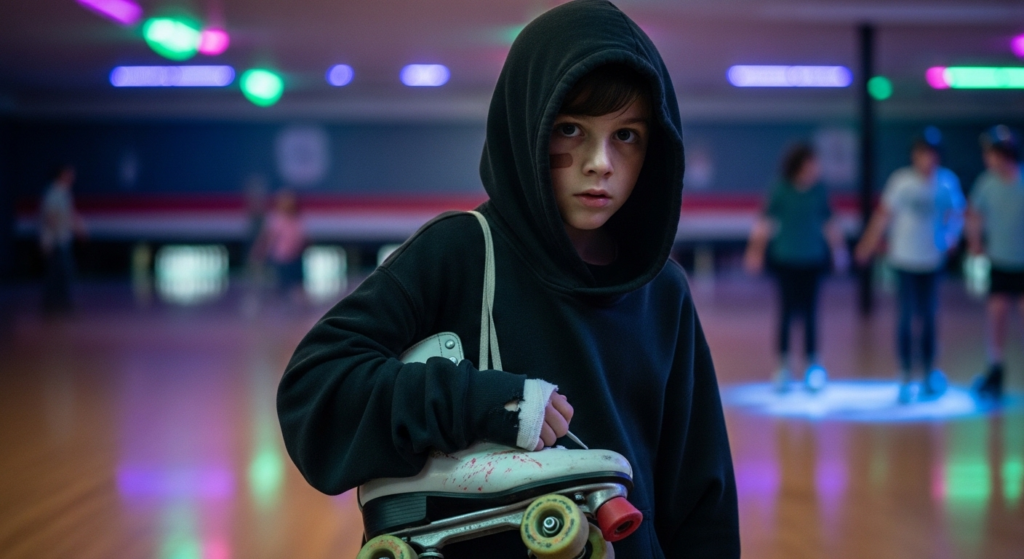
The sick, hollow thud of an eight-year-old’s knees slamming into the polished hardwood floor of a roller rink is a sound you never quite get used to, but it was his haunting, echoing laughter right afterward that made the hair on the back of my neck stand up.
I’ve managed the Starlight Roller Arena in Dayton, Ohio, for seven years. In that time, I’ve seen it all. I’ve bandaged scraped chins, broken up teenage fistfights over stolen arcade tokens, and wiped up more spilled Blue Raspberry slushies than I care to count.
But I had never seen a kid like Leo.
It was a sweltering Friday night in mid-July. The kind of suffocating Midwestern heat that presses against the glass doors and makes the asphalt in the parking lot soft.
To make matters worse, our ancient rooftop AC unit had picked that exact afternoon to completely die.
Inside the rink, it was a humid ninety degrees. The air was thick with the smell of cheap floor wax, stale popcorn, and the sweat of a hundred local kids trying to skate away their summer boredom.
Everyone was wearing tank tops, athletic shorts, and crop tops, their faces flushed from the heat and the exertion.
Everyone except him.
He was a tiny, fragile-looking thing. Eight years old, maybe nine if he was a late bloomer.
He was drowning in an adult-sized, heavy, dark gray winter hoodie. The thick fleece kind that you wear when shoveling snow in December. The hood was pulled up tight over his head, casting a deep shadow over his pale, exhausted little face.
And he kept falling.
Not the clumsy, flailing falls of a beginner trying to find their balance. These were heavy, uncontrolled drops. He would skate two or three shaky strides, his rental skates wobbling wildly, and then his legs would just give out.
Smack.
Down onto his knees. Down onto his hips. Hard impacts that made the other skaters flinch and swerve to avoid him.
But every single time he hit the floor, before anyone could even rush over to ask if he was okay, he would let out a loud, forced bark of laughter.
“Hahaha! Whoops! I’m so clumsy!” he would yell to nobody in particular, his voice cracking with a strange, frantic energy. “Silly me!”
He would scramble back to his feet with desperate speed, brushing off his heavy hoodie, ignoring the wincing pain that was clearly flashing across his eyes.
I stood behind the rental counter, a damp rag in my hand, watching him with a growing sense of dread pooling in my stomach.
There was something deeply, terribly wrong with that laugh.
It wasn’t the sound of a kid having fun. It was the sound of a hostage trying to convince his captor that everything was fine. It was a practiced, desperate performance.
“You seeing this, Sarah?”
Marcus’s deep, gravelly voice broke my concentration. He limped over from the DJ booth, wiping his forehead with a towel.
Marcus was fifty-eight, a retired Navy mechanic with a bad knee and a heart he tried his hardest to pretend was made of stone. He fixed the skates, spun the eighties pop tracks, and essentially acted as the grandfather to every stray kid who wandered into Starlight.
“Yeah,” I murmured, my eyes still locked on the boy in the gray hoodie. “I’m seeing it.”
“Kid’s gonna give himself a heatstroke,” Marcus grunted, leaning heavily against the scarred Formica counter. “It’s a sauna in here. He’s been skating for two hours in that winter gear. I turned off the disco lights just to drop the temperature a fraction, but it ain’t helping.”
“Where are his parents?” I asked, scanning the dark perimeter of the rink. The neon carpeted seating area was packed with chatting moms and bored dads scrolling on their phones, but no one was watching the boy in the gray hoodie.
“Dropped him off at five,” Marcus said, his jaw tightening. “A rusty blue sedan. Woman driving didn’t even put it in park. Shoved him out the door, handed him a crumpled ten-dollar bill, and peeled out. Hasn’t been back since.”
I felt a familiar, cold ache in my chest.
Before I was the manager of Starlight, I was a ward of the state. I spent my childhood bouncing between six different foster homes in three different counties. I know the look of a throwaway kid. I know the posture of a child who is trying to take up as little space in the universe as possible.
“He’s fallen a dozen times in the last twenty minutes, Marcus. And that laugh…”
“It’s a defense mechanism,” Marcus said quietly. For all his gruffness, Marcus was incredibly observant. “He’s terrified someone is going to notice he’s hurt. If he laughs, people look away. People don’t ask questions about happy kids.”
Smack.
We both flinched. The boy had gone down again, this time near the corner by the arcade. He hit the boards hard with his shoulder.
“Hahaha! Wow, that was a big one!” his voice echoed over the fading beat of a Madonna song.
But this time, he didn’t bounce right back up.
He stayed on his knees for a second too long. I could see his small shoulders heaving up and down beneath the thick, suffocating fleece. He was panting.
“That’s it,” I said, tossing the damp rag onto the counter. “I’m going in.”
“Careful, Sarah,” Marcus warned softly. “You know the rules. Don’t spook him. If he bolts, we can’t legally stop him, and God knows what he’s going back to.”
I nodded, my heart pounding a heavy rhythm against my ribs. I unlatched the half-door of the counter and stepped out onto the worn neon carpet.
I didn’t put on skates. I walked in my sneakers around the outer perimeter, making my way toward the arcade corner.
The heat was oppressive. Just walking made a fresh layer of sweat break out on my forehead. How this tiny child was surviving inside a winter coat was beyond me.
As I got closer, I could see the physical toll it was taking on him.
He was leaning against the half-wall separating the rink from the arcade. His face was dangerously flushed, an unnatural, blotchy red. Sweat was pouring down his temples, matting his dark hair against his forehead. His breathing was shallow and rapid.
“Hey there, buddy,” I said, keeping my voice soft, casual, and distinctly non-threatening. I stopped a few feet away, making sure not to trap him in the corner.
He whipped his head around, his eyes wide and panicked. They were a striking, pale blue, but right now, they were dilated with pure terror.
“I’m fine!” he blurted out immediately, forcing a wide, trembling smile onto his face. “I’m just clumsy! I’m having so much fun. It’s a great rink, ma’am.”
It was a scripted response. A perfectly rehearsed lie.
“I’m glad you’re having fun,” I smiled back, crouching down slightly so I wasn’t towering over him. “I’m Sarah. I run this place. What’s your name?”
He hesitated, his eyes darting toward the exit doors. “Leo.”
“Well, Leo, you’re a brave skater. But our AC is busted today, and I’m practically melting. You look like you’re baking in that hoodie. Why don’t we take it off? I can put it behind the counter for you so nobody takes it.”
Instantly, his hands shot up, gripping the collar of the hoodie with a desperate, white-knuckled intensity. He yanked the thick fabric tighter around his throat.
“No!” he shouted. Then, realizing his tone, he immediately softened his voice, forcing that fake, hollow laugh again. “Haha, no, thank you, ma’am. I get cold easily. I’m actually a little chilly right now.”
He was literally dripping with sweat. A drop of perspiration rolled off the tip of his nose and fell onto the worn carpet. He was shivering, but not from the cold. He was shivering from heat exhaustion.
“Leo, sweetheart,” I kept my voice gentle, masking the rising panic inside me. “It’s ninety degrees in here. If you keep skating in that, you’re going to pass out. Let’s just unzip it a little bit, okay?”
I took a slow step forward, reaching my hand out—not to touch him, but just to gesture toward the zipper.
It was a mistake.
The moment my hand moved toward him, Leo’s entire body violently flinched. He scrambled backward on his skates, a pure, instinctual reaction of raw terror.
He lost his footing. His left skate slipped out from under him, and he crashed backward.
This time, he didn’t hit the wood. He hit the sharp, metal edge of the arcade token machine.
There was a sickening crack, followed by a sharp, breathless gasp.
For the first time all night, Leo didn’t laugh.
He crumpled onto the floor, curling into a tight fetal position, clutching his side. A whimper escaped his lips—a tiny, broken sound that shattered my heart into a million pieces.
“Leo!” I yelled, abandoning all caution and dropping to my knees beside him.
“Don’t touch me! Please, don’t tell him! I’m sorry!” he shrieked, his voice raw with panic. He was blindly swatting at the air, his eyes squeezed shut, bracing for a blow that wasn’t coming.
“Leo, it’s okay, you’re safe, it’s just Sarah,” I pleaded, my hands hovering over him, terrified to make contact. “You hit the machine. I need to make sure you aren’t bleeding.”
The entire rink had gone dead silent. The music had stopped. Marcus had killed the track from the booth and was already sprinting out from behind the counter, his bad knee forgotten. The teenagers and parents were staring, a circle of concerned faces gathering around us.
Leo was hyperventilating, his chest heaving under the heavy gray fleece. The impact with the token machine had twisted the hoodie, pulling the thick material up and away from his body.
The bottom hem rode up past his waist, exposing his lower back and ribs.
The breath caught in my throat. The blood in my veins turned to ice.
I froze, my eyes locked on the patch of exposed skin.
It wasn’t a scrape. It wasn’t a bruise from falling on the rink.
His entire left side, from his ribs down to his hip, was a canvas of horrific, mottled purple and black. But it was the shapes that made my stomach heave.
They were distinct. Symmetrical.
Burn marks. Small, perfect circles, clustered together in a terrifying pattern. And overlapping them, deep, dark contusions in the unmistakable shape of adult fingers. A brutal, crushing grip.
I had seen abuse before. But the sheer savagery of this, inflicted on a tiny, eighty-pound child, made the room spin.
Marcus skidded to a halt beside me, dropping to his good knee. He took one look at Leo’s exposed side, and all the color drained from his weathered face. A dark, dangerous fury ignited in the old sailor’s eyes.
“Dear God…” Marcus whispered, his voice trembling.
At the sound of Marcus’s voice, Leo’s eyes snapped open. He realized the hoodie had ridden up.
A sound of pure, unadulterated anguish tore from the boy’s throat. He violently yanked the fabric down, sobbing hysterically now, no longer trying to hide it, no longer trying to laugh.
“Please!” Leo begged, grabbing the collar of my shirt with trembling, sweaty hands. His blue eyes were wide pools of sheer terror, begging me for mercy. “Please don’t call the police! Please!”
“Leo, honey, we have to,” I said, tears blurring my vision as I gently placed my hands over his freezing, trembling knuckles. “Somebody is hurting you. We have to protect you.”
“You don’t understand!” he screamed, his voice cracking, leaning in so close I could feel his feverish breath on my cheek. “If the police come… if they take me away…”
He swallowed hard, a tear cutting a clean line through the grime on his cheek.
“He told me if I ever told anyone… he would go into the basement and do this to my baby sister next. And she’s only four.”
The floor seemed to drop out from under me.
Marcus slowly reached for his walkie-talkie, his hand shaking with rage. “Sarah… lock the front doors. Don’t let anyone in or out.”
Because looking up, through the glass of the main entrance, I saw a rusty blue sedan slowly pull up to the curb.
And a man was getting out.
Chapter 2: The Glass Barrier
The air in the Starlight Roller Arena, already thick and stifling from the broken air conditioner, suddenly felt as heavy as wet concrete. The muffled, heavy bass of the pop song that had been playing moments ago was entirely gone, replaced by the collective, held breath of sixty people staring at the front entrance.
Through the smudged, sticker-covered glass of the double doors, the Ohio evening sun cast long, distorted shadows across the parking lot. The rusty blue sedan sat idling at the curb. The exhaust pipe rattled, emitting a thin, foul-smelling plume of gray smoke that curled into the stagnant summer air.
Then, the driver’s side door groaned open.
A man stepped out.
He didn’t look like a monster. He didn’t look like the kind of villain you see in movies, with jagged scars or a maniacal grin. He looked terrifyingly, sickeningly ordinary. He was average height, wearing a faded polo shirt stretched tight over a growing gut, and cargo shorts stained with grease. He had a pair of cheap sunglasses resting on the brim of a baseball cap. But it was his posture that sent a jolt of primal alarm straight down my spine. He walked with a stiff, agitated rigidity—the coiled, unpredictable energy of a man who was used to taking whatever he wanted by force.
He slammed the car door shut. The metallic bang seemed to echo even through the thick glass of the rink.
“Sarah. Now.”
Marcus’s voice was a harsh, commanding bark that snapped me out of my temporary paralysis. The older man was already moving, his bad knee dragging slightly against the neon-patterned carpet, but his speed was incredible for a man his age. He wasn’t the friendly DJ anymore; he was the Navy mechanic who had seen combat. His face was a mask of cold, hard focus.
“Get the kid to the back office. Lock the deadbolt,” Marcus ordered, his eyes never leaving the man approaching the doors. “Do not come out until I give you the all-clear, or until you see a badge. Understand?”
“Marcus, what are you going to do?” I stammered, my hands trembling as I reached down to help Leo.
“I’m going to make sure the doors are locked,” Marcus said, pulling a heavy ring of brass keys from his belt loop. The metal jingled sharply in the quiet room. “And then I’m going to have a very polite conversation through the glass. Go. Now.”
I turned back to Leo. The eight-year-old was completely frozen, his pale blue eyes locked on the front doors. His breathing was so shallow and rapid I thought he might pass out right there on the arcade floor. He was clutching his ribs, his knuckles white, the heavy gray hoodie soaked through with cold sweat.
“Leo,” I whispered, keeping my voice as steady as I possibly could. “Leo, look at me.”
He didn’t blink. He didn’t move. He was trapped in a flashback, a waking nightmare that had just pulled into the parking lot.
“Leo!” I said, a little sharper this time, grabbing his right shoulder—the uninjured one.
He jumped, letting out a small, strangled gasp.
“We have to move,” I told him, looking directly into his terrified eyes. “We’re going to my office. It has a heavy metal door. He cannot get in. But you have to stand up, buddy. Can you stand up?”
“He’s here,” Leo whimpered, his voice barely a breath. “He knows. I fell… I fell and I didn’t laugh fast enough. He always knows when I mess up.”
The psychological conditioning was horrifying. This man had trained this child to believe that any display of pain, any cry for help, would be instantly detected and violently punished.
“He doesn’t know anything,” I said fiercely, channeling every ounce of protective instinct I possessed. “He’s outside. We are inside. And I am not going to let him touch you. But you have to help me, Leo. We have to skate to the back.”
It was a clumsy, agonizing process. Taking off his rental skates would take too much time, and we had seconds before the man reached the doors. I hauled Leo to his feet. He cried out, a sharp hiss of pain as his bruised ribs shifted, but he clamped a hand over his mouth to muffle the sound.
I wrapped my arm around his waist, careful to avoid the left side of his body, and half-carried, half-dragged him across the carpet. His skates rolled awkwardly, catching on the fibers. Every step felt like wading through molasses.
Around us, the crowd of teenagers and parents began to murmur. They didn’t know the full story, but they could read the tension in the room. A few mothers instinctively pulled their children closer to them. A couple of older teenage boys stepped forward, their faces hardened, looking toward the front doors, silently offering themselves as a barrier.
“Keep back, folks! Everyone step away from the entrance!” Marcus yelled, waving his arms as he reached the double doors.
Just as Marcus slid the heavy metal deadbolt home with a loud, final click, the man reached the glass.
I glanced back over my shoulder just in time to see him pull the exterior handle. The door didn’t budge. He stopped, his brow furrowing in confusion. He pulled it again, harder this time, the metal frame rattling.
Through the glass, he made eye contact with Marcus.
Even from thirty feet away, I could see the man’s demeanor instantly change. The false, relaxed posture vanished. His face darkened, a dangerous red flush creeping up his neck. He slapped his open palm against the glass, pointing a thick, blunt finger at Marcus, his mouth moving in an angry shout that was muted by the heavy panes.
“Keep moving, Sarah!” Marcus roared without looking back at me.
I didn’t need to be told twice. I pushed open the door to the back hallway, dragging Leo inside, and slammed it shut behind us. We stumbled into my small, cluttered manager’s office. It smelled like stale coffee and receipt paper. I immediately threw the heavy deadbolt, grabbed the back of the wooden desk chair, and wedged it under the doorknob.
It was dark in the office, lit only by the faint, buzzing glow of a single fluorescent tube overhead. The sudden quiet of the back room, separated from the main rink, was deafening.
I eased Leo onto the small, faux-leather sofa against the wall. The moment his weight settled onto the cushions, his adrenaline seemed to crash. He began to shake violently, his teeth chattering despite the oppressive heat of the room.
“Okay. Okay, we’re safe,” I panted, wiping the sweat from my own forehead. I dropped to my knees in front of him and immediately began unlacing his heavy roller skates. “Let’s get these off you. You did so good, Leo. You’re so brave.”
He didn’t answer. He was staring at the wall, rocking slightly back and forth. His arms were wrapped tightly around his torso, as if trying to hold himself together.
As I pulled the heavy skates off his small feet, my mind was racing.
I need to call 911. I need to get an ambulance for his ribs. I need to make sure Marcus is okay. But most importantly… Mia.
The four-year-old sister. The leverage. The reason Leo had endured the torture in silence.
I knew the exact kind of monster we were dealing with. When I was ten years old, I lived in a foster home in Cleveland. The foster father, a man named Gary, had a similar method of control. He never hit me. Instead, he would corner my younger foster brother, a sweet kid named Toby, and tell me that if I ever complained about the lack of food, or the fact that we were locked in our rooms for twelve hours a day, Toby would be the one to pay the price.
It is the most insidious, soul-destroying form of abuse. It weaponizes a child’s love and empathy against them. It turns them into a willing participant in their own destruction.
I looked up at Leo. His face was ghostly pale beneath the dirt and sweat.
“Leo,” I said softly, reaching over to grab my cell phone from the desk. “I’m going to call the police now. But I need you to tell me exactly where you live. I need to tell them where Mia is.”
At the mention of his sister’s name, Leo snapped out of his trance. He lunged forward, grabbing my wrist with shocking strength.
“No! Please!” he sobbed, fresh tears spilling over his eyelashes. “If the police show up at the house, my mom… she won’t be able to stop him! He told me! He said if the cops ever come, he’ll make sure they don’t find Mia until it’s too late!”
“Who is he, Leo?” I asked, my voice trembling. “Is he your dad?”
Leo shook his head violently. “No. His name is Ray. He’s my mom’s boyfriend. He moved in last year.”
“Where is your mom right now?”
“She works the night shift at the hospital,” Leo cried, his breath hitching. “She cleans the floors. She’s never home at night. It’s just me, Ray, and Mia. Ray hates it when Mia cries. He says she’s too loud. I try to keep her quiet, I play with her, I read to her, but she’s only four. Sometimes she wants her mom.”
The picture was painting itself in horrifying clarity. A working mother, exhausted, absent. A predatory boyfriend who had established a reign of terror in the house, using the older sibling as a punching bag to enforce order.
“Why did he bring you here today?” I asked, needing to keep him talking, needing to keep his brain engaged while I figured out what to tell the 911 dispatcher.
“He… he got mad this afternoon,” Leo stammered, pulling the hoodie tighter around himself. “Mia spilled her juice. It got on his shoes. He grabbed her arm really hard. I stepped in. I pushed him away from her.”
A tiny, eight-year-old boy, throwing himself between a grown man and his little sister. The courage it must have taken.
“He hit me. A lot,” Leo continued, his voice dropping to a whisper. “Then he used his… his lighter. The one he uses for his cigars. He said he was going to teach me a lesson about respect.”
I felt bile rise in the back of my throat. The burn marks. Perfect, symmetrical circles. Cigar lighters.
“After he did it… he told me to get in the car. He brought me here. He said I had to skate for three hours. He made me wear the hoodie so nobody would see. He said if I took it off, or if I told anyone, he would go home and do the exact same thing to Mia. He said he was going back home to watch her while I was here.”
My blood ran cold.
He was going back home to watch her.
“Leo,” I asked, a sense of absolute urgency gripping my chest. “Is Mia home right now? With him?”
“No,” Leo sniffled, wiping his nose with the back of his sleeve. “When he dropped me off, he said he was going to the bar across the street from the rink. He said he was going to have a few beers, and then he would come pick me up. He left Mia at the house. He locked her in the basement. He said she couldn’t make any noise down there.”
A four-year-old girl. Locked in a basement. Alone.
The timeline slammed into place in my head. The man—Ray—hadn’t gone home. He was right outside the glass doors of the roller rink. And the little girl was completely unprotected, but right now, she was alone.
I didn’t wait another second. I dialed 911.
“911, what is your emergency?” a calm, female voice answered.
“My name is Sarah, I’m the manager at the Starlight Roller Arena,” I said, speaking fast but clearly. “I have a child abuse situation, an active threat, and a hostage situation all happening at once. I need officers at the rink immediately, but I also need units dispatched to a residential address to secure a four-year-old child.”
“Okay, Sarah, slow down,” the dispatcher said, her tone shifting to high alert. “Are you in immediate danger at the rink?”
“The suspect is locked outside the front doors. My employee is holding the doors, but the man is aggressive. Inside with me is an eight-year-old boy who has been severely beaten and burned with a lighter. The suspect is the mother’s boyfriend. He left the boy’s four-year-old sister locked in the basement of their house.”
“Copy that. I am dispatching units to the rink now. What is the address of the house?”
I pulled the phone away from my ear and looked at Leo. “Leo. The police are going to go get Mia. They are going to break down the door and get her out of the basement before Ray can even get back to his car. But you have to give me the address. Now.”
Leo looked at me, a war raging in his eyes. The conditioning, the fear, the absolute terror of Ray’s threats battling against the desperate hope that maybe, just maybe, an adult was finally going to save them.
“1442 Elmwood Drive,” he whispered. “It’s the yellow house at the end of the cul-de-sac.”
“1442 Elmwood Drive,” I repeated into the phone. “Yellow house. The child is locked in the basement.”
“Units are en route to both locations, Sarah,” the dispatcher confirmed. “Stay on the line with me. Do not let the suspect inside. What is the suspect’s description?”
“White male, late thirties, faded polo shirt, cargo shorts, baseball cap. He drives a rusty blue sedan, parked right out front.”
Suddenly, a loud, violent CRASH echoed from the main rink, vibrating through the walls of the back office.
Leo let out a terrified scream, curling into a tight ball on the sofa and covering his ears.
“What was that?” the dispatcher demanded.
“He’s trying to break the glass,” I said, my heart hammering a frantic rhythm against my ribs. “He’s trying to get in.”
I stood up, leaving the phone on speaker on the desk, and pressed my ear against the heavy wooden door of the office.
I could hear shouting. Not just Marcus, but several voices. The deep, aggressive roar of Ray outside, demanding to be let in. The muffled thuds of him kicking the reinforced safety glass of the double doors.
“Let me in, you old freak!” Ray’s voice filtered through the building, distorted and filled with rage. “I’m here to pick up my kid! You have no right to lock me out!”
“The police are on their way, buddy!” Marcus’s voice boomed back, steady and unflinching. “You better get back in that rust bucket and drive away, or you’re going to leave in handcuffs!”
“You’re making a big mistake!” Ray screamed, his fists pounding against the glass. “Where is he? Where’s Leo? Tell that little brat to get out here right now!”
Inside the office, Leo was hyperventilating again. He was staring at the door, expecting it to burst open at any second.
I ran back to the sofa and pulled him into my arms. I didn’t care about the heat, or the sweat, or the grime. I held him tight, resting my chin on top of his head.
“He’s not getting in,” I promised him, rocking him slightly. “The glass is shatterproof. Marcus won’t let him through. The police are coming.”
“He’s so angry,” Leo sobbed into my shoulder. “He’s going to kill us, Sarah. He’s going to kill all of us.”
“No, he’s not,” I said, my voice hardening with a fierce, protective resolve. “He is a coward, Leo. Men who hurt children are cowards. And cowards always run when people fight back.”
Through the phone speaker on the desk, the dispatcher’s voice cut through the tension.
“Sarah? Units are pulling up to Elmwood Drive now. They are breaching the front door.”
I squeezed my eyes shut, silently praying. Please let her be okay. Please let them find her.
“Sarah, update on your location,” the dispatcher continued. “Two cruisers are pulling into the parking lot of the roller rink. Do you see them?”
I couldn’t see the parking lot from the windowless office, but the reaction in the main rink told me everything I needed to know.
The pounding on the front doors abruptly stopped.
There was a moment of eerie silence.
Then, the muffled sound of Marcus yelling, “Get down on the ground! Put your hands where they can see them!”
Through the thick walls, the unmistakable crackle of a police bullhorn echoed across the parking lot.
“Step away from the doors! Put your hands on your head and get down on your knees! Now!”
I let out a long, shaky breath, burying my face in Leo’s thick, sweat-soaked hoodie.
“They’re here, buddy,” I whispered, tears finally breaking free and streaming down my cheeks. “The police are here. They got him.”
Leo didn’t say anything. He just clung to my shirt, his small fingers digging into the fabric, trembling like a leaf in a hurricane.
A few minutes later, there was a sharp knock on the office door.
I flinched. Leo whimpered.
“Sarah?” Marcus’s voice called through the wood, calm and reassuring. “It’s me. It’s safe. You can open the door.”
I pulled the chair away from the doorknob and unlocked the deadbolt.
Marcus was standing in the hallway. Behind him, two police officers in heavy tactical vests were walking toward us. The flashing red and blue lights from the cruisers outside cast a frantic, rhythmic glow across the neon carpet of the rink.
“They got him,” Marcus said softly, looking past me to Leo on the couch. “He’s in the back of the cruiser.”
One of the officers, a tall woman with kind eyes and a blonde ponytail, stepped forward.
“Hi, Sarah. I’m Officer Jenkins,” she said, her voice gentle. She crouched down to eye level with Leo. “Hi, Leo. I’m one of the good guys. We’re going to get you some help, okay? We have an ambulance waiting right outside.”
Leo looked at her, then looked up at me, his eyes filled with a desperate, unspoken question.
Mia.
Before I could even ask the officer, the radio on her shoulder chirped.
“Dispatch to Jenkins. Be advised, units at Elmwood Drive have breached the residence. They have located the four-year-old female in the basement.”
The entire room held its breath. The silence stretched out for what felt like an eternity.
“Child is conscious and breathing,” the radio crackled again. “She is dehydrated and frightened, but physically unharmed. Paramedics are on scene with her now.”
A sound tore from Leo’s throat—a sound I will never, ever forget. It wasn’t a cry of pain. It was a massive, shuddering gasp of absolute relief. The invisible weight of the world, a weight no eight-year-old should ever have to carry, suddenly lifted from his small, battered shoulders.
He slumped forward, burying his face in his hands, and wept. Not the quiet, terrified whimpers from earlier, but loud, ugly, healing sobs.
I sat down next to him, wrapping my arms around him again, letting him cry. Officer Jenkins placed a gentle hand on his back. Even Marcus, the tough-as-nails Navy veteran, had to look away, hurriedly wiping a rough hand across his eyes.
“Come on, sweetheart,” I whispered, pressing a kiss to the top of his sweaty head. “Let’s get you out of this hoodie.”
He didn’t fight me this time. He didn’t pull away.
As I gently unzipped the heavy gray fleece and pulled it off his shoulders, the stifling heat of the room hit his damp skin. He shivered, but he looked up at me, and for the first time all night, the terrified, hunted look in his eyes was gone.
“Can I… can I see her?” he asked, his voice thick with tears. “Can I see Mia?”
“I promise you,” Officer Jenkins smiled softly, “we’re going to take you to the same hospital. You’re going to see your sister tonight.”
We walked out of the office, Leo leaning heavily against my side. The rink was completely silent as we made our way across the floor toward the front doors. The teenagers and parents stood by the boards, watching with wide, somber eyes. No one whispered. No one pointed.
As we stepped out into the humid Ohio night, the heat hit us like a physical blow. But the air felt cleaner somehow.
To our left, the rusty blue sedan sat empty. A few yards away, in the back of a police cruiser, I saw the silhouette of Ray, his hands cuffed behind his back, his head bowed.
An ambulance was idling near the curb, its back doors open, two paramedics waiting with a stretcher.
As we approached, Leo suddenly stopped walking. He pulled away from my side, standing on his own two feet. He looked back at the glass doors of the Starlight Roller Arena, then up at me.
“Thank you, Sarah,” he whispered.
“You don’t have to thank me, Leo,” I said, crouching down to hug him one last time. “You saved your sister today. You’re the hero.”
He managed a small, weak smile. A real one this time.
“Do you think…” he hesitated, looking down at his bruised ribs. “Do you think when I’m all healed up… I could come back and try skating again? Without the hoodie?”
Tears blurred my vision as I squeezed his hand.
“Leo,” I smiled, my voice thick with emotion. “You have free skating passes for life. And next time, I’ll even turn the AC on for you.”
He laughed. It wasn’t the forced, frantic bark from before. It was a quiet, genuine sound.
The paramedics guided him onto the stretcher, and as the ambulance doors closed, I stood in the sweltering parking lot with Marcus, the flashing police lights painting the night sky red and blue. The nightmare was over, but as the sirens wailed, fading into the distance, I knew the hardest part of their journey—the healing, the reckoning, the truth of their mother’s involvement—was only just beginning.
Chapter 3: The Sterile White Hallways and the Sins of Silence
The drive to Dayton Children’s Hospital was a blur of hazy streetlights, the rhythmic thump-thump of Marcus’s ancient Ford pickup tires on the cracked asphalt, and a suffocating, heavy silence. The adrenaline that had fueled me back at the rink was evaporating, leaving behind a cold, hollow ache in the pit of my stomach.
Marcus kept his eyes fixed dead ahead on the road. His large, calloused hands gripped the steering wheel so tightly his knuckles were bone-white. The dashboard clock glowed a faint, aggressive green: 11:42 PM.
“You okay, kid?” Marcus finally rasped, his voice rougher than usual. He didn’t look over at me.
“I don’t know,” I admitted, leaning my head against the cool passenger-side window. The vibration of the glass against my temple was the only thing keeping me grounded. “I just keep thinking about that hoodie. Three hours, Marcus. He skated for three hours with second-degree burns against his ribs, just so that monster wouldn’t hurt his sister. What kind of world is this?”
“A broken one,” Marcus said quietly, the gravel in his voice thickening. “But tonight, you pulled two pieces out of the wreckage. Don’t forget that.”
We pulled into the emergency room parking lot, the glaring fluorescent lights of the entrance cutting through the humid Ohio midnight. The heat outside was still oppressive, a wet blanket clinging to our skin, but the moment the sliding glass doors of the ER swooshed open, we were hit by a wall of aggressively frigid, sterile air.
It smelled like industrial bleach, rubbing alcohol, and the faint, unmistakable metallic tang of fear.
The waiting room was a purgatory of uncomfortable vinyl chairs and muted televisions playing late-night infomercials. We approached the triage desk. A nurse with tired eyes and a name tag that read Brenda looked up from her computer. Brenda was a veteran of the night shift; you could tell by the permanent, skeptical arch of her left eyebrow and the fact that she was guarding a massive, heavily stained Yeti thermos like it was the Holy Grail. Her strength was an unflappable calm in the face of trauma, but her weakness was a deeply ingrained, almost abrasive cynicism.
“Can I help you?” Brenda asked, her voice flat, devoid of pleasantries.
“We’re here for Leo,” I said, leaning over the high counter. “And his little sister, Mia. They were brought in by ambulance about an hour ago from the Starlight Roller Arena.”
Brenda’s eyes flicked up, locking onto mine. The skepticism vanished, replaced instantly by a sharp, assessing look. She knew exactly who we were talking about. Word traveled fast in pediatric ERs when cases like this came through the doors.
“You the manager who made the call?” she asked, her voice dropping an octave, losing its sharp edge.
“Yes. Sarah. This is Marcus.”
“Have a seat,” Brenda said, nodding toward a secluded corner of the waiting room. “They’re back in treatment room four. I’ll let Detective Russo know you’re here. He’s going to want your statements.”
We sat in the stiff blue chairs for what felt like an eternity. Every time the double doors to the back hallway swung open, my heart leaped into my throat. I couldn’t get the image of Leo’s battered ribs out of my head. I couldn’t stop wondering what they had found when they opened that basement door.
Ten minutes later, the doors pushed open, and a man walked out holding a battered legal pad.
This had to be Detective Russo. He looked exactly how a Dayton SVU detective working a Friday night shift should look: perpetually exhausted. He was in his late forties, wearing a crumpled dress shirt with the sleeves rolled up past his elbows and a loosened tie. He had dark circles under his eyes that looked like bruises, and he clicked a cheap plastic retractable pen with a rapid, restless energy. His strength was his relentless, bulldog tenacity in building a case, but his weakness—which was immediately apparent—was a complete lack of bedside manner. He was a man who dealt in facts, not feelings.
“Sarah? Marcus?” he asked, walking over and pulling up a chair opposite us. He didn’t offer a handshake. He just clicked his pen. “I’m Detective Russo. I need to get exactly what happened tonight on the record.”
For the next twenty minutes, Marcus and I recounted every detail. The sweltering hoodie. The forced laughter. The fall by the arcade. The exposure of the burns. The confession about Mia in the basement, and Ray’s arrival.
Russo wrote furiously, his handwriting an illegible scrawl. When I described the perfect, symmetrical circles of the cigar lighter burns, his jaw tightened, the muscle in his cheek feathering.
“We got the bastard,” Russo said bluntly, finally stopping the relentless clicking of his pen. “He’s sitting in an interrogation room at the precinct right now, demanding a lawyer and claiming the kid fell off his bike. But he’s not walking. We have the lighter in his pocket. We have the medical evidence. And we have the sister.”
“How is Mia?” I asked, the question catching in my throat.
Russo sighed, rubbing the bridge of his nose. “Physically? She’s malnourished, severely dehydrated, and she has some bruising on her forearms where he grabbed her. The basement he locked her in was an unfinished root cellar. Pitch black. No ventilation. It was nearly a hundred degrees down there. She was huddled in a corner behind a broken washing machine. But she’s alive. And she’s holding onto her brother like he’s a life raft.”
A profound wave of relief washed over me, closely followed by a sickening wave of anger.
“Where is the mother?” Marcus growled, leaning forward, his massive hands resting on his knees. “Leo said she works the night shift at another hospital. How in the hell does a mother not know her kid’s torso is being used as an ashtray?”
Russo looked at Marcus, his dark eyes unreadable. “That is the million-dollar question, Marcus. Her name is Evelyn. We sent a squad car to pick her up from Miami Valley Hospital about forty minutes ago. She should be arriving any—”
“Excuse me! Excuse me, where are my children?!”
The frantic, shrill voice echoed through the quiet waiting room.
I whipped my head around. Bursting through the sliding glass doors was a woman in faded, wrinkled blue hospital scrubs. She looked terrifyingly small, practically swallowed by the oversized scrub top. Her dark hair was pulled back into a messy, frantic bun, and she smelled strongly of industrial floor cleaner and stale sweat.
This was Evelyn.
She looked so much like Leo. She had the same pale blue eyes, but right now, they were wide, frantic, and brimming with terrified confusion. Two uniformed officers trailed closely behind her.
Russo stood up immediately, his posture shifting into a defensive, authoritative stance. “Evelyn? I’m Detective Russo. We need to talk.”
“Where is Leo? Where is Mia?” Evelyn demanded, ignoring the detective, her eyes darting around the sterile room. She was hyperventilating, clutching a worn, imitation-leather purse to her chest like a shield. “The police came to my work… they said Ray was arrested… they said my babies are here! What happened? Was there a car accident?”
I felt a cold knot form in my chest.
Was there a car accident?
She genuinely didn’t know. Or, at least, the protective walls of her denial were so thick, so deeply reinforced, that she was truly blind to the monster living in her own home.
“Evelyn, please sit down,” Russo said, his voice lowering, taking on a firm, authoritative tone that brooked no argument. “There was no car accident. Ray was arrested outside a roller rink tonight. He is being charged with aggravated assault, child endangerment, and unlawful imprisonment.”
Evelyn stopped dead in her tracks. The purse slipped from her fingers, hitting the linoleum floor with a dull thud.
“What?” she breathed, the color completely draining from her face. She looked at Russo as if he were speaking a foreign language. “No. No, no, no. Ray was watching them. He’s at home with them. He’s a little strict, sure, but he loves them. He wouldn’t… he wouldn’t do anything to…”
“He locked your four-year-old daughter in a sweltering root cellar,” Russo stated, mercilessly cutting through her desperate rationalizations. He wasn’t going to coddle her. “And he used a metal cigar lighter to burn second-degree brands into your eight-year-old son’s ribcage.”
The silence that followed was absolute.
Evelyn stared at the detective. For five long seconds, she just stared, her mouth slightly parted, her brain completely short-circuiting.
Then, the denial flared up—a ferocious, protective, ugly thing.
“You’re lying,” she whispered, shaking her head. Then, louder: “You’re lying! Ray wouldn’t do that! Leo is clumsy! He falls all the time! He has a condition where he bruises easily, I’ve told Ray that! Ray is a good man! He took us in when we had nothing! He pays the rent!”
I couldn’t stop myself.
The memories of my own childhood—of standing in a kitchen while my foster mother watched her husband back me into a corner, of her turning around to wash the dishes while I cried—surged to the surface, hot and venomous.
I stood up from the blue vinyl chair. Marcus reached out to grab my arm, a warning to stay out of it, but I shrugged him off.
“He’s not clumsy, Evelyn,” I said, my voice trembling with a rage I hadn’t felt in twenty years.
Evelyn snapped her attention to me, her eyes flashing with defensive fury. “Who the hell are you?”
“I’m the woman who runs the roller rink,” I stepped closer, closing the distance between us. I didn’t care about the detective. I didn’t care about protocol. I needed this woman to wake up. “I’m the woman who had to watch your tiny, terrified son fall on his face a dozen times in a ninety-degree room, wearing a winter coat, laughing like a maniac every time he hit the ground.”
Evelyn swallowed hard, taking a half-step backward. “He gets cold easily…”
“Stop it!” I shouted, the volume of my voice echoing off the sterile white walls, causing Nurse Brenda to jump behind her counter. “Stop lying to yourself! He wasn’t cold! He was hiding the burns! He was hiding the fact that his ribcage looks like raw meat because the man sleeping in your bed tortured him! And he did it silently, he took every single hit, every single burn, because Ray threatened to do it to your baby girl if he made a sound!”
Evelyn’s breath hitched. A violent shudder ripped through her small frame.
“No,” she whimpered, raising her hands to her ears, a childlike gesture of absolute refusal. “No, I check them. I give them baths. I would have seen…”
“When was the last time you gave Leo a bath?” Russo interjected, his voice like a whip cracking in the silent room. “When was the last time you saw him without a shirt on? A week? Two weeks?”
Evelyn squeezed her eyes shut. Tears began to leak from beneath her lashes, cutting through the exhaustion on her face. “I work nights… I sleep during the day. Ray handles the mornings. Ray handles the baths. I’m just… I’m trying to keep a roof over our heads. I’m just trying to survive.”
“So was Leo,” I said, my voice dropping to a harsh, ragged whisper. “But he had to survive Ray. And he had to survive you turning a blind eye.”
“That’s enough, Sarah,” Marcus said softly, coming up behind me and placing a heavy, grounding hand on my shoulder.
But it wasn’t enough. Not for me. Because I knew the truth about the Evelyns of the world. I knew that weakness, that desperation to be loved by a man, that sheer terror of being a single mother with no money—it made them complicit. It made them dangerous.
“He came home with bruises last month,” Evelyn choked out, her voice breaking, the walls of her denial finally beginning to crumble under the sheer weight of the evidence. She dropped to her knees right there in the waiting room, her face buried in her hands. “A black eye. Ray said… Ray said a kid at the park threw a baseball at his face. And last week, he was limping. Ray said he fell off the porch. I wanted to believe him. God, I just wanted to believe him. If I didn’t believe him… where would we go?”
It was the ultimate, tragic enlightenment. The horrific realization that her desire for stability had cost her children their safety. She hadn’t lit the lighter, but she had handed Ray the matches.
Before anyone could say another word, the double doors at the end of the hallway pushed open.
A doctor walked out. He looked entirely out of place in the grim setting of the ER. Dr. Aris Thorne was a pediatric specialist. He was tall, thin, and had a remarkably gentle face. His defining detail was a bright, obnoxious cartoon-character tie—tonight, it was SpongeBob SquarePants—that hung loosely around his neck. His strength was his profound, deeply meticulous empathy for his young patients; his weakness was that he absorbed their pain, carrying it with him like invisible lead weights. You could see it in the heavy droop of his shoulders.
He approached our group, his eyes taking in Evelyn weeping on the floor, the stern detective, and Marcus and me standing vigil.
“Are you the mother?” Dr. Thorne asked quietly.
Evelyn scrambled to her feet, wiping her face with the back of her sleeves, smearing mascara across her cheeks. “Yes. I’m Evelyn. Please, can I see them? Are they okay?”
Dr. Thorne looked at her for a long, calculating moment. He didn’t offer a reassuring smile.
“Evelyn,” Dr. Thorne said, his voice calm but laced with a terrifying gravity. “I have just spent the last hour treating your son. I have documented eighteen distinct, circular, second-degree contact burns on his left flank. I have documented deep tissue contusions consistent with an adult hand violently grabbing his arm. I have also noted older, fading bruises in various stages of healing on his back and thighs.”
Evelyn let out a muffled sob, clapping a hand over her mouth.
“He is currently stable. We have administered a strong narcotic painkiller, and we have dressed his burns. He is exhausted, but he is awake.” Dr. Thorne paused, his eyes shifting to Detective Russo, then back to Evelyn. “Your daughter, Mia, was severely dehydrated and terrified. But physically, she is uninjured. We have her set up with an IV in the same room as her brother.”
“I want to see them,” Evelyn begged, stepping forward, reaching out to grab the doctor’s arm. “Please. I need to hold them.”
Dr. Thorne gently but firmly removed her hand from his arm.
“You can see them,” Dr. Thorne said smoothly. “But I need you to understand something very clearly before you walk into that room. Child Protective Services has already been notified. They have an emergency caseworker en route. Based on the severity of the abuse, and the fact that it occurred in your home over a prolonged period, CPS will be taking temporary emergency custody of both children tonight.”
The words hit Evelyn like a physical blow. She staggered backward, hitting the triage counter. Nurse Brenda reached out to steady her.
“No,” Evelyn gasped, the air leaving her lungs. “No, you can’t. I didn’t do this! Ray did this! Ray is in jail! I’m their mother! You can’t take them away from me!”
“We have to, ma’am,” Detective Russo said, his voice devoid of sympathy. “Until a full investigation is complete, and a judge determines that you are a fit and capable guardian who can guarantee their safety, they are wards of the state. They will be placed in emergency foster care.”
Foster care.
The two words echoed in my head, triggering a cold sweat down my spine. I knew the foster care system. I knew the crowded group homes, the garbage bags used as luggage, the terrifying uncertainty of waking up in a stranger’s house.
I looked down the long, sterile white hallway. At the end of it, behind one of those heavy wooden doors, an eight-year-old boy who had just fought a war to protect his sister was about to find out that he was losing his home anyway.
“Can I…” I started, my voice wavering slightly. I looked at Dr. Thorne. “Can I just say goodbye to him? I just want him to know that he did a good job tonight.”
Dr. Thorne looked at me, then at Detective Russo. Russo gave a slow, barely perceptible nod.
“Follow me,” Dr. Thorne said.
I left Evelyn sobbing in the waiting room with the detective and Marcus. I followed the doctor down the bright, freezing hallway. The smell of bleach grew stronger. We stopped outside Room 4.
Through the small glass window in the door, I saw them.
The hospital bed was massive, making the children look even smaller than they were. Leo was sitting propped up against the pillows. He was wearing a light blue hospital gown. The heavy gray hoodie was gone, replaced by thick white gauze that was visible peeking out from the neckline of the gown. His face was pale, his eyes heavy with the painkillers, but he was awake.
Curled up next to him, practically tucked under his right arm—the uninjured side—was a tiny girl with a mess of curly brown hair. Mia. She was fast asleep, her small fist clutching the fabric of Leo’s gown, an IV line snaking from the back of her little hand.
Leo’s chin rested on the top of his sister’s head. His eyes were fixed on the door. When he saw me through the glass, his face softened.
Dr. Thorne pushed the door open quietly.
“Hey, buddy,” I whispered, stepping into the room. The only sound was the soft, rhythmic hum of the heart monitor.
“Hi, Sarah,” Leo said, his voice thick and sluggish from the medication. He managed a tiny smile. “Did they… did they get him?”
“They got him,” I promised, stepping closer to the bed, being incredibly careful not to bump the mattress. “He’s in a cell. He can’t hurt you or Mia ever again.”
Leo looked down at his sleeping sister, his pale blue eyes filling with tears that didn’t fall. “They said my mom is here. But the police officer said we can’t go home with her. He said we have to go live somewhere else.”
My heart broke completely. The ultimate consequence. He had done everything right, he had survived the unimaginable, and his reward was losing the only life he knew.
“It’s just for a little while, Leo,” I lied, the words tasting like ash in my mouth. I knew how the system worked. Once you were in, you rarely got out quickly. “It’s just to make sure you’re perfectly safe. There are people whose whole job is to find a really nice, safe place for you and Mia to stay together.”
Leo looked up at me. The painkillers couldn’t mask the deep, ancient sorrow in his eight-year-old eyes.
“Will you come visit me?” he asked, his voice breaking. “At the new place? So I can show you I don’t need the hoodie anymore?”
I reached out, my fingers trembling, and gently smoothed the hair back from his forehead.
“I’m not going anywhere, Leo,” I promised, looking him dead in the eye. “I’m going to find out exactly where they take you. And I’m going to be there. You’re stuck with me now.”
He let out a long, shaky breath, his eyes fluttering shut as the exhaustion and the drugs finally pulled him under. He didn’t let go of his sister.
I walked out of the room, leaving them in the dim light of the hospital machines. The central conflict had exploded, the truth was out, and the immediate danger was over. But as I walked back down that sterile hallway, listening to Evelyn’s muffled sobs echoing from the waiting room, I realized the hardest battle wasn’t the one we fought against the monster tonight.
The hardest battle was going to be tomorrow, fighting a broken system to make sure those two children never fell through the cracks again.
Chapter 4: The Weight of the Air and the Courage to Breathe
The sunrise over Dayton, Ohio, the morning after the nightmare didn’t feel like a victory. It felt like an insult. The sky bled into a soft, beautiful bruised purple, then a brilliant, indifferent gold, illuminating the cracked asphalt of the Starlight Roller Arena parking lot as if nothing in the world had fundamentally shattered just hours before.
I sat on the hood of my rusted Honda Civic, staring at the front doors of the rink. The neon signs were finally powered down. The police tape that had briefly cordoned off the entrance where Ray’s sedan had been parked was already gone, leaving only a faint oil stain on the concrete.
I hadn’t slept. I hadn’t even gone home to change out of my sweat-stained, wrinkled manager’s polo. The heavy, sterile smell of Dayton Children’s Hospital was still clinging to the fibers of my clothes, a phantom odor of bleach, iodine, and raw, unfiltered grief.
My phone buzzed in my pocket. It was Marcus.
“You still at the lot?” the text read.
“Yeah,” I replied.
“Go home, Sarah. Get some sleep. The rink stays closed today. I already called the staff. I’m heading to the precinct to sign my official statement for Russo. We did what we could.”
I stared at the glowing screen until the words blurred. We did what we could. It was the most dangerous, insidious lie we tell ourselves when we brush up against the broken edges of the child welfare system. I knew it intimately. When I was eleven years old, a well-meaning teacher had noticed the bruises on my arms. She made the call. She did what she could. The police came, they took my foster father away in handcuffs, and the teacher went home feeling like a hero.
She didn’t see the aftermath. She didn’t see me sitting in a sterile, fluorescent-lit CPS office for fourteen hours with nothing but a bruised apple and a coloring book, waiting for a social worker to find an open bed in a group home three towns over. She didn’t see the profound, terrifying freefall of suddenly belonging to no one.
I couldn’t let Leo and Mia go into that freefall alone. I had made a promise.
At 9:00 AM, I pushed myself off the hood of my car, got into the driver’s seat, and drove directly to the Montgomery County Department of Job and Family Services building.
The CPS office was exactly as I remembered it from my childhood, right down to the depressing beige walls and the distinct, suffocating aura of chronic underfunding and bureaucratic despair. The waiting area was packed. Exhausted social workers with towering stacks of manila folders hurried past rows of plastic chairs filled with crying toddlers, dead-eyed teenagers, and angry, defensive parents.
I marched up to the thick plexiglass window of the receptionist’s desk.
“I need to speak to the emergency caseworker assigned to Leo and Mia,” I said, my voice hoarse but steady. “They were brought in last night from Dayton Children’s Hospital.”
The receptionist, a weary woman with thick glasses, barely looked up from her computer monitor. “Are you a relative?”
“No,” I said firmly. “I’m the person who called 911. I’m the one who stayed with them. I need to know where they are being placed.”
“Ma’am, unless you are a registered relative or legal counsel, I cannot release placement information to you. It’s confidential.”
“Look at me,” I said, leaning closer to the plexiglass, my voice dropping to a dangerous, desperate register. “That little boy just spent three hours skating with second-degree burns on his body to protect his sister. I told him I would be there. I am not leaving this building until somebody tells me he is safe. Arrest me for trespassing if you have to.”
The receptionist paused, her fingers freezing over her keyboard. She looked at my bloodshot eyes, my disheveled hair, and the absolute, unyielding stubbornness setting my jaw. She let out a long, heavy sigh.
“Have a seat,” she muttered. “I’ll see if Mrs. Higgins has five minutes.”
It took forty-five minutes. Finally, a heavy wooden door swung open, and a woman stepped into the waiting room.
Eleanor Higgins was in her late fifties, wearing a sensible, slightly rumpled cardigan and carrying a binder so overstuffed with paperwork it threatened to snap at the hinges. She had the eyes of a woman who had seen the absolute worst of humanity every single day for thirty years, yet somehow still dragged herself out of bed every morning to fight the tide. Her strength was her encyclopedic knowledge of the system and her fierce, maternal advocacy; her weakness was that there simply wasn’t enough of her to go around. She was drowning in cases.
“You’re Sarah?” she asked, approaching me with a brisk, no-nonsense stride.
“Yes,” I stood up immediately.
“Walk with me,” Mrs. Higgins instructed, turning back toward the labyrinth of hallways.
I followed her into a small, windowless office that smelled strongly of stale coffee and printer ink. She dropped the massive binder onto her desk with a loud thwack and sank into her chair, gesturing for me to sit opposite her.
“I read Detective Russo’s preliminary report this morning,” Mrs. Higgins said, taking off her reading glasses and pinching the bridge of her nose. “And I read Dr. Thorne’s medical evaluation. What you and your employee did last night at the roller rink saved those children’s lives. I need you to know that.”
“Where are they?” I asked, cutting straight to the point. The pleasantries felt like wasted breath.
“They were discharged from the hospital at 6:00 AM,” she said, her tone shifting into a professional, measured cadence. “Because of the severity of the trauma, and the fact that they must be kept together at all costs—which is a logistical nightmare in this county, let me tell you—I had to pull a massive favor. I placed them with an emergency foster family in Kettering. A man named David Miller.”
“Is he a good man?” I asked, my heart hammering against my ribs. “Is the house safe? Has he dealt with trauma like this before? Because Leo… Leo has been conditioned to hide his pain. If this foster dad is strict, if he yells, Leo is going to completely shut down.”
Mrs. Higgins looked at me, a flicker of genuine surprise softening her hardened features. She leaned back in her chair.
“You’ve been in the system, haven’t you?” she asked quietly.
It wasn’t an accusation. It was a recognition. A silent acknowledgment of the invisible scars we both knew how to identify.
“Six homes in three counties,” I answered, my gaze locking onto hers. “I know what happens when the adrenaline wears off and the survival instincts kick in. Leo is going to think every move he makes is being watched. He’s going to try to be invisible so he doesn’t get punished.”
Mrs. Higgins nodded slowly, her expression turning somber. “David Miller is a retired middle school counselor. He’s been fostering emergency placements for twelve years. He specializes in severely traumatized siblings. He’s patient, he’s quiet, and he knows how to give them space. They are physically safe, Sarah.”
“But?” I pressed, catching the subtle hesitation in her voice.
“But the psychological damage is immense,” she admitted, opening her binder and flipping to a fresh, terrifyingly blank page. “I dropped them off at David’s house three hours ago. Mia immediately hid under the kitchen table and wouldn’t come out. And Leo… Leo walked into the house, found the corner of the living room furthest from the windows, sat down on the floor, and hasn’t spoken a single word since.”
The image struck me with the force of a physical blow. The brave, desperate little boy who had thrown himself between a monster and his sister, the boy who had laughed through excruciating pain, had finally hit the wall. The false armor had completely shattered, leaving nothing but raw, exposed terror.
“I need to see him,” I pleaded, leaning forward over the desk. “I promised him I would be there. He needs to know that the adults in his life aren’t just going to disappear the second the crisis is over.”
Mrs. Higgins tapped her pen against the desk, a deep frown creasing her forehead. “Standard protocol dictates a settling-in period. We usually don’t allow outside visitors for the first few weeks to allow the children to bond with the foster placement.”
“Please, Mrs. Higgins,” my voice cracked, the exhaustion and the emotion finally breaking through my defenses. “Protocol is for kids who haven’t had their ribs used as an ashtray. Leo doesn’t trust the system. He trusts me. He trusts the roller rink. Let me be a bridge for him.”
The social worker stared at me for a long, agonizing minute. She looked at the towering stacks of files on her desk—hundreds of broken lives, hundreds of fractured families. Then, she looked back at me, perhaps seeing a flicker of the foster kid I used to be, begging for just one person to stay.
She ripped a small yellow Post-it note off a pad, scribbled an address on it, and slid it across the desk.
“David knows you might be coming,” Mrs. Higgins said softly. “Don’t overwhelm them, Sarah. Just let him know you kept your promise.”
The house in Kettering was a small, unassuming ranch-style home with a meticulously kept front lawn and a sprawling, ancient oak tree casting deep, comforting shade over the driveway. There were no rusty sedans parked outside. There was a bright plastic tricycle resting near the porch stairs.
I parked my car, my hands shaking so violently I struggled to pull the keys from the ignition.
I walked up to the front door and knocked gently.
A moment later, the door opened, revealing a tall, solidly built man in his early sixties. He had a graying beard, kind, crinkling eyes, and he was wearing a faded Ohio State University sweatshirt covered in what looked suspiciously like flour.
“You must be Sarah,” he smiled, his voice a deep, resonant, incredibly calming baritone. “I’m David. Come on in.”
I stepped into the house. It smelled like baking bread and vanilla. It was a stark, jarring contrast to the sterile hospital and the depressing CPS office. The living room was bathed in soft, natural light, filled with comfortable, worn-in furniture and shelves overflowing with books and board games.
“How are they?” I whispered, afraid to break the quiet sanctity of the home.
David’s smile faded slightly, replaced by a look of profound, gentle sorrow. He pointed toward the hallway leading to the bedrooms.
“Mia finally fell asleep about an hour ago,” he said quietly. “I set up a small tent with blankets in her bedroom because she refused to sleep on the bed. She needed to feel enclosed. But Leo…”
David sighed, running a hand through his graying hair.
“Leo is in the kitchen,” David continued. “He found a stack of Tupperware containers. He’s been methodically taking food from the pantry—crackers, granola bars, anything non-perishable—and hiding them in his pockets and in his room. He’s preparing for a famine. He’s preparing to be locked away again.”
Food hoarding. It was a classic, heartbreaking symptom of severe neglect and abuse.
“Can I go in?” I asked.
David nodded. “Just move slowly. Announce yourself before you enter the room.”
I walked softly down the hallway, the hardwood floor creaking slightly under my sneakers. I reached the archway leading into the bright, sunny kitchen.
“Leo?” I called out softly. “It’s Sarah.”
I stepped into the room.
Leo was standing near the open pantry door. He jumped violently at the sound of my voice, a box of graham crackers slipping from his hands and clattering onto the linoleum floor.
He was wearing clean clothes—a soft, oversized t-shirt and loose sweatpants provided by David. But his posture was identical to the night before. His shoulders were hunched up around his ears, his chin tucked down to his chest, his eyes wide and hunted, scanning the room for the nearest exit.
“I’m sorry!” he blurted out immediately, taking a terrified step backward, his hands flying up to protect his face. “I’m sorry, I was just looking, I wasn’t stealing, I swear, I’m sorry!”
The psychological programming of the abuse was still screaming in his brain, overriding logic, overriding safety.
“Leo, hey, look at me,” I said, dropping to my knees right there on the kitchen floor, ignoring the scattered graham crackers. I kept my hands open and resting on my thighs, a completely non-threatening posture. “You are not in trouble. You are never going to be in trouble for being hungry ever again.”
He stared at me, his chest heaving, his pale blue eyes darting frantically between my face and the spilled food on the floor.
“Sarah?” he whispered, his voice trembling.
“I told you I wasn’t going anywhere, buddy,” I smiled, though tears were burning the back of my throat. “I promised I’d find you.”
He didn’t run toward me. He didn’t launch himself into my arms like a child in a movie. Real trauma doesn’t work like that. Healing isn’t a sudden, cinematic embrace. Healing is a slow, agonizing crawl out of the dark.
He took one tentative, shaking step toward me. Then another.
He stopped a few feet away, wrapping his arms around his own torso, protecting his bandaged ribs.
“Is he… is Ray really in jail?” Leo asked, his voice barely audible over the hum of the refrigerator. “David said he was, but… Ray told me the police work for him. He told me if I ever told, the police would bring me right back to him.”
The depth of the manipulation made me feel physically sick.
“Ray lied to you, Leo,” I said firmly, putting absolute, unshakeable conviction into every syllable. “Ray is a liar and a coward. The police don’t work for him. The police locked him in a small, concrete room with metal bars. He doesn’t have his lighter. He doesn’t have his car. He cannot hurt you. He cannot hurt Mia. He is never, ever going to step foot in this house.”
Leo squeezed his eyes shut. A single, heavy tear rolled down his cheek.
“And my mom?” he asked, the question shattering the last piece of my heart.
That was the hardest truth of all.
“Your mom loves you,” I chose my words with agonizing care, “but right now, your mom has a lot of things she needs to learn about how to keep you safe. She is going to have to talk to the judge, and she is going to have to take classes, and she is going to have to prove that she can be the mother you deserve. Until then, you and Mia are going to stay here with David. And David is a really, really good guy.”
Leo looked down at his bare feet. He slowly reached down and picked up the box of graham crackers he had dropped. He held it tightly against his chest.
“He let me pick out my own cereal this morning,” Leo whispered, a tiny, fragile spark of wonder in his voice. “He didn’t even yell when I spilled the milk. He just handed me a towel.”
“That’s because spilling milk is just an accident, Leo,” I said softly. “It’s okay to make mistakes here. It’s okay to fall down, and you don’t even have to laugh if it hurts.”
At those words, the invisible, heavy gray hoodie he was still wearing in his mind seemed to loosen just a fraction of an inch. He let out a long, shuddering breath, the tension leaving his small shoulders. He took the final step forward and rested his head against my shoulder. I wrapped my arms around him, avoiding his left side, and just held him as he finally allowed himself to be a little boy who was simply, profoundly tired.
The wheels of justice turn agonizingly slow, but when they finally grind to a halt, the crush is absolute.
Over the next eight months, I became a permanent fixture in Leo and Mia’s lives. I visited David’s house twice a week. We played board games, we helped David bake bread, and slowly, painstakingly, the haunted look in Leo’s eyes began to fade. The food hoarding stopped. The flinching at loud noises lessened. Mia emerged from her shell, transforming into a loud, bossy, incredibly vibrant four-year-old who trailed after her older brother like a shadow.
And simultaneously, the legal system dismantled the monster who had terrorized them.
Ray’s trial never reached a jury. Detective Russo had built a case so airtight, so overflowing with undeniable medical evidence, photographic proof of the burns, and the devastating, clinical testimony of Dr. Thorne, that Ray’s public defender forced him to take a plea deal.
I was sitting in the back row of the Montgomery County Courthouse on a freezing morning in February when the sentence was handed down.
Ray looked drastically different. The swagger was gone. The intimidating aura had evaporated. Stripped of his faded polo shirts and cheap sunglasses, dressed in a baggy, orange county-issue jumpsuit, with his hands and feet shackled, he looked exactly like what he was: a pathetic, small, violently insecure man.
The judge, a stern woman with a reputation for mercilessly prosecuting child abusers, looked down at Ray from the bench with absolute disgust.
“Raymond Vance,” the judge’s voice echoed through the high-ceilinged courtroom like thunder. “The systemic, sadistic torture you inflicted upon an eight-year-old boy, and the psychological terror you utilized against a four-year-old girl, represents the absolute darkest, most depraved corners of human behavior. You weaponized a child’s love for his sibling to secure your own silence. You are a predator of the highest order.”
Ray kept his head down, staring at the polished wooden table. He didn’t look back at the gallery. He didn’t look at me, and he certainly didn’t look at Evelyn, who was sitting two rows ahead of me, weeping silently into a crumpled tissue.
“I accept your guilty plea,” the judge continued, bringing the gavel down with a sharp, final crack. “I sentence you to twenty-five years in a maximum-security state penitentiary, without the possibility of parole. You are remanded to the custody of the state. Get him out of my courtroom.”
As the bailiffs hauled Ray to his feet and led him through the heavy side door, a collective sigh of relief washed over the gallery. Detective Russo, sitting near the front, gave a curt, satisfied nod.
It was over. The dragon was slain.
But as I watched Evelyn slowly stand up from her bench, looking utterly destroyed, I knew the tragedy was far from neatly resolved.
Evelyn had lost her children. The court had ruled that her profound negligence and willful ignorance had created the environment that allowed the abuse to happen. Her parental rights were temporarily severed. She was mandated to complete years of intensive therapy, parenting classes, and secure stable, independent housing and employment before she could even petition for supervised visitation.
I walked out of the courtroom behind her. In the chilly marble hallway of the courthouse, she stopped and turned to look at me.
She looked ten years older than she had that night in the hospital. The frantic denial was gone, replaced by a hollow, crushing guilt.
“Sarah,” Evelyn said, her voice a brittle rasp.
I stopped, my hands thrust deep into my winter coat pockets. I didn’t feel anger toward her anymore. I just felt a profound, heavy sadness.
“I hear… I hear from Mrs. Higgins that they’re doing well,” Evelyn said, unable to make eye contact with me. “I hear David is a good man.”
“He is,” I said simply. “They are safe. They are healing.”
Evelyn nodded, a tear escaping and tracing a path down her pale cheek. “Tell Leo… tell him I’m sorry. Tell him I’m doing the work. I go to therapy every Tuesday and Thursday. I got a day shift job. Tell him… I’m trying to fix what I broke.”
“I’ll tell him,” I promised quietly. “Keep doing the work, Evelyn. Don’t do it for the court. Do it for them.”
She gave a small, broken nod, turned, and walked away down the long corridor, a solitary figure carrying the immense, suffocating weight of a mother who had failed her most basic biological imperative.
A year is a long time in the life of a child. It is enough time for bones to knit, for burns to fade into silvery, painless scars, and for the nervous system to finally learn that the world is not entirely made of teeth and claws.
It was mid-July again. The heat in Dayton was just as oppressive, just as suffocating as it had been exactly one year prior.
The Starlight Roller Arena was packed. It was a Saturday afternoon, and the air was thick with the smell of cheap floor wax, popcorn, and the chaotic, booming energy of a hundred kids skating under the spinning disco lights.
And miraculously, the rooftop AC unit was actually working, blasting glorious, freezing air throughout the massive building.
I was standing behind the rental counter, wiping down a pair of size four skates, when I heard the heavy double doors of the front entrance swing open.
I looked up.
Walking through the doors, holding a brightly colored slushie in one hand and holding onto David’s massive, calloused hand with the other, was Leo. Mia was skipping slightly ahead of them, already pointing excitedly at the arcade token machines.
Leo was nine years old now. He looked taller, healthier. The unnatural, ghostly pallor of his skin was gone, replaced by the flushed, healthy glow of a kid who had spent the entire summer running around a backyard, completely unafraid of the sun.
But the most beautiful, breathtaking detail of all?
He wasn’t wearing a gray hoodie.
He was wearing a bright red, short-sleeved t-shirt and a pair of athletic shorts. His arms were bare. His neck was bare. He was completely, unapologetically visible to the world, taking up exactly as much space as he deserved.
He saw me behind the counter and his face lit up with a brilliant, gap-toothed smile. He let go of David’s hand and sprinted across the neon-patterned carpet, slamming into the half-door of the counter.
“Sarah!” he yelled, the sound ringing out clear and joyful over the pounding bass of the music.
“Hey there, stranger,” I laughed, reaching over the counter to ruffle his hair. “You ready to hit the wood?”
“I think so,” Leo grinned, though a slight, nervous hesitation flickered in his pale blue eyes as he looked out at the crowded rink. “But… I haven’t skated since… you know. Since that night. What if I fall?”
I unlatched the half-door, stepped out from behind the counter, and knelt down so I was exactly at his eye level. I placed my hands gently on his shoulders.
“Leo,” I said, my voice steady, filled with all the fierce, unyielding love I had for this incredible little boy. “Everybody falls. The wood is hard, and the skates are slippery. You are going to fall down today. Probably more than once.”
He swallowed hard, looking at his bright red sneakers.
I reached out and gently tilted his chin up until he was looking directly into my eyes.
“But here is the difference,” I told him softly. “When you fall down today, you don’t have to laugh. If it hurts, you can cry. If you need help, you can ask for it. And nobody is going to be angry. Nobody is going to punish you. You are just a kid at a roller rink, and you are completely, totally safe.”
He stared at me for a long moment, absorbing the profound, liberating truth of those words. The last lingering shadows of Ray’s conditioning, the invisible chains of the gray hoodie, finally, permanently shattered.
He took a deep breath, the air filling his lungs, expanding his scarred but unbroken ribs.
“Okay,” Leo smiled, a genuine, brave, beautiful smile. “I need a size five, please.”
Ten minutes later, Marcus put on a classic eighties pop anthem. The bass vibrated through the floorboards.
I stood by the boards with David, watching as Leo stepped out onto the polished hardwood. His legs were shaky at first. He wobbled, his arms windmilling as he tried to find his center of gravity.
He took two strides. He lost his balance.
Smack.
He went down, landing hard on his right hip.
The rink didn’t go silent. The music didn’t stop. Nobody stared in horror. It was just another kid taking a spill.
For a split second, my heart jumped into my throat. I watched him sitting on the floor.
Leo didn’t panic. He didn’t let out a frantic, forced bark of laughter. He didn’t scramble to his feet in terror.
He just sat there for a second, rubbing his hip with a slight grimace. Then, he looked over at where David and I were standing by the boards. He gave us a tiny, dramatic thumbs-up, pushed himself back onto his skates, and kept rolling forward, his bright red shirt a brilliant, blazing beacon of survival under the neon lights.
He was finally free. And as I watched him glide around the corner, blending in seamlessly with the chaotic, joyful crowd of childhood, I realized that true courage isn’t the absence of fear, and it isn’t suffering in silence; true courage is standing back up, taking off the armor, and trusting the world enough to let it see your scars.
Notes and Philosophy:
Child abuse is a darkness that thrives in silence, isolation, and the terrifying conditioning that makes victims believe their suffering is necessary to protect the ones they love. The “gray hoodie” in this story is a metaphor for the profound psychological armor that traumatized children wear to hide their pain from a world that has repeatedly failed them.
As a society, we often look for the obvious signs: the black eyes, the broken bones, the loud cries for help. But the most dangerous forms of abuse are quiet. They are the forced, inappropriate laughter when a child is hurt. They are the flinching at sudden movements. They are the hoarding of food, the obsessive need to remain invisible, and the wearing of winter clothes in sweltering heat to cover the physical evidence of cruelty.
It is not enough to simply “do what we can” when we see these signs. We must be fiercely, unrelentingly observant. We must recognize that an abused child will rarely ask for rescue, because their abuser has convinced them that rescue will only bring worse consequences. We must be the ones to ask the hard questions, to challenge the unbelievable excuses, and to stand as an unwavering barrier between the innocent and the monsters who prey on them.
Healing from trauma is not a sudden epiphany; it is a slow, grueling process of unlearning terror. It requires patience, consistency, and an environment where a child is allowed to make mistakes, to feel pain without punishment, and to finally understand that they do not have to carry the weight of the world alone. Speak up. Step in. The courage to break the silence can save a life.