I’ve worked the graveyard shift at Mercy General for six years. I’ve seen things that would make most people lose their appetite for a week—shattered limbs, the gray pallor of a heart that’s given up, the hollow stare of the grieving. You’d think I’d be numb to it by now. You’d think I could spot a lie from a mile away.
But that Tuesday night at “The Suds Stop” 24-hour laundromat, I almost missed it. I almost walked away.
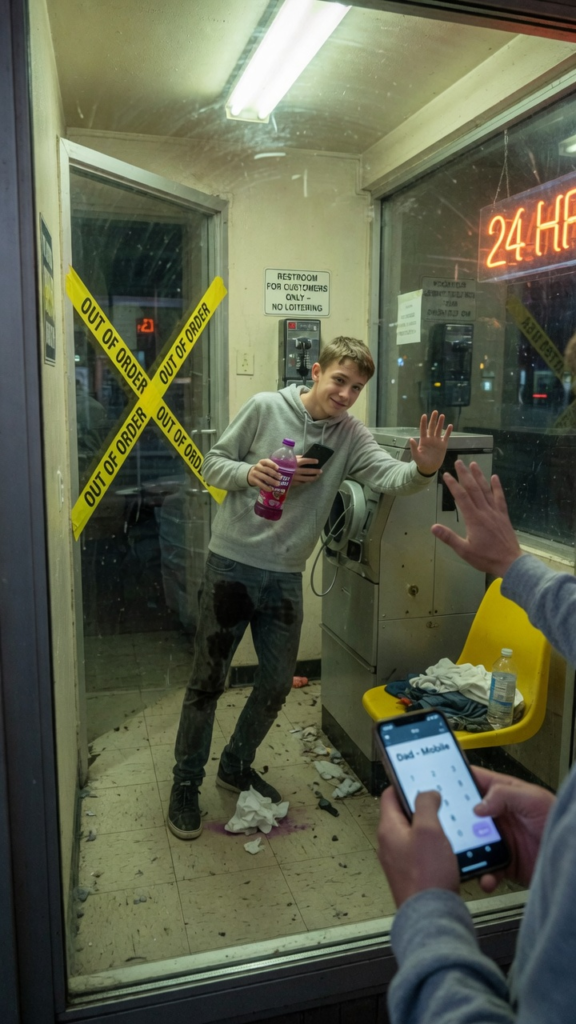
The air in the laundromat was thick with the smell of industrial-grade lavender and the humid, metallic tang of oversized dryers. It was 2:15 AM. The only sounds were the rhythmic thump-thump of a sneaker in a nearby machine and the flickering hum of a fluorescent light that was about to die.
I was folding my scrubs, my mind a fog of exhaustion, when I saw him.
He couldn’t have been more than seven. He was sitting on a plastic orange chair right outside the single-occupancy restroom. He was wearing a faded “Avengers” t-shirt two sizes too big and a pair of dark denim jeans. He was clutching a small, stuffed rabbit that had lost most of its fur and one of its bead eyes.
But it was his posture that caught me. He wasn’t swinging his legs or playing with a phone. He was rigid. His knuckles were white where he gripped the rabbit’s neck.
“Hey there, kiddo,” I said, trying to keep my voice light. “You’re up pretty late, aren’t you?”
He didn’t look up. He just stared at the restroom door. “Waiting for my dad,” he whispered. His voice was thin, like paper.
That’s when I noticed the dark patch on his right thigh. It was a jagged, deep-colored stain that had soaked into the denim. In the harsh, flickering light, it looked almost black.
“Oh man, looks like you had an accident,” I said, nodding toward the stain. “Did a soda explode on you?”
The boy finally looked at me. His eyes were huge, rimmed with a tired redness that a child that age shouldn’t have. He quickly pulled his rabbit over the stain, shielding it from my view.
“It’s just juice,” he said. His voice was suddenly louder, defensive. “I spilled my grape juice. It’s fine.”
“Grape juice is the worst for stains,” I teased gently, though a small cold knot was starting to form in the pit of my stomach. As a nurse, you learn to trust your “gut-check.” And my gut was screaming. “You want me to help you get that in the wash? Or I can call your dad out so he can help you change?”
The reaction was instantaneous. The boy’s face went from pale to ghostly. He gripped the arms of the plastic chair so hard I thought they might snap.
“No!” he gasped. “Don’t call him. Don’t knock. He… he’s tired. He says we have to be quiet.”
I froze. “Leo?” I asked, guessing at a name just to see if he’d respond.
“It’s Toby,” he corrected automatically, then immediately looked like he regretted saying it.
“Toby,” I said softly, stepping a bit closer. I stayed low, so I wasn’t looming over him. “I’m Sarah. I’m a nurse. I help people for a living. Can I just see that ‘juice’ stain? If it’s sticky, it’ll be uncomfortable for you to sit in.”
He shook his head violently. “It’s not sticky. It’s just… it’s just juice. Please go away.”
I looked toward the restroom door. It had been closed since I arrived twenty minutes ago. No sound of a flush. No sound of a faucet. Just silence.
“Toby, where’s your mom?”
“Working,” he said. “She’s always working.”
“And your dad… is he okay in there?”
Toby looked at the door, and for the first time, I saw it—raw, unfiltered terror. Not the kind of fear a kid has of the dark or a monster under the bed. This was the fear of something real. Something that lived in his house.
“He’s just sleeping,” Toby whispered. “He told me to wait here. He said if I moved, he’d give me something to really cry about.”
The cold knot in my stomach turned into an icy block of lead. I looked at the “juice” stain again. Now that I was closer, I could see the way the fabric was stiffening. It wasn’t grape juice. It was too thick. And there was a faint, metallic scent rising from the boy’s clothes that I knew all too well from the ER.
Blood.
“Toby,” I said, my voice trembling slightly despite my training. “I need you to listen to me. I’m going to get my phone, and I’m going to call some friends who can help. Okay?”
“No! He’ll be mad!” Toby scrambled back in the chair, his eyes darting toward the restroom door. “He said no phones! He said the police are bad people who take kids away!”
I reached out a hand, but he flinched so hard he nearly fell off the chair.
At that moment, the restroom door handle turned.
Read the full story in the comments. If you don’t see the new chapter, click on ‘All comments’.
FULL STORY
CHAPTER 1: The Midnight Watch
The Suds Stop was the kind of place where dreams went to die at 3:00 AM. It was located on the corner of 4th and Main, nestled between a shuttered hardware store and a diner that served coffee strong enough to strip paint. The windows were perpetually fogged with the steam of a dozen industrial washers, and the linoleum floor was a mosaic of scuffs and ancient gum.
I shouldn’t have been there. I had a perfectly good washer and dryer at my apartment, but the dryer had blown a fuse two days ago, and my landlord, Mr. Henderson—a man whose soul was as shriveled as a dried raisin—was “getting around to it.”
So, here I was. Sarah Jenkins, thirty-two years old, single, exhausted, and currently staring at a seven-year-old boy who was terrified of a bathroom door.
My life wasn’t supposed to be this way. Ten years ago, I was the girl with the “Most Likely to Succeed” superlative in my high school yearbook. I had a scholarship to Vanderbilt, a boyfriend who promised the world, and a heart full of unjaded ambition. But life has a way of sanding you down. My father’s illness took the scholarship money. My boyfriend’s ambition didn’t include a girl who worked two jobs to pay medical bills. And now, I was a night-shift nurse who found peace in the hum of a laundromat because the silence of my own apartment was too loud.
I looked at Toby. He was small for his age, his collarbone prominent against the neckline of his shirt. He looked like a bird that had fallen out of its nest and was waiting for a predator to notice.
“Toby,” I whispered, my eyes flicking to the restroom door. The handle was still turning, but slowly, as if whoever was on the other side was struggling with the lock. “Does your dad… does he hurt you?”
It was a blunt question, the kind I’d been trained to ask with more finesse in the hospital, but the adrenaline was starting to pump.
Toby didn’t answer. He just tucked his chin into his chest and started rocking. Thump. Thump. Thump. His head hit the back of the plastic chair with a dull rhythm. “I spilled juice. I spilled juice. I spilled juice.”
“Sarah? You okay?”
I jumped, spinning around. It was Marcus.
Marcus was the owner of The Suds Stop. He was a mountain of a man, an African American veteran who had lost an arm in Desert Storm and replaced it with a prosthetic that he moved with surprising grace. He was sixty-four, had a white beard that looked like a cloud, and was the unofficial guardian of the neighborhood.
“Marcus,” I breathed, my heart hammering. “Thank God.”
Marcus walked over, his heavy boots echoing on the linoleum. He looked at me, then his eyes drifted down to Toby. He saw the rocking. He saw the “juice” stain. His expression didn’t change, but his eyes grew hard.
“Who’s the little man?” Marcus asked, his voice a deep, comforting rumble.
“His name is Toby,” I said, moving closer to Marcus. I lowered my voice. “He’s waiting for his dad. He’s been in that restroom for twenty minutes. Marcus, I think the boy is hurt. And I don’t think it’s an accident.”
Marcus looked at the restroom door. He’d seen plenty of junkies use his bathrooms to shoot up. He’d seen people hide from the rain, hide from the law, and hide from themselves. But a kid waiting outside while the world bled through his jeans? That was new.
“Hey, Toby,” Marcus said, kneeling with a grunt. He didn’t mind the one arm; he used his good hand to reach into his pocket and pull out a strawberry lollipop. “You like these? My grandkids say they’re the best.”
Toby stopped rocking. He looked at the candy, then at Marcus. He didn’t take it.
“My dad says don’t take things from strangers,” Toby said.
“Smart man, your dad,” Marcus said, his voice devoid of any judgment. “But I’m not a stranger. I’m Marcus. I own this whole place. Every machine, every soap bubble. That makes me the captain of this ship. And you look like you might need a first mate.”
Toby’s eyes flicked back to the door. The handle had stopped turning. It was just… still.
“He’s gonna be mad,” Toby whispered.
“Why is he going to be mad, Toby?” I asked, kneeling beside Marcus. “Because you’re talking to us?”
“Because of the juice,” Toby said, a tear finally escaping and rolling down his dusty cheek. “He told me if I spilled anything else, he’d give me away. He said he’d leave me here and I’d have to live in the washers.”
The sheer cruelty of the threat made my blood boil. It was a classic tactic—isolate the child with fear of abandonment.
“He’s not going to leave you here, Toby,” I said firmly. “I won’t let him.”
“You can’t stop him,” Toby said, his voice rising in a thin wail. “You don’t know him! He’s… he’s big. And when he gets the ‘shaky hands,’ he gets real mean.”
The “shaky hands.” Withdrawal. Or maybe just a simmering, violent rage fueled by something cheaper than whiskey.
I looked at Marcus. “We need to call it in.”
Marcus nodded. He reached for his belt where he kept his phone, but before he could pull it out, the restroom door didn’t just open—it was kicked.
The heavy wooden door slammed against the interior wall with a bang that sounded like a gunshot in the quiet laundromat. Toby screamed, a small, choked sound, and scrambled behind the orange chair.
A man stumbled out.
He was tall, gaunt, with a week’s worth of beard growth and eyes that were bloodshot and wild. He was wearing a grease-stained hoodie and work boots that were caked in mud. He looked like a man who had been fighting a war with himself and was losing badly.
This was David. Toby’s father.
He didn’t see me or Marcus at first. His eyes were locked on Toby.
“Toby! I told you to stay put!” he roared. His voice was raspy, cracking with a frantic edge. He took a lurching step forward, his balance off. “Did you move? I told you not to move!”
“I didn’t move, Daddy! I stayed right here!” Toby was trembling so hard the chair was rattling.
“Who are these people?” David demanded, finally noticing Marcus and me. He squinted, his hand going to his forehead as if the flickering light was physically hurting him. “What are you doing with my kid?”
“We were just keeping him company, sir,” Marcus said, his voice like iron. He stood up, towering over David despite having only one arm. “He’s a little upset. Said he spilled some juice.”
David’s eyes dropped to Toby’s leg. For a split second, I saw something flicker in his gaze—not anger, but a profound, sickening guilt. It was gone in a flash, replaced by a wall of defensive aggression.
“It’s none of your business,” David spat. He reached out and grabbed Toby by the arm—the arm Toby was using to shield his leg. Toby let out a sharp cry of pain. “Come on. We’re leaving.”
“Wait,” I said, stepping forward. My heart was racing so fast I could feel it in my throat. “Sir, your son is bleeding. I’m a nurse. Let me just take a look at it. It might need stitches.”
David spun on me, his face inches from mine. I could smell him—stale beer, sweat, and a chemical scent that made my skin crawl. “He’s fine! He’s a boy, he fell. It’s a scratch. Get your hands off my business or you’ll regret it.”
“He’s not fine,” I said, my voice surprisingly steady. “The way he’s protecting that leg, the amount of blood… that’s not a scratch from a fall.”
David’s hand tightened on Toby’s arm. The boy was whimpering now, a low, rhythmic sound.
“Last warning, lady,” David hissed.
Marcus stepped between us. “Actually, friend, I think you’ve had your last warning. This is my establishment. And I don’t like the way you’re handling that boy. Why don’t you sit down, let the lady look at the leg, and we can all talk this out like men?”
David looked at Marcus, then at the door, then back at Toby. He looked like a cornered animal. “We don’t need your help. We don’t need anyone.”
He jerked Toby toward the exit. Toby stumbled, his injured leg buckling. He fell to one knee, a fresh bloom of red spreading across the denim.
“Daddy, it hurts!” Toby sobbed.
David didn’t stop. He literally dragged the boy across the floor.
“Marcus!” I yelled.
Marcus didn’t hesitate. He reached out with his prosthetic arm—a solid, heavy piece of engineering—and gripped David’s shoulder. “I said, sit down.”
David spun around and swung. It was a wild, clumsy punch that Marcus easily dodged. But the momentum sent David crashing into a row of rolling laundry carts.
Toby was left huddled on the floor, clutching his leg.
I ran to him. I didn’t care about David. I didn’t care about the consequences. I knelt in the grime of the laundromat floor and pulled out a pair of trauma shears I always kept in my bag.
“Toby, I’m going to cut your jeans, okay? I need to see.”
“No, he’ll kill me!” Toby screamed.
“He won’t touch you,” I promised, my eyes locked on his. “I’ve got you.”
I sliced through the thick denim. My breath hitched.
It wasn’t a scratch. It wasn’t a fall.
On Toby’s thigh was a deep, jagged puncture wound, surrounded by a massive, purple-black bruise that looked like a map of a nightmare. It looked like he’d been impaled by something—a piece of rebar, maybe, or a jagged pipe. And it was infected. The edges were angry and yellow, and the heat radiating from it was intense.
“Toby,” I whispered, “how did this happen?”
Toby looked at his father, who was struggling to get up while Marcus held him down.
“I… I fell on the “bitey” chair,” Toby whispered. “The one in the basement. Daddy was mad because I broke his glass. He pushed me… and the chair bit me.”
My stomach dropped. The “bitey” chair. A broken piece of furniture in a basement where a child was shoved in anger.
Suddenly, the front door of the laundromat swung open.
It was Officer Jim Miller.
Jim was a regular at the diner next door. He was fifty, had a gut that hung over his belt, and a heart that had been broken by twenty years on the force. He’d seen me through the window and the commotion of Marcus holding David down.
“Everything okay in here, Marcus?” Jim asked, his hand resting on his holster.
“Not even close, Jim,” Marcus said, his voice heavy with grief. “Not even close.”
Jim’s eyes moved from the struggling father to the kneeling nurse, and finally, to the small boy with a hole in his leg.
“Call an ambulance,” Jim said into his radio, his voice cracking.
As the sirens began to wail in the distance, David stopped struggling. He slumped against the laundry carts, his head in his hands.
“I didn’t mean it,” he moaned. “I just… I just needed him to be quiet. I’m so tired. I’m so tired.”
I didn’t look at him. I held Toby’s hand. The boy was looking at me, his eyes searching mine.
“Am I going to the washers now?” he asked.
“No, Toby,” I said, a tear of my own finally falling. “You’re going to the hospital. And then, we’re going to find you a place where nothing ever ‘bites’ you again.”
But as the EMTs rushed in, I saw the look on Toby’s face. It wasn’t relief. It was a terrifying, heartbreaking loyalty. He was watching his father being handcuffed, and he was reaching out his small, blood-stained hand.
“Daddy?” he called out. “Don’t forget my rabbit.”
That was the moment I knew. This wasn’t just a story about a bad man and a hurt kid. This was a story about the complicated, jagged pieces of love that get stuck in our throats.
And I knew my night shift was just beginning.
CHAPTER 2: The Sterile Silence of Mercy
The ambulance ride was a blur of neon city lights and the rhythmic, piercing wail of the siren. Inside the cramped, swaying cabin, the air tasted like ozone and adrenaline. I sat on the bench, my hands still stained with a mixture of laundry detergent and Toby’s blood. I looked down at my fingernails, seeing the dark crescents of his trauma etched into my skin, and felt a wave of nausea that had nothing to do with the motion of the vehicle.
Toby was strapped into the gurney, looking even smaller than he had in the laundromat. They had given him a puff of Penthrox for the pain—the “green whistle”—and he was drifting in a dissociative fog. His eyes were half-closed, tracking the flickering fluorescent bars on the ceiling of the rig.
“You’re doing great, Toby,” the EMT, a guy named Mike who I’d seen in the ER a hundred times, said softly. He was checking the IV line he’d managed to start in the boy’s thin arm. “We’re almost there. Sarah’s here. You’re safe.”
Toby didn’t look at Mike. He looked at me. His voice was a ghostly rasp, barely audible over the roar of the engine. “Is the rabbit okay?”
I reached into my bag and pulled out the mangled stuffed toy. It was damp and smelled like the floor of The Suds Stop. “He’s right here, Toby. He’s a little tired, but he’s staying with us.”
I tucked the rabbit under the boy’s good arm. He squeezed it, a tiny, reflexive movement of his fingers. As a nurse, I’ve seen the way children cling to objects when their world dissolves. It’s a tether to a reality that no longer exists. For Toby, that rabbit was the only thing that hadn’t betrayed him.
The Arrival at Mercy General
We swung into the ambulance bay of Mercy General at 3:15 AM. The automatic doors hissed open, admitting a rush of cold, sterile air. This was my world. I knew the exact frequency of the monitors, the specific way the linoleum squeaked under rubber soles, and the names of the night-shift janitors. But tonight, I wasn’t the woman in the blue scrubs with the stethoscope. I was a witness. I was a ghost in my own workplace.
“Trauma Room 3!” a voice barked.
It was Dr. Aris Thorne.
Aris was a legend at Mercy. He was forty-eight, with salt-and-pepper hair that he kept cropped short and a surgical precision in his movements that bordered on the mechanical. He was a man of few words, most of them blunt. He’d served as a combat surgeon in the Middle East before coming to the ER, and he had the “thousand-yard stare” to prove it. His strength was his unflappable calm; his weakness was a total lack of bedside manner. He treated bodies like engines that needed fixing, often forgetting there was a person inside.
“Sarah?” Aris stopped mid-stride, his brow furrowing as he saw me jumping out of the back of the rig. “What are you doing here? You’re off tonight.”
“I was at the laundromat,” I said, my voice shaking. “I found him. Aris, it’s a puncture wound. Deep. Infected. His father… he’s in custody.”
Aris didn’t waste time with sympathy. He nodded to the EMTs. “Get him on the bed. Vitals now. Let’s see that leg.”
I stood back, forced into the corner of the room as the trauma team swarmed. It was a choreographed dance of chaos. Scissors cutting away the rest of Toby’s jeans. The beep-beep-beep of the heart monitor. The smell of Betadine.
“Jesus,” Aris muttered as he peeled back the makeshift dressing I’d applied. “Look at the erythema. This isn’t from tonight. This is three, maybe four days old.”
“He said he fell on a ‘bitey chair’ in the basement,” I offered, stepping closer despite the nurses trying to push me back.
Aris looked up at me, his eyes cold and sharp behind his glasses. “A ‘bitey chair’? You mean he was pushed onto a broken piece of furniture and left to rot in a damp basement. There’s signs of early cellulitis here, maybe even osteomyelitis if that puncture hit the bone.”
Toby let out a low, whimpering moan as Aris probed the wound.
“I’m sorry, Toby,” I whispered, though I knew he couldn’t really hear me.
“Sarah, go to the waiting room,” Aris said, his voice softer now but still firm. “You’re too close to this. You’re shaking. Go get some coffee. I’ll come find you when he’s stable.”
“Aris—”
“Go,” he commanded. “Before I have security escort you out for interfering with a minor’s care.”
The Ghost in the Hallway
I walked out of the trauma bay, my legs feeling like they were made of lead. The ER waiting room was a graveyard of broken people. A woman clutching a crying infant, a man with a blood-soaked bandage on his hand, a homeless man sleeping fitfully in the corner.
I sat down on a hard plastic chair, the same kind Toby had been sitting on at the laundromat. The irony wasn’t lost on me.
“Rough night?”
I looked up. Standing there was Elena Vance.
Elena was the hospital’s head social worker. She was twenty-nine, looked like she survived entirely on cold espresso and spite, and had a wardrobe that consisted exclusively of oversized blazers and sensible flats. She was sharp-tongued and cynical, a defense mechanism developed from years of seeing the absolute worst things humans do to those they claim to love. Her strength was her legal mind; her weakness was the way she carried every case home with her, hidden behind a mask of indifference.
“I found the boy,” I said, leaning my head against the wall.
Elena sat down next to me, offering a lukewarm cup of coffee. “Toby Miller. I just got the call from the precinct. The father, David Miller, is being booked as we speak. Aggravated child endangerment, assault with a deadly weapon—the works.”
“Is there a mother?” I asked, the caffeine hitting my empty stomach like a lightning strike.
Elena sighed, flipping open a folder. “Melissa Miller. She’s a night manager at a distribution center three towns over. She works twelve-hour shifts to keep the lights on. David… David was a contractor until he fell off a roof two years ago. Got hooked on the ‘happy pills’ the doctors gave him for his back. When the pills ran out, he moved on to the cheaper stuff. Meth, probably. The ‘shaky hands’ the kid mentioned? That’s withdrawal.”
I closed my eyes. It was a story I’d heard a thousand times. A common American tragedy. Injury leading to addiction, leading to the slow, agonizing collapse of a family unit. But hearing it didn’t make Toby’s “juice” stain any less red.
“Toby thinks it’s his fault,” I said. “He thinks he’s being punished because he spilled juice.”
Elena looked at me, her expression softening for just a fraction of a second. “They always do, Sarah. It’s easier for a child to believe they are ‘bad’ than to believe their parents are monsters. If the kid is ‘bad,’ he can try to be ‘good’ and fix the world. If the parent is a monster, the world is just a terrifying, unpredictable place where no one is safe.”
“I want to stay with him,” I said.
“You know the rules,” Elena countered. “You aren’t family. You aren’t on his care team. Technically, you’re a witness in an ongoing criminal investigation.”
“I don’t care about the rules, Elena. That boy is terrified of the dark, and right now, his whole life is dark. He has that rabbit. He has nothing else.”
Elena stared at me for a long time. She knew my history. She knew about my younger brother, Danny. She knew about the night twenty years ago when I had stayed silent while my father’s “bad days” turned into a tragedy we never spoke about.
“I can get you in as a ‘volunteer advocate’ for the next few hours until Child Protective Services takes official custody,” Elena said, standing up. “But Sarah… don’t get attached. This kid is going into the system. And the system isn’t a fairy godmother. It’s a meat grinder.”
The Shadow of the Past
I followed Elena back into the pediatric wing. Toby had been moved to a private room. Aris had cleaned the wound, started him on heavy-duty IV antibiotics, and given him something to sleep.
The room was dim, the only light coming from the glowing monitors. Toby looked like a porcelain doll in the oversized hospital bed. His breathing was steady, but every few minutes, his hand would twitch, searching for the rabbit.
I sat in the chair by his bed and took his small, cold hand in mine.
As I sat there, the memories I had spent a decade burying began to claw their way to the surface. I remembered being six years old, sitting on the floor of a kitchen that smelled like burnt toast and cheap gin. I remembered my brother Danny crying because he’d dropped a glass of milk.
I remembered my father’s shadow looming over us, the way his voice would drop into that low, dangerous rumble. “Why can’t you just be quiet? Why do you have to make everything so hard?”
I remembered the “bitey” things in our house, too. The corner of the coffee table. The heavy belt. The silence that followed the screams—a silence so thick you could drown in it.
I had survived. I had worked three jobs, put myself through nursing school, and built a life out of the wreckage. I thought I was “healed.” But looking at Toby, I realized that healing is just a scab. Underneath, the wound is always wet.
“Sarah?”
I looked up. Aris was standing in the doorway. He looked tired. The adrenaline of the trauma bay had faded, leaving behind the weary bones of a man who had seen too much.
“He’s going to keep the leg,” Aris said, walking over to check the IV drip. “But he’s malnourished. Dehydrated. And he has old fractures in his ribs that never set right. This wasn’t a one-time thing, Sarah.”
My grip on Toby’s hand tightened. “How did no one see? How did the mother not know?”
“Maybe she didn’t want to see,” Aris said, his voice devoid of judgment. “Or maybe she was too busy trying to survive herself. Poverty and addiction don’t leave much room for observation. They turn life into a series of fires you’re constantly trying to put out.”
“He’s just a baby,” I whispered.
“He’s a survivor,” Aris corrected. “There’s a difference.”
Aris stayed with me for a moment, the two of us watching the boy sleep. In the quiet of the hospital, the professional boundaries felt thinner.
“You did a good thing tonight, Sarah,” Aris said. “Most people would have seen a kid at a laundromat and assumed everything was fine. They would have looked at their own laundry and gone home.”
“I couldn’t,” I said. “I knew what that ‘juice’ was.”
Aris nodded. “I know you did. Just make sure you don’t lose yourself in this. You can’t save them all.”
“I just want to save this one,” I said.
The Visitor
At 5:00 AM, the door to the room creaked open. I expected Elena or a nurse.
Instead, a woman stood there.
She was wearing a neon yellow safety vest over a stained sweatshirt. Her hair was pulled back in a messy knot, and her face was a map of exhaustion and grief. She looked like she had aged twenty years in a single night.
This was Melissa Miller. Toby’s mother.
She didn’t see me at first. Her eyes went straight to Toby. She let out a sob that sounded like a physical rip in the air and rushed to the bedside.
“Oh, baby,” she wailed, her hands hovering over him, afraid to touch the wires. “My sweet boy. What did he do? What did he do to you?”
I stood up, giving her space. “Mrs. Miller? I’m Sarah. I’m the nurse who found him.”
Melissa turned to me. Her eyes were red-rimmed and hollow. “They told me at the precinct. They said a nurse found him. They said David… they said he let this happen.”
“He didn’t just let it happen, Melissa,” I said, my voice harder than I intended. “He pushed him. He left him in a basement with an infected wound. He lied to me about what it was.”
Melissa collapsed into the chair I had just vacated. She buried her face in her hands. “I knew he was getting bad again. I knew the ‘shaky hands’ were back. But I had to work. If I don’t work, we’re on the street. I thought… I thought he still loved Toby enough to keep him safe.”
“Love isn’t enough when the addiction takes over,” I said softly.
Melissa looked at Toby, then back at me. There was a desperate, flickering look in her eyes—the look of someone who was about to make a choice. “They’re going to take him, aren’t they? The social worker… she said I wasn’t ‘providing a safe environment.’”
“They have to keep him safe, Melissa,” I said.
“He is my life!” she hissed, her voice rising in a frantic pitch. “He’s all I have! You don’t understand. You people with your clean clothes and your degrees… you don’t know what it’s like to have to choose between a paycheck and a child’s safety.”
“I know what it’s like to be the child,” I said, my voice low and steady.
The room went silent. Melissa stared at me, her mouth slightly open.
“I grew up in a house like yours,” I continued. “My mom worked double shifts, too. She didn’t see the bruises because she was too tired to look. She didn’t hear the screams because she was asleep for four hours before her next shift. She thought she was ‘providing.’ But providing isn’t just food and a roof. It’s protection. And Toby wasn’t protected.”
Melissa’s face crumpled. The defiance drained out of her, leaving only a broken, tired woman.
At that moment, Toby’s eyes fluttered open. He looked at his mother, then at me.
“Mommy?” he whispered.
“I’m here, baby. I’m here.” Melissa reached out and stroked his hair.
Toby looked past her, toward the door. “Is Daddy coming? I have his rabbit. I didn’t lose it.”
The loyalty. The crushing, beautiful, terrible loyalty of a hurt child. It hit me like a physical blow. Toby wasn’t thinking about the “bitey chair” or the basement. He was thinking about the man who had hurt him, making sure he was okay.
Melissa started to cry again, great, racking sobs that shook her entire body.
I stepped out into the hallway, needing air. The sun was starting to peek over the horizon, casting long, pale shadows across the hospital parking lot.
Elena was waiting for me by the nurse’s station. She had a new stack of paperwork in her hand.
“The police found the basement, Sarah,” she said.
“And?”
“It wasn’t just a chair,” Elena said, her voice tight. “It was a cage. David had built a small enclosure out of scrap wood and wire. He called it the ‘quiet zone.’ Toby had been kept in there whenever David was ‘shaky.’ The ‘bitey’ part was a piece of jagged metal wire Toby had caught his leg on trying to climb out.”
I felt the world tilt.
A cage.
I looked through the glass window of the room. Toby was holding his mother’s hand, his eyes closing again as the medication pulled him back under. He looked so peaceful. He looked so innocent.
And I knew that the “juice” stain was just the beginning. The real stains were much deeper, hidden in the dark corners of a basement and the silence of a mother who was too tired to see.
“What happens now?” I asked Elena.
“Now,” Elena said, “we fight. But the problem with fighting for a kid like Toby is that sometimes, the person you’re fighting is the person he loves most.”
I looked at my hands again. They were clean now, but I could still feel the weight of him.
“Then I guess we better get ready,” I said. “Because I’m not letting him go back to that cage.”
As I walked away from the room, I didn’t see the man standing at the end of the hallway.
A man in a tan suit, holding a briefcase, watching me with an intensity that made the hair on the back of my neck stand up.
A man who didn’t look like a doctor, or a cop, or a social worker.
A man who looked like he knew exactly who I was.
And exactly what I was hiding.
CHAPTER 3: The Trial of Silence
The sun didn’t so much rise over the city as it did leak, a pale, sickly yellow that washed over the hospital parking lot like a bruise. I stood by the window of the breakroom, clutching a cup of coffee that had gone cold twenty minutes ago. My eyes burned, and my skin felt several sizes too small for my body.
In the ER, we call it “compassion fatigue,” but this felt more like a haunting. Every time I closed my eyes, I saw that “juice” stain. I saw the way Toby’s fingers curled around that one-eyed rabbit. I saw the ghost of my own brother, Danny, staring back at me from the shadows of my memory.
“You’re still here.”
I didn’t need to turn around to know it was Dr. Aris Thorne. His voice had that gravelly, no-nonsense texture that usually signaled a long shift ending or a difficult surgery beginning.
“I can’t leave yet,” I said, my voice sounding thin even to my own ears. “Child Protective Services is coming for the formal interview. I’m the primary witness.”
Aris stepped up beside me, leaning his heavy shoulders against the window frame. He smelled like sterile scrub soap and the faintest hint of peppermint. “The mother is in there now. She’s been crying for three hours. The nurses say she won’t let go of the kid’s hand.”
“She’s a victim too, in a way,” I murmured. “But that doesn’t change the fact that she let him live in a cage.”
Aris looked at me, his sharp eyes narrowing. “A cage, Sarah. Think about that word. We see ‘neglect’ every day. We see ‘accidents.’ But a cage is a choice. It’s an architectural decision to strip a human being of their personhood.”
He was right. David Miller hadn’t just lost his temper. He had built a reality for Toby where the boy was less than a son—he was a nuisance to be stored.
The Man in the Tan Suit
I left Aris and headed back toward the pediatric wing. The hallway was busier now as the day shift arrived, the air filled with the cheerful, forced “good mornings” of people who hadn’t spent their night scrubbing blood off a seven-year-old.
Halfway to Toby’s room, I saw him again.
The man in the tan suit.
He was standing near the nurse’s station, checking an expensive-looking watch. He was polished—the kind of polished that costs five hundred dollars a haircut. He looked like he belonged in a boardroom on Wall Street, not in the gritty, flu-scented halls of Mercy General.
As I approached, he looked up. His eyes weren’t cold; they were worse. They were professional.
“Ms. Jenkins?” he asked. His voice was smooth, a practiced baritone.
“Who are you?” I asked, stopping a few feet away. I felt the old defensive prickle at the base of my neck.
“My name is Julian Vane,” he said, extending a hand that I didn’t take. He didn’t seem offended. He simply tucked it into his pocket. “I’m an attorney representing the Miller family. Specifically, David Miller’s parents.”
I felt a surge of cold fury. “David Miller’s parents? Where were they when their grandson was being kept in a basement? Where were they when he was bleeding out in a laundromat?”
Julian Vane sighed, a sound of polite regret. “Mr. and Mrs. Miller senior have been estranged from their son for years due to his… substance issues. They had no idea of the conditions Toby was living in. But now that they are aware, they wish to take immediate custody.”
“Over my dead body,” I snapped.
“Ms. Jenkins, let’s be civil,” Vane said, stepping closer. He lowered his voice, and for the first time, I saw a flicker of something predatory in his gaze. “I understand you have a personal interest in this case. A very personal one. I’ve done my homework, Sarah. I know about your father. I know about what happened to your brother, Danny, back in 1998.”
The world seemed to tilt. The sounds of the hospital—the paging system, the rolling carts, the distant sirens—all vanished into a high-pitched ring in my ears.
“How do you know that?” I whispered.
“Public records are a wonderful thing,” Vane said. “Especially when a witness is as… vocal as you’ve been. My clients want their grandson. They have the resources to provide for him. You, on the other hand, are a night-shift nurse with a history of ‘childhood trauma’ and a tendency to over-identify with patients. If this goes to a custody hearing, my job will be to suggest that your testimony is colored by your own unresolved PTSD. That you didn’t see a ‘juice’ stain—you saw a ghost.”
I felt like I’d been punched in the gut. He was weaponizing my survival against me. He was telling me that because I had been hurt, I could no longer see the truth.
“He was in a cage, Julian,” I hissed, leaning in so close I could see the pores in his perfectly tanned skin. “Go ahead. Tell the judge I’m crazy. But then explain why a seven-year-old boy calls a basement prison a ‘quiet zone.’ Explain the ‘bitey chair.’ Explain why he was terrified to let me call his father.”
Vane didn’t flinch. He just straightened his tie. “I don’t have to explain anything, Ms. Jenkins. I just have to create reasonable doubt about the person who reported the crime. Enjoy your coffee. It’s going to be a very long day.”
He turned and walked away, his polished shoes clicking rhythmically on the linoleum.
The Weight of the Basement
I found Elena Vance in the cafeteria, staring into a bowl of oatmeal like it held the secrets to the universe. When I told her about Julian Vane, she didn’t look surprised.
“The Millers are old money, Sarah,” she said, stabbing at her food. “David was the black sheep. The ‘accident’ that ruined their reputation. They don’t want the kid because they love him; they want the kid because having a grandson in foster care is a stain on their legacy they can’t scrub out.”
“We can’t let them have him,” I said, my hands shaking so hard I had to hide them under the table. “They’ll just bury him in a different kind of cage. A golden one. They won’t get him the therapy he needs. They’ll just try to make everyone forget what happened.”
Elena looked at me, her sharp features softening. “Sarah, you need to go home. You’ve been awake for twenty-four hours. You’re starting to vibrate.”
“I can’t go home, Elena. Vane knows about Danny.”
Elena froze. “How?”
“He looked it up. He’s going to use it to disqualify my testimony. He’s going to say I’m projecting my own abuse onto Toby’s situation.”
“That son of a bitch,” Elena whispered. She reached across the table and grabbed my wrist. “Listen to me. He can try. But I have the police report. I have the photos of the basement. I have the medical evaluation from Aris. A fancy suit can’t talk his way out of a puncture wound that hit the periosteum.”
“But Toby won’t talk,” I said, the realization hitting me with a fresh wave of despair. “I went back in there before I came to find you. He was awake. He was eating a piece of toast. I asked him if he wanted to tell me about the basement. You know what he did? He put his finger to his lips and whispered, ‘We don’t talk about the quiet zone, or the monsters come back.’“
Toby wasn’t just physically wounded. He was psychologically shackled. His loyalty to his father—that twisted, desperate love—was a gag that Julian Vane was going to use to his full advantage.
A Trip to the Ghost House
I knew I shouldn’t do it. It was a violation of a dozen hospital policies and probably a few laws. But I couldn’t sit still.
I needed to see it for myself.
I called Marcus. He answered on the first ring, his voice a deep, comforting balm.
“I’m outside the Miller house, Sarah,” he said. “I followed the police cruiser after you left. I… I couldn’t just go back to folding shirts, girl. Not after seeing that boy’s face.”
“Stay there, Marcus. I’m coming to you.”
The Miller house was a dilapidated split-level in a neighborhood where the lawns were mostly dirt and the “For Sale” signs were rusted. It was the kind of place people moved to when they were running out of options.
Marcus was sitting on the tailgate of his truck, his prosthetic arm resting on his knee. He looked like a guardian deity of the working class.
“The cops are done,” Marcus said, nodding toward the yellow crime scene tape fluttering in the wind. “They took what they needed. But they left the door unlocked. This neighborhood… nobody’s coming in here to steal anything. There’s nothing left to take.”
I stepped over the tape. My heart was thudding a frantic rhythm against my ribs.
The house smelled of stale cigarettes, unwashed clothes, and a sharp, chemical undertone that I recognized as the “shaky hands” fuel. I walked through the kitchen—dirty dishes piled high, a single, half-empty bottle of grape juice on the counter. My breath hitched.
The “juice.”
I followed the trail of grime down to the basement door. It creaked as I pushed it open.
The air down there was cold. It felt like stepping into a tomb. I flicked on my phone’s flashlight.
In the corner, under a single, bare bulb, was the “cage.”
It wasn’t a cage like you’d see at a zoo. It was worse because it was improvised. It was made of old wooden pallets and chicken wire, held together with zip ties and duct tape. Inside, there was a single, thin mattress covered in a Disney-themed sheet that was gray with filth.
And there, in the corner of the enclosure, was the “bitey chair.”
It was an old, wooden kitchen chair, one of its legs snapped off, leaving a jagged, spear-like splinter of wood pointing upward. There was a dark, dried smear on the wood.
Toby’s blood.
I stood there in the dark, the flashlight beam shaking in my hand. I could almost see him. I could see the seven-year-old boy huddling on that mattress, the shadows of the basement closing in on him, the sound of his father’s heavy boots overhead. I could hear him whispering to his rabbit, telling himself that if he was just quiet enough, the “bitey chair” wouldn’t hurt him again.
“He wasn’t just hiding,” I whispered to the empty room. “He was waiting for someone to notice.”
I reached out and touched the chicken wire. It was sharp. It tore at my skin, leaving a thin red line on my palm.
Suddenly, I heard a floorboard creak above me.
I froze. My pulse skyrocketed. “Marcus?”
No answer.
I slowly climbed the stairs, my phone light cutting through the dust motes. When I reached the kitchen, I saw a figure standing by the window.
It wasn’t Marcus.
It was Melissa Miller.
She was holding the bottle of grape juice, her knuckles white. She looked like a ghost in her own home.
“He used to be so sweet,” she said, her voice hollow. She didn’t look at me. “When Toby was a baby, David would stay up all night rocking him. He’d sing those old folk songs. He was a good man, Sarah. He was.”
“The man who built that cage isn’t a good man, Melissa,” I said, stepping into the room.
“The pills changed him,” she whispered. “It was like… like something else moved into his skin. I tried to fix it. I tried to work more, to buy him the things he needed, to keep the peace. I thought if I could just keep him happy, the monster would leave.”
“You can’t keep a monster happy by feeding it your son,” I said, the words sharp and cruel.
Melissa finally looked at me. Her face was a mask of agony. “What am I supposed to do? They told me if I testify against him, they’ll take Toby away forever. They said I’m an ‘enabler.’ They said I’m just as guilty.”
“You are guilty, Melissa,” I said, moving closer. I took the bottle of juice from her hand and set it on the counter. “But you can choose what kind of guilty you want to be. You can be the woman who let her son suffer, or you can be the woman who finally stood up and ended it.”
“They have a lawyer,” Melissa said, her voice trembling. “A man in a suit. He came to the hospital. He said if I don’t sign a paper giving custody to David’s parents, he’ll tell the police I was the one who pushed Toby. He said he has ‘evidence.’”
Julian Vane. He wasn’t just coming for me. He was dismantling Melissa, piece by piece, ensuring that no one would be left to speak for Toby.
The Breaking Point
I left the house feeling sick. Marcus was waiting for me outside, his face etched with concern.
“You okay, Sarah? You look like you’ve seen a ghost.”
“I’ve seen a lot of them today, Marcus,” I said. “I need you to do me a favor. You know everyone in this neighborhood. You know who sees what.”
Marcus nodded. “I see everything that happens at that laundromat. And I know who hangs out in the alley behind this house.”
“Find me someone who saw David with those ‘shaky hands.’ Find me someone who heard the screaming. Vane is trying to say this was a one-time accident. I need proof that it was a pattern.”
“I’ll see what I can do,” Marcus said. “But Sarah… be careful. People like Vane? They don’t play by the rules we do. They don’t care about the ‘juice’ stain. They only care about the win.”
I drove back to the hospital in a daze. I needed to see Toby. I needed to know he was still there.
When I walked into his room, the lights were off. Toby was asleep, but he was restless, his head tossing from side to side.
“No,” he muttered in his sleep. “Not the quiet zone. I’ll be good. I’ll be good.”
I sat by his bed and took his hand. “You are good, Toby,” I whispered. “You are so good.”
The door opened softly. I expected a nurse.
Instead, it was Aris. He looked at me, then at the boy. He didn’t say anything for a long time. Then, he reached into his pocket and pulled out a small, digital recorder.
“I’m not supposed to show you this,” Aris said, his voice a low rumble. “But after you left, Toby had a night terror. He started talking. He thought I was his father.”
Aris pressed play.
The sound that came out of the speaker was haunting. It was Toby’s voice, but it sounded older, heavy with a weight no child should carry.
“Don’t put me back, Daddy. I’ll wash the juice. I’ll scrub it until the floor is white. Just don’t let the ‘bitey’ things come back. I promise I’ll be a ghost. I’ll be so quiet you won’t even know I’m here.”
Then, a sound of a struggle. A muffled cry. And then, the most devastating part.
“I love you, Daddy. Please love me back.”
I felt the tears finally spill over. It was the “Trial of Silence” in its purest form. Toby was willing to disappear, to become a ghost, just for the hope of a father’s love.
“Is this enough?” I asked Aris, looking at the recorder.
“In a medical sense? Yes,” Aris said. “In a legal sense? It’s hearsay. Vane will say the boy was delirious from the infection and the medication.”
“Then we need something else,” I said, standing up. “We need the one person who can’t be silenced.”
“Who?”
“Me,” I said. “And I’m going to tell them everything. About Toby. About the basement. And about Danny.”
Aris looked at me, a flicker of respect—and fear—in his eyes. “If you do that, Sarah, you’re opening a door you might never be able to close. Your career, your reputation… Vane will tear it all down.”
“Let him,” I said, looking down at Toby. The boy had finally settled into a deep sleep, his hand still clutching mine. “I’ve spent twenty years being quiet. I’m done being a ghost.”
As I walked out of the room, I saw Julian Vane standing at the end of the hallway. He smiled at me—a cold, victory-scented smile.
He thought he had won. He thought he had buried the truth under a mountain of legal filings and past traumas.
But he didn’t know one thing.
A nurse knows how to find a pulse even in the darkest room. And I had just found mine.
CHAPTER 4: The Sound of the Truth
The Clark County Courthouse felt like a cathedral built of cold intentions. The air inside was pressurized, heavy with the scent of floor wax and the silent prayers of people who had run out of luck. I stood in the hallway, wearing the only blazer I owned—a navy blue one I’d bought for my father’s funeral. It felt tight across my shoulders, a physical reminder of the weight I was carrying.
“You don’t have to do this alone, Sarah.”
I looked up. Aris Thorne was standing there, looking out of place without his lab coat. He was wearing a charcoal suit that made him look like a retired general. He held out a paper cup of tea. “The hospital board isn’t happy you’re here. They think this is a liability.”
“I know,” I said, taking the tea. My hands were finally still. “They told me if I testify, they can’t guarantee my shift lead position when I get back.”
“Positions can be replaced,” Aris said, his voice dropping to that low, tectonic rumble. “A child’s soul can’t. If you need a job, I know three clinics that would kill for a nurse with your backbone.”
I managed a small, tired smile. “Thanks, Aris.”
At the end of the hall, the heavy oak doors of Courtroom 4B swung open. Julian Vane stepped out, looking like he’d been born in a courtroom. He saw us and didn’t even blink. He just adjusted his French cuffs and turned to talk to two elderly people who looked like they were carved from ice. David Miller’s parents. They weren’t crying. They weren’t even looking at the photos of the “quiet zone” that the bailiff was carrying inside. They were looking at their watches.
“It’s time,” Elena Vance said, appearing at my side. She looked like she hadn’t slept in forty-eight hours. Her eyes were bloodshot, but her jaw was set in a way that made her look dangerous. “Judge Sterling is on the bench. She doesn’t like delays.”
The Gavel of Justice
The courtroom was smaller than I expected. It felt intimate, which only made it more terrifying. At the front sat Judge Martha Sterling. She was a woman in her sixties with a shock of white hair and eyes that seemed to see through the mahogany desk and right into your marrow. She had a reputation for being a “hard-liner” for the law, but a “soft-touch” for the vulnerable.
“This is a hearing to determine the temporary and permanent custody of Toby Miller,” Judge Sterling began, her voice echoing. “We will hear testimony from the reporting party, the medical staff, and the family representatives.”
Julian Vane stood up first. “Your Honor, before we begin, I’d like to remind the court that we are looking for the best environment for this child. My clients, the senior Millers, offer a ten-thousand-square-foot home, private schooling, and round-the-clock medical care. Compared to the alternatives—foster care or a mother who allowed this to happen—the choice is clear.”
“The choice is about safety, Mr. Vane,” Sterling said dryly. “Not square footage. Proceed.”
The first witness was Detective Miller (no relation to David). He didn’t use many words. He just laid out the photos.
The cage. The chicken wire. The “bitey chair” with the jagged wood. The single Disney sheet.
The room went silent. Even the court reporter seemed to pause for a heartbeat. I looked at Toby’s grandparents. The grandmother looked away, her lip curling in a faint expression of distaste, as if the photos were merely “uncouth.”
“And what did the father say when you arrested him?” Elena asked the detective.
“He said it was for the boy’s own good,” the detective replied. “He said Toby was ‘too loud’ when he had his headaches. He called it ‘parental discipline.’”
The Cross-Examination of a Ghost
“The court calls Sarah Jenkins to the stand.”
My heart did a slow, heavy roll in my chest. I walked to the stand, the eyes of the room following me. I felt the phantom weight of Toby’s hand in mine. I felt the “juice” stain on my own soul.
I told the story. I told it from the beginning—the laundromat, the 2:15 AM hum of the dryers, the way Toby looked at that restroom door like it was the mouth of a cave. I told them about the “juice.”
“And you’re certain it was blood?” Vane asked, standing up for his cross-examination. He didn’t approach the stand. He stayed back, using the space to dominate the room.
“I’m a nurse, Mr. Vane. I know the difference between grape juice and an infected puncture wound.”
“Of course, of course,” Vane said, his voice dripping with mock-respect. “You’re an expert on wounds, aren’t you, Ms. Jenkins? Especially the ones that don’t show.”
He walked toward me then, a single sheet of paper in his hand. “Let’s talk about 1998. Your brother, Danny. He was five, wasn’t he?”
I felt the air leave the room. “Yes.”
“He fell down a flight of stairs? That was the official report?”
“My father pushed him,” I said, my voice cracking. “I told the police, but no one believed a twelve-year-old girl. They said I was ‘imaginative.’ They said it was a tragic accident.”
“And you’ve lived with that guilt for twenty years, haven’t you?” Vane leaned in, his eyes gleaming. “You couldn’t save Danny. So you went to that laundromat that night looking for a Danny to save. You saw a boy with a stain on his pants and you projected your entire childhood trauma onto a man who was just having a bad night. You didn’t see a crime, Sarah. You saw a memory.”
“That’s enough!” Aris shouted from the gallery, standing up.
“Sit down, Dr. Thorne!” the Judge barked.
Vane ignored the outburst. “Isn’t it true, Ms. Jenkins, that you are currently on a leave of absence for ’emotional exhaustion’? Isn’t it true that you’ve had three ‘panic attacks’ on the clock in the last year? You’re not a reliable witness. You’re a woman suffering from a decades-long break from reality.”
I looked at Vane. I looked at the way he was smiling. He thought he had broken me. He thought the “Danny” card was his ace in the hole.
I took a deep breath. The scent of the hospital—that metallic, sterile, honest scent—seemed to fill my lungs.
“You’re right, Mr. Vane,” I said, my voice suddenly clear and resonant. “I didn’t save Danny. I stayed quiet because I was scared. I watched him die because the world told me that fathers don’t do things like that. But that’s exactly why I’m a reliable witness. Because I know what silence sounds like. I know the specific way a child holds their breath when they’re waiting for the next blow. Toby wasn’t ‘juice.’ Toby was a cry for help that the rest of the world was too busy to hear. And I will not be quiet again.”
Judge Sterling looked at me for a long time. Then she looked at Vane. “Move on, Counsel. The witness’s personal history is noted, but the physical evidence of the ‘bitey chair’ remains.”
The Sound of the Truth
The final witness was the one no one expected.
Melissa Miller.
She walked to the stand, looking small and fragile. She looked at David, who was sitting at the defense table in a jumpsuit, his head bowed. For a moment, I thought she would crumble. I thought she would sign the papers and let the grandparents take him.
“Mrs. Miller,” Elena said softly. “Did you know about the basement?”
Melissa looked at Toby’s grandparents. She looked at the man in the tan suit who had threatened her. Then, she looked at me.
She reached into her bag and pulled out a small, cracked digital device. A baby monitor.
“I found this hidden under the couch this morning,” Melissa said, her voice trembling. “David didn’t know I had it. I used it when Toby was a baby. I… I turned it on. I wanted to hear him. But it recorded. It has a memory card.”
She handed it to the bailiff.
The courtroom went dead silent as the audio began to play. It wasn’t Toby’s sleep-talking. It was a recording from three nights ago.
The sound of a man’s heavy, rhythmic breathing. The “shaky hands” clicking against a glass. And then, a small, polite voice.
“Daddy? Can I have some water? I’m thirsty.”
“Shut up, Toby. I told you to be quiet.”
“But my leg hurts. The chair bit me.”
A loud crack—the sound of a hand hitting a face. Toby didn’t scream. He just let out a small, wet gasp.
“You want to see what happens when you’re loud? You want to go back in the hole?”
“No, Daddy! Please! I’ll be good! I’ll be juice! I’ll be grape juice! Just don’t put me in the dark!”
The recording cut off.
The silence that followed was absolute. David Miller let out a low, animalistic moan and buried his face in his hands. The grandparents looked at the floor. Julian Vane finally sat down. He didn’t look at me. He didn’t look at anyone.
“I’m done being quiet,” Melissa whispered from the stand. “Take him. Take Toby to somewhere safe. Even if it’s not with me. Just… don’t let the monsters back in.”
The New Morning
The legal battle didn’t end that day, but the war was won.
Judge Sterling stripped David Miller of all parental rights and denied the grandparents’ petition for custody, citing their “willful blindness” to the abuse. Melissa was ordered into intensive therapy and a transitional housing program, with the goal of eventual reunification, but for now, Toby needed a bridge.
Two weeks later, I was sitting on a bench at a park three miles from the hospital. The sun was warm, the kind of heat that actually reaches your bones.
A small figure was sitting in the grass, painstakingly picking dandelions and putting them in a pile. He was wearing a pair of bright yellow shorts and a brand-new “Avengers” shirt. His leg was bandaged, but he wasn’t limping.
“Hey, Toby,” I called out.
He looked up. His eyes were still huge, but the redness was gone. He looked like a kid. Just a kid.
“Look, Sarah! I found a yellow one!”
He ran over to me, clutching the dandelion. He didn’t flinch when I reached out to ruffle his hair. He didn’t look at the shadows.
“That’s a beauty,” I said.
Beside him, resting on the bench, was the rabbit. Marcus had taken it home and spent four hours cleaning it with industrial-grade soap. It had two new blue bead eyes and a fresh ribbon around its neck.
“Is my dad in the ‘quiet zone’ now?” Toby asked, his voice curious but not afraid.
“He’s in a place where he can’t hurt anyone, Toby,” I said. “And he’s getting the help he needs to stop being a monster. But you… you never have to go back there again.”
Toby nodded, satisfied with the answer. He went back to his dandelions.
I felt a presence beside me. It was Aris. He was carrying two ice cream cones. He handed me one.
“He’s doing well,” Aris said, watching Toby. “The foster family Elena found is good. They have a dog. Toby likes the dog.”
“He’s going to be okay, isn’t he?” I asked.
Aris looked at me, his expression uncharacteristically soft. “He has a long road, Sarah. We all do. But the infection is gone. The wound is closed. The rest is just time and light.”
I looked at the “juice” stain on my own memory. For the first time in twenty years, it didn’t look like a tragedy. It looked like a map. A map that had led me to that laundromat, to that boy, and finally, to myself.
I took a bite of the ice cream. It was cold and sweet.
“I’m going back to work on Monday,” I said. “Day shift. I think I’m done with the graveyard.”
“Good,” Aris said. “We need you in the light.”
Toby ran over then, holding a fistful of yellow weeds. He handed one to me and one to Aris.
“For the doctors,” he said, puffing out his chest.
As we sat there in the sun, I realized that the most powerful thing in the world isn’t a gavel or a law or a fancy suit. It’s the moment a child stops being a ghost and starts being a boy.
And as the sun began to set, casting long, golden shadows across the grass, I knew that Danny was finally resting. Because today, the “quiet zone” was finally full of noise.
The beautiful, messy, wonderful noise of a life being lived.
THE END.
ADVICE & PHILOSOPHY FOR THE SOUL:
We are all born with a “juice” stain—a mark of the things that have hurt us, the things we’ve lost, and the secrets we carry. For a long time, we try to scrub those stains away, or we hide them behind “Avengers” t-shirts and professional titles. We think our trauma makes us damaged goods.
But here is the truth: Your wounds are your windows. It is through the cracks in our own hearts that we are able to see the cracks in others. If Sarah hadn’t been a “hurt child,” she never would have noticed Toby. Her pain was her superpower.
Don’t be afraid of your past. Don’t let the “Julian Vanes” of the world tell you that your experience disqualifies you from being a hero. The world doesn’t need more perfect people; it needs more people who have walked through the dark and aren’t afraid to go back in to pull someone else out.
Speak up. Even if your voice shakes. Even if you think no one is listening. Because somewhere, in a dark basement or a quiet laundromat, someone is waiting for the sound of the truth to set them free.
If this story touched your heart, please share it. You never know who might need to know they aren’t alone in the “quiet zone.”