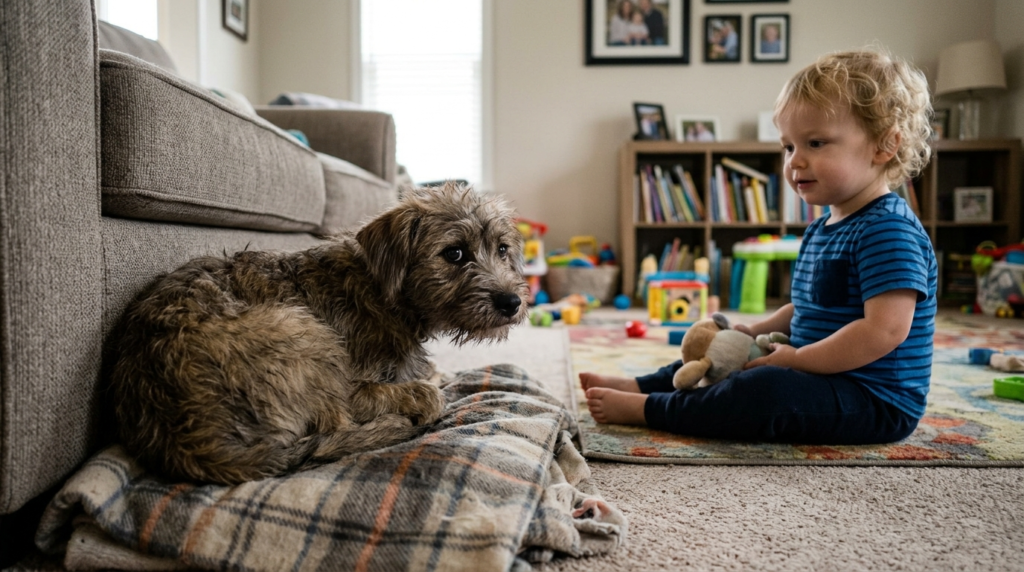
I’ve been a father for four years and a dog lover my entire life, but absolutely nothing could have prepared me for the sickening reality I uncovered when I took a pair of scissors to my new rescue puppy’s matted fur.
My wife, Sarah, and I had been talking about getting a dog for over a year. Our son, Leo, had just turned four, and we lived in a quiet, standard suburban neighborhood in Ohio with a big fenced-in backyard. It felt like the perfect time to add a furry member to the family. We wanted Leo to grow up with a best friend, to learn responsibility, and to experience that unconditional bond only a dog can offer. We didn’t want a designer breeder dog. We specifically wanted to rescue, to give a second chance to a dog that the world had thrown away. I just didn’t realize that the dog we were about to bring into our home was carrying a secret so dark it would completely shatter my reality.
It was a rainy Tuesday afternoon when I drove out to the county animal shelter. It wasn’t one of those nice, well-funded rescue centers you see on television with glass doors and pastel-painted walls. This place was out on the edge of town, an old concrete building surrounded by chain-link fences and overgrown weeds. The moment I walked through the heavy metal doors, the smell of bleach, wet concrete, and sheer canine anxiety hit me like a physical wall. The noise was deafening—dozens of dogs barking, howling, and throwing themselves against the chain-link of their runs.
A tired-looking volunteer named Gary, a guy in his fifties with permanent bags under his eyes, walked me down the long, echoing concrete aisle. I looked at pit bull mixes, energetic labs, and sad-eyed hounds. But then we reached cage 42 at the very back of the facility. The cage was dark, and at first, I thought it was completely empty.
“What about this one?” I asked, pointing to the shadows.
Gary sighed, a heavy, defeated sound. “That’s Barnaby. Or at least, that’s what we’ve been calling him. He’s a stray. Animal control picked him up wandering near the old abandoned railyard on the south side. He’s in rough shape, buddy. Real rough shape.”
I squinted into the gloom. Curled into a tight, miserable ball in the furthest corner of the damp concrete floor was a dog. It was hard to even tell what breed he was, or how big he actually was beneath the grime. He was entirely encased in a thick, solid shell of matted fur. The mats were black with motor oil, mud, and god knows what else. They hung off him like dreadlocks made of concrete. He didn’t bark. He didn’t move toward the front of the cage. He just lay there, trembling so violently that I could see his matted fur vibrating from five feet away.
“We haven’t been able to groom him,” Gary explained, keeping his voice low. “Every time we bring out the clippers, he completely panics. Trashes around, soils himself. The vet comes in on Thursdays, and we were planning to heavily sedate him to shave him down, but to be honest, he’s on the euthanasia list for tomorrow morning. We just don’t have the space or the resources for a dog this traumatized.”
Those words hit me right in the chest. Tomorrow morning. I looked at the trembling mass of dirty fur. Through the tangled mess covering his face, I caught a brief, fleeting glimpse of a brown eye. It was wide, terrified, and utterly devoid of hope. He had completely given up.
“I’ll take him,” I said. The words left my mouth before my brain could even process the logistics.
Gary looked at me like I was crazy. “Are you sure? You said you have a toddler at home. A dog with this level of unknown trauma… we don’t know his triggers. We don’t know his history. It could be a massive liability.”
“I’m sure,” I insisted, though my heart was hammering against my ribs. “I’m not letting him die tomorrow.”
The car ride home was agonizingly silent. I had placed him in a plastic crate in the back of my SUV. He didn’t make a single sound. No whining, no scratching, just that continuous, heavy trembling that rattled the plastic walls of the crate. The smell filling my car was overpowering—a mixture of rotting garbage, stale urine, and wet decay. I rolled the windows down despite the cold rain just to breathe.
When I finally pulled into my driveway, Sarah and Leo were waiting on the porch. Leo was bouncing up and down, clutching a brand-new stuffed squeaky toy. “Puppy! Puppy! Daddy brought the puppy!” he cheered.
I got out of the car and held up a hand, giving Sarah a serious look. “Hey, buddy. You need to be very, very quiet, okay? The puppy is really scared and he’s not feeling well.”
I carried the crate inside and set it down in the corner of the living room. I opened the metal grated door and backed away. We sat on the couch in silence for twenty minutes. Finally, a small, dirty, matted snout poked out of the darkness of the crate. Barnaby slowly crept out, his belly dragging almost flat against the hardwood floor. He looked like a creature from a nightmare, completely enveloped in his armor of filth.
Leo gasped and took a single step forward, holding out the toy. “Hi puppy—”
The reaction was instantaneous and terrifying. The moment Barnaby’s eyes locked onto my four-year-old son, the dog froze. A low, ragged sound tore from his throat—not a growl of aggression, but a whimper of pure, unadulterated terror. He scrambled backward so fast his claws slipped on the hardwood, frantically throwing himself behind the heavy oak TV stand. He squeezed himself into the narrow, dusty gap against the wall, shaking so hard the entire piece of furniture rattled.
Sarah grabbed Leo’s hand and pulled him back. “Oh my god. What happened to him?” she whispered, staring at the dark gap behind the TV.
“I don’t know,” I replied, feeling a cold knot form in my stomach. “They found him near the railyard. He’s just… he’s been through hell.”
That was the beginning of the longest two weeks of my life.
We set up a quiet, safe space for Barnaby in the laundry room with a soft bed, food, and water. For the first three days, he didn’t leave that room. He would only eat in the dead of night when the house was completely silent. If I walked into the room to change his water, he would cower in the corner, pressing his face against the wall as if hoping he could disappear into it.
But his reaction to me or Sarah was nothing compared to his reaction to Leo.
It became an undeniable, deeply concerning pattern. If Barnaby was bravely venturing into the hallway, and he heard the sound of Leo’s little footsteps, he would panic. He wouldn’t just hide; he would desperately seek out the smallest, darkest, most inaccessible corners of the house. He shoved himself under the lowest couch cushions. He tried to burrow behind the water heater in the basement. Whenever Leo was in the same room, Barnaby would stare at him with an intensity that was hard to read. It wasn’t aggression. He never bared his teeth. He never snapped. It was a deep, paralyzing phobia.
“Is it possible kids hurt him?” Sarah asked me one night as we lay in bed, listening to the faint sound of Barnaby scratching at his matted fur downstairs. “Kids can be cruel. Maybe some teenagers at the railyard threw rocks at him?”
“Maybe,” I said, staring at the ceiling. “The shelter said they didn’t know his history. But his fear of Leo… it’s specific. It’s like he expects Leo to do something terrible to him.”
The situation was taking a toll on all of us. Leo was heartbroken that his new dog wouldn’t play with him. Sarah was constantly on edge, worried that a terrified dog might eventually bite out of self-defense. And I was overwhelmed with guilt and frustration. I wanted to help him, but he wouldn’t let me near him.
Adding to the tension was his physical condition. The mats on his fur were getting worse. They were tight against his skin, pulling and pulling with every movement he made. I knew they had to be incredibly painful. He scratched constantly, a wet, heavy thumping sound that echoed through the house. The smell, too, was becoming unbearable. It was a sour, metallic odor that seemed to seep into our furniture and clothes.
I called our local vet, Dr. Evans, on day five.
“I have a severely matted rescue,” I explained over the phone. “He’s terrified. I need to bring him in to get shaved down.”
“We’re completely booked for surgery for the next week and a half,” Dr. Evans told me apologetically. “And honestly, if he’s that traumatized, dragging him into a strange clinic and forcing him onto a steel table right now might break whatever little trust you’re trying to build. Give him some time to decompress in your home. Let him learn that he’s safe. Bring him in on the 14th, and we’ll give him a mild sedative and handle the coat.”
So, I waited. I spent hours sitting on the floor of the laundry room, reading books out loud in a soft voice, tossing high-value treats near him, trying to show him I wasn’t a threat. Very slowly, infinitesimally slowly, he started to tolerate my presence. He stopped bolting when I entered the room. He even started taking pieces of hot dog from my hand, though he would snatch them quickly and retreat.
But his terror of Leo never wavered. In fact, as Barnaby got slightly more comfortable with the layout of the house, his avoidance of my son became more strategic. He would actively monitor the hallways, watching from the shadows to make sure Leo wasn’t around before he moved.
It was maddening. I couldn’t understand it. Leo was a gentle kid. He knew not to yell around the dog, not to chase him. But to Barnaby, my four-year-old son was a monster.
By day 12, things escalated. Barnaby stopped eating. He just lay in his bed in the laundry room, panting heavily, his eyes dull. He kept chewing at a massive, rock-hard mat of fur on his right ribcage. The skin around it looked red and inflamed. The metallic, sour smell coming from him had turned into something distinctly worse. It smelled like infection. It smelled like decay.
“You can’t wait for the vet appointment,” Sarah said firmly on the morning of day 14. She was standing in the kitchen, holding a can of air freshener. “He’s suffering. The mats are pulling his skin tight. He might have an open wound under there that’s getting infected. You need to cut some of it off. Just the worst parts. Just enough to give him some relief until tomorrow.”
I looked at Barnaby, who was huddled under the kitchen table. He looked miserable. She was right. I couldn’t let him sit in this pain for another twenty-four hours.
“Okay,” I said, taking a deep breath. “Keep Leo in his bedroom. Turn on the TV, make sure he stays in there. I don’t want Barnaby getting spooked.”
Sarah nodded and guided Leo upstairs.
I went to the bathroom and opened the bottom drawer. I pulled out my heavy-duty electric hair clippers, a comb, and a pair of sharp medical scissors I kept in the first-aid kit. My hands were actually shaking a little. I had no grooming experience, and I was terrified of accidentally cutting his skin. But the matted shell of fur was so thick, I figured I could at least cut away the top layers to relieve the tension.
I walked back into the kitchen and sat cross-legged on the linoleum floor, a few feet away from the table where Barnaby was hiding. I didn’t reach for him. I just sat there, placing the tools on the floor.
“Hey, buddy,” I whispered, keeping my voice low and soothing. “I know. I know it hurts. I’m just going to help you a little bit. That’s all.”
I tossed a piece of cheese on the floor. He didn’t move. I tossed another one closer to him. He slowly crept out from under the table, his head low, his eyes darting nervously toward the stairs where Leo had gone. He ate the cheese. I let him sniff my hand. I gently ran my fingers over his head, avoiding the worst of the mats. He was trembling, but he didn’t run away.
I picked up the medical scissors. I knew the electric clippers would be too loud right now and would send him into a panic. I had to do this manually.
I targeted the massive, foul-smelling clump of fur on his right ribcage—the one he had been obsessively chewing at. It was the size of a softball, rock-hard, and completely fused to the hair around it. It felt less like fur and more like a heavy, solid mass of tar and dirt.
I scooted closer. Barnaby stiffened, letting out a tiny, high-pitched whine.
“Shh, it’s okay. Good boy,” I murmured, my heart pounding in my ears.
I carefully slid the bottom blade of the scissors underneath the edge of the massive mat, keeping the flat side pressed flush against his skin to ensure I wouldn’t cut him. The fur was so dense and thick that it required significant physical effort just to close the scissors. The blades crunched through the dirt and grime.
Snip. Snip. Snip.
Barnaby was panting heavily, his eyes wide with fear, but he stayed still. He seemed to understand, on some primitive level, that I was trying to remove the thing that was causing him so much pain.
I worked slowly, painstakingly, cutting a circle around the base of the solid chunk of matted fur. It took me nearly twenty minutes just to loosen it. My fingers were cramping, and my shirt was sticking to my back with sweat. The smell emanating from the fur as I broke it open was absolutely nauseating—a sharp, stinging stench of rust, old blood, and dirt.
Finally, I cut through the last stubborn strands holding the mass to his body.
“Got it,” I exhaled, feeling a rush of relief. “Good boy, Barnaby. You’re such a good boy.”
I grabbed the heavy, rock-like chunk of matted fur and gently pulled it away from his side.
As the fur peeled back, separating from his skin, the ambient light of the kitchen fell onto the area that had been hidden in darkness for who knows how long.
I looked down.
My breath caught in my throat. My brain physically stuttered, unable to comprehend the visual information it was receiving. The scissors slipped from my sweaty fingers and hit the linoleum floor with a sharp, echoing clack.
I fell backward, my hands scrambling against the floor as I scrambled away from the dog, my mouth opening in a silent scream of absolute, unadulterated horror.
There was no wound under the fur. There was no infection.
What was buried beneath the matted hair… wasn’t a dog’s skin at all.
What was buried beneath the matted hair… wasn’t a dog’s skin at all.
My heart completely stopped. The silence in the kitchen was deafening, broken only by the sound of my own ragged, panicked breathing and the soft, terrified panting of the dog cowering in front of me.
I scrambled backward on the linoleum, my hands slipping on the floor, my mind violently rejecting what my eyes were seeing. It didn’t make any sense. It was biologically impossible.
Where warm, pink skin should have been, there was a hard, matte-black, rectangular surface.
It was a plastic box.
I sat there, frozen, my back pressed against the lower kitchen cabinets. A cold sweat broke out across the back of my neck. My stomach churned so violently I thought I was going to throw up right there on the floor.
“What… what the hell is that?” I whispered to the empty room.
Barnaby didn’t move. He just lay there, his head resting on his front paws, staring up at me with those wide, defeated brown eyes. He let out a low, pathetic whimper that sounded less like a dog and more like a crying child.
I forced myself to crawl forward. My hands were shaking so badly I could barely keep myself steady. I needed to see it closer. I needed to understand what kind of nightmare I had just uncovered.
I leaned in, ignoring the nauseating wave of metallic decay that rolled off the exposed area.
It was an electronic device. Roughly the size of a deck of cards, but thicker. It was made of heavy-duty black plastic, the kind used for industrial tools.
But it wasn’t just sitting on his fur. It was embedded in him.
Whoever had done this to him hadn’t just placed the box on his side. They had secured it. I could see two thick, heavy-duty black plastic zip-ties looping over the top and bottom of the box.
The zip-ties disappeared deep into his matted fur, wrapping entirely around his small ribcage. They were pulled so tight that they had dug violently into his flesh. The fur had literally grown over and around the plastic bands, creating a thick, filthy shell that completely hid the cruel contraption from the outside world.
The skin surrounding the edges of the box was raw, weeping, and heavily infected. This wasn’t a new injury. This device had been strapped to this poor animal for months. Maybe even a year.
I reached out, my fingers trembling, and gently wiped away a layer of crusted dirt from the face of the black box.
There were no buttons. There was no screen.
But there was a small, circular wire mesh grille on one end, resembling a tiny microphone or a speaker. And protruding from the back of the box, directly into Barnaby’s exposed, infected flesh, were two rusted metal prongs.
A shock collar.
But it wasn’t a collar. It was a torture device strapped directly to his ribs, hidden away where no one would ever see it, slowly cutting him in half as he grew.
My brain struggled to put the pieces together. Why would someone do this? Why not just use a regular collar? Why strap it to his ribs?
I gently touched the side of the plastic casing to see how deeply the prongs were embedded.
The moment my fingertip brushed the hard plastic, a tiny, faint red LED light blinked to life next to the microphone grille.
Blink.
Barnaby’s entire body seized.
It wasn’t a flinch. It was a violent, full-body convulsion. His eyes rolled back, his jaw locked open in a silent, agonizing scream, and his muscles locked up completely rigid. He slammed against the linoleum floor, thrashing in a sudden, brutal fit of electrocution.
“Barnaby!” I screamed, lunging forward, completely abandoning any caution.
I didn’t care if he bit me. I threw my arms over him, trying to hold his thrashing body steady. I could feel the electricity. It was a terrifying, low-level hum that buzzed right through his matted fur and into my own hands.
The shock lasted for three excruciating seconds. Then, the red light blinked off.
Barnaby collapsed instantly, going completely limp in my arms. His breathing was incredibly shallow, a rapid, weak wheezing that rattled in his chest. He had voided his bowels on the floor, his body entirely spent from the massive jolt of electricity.
I was kneeling in the mess, cradling his filthy, matted head in my lap, tears streaming down my face. I was sobbing. Ugly, loud, gasping sobs of pure fury and heartbreak.
“Sarah!” I roared at the top of my lungs, my voice cracking. “SARAH! GET DOWN HERE NOW!”
Footsteps thundered on the stairs. Sarah came running into the kitchen, her eyes wide with panic.
“What happened? I heard you—”
She stopped dead in her tracks. She took in the scene: the blood, the mess on the floor, the medical scissors discarded in the corner, and me, kneeling on the linoleum, clutching a lifeless-looking dog while crying hysterically.
“Oh my god,” she gasped, her hands flying to her mouth. “Is he… did he…”
“He’s alive,” I choked out, gently lifting him. He was like dead weight. “Get the keys. Grab a towel. Start the car. Now, Sarah. Right right fucking now!”
She didn’t ask questions. She saw the absolute terror in my eyes and moved on pure adrenaline. She bolted to the hallway closet, grabbed a thick beach towel, threw it to me, and grabbed her purse.
I wrapped Barnaby tightly in the towel, making sure not to apply any pressure to his right ribcage. I scooped him up. He weighed almost nothing. Without that thick armor of matted fur, he felt like a bundle of fragile sticks wrapped in wet tissue paper.
As I carried him toward the front door, I heard Leo’s bedroom door open upstairs.
“Daddy?” Leo’s small, confused voice called out. “Is the puppy okay?”
“Stay in your room, Leo!” Sarah yelled, her voice trembling. “Mommy and Daddy have to take the puppy to the doctor! We’ll be right back!”
We bolted out into the rain. It was a torrential downpour now, the sky a bruised, angry purple. Sarah had the SUV running, the hazard lights flashing in the gloomy driveway.
I climbed into the back seat, laying Barnaby across my lap, keeping the towel securely around him.
“Drive to the emergency vet clinic on Route 9,” I ordered. “Don’t stop for anything.”
Sarah threw the car into reverse and peeled out of the driveway, the tires screaming against the wet asphalt.
The drive was a blur of flashing windshield wipers, blaring horns, and my own frantic heartbeat. I kept my hand pressed lightly against Barnaby’s chest, praying to feel the steady thump of his heart. It was there, but it was erratic. Too fast, then too slow.
“What happened back there?” Sarah asked, her voice cracking as she swerved around a slow-moving sedan. She kept shooting terrified glances at us in the rearview mirror. “Did you cut him? It’s okay if you did, we just need to tell the vet—”
“I didn’t cut him,” I said, my voice eerily calm despite the chaos inside me.
“Then why is there so much blood?”
“Someone strapped a box to him,” I said, staring down at the matted bundle in my lap. “An electric shock box. They zip-tied it around his ribs. It’s grown into his skin.”
The SUV swerved violently as Sarah gasped, almost losing control of the wheel. “What? Who would do that? Why?”
“I don’t know,” I lied.
Because in the back seat of that speeding car, looking down at the tiny microphone grille on that cruel black box, the horrific truth was finally locking into place.
I remembered the blink. The tiny red LED light that had triggered the shock.
It had blinked the exact moment my fingertip brushed against the hard plastic casing. But I hadn’t pushed a button. I had just scraped my nail against the plastic.
It made a sound. A sharp, high-pitched scratch.
Then I thought about the first day we brought him home. When Leo held out his squeaky toy.
Squeak.
Barnaby had scrambled behind the TV, shaking in absolute terror.
I thought about the last two weeks. How Barnaby would bravely explore the hallway, only to completely panic and hide the second he heard Leo’s high-pitched, four-year-old voice echoing from the kitchen.
How he would cower when Leo’s light-up shoes squeaked on the hardwood floor.
How he actively avoided my son like he was the devil himself.
The box wasn’t triggered by a remote control.
It was voice-activated.
More specifically, it was frequency-activated.
Someone hadn’t just strapped a shock collar to a dog’s ribs to hurt him. They had intentionally modified the microphone, calibrating the sensor to register specific, high-frequency sound waves.
The pitch of a squeaky toy. The pitch of small shoes on a hard floor. The pitch of a child’s laughter.
Every single time my four-year-old son spoke, laughed, or played near this dog for the last fourteen days… that black box had delivered a blinding, agonizing jolt of electricity directly into his exposed ribs.
We hadn’t been giving him a safe haven. We had been unknowingly torturing him every single day.
My vision blurred with a fresh wave of tears. The guilt was suffocating. It felt like a physical weight crushing my chest. I had forced this broken animal into a house with a toddler, completely blind to the fact that my own son’s joyful existence was the trigger for his endless agony.
“I’m so sorry,” I whispered to the unconscious dog, burying my face in the wet, foul-smelling towel. “I’m so, so sorry.”
We slammed into the parking lot of the 24-hour emergency veterinary hospital. Sarah didn’t even park properly; she just threw the SUV into park directly in front of the sliding glass emergency doors, blocking the ambulance bay.
I kicked the car door open and sprinted through the rain, carrying Barnaby in my arms.
“I need help!” I screamed as the automatic doors slid open.
The waiting room was brightly lit and sterile. A few pet owners looked up in shock. The receptionist behind the desk immediately stood up, her eyes locking onto the blood soaking through the towel.
“Code Red to triage,” she barked into an intercom before rushing around the desk to meet me. “Sir, what happened? What kind of trauma?”
“He’s got a device,” I babbled, out of breath, laying Barnaby gently onto the metal triage table that a vet tech was hurriedly rolling toward us. “Someone zip-tied a shock collar to his ribs. It’s deep. It’s infected. It went off and he collapsed.”
The vet tech, a young woman with scrubs and a serious expression, pulled back the towel.
She took one look at the massive chunk of matted fur I had cut away, and the black plastic box embedded in the raw, weeping flesh beneath it.
She physically recoiled. “Jesus Christ.”
“Get Dr. Miller out here right now,” the receptionist yelled down the hallway.
Within seconds, a tall, gray-haired veterinarian burst through the swinging doors. He took one look at the table, his professional demeanor instantly fracturing into an expression of pure, horrified disgust.
“Let’s get him into OR 1,” Dr. Miller ordered, his voice clipped and urgent. He looked at me. “Are you the owner?”
“I just adopted him two weeks ago,” I said, my voice shaking. “From the county shelter. They didn’t know. Nobody knew. It was hidden under the mats.”
“We need to sedate him and cut those zip-ties immediately before the infection spreads to his bloodstream or the electrical charge damages his heart,” Dr. Miller said, already moving the table down the hall. “Wait out here. We will do everything we can.”
The swinging doors closed, leaving Sarah and me alone in the sterile hallway.
Sarah collapsed into a plastic waiting room chair, covering her face with her hands, sobbing quietly. I couldn’t sit. I paced the length of the waiting room, my boots leaving muddy, bloody footprints on the spotless tile.
I felt like I was losing my mind.
I lived in a safe, quiet suburb. I paid my taxes, I mowed my lawn, I took my kid to the park. I believed that while the world had bad things in it, true, cinematic evil was something that happened far away, on the news, to other people.
But I had just carried pure, unadulterated evil into my home.
Someone had built that device. Someone had spent time sitting at a workbench with a soldering iron, modifying a circuit board, testing frequencies, and adjusting metal prongs.
Someone had caught a terrified stray dog, held him down, and violently tightened industrial plastic around his ribs.
They hadn’t done it out of anger. They hadn’t done it in a moment of passion.
They had done it methodically. Clinically. With the specific, calculated intention of creating an animal that was fundamentally, psychologically broken by the sound of human children.
Why?
Was it a sick sociopath in a basement? Was it someone training dogs for some kind of horrific underground fighting ring where they needed the animals to be terrified of the crowd noise?
I didn’t know. But as I paced that waiting room, staring at my blood-stained hands, a terrifying new thought crept into my mind.
The county shelter said they found Barnaby wandering near the abandoned railyard on the south side of town.
That railyard was less than three miles from my neighborhood.
Whoever built that device, whoever tightened those zip-ties… they were local. They lived in my town. They shopped at my grocery store. They drove on the same roads as my family.
Two hours passed. The longest two hours of my entire life.
The rain stopped outside, leaving the world dark and slick. The waiting room was empty save for the quiet hum of the vending machine in the corner.
Finally, the swinging doors pushed open.
Dr. Miller walked out. He had taken off his surgical gown, but he still wore his blue scrubs. He looked exhausted. He was holding a clear, plastic evidence bag.
Inside the bag, sealed away, was the black box.
It looked even worse under the bright fluorescent lights of the hallway. The zip-ties were cut, revealing how thick and rigid they were. The metal prongs were coated in dried blood and yellow pus.
I stopped pacing and walked over to him, Sarah standing up right behind me.
“Is he…?” I couldn’t finish the sentence.
“He’s alive,” Dr. Miller said, letting out a heavy, tired breath. “His heart held out. We had to give him a massive dose of broad-spectrum antibiotics and fluids. He was severely dehydrated, and the infection was dangerously close to going septic.”
Sarah let out a loud gasp of relief, grabbing my arm.
“We removed the device,” Dr. Miller continued, holding up the plastic bag. His eyes were hard, burning with a quiet, suppressed rage. “It took an hour of delicate surgery. The zip-ties had actually begun to notch into his rib bones. If you had waited even one more week, the pressure would have punctured his lung.”
“He’s going to be okay?” I asked, my voice cracking.
“Physically? Yes. He’s going to have a brutal scar, and he’ll be on antibiotics for a month, but his body will heal,” Dr. Miller said.
He lowered the bag, looking me dead in the eye.
“But I need you to listen to me very carefully,” the vet said, his voice dropping to a serious, low octave. “I have been a veterinarian for twenty-eight years. I have seen hit-and-runs. I have seen starvation. I have seen terrible, heartbreaking neglect.”
He tapped the plastic bag with his finger.
“I have never, in my entire career, seen something this deeply, intentionally malicious.”
Dr. Miller turned the bag around so I could see the back of the black plastic casing.
“This isn’t a standard shock collar you buy at a pet store,” he explained. “It’s heavily modified. Someone gutted a high-voltage cattle prod capacitor and wired it into a sound-activated circuit board. The voltage this thing was kicking out was enough to drop a grown man to his knees.”
I felt the blood drain from my face. “It was triggered by sound.”
“Yes,” Dr. Miller nodded grimly. “We tested it in the back before we sealed it. The microphone is calibrated to a very specific frequency range. Around 300 to 500 hertz.”
“A child’s voice,” I whispered, feeling sick all over again.
“Exactly,” Dr. Miller said. “Whoever built this wanted to ensure that this dog associated the presence of children with unimaginable physical agony. This is premeditated torture.”
The vet took a step back, pulling a small card from his pocket.
“Because of the nature of the injuries, I am legally mandated to report this as a felony case of animal cruelty,” Dr. Miller said. “I’ve already called it in. The local police department is dispatching an officer right now. They’re going to want to take this device as evidence, and they are going to want to ask you exactly where you got this dog.”
As if on cue, the sliding glass doors of the clinic slid open.
A uniformed police officer walked into the waiting room. His utility belt clinked against his heavy flashlight. He shook the rain off his jacket, his eyes scanning the room before landing on us.
“I’m Officer Davis,” he said, his voice deep and authoritative. “I’m responding to a call from Dr. Miller regarding a severe case of animal abuse?”
“That’s me,” Dr. Miller said, holding up the plastic bag.
Officer Davis walked over. He looked at the bloody, rusted torture device inside the plastic. His professional, detached demeanor cracked for a split second, his jaw clenching tight.
“Jesus,” the officer muttered. He pulled a small notebook from his breast pocket. He looked at me, clicking his pen.
“Sir, I’m going to need your name, your address, and everything you know about how this animal came into your possession. We need to find out exactly where this dog came from.”
“The county shelter,” I said numbly. “They found him near the abandoned railyard on the south side.”
Officer Davis stopped writing. He looked up slowly, his eyes locking onto mine with a sudden, intense sharpness.
“The south side railyard?” he asked, his voice suddenly very tight.
“Yes,” I said, confused by his reaction. “Why?”
Officer Davis slowly closed his notebook. He looked at Dr. Miller, then back to me. The atmosphere in the room shifted instantly from a standard police inquiry to something heavy, dark, and deeply urgent.
“Because,” Officer Davis said, keeping his voice dangerously low, “this is the third dog we’ve pulled out of that railyard in the last six months with one of these exact same black boxes strapped to its ribs.”
My breath caught in my throat.
“And,” the officer continued, his eyes dead serious, “the other two didn’t survive.”The silence that followed Officer Davis’s words was so absolute, so suffocating, that I could hear the faint, erratic buzzing of the fluorescent light bulb in the ceiling above us.
“The third dog?” I repeated, my voice barely a whisper. The words felt like ash in my mouth.
Officer Davis didn’t blink. He kept his dark eyes locked on mine, his posture stiff and formal, but I could see the underlying tension in his jaw.
“Three dogs,” the officer confirmed, his voice dropping an octave, meant only for Sarah, Dr. Miller, and me. “The first one was brought in by a sanitation worker about six months ago. Found in a dumpster near the north end of the old railyard. A terrier mix. It had the exact same device zip-tied to its chest. It was already dead from cardiac arrest when they found it.”
Sarah let out a small, muffled sob, pressing her hands tightly over her mouth. I reached out and grabbed her arm, needing something to anchor me to the floor before my legs gave out.
“And the second?” Dr. Miller asked, his medical detachment completely gone, replaced by a cold, hard anger.
“Two months ago,” Officer Davis said, looking down at his notebook. “A golden retriever mix. Found tied to a chain-link fence on the south edge of the yard. Same modified black box. Same frequency trigger. That one had been out there so long the infection went septic. It died on the transport to the county animal hospital.”
The officer pointed a thick finger at the plastic evidence bag still clutched in the veterinarian’s hand.
“That box right there,” Davis said grimly. “That’s the signature. We’ve had detectives quietly canvassing the industrial parks and the homeless encampments near the tracks, looking for anyone with a background in electrical engineering or radio frequencies. We kept it out of the local news because we didn’t want the sick son of a bitch to know we were onto him, and we didn’t want copycats.”
My mind was spinning, desperately trying to process the sheer scale of the nightmare we had stumbled into.
“But why?” I asked, feeling a cold sweat break out across the back of my neck. “Why wire it to go off at the sound of a kid’s voice? What does that even accomplish?”
Officer Davis sighed, a heavy, exhausted sound that made him look ten years older. He holstered his pen and looked around the empty waiting room to ensure we were still alone.
“We brought in an animal behaviorist to consult on the second case,” Davis explained quietly. “Her theory is that someone is trying to aggressively condition these animals. If a dog experiences blinding, agonizing pain every single time it hears a child speak or laugh, it only takes a few weeks for its brain to completely rewire.”
He paused, letting the horror of the concept sink in.
“The dog learns that children equal torture. So, what happens when a dog that has been conditioned like that finally breaks loose? What happens when it sees a kid walking down the street, or playing in a park, and it decides to defend itself before the pain can start?”
A wave of pure nausea washed over me. I literally had to lean back against the triage table to keep from collapsing.
They weren’t just torturing dogs. They were creating weapons.
Someone in my town was intentionally taking discarded, forgotten shelter dogs and systematically turning them into violent, deeply traumatized time bombs, specifically engineered to fear—and potentially attack—human children.
And I had brought one of those time bombs directly into my home, right into the living room where my four-year-old son played on the rug every single day.
If Barnaby hadn’t been so physically weak, if he hadn’t been so starved and broken by the time I found him… the outcome could have been entirely different. If he had been a larger breed, or if he had possessed just an ounce of fight left in him, Leo’s innocent squeaky toy could have triggered a defensive mauling.
“Oh my god,” Sarah whispered, her face pale as a ghost. She looked at me, and I could see the exact same terrifying realization dawning in her eyes. “Leo. He was around Leo for two weeks.”
“You got lucky,” Officer Davis said, his tone blunt but not unkind. “This animal chose flight instead of fight. But you need to understand the gravity of this situation. The person building these devices is escalating. The first two dogs were found dead. This one made it to the shelter system alive. We need to find out exactly how.”
The officer turned to me, his notebook back open.
“I need you to walk me through exactly what happened at the county shelter,” Davis instructed. “Who did you speak to? Who processed the adoption? Did they give you any paperwork indicating who brought the dog in?”
For the next thirty minutes, I stood in that sterile, brightly lit hallway and gave Officer Davis every single detail I could remember. I told him about Gary, the tired volunteer. I told him about cage 42 at the very back of the facility. I explained how the shelter staff hadn’t been able to groom Barnaby because of his extreme panic, completely unaware of the lethal device buried beneath his matted armor.
Davis took copious notes, his brow furrowed in deep concentration.
“I’m going to head down to the county shelter first thing in the morning,” the officer said, finally flipping his notebook shut. “I need to look at their intake logs. If Animal Control didn’t pick this dog up, someone had to drop it off.”
He looked at me, his expression deadly serious.
“I need you to listen to me,” Davis said. “Do not post about this on Facebook. Do not go on Nextdoor. Do not tell your neighbors. If this guy realizes one of his victims survived and the police have the device, he might destroy his workshop and disappear. Or worse, he might panic and do something reckless. You go home. You lock your doors. You keep your kid inside.”
We left the clinic at 2:00 AM.
Barnaby was staying overnight in the intensive care unit. Dr. Miller had him on an IV drip of heavy painkillers and broad-spectrum antibiotics. Before we left, the vet let me scrub in and walk back to the recovery ward to see him.
Barnaby was lying on a soft fleece blanket inside a heated stainless-steel kennel. The massive chunk of matted fur was gone, replaced by a large, raw, shaved square on his right side. The skin was violently bruised, a sickly mosaic of purple, black, and angry red, with deep, weeping indentations where the plastic zip-ties had dug into his flesh.
He was heavily sedated, his eyes half-closed, but as I knelt in front of the cage, his tail gave one, weak, microscopic thump against the blanket.
I pressed my forehead against the cold metal bars of the cage, the tears finally spilling over. “I’ll be back for you tomorrow, buddy,” I whispered into the quiet room. “I promise. Nobody is ever going to hurt you again.”
The drive home was a silent, paranoid nightmare.
The rain had stopped, leaving the suburban streets slick and black under the glow of the streetlights. Every single thing looked different to me now.
I looked at the houses we passed. The nice, middle-class homes with their manicured lawns, their two-car garages, and their basketball hoops in the driveways. I had always assumed the people living behind those doors were just like me. Normal people living normal lives.
But the railyard was only three miles away.
Whoever was doing this lived among us. It could be the quiet guy who always mowed his lawn on Sundays. It could be the local mechanic who fixed my brakes last month. It could be the retired electrical engineer who lived three houses down from us.
Evil didn’t always look like a monster in a horror movie. Sometimes it wore a fleece vest, drove a sensible sedan, and waved at you in the grocery store parking lot.
When we finally pulled into our driveway, the house was completely dark. The babysitter, a teenage girl from down the street, had fallen asleep on the couch. Leo was safely tucked into his bed upstairs, clutching his stuffed dinosaur, completely oblivious to the horrors of the adult world.
I paid the babysitter, locked the deadbolt behind her, and checked every single window in the house. I made sure the security system was armed.
I didn’t sleep a single minute that night. I sat in a chair by the front window, staring out into the dark street, watching for any car that slowed down, any shadow that moved near the edge of our property.
The next morning, the sun rose, casting a harsh, unforgiving light over our quiet neighborhood.
I called the clinic at 8:00 AM. Dr. Miller informed me that Barnaby had made it through the night. His fever had broken, and he was stable enough to go home, provided he stayed on strict bed rest and continued his medications.
I drove to the clinic alone. When they brought Barnaby out to the lobby, my heart broke all over again. Without the massive shell of matted fur, he looked incredibly small, frail, and fragile. He was wearing a surgical cone to keep him from licking the massive wound on his side.
He walked slowly, his head down, heavily medicated. But when he saw me standing by the reception desk, he didn’t cower. He didn’t try to hide behind the vet tech. He took three slow, wobbly steps toward me and leaned his fragile little head against my shin.
It was a massive leap of trust from a dog that had every right to hate humanity.
I gently loaded him into the car and drove him home. We had established a strict protocol: Leo was at preschool until 3:00 PM, and when he was home, Barnaby would be kept securely in my home office behind a baby gate, in absolute silence, until we could figure out how to slowly rehabilitate his shattered mind.
I settled Barnaby onto a orthopedic dog bed in my office. He drank some water, let out a long, exhausted sigh, and immediately fell asleep.
I sat at my desk, staring at the wall. The house was quiet. Too quiet.
Officer Davis had told me to stay out of it. He had told me to let the police handle the investigation.
But I couldn’t shake the restless, burning anger in my chest. The police had known about this for six months, and they hadn’t caught the guy. Two dogs had died horribly, and Barnaby had almost been the third.
My mind kept drifting back to the county shelter. To Gary, the volunteer.
I needed to know exactly how Barnaby ended up in cage 42. I needed to know if the shelter had any idea who had dropped him off. The police might be looking through official intake logs, but sometimes, the official logs didn’t tell the whole story. Sometimes, you needed to talk to the guy on the ground.
At 11:00 AM, I couldn’t take it anymore. I told Sarah I was going to run to the pharmacy to pick up some extra bandages for Barnaby.
Instead, I drove straight across town to the county animal shelter.
The place looked even more depressing in the daylight. The concrete was stained, the weeds were overgrown, and the sound of barking echoed across the empty parking lot.
I walked through the heavy metal doors, bracing myself against the smell of bleach and desperation.
Gary was at the front desk, sorting through a pile of donated, ragged towels. He looked up, his permanent bags under his eyes seeming even darker today.
“Hey,” Gary said, recognizing me instantly. “You’re the guy who took Barnaby yesterday. How’s he doing? Did he settle in?”
I walked up to the counter, leaning in close so the other volunteers couldn’t hear.
“Gary, I need to talk to you,” I said, my voice tight and serious. “And I need you to be completely honest with me.”
Gary frowned, dropping the towel he was holding. “What’s going on? Did he bite someone? Look, I told you he was a liability—”
“He didn’t bite anyone,” I interrupted. “But when I went to cut away his matted fur yesterday, I found something. Something horrible.”
I quickly and quietly explained what I had found. I told him about the plastic box, the metal prongs, the zip-ties, and the frequency trigger.
As I spoke, the color completely drained from Gary’s face. He stumbled backward, his hand grabbing the edge of a metal filing cabinet to steady himself. He looked like he was going to be sick right there in the lobby.
“A shock box?” Gary whispered, his voice trembling. “Wired to go off at… at a kid’s voice? Oh my god. Oh dear god, we didn’t know. We swear to you, we had no idea. We couldn’t get close enough to groom him, the mats were so thick—”
“I know you didn’t know,” I said gently, trying to calm him down. “The vet confirmed it was hidden deliberately. The police are involved now. An Officer Davis.”
“Davis was just here an hour ago,” Gary stammered, wiping a hand across his sweaty forehead. “He was asking for the intake logs for the last month. He took copies of everything.”
“Gary,” I said, leaning closer. “Look at me. Did you tell the officer exactly who brought Barnaby in?”
Gary hesitated. He looked down at his shoes, shifting his weight uncomfortably. “The log says he was a stray picked up near the railyard. That’s what I told the cop.”
“Gary,” I warned, my voice hardening. “This isn’t the time to cover for protocol. The guy who did this has killed two other dogs. He is a psychopath. If you know something that isn’t on that official piece of paper, you have to tell me.”
Gary swallowed hard. He looked around the lobby nervously before leaning in close across the counter.
“Animal control didn’t pick him up,” Gary confessed, his voice barely a breath. “We’ve been under investigation for being over capacity. The county told us we couldn’t accept any more anonymous drop-offs from the public. We were strictly taking in animal control seizures only.”
He wiped his hands on his jeans.
“But three weeks ago, right before closing, a guy pulled up to the back loading dock. I was taking out the trash. He had Barnaby in a cardboard box in the bed of his truck. He said he found him wandering out by the old railyard and he couldn’t keep him. The dog looked so pathetic, so miserable… I couldn’t just tell the guy to drive away. I knew if I turned him away, the guy would just dump the dog in a ditch somewhere.”
“So you took him,” I said.
“I took him, and I forged the intake paperwork to say one of our animal control officers brought him in as a stray,” Gary admitted, tears welling up in his eyes. “I just wanted to get the dog out of the cold. I didn’t know I was helping a monster.”
“The guy in the truck,” I pressed, my heart hammering against my ribs. “Gary, you have to remember everything you can about him. What did he look like? What kind of truck was it?”
Gary closed his eyes, squeezing them shut as he tried to pull the memory forward.
“It was dark, and it was raining,” Gary said slowly. “He was a white guy. Maybe late forties, early fifties. Average build. He was wearing a faded Carhartt jacket and a dirty baseball cap pulled down low. He didn’t make eye contact. He just shoved the box at me and said he found him at the railyard.”
“What about the truck?” I asked.
“It was a pickup. Older model. Dark green, maybe blue. I think it was a Ford F-150. The tailgate was heavily dented on the right side, like he had backed into a pole.”
Gary opened his eyes, a sudden spark of recognition hitting him.
“And there was a sticker on the back window,” Gary said rapidly. “It was peeling, but I recognize the logo. It was a union sticker. Local 48. The electrical workers union.”
An electrical worker. A dark truck with a dented tailgate. Someone who knew exactly how to modify high-voltage capacitors and sound-activated circuit boards.
The profile Officer Davis had given us was spot on.
“Thank you, Gary,” I said, pulling away from the counter. “You need to call Officer Davis right now. Give him that exact description. Tell him about the forged log.”
“I will,” Gary nodded frantically. “I’m calling him the second you leave.”
I practically ran out of the shelter doors and sprinted to my SUV.
I sat behind the steering wheel, my hands gripping the leather so tightly my knuckles were white. The police had a lead now. They had a vehicle description and a union affiliation. It was only a matter of time before they tracked the guy down.
I should have driven home. I should have gone back to my safe, secure house, locked the doors, and waited for the police to do their job.
But a dark, obsessive thought had taken root in my brain.
The railyard.
Every single dog had been found at or near the old abandoned southside railyard. The suspect told Gary he found Barnaby there. It wasn’t just a dumping ground.
It was his hunting ground. Or maybe, it was his workshop.
If this guy was an electrician, if he was building these horrific devices, he needed a place to do it. He wouldn’t do it in his own garage in a suburban neighborhood where a screaming dog could be heard by the neighbors. He needed isolation. He needed power.
He needed an abandoned industrial space.
Before I could talk myself out of it, I put the SUV in drive and pulled out of the shelter parking lot, turning south.
The southside railyard had been decommissioned in the late 90s. It was a massive, sprawling wasteland of rusted tracks, decaying concrete loading platforms, and overgrown weeds. The city had put up chain-link fences to keep teenagers out, but the fences had been cut and peeled back in dozens of places over the years.
I parked my SUV behind a dilapidated strip mall about half a mile from the yard and walked the rest of the way on foot. I didn’t want my car to be seen.
I slipped through a wide gap in the rusted fence and stepped onto the crunchy, gravel-covered ground of the railyard.
It was eerily quiet. The distant hum of the highway felt miles away. Towering, rusted grain silos cast long, dark shadows over the decaying train cars that had been left to rot on the tracks.
I walked slowly, keeping to the shadows, my heart pounding so hard I could feel it in my teeth. I didn’t even know what I was looking for. I was just acting on pure, reckless adrenaline.
I wandered through the maze of rusted metal for twenty minutes, finding nothing but empty beer cans, old graffiti, and the occasional scuttling rat.
I was just about to give up, to admit that I was playing amateur detective and needed to go home to my family, when I saw it.
Tucked away in the furthest, darkest corner of the yard, partially hidden behind a massive, rusted diesel engine, was an old brick maintenance shed.
Unlike the other buildings in the yard, the heavy steel door on this shed wasn’t rusted completely shut. It was closed, but the padlock on the latch was new. A heavy-duty, shiny silver master lock.
And there, running from a nearby utility pole directly into a small, broken window at the top of the shed, was a thick, black extension cord.
Someone was siphoning electricity into the abandoned building.
I crept closer, my boots crunching agonizingly loud on the gravel. I pressed my back against the rough brick wall of the shed, holding my breath.
I slowly edged my way toward the dirty, grime-covered window near the door. The glass was caked with years of industrial dirt, but someone had recently wiped a small circle clean on the inside.
I leaned in, cupping my hands around my eyes to block out the glare of the overcast sky, and peered through the small, clean circle of glass.
The inside of the shed was dimly lit by a single, harsh fluorescent work light hanging from the ceiling.
It wasn’t empty.
Against the far wall was a heavy wooden workbench. The surface was cluttered with tools—soldering irons, wire strippers, pliers, and spools of thick, black electrical wire.
In the center of the table sat three gutted, high-voltage cattle prod capacitors.
They were identical to the one the vet had pulled off Barnaby’s ribs.
My blood ran completely cold. I had found it. I had found the monster’s workshop.
I reached into my pocket, my fingers fumbling frantically for my cell phone to call Officer Davis.
But before I could unlock the screen, a sound shattered the heavy silence of the railyard.
It was the heavy, distinct crunch of thick truck tires rolling over the gravel directly behind me.
I froze, pure terror paralyzing every muscle in my body.
I slowly turned my head.
Pulling around the rusted diesel engine, cutting off my only path of escape, was a dark green Ford F-150.
The tailgate was heavily dented on the right side. And plastered on the rear window, peeling at the edges, was a faded sticker for the electrical workers union.
The truck rolled to a stop less than twenty feet away from me. The engine idled, a low, menacing growl in the quiet railyard.
The driver’s side door clicked open.
And a man wearing a faded Carhartt jacket stepped out onto the gravel, a heavy metal tire iron gripped loosely in his right hand.
The man didn’t run towards me. He didn’t yell.
That was the most terrifying part.
He just closed the heavy door of his Ford F-150 with a solid, metallic thud, his eyes locking onto mine with the cold, dead calculation of a predator who had just cornered a rat in his basement.
He was exactly as Gary had described. Late forties, maybe early fifties. He had a thick, graying beard, a faded brown Carhartt jacket stained with grease, and a dark blue baseball cap pulled low over his eyes.
The heavy metal tire iron dangled casually from his right hand, tapping a slow, rhythmic beat against the side of his denim-clad leg.
Tap. Tap. Tap.
Every instinct in my body screamed at me to run, but there was nowhere to go. Behind me was the solid brick wall of the maintenance shed. To my left was a rusted, impassable mountain of old train axles. To my right, the man was slowly cutting off my only path back to the open railyard.
“You shouldn’t be back here,” the man said. His voice was gravelly, completely devoid of emotion. “This is private property.”
I swallowed hard, my mouth completely dry. My heart was hammering so violently against my ribs I thought it was going to crack my sternum.
“I’m not looking for trouble,” I lied, raising my hands slightly in a placating gesture. “I just… I got turned around. I parked by the strip mall.”
The man stopped about ten feet away from me. He slowly tilted his head, his eyes moving from my face to the small circle I had rubbed clean on the grimy window of the shed.
Then, a slow, sickening smile spread across his face.
“You didn’t get turned around,” he said softly. He gripped the tire iron a little tighter. “You were looking in my window.”
I didn’t say anything. I couldn’t.
“You look like a suburban guy,” the man continued, taking another slow step forward. The gravel crunched under his heavy work boots. “Nice boots. Clean hands. You don’t belong in the southside yards. Which means you came looking for something specific.”
He paused, his eyes narrowing. “You’re the guy who took the mutt from the shelter, aren’t you?”
A cold wave of pure, absolute dread washed over me.
“I heard the shelter volunteers talking when I drove by earlier to check the perimeter,” the man said, a dark amusement dancing in his eyes. “Heard some guy rushed a matted stray to the emergency vet because he found a little surprise hidden in its fur. Guess you figured out how it worked, huh?”
“You’re a monster,” the words tore out of my throat before I could stop them. The paralyzing fear was suddenly being pushed aside by a blinding, white-hot rage. I thought about Barnaby thrashing on my kitchen floor. I thought about the two other dogs who had died agonizing deaths right where I was standing.
The man didn’t look offended. He actually chuckled.
“A monster?” he repeated, shaking his head. “No, buddy. I’m a public servant. I’m fixing a broken system.”
He pointed the tire iron at me.
“Ten years ago, my little girl was riding her bike in our cul-de-sac. A neighbor’s pit-mix got off its chain. Unprovoked. Tore half her face off before I could get a shovel and beat the thing to death. She’s had fourteen reconstructive surgeries. She still won’t look in a mirror.”
His voice began to rise, the cold detachment replaced by a simmering, venomous hatred.
“The police did nothing. Animal control gave the owner a fine. A fine! These animals are predators. They are loaded guns walking around our neighborhoods, and people like you bring them into your houses and put them right next to your kids.”
“So you torture innocent strays?” I yelled back, my hands balling into fists. “You wire them to be electrocuted by the sound of a child’s voice?”
“I’m conditioning them!” the man barked, taking a sudden, aggressive step forward. “I’m teaching them that children are untouchable. I’m rewiring their predator brains with negative reinforcement. If they associate the sound of a kid with unimaginable pain, they’ll run the other way. I’m making the streets safe.”
“You’re making them ticking time bombs!” I screamed. “If a dog is backed into a corner and a kid laughs, it’s not going to run! It’s going to attack to stop the pain! You’re going to get a child killed!”
That hit a nerve.
The man’s face contorted into a mask of pure, unhinged fury.
“You don’t know what you’re talking about,” he snarled. “And you aren’t going to tell anyone about my work.”
He lunged.
He was incredibly fast for a man his age. He swung the heavy steel tire iron in a brutal, horizontal arc aimed directly at my skull.
I dropped to my knees an absolute fraction of a second before the metal connected.
The tire iron smashed into the brick wall of the shed right where my head had been, sending a shower of red dust and sparks raining down on my shoulders. The impact sent a shockwave up the man’s arm, making him stumble slightly.
Adrenaline exploded through my veins. It was pure, primal survival.
Before he could recover his balance and take another swing, I drove my shoulder straight into his midsection.
The air rushed out of his lungs with a heavy grunt. We both went crashing backward into the wet, dirty gravel.
I scrambled on top of him, grabbing for the wrist that held the tire iron, but he was incredibly strong. He bucked his hips violently, throwing me off him. I rolled across the broken glass and rusted metal shards littering the ground, feeling a sharp pain slice across my forearm.
I scrambled to my feet just as he was getting up. His cap had fallen off, revealing thinning gray hair plastered with sweat. There was mud on his face, and his eyes were wild.
He swung the iron again, a chaotic, downward strike.
I threw my left arm up to block it.
The metal bar slammed into my forearm. I heard a sickening crack, followed instantly by a blinding flash of agony that dropped me straight back to my knees. My vision went completely white for a second.
“You’re going to disappear right here in the yard,” the man panted, standing over me, raising the iron for a final blow to my head. “Just like the dogs.”
I closed my eyes, raising my good arm in a pathetic, desperate attempt to shield my face. I thought of Sarah. I thought of Leo playing with his blocks on the living room rug.
SCREEECH.
The sound of tires locking up and skidding violently across gravel tore through the railyard.
The man froze, the tire iron suspended mid-air.
We both turned our heads.
Tearing around the rusted grain silos, lights flashing and siren blaring, was a black and white county police cruiser.
Gary.
Gary had called Officer Davis the absolute second I walked out of the shelter.
The cruiser didn’t even come to a full stop. The driver’s side door kicked open and Officer Davis poured out from behind the wheel, his service weapon already drawn and leveled directly at the man’s chest.
“DROP THE WEAPON! DROP IT NOW!” Davis roared, his voice echoing off the metal trains like thunder.
Two more police cruisers swarmed into the yard right behind him, kicking up massive clouds of dust, officers spilling out with weapons drawn.
The man holding the tire iron looked at the three guns pointed at his chest. He looked down at me, kneeling in the dirt holding my shattered arm.
The fight instantly drained out of him. The tire iron slipped from his fingers, hitting the gravel with a dull thud. He slowly raised his hands in the air, falling to his knees.
“Face down on the ground! Do it now!” an officer screamed.
Three cops descended on him in seconds, pressing his face into the wet gravel, violently ratcheting steel handcuffs around his wrists.
Officer Davis sprinted over to me, holstering his weapon. He dropped to his knees beside me, his eyes quickly scanning my bleeding arm and the gash on my forehead.
“Are you okay? Did he hit your head?” Davis demanded, pulling a radio from his belt. “Dispatch, I need an ambulance at the southside yards immediately. Suspect is in custody. I have one civilian injured.”
“My arm,” I gasped, the shock finally wearing off and the agonizing pain setting in. “He broke my arm.”
“You’re lucky he didn’t break your skull,” Davis said, his tone a mixture of intense relief and furious anger. “I told you to stay out of it. What the hell were you thinking coming here alone?”
I couldn’t argue. He was right. I pointed my shaking, bloody finger toward the heavy steel door of the brick building.
“The shed,” I whispered, the adrenaline crash making my head spin. “The window. Look inside.”
Davis stood up. He walked over to the grimy window and peered through the small circle I had cleaned.
He stood there in silence for a long, agonizing moment. When he finally turned back to me, his face was completely pale. The tough, seasoned cop looked utterly sickened.
“Get crime scene investigators down here right now,” Davis yelled to the other officers. “We’ve got the workshop. We’ve got everything.”
The next four weeks were a blur of hospitals, police stations, and physical therapy.
My left forearm was fractured in two places. I required surgery to have a metal plate and six screws installed. I spent the first week high on painkillers, sitting in the recliner in my living room, watching the news unfold.
The arrest made national headlines.
The police raided the shed and the man’s home. They found ledgers. They found blueprints for the devices. They found a sick, twisted diary detailing his “conditioning experiments” on the local stray population.
He was charged with multiple counts of aggravated animal cruelty, practicing veterinary medicine without a license, and the attempted murder of a human being. The prosecutor, a dog lover herself, publicly vowed to put him in state prison for the rest of his natural life.
The nightmare was finally over. The monster was locked in a cage, where he belonged.
But for our family, the real work was just beginning.
Barnaby’s physical wounds healed much faster than mine. The massive, weeping infection on his side cleared up after two weeks of heavy antibiotics. The skin knit back together, leaving a large, raw, hairless scar across his right ribcage—a permanent reminder of the torture he had endured.
His fur, no longer matted with oil and decay, began to grow back soft and fluffy. After a gentle, medicated bath from Sarah, we finally discovered what he actually looked like. He was a terrier-poodle mix, with floppy ears, expressive eyebrows, and a scruffy, adorable face.
But his mind… his mind was completely shattered.
The man in the railyard had succeeded in his twisted conditioning. Barnaby’s fear of Leo wasn’t just a quirk anymore; it was a deeply ingrained, severe trauma response.
If Leo coughed on the other side of the house, Barnaby would urinate in terror. If Leo laughed at a cartoon, Barnaby would frantically try to dig a hole through the hardwood floor to escape the imaginary pain he was expecting.
“We can’t live like this,” Sarah said to me one night. I was sitting on the couch with my arm in a heavy cast, Barnaby trembling against my good side. “Leo is starting to think the dog hates him. It’s not fair to Leo, and it’s definitely not fair to Barnaby. He lives in constant terror.”
“I’m not giving up on him,” I said fiercely. “I saved his life. I’m not sending him back to a shelter.”
“I’m not saying we give him up,” Sarah replied gently, placing a hand on my knee. “I’m saying we need professional help.”
We hired a specialized canine behaviorist named Dr. Aris, a woman who worked exclusively with severely traumatized bait dogs and abuse survivors.
She came to our house twice a week. She explained that Barnaby had severe PTSD. His brain had formed a hardwired neurological pathway: High-frequency child noise = blinding electrical pain.
“We have to break the pathway,” Dr. Aris explained, sitting cross-legged on our living room floor. “We have to use classical counter-conditioning. We have to teach his brain that the sound of your son doesn’t predict pain. It predicts the greatest things in the world.”
It was a slow, agonizingly tedious process.
For the first month, Leo wasn’t even allowed in the same room as Barnaby.
We started at a massive distance. We put Barnaby in the sunroom at the back of the house with me. Sarah would take Leo to the very front of the house, out on the porch.
Sarah would have Leo say a single word. “Hello!”
The faint, muffled sound of the high-pitched voice would reach the sunroom. Barnaby would instantly freeze, his eyes widening in terror, waiting for the shock.
The absolute millisecond he heard the voice, before he could panic, I would shove a piece of warm, high-value roasted chicken directly into his mouth.
Voice. Chicken. Voice. Chicken. Voice. Chicken.
We did this hundreds of times. Thousands of times.
It was exhausting. There were days when Barnaby would regress, refusing to eat the chicken, just shaking uncontrollably. There were days when my broken arm ached so badly I wanted to scream. There were days when Leo cried because he just wanted to pet his dog.
But we didn’t stop. We couldn’t.
Slowly… miraculously… the needle began to move.
By month three, Barnaby stopped shaking when he heard Leo’s voice from the other room. Instead of cowering, his ears would perk up, and he would look directly at my hand, expecting the chicken.
The neurological pathway was rewriting itself. The sound of a child was no longer triggering the pain receptors in his brain; it was triggering his salivary glands.
By month four, we moved them closer. Leo would sit in the hallway. Barnaby would sit in the living room.
By month five, they were in the same room.
Leo was an absolute champion. A four-year-old boy showing more empathy and patience than most adults I knew. He learned to speak in soft, low tones. He learned never to make sudden movements. He learned to toss pieces of hot dog across the room without making eye contact, letting Barnaby make the choice to approach.
And then, finally, the day came that I will remember for the rest of my life.
It was late August. The weather was beautiful. We were all out in the fenced-in backyard. I was sitting in a lawn chair, my cast finally removed, my arm weak but healing. Sarah was reading a book.
Leo was sitting in the middle of the grass, quietly playing with his toy trucks in the dirt.
Barnaby was lying in the shade of the oak tree, gnawing on a bone.
Suddenly, one of Leo’s trucks got stuck in the mud. Leo let out a sharp, high-pitched giggle of frustration.
The trigger sound.
I completely tensed up. My hand instinctively went to the bag of treats in my pocket. I looked at Barnaby, fully expecting him to bolt for the back door in a blind panic.
But Barnaby didn’t run.
He stopped chewing his bone. He lifted his head, his ears swiveling toward the sound of the little boy laughing.
He didn’t look at me for chicken. He looked at Leo.
Slowly, tentatively, Barnaby stood up.
My heart stopped beating. Sarah lowered her book, her mouth falling open slightly. Neither of us dared to breathe. We didn’t say a word.
Barnaby took a step toward Leo. Then another. His posture was low, slightly submissive, but his tail was giving a slow, nervous wag.
He walked across the grass, completely unprompted, until he was standing just two feet away from my son.
Leo froze. He remembered the rules. He didn’t reach out. He didn’t make a sound. He just sat incredibly still, holding his breath, his little eyes wide with wonder.
Barnaby stretched his neck forward. He extended his scruffy little snout.
And very, very gently, he sniffed Leo’s little light-up sneaker.
Then, he sniffed Leo’s knee.
Finally, Barnaby stepped completely forward, closed the distance, and pressed his cold, wet nose directly against Leo’s cheek, giving him one, tiny, hesitant lick.
Leo let out a soft, delighted gasp. Slowly, carefully, my four-year-old son raised his small hand and rested it on top of Barnaby’s head, gently stroking the soft fur between his ears.
Barnaby didn’t flinch. He didn’t cower.
He leaned into the touch, let out a long, heavy sigh, and laid down in the grass right next to Leo, resting his chin on the boy’s leg.
I sat back in my lawn chair, the tears freely streaming down my face. I looked over at Sarah, and she was crying too, her hand pressed over her heart.
The monster in the railyard had tried to use science and pain to break the bond between humans and dogs. He had tried to engineer a world driven by fear and violence.
But looking at my son, gently petting the dog that had survived unimaginable hell, I knew the monster had failed.
Pain is a powerful teacher. Trauma leaves scars that never truly fade.
But love… love is the strongest frequency of all.