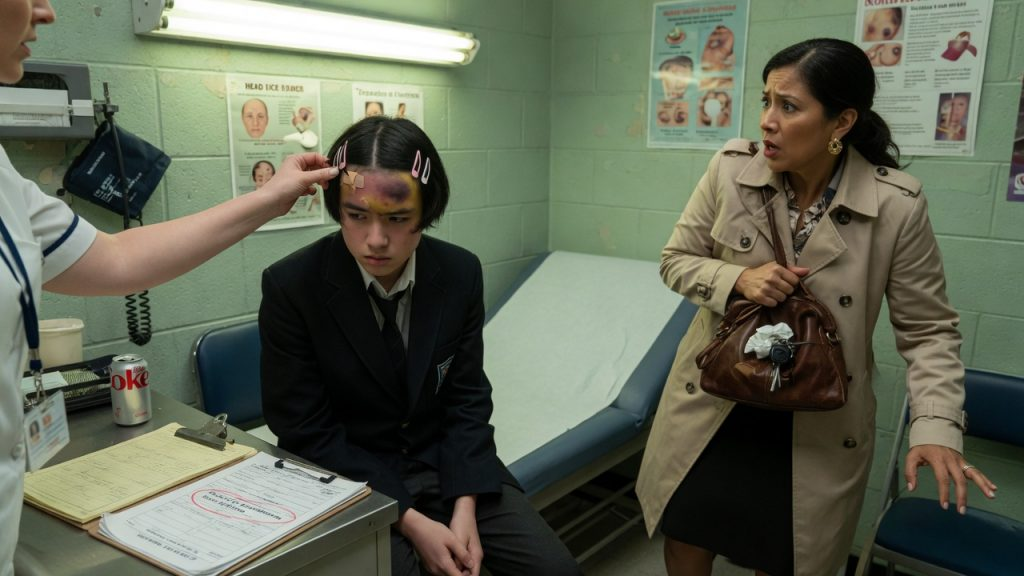
I still hear the sharp, metallic scrape of the chair legs against the linoleum as Leo’s mother shot up, her eyes wide with a terror that made the blood in my veins run cold.
It was a Tuesday in late October, the kind of dreary, overcast morning in our affluent Chicago suburb where the sky looked like bruised iron. The wind was howling outside Oakridge Elementary, rattling the thin glass of my clinic windows. I’ve been the school nurse here for four years. Before this, I spent a decade in the pediatric trauma ward at Chicago Med. I left the ER because I couldn’t handle the nightmares anymore—the sound of flatlining monitors, the sight of tiny bodies broken by a world that should have protected them. I took this job because I thought it would be nothing but scraped knees, ice packs, and faked stomachaches to get out of math class.
I was wrong.
The day started normally enough. Maggie, the school secretary, was leaning against the doorframe of my clinic, nursing a styrofoam cup of her atrocious hazelnut coffee. Maggie is fifty-something, fiercely loyal, and knows the dark secrets of every family in this zip code. She’s the kind of woman who will give you the shirt off her back but will judge the brand of the one you were wearing before.
“Vance is on a tear today,” Maggie muttered, rolling her eyes toward the principal’s office. Principal David Vance was a bureaucrat through and through. He cared more about district funding, test scores, and avoiding scandals than the actual human children walking his hallways. His weakness was his absolute terror of the wealthy PTA parents; his strength, buried deep beneath layers of corporate cowardice, was a stubborn, protective streak that only flared up when he was backed into a corner.
“Standardized testing prep?” I asked, organizing my box of superhero band-aids.
“Worse. The school board is auditing the attendance records,” Maggie sighed, taking a sip of her coffee and grimacing. “Oh, by the way. The new kid in Mrs. Gable’s second-grade class? Leo? He’s on his way down here. Teacher says he threw up in the hallway. Poor thing looks like a stiff breeze would knock him over.”
I nodded, my nurse instincts immediately kicking in. “Did you ever get his missing file from his old school?”
Maggie’s brow furrowed. “No. And it’s weird. His mother, Clara, said they just moved from out of state—somewhere in Oregon. She promised to bring the immunization records last week, but every time I call, it goes straight to voicemail. She drives a brand new white Lexus, wears clothes that cost more than my mortgage, but she can’t seem to figure out how to operate a fax machine.”
Before I could reply, the heavy wooden door of the clinic squeaked open.
There stood Leo.
He was eight years old, but he looked small for his age. His shoulders were slumped, pulled inward as if he were trying to make himself take up as little space in the world as possible. He wore an oversized, faded gray hoodie that swallowed his thin frame, but it was his hair that always caught my attention. It was dark, stringy, and cut in a severe, heavy bowl style. The bangs were unnaturally long, hanging completely over his eyes, practically brushing the bridge of his nose. He looked like a child hiding behind a curtain.
“Hey there, Leo,” I said softly, crouching down to his eye level. “Mrs. Gable says your tummy isn’t feeling too well today.”
He didn’t speak. He just nodded slowly, his hands gripping the hem of his hoodie so tightly that his small knuckles were white.
“Come on in, buddy. Let’s get you on the cot.” I guided him gently by the shoulder. I noticed immediately how he flinched when my hand made contact with him. It wasn’t a normal, ticklish flinch. It was the deep, instinctual flinch of a child who associates sudden touch with pain. My ER radar, dormant for four years, suddenly flared to life.
I helped him sit on the crinkly paper covering the examination cot. He kept his head bowed, his chin resting against his chest.
“Can you look at me, Leo?” I asked gently. “I need to ask you a few questions.”
He shook his head, the long bangs swaying heavily.
I pulled up my rolling stool and sat in front of him. “Does your tummy hurt right now? Or do you feel like you need to throw up again?”
“Cold,” he whispered. His voice was incredibly raspy, like he hadn’t used it in days.
I reached for my temporal thermometer, the kind you scan across the forehead. “Okay, I’m just going to take your temperature, alright? It’s not going to hurt. It just beeps.”
As I brought the thermometer toward him, Leo panicked. Both of his hands flew up to his forehead, pressing his bangs flat against his skin. He shrank back against the wall, his breathing turning rapid and shallow.
“No,” he whimpered. “No, no, no.”
I instantly lowered my hands, holding them palms out to show I wasn’t a threat. “Okay! Okay, Leo. No thermometer right now. You’re safe. Nobody is going to force you to do anything.”
I watched him carefully. He was shivering, a fine tremor wracking his small body, and his face—what little I could see of it—was flushed a deep, sickly red. He was definitely running a high fever. But the way he guarded his forehead… it wasn’t normal. Children guard their stomachs when they ache, their ears when they have an infection. They don’t violently protect their hair unless they are hiding something beneath it.
I stepped out into the main office. Maggie was typing away at her computer. Officer Mark Jenkins was leaning over her desk, laughing at something on her screen. Mark was the School Resource Officer. He was an ex-Marine, built like a tank, with a sharp, cynical sense of humor that masked a deep well of PTSD he rarely talked about. He had a short temper for bureaucracy, but if a kid was in trouble, there was no one else you’d want in your corner.
“Mark, can you stick around the front office for a bit?” I asked quietly, my tone erasing the smile from his face.
He straightened up instantly, his military posture returning. “Everything okay, Sarah?”
“I don’t know yet,” I murmured. I turned to Maggie. “Maggie, call Clara. Tell her Leo has a fever and she needs to come pick him up immediately. Don’t take no for an answer.”
Maggie didn’t ask questions. She just picked up the phone.
I went back into the clinic. Leo had curled into a tight ball on his side, his knees pulled up to his chest. The room was quiet, save for the hum of the fluorescent lights and the ticking of the wall clock. I sat beside him in silence, just letting him get used to my presence. In my years in the ER, I learned that silence is often the best medicine for a terrified child.
Twenty minutes later, the front office door chimed. I heard the sharp, frantic clicking of high heels on the linoleum.
Clara burst into the clinic.
She was a stunning woman in her late thirties, dressed in a tailored cream-colored trench coat, expensive slacks, and a silk blouse. She carried a massive Prada purse on her arm. But despite the outward display of wealth and poise, there was a frantic, chaotic energy radiating from her. Her eyes were bloodshot and darted around the room like a trapped bird. I noticed her fingernails—despite the expensive diamond rings on her fingers, the nails themselves were bitten down to the quick, the cuticles raw and bloody.
“Leo!” she gasped, rushing toward the cot. “Oh, my poor baby. Let’s go. We’re going home right now.”
She reached out and grabbed his arm, yanking him upward with a force that was entirely inappropriate for a sick child. Leo let out a sharp cry of pain.
“Ma’am, please, wait,” I said, stepping between her and the door. I kept my voice calm, but authoritative. “He’s running a very high fever. He threw up earlier. I need to make sure he’s stable before you take him out into the cold.”
Clara’s eyes snapped to mine. There was hostility there, sharp and cold. “He’s fine. It’s just a bug. I’ll take him to our private pediatrician.”
“I understand,” I said, my heart beginning to pound a slow, heavy rhythm against my ribs. “But as school policy dictates, I need to get a baseline temperature before I can officially sign him out for medical release. It’s an insurance liability for the district.” A lie, but a necessary one to stall her.
Clara looked like she wanted to argue, but the mention of district policy made her hesitate. She glanced at the clinic door, then back at me. “Fine. Do it quickly.”
I walked over to the sink, washed my hands, and put on a pair of blue nitrile gloves. I grabbed the temporal thermometer and an alcohol swab. I approached the cot. Leo was shaking violently now, his eyes glued to the floor. Clara stood right behind him, her hands resting heavily on his shoulders. It didn’t look like a comforting embrace; it looked like a restraint.
“Okay, Leo,” I said softly. “Just going to check that fever.”
I moved the thermometer toward his head. Again, his hands flew up to protect his bangs.
“Leo, stop it,” Clara snapped, her voice suddenly harsh and guttural. “Let the nurse do her job.”
She grabbed both of his wrists and pulled them down, holding them firmly against his sides. Leo let out a whimpering, high-pitched noise that sounded like a wounded animal.
I frowned, my unease turning into cold dread. “Ma’am, you don’t need to hold him like that.”
“Just do the scan!” she hissed.
I nodded slowly. I needed a clear patch of skin to get an accurate reading. I reached out with my left hand, gently taking hold of his heavy, dark bangs. They felt stiff. As I touched the hair, my gloved fingers came away slightly sticky. Hair spray? No, something thicker.
“Don’t touch his hair!” Clara suddenly shouted, stepping forward.
But it was too late. I had already pinned the bangs back, brushing them away from his forehead.
What I saw made my breath catch in my throat.
His forehead wasn’t just hot and flushed. The skin was smeared with thick, beige liquid—heavy, theatrical-grade foundation that had begun to melt and run due to his high fever and sweat. The makeup was meant to cover up the upper half of his face.
But the fever had washed it away in streaks, revealing what was hidden underneath.
Right in the center of the little boy’s forehead, stamped deeply into the skin, was a horrific, raised scar. It wasn’t an accident. It wasn’t a scrape. It was a deliberate, perfectly symmetrical brand. It looked like it had been burned into his flesh with a heated iron.
It was the shape of a jagged crescent moon, intersecting with a sharp, rigid cross.
I stopped breathing. The ER nurse inside me, the woman who had seen every horror humanity could inflict upon itself, stood paralyzed. I knew that symbol. Anyone who followed the news knew that symbol. It was the mark of the “Children of the New Dawn”—an extremist, violent cult that had been raided by the FBI three years ago in a compound in rural Oregon. The cult leader had branded his “pure” children. During the raid, several children had vanished into thin air, smuggled out by zealots before the feds breached the gates.
One of those missing children was a five-year-old boy named Julian.
Julian, who would be exactly eight years old right now.
I looked down at the boy on my cot. I looked past the dyed dark hair, past the sick, pale face, and saw the faint, unmistakable dusting of freckles across his nose that I had seen on a hundred missing child posters.
This wasn’t Leo. This wasn’t her son.
“Oh my god,” I whispered, the words slipping out before I could stop them.
The silence in the room stretched until it felt like it was going to snap.
Clara looked at my face. She saw the recognition dawn in my eyes. She saw my gaze lock onto the branded scar on the boy’s forehead.
The facade of the wealthy, annoyed suburban mother vanished instantly. In a flash of pure, animalistic panic, she let out a sharp gasp.
She grabbed her Prada purse from the chair with a violent yank, the heavy gold chain slamming against the metal armrest. She stood up so fast her chair screeched backward, flipping over onto the linoleum with a deafening crash.
“We’re leaving,” she snarled, her voice dropping an octave into something cold and terrifying. She lunged for the boy’s arm, her perfectly manicured fingers digging into his flesh like talons.
“No!” I yelled, my body moving on instinct before my brain could catch up. I stepped directly into her path, blocking the door.
“Get out of my way, you stupid bitch!” Clara screamed, dropping the purse and shoving me hard in the chest.
I stumbled backward, hitting the edge of my desk, but I reached under the counter and hit the heavy red button we had installed after the last active shooter drill. The magnetic lock on the clinic door engaged with a loud, heavy THUNK.
We were locked in. And the secret was finally out.
Chapter 2
The heavy magnetic lock engaged with a sound that felt like a gavel striking wood. Thunk. It was a dense, hollow noise that vibrated through the cheap linoleum floor of the clinic, sealing the three of us inside a twelve-by-twelve room that suddenly felt as small as a coffin.
For a fraction of a second, time seemed to suspend itself in a strange, thick syrup. I could hear the erratic, shallow rasp of the boy’s breathing from the examination cot. I could hear the faint, muffled sounds of the elementary school through the cinderblock walls—the distant scrape of chairs, a teacher’s muffled voice, the innocent, mundane hum of an ordinary Tuesday.
And then, I looked at Clara.
The wealthy, indignant suburban mother vanished. The transformation was so absolute, so physically jarring, that I instinctively took a half-step backward. The frantic, nervous energy that had propelled her into my clinic evaporated, replaced by a cold, terrifying stillness. Her posture shifted. Her shoulders dropped. Her perfectly manicured hands uncurled from fists into loose, relaxed claws at her sides. But it was her eyes that made my blood run cold. The manic panic was gone. In its place was a flat, dead, shark-like emptiness. It was the look of a predator that had realized the trap was sprung and decided the only way out was through the person who set it.
“Unlock the door, Sarah,” she said.
Her voice wasn’t yelling anymore. It was a terrifyingly calm, even whisper. It lacked any inflection, any trace of the maternal panic she had been faking just moments before. It sounded rehearsed. It sounded fanatical.
“I can’t do that, Clara,” I replied, forcing my voice to remain steady, though my knees were trembling so violently I thought I might collapse. I kept my back firmly against the heavy wooden door, my hands splayed flat against the surface. “You and I both know you aren’t his mother. And I know what that brand on his forehead means.”
“You don’t know anything,” she hissed, taking a slow, deliberate step toward me. “You are interfering with a higher design. You are standing in the way of the Dawn. Give me the boy.”
“No.” I swallowed hard, my throat feeling like sandpaper. “The police are already on their way.” It was a bluff. I had hit the lockdown button, which alerted the front office and the SRO, but I didn’t know if Maggie had dialed 911 yet.
Clara didn’t care. She didn’t look at the boy, who was now curled into a tight, trembling ball on the crinkly paper of the cot, his hands still desperately clamped over his forehead as if trying to push the horrific brand back under his skin. She only looked at me.
“The shepherd does not ask the sheep for permission to reclaim the flock,” she murmured, a chilling smile pulling at the corner of her mouth.
Then, she lunged.
She moved with a ferocity and speed that defied her tailored silk blouse and designer slacks. She didn’t throw a punch; she threw her entire body weight at me, her hands coming up like talons. Her heavy, gold-chained Prada purse swung in a wild arc, the solid metal clasp catching me squarely on the left cheekbone.
Pain exploded across the side of my face, a blinding flash of white light that sent me reeling sideways. I tasted copper instantly as my teeth cut into the inside of my cheek. I stumbled, my hip crashing into the stainless-steel medical cart. A cascade of plastic basins, tongue depressors, and boxes of latex gloves scattered across the floor with a deafening clatter.
Before I could regain my balance, Clara was on top of me. Her manicured fingers, the ones with the bloody, bitten cuticles, wrapped around my throat. She shoved me backward against the edge of the sink counter, the hard edge digging painfully into my lower spine.
“You profane, stupid little woman!” she screamed, the facade completely shattered now. Flecks of spit hit my face as she bore down, her thumbs pressing agonizingly into my windpipe. “He is chosen! He is the vessel! You cannot keep him from the light!”
I gagged, my hands flying up to grip her wrists. She was surprisingly strong, fueled by an adrenaline cocktail of fanaticism and desperation. My vision began to swim, dark spots blooming at the edges of my sight. My ER training, dormant for years beneath layers of elementary school band-aids and ice packs, surged to the surface. Panic is the enemy. Action is survival.
I stopped trying to pull her hands away from my neck. Instead, I drove my right palm upward, striking her hard under the chin. Her jaw snapped shut with a sickening click. She gasped, her grip loosening just a fraction, and I used that momentary weakness to shove her backward with both hands.
She stumbled, her high heel catching on the edge of the fallen medical cart. She went down hard, her shoulder slamming against the linoleum.
I gasped for air, coughing violently as oxygen rushed back into my burning lungs. “Mark!” I screamed, my voice raw and ragged. “Mark, help!”
Clara was already scrambling back to her feet, her perfectly styled hair now a tangled, disheveled mess. She cast a frantic glance at the locked door, then turned her wild eyes toward the examination cot.
Julian.
She lunged toward the boy.
“Leave him alone!” I yelled, throwing myself forward. I grabbed the back of her cream-colored trench coat, yanking backward with all my might. We both crashed to the floor, rolling in a tangle of limbs amidst the scattered medical supplies. She kicked wildly, her heel connecting with my shin, sending a jolt of fire up my leg.
She scrambled on all fours toward the cot, her hand reaching out to grab Julian’s ankle. The boy finally made a sound—a high, thin, reedy shriek of pure, unadulterated terror. He pressed himself backward against the wall, trying to fuse his small body with the drywall, his eyes wide and unblinking beneath the mess of foundation and sweat.
“Come to me, vessel,” Clara commanded, her fingers wrapping around his thin ankle.
Suddenly, the heavy clinic door shook violently in its frame.
BANG.
Someone was throwing their weight against it from the outside.
BANG.
“Sarah! Stand clear!” a voice boomed through the thick wood. It was Officer Mark Jenkins.
Clara froze, her head snapping toward the door. The sound of male authority, aggressive and impending, seemed to crack her fanatical resolve for a split second. She looked at the heavy magnetic lock at the top of the frame. She knew she couldn’t break it.
“Mark, the key card override! Use the override!” I screamed, pulling myself up to a kneeling position, my head throbbing relentlessly.
There was a frantic scraping sound, the beep of the electronic keypad, and then the heavy thunk of the magnet disengaging.
The door flew open with such force that the handle punched a dent into the drywall behind it.
Mark Jenkins filled the doorway. At six-foot-two and two hundred and twenty pounds of solid muscle, the former Marine looked less like a school resource officer and more like a tactical strike force. His hand rested instinctively on the butt of his duty weapon, his eyes sweeping the room, taking in the chaos, the overturned cart, my bleeding face, and Clara’s grip on the boy’s ankle.
His eyes locked onto Clara.
“Let go of the boy,” Mark said. His voice wasn’t a shout. It was a low, gravelly rumble, vibrating with the kind of absolute, uncompromising authority that only comes from a man who has seen war and survived it. It was the voice of a protector who had found a wolf in the sheep pen.
Clara stood up slowly, keeping her grip on Julian’s leg. She puffed out her chest, a bizarre, arrogant defiance masking her obvious physical disadvantage. “You have no jurisdiction over the affairs of the Dawn. This child belongs to the Shepherd.”
Mark didn’t hesitate. He didn’t try to reason with her. He stepped into the room, crossing the distance in two massive strides. Clara raised her free hand to strike him, but Mark was faster. He caught her wrist mid-air, twisting it backward in a smooth, practiced motion that forced her to release Julian’s ankle with a gasp of pain.
In one fluid movement, Mark spun her around, forcing her face-first against the cinderblock wall. He kicked her legs apart to unbalance her and pinned her arms squarely behind her back. The loud click-click of metal handcuffs echoing in the small clinic was the most beautiful sound I had ever heard.
“Clara whatever-your-name-is, you’re under arrest,” Mark growled, his knee pressed firmly against the small of her back to keep her pinned. “Maggie! Call PD! Tell them we have an assault and an attempted kidnapping!”
Maggie appeared in the doorway, her face drained of all color, her cell phone already pressed to her ear. She took one look at the blood running down my chin and let out a choked sob before turning her back to speak frantically to the dispatcher.
“I’m okay, Maggie,” I breathed out, leaning against the counter and sliding slowly down until I was sitting on the floor. The adrenaline was beginning to crash, leaving behind a cold, shaking exhaustion. I reached up and touched my cheekbone. My fingers came away wet and red.
Mark hauled Clara to her feet. She wasn’t struggling physically anymore, but her eyes were wild, darting around the room. She began to mutter rapidly under her breath, a continuous, rhythmic chanting in a language I didn’t recognize. It sounded guttural, full of sharp consonants and hissed syllables.
“Quiet,” Mark snapped, giving her arm a slight shake. He looked over his shoulder at me. His tough, impenetrable exterior softened just a fraction. “You alright, Sarah?”
“I’ll live,” I managed to say, offering a weak smile. “Just… keep her away from him.”
I turned my attention back to the examination cot. Julian hadn’t moved. He was still pressed against the wall, his knees pulled tight to his chest, his hands still covering his forehead. He was shaking so hard his teeth were audibly chattering. The chaotic violence that had just erupted around him seemed to have pushed him completely over the edge into a dissociative state.
I forced myself to stand up. My legs felt like lead, and my lower back screamed in protest, but I ignored it. I walked slowly to the sink, wetted a fresh paper towel, and approached the cot.
“Hey, buddy,” I whispered, keeping my voice as soft and melodic as possible. I didn’t reach for him. I just stood near the edge of the cot. “It’s over. She can’t hurt you anymore. You’re safe.”
He didn’t acknowledge me. His eyes were fixed on a spot on the floor, blank and unseeing.
Before I could try again, the heavy footsteps of Principal Vance echoed in the hallway. He pushed past Maggie, his face a mask of bureaucratic horror. He was a small, balding man who sweat profusely under pressure, and right now, he looked like he was standing in a sauna.
“What in God’s name is going on in here?” Vance sputtered, staring at the overturned cart, the blood on my face, and Mark holding a handcuffed, chanting PTA mother. “Sarah? Mark? Do you have any idea the liability—”
“Save it, David,” Mark cut him off sharply. He didn’t use the principal’s title, a clear sign of how little patience he had for Vance’s usual cowardice. “This woman assaulted Nurse Sarah and tried to drag this kid out of here by force.”
Vance blanched, pulling a handkerchief from his pocket and dabbing his forehead. “Assault? Kidnapping? Good lord, the board is going to have my head. We need to call her husband, we need to minimize—”
“She’s not his mother,” I interrupted, my voice finding its strength. I turned to look at Vance, locking eyes with him. “David, look at the boy.”
Vance frowned, stepping cautiously toward the cot. He peered over my shoulder at the shivering child. “He looks sick. What is that mess on his face?”
“It’s makeup,” I said grimly. I slowly reached out. Julian flinched, but he didn’t pull away this time as I gently took his wrists and coaxed his hands down from his forehead.
With the damp paper towel, I carefully wiped away the remaining streaks of thick beige foundation and the sweat-soaked bangs. The jagged crescent moon and the rigid cross, raised and angry against his pale skin, were revealed in stark, undeniable detail.
Vance stopped wiping his brow. The handkerchief fell from his limp fingers, fluttering to the linoleum floor. The bureaucratic panic drained from his face, replaced by genuine, human horror.
“Dear God,” Vance whispered. “Is that… is that a brand?”
“It’s the mark of the Children of the New Dawn,” I said quietly, the words tasting like ash in my mouth. “Three years ago, the FBI raided their compound in Oregon. Several children went missing during the chaos. This is one of them. I think his real name is Julian.”
The room fell into a heavy, stunned silence, broken only by Clara’s continuous, unsettling chanting.
Vance looked at me, then at Mark, the reality of the situation finally piercing his armor of policy and procedure. This wasn’t a schoolyard scrape. This wasn’t a custody dispute. This was national news. This was a monster in his hallway.
For the first time since I had met him, Vance stood up straight. The cowardice vanished, replaced by a sudden, protective fury. “Mark,” he said, his voice surprisingly firm. “Get that piece of trash out of my school and into your holding room until the real police arrive. If she speaks another word, gag her.”
Mark nodded, a grim smile of respect touching his lips. “Yes, sir. Let’s walk, lady.” He shoved Clara forward, marching her out of the clinic and down the hall.
Vance turned to me. “Sarah. Do whatever you need to do. I’ll handle the police when they get here. I’m locking down the school. Nobody comes in or out.”
As Vance left to issue the lockdown protocols, I was finally left alone with Julian.
The adrenaline was completely gone now, leaving me hollowed out and aching. I pulled my rolling stool up to the cot and sat down. I didn’t try to touch him again. I just sat there, acting as a physical barrier between him and the door.
Looking at his branded forehead, an old, familiar ghost rose up in my chest. A dark memory from my time at Chicago Med. Her name had been Lily. She was six years old, brought into the ER with a shattered collarbone and a story about falling out of a tree. I had treated her, patched her up, and let her parents take her home, believing their tearful, convincing lies. Two weeks later, she was brought back in an ambulance. She didn’t survive the night.
I had quit the ER the next day. I had sworn to myself that I would never, ever look away again. I would never let a shadow pass me by without shining a light on it. I had run to the quiet suburbs, thinking I could escape the darkness, only to find that monsters wear Prada trench coats and drive luxury cars just as easily as they wear rags.
“I’m sorry, Lily,” I whispered into the quiet room, an old prayer I recited whenever the guilt threatened to drown me.
“Who is Lily?”
The voice was tiny, raspy, and barely audible over the hum of the fluorescent lights.
I blinked, pulling myself out of the memory. Julian had uncurled slightly. He was looking at me. His dark, intelligent eyes were still wide with fear, but there was a flicker of curiosity there, too.
“Lily was a little girl I knew a long time ago,” I answered softly, keeping my movements slow and deliberate. “I wasn’t able to help her when she needed it. So, I made a promise that I would always try to help anyone else who needed it. Do you need help, Julian?”
He flinched when I said his name. It was the first time he had heard his real name spoken aloud in probably three years. He looked down at his trembling hands, picking at a loose thread on his oversized hoodie.
“They told me Julian was dead,” he whispered, his voice trembling. “They said the fire took him. I am Novus now. Novus of the Dawn.”
My heart broke into a thousand jagged pieces. The psychological conditioning, the brainwashing—it was deep. Clara hadn’t just branded his skin; she had tried to burn away his identity.
“Julian isn’t dead,” I told him, leaning forward slightly. “He’s right here. And he is very, very brave.”
Before he could answer, the wail of police sirens cut through the heavy air, growing rapidly louder until they sounded like they were right outside the window. Blue and red lights began to strobe against the frosted glass of the clinic.
The cavalry had arrived.
Within minutes, the school was swarming. The hallway outside my clinic became a chaotic blur of uniforms, radios squawking, and the heavy thud of combat boots.
A man pushed his way through the doorway, flashing a gold badge at Maggie before stepping into my clinic. He was a tall, stoop-shouldered man in a rumpled gray suit that looked like he had slept in it. His tie was stained with coffee, and he had the deep, bruised bags under his eyes of a man who worked too many graveyard shifts.
“Detective Ray Miller, Local PD,” he said, his voice a gravelly baritone. He took in the scene—the overturned cart, the blood on my face, the terrified boy on the cot. His sharp, calculating eyes missed nothing. “You the nurse?”
“Sarah,” I nodded.
“Alright, Sarah. Paramedics are right behind me to look at that cheek,” Miller said, pulling a small notebook from his breast pocket. “My guys have the woman in custody. Jenkins gave me the cliff notes. You’re saying this kid is a missing person from an FBI cult raid three years ago?”
“Yes,” I said firmly. “Look at his forehead, Detective. That’s the brand of the Children of the New Dawn.”
Miller stepped closer, squinting at Julian’s scar. He let out a low, slow whistle. The weary cynicism in his posture vanished, replaced by the sharp intensity of a bloodhound catching a scent. “I’ll be damned. The Feds have been hunting these splinters for years. You just handed them a golden goose.”
He turned back to me. “I need to get child protective services in here, and I need to call the Bureau in Chicago. But first, I need you to walk me through exactly what happened, from the minute she walked in.”
I told him everything. I told him about the missing file, the blocked phone numbers, the makeup, the fight. Miller wrote furiously, his expression grim.
“She called him a ‘vessel,’” I added, wrapping my arms around myself as a sudden chill hit me. “She said I was interfering with a higher design.”
Miller stopped writing. He looked at me, tapping his pen against the notebook. “Fanatics. They don’t operate logically. If she thinks this kid is some kind of chosen prophet, she wasn’t acting alone. These splinters travel in packs.”
The thought sent a new wave of terror crashing over me. “You think there are more of them here? In town?”
“I think a woman driving a brand new Lexus and living in this zip code doesn’t fit the profile of a backwoods cultist unless she has a very well-funded support network,” Miller said grimly. “We need to get this kid out of here to a secure location. Now.”
He turned toward the door to shout orders to his officers, but stopped abruptly as another figure entered the clinic.
It was Dr. Aris Thorne, the school district’s lead child psychologist. Dr. Thorne was a tall, gentle man in his late sixties, with a neat silver beard and a penchant for wearing soft, earth-toned cardigans. Before joining the district, he had spent twenty years as a crisis negotiator for the state police. He had a preternatural ability to calm a room just by standing in it.
But it wasn’t Dr. Thorne who caught Julian’s attention.
Padding softly beside the psychologist, on a loose red leash, was Barnaby. Barnaby was a three-year-old Golden Retriever, a certified emotional support animal who worked with the special education department. He was a massive, shaggy beast with soulful brown eyes and an endlessly wagging tail.
“I heard we had a situation, Sarah,” Dr. Thorne said quietly, his eyes taking in the blood and the mess. He looked at Julian. “I thought we might need some specialized backup.”
He let go of the leash.
Barnaby didn’t run. He didn’t bark. He seemed to sense the heavy, traumatized energy in the room. He padded slowly across the linoleum, navigating around the overturned medical cart, and stopped right next to the examination cot. He sat down heavily, looked up at Julian, and let out a soft, huffing sigh, resting his large, furry chin on the edge of the mattress.
Julian stared at the dog. For the first time since he walked into my clinic, the rigid, terrified tension in his shoulders seemed to crack. Slowly, agonizingly slowly, he uncurled one arm from around his knees. His trembling hand reached out, hovering just inches above the dog’s head.
Barnaby didn’t move. He just looked at the boy with unconditional, uncomplicated patience.
Julian lowered his hand, burying his thin fingers into the thick, golden fur behind Barnaby’s ears.
A single tear slipped down Julian’s cheek, cutting a clean track through the remaining makeup and grime. Then another. And another. He didn’t sob; he just wept silently, the emotional dam finally breaking as he clung to the dog like a lifeline.
“Let him process,” Dr. Thorne murmured, stepping back to stand beside me and Detective Miller. “He’s been holding his breath for a very long time.”
I watched them, feeling a tight, painful knot in my chest begin to loosen. We had him. He was safe. The nightmare was over.
But as I turned to walk toward the sink to clean the dried blood off my face, my foot kicked something under the edge of the counter.
It was Clara’s cell phone. It must have fallen out of her coat pocket during our struggle.
The screen was lit up. It was on silent, but a notification banner was glowing brightly across the locked screen. I bent down and picked it up.
My heart, which had finally begun to slow down, suddenly stopped dead in my chest.
The knot tightened again, harder this time. The nightmare wasn’t over. It was just beginning.
I stared at the glowing text message, the words burning themselves into my retinas.
Sender: The Shepherd
Message: We saw the police cars. The school is surrounded. We are initiating Protocol Genesis. Bring the Vessel out the south exit in three minutes, or we will cleanse the building with fire. The flock is ready.
I looked up, my eyes locking with Detective Miller. The blood drained from my face so quickly I felt dizzy.
“Detective,” I whispered, holding out the phone with a trembling hand. “They aren’t just in town.”
Miller took the phone, his eyes scanning the screen. His jaw tightened, the muscles ticking furiously beneath his skin. He dropped his notebook and reached for the radio on his shoulder.
“They’re outside.”Chapter 3
Sender: The Shepherd
Message: We saw the police cars. The school is surrounded. We are initiating Protocol Genesis. Bring the Vessel out the south exit in three minutes, or we will cleanse the building with fire. The flock is ready.
Three minutes.
One hundred and eighty seconds.
I stared at the glowing pixels on the cracked screen of Clara’s phone, and for a terrifying moment, the English language lost all meaning. The words were just shapes, sharp and violent, cutting through the thin veil of safety I had spent the last four years building around myself.
“Outside,” Detective Miller repeated, his voice a low, raspy scrape against the sudden, suffocating silence of the clinic. The weary, rumpled local cop vanished, instantly replaced by a man staring down the barrel of a mass casualty event.
He didn’t hesitate. Miller dropped his notebook—it hit the linoleum with a soft, pathetic slap—and grabbed the heavy black radio clipped to his shoulder.
“Dispatch, this is Miller. Code 3, emergency, I need every available unit to Oakridge Elementary right now! I need the tactical team, I need fire and rescue, and patch me through to the FBI field office in Chicago. We have a confirmed hostage situation with an active threat of arson. Multiple armed suspects likely forming a perimeter. Do not let any patrol cars approach blind. They are expecting us.”
The radio crackled back, the dispatcher’s voice pitching up two octaves in sheer panic. “Copy, Miller. All units responding. What is the suspect count?”
“Unknown,” Miller barked, his eyes sweeping the small clinic, calculating our defensibility. It was a room meant for band-aids and asthma inhalers, not a siege. We had one door, two frosted glass windows facing the parking lot, and walls made of cheap drywall over cinderblock. “Just get them here. We are officially in a barricade situation.”
Three minutes.
My eyes darted to the clock on the wall above my desk. The red second hand swept across the white face in a smooth, continuous motion. It was 10:14 AM.
“Sarah.”
I blinked, pulling myself out of the paralyzing spiral of my own rising panic. Mark Jenkins was standing directly in front of me. The SRO had shed his windbreaker, revealing the dark tactical vest beneath it. His hand was resting firmly on my shoulder. His grip was tight, grounding me to the floor, pulling me back from the edge of the abyss.
“I need you with me, Sarah,” Mark said, his voice dropping into that low, authoritative rumble that commanded absolute obedience. It was the voice that had kept his squad alive in Fallujah. “I know your heart is beating out of your chest right now, but I need the ER nurse. Not the school nurse. You copy?”
I swallowed the dry lump in my throat. I looked into his eyes. There was fear there—he wasn’t a robot, he knew exactly how bad this was—but there was also a steely, unyielding resolve. Mark had survived nightmares that I couldn’t even fathom. He wasn’t going to let this one consume us.
“I copy,” I whispered. Then, I cleared my throat, forcing the tremor out of my voice. “I copy.”
“Good.” Mark turned to Miller. “Ray, the south exit is right down the main corridor. If they breach, they’ve got a straight shot down the hall to this clinic. We’re a sitting duck in here. The windows are single-pane glass. A stray rock could break them, let alone a bullet or a Molotov.”
“I know,” Miller said, drawing his service weapon. The heavy, metallic clack of a round being chambered sent a fresh jolt of adrenaline through my veins. “Where’s your safest room? We need an interior core. No windows. Solid doors.”
“The records vault,” Mark replied instantly. “Behind the principal’s office. Steel door, concrete walls. It’s an old fallout shelter from the sixties they converted. But we have to cross forty feet of open hallway to get there.”
“Do it,” Miller commanded. “I’ll hold the hallway. You get the kid and the civilians to the vault.”
“Wait,” a soft, steady voice interrupted.
We all turned. Dr. Aris Thorne was kneeling beside the examination cot. He hadn’t moved since the threat was announced. His hand was still resting gently on the back of Barnaby, the massive golden retriever, who was acting as a warm, breathing anchor for the terrified eight-year-old boy.
Julian—Novus, to the monsters outside—was staring at the wall, his eyes wide and unblinking. The tears had stopped, but his body was rigid, locked in a state of sheer, unadulterated terror.
“Aris, we don’t have time,” Mark said, taking a step toward the cot. “We have to move him.”
“If you grab him now, you will lose him,” Dr. Thorne said smoothly, his eyes never leaving the boy’s face. The former crisis negotiator possessed a supernatural calm that felt completely alien in a room vibrating with panic. “Listen to his breathing, Mark. He’s hyperventilating. His heart rate is skyrocketing. If you force him into that hallway right now, he will panic. He might run. And if he runs toward the south exit…”
Thorne didn’t need to finish the sentence.
Two minutes left.
“Julian,” Dr. Thorne said, his voice dropping into a rhythmic, almost hypnotic cadence. “I need you to look at me, son.”
Julian slowly turned his head. The raised, angry brand on his forehead—the crescent moon and cross—seemed to pulse under the harsh fluorescent lights.
“They’re coming,” Julian whispered. His voice didn’t sound like a child’s anymore. It sounded old, hollowed out by a lifetime of indoctrination. “The Shepherd said Protocol Genesis. That means the end of the world. It means the fire.”
“What is the fire, Julian?” Thorne asked gently, keeping his body language open and non-threatening.
“Purification,” the boy answered automatically, reciting a doctrine that had been beaten into him. “The vessel must be returned to the flock, or the profane world must be cleansed. The fire takes everything away. It leaves only the ash. It leaves only the Dawn.”
Julian looked at me. His dark eyes locked onto mine, and for a second, I saw a flicker of the little boy trapped beneath the cult programming. A little boy who just wanted his real mother.
“I don’t want to burn,” he whispered, a single tear cutting a fresh track through the dirt and makeup on his cheek. “I don’t want to be ash.”
The ghost of Lily—the six-year-old girl I couldn’t save in the ER all those years ago—flared violently in my chest. The guilt that had haunted me for four years, the crushing weight of failing to protect a child from the monsters in her own home, suddenly catalyzed into pure, blinding rage.
I wasn’t going to fail this time. I didn’t care if there was an army of fanatics outside. I was not going to let this boy burn.
I dropped to my knees beside the cot, ignoring the sharp protest of my bruised back. I leaned in close to Julian, making sure I was the only thing he could see.
“Listen to me, Julian,” I said, my voice fierce and steady. I didn’t speak to him like a victim. I spoke to him like a survivor. “You are not a vessel. You are a little boy who belongs with people who love you. And I promise you, on my life, you are not going to burn today. Do you hear me? I will not let the fire touch you.”
He stared at me, his chest heaving. He looked down at Barnaby. The dog whined softly and bumped his wet nose against Julian’s trembling hand.
“Okay,” Julian whispered, his fingers gripping the dog’s fur tight. “Okay.”
“Good,” I said, standing up. “Aris, take his left hand. I’ll take his right. Barnaby stays right next to him.”
“One minute and thirty seconds,” Mark announced, checking his heavy tactical watch. “Vance is supposed to be locking down the school. Where the hell is the announcement?”
As if on cue, the PA system above our heads crackled with a sharp burst of static.
Principal David Vance’s voice echoed through the speaker. It was shaking, lacking its usual bureaucratic polish, but the message was clear.
“Teachers and students. This is a Code Red lockdown. I repeat, this is a Code Red lockdown. Secure your classrooms immediately. Lights out, doors locked, out of sight. This is not a drill. May God be with us.”
The silence that followed was heavier than anything I had ever experienced. Oakridge Elementary housed over six hundred students and fifty staff members. Usually, the building hummed with life—the thud of sneakers, the distant sound of a choir practicing, the muffled laughter through classroom doors.
Now, there was absolutely nothing. It was the terrifying, breathless silence of prey hiding in the tall grass while the predator circles.
“Alright, that’s it,” Miller said, stepping to the door of the clinic and peering cautiously out into the main hallway. “It’s a ghost town. Mark, you take point. I’ll cover the rear. Sarah and Doc, you keep the kid sandwiched between you. We move fast, but quiet. Keep your heads down. If we hear glass breaking, we hit the deck. Go, go, go.”
We spilled out of the clinic and into the main administrative hallway.
The air felt thin, charged with a static electricity that made the hair on my arms stand up. The hallway stretched out in front of us, lined with lockers on one side and a wall of windows looking out into the central courtyard on the other. At the far end of the corridor, about fifty yards away, were the heavy double doors of the south exit.
Beyond those glass doors, I could see the edge of the parking lot.
And I saw them.
Three dark, unmarked vans had smashed through the chain-link gate at the back of the staff parking lot. They were parked in a staggered V-formation, blocking any approach from the street.
Even from this distance, I could see figures moving behind the vehicles. They weren’t wearing masks or tactical gear. They were dressed in ordinary clothes—jeans, flannel shirts, winter coats. They looked like parents waiting to pick up their kids. But they were moving with military precision, pulling heavy black duffel bags from the trunks of the vans.
“Ray,” Mark growled, his hand gripping his holstered weapon. “Look at the doors.”
One of the figures, a tall man in a dark green hunting jacket, walked purposefully up to the glass doors of the south exit. He didn’t carry a gun. He carried a heavy, red plastic jerry can.
He didn’t look angry. He didn’t look frantic. He looked completely, utterly serene.
He began to pour a thick, clear liquid all over the outside of the glass doors and the concrete steps.
“Accelerant,” Miller hissed. “They’re prepping the doors. If they ignite that, it’ll blow the glass inward and fill the hall with smoke in ten seconds.”
“Thirty seconds,” Mark said, his voice tight. “Move. Now!”
We broke into a rapid half-jog. I gripped Julian’s small hand so tightly my knuckles ached. He was keeping up, his eyes glued to Barnaby’s wagging tail, letting the dog guide him through the terror. Dr. Thorne was on his other side, a silent, calming presence.
We passed the front reception desk. Maggie, the secretary, was nowhere to be seen. She had likely barricaded herself in the breakroom. The phones on her desk were lighting up like a Christmas tree—silent, flashing red lights indicating incoming calls from panicked parents who were likely already watching the news break on local channels.
“Almost there,” Mark grunted, turning the corner toward the principal’s office suite.
“Fifteen seconds,” Miller called from behind us. He had stopped walking and was crouched behind a heavy oak display case, his gun trained on the distant south exit doors.
We reached the heavy wooden door of Principal Vance’s office. Mark shoved it open, not bothering to knock. The office was empty, Vance’s leather chair pushed back hastily. Mark bypassed the desk and headed straight for the small alcove in the back of the room.
There it was. The records vault.
It was a heavy, steel door set into a reinforced concrete frame. It looked like the entrance to a bank safe. Mark grabbed the heavy metal lever and threw his entire body weight into pulling it down. The locking mechanism groaned, a heavy, metallic shriek of rust and disuse, before the door swung outward on its massive hinges.
The inside of the vault was pitch black, smelling of old paper, dust, and ozone.
“Get in,” Mark ordered, pushing us toward the dark opening.
Dr. Thorne stepped in first, leading Barnaby. I followed, pulling Julian with me. The darkness swallowed us instantly. It felt like stepping into a tomb.
“Ray! Fall back!” Mark bellowed down the hallway.
I turned around, looking out past Mark’s broad shoulders. I could see the length of the hallway, all the way back to the main reception area, and beyond that, the distant glass of the south exit.
Through the glass, I saw the man in the green hunting jacket step back from the soaked doors.
He reached into his pocket.
The three minutes were up.
He pulled out a road flare, twisted the cap, and struck it. A blinding, sputtering red light erupted in his hand, casting demonic, dancing shadows across his serene face.
He looked directly through the glass, down the length of the hallway, as if he could see straight into my soul.
And he tossed the flare onto the concrete steps.
The ignition was instantaneous. It wasn’t a slow build; it was a violent, explosive WHOOSH that rattled the fillings in my teeth even from fifty yards away. A wall of orange and yellow fire erupted against the south exit doors, towering ten feet into the air.
“Ray!” Mark screamed again.
Miller was running. The heavy-set detective was sprinting down the hallway with a speed born of pure, primal adrenaline.
Behind him, the intense heat of the accelerant proved too much for the commercial glass.
CRACK.
The sound was like a cannon shot. The heavy double doors shattered inward simultaneously, a tidal wave of broken safety glass, thick black smoke, and roaring flames vomiting into the school corridor.
The fire alarm system finally detected the breach.
The school’s klaxons engaged. It was a deafening, shrieking, synthetic wail that pierced the eardrums like an icepick. Above our heads, blinding white strobe lights began to flash violently, turning the smoke-filled hallway into a disjointed, staccato nightmare.
“I’m clear! Shut it!” Miller yelled, diving through the door of Vance’s office and scrambling across the carpet.
Mark grabbed the heavy steel lever of the vault door and hauled it shut. The massive metal slab slammed into its frame, instantly cutting off the deafening wail of the fire alarm and the blinding flash of the strobes.
He engaged the internal deadbolt. CLANK.
We were sealed in.
The silence inside the vault was jarring, broken only by our heavy, ragged breathing and the soft, frightened whimpers of Julian. The air was thick, smelling strongly of mold and the stale paper of a thousand student records.
Mark clicked on a heavy tactical flashlight attached to his vest. The harsh white beam cut through the darkness, illuminating the small, cramped space. It was roughly fifteen by twenty feet, lined floor to ceiling with metal filing cabinets. There was no other exit. No ventilation shafts. Just a solid concrete box.
“Everyone okay?” Mark asked, sweeping the beam over our faces.
“Yeah,” Miller wheezed, leaning heavily against a filing cabinet, his hands on his knees as he tried to catch his breath. “That was close. Too close.”
I knelt down in front of Julian. The boy was trembling so violently his teeth were clattering against each other. Dr. Thorne was already beside him, murmuring softly, while Barnaby pressed his heavy body against the boy’s legs.
“We’re safe, Julian,” I said, putting my hands gently on his shoulders. “The fire can’t get in here. We’re safe.”
“They’re going to burn it all,” Julian whispered, his eyes wide and vacant in the glare of the flashlight. “The Shepherd won’t stop until he gets the vessel.”
“The FBI is on the way, son,” Miller said, coughing slightly from the smoke he had inhaled. He pulled his radio from his belt. “Once SWAT gets here, these nutjobs are going to realize they picked the wrong fight.”
Miller keyed his radio. “Dispatch, this is Miller. Be advised, suspects have breached the south exit with an incendiary device. Fire is spreading in the main corridor. We are secured in the interior vault. What is the ETA on the fire department and tactical units?”
The radio buzzed with static.
Miller frowned. He tapped the side of the radio and tried again. “Dispatch, this is Miller. Do you copy?”
More static. A thick, heavy wall of white noise.
“Concrete box, Ray,” Mark pointed out grimly, shining his light at the ceiling. “We’re encased in two feet of reinforced steel and concrete. Radio signals can’t penetrate. We’re cut off.”
Miller cursed under his breath, sliding the radio back into its holster. “Great. So we sit tight and wait for the cavalry to put out the fire and dig us out.”
“They will,” I said, trying to inject a confidence into my voice that I didn’t feel. I looked at the heavy steel door. “This is the safest place in the building.”
For a few minutes, we just existed in the damp, dusty darkness. The adrenaline began to recede, leaving behind a profound, aching exhaustion. My face throbbed where Clara had hit me with her purse. My back screamed from being shoved into the counter. But as I looked at Julian, safe and unharmed, I felt a fierce, protective pride.
We had beaten them. The cult had tried to take him, and we had locked them out.
“Aris, how’s his heart rate?” I asked quietly.
“Slowing down,” Thorne replied softly, his hand resting on Julian’s back. “Barnaby is doing his job. He’s grounding him.”
“Good,” I sighed, leaning my head back against the cold metal of a filing cabinet.
I closed my eyes, letting the darkness wash over me.
Then, I heard it.
It was faint at first. So faint I thought it was just the blood rushing in my own ears. But it was rhythmic. Deliberate.
Thump.
A pause.
Thump.
I opened my eyes. Mark and Miller had heard it too. Mark’s flashlight beam immediately swung toward the heavy steel door.
“Did that come from the office?” Miller whispered, his hand going back to his gun.
Thump.
It was closer this time. It wasn’t coming from Vance’s office. It was coming from the hallway just outside the office door. Heavy, deliberate footsteps.
But it wasn’t just footsteps.
There was a dragging sound. Something metallic, scraping against the linoleum floor.
Screeech… Thump.
“That’s not a cop,” Mark said, his voice dropping to a barely audible whisper. He stepped in front of the door, raising his weapon, aligning the sights with the center of the steel slab.
“How did they get past the fire?” I breathed, terror seizing my heart in a vice grip. The south exit was completely engulfed. There was no way anyone could have walked through that inferno.
“They didn’t,” Miller said, his face paling in the flashlight beam. “The fire at the south exit… it was a distraction.”
The horrific realization hit me like a physical blow. The three minutes. Protocol Genesis. The man with the flare. It was all a theatrical performance to draw the police’s attention to the back of the school.
To make everyone look the other way while the rest of the flock broke in through a different entrance.
They were already inside the school. They were roaming the halls.
Screeech… Thump.
The footsteps stopped.
They were right outside the heavy wooden door of Vance’s office. Just twenty feet away from our steel vault.
“Hello?” a voice called out.
It was a man’s voice. It was soft, melodic, and chillingly calm. It echoed slightly in the silence of the outer office.
Julian let out a sharp gasp, burying his face into Barnaby’s fur. The dog let out a low, warning growl.
“I know you’re in there, little vessel,” the melodic voice crooned from the other side of the wall. “The Shepherd hears your heart beating. Open the door, and let us bring you to the Dawn. If you don’t…”
There was a loud, metallic clatter as something heavy was set down on Vance’s desk.
“I have enough C-4 to turn this entire wing of the school to ash. And I will start with the classrooms.”
The melodic voice paused, letting the threat hang in the stifling air of the vault.
“You have sixty seconds.”
Chapter 4
“You have sixty seconds.”
The words hung in the stale, dust-choked air of the records vault, freezing the blood in my veins.
Sixty seconds. One minute. That was all that stood between the fragile, trembling boy in my arms and the total annihilation of the school. I stared at the heavy, riveted steel of the vault door, my mind violently rejecting the reality of the situation. It was a Tuesday. I was supposed to be handing out ice packs and checking vaccination records. Instead, I was sitting on a cold concrete floor, listening to a madman casually threaten to vaporize hundreds of children.
“Fifty-five seconds,” the melodic, sickeningly calm voice called out from the other side of the steel. The sound was muffled, but the acoustics of the concrete walls seemed to amplify the sheer arrogance bleeding through the metal. It was a voice that had never been told no. A voice that believed it spoke for God.
Mark Jenkins didn’t panic. The former Marine’s face turned into a mask of pure, sculpted granite. He didn’t look at the door. He looked at Detective Miller. The two men shared a silent, terrible conversation in the space of a single heartbeat. It was the grim arithmetic of law enforcement in a mass casualty scenario.
Hundreds of kids hiding in locked classrooms down the hall.
One boy hiding in the vault.
“We don’t negotiate,” Mark whispered, his voice so low it barely registered over the sound of my own frantic heartbeat. He raised his service weapon, aligning the glowing tritium sights perfectly with the center of the steel door. “If he blows the C-4, he blows it. But if we open this door, he takes the kid, and he probably blows the school anyway to cover his tracks. Fanatics don’t leave witnesses.”
“There are six hundred kids in this building, Mark,” Miller rasped, sweat dripping from his chin, staining the collar of his rumpled shirt. His hands were shaking, just a fraction, as he gripped his own gun. “My daughter’s middle school is three miles from here. If I was sitting in my living room watching this on the news… I’d want the cops to do whatever it took to save the masses.”
“Forty-five seconds. The clock is ticking, Sarah,” the voice crooned.
My breath caught in my throat. He knew my name.
“How does he know my name?” I whispered, a fresh wave of terror washing over me.
“Clara,” Miller grimaced. “She must have radioed him or texted him before we locked her up. They know exactly who is in this box.”
“Sarah,” the Shepherd’s voice continued, dropping into a tone of faux-sympathy that made my skin crawl. “I know you think you are acting righteously. I know about the pain you carry. Clara told me you were an emergency nurse. You try to save the broken things because you yourself are broken. But the vessel is not yours to fix. He belongs to the Dawn. Open the door, Sarah. Do not let your misplaced maternal instincts condemn hundreds of innocent children to the fire.”
I looked down at Julian. He was curled into a fetal position against my legs, his small hands buried so deeply in Barnaby’s golden fur that his knuckles were stark white. The dog was a solid, unmoving mountain of comfort, emitting a low, continuous rumble from deep within his chest.
Julian looked up at me. His dark eyes, framed by the horrific, jagged brand on his forehead, were wide pools of absolute certainty.
“He’s not lying,” Julian whispered, his voice trembling but completely devoid of childish naivety. He had seen these people operate. He knew their capacity for violence. “The Shepherd always keeps his promises. He will burn them all.”
“Thirty seconds,” the voice sang.
Suddenly, Dr. Aris Thorne moved. The elderly psychologist smoothly rose from his kneeling position beside Barnaby and walked directly to the steel door. He didn’t draw a weapon. He didn’t look panicked. He simply placed his flat palms against the cold, gray metal, leaned his forehead against it, and took a deep, steadying breath.
When he spoke, his voice was entirely different from the gentle, grandfatherly tone he used with the students. It was the voice of the crisis negotiator who had spent two decades talking men off bridges and coaxing armed kidnappers out of barricaded houses. It was deep, resonant, and projected from the diaphragm, designed to cut through hysteria and demand attention.
“Listen to me very carefully,” Aris commanded, his voice booming through the steel. “My name is Dr. Aris Thorne. I am the lead psychological authority in this district, and I am the one making the decisions in this room. Who am I speaking to?”
There was a pause on the other side. The sudden shift in authority had clearly derailed the Shepherd’s theatrical countdown.
“I am the Shepherd of the New Dawn,” the voice replied, the melodic lilt hardening into something slightly more irritated.
“No, you’re not,” Aris countered instantly, his tone flat and dismissive. “The Shepherd is a title. I asked for your name. If you are going to hold the lives of six hundred children in your hands, the least you can do is have the common courtesy to introduce yourself as a man, not a metaphor.”
Mark lowered his gun just a fraction, his brow furrowing as he watched Aris work. Miller wiped his forehead, his eyes darting between the door and the psychologist. Aris was buying us time. He was breaking the suspect’s script.
“My name is of the old world. It is dust,” the man outside replied, his voice rising in volume. “And you have twenty seconds, Dr. Thorne.”
“You are threatening to detonate high explosives, which will unequivocally destroy this room and the boy inside it,” Aris continued, ignoring the countdown entirely. “But your own doctrine, specifically the Fourth Tenet of the Dawn, explicitly forbids the destruction of a marked vessel before the convergence. If you trigger that C-4, you are not a Shepherd. You are a heretic killing your own prophet. And you know it.”
The silence that followed was heavy, pregnant with a sudden, furious tension. Julian gasped softly, looking at Aris with a mixture of awe and terror. Aris had studied the cult’s manifesto after the FBI raid three years ago. He knew their rulebook better than some of their own foot soldiers.
“The profane world has corrupted him,” the Shepherd hissed through the door, the calm facade finally cracking, revealing the seething, fanatical rage underneath. “If he cannot be reclaimed, he must be purified. The fire cleanses all!”
“Fifteen seconds,” Aris whispered to Mark, turning his head just slightly. “He’s backed into a theological corner. He’s narcissistic, rigid, and his grandiosity is being challenged. He’s going to detonate.”
Mark swore violently under his breath. He looked at Miller. “We have to breach our own door. It’s the only way to control the funnel. If he blows it, we’re all dead. If we open it, we can engage him.”
Miller nodded grimly. “Do it.”
“Sarah,” Mark ordered, his voice cracking like a whip. “Get the boy behind the furthest filing cabinet. Get down, cover his ears, and do not look at the door. When it opens, it’s going to be loud.”
I didn’t argue. I didn’t freeze. The ER nurse took over completely. I grabbed Julian by the shoulders and hauled him to his feet. “Come on, buddy. Move, move, move.”
I pushed him into the deepest, darkest corner of the vault, wedging him between two massive steel filing cabinets. Barnaby followed instantly, using his large body to pin Julian against the concrete wall. I threw myself over both of them, acting as a human shield, pressing my face into the dog’s warm, coarse fur.
“Aris, step back,” Mark commanded.
Aris retreated, moving to the side of the room, out of the direct line of fire.
“Ten seconds!” the Shepherd screamed from the outer office, his voice echoing wildly. “Nine! Eight!”
Mark stepped up to the heavy metal lever of the vault door. He gripped his Glock 19 in his right hand, keeping it leveled at chest height. With his left hand, he gripped the cold steel handle.
“Miller, you go low, I go high,” Mark said. “On three. One. Two. Three!”
Mark threw his entire body weight backward. The heavy internal deadbolt disengaged with a deafening CLACK. He hauled the lever down and violently yanked the massive steel door inward.
Light from the outer office flooded the pitch-black vault, blindingly bright.
“Seven! Si—!”
The Shepherd’s countdown was cut off.
Before the door had even fully swung open, Mark moved. He didn’t wait to acquire a target. He didn’t wait for a threat. He relied on pure, muscle-memory instinct forged in the worst combat zones on earth. He launched a heavy, blinding-white tactical flashbang directly through the opening, bouncing it off the doorframe into the principal’s office.
“Close your eyes!” Mark roared.
I buried my face deeper into Barnaby’s neck and squeezed my eyes shut.
BOOM.
The explosion inside the confined space of the office suite was apocalyptic. The concussive wave hit the inside of the vault like a physical punch, rattling my teeth and stealing the breath from my lungs. A blinding flash of magnesium light pierced straight through my closed eyelids, followed instantly by a high-pitched, agonizing ringing in my ears.
“Police! Drop it! Drop it now!” Miller’s voice bellowed, followed immediately by the rapid, deafening CRACK-CRACK-CRACK of handgun fire.
I kept my body firmly over Julian. The boy was screaming, a sound of pure, unadulterated terror that broke my heart, but I couldn’t comfort him over the din of the gunfire. The air instantly filled with the acrid, chemical smell of burnt powder and pulverized drywall.
CRACK-CRACK.
“He’s got a switch! Watch his hand!” Mark yelled.
More gunfire. A heavy thud, like a sack of wet cement hitting the floor. The sound of shattering glass.
Then, chaos erupted from a completely different direction.
Over the ringing in my ears, I heard the unmistakable, terrifying sound of the exterior windows of Principal Vance’s office exploding inward. It wasn’t gunfire; it was the synchronized breach of heavy tactical operators.
“FBI SWAT! Nobody move! Show me your hands!” multiple voices screamed, overlapping in a chaotic, aggressive symphony of federal authority. The heavy thud of combat boots hitting the carpet. The aggressive racking of assault rifles.
“Blue! Blue! We are friendly! Local PD!” Miller screamed at the top of his lungs, his voice cracking with desperation.
“Hold your fire! Suspect is down! Suspect is down!” Mark shouted.
I didn’t move. I couldn’t. My body was locked in a state of rigid, adrenaline-fueled paralysis. I kept my arms wrapped so tightly around Julian I was afraid I was hurting him. Barnaby was whining, a high, distressed sound, but the brave dog hadn’t moved an inch from his protective stance.
“Clear the switch! Secure his hand!” a new, deep voice commanded. It wasn’t Mark. It was the SWAT team leader. “I need a bomb tech in here right now! We have a possible IED!”
Footsteps rushed past the vault door. “Hold the perimeter. We’ve got multiple suspects in custody outside. The fire department has the south exit contained.”
Slowly, agonizingly slowly, the chaotic screaming began to subside, replaced by the crisp, organized communication of a secured scene.
“Sarah,” a gentle hand touched my shoulder.
I flinched violently, letting out a choked gasp.
“It’s Aris,” the psychologist’s calm voice cut through the ringing in my ears. “It’s over, Sarah. You can let him go now. They’re secure.”
I opened my eyes. The vault was hazy with gunsmoke and dust. Aris was kneeling beside me, his earth-toned cardigan covered in a fine layer of white drywall powder. He gave me a soft, reassuring smile.
I loosened my grip on Julian. The boy pushed himself up slowly, his face streaked with tears and dust. He looked toward the open vault door.
“Don’t look out there, buddy,” I said quickly, reaching up to gently turn his face back toward me. “Look at me. Look at Barnaby.”
Mark appeared in the doorway of the vault. He was covered in plaster dust, and there was a smear of blood on his cheek that didn’t belong to him, but his weapon was holstered. He leaned heavily against the thick steel doorframe, looking utterly exhausted.
“The C-4?” Aris asked quietly.
“Blocks of modeling clay wrapped in electrical tape with a gutted garage door opener,” Mark grunted, wiping the sweat and dust from his eyes. “It was a bluff. A psychological pressure cooker designed to make us panic and hand over the kid. If we had stayed in here and let the clock run out, nothing would have happened. If we had opened the door without the flashbang… he would have shot us all.”
I closed my eyes, a wave of profound, nauseating relief washing over me. It was a bluff.
“Where is he?” Julian asked, his voice barely a whisper. “The Shepherd?”
“He’s going away for a very, very long time, Julian,” Mark said, his tone softening as he looked at the boy. “He can’t hurt you anymore. None of them can. The FBI just rolled up their entire perimeter. They caught the woman, Clara, trying to slip away in the confusion. It’s done.”
A tall man in heavy green tactical gear, wearing a helmet and carrying an M4 rifle slung across his chest, stepped into the doorway next to Mark. He had the letters FBI emblazoned in gold across his vest. He took off his helmet, revealing a sharp, intelligent face with kind eyes.
“Are you the nurse?” the agent asked, looking at me.
“Yes. I’m Sarah.”
“You did good, Sarah. You kept him alive,” the agent said, nodding respectfully. He crouched down to Julian’s eye level. “Julian? My name is Agent Davis. I’ve been looking for you for three years, buddy. You’ve grown a lot.”
Julian shrank back slightly, his hand finding Barnaby’s fur again. He was still wary, still heavily programmed by the cult’s fear-mongering about the “profane” authorities.
“It’s okay to be scared,” Agent Davis said softly. “But I have someone waiting for you at the command center outside. Someone who has never stopped looking for you. Not for a single day.”
Julian’s eyes widened. “My… my dad?”
“Yes,” Davis smiled. “Your dad. He flew in from Portland as soon as we got the hit on the facial recognition from the school’s security cameras. He’s outside right now, driving the paramedics crazy trying to get in here.”
The transformation in Julian was instantaneous. The rigid, traumatized cult vessel vanished, entirely replaced by an eight-year-old boy who just wanted his father. The tears returned, but this time, they weren’t tears of terror. They were the desperate, heavy tears of a child realizing the nightmare was finally breaking.
“Come on,” I said, my own voice thick with emotion. I stood up, my legs trembling so badly I had to lean against the filing cabinet for support. I reached out my hand. “Let’s go see your dad.”
Julian took my hand. It was a small, dirty, cold little hand, but his grip was incredibly strong.
We walked out of the vault.
The principal’s office was completely destroyed. The windows facing the courtyard were shattered, the heavy oak desk was overturned, and the walls were peppered with bullet holes. There was a large, dark pool of blood staining the carpet near the door, but the Shepherd’s body had already been dragged out into the hallway by the tactical medics.
We moved slowly down the main corridor. The air was thick with the smell of smoke and water. The fire suppression system had finally kicked in, and a steady drizzle of cold, dirty water fell from the ceiling sprinklers.
Through the haze, I saw the south exit. The heavy glass doors were gone, replaced by a charred, blackened gaping hole. Firefighters in heavy turnout gear were hitting the smoking remains of the concrete steps with high-pressure hoses.
The school was swarming with police, federal agents, and paramedics. Students were being evacuated from the opposite wing of the building, a long, terrified line of children holding hands, guided by pale, shaken teachers.
As we stepped out through the shattered main entrance and into the cold October air, the sheer scale of the response hit me. The parking lot was a sea of flashing red and blue lights. News helicopters circled overhead, their rotors chopping loudly through the gray sky. A massive perimeter of yellow police tape held back a frantic, screaming crowd of parents.
But I didn’t care about the cameras. I didn’t care about the chaos.
I was focused on the man breaking through the police line.
He was a tall, thin man with unkempt brown hair, wearing a faded flannel shirt and jeans. He looked like a man who hadn’t slept a full night in three years. His face was gaunt, etched with lines of profound, unimaginable grief.
He was fighting against two uniform officers who were trying to hold him back from the active scene.
“Let him through!” Agent Davis barked into his shoulder radio.
The officers stepped aside.
The man stopped. He stood in the middle of the wet asphalt, staring at the small group of us emerging from the school. His eyes locked onto the small boy holding my hand. He saw the oversized gray hoodie. He saw the heavy, dark bangs. He saw the raised, horrific brand stamped into the center of his forehead.
“Julian?” the man breathed. His voice carried over the sirens and the helicopters. It was a sound of pure, shattered disbelief.
Julian stopped walking. He let go of my hand. He took one step forward, then another. He stared at the man, his lower lip trembling violently.
“Daddy?” Julian whispered.
The man fell to his knees on the wet pavement. He didn’t care about the mud or the glass. He just opened his arms.
“Julian. Oh my god, Julian,” he sobbed, the sound tearing out of his chest like a physical thing.
Julian ran. He sprinted across the asphalt, his small sneakers slapping against the puddles, and threw himself into his father’s arms. The two of them collapsed together, a tangled mess of tears and desperate, crushing embraces. The father buried his face in Julian’s neck, rocking him back and forth, crying so hard his entire body shook. Julian clung to his father’s flannel shirt, burying his branded forehead against his dad’s chest, hiding the cult’s mark against the only person who could truly make it disappear.
I stood there, the cold rain mixing with the dried blood and sweat on my face, and watched them.
Mark stepped up beside me. He didn’t say anything. He just placed a heavy, reassuring hand on my shoulder. Dr. Thorne stood on my other side, Barnaby sitting quietly at his feet.
“You did it, Sarah,” Mark said quietly.
I looked at the father and son, holding each other like they were the only two people left on earth.
And for the first time in four years, the ghost of Lily—the little girl I couldn’t save in the Chicago Med ER—finally went quiet. The crushing, suffocating guilt that had chased me to this affluent, supposedly safe suburb finally released its grip on my heart. I hadn’t been able to save Lily. That was a tragedy I would carry forever. But today, I hadn’t looked away. Today, I had stood in the door. I had fought the monster.
I had saved him.
A paramedic with a bright orange trauma bag jogged up to me, pulling a penlight from his pocket. “Ma’am, we need to look at that cheek. It looks like you’ve got a minor fracture, and you’re bleeding pretty badly.”
“I’m fine,” I said, my voice hoarse but steady. I offered the young medic a tired, genuine smile. “Just a few scrapes. I’m exactly where I need to be.”
I let the medic guide me toward the waiting ambulance, looking back one last time at the broken boy who was finally, truly, going home. The sky above Oakridge Elementary was still bruised and overcast, but as the wind shifted, blowing the smoke away from the shattered doors, a thin, brilliant sliver of sunlight broke through the gray.
It wasn’t the Dawn the cult had promised. It was something much better. It was just a regular, beautiful morning.
Writer’s Note: Trauma leaves a mark on all of us. Sometimes those marks are physical, like a brand burned into the skin, and sometimes they are invisible, carried deep within the chambers of our hearts, like the ghosts of the people we couldn’t save. But our scars do not define our future. They are simply proof that we survived the fire. We cannot always stop the monsters from entering our world, whether they wear tailored trench coats or hide behind doctrines of fanaticism. But we can choose to be the people who stand in the doorway. We can choose to be the ones who refuse to look away. If you see someone struggling, if you sense the flinch of a wounded child or the quiet desperation of a friend, step forward. Your courage, your intervention, might just be the sliver of sunlight that breaks their darkest night.