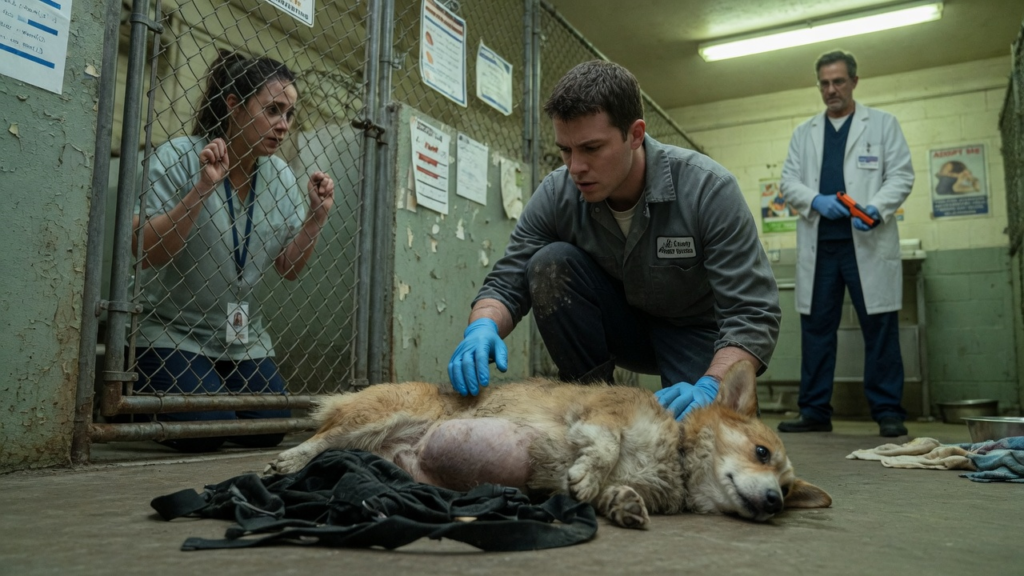
“Watch his teeth!” Sarah screamed, her hands slamming against the chain-link fence of Kennel 42.
I didn’t have time to pull back.
The Corgi’s jaws snapped shut on the thick Kevlar of my right forearm.
The force of his bite was terrifying. It sent a numb, electric shockwave straight up to my elbow.
I heard the sickening crunch of his yellowed canines grinding against the reinforced fabric of the bite sleeve.
This was Subject 42.
And in exactly sixty minutes, he was scheduled to be euthanized.
He had arrived at our county animal control facility three days ago, shoved unceremoniously into the overnight drop box like a bag of unwanted trash.
Normally, Corgis don’t last a single hour in a county shelter before a rescue swoops in to save them. They are highly adoptable. They are the clowns of the dog world, famous for their big ears, stubby legs, and permanent, goofy smiles.
But Subject 42 wasn’t smiling.
Subject 42 was a nightmare.
From the moment the morning shift arrived and found him in the metal drop box, he had been violently, aggressively untouchable.
He had backed himself into the darkest corner of the concrete kennel, his small body trembling so hard that his claws rapidly clicked against the wet floor.
Any time a staff member came within five feet of the cage, he would erupt.
He didn’t just bark. He screamed. It was a high-pitched, frantic sound, accompanied by a low, guttural rattling in his chest that sounded like a flooded engine.
Yesterday, our junior tech, Jimmy, had tried to loop a standard catchpole around the dog’s neck just to scan him for a microchip.
The Corgi had lunged with such blinding speed that Jimmy fell backward, dropping the pole. There was still a smear of blood on the aluminum handle where the dog’s mouth had caught Jimmy’s knuckle.
Since then, nobody had been allowed inside Kennel 42.
Dr. Evans, the exhausted head veterinarian of our underfunded facility, had taken one look at the dog’s chart and made his decision.
“Feral. Highly aggressive. Extreme bite risk.”
He stamped the bright red “EUTHANIZE” sticker on the clipboard and scheduled it for 9:00 AM Tuesday.
It was currently 8:00 AM.
The smell of bleach, wet fur, and raw fear hung heavy in the cold morning air.
I was the facility’s last-resort rehabilitation coordinator. My job was to take the dogs that nobody else wanted to touch and try to find the soul buried underneath the trauma.
I had seen dogs act out of malice. I had seen dogs act out of dominance.
But as I stared at Subject 42 through the chain-link fence, I didn’t see a killer.
I saw a prisoner.
And I saw the harness.
That was the most bizarre part of the entire situation. The Corgi was wearing a massive, heavy-duty tactical harness.
It was military green, constructed from incredibly thick canvas and reinforced with heavy nylon straps. It looked like the kind of gear you would see on a police K9 or a military working dog.
It looked utterly ridiculous on a dog with three-inch legs.
But it wasn’t funny. It was a torture device.
The harness was filthy, completely caked in layers of dried mud, grease, and dark, rusty stains that I desperately hoped weren’t blood.
It was fastened incredibly tight. The nylon straps dug deeply into the dog’s flesh, matting his fur down to the skin.
But that wasn’t the worst part.
Underneath the harness, strapped tightly against the Corgi’s lower chest and underbelly, was a massive, swollen lump.
It was horrific.
It was roughly the size of a large grapefruit, protruding awkwardly from his right side, pressing against his ribcage.
Every time the dog took a breath, the tight canvas of the harness squeezed the mass.
Every time the dog shifted his weight, the heavy plastic buckles scraped against the lump.
And every time it happened, the Corgi would flinch, his eyes squeezing shut in an involuntary spasm of pure agony, before immediately resuming his furious snarling.
“He’s guarding the mass,” Dr. Evans had explained earlier that morning, sipping his black coffee in the breakroom. “It’s either a massive, advanced-stage tumor, or a severely infected abscess that is dangerously close to rupturing.”
“We can’t just operate on it?” I had asked, pleading with the vet.
Dr. Evans had sighed, rubbing his temples. “Mark, we are a county shelter running on donations and a deficit. We do not have the thousands of dollars required to anesthetize an aggressive dog, surgically remove a mass of that size, and provide weeks of post-op care. He is in excruciating pain, and his aggression is an uncontrollable trauma response to that pain.”
Dr. Evans had looked me dead in the eye.
“The most humane thing we can do for him is let him go.”
Now, kneeling inside the kennel with the dog’s teeth clamped down on my arm, Dr. Evans’ words echoed in my head.
Sarah was sobbing outside the kennel. “Mark! Let go! He’s going to tear your arm open!”
I didn’t let go.
I didn’t yell. I didn’t strike the dog. I didn’t even try to pull my arm away.
If you pull back from a dog in full fight-or-flight mode, their predatory instinct takes over. They bite harder. They thrash. They tear.
Instead, I did the exact opposite of what human instinct tells you to do.
I pushed my arm further into his mouth.
I made my arm completely limp, turning it into dead weight.
“It’s okay,” I whispered.
My face was just inches from his. I could smell the metallic tang of his saliva and the rancid, unwashed odor of his coat.
I could see the dilated, terrified whites of his eyes.
“I’m not going to hurt you,” I said softly, keeping my voice entirely devoid of panic. “I know it hurts. I know.”
For ten agonizing seconds, the Corgi kept his jaws locked. His whole body vibrated with a terrifying intensity.
Then, something shifted.
He realized I wasn’t fighting back.
He realized I wasn’t hitting him with a pole or spraying him with a hose.
Slowly, the pressure on my arm began to decrease.
The frantic trembling in his jaw turned into a weak, exhausted quiver.
He opened his mouth.
I slowly, deliberately, pulled my Kevlar-covered arm back, resting it on my knee.
The dog didn’t lunge again. Instead, he scrambled backward until his tail hit the concrete wall.
He collapsed onto his side, panting furiously, his chest heaving up and down.
He looked absolutely defeated. His spirit was broken.
He tucked his chin down, curling his body around the massive lump under his harness in a deeply protective, fetal position.
I glanced up at the clock on the wall outside the kennel.
8:45 AM.
Fifteen minutes.
Dr. Evans would be coming down the hallway with the blue syringe any minute now.
I had fifteen minutes to prove this dog was worth saving. I had fifteen minutes to get that torturous harness off his body.
“Okay, buddy,” I murmured, sliding forward on my knees, ignoring the sharp pain radiating down my bruised arm. “We’re going to get this off you.”
I reached out with my left hand.
The dog watched my hand approach. His lips twitched, exposing a sliver of yellow teeth, but he didn’t growl.
He just let out a long, pathetic, high-pitched whine.
It was the sound of a creature that knew it had lost the fight.
My thick, clumsy fingers brushed against the heavy canvas of the harness.
The material was stiff, coated in layers of grime.
I followed the strap up to the top of his back, right between his shoulder blades.
There was a massive, heavy-duty plastic tactical buckle. The kind you have to squeeze on both sides simultaneously with significant force to release.
I positioned my thumb and index finger on the release prongs.
I pressed down.
Nothing happened.
The mechanism was completely jammed with mud, dried leaves, and grime. It felt like it was glued shut.
“Damn it,” I muttered under my breath.
I pressed harder, my thumb aching against the rigid plastic.
The Corgi whimpered again, shifting his weight.
As he moved, I got a better look at the massive lump protruding from his side.
I frowned.
Something wasn’t right.
I had seen hundreds of tumors in my career. Tumors are usually hard, irregular masses underneath the skin. They feel dense.
I had seen hundreds of abscesses, too. Abscesses are usually hot to the touch, red, and swollen tight like a balloon ready to pop.
But this lump… it didn’t look like either of those things.
For one, the lump itself was covered in the exact same matted, dirty fur as the rest of the dog’s body. But it looked loose.
And the shape was bizarre. It wasn’t perfectly round. It was oblong, almost pill-shaped, stretching from the dog’s armpit all the way down to his groin.
“Mark!” Sarah’s voice snapped my attention back. She was staring down the hallway. “Dr. Evans is coming. He has the dart gun. You need to get out of there right now.”
I could hear the heavy, measured footsteps of the veterinarian echoing on the tile floor.
Panic, cold and sharp, flooded my chest.
I looked back down at the jammed buckle.
I couldn’t fail him. Not when I was this close.
I ripped the Kevlar glove off my right hand with my teeth, spitting it onto the floor.
I needed the dexterity of my bare fingers.
“Mark, what are you doing?!” Sarah shrieked. “If he bites you bare-handed, he’ll hit the bone!”
I ignored her.
I placed my bare thumb and index finger on the jammed buckle.
The Corgi flinched as my warm skin touched his back. He let out a low rumble, a warning sign that his patience was evaporating.
“Please,” I whispered to the dog, tears suddenly stinging the corners of my eyes. “Just give me one second. Please.”
I squeezed the plastic prongs with every ounce of strength I had in my hand. My knuckles turned completely white.
My thumb screamed in pain as the sharp plastic dug into my skin.
Footsteps stopped right outside the kennel.
“Mark, step out of the enclosure immediately,” Dr. Evans’ stern, commanding voice rang out.
I heard the metallic clatter of the dart gun being loaded.
“Just wait!” I screamed back, refusing to look away from the buckle.
I squeezed harder.
CRACK.
The dried mud inside the mechanism suddenly gave way.
The two heavy plastic prongs depressed inward, and with a loud, echoing snap, the buckle exploded open.
The tension on the harness vanished instantly.
The heavy canvas straps fell slack against the dog’s body.
The Corgi let out a massive, shuddering gasp of air, his ribs expanding fully for what must have been the first time in weeks.
He didn’t bite me. He didn’t run.
He just laid his head down flat on the concrete, closing his eyes in sheer relief.
“I got it,” I breathed, my hands shaking uncontrollably. “I got the harness off.”
“It doesn’t matter,” Dr. Evans said coldly from the other side of the fence. “The dog is scheduled. Step away from the mass before it ruptures, Mark. I’m not playing games.”
I grabbed the top handle of the heavy canvas harness.
I gently lifted it up, sliding the thick straps off the dog’s short front legs.
The harness was incredibly heavy. It must have weighed five pounds on its own.
I pulled it completely free and tossed it into the corner of the cage. It hit the floor with a wet, heavy thud.
I turned my attention back to the dog.
I braced myself to see the horror of the exposed tumor. I expected to see raw, infected skin. I expected to see blood and pus.
I slowly leaned forward, peering at the massive lump on his side.
The dim fluorescent light of the kennel flickered, illuminating the dog’s underbelly.
I stared at the lump.
My brain simply stopped functioning.
I blinked. Once. Twice.
I couldn’t process what I was looking at.
The massive, swollen lump… wasn’t attached to the dog’s body.
It wasn’t a tumor. It wasn’t an abscess. It wasn’t a medical anomaly.
The lump was a separate entity, completely detached from the Corgi’s skin. It had simply been pinned fiercely against his side by the suffocatingly tight straps of the tactical harness.
“What… what is that?” Sarah whispered, her face pressed against the chain-link fence, trying to get a better look.
I couldn’t answer her. My throat had completely dried up.
Because as I stared at the dark, matted mass of fur lying next to the exhausted dog…
The mass slowly expanded.
And then it contracted.
It was breathing.
Not the ragged, panicked breathing of the Corgi. This was a separate, tiny, rhythmic rising and falling.
The Corgi opened one eye, looking at me cautiously.
He didn’t growl. He didn’t bare his teeth.
Instead, he slowly lowered his snout, nudging the strange, breathing lump with his wet nose.
He licked it. Gently, tenderly.
And then, from deep inside the tangled, filthy mass of fur, a sound emerged.
It wasn’t a bark. It wasn’t a growl. It wasn’t anything a dog should ever sound like.
It was a tiny, fragile, impossibly high-pitched noise that sent a violent shiver down my spine and made my heart completely stop in my chest.
Dr. Evans slowly lowered the dart gun, his face turning entirely pale.
“Mark…” the veterinarian whispered, his voice trembling for the first time since I’d met him. “What the hell is that?”
CHAPTER 2
The sound in the kennel vanished.
The only thing I could hear was the frantic thudding of my own pulse in my ears, heavy and deafening.
Dr. Evans stood perfectly still in the hallway. The heavy metal barrel of the tranquilizer gun was still raised, gleaming sharply under the harsh, flickering fluorescent lights of the shelter.
His finger was still resting dangerously close to the trigger.
“Did you hear that?” Sarah’s voice cracked. She was pressing her face against the chain-link fence, her fingers gripping the metal wire so tightly her knuckles had turned completely white.
I couldn’t answer her. My throat felt like it was coated in sand.
I was entirely mesmerized by the dirty, matted mass of fur lying on the wet concrete floor.
It was completely detached from the Corgi. The suffocating military harness was gone. Yet, the dog refused to pull away from the strange bundle.
The Corgi’s breathing was ragged. His ribs expanded and contracted in sharp, painful gasps now that the agonizing pressure was finally off his chest.
But his dark, terrified eyes never left the lump of fur.
Then, the sound happened again.
It was a tiny, muffled squeak.
It sounded desperate. It sounded like a creature taking its final, struggling breaths at the bottom of a deep well.
But as I leaned in closer, my blood suddenly ran cold.
That wasn’t just one squeak.
There were two distinct, overlapping pitches.
“Mark,” Dr. Evans’ voice sliced through the heavy silence. The clinical, detached tone of the head veterinarian was back, replacing his momentary shock. “Step away from the animal right now.”
I didn’t move. My bare knees were soaking wet from the chemical-laced water on the kennel floor.
“Doc, there’s something alive in there,” I whispered, pointing a shaking finger at the matted bundle. “He wasn’t guarding a tumor. He was protecting this.”
“I don’t care if it’s a litter of golden retrievers,” Dr. Evans snapped, taking a heavy step closer to the cage. “That dog is a Category 4 bite risk. He just had his jaws locked onto your forearm for two minutes.”
“He let go!” I argued, my voice rising.
“Because he’s exhausted, Mark! The adrenaline is crashing. In exactly thirty seconds, his fight-or-flight response is going to reboot, and he is going to tear your face open.”
Dr. Evans raised the tranquilizer gun until it was aimed directly at the Corgi’s trembling shoulder.
“I am darting him. Protocol dictates we neutralize the immediate threat before investigating secondary anomalies. Move.”
“No!” Sarah screamed from the hallway, slamming her hands against the fence.
I reacted purely on instinct.
I threw my upper body forward, positioning my back directly between the barrel of the tranquilizer gun and the exhausted Corgi.
“Mark, what the hell are you doing?!” Dr. Evans roared. “Are you insane? That dart is loaded with enough chemical to drop a mastiff. If you take that dart in the spine—”
“Give me two minutes,” I begged, staring at the vet through the chain-link grid. “Just two minutes. If I can’t separate whatever is in that fur from the dog in two minutes, you can dart him. You can dart both of us.”
Dr. Evans stared at me. His jaw muscles clenched so hard I thought his teeth might crack.
He glanced up at the clock on the wall.
It was 8:51 AM.
Nine minutes until the dog’s official, legally mandated euthanasia time.
“Two minutes,” Dr. Evans hissed, slowly lowering the barrel of the gun toward the floor, but keeping his finger firmly on the trigger guard. “And if that dog so much as twitches his lip at you, I am putting him to sleep permanently.”
I nodded quickly, swallowing hard.
I slowly turned my attention back to the Corgi.
The sudden shouting match had terrified him all over again. He had dragged himself backward, his spine pressed painfully into the sharp corner of the concrete wall.
He was snarling again.
It wasn’t a warning growl this time. It was a guttural, desperate sound bubbling up from deep within his chest, rattling with mucus and sheer terror.
He had dragged the matted lump of fur with him.
He had pinned it beneath his short front paws, hovering his heavy head over it like a dragon fiercely guarding a hoard of treasure.
“Hey, buddy,” I whispered, keeping my voice as low and soothing as humanly possible. “It’s just me. I got the bad harness off. I’m not going to hurt you.”
I extended my bare, unprotected hand toward him, palm facing up.
A peace offering.
The Corgi snapped his jaws violently at the empty air, the sharp clack of his teeth echoing in the small enclosure. He missed my fingers by less than an inch.
Sarah gasped loudly behind me.
“That’s one,” Dr. Evans warned coldly from the hallway.
“He’s just scared,” I said quickly, not breaking eye contact with the dog.
I didn’t pull my hand back. I kept it suspended in the air, inches from his snarling snout.
Slowly, carefully, I lowered my gaze to the matted bundle beneath his paws.
It looked like a piece of roadkill. It was a solid, hardened mass of mud, grease, and tightly woven gray fur. It smelled like raw sewage and metallic blood.
But as I watched, the bundle shivered.
A tiny, impossibly frail pink nose pushed its way through a crack in the hardened mud.
It was a newborn kitten.
It couldn’t have been more than a few days old. Its eyes were still tightly sealed shut. It opened its mouth, letting out another desperate, silent scream.
And then, right beside it, a second tiny pink nose poked through the grime.
Two kittens.
“Oh my god,” Sarah sobbed, covering her mouth. “They’re babies.”
“How is that even possible?” Dr. Evans muttered, his professional detachment finally slipping. “How did two feral kittens end up strapped underneath a tactical harness on a stray dog?”
“Someone put them there,” I said, a wave of profound, burning nausea hitting my stomach.
I looked at the way the fur was mangled. This wasn’t an accident. This wasn’t a dog finding orphaned kittens in a ditch and trying to keep them warm.
This was deliberate.
“Someone packed these kittens against his ribs and locked the harness over them,” I said, my voice trembling with a sudden, violent rage. “They used him as a walking tomb.”
The Corgi whined, a high, heartbreaking sound. He gently nudged one of the tiny pink noses with his own dirty snout.
“Mark, you have to get them away from him,” Dr. Evans said urgently. “If he panics and steps on them, or if he rolls over, he’s going to crush them instantly. They are incredibly fragile.”
“I know,” I breathed.
I moved my hand closer.
The Corgi’s lips curled back, exposing his yellowed fangs. He let out a deep, warning rumble.
“I need to take them, buddy,” I whispered to the dog. “You’ve done a good job. You kept them safe. But I need to take them now.”
I slowly reached my fingers toward the hardened shell of matted fur.
The instant my skin brushed against the bundle, the Corgi erupted.
He didn’t bite me. Instead, he violently shoved his head under my hand, throwing his entire body weight forward to block me from touching the kittens.
He slammed his heavy skull against my chest, knocking me backward onto the wet concrete.
“Mark!” Sarah screamed.
“That’s it, I’m taking the shot!” Dr. Evans yelled, immediately raising the dart gun.
“Wait!” I yelled, scrambling back to my knees. “He didn’t bite! He was just blocking me!”
“He is highly unstable!” the vet roared back. “He is one misfire away from killing those kittens himself!”
I looked back at the dog.
He hadn’t retreated to the corner. He was standing directly over the bundle of fur, his short legs trembling violently under the strain of his own weight.
He was staring directly at me. His chest heaved.
But he wasn’t snarling anymore.
He was crying.
Thick, wet tears were visibly streaming down his dirty face, cutting clean tracks through the grime on his cheeks.
He looked at me, then looked down at the bundle, then back at me.
It was the most human expression of absolute despair I had ever seen on an animal.
He wanted help. He was begging for help. But his trauma wouldn’t let him surrender control.
“Okay,” I whispered, my own vision blurring with tears. “Okay. We do this together.”
I didn’t reach for the bundle this time.
Instead, I reached out and gently placed my hand flat against the side of the Corgi’s neck.
He flinched violently, his whole body stiffening like a board. I expected his teeth to sink into my wrist at any second.
I held my breath.
Five seconds passed. Then ten.
Slowly, the tension began to drain out of his neck. He lowered his head, pressing his cold, wet nose against my knee.
He surrendered.
“Good boy,” I choked out. “You’re a good boy.”
With my right hand firmly but gently massaging the back of the dog’s neck, I used my left hand to carefully pull the matted bundle of fur out from beneath his front paws.
It was surprisingly heavy.
I pulled it into my lap, keeping it right next to the dog so he could still see and smell it.
“Sarah,” I called out, my voice tight. “Go to the trauma cart. Get me the electric clippers, some warm saline, and a pair of surgical scissors. Fast.”
Sarah didn’t hesitate. She bolted down the hallway, her boots slipping on the tile.
I looked down at the mass in my lap.
It was completely encased in a hard shell of dried mud, grease, and… something else.
I ran my thumb over the hardened surface. It felt sticky, yet rock solid.
I realized with a sick jolt what it was.
Industrial adhesive. Gorilla glue.
Someone hadn’t just placed the kittens against the dog’s chest. They had glued the kittens’ soft fur directly into the thick, wiry coat of the Corgi, creating one inseparable, horrifying mass, before strapping the tight harness over everything.
“Doc,” I said, my voice barely a whisper. “It’s glue. They’re glued together.”
Dr. Evans slowly lowered the gun, walking right up to the chain-link fence. He peered through the metal diamonds, his eyes wide with horror.
“Dear god,” he breathed. “If that adhesive has seeped into their skin… peeling it off will tear their dermal layer completely. They’ll bleed to death.”
Sarah rushed back, sliding to a halt in front of the kennel. She shoved a plastic bin filled with medical supplies under the gap at the bottom of the fence.
“Here!” she panted. “Clippers, saline, scissors.”
I grabbed the heavy-duty electric clippers. My hands were shaking so badly I could barely flick the power switch.
The clippers buzzed to life with a loud, aggressive hum.
The Corgi immediately panicked at the sound. He tried to scramble backward, but he was too weak. He just whined, pawing frantically at my knee.
“It’s okay, it’s okay,” I shushed him, pressing my forearm gently against his chest to keep him steady.
I took a deep breath, aiming the vibrating metal teeth of the clippers at the thickest part of the matted fur, trying to find a seam between the kittens and the glue.
I pressed the clippers in.
Instantly, the machine choked. The motor made a horrible, grinding screech, and the blades stopped dead.
“What’s wrong?” Sarah asked in a panic.
“The glue is too thick,” I muttered, pulling the clippers back. “It jammed the blades instantly. It’s like trying to cut through concrete.”
“Use the surgical scissors,” Dr. Evans instructed sharply. “Small, precise cuts. You have to separate the mass from the kittens’ bodies without nicking their skin.”
I dropped the useless clippers and picked up the small, sharp stainless-steel scissors.
The kittens were screaming silently, their tiny mouths wide open, suffocating inside their glued prison.
I carefully wedged the sharp tip of the scissors into a tiny gap near the first kitten’s pink nose.
I squeezed the handles.
The scissors bit into the hardened mass.
Suddenly, a sharp, metallic clink echoed from the blades.
The scissors couldn’t cut through.
I frowned, pushing harder. The metal handles dug painfully into my fingers.
Clink.
“It won’t cut,” I said, a fresh wave of panic rising in my chest.
“They’re surgical steel, Mark, they can cut through bone,” Dr. Evans snapped. “Squeeze harder!”
“I am!” I yelled back. “There’s something inside the fur!”
I dropped the scissors and used both of my thumbs to aggressively pry apart the hardened mass of glued fur near the kitten’s head.
The glue cracked, peeling back just a fraction of an inch.
Underneath the fur, buried deep inside the hardened adhesive, something dark and metallic caught the harsh fluorescent light.
I stared at it. My brain refused to process the image.
It wasn’t just glue.
Wrapped tightly around the tiny, fragile bodies of both kittens, binding them together like a terrifying package, was a thick, rusty strand of industrial barbed wire.
And as I followed the line of the wire with my eyes, I realized the ultimate, horrifying truth.
The wire didn’t just bind the kittens.
It extended out of the glued mass, plunging directly, deeply, into the raw, bleeding flesh of the Corgi’s underbelly.
They weren’t just strapped to him.
They were anchored into him.
“Mark,” Dr. Evans said, his voice dropping to a terrified whisper. “Look at the clock.”
I looked up.
It was 8:58 AM.
Two minutes.
And if I pulled this bundle away from the dog right now, the barbed wire would tear his stomach entirely open.
CHAPTER 3
The world outside that kennel ceased to exist.
The barking of the three hundred other dogs in the facility, the hum of the industrial fans, the distant sound of a garbage truck—it all faded into a dull, grey roar.
All that mattered was the 8:59 AM flickering on the digital clock and the jagged, rusty metal biting into the Corgi’s ribs.
“Mark, don’t move,” Dr. Evans said, his voice dropping an octave.
I looked up. The veterinarian wasn’t looking at the kittens anymore.
He was looking at the Corgi’s abdomen.
The barbed wire wasn’t just resting against the skin.
As the dog breathed, I could see the wire actually sliding in and out of three distinct puncture wounds.
Whoever had done this hadn’t just wrapped the wire around the dog.
They had used a piercing tool to thread the wire through the subcutaneous layer of the Corgi’s flank, anchoring the kittens to his living muscle.
It was a biological harness. A living cage.
“If you pull that bundle,” Evans whispered, “you’ll trigger a massive internal hemorrhage. He’ll bleed out on this concrete in under sixty seconds.”
“I have to get it out,” I said, my voice sounding like it belonged to a stranger.
“We don’t have the equipment here!” Evans yelled, his professional composure finally shattering. “He needs a sterile surgical suite, four units of blood, and a vascular specialist. We are in a county kill-shelter with a budget of fifty cents and a dart gun!”
The Corgi let out a long, low moan.
His head was resting on my thigh now. He wasn’t snarling.
He was looking up at me with those deep, liquid brown eyes, and for the first time, I didn’t see aggression.
I saw a father.
I saw a protector who had endured weeks of agony just to keep two tiny heartbeats going.
He had become a monster to the world so that nobody would get close enough to see his weakness—the two lives he was carrying.
He had fought us because he thought we were there to finish the job his owner had started.
Sarah was back at the fence, her face streaked with tears. “Mark, look at the kittens. They’re stopping.”
I looked down at the matted lump in my lap.
The tiny pink noses were no longer twitching.
The rhythmic rising and falling of the fur had slowed to a crawl.
The cold of the concrete floor and the lack of blood flow from the Corgi’s warmth were killing them.
“They’re fading,” I said, a cold lump forming in my throat. “Doc, if we wait for a transport, they’re dead. If we wait for a miracle, they’re dead.”
“And if you cut that wire now, the dog is dead!” Evans countered.
The heavy metal door at the end of the hallway creaked open.
“Evans! Is it done yet?”
A tall man in a crisp, tan uniform stepped into the hallway.
It was Miller, the Director of Animal Control.
Miller didn’t care about rehabilitation. He cared about liability.
He cared about the three people Subject 42 had tried to bite in the last forty-eight hours.
“We have the county inspectors coming in at ten,” Miller barked, checking his watch. “I want that kennel cleaned and sanitized. Why is the aggressive Corgi still breathing?”
Dr. Evans turned, shielding the view of the kennel with his body. “We have a complication, Miller. Give us ten minutes.”
“The clock says 9:01, Evans,” Miller said, walking toward us, his heavy boots echoing like gunshots. “Policy is policy. That dog is a liability. If he’s not down in the next sixty seconds, I’ll file a report that you’re obstructing public safety.”
Miller reached the fence and looked in.
He saw me sitting in the blood and grime, holding a snarling “monster” in my lap.
He saw the matted bundle of fur.
“What is this? A science project?” Miller sneered. “Evans, use the dart. Now. Or I’ll call the police to come in here and discharge a firearm.”
The Corgi felt the shift in energy.
He felt the arrival of a predator.
He tried to stand up, his front legs buckling under the weight of the barbed wire.
He let out a bark so filled with pain and fury that Miller actually jumped back.
“See?” Miller pointed a trembling finger. “He’s dangerous! Kill it!”
“He’s a hero!” I screamed at the top of my lungs, my voice echoing off the concrete walls.
The entire hallway went silent. Even the dogs in the other kennels seemed to stop barking for a split second.
“He’s not aggressive, Miller,” I said, my voice shaking with rage. “He’s a victim of a level of cruelty I didn’t think existed. Look at his chest.”
I tilted the Corgi back just enough for the light to hit the puncture wounds and the rusty wire.
Miller squinted. He saw the wire. He saw the kittens.
For a second, I saw a flash of human emotion on his face.
Then, the bureaucrat took back over.
“It doesn’t matter,” Miller said, though his voice was quieter. “He’s mangled. Even if you get that wire out, he’s a medical wreck. We don’t have the funds. The kittens won’t survive the hour anyway. End it. For all of them. It’s the only mercy they have left.”
I looked down at the Corgi.
He was licking my bare hand.
It was a goodbye.
He knew. Animals always know when the light is fading.
He nudged the kitten bundle toward me one last time, a final request from a dying soldier.
Save them. Forget me.
“No,” I whispered.
I looked at Sarah. “Hand me the heavy-duty wire cutters from the maintenance kit. The ones with the insulated handles.”
“Mark, what are you doing?” Evans asked, his hand hovering over the dart gun.
“I’m going to cut the anchors,” I said.
“You’ll kill him!”
“He’s already dead according to the clock!” I snapped. “If I’m going to lose him, I’m going to lose him trying to give him one second of life without that metal in his gut.”
Sarah shoved the heavy wire cutters through the bottom of the fence.
I grabbed them. They were cold and heavy.
I looked at Dr. Evans.
“Doc, if you’re going to help, get the hemostats and the pressure bandages ready. If you’re not, get out of the way so I can work.”
Evans looked at Miller. Miller looked at the floor.
The veterinarian let out a long, shaky breath.
He set the tranquilizer gun down on the floor.
“Sarah, get the portable oxygen tank and the heating pads,” Evans ordered. “Miller, if you want to be a director, go call the emergency vet hospital in the city. Tell them we have a Level Red trauma incoming. Tell them I’m paying for it out of my own damn pocket.”
Miller hesitated for a second, then turned and ran toward the office.
“Okay, Mark,” Evans said, kneeling on the other side of the fence. “You have to be surgical. If you twist that wire while you cut, you’ll shred the artery. You have to clip it clean, then I’ll reach through the fence and clamp the wound immediately.”
I nodded.
I positioned the heavy blades of the wire cutters against the first rusty strand.
The Corgi watched me.
He didn’t move. He didn’t blink.
He stayed perfectly still, as if he understood that his life was hanging by a single, metallic thread.
I squeezed the handles.
Snap.
The first wire broke.
A spray of dark, venous blood hit my shirt.
The Corgi flinched, a small whimper escaping his throat, but he stayed grounded.
“Clamp!” Evans yelled.
He shoved his gloved hands through the chain-link, his fingers finding the wound and applying massive pressure.
“Next one,” Evans urged. “Quickly!”
I moved the cutters to the second anchor. This one was deeper. It was buried near the diaphragm.
Every time the dog breathed, the wire moved.
I had to timing it perfectly.
I waited for the exhale.
Snap.
The second wire was free.
The Corgi’s head fell onto the concrete. His eyes began to roll back in his head.
He was going into shock.
“He’s losing too much!” Sarah cried, returning with the oxygen.
She shoved the mask through the fence, and I pressed it against the dog’s snout.
“One more,” I whispered, my vision blurring from the sweat stinging my eyes. “Just one more, buddy. Stay with me.”
The final wire was the one holding the kittens’ matted fur to his groin. It was twisted into a knot.
I couldn’t get the cutters around it.
The wire was too tight against the skin.
“I can’t get a grip,” I said, panic rising.
The Corgi’s heart was racing. I could feel it thumping against my leg like a trapped bird.
Then, the dog did something impossible.
With his last ounce of strength, he arched his back, stretching his skin tight, exposing the knot of the wire just enough for the blades to slip underneath.
He was helping me.
He was sacrificing his last bit of energy to make the final cut possible.
I didn’t hesitate.
I squeezed.
The final wire gave way.
The matted bundle of fur fell away from his body, completely detached.
“Got it!” I yelled.
But the victory was short-lived.
The Corgi’s body went completely limp.
The frantic thumping of his heart slowed… and then it stopped.
The silence in the kennel was absolute.
“He’s gone,” Sarah whispered, her hand over her mouth. “He’s gone.”
I looked at the dog. I looked at the two kittens, still trapped in their glue-prison, barely shivering.
I felt a hollow, crushing weight in my chest.
We were too late.
The clock on the wall read 9:05 AM.
I had saved him from the wire, only to watch him die on the floor.
I reached out to close the Corgi’s eyes.
But as my fingers touched his eyelid, I felt something.
A tiny, microscopic vibration.
A twitch.
I looked down at the dog’s chest.
It wasn’t moving.
But then, I looked at the kittens.
The matted bundle was lying three inches away from the dog’s nose.
The first kitten, the one with the pink nose, let out a tiny, pathetic cry.
The Corgi’s ear flickered.
His eyes didn’t open, but his tail… his tiny, stubby Corgi tail… gave one, single, weak wag against the concrete floor.
“He’s still in there!” I screamed. “Doc, he’s still in there!”
Evans didn’t waste a second. “Pass him through the gate! Now!”
We lifted the bloody, broken Corgi and slid him through the kennel door. Evans and Sarah began working on him with the intensity of a battlefield trauma team.
I stayed inside the kennel.
I was alone with the matted bundle of fur.
The “tumor.”
The “danger.”
I picked up the kittens. They were cold as ice.
I tucked them inside my own shirt, pressing them against my skin to give them the warmth they had been stealing from the Corgi for weeks.
I looked at the tactical harness lying in the corner.
The “military-green” harness that had hidden this crime.
I noticed something I had missed before.
Inside the lining of the harness, there was a small, hand-written tag.
It wasn’t a brand name.
It was a name and a phone number.
And as I read the name, the final piece of the puzzle clicked into place, and my blood turned to pure, sub-zero ice.
The person who had done this wasn’t a stranger.
And they weren’t done with this dog.
CHAPTER 4
The sirens of the transport van were still wailing in my ears long after the Corgi had been rushed through the double doors of the Metropolitan Veterinary Specialty Hospital.
I sat on the cold plastic chair of the waiting room, my hands still stained with the dark, copper-scented blood of a dog who had given everything to save two lives that weren’t even his own species.
I looked down at the tactical harness sitting in the plastic evidence bag between my feet.
The handwritten tag inside was staring back at me.
Property of: Robert “Bobby” Vance. Phone: 555-0192.
I didn’t need to look up the number. I didn’t need to check the local directory.
I knew that number by heart because I had dialed it every single week for the last three years.
Bobby Vance was the Chairman of the Board for our county shelter.
He was the “Grand Benefactor.” The man whose face was on every brochure, the man who stood next to the Mayor at every charity gala, shaking hands and talking about “giving a voice to the voiceless.”
Bobby Vance wasn’t just a donor. He was the man who decided who got hired, who got fired, and which animals were “too expensive” to keep alive.
He was the one who had pushed for the strict 72-hour euthanasia policy for “aggressive” dogs.
My stomach did a violent, sickening flip.
It wasn’t just a random act of cruelty.
It was a setup.
Vance had engineered a “monster” so he could justify his policies. He had taken a gentle, loyal Corgi, a dog he likely owned privately, and turned him into a living nightmare of pain and barbed wire.
He had expected the dog to be put down within hours. He had expected the “tumor” to be buried in a mass grave at the county landfill, hiding the evidence of the kittens and the wire forever.
He wanted to prove that “vicious” dogs couldn’t be saved, all while using his military-grade hardware to perform a sick, twisted experiment on the limits of animal endurance.
“Mark?”
I looked up. Sarah was standing over me, her face pale, holding two small bundles wrapped in warm, white towels.
“They’re stable,” she whispered, her voice trembling with a mix of exhaustion and relief. “The vet tech used a specialized solvent to dissolve the industrial glue. They have some skin irritation and they’re dehydrated, but they’re nursing from a bottle now.”
She sat down next to me, showing me the two tiny, tuxedo-patterned kittens. Their eyes were still closed, but they were warm. They were breathing.
“How is he?” I asked, nodding toward the surgical wing.
Sarah’s expression darkened. “It’s bad, Mark. Dr. Evans is in there with their head surgeon. The barbed wire had barbs that were nearly an inch long. They had to resect a portion of his abdominal wall. He’s lost a lot of blood. They don’t know if his heart can take the stress of the anesthesia.”
We sat in silence for a long time. The only sound was the rhythmic click-click-click of the kittens’ tiny mouths on the bottle Sarah was holding.
Suddenly, the heavy glass front doors of the hospital swung open.
A man in a custom-tailored navy suit stepped into the lobby. He was tall, silver-haired, and radiated the kind of practiced authority that made people instinctively stand up straighter.
Bobby Vance.
He looked around the lobby, his eyes landing on me and the blood on my shirt. He didn’t look like a man coming to save a dog. He looked like a man coming to clean up a mess.
“Mark,” he said, his voice smooth and commanding. “I heard there was an incident at the shelter. Miller called me. He said you interfered with a scheduled euthanasia and moved a Category 4 animal to a private facility without authorization.”
He walked toward us, his expensive leather shoes clicking on the linoleum.
“I’m here to take over, son. This is a liability nightmare for the county. You’ve put us all at risk.”
I stood up. My legs felt like lead, but my heart was burning with a cold, focused fire.
“He’s not a Category 4, Bobby,” I said, my voice steady.
Vance stopped three feet away. He glanced at the kittens in Sarah’s lap, then back at me. A tiny, almost imperceptible muscle in his jaw twitched.
“He’s a dangerous animal that should have been put down at 9:00 AM,” Vance said. “Where is he? I have a transport team outside. We’re moving him back to the county facility for final processing.”
“He’s in surgery,” I said. “And he’s not going anywhere.”
Vance narrowed his eyes. “Mark, don’t be a hero. You’re a low-level employee. I am the Chairman. I’ve already contacted the police. You’ve stolen county property.”
“I found your tag, Bobby,” I whispered.
The lobby went dead silent.
Vance froze. The “benefactor” mask didn’t slip, but the eyes behind it turned into shards of ice.
“I don’t know what you’re talking about,” he said.
I reached into the evidence bag and pulled out the green harness. I held the tag up so he could see his own handwriting.
“The barbed wire was threaded through his skin,” I said, my voice rising so that everyone in the waiting room could hear. “The kittens were glued to his chest. You used this dog to create a fake narrative of aggression. You tortured him for your own sick agenda.”
Vance took a step closer, his voice dropping to a low, dangerous hiss. “Nobody will believe you. I’m the biggest donor in this city. You’re a guy who cleans up dog poop for a living. That tag proves nothing. I’ll say the dog was stolen from me months ago by a disgruntled employee. Like you.”
He reached out to grab the harness from my hand.
“Don’t touch it,” a new voice boomed.
Dr. Evans was standing in the doorway of the surgical wing. He was covered in blood, his surgical mask hanging around his neck.
But he wasn’t alone.
Next to him stood a man in a police uniform—the hospital’s security detail—and Dr. Evans was holding a smartphone.
“I heard everything, Bobby,” Evans said, his voice shaking with fury. “The intercom in the surgical suite was on. We were using it to coordinate with the lab. The whole staff heard you.”
Vance turned, his face finally turning a sickly, mottled grey.
“This is a misunderstanding,” he stammered, his hands beginning to shake. “I was… I was testing the shelter’s response times. It was a simulation—”
“Save it for the grand jury,” the police officer said, stepping forward and placing his hand on his handcuffs. “Mr. Vance, you’re under arrest for felony animal cruelty and filing false reports.”
As they led Bobby Vance out of the hospital in handcuffs, he didn’t look like a titan of industry. He looked like a coward.
I turned to Dr. Evans. My breath was hitched in my throat.
“Is he…?”
Evans looked at me, a tired, genuine smile finally breaking through the grime on his face.
“He’s a fighter, Mark. I’ve never seen anything like it. His heart stopped twice on the table, but every time those kittens cried in the recovery room next door… he came back. He refused to let go.”
Evans stepped aside.
“You want to see him?”
I followed Evans into the recovery ward.
The room was dim and quiet. In the center, on a large heated bed, lay the Corgi.
His chest was shaved and covered in thick, white bandages. He had IV lines in both front legs. He looked small. He looked fragile.
But as I walked toward the bed, his ears flickered.
He opened his eyes. They were clear. They were soft.
The “monster” was gone. Only the hero remained.
Sarah walked in behind me and gently placed the two kittens on the bed, just a few inches from the Corgi’s nose.
The kittens immediately crawled toward the warmth of the dog’s body, burying their tiny faces into his fur.
The Corgi let out a long, contented sigh. He didn’t have the strength to lift his head, but he nudged the kittens with his nose, a soft, protective gesture that brought everyone in the room to tears.
He wasn’t Subject 42 anymore.
“What are you going to name him?” Sarah asked, wiping her eyes.
I looked at the dog. I thought about the hour he had left, the wire in his skin, and the way he had looked at me when he surrendered.
“Arthur,” I said. “Because he’s a king.”
Six months later.
The sun was shining over the park behind the new, non-kill shelter—the one funded by the assets seized from the Bobby Vance Foundation.
A short-legged, energetic Corgi was racing across the grass, his “lucky” orange harness bright against his golden fur. He had a slight limp in his back leg, a permanent reminder of the wire, but it didn’t slow him down for a second.
“Arthur! Come!” I called out.
Arthur turned, his big ears flopping, and sprinted toward me.
But he wasn’t alone.
Two nearly full-grown tuxedo cats were racing right alongside him, weaving between his legs and playfully batting at his ears.
They were inseparable.
They slept together, ate together, and to this day, the cats refuse to sleep unless they are curled up against Arthur’s chest—right where they had been protected during the darkest hour of their lives.
Arthur reached me and flopped onto his back, tongue lolling out in a massive, goofy grin.
I knelt down, rubbing his belly—the belly that was now covered in soft, healthy fur, with only the faintest white scars to show where the barbs had been.
“You did it, buddy,” I whispered. “You saved them. And you saved us, too.”
Arthur let out a happy “woof” and licked my face, while the two cats purred loudly against his side.
Everyone thought he was too dangerous to save.
But it turns out, he was just waiting for someone to be brave enough to see the heart beneath the harness.