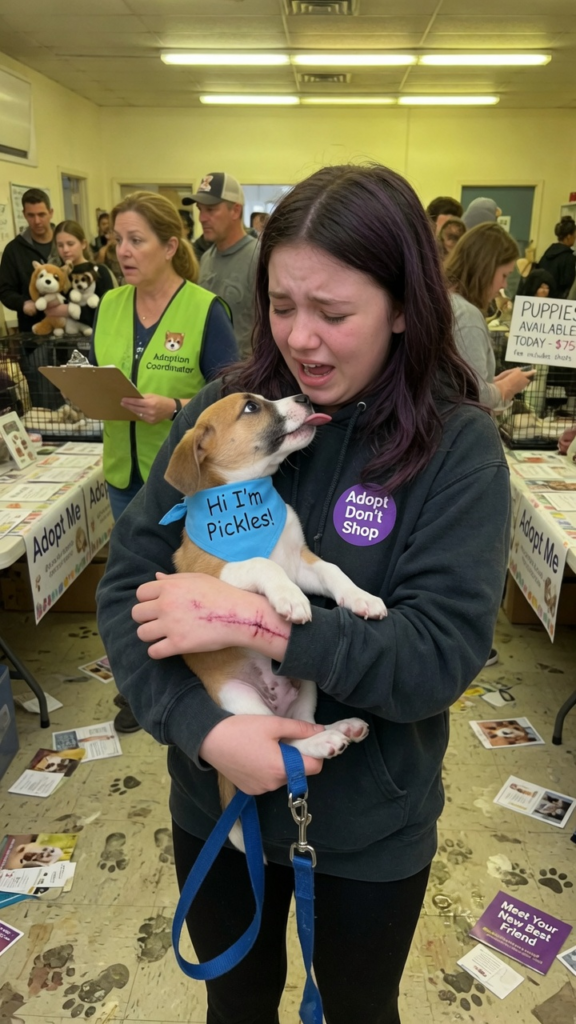
The clatter of the heavy metal leash clip hitting the sun-baked asphalt sounded like a gunshot over the dull, happy roar of the Sunday farmers market.
It wasn’t the sound itself that made my stomach drop. It was the absolute, frozen terror in the young woman’s eyes right after she dropped it.
It was a sweltering late-July afternoon in Oak Creek, the kind of midwestern summer day where the air feels heavy, wet, and thick enough to chew. The asphalt was radiating heat right through the soles of my beat-up Converse.
I was volunteering at the Second Chance Hounds adoption tent, sweating through my blue rescue t-shirt, trying to keep a dozen restless shelter dogs hydrated and happy.
My name is Sarah. I’m thirty-two, a former emergency room nurse, and currently a full-time medical equipment sales rep. I left the ER three years ago because I had a bad habit of taking the trauma home with me.
I couldn’t leave the worst days of other people’s lives at the hospital doors. I absorbed them.
Volunteering at the dog rescue was supposed to be my safe place. Dogs are simple. They tell you exactly how they feel. When they’re scared, they cower. When they’re happy, their whole body wags. There’s no deception, no hidden motives, no polite smiles covering up domestic nightmares.
Or so I thought.
Ben, the founder of Second Chance Hounds, was busy trying to untangle three golden retriever mixes who had decided to braid their leashes around the leg of our pop-up canopy. Ben is forty-five, built like a retired linebacker, and has a slight limp in his left leg from a bad bite he took years ago pulling a fighting dog out of a basement.
He’s gruff, intensely pragmatic, and completely oblivious to subtle human emotions. He speaks “dog” fluently, but human beings often baffle him.
“Sarah, grab Barnaby, will you?” Ben had shouted over his shoulder, wiping sweat from his forehead with the back of a dirt-streaked hand. “He’s getting anxious with the foot traffic.”
Barnaby was a scruffy, wire-haired terrier mix with one floppy ear, one straight ear, and a heart far too big for his twenty-pound body. He was a stray, found wandering an industrial park, and he desperately craved human contact.
That’s when I saw her.
She was standing at the edge of our shaded canopy. She looked young, maybe nineteen or twenty, with dark hair pulled back into a messy bun that looked like it had been slept in.
But what immediately caught my former-ER-nurse eye was her outfit. It was ninety-two degrees with eighty percent humidity, and she was wearing a thick, oversized, long-sleeved gray flannel shirt buttoned all the way up to her collarbone. She had on dark, heavy jeans and closed-toe boots.
She was sweating. Profusely. A fine sheen of moisture coated her pale face, and her hands were jammed deep into her pockets.
I watched her for a moment. People often hover at the edge of adoption events. They want to pet the dogs, but they know they can’t afford one, or their landlord doesn’t allow pets, so they stand on the perimeter, soaking in the secondhand joy.
But she wasn’t looking at the dogs with casual longing. She was staring at Barnaby like he was a life raft and she was drowning.
I grabbed Barnaby’s leash, grabbed a handful of liver treats from my left pocket—I always carry the exact same brand, it’s a superstitious habit of mine—and walked over to her.
“Hi,” I said, keeping my voice soft, the way I used to when approaching a skittish patient. “This is Barnaby. Would you like to say hello? He’s a professional cuddler.”
She jumped slightly when I spoke, her shoulders instantly creeping up toward her ears. A defensive posture.
“Oh. Um. I don’t know,” she whispered. Her voice was incredibly quiet, raspy, as if she hadn’t spoken out loud in days.
“He’s very gentle,” I assured her, letting the leash out just enough so Barnaby could approach.
Barnaby didn’t jump. He didn’t bark. As if sensing the fragility of the girl in front of him, the little terrier simply walked up to her scuffed boots and sat down, looking up at her with big, soulful brown eyes. Then, he gently placed one paw on her toe.
A choked, muffled sound escaped the girl’s throat. It sounded like a sob she had forcefully swallowed.
Slowly, her hands came out of her flannel pockets. She sank to her knees right there on the dirty, hot asphalt, ignoring the grime.
She didn’t pet him normally. She didn’t scratch his ears or rub his belly. She wrapped both of her arms completely around the little dog and buried her face in his scruffy neck.
She was hugging him tightly. Too tightly, I thought at first. I instinctively reached out, worried she might frighten Barnaby or squeeze him too hard.
But Barnaby didn’t mind. He leaned his weight into her chest, letting out a soft sigh, resting his chin on her shoulder.
I stood there, holding the end of the leash, giving her a moment. It was a beautiful, heartbreaking sight. I figured she was just going through a tough breakup, or maybe she missed a childhood pet. People get emotional around dogs. It happens every weekend.
“He likes you,” I said gently. “I’m Sarah, by the way.”
She didn’t look up from the dog’s fur, but she whispered, “Maya.”
“It’s nice to meet you, Maya. Do you have dogs at home?”
Maya shook her head rapidly, still burying her face. “No. Not allowed.”
That’s when the shift happened.
Barnaby, being a dog who wants to reciprocate affection, turned his head. Maya had her arms wrapped tight around him, her wrists exposed near his face.
The little terrier extended his tongue and gave her right wrist a long, affectionate lick.
It wasn’t a bite. It wasn’t a nip. It was just a soft, wet tongue.
But the moment the dog’s tongue touched the skin of her wrist, Maya let out a sharp, breathless gasp.
It wasn’t a startled sound. It was a sound of pure, agonizing physical pain.
She flinched so violently that she threw herself backward. Her arms snapped back to her chest, and she scrambled away crab-style on the asphalt.
The movement was so sudden and violent that the nylon leash whipped out of my loosely gripped hand, the heavy metal clasp clattering loudly onto the ground.
Barnaby stood there, confused, his tail dropping between his legs.
“Maya! Are you okay?” I dropped to a crouch, reaching for the leash but keeping my eyes locked on her.
She was panting, her eyes wide with a panicked, hunted look. She was gripping her right wrist with her left hand, holding it tight against her stomach.
In her frantic scramble backward, the oversized sleeve of her heavy flannel had ridden up her forearm. Just an inch. Maybe two.
But as a former ER nurse, an inch is all I needed.
I saw it.
It wasn’t just a bruise. A normal bruise from bumping into a table is purplish-yellow, faded at the edges.
This was a distinct, deep, angry ring of dark purple and black, with broken blood vessels forming a perfect band around her slender wrist. The skin was swollen, shiny, and angry red in the center.
It was a ligature mark. Someone had grabbed her. Hard. And based on the coloring and the localized swelling, it had happened within the last twenty-four hours.
When Barnaby licked her wrist, the pressure of his tongue had dragged across a severe, fresh injury.
My breath caught in my throat. The summer heat suddenly felt freezing cold.
Maya realized what I was looking at. Her eyes darted from my face down to her exposed wrist. With a frantic, jerky motion, she yanked the heavy flannel sleeve down, pulling it over her hand to hide the evidence.
“I’m sorry,” she stammered, her voice trembling so badly it broke. “I’m sorry, I didn’t mean to—he startled me. I’m sorry.”
“Maya, honey, it’s okay,” I said, keeping my hands visible, palms open. I didn’t move toward her. I knew better than to corner someone in a state of panic. “You didn’t do anything wrong. Barnaby is fine. You’re fine. I just… I saw your wrist. Do you need some ice? Or a first aid kit?”
“No!” She pushed herself up to her feet, stumbling slightly. She looked around the busy farmers market with an expression of absolute terror. She wasn’t looking at the artisan soap stalls or the vegetable stands. She was scanning the crowd. Searching for someone. Or watching out for someone.
“Please, Maya,” I stood up slowly, picking up Barnaby’s leash. “I used to be a nurse. I know what that mark is. I can help you.”
“You can’t,” she whispered. Her eyes locked onto a point somewhere behind my left shoulder, and all the color completely drained from her face. She looked like she was about to pass out.
I felt the hairs on the back of my neck stand up. The instinct I used to rely on in the trauma ward—the deep, primal warning that a situation was about to turn volatile—screamed in my head.
I turned around.
Walking toward us, parting the crowd of casual Sunday shoppers with a rigid, entitled stride, was a man.
He was incredibly handsome, in a sterile, perfectly manicured sort of way. He looked to be in his late twenties, wearing a crisp, short-sleeved polo shirt that hugged the muscles of his arms, and expensive sunglasses perched on his head. He had an iced coffee in one hand.
He looked like a successful young professional enjoying a weekend stroll.
But his eyes were fixed on Maya, and they were utterly dead. There was a tight, controlled tension in his jaw.
“Maya,” he called out. His voice was smooth, deep, and carried perfectly over the noise of the crowd. It didn’t sound angry. It sounded pleasant.
But the moment he spoke her name, Maya physically shrank. Her posture collapsed. She folded her arms tightly across her chest, hiding her wrists, and bowed her head.
“There you are, babe,” the man said, closing the distance. He stopped next to her, not looking at me or the dog. He reached out with his free hand and placed it on the back of Maya’s neck.
It looked like an affectionate gesture to anyone passing by. A boyfriend resting his hand on his girlfriend’s neck.
But I saw the way his fingers curled. I saw the way his thumb pressed directly into the sensitive nerve bundle at the base of her skull. I saw Maya’s eyes squeeze shut as her breathing grew shallow.
“I was waiting by the kettle corn stand. Didn’t we say we were going to wait by the kettle corn stand?” His voice was still incredibly even. No raised volume. No overt threat.
“I—I’m sorry, Marcus,” Maya breathed, her voice completely devoid of the emotion she had shown just moments before with the dog. She sounded like a pre-programmed machine. “I just wanted to look at the puppies.”
Marcus finally turned his gaze to me. He looked me up and down, noting my sweaty rescue t-shirt, messy ponytail, and the dusty terrier sitting at my feet. A brief, patronizing smile flashed across his perfect face.
“Sorry about her,” Marcus said to me, his tone dripping with fake apology. “She gets distracted easily. Hates dogs, actually. Highly allergic. We really need to get going.”
Hates dogs.
The lie was so blatant, so bold, it took my breath away. I thought of how she had buried her face in Barnaby’s fur, seeking a brief moment of comfort in an otherwise terrifying existence.
“She seemed to really like this one,” I said. I kept my voice neutral, steady. I locked eyes with Marcus. I wanted him to know that I saw him. That I wasn’t an oblivious bystander.
Marcus’s smile didn’t reach his eyes. His fingers tightened just a fraction on the back of Maya’s neck. I saw her wince, a microscopic tightening of her facial muscles.
“She’s confused,” Marcus said smoothly. “Come on, Maya. Let’s go home. You need to take your allergy medicine.”
He applied pressure to her neck, steering her away. Maya didn’t look back at me. She didn’t look at Barnaby. She just kept her head down, staring at the asphalt, her heavy flannel shirt swallowing her fragile frame as she walked away into the sunlit crowd.
I stood there for a long time, the leash burning a hole in my hand.
The heat of the day pressed down on me, suffocating and heavy. Ben walked over, holding two empty water bowls, wiping his brow.
“Hey, Sarah. You good?” Ben asked, noticing my frozen stance. “Did that girl want an application for Barnaby? She looked pretty attached.”
I looked down at the little terrier. Barnaby was staring in the direction Maya had gone, letting out a soft, confused whine.
“No, Ben,” I said quietly, a cold knot of absolute certainty forming in the pit of my stomach. “She didn’t take an application.”
I looked back at the spot where Maya had been kneeling. I thought about the deep purple ring around her wrist. I thought about the dead, cold look in Marcus’s eyes, and the way he had squeezed her neck in broad daylight, hiding his control in plain sight.
I had left the emergency room to escape this exact feeling. The feeling of being helpless while someone was suffering. The feeling of patching someone up and sending them back into a war zone.
But as I stood there in the bustling farmers market, surrounded by happy families and rescued dogs, I knew one thing for certain.
I wasn’t an ER nurse anymore. I wasn’t bound by hospital protocol. I didn’t have to wait for Maya to be wheeled in on a gurney.
I had her first name. I had the boyfriend’s first name. And I had a gut feeling that if somebody didn’t do something, Maya wasn’t going to survive the summer.
I reached into my pocket, my fingers brushing against the dog treats, and pulled out my phone.
“Hey Ben,” I said, my voice hardening, the old, familiar adrenaline of the trauma ward flooding my veins. “Can you watch Barnaby for a few minutes? I need to make a phone call.”
Chapter 2
The phone rang four times before a gruff, exhausted voice answered.
“Miller. Talk to me.”
“David, it’s Sarah.”
There was a pause on the other end of the line, followed by the distinct sound of a heavy sigh and the squeak of an old leather office chair leaning back. Detective David Miller of the Oak Creek Police Department had been my unofficial lifeline during my five years in the ER. He was a twenty-year veteran of the force, a man whose strength was his methodical, deeply compassionate nature, and whose fatal weakness was his profound cynicism regarding the justice system he served. He kept a faded Polaroid of his late golden retriever, Buster, taped to his dashboard—the only thing I ever saw him look at with unadulterated fondness.
“Sarah,” David said, his voice softening just a fraction. “It’s been a while. You finally ready to come back to the trauma ward, or are you still peddling CPAP machines and heart monitors?”
“Still in medical sales, Dave. It pays better, and nobody bleeds on my shoes.”
“Fair enough. What’s going on? You don’t call me on a Sunday afternoon unless the sky is falling.”
I leaned against the rusted side of my Subaru Outback in the farmers market parking lot, watching the heat waves shimmer off the asphalt. “I need a favor. Off the books. I just saw something at the dog rescue.”
I told him everything. I described Maya’s heavy flannel shirt in ninety-degree heat, the flinch when Barnaby licked her wrist, the dark, fresh ligature mark, and the terrifying, controlled arrival of the man named Marcus. I described the way he pinched the nerve bundle at the base of her skull.
David listened in complete silence. He never interrupted. When I finally finished, I heard the flick of a lighter and the sharp inhale of a cigarette—a habit he was supposed to have quit three years ago after a mild heart attack.
“Sarah,” David said slowly, exhaling the smoke. “You know the drill. You know the law. Did she ask for help?”
“No. She was terrified.”
“Did he hit her in public?”
“No. He masked it as affection. But Dave, I saw her wrist. I know what a defensive wound looks like. I know what someone looks like when they’re trapped.”
“I believe you,” David said, his voice heavy with the familiar, crushing weight of bureaucracy. “I really do. But you know exactly what happens if I run a patrol car over there based on a first-name tip from a bystander at a dog show. We knock on the door. Marcus answers, looking perfectly respectable. Maya stands behind him, wearing long sleeves, and tells my officers that she’s fine, she tripped, she’s clumsy, everything is wonderful. Then we leave. And the second our cruiser turns the corner, Marcus locks the door, and Maya pays the price for our visit. You know this, Sarah. We saw it in the ER a hundred times.”
He was right. And it made me sick to my stomach.
It brought rushing back the memory of Elena.
Elena was the reason I left nursing. Three years ago, she had come into my ER on a rainy Tuesday night with a broken orbital bone and a shattered collarbone. She had told the triage nurse she fell down the stairs. Her husband had stood right next to her bed the entire time, holding her hand, kissing her forehead, playing the role of the devoted, terrified spouse. But I had seen the way Elena’s eyes darted around the room, tracking his every movement like a cornered animal. I had seen the older, fading bruises on her ribs when I changed her gown.
I had tried to get her alone. I had tried to slip her a hotline number. But I followed protocol. I didn’t push too hard. I let her walk out of those sliding glass doors with him.
Two weeks later, Elena was brought back in a body bag.
I had quit the next morning. I had sworn I would never again be a passive witness to someone else’s destruction.
“I can’t just let it go, Dave,” I whispered into the phone, squeezing my eyes shut as the memory of Elena’s pale face flashed in my mind. “I can’t do it again.”
David sighed again. “I’m not telling you to let it go. I’m telling you that the police can’t kick down a door without probable cause. But you aren’t bound by my badge. Give me their descriptions again.”
I rattled off everything I remembered. Marcus’s height, his build, his expensive clothes, the specific brand of his iced coffee. Maya’s physical features.
“Alright,” David muttered. “Oak Creek isn’t that big. A guy looking like a GQ model walking around with a girl who looks like a ghost. I’ll run some quiet searches on recent domestic disturbance calls in the upscale neighborhoods, see if anything matches a ‘Marcus’. But Sarah? Be careful. Guys who control their partners like that… they are entirely different animals when their authority is challenged. Don’t play hero.”
“I won’t. Thanks, Dave.”
I hung up, staring at the blank screen of my phone. I wasn’t going to wait for David’s quiet searches. I needed to move faster.
I drove back to my apartment, a modest, second-floor walk-up in the older part of town. It was quiet, decorated in neutral tones, a sterile sanctuary I had meticulously designed to be the exact opposite of the chaotic, screaming environment of a hospital.
I didn’t even bother taking off my shoes. I dropped my keys on the counter, opened my laptop, and dialed Chloe.
Chloe Jenkins was my best friend, my current co-worker in the medical sales company, and an absolute force of nature. She was twenty-eight, brilliant, and fiercely loyal. Her greatest strength was her mind; she could find a needle in a digital haystack in under five minutes. Her weakness was her impulsivity, born from years of self-medicating a turbulent childhood. She was a recovering alcoholic, two years sober, who channeled all her obsessive, addictive energy into true crime podcasts, amateur internet sleuthing, and chewing an ungodly amount of cinnamon gum. She also had a nervous habit of picking at her dark red nail polish until her cuticles bled.
“Speak to me,” Chloe answered on the first ring, the snapping of her gum loud in my ear.
“I need you to work your magic,” I said, opening my browser. “I need to find a couple in Oak Creek. First names Marcus and Maya. He looks late twenties, wealthy, drives something expensive, probably wears tailored suits when he isn’t in designer golf wear. She is young, maybe twenty, dark hair, terrified.”
“Ooh, a mystery. What did the rich boy do?”
“He’s abusing her. Physically and psychologically. I saw them at the rescue.”
The snapping of the gum stopped instantly. Chloe’s tone shifted from playful to razor-sharp. “Give me ten minutes.”
It took her eight.
My phone chimed with a text containing a single link to a LinkedIn profile.
I clicked it.
Staring back at me from the screen, wearing a bespoke navy suit and a predatory, confident smile, was the man from the farmers market.
Marcus Sterling. Vice President of Acquisitions, Sterling Real Estate Development.
“He’s a local prince,” Chloe’s voice came through the phone speaker as I stared at the screen. “His father owns half the commercial real estate in Oak Creek. Marcus is the golden boy. Took over the day-to-day operations two years ago. Spotless record. Sits on the board of the Oak Creek Heritage Foundation, donates heavily to the local animal shelter—which is ironic, considering what you told me about him saying she hates dogs.”
“What about Maya?” I asked, my fingers flying over the keyboard as I cross-referenced his name on Instagram and Facebook.
“That’s where it gets weird,” Chloe said, the rapid clicking of her own mouse echoing through the line. “Marcus’s social media is perfectly curated. Lots of photos of him cutting ribbons, playing golf, shaking hands with the mayor. But there is almost zero trace of a girlfriend. I had to dig through a tagged photo from a charity gala six months ago to even find her face. Her name is Maya Lin. She’s twenty-one. She used to be an art student at the community college, but she dropped out a year ago. Right around the time she moved in with Marcus.”
“Financial control,” I murmured, a cold chill washing over me. “He pulled her out of school. Made her dependent on him.”
“It gets worse,” Chloe said quietly. “I pulled property records. Marcus owns a massive, gated property on the north ridge. High-security system, cameras everywhere. It’s a fortress. But here is the kicker, Sarah. Maya has no digital footprint from the last eight months. No new posts. No tagged photos by friends. Her cell phone number, the one listed on her old college directory, was disconnected.”
He was erasing her.
It was a textbook tactic of a master manipulator. You isolate the victim. You cut off their access to friends, family, and finances. You make their entire world shrink until it consists only of you. You become their warden, their judge, and their only source of survival.
“Where is he going to be next?” I asked, leaning closer to the screen.
“Sterling Development is hosting a massive open house and community mixer this Tuesday evening,” Chloe replied. “They’re unveiling the plans for that new luxury condo complex downtown. It’s a public relations event. Champagne, hors d’oeuvres, local press. The whole town’s elite will be there.”
“Will he bring Maya?”
“He brought her to the farmers market. A guy like Marcus, an abuser who cares that much about his public image, uses his partner as a prop. A quiet, obedient accessory to show the world how perfect his life is. He’ll bring her.”
“I’m going,” I said.
“I’m going with you,” Chloe countered immediately. “I already RSVP’d for both of us under the guise of our medical supply company looking for commercial office space. We wear nice dresses, we drink sparkling water, and we get a closer look.”
Tuesday night arrived with a suffocating, muggy heat that clung to the town of Oak Creek. The Sterling Development event was being held in the grand ballroom of the historic Oak Creek Hotel. It was a sea of tailored suits, expensive perfumes, and polite, networking laughter.
Chloe and I stood near a towering ice sculpture, nursing our mocktails. Chloe was wearing a sharp, emerald-green pantsuit, her jaw working furiously on a fresh piece of cinnamon gum. I wore a simple black cocktail dress, my heart hammering a frantic, uneven rhythm against my ribs.
I scanned the room, relying on the old triage instincts to cut through the noise and assess the environment.
Then, I saw him.
Marcus Sterling was holding court near the architectural blueprints on the far side of the room. He looked immaculate in a charcoal gray suit, a glass of bourbon in one hand, effortlessly charming a group of city council members.
And standing exactly one step behind his right shoulder was Maya.
My breath caught.
She looked entirely different from the girl in the heavy flannel shirt at the dog rescue, yet somehow, she looked even more trapped. She was wearing a stunning, floor-length silk dress in a pale blush color. The dress had long sleeves and a high neckline, perfectly designed to cover every inch of her arms, collarbone, and neck. Her hair was professionally styled, framing her face in elegant waves.
To the untrained eye, she looked like a beautiful, shy young woman supporting her successful boyfriend.
But I saw the truth. I saw the way her posture was rigidly locked, her shoulders tight with tension. I saw the vacant, thousand-yard stare in her eyes. She held a glass of untouched champagne in both hands, her knuckles white from gripping the stem so tightly.
Whenever Marcus shifted his weight, Maya instinctively flinched, adjusting her own position to ensure she remained exactly where he wanted her—visible, but out of the way.
“Look at his left hand,” Chloe murmured, leaning in close to my ear.
I looked. Marcus’s left hand, the one not holding his drink, was resting casually on the small of Maya’s back. But his fingers weren’t relaxed. They were curled inward, pressing firmly into her spine. A constant, physical reminder of his control. A silent threat in a room full of people.
“I need to talk to her,” I said, my voice barely above a whisper. “I need to get her away from him, just for a minute.”
“That’s going to be nearly impossible,” Chloe said, her eyes tracking Marcus. “He hasn’t looked away from her for more than ten seconds. He’s guarding her.”
We watched for nearly an hour. The routine never varied. Marcus would engage in conversation, laugh at a joke, and Maya would remain frozen behind him.
But then, an older man with silver hair and a booming voice—Marcus’s father, the patriarch of the Sterling empire—walked over and clapped Marcus on the shoulder, pulling him into a tight circle of aggressively animated investors.
For the first time all evening, Marcus had to physically turn his back on Maya to address the group. He leaned in to look at a document his father was pointing at. His hand dropped from Maya’s back.
Maya stood there for a moment, unmoored. Then, very slowly, she set her champagne glass down on a passing waiter’s tray. She kept her head down, murmured something to the air, and began walking quickly toward the corridor that led to the restrooms.
“Now,” I said, thrusting my glass into Chloe’s hand. “Keep an eye on him. If he starts heading toward the hallway, text me.”
“Go,” Chloe said, pulling out her phone.
I navigated through the crowd as fast as I could without drawing attention, slipping into the softly lit, marble-tiled corridor. I pushed open the heavy oak door of the women’s restroom.
It was an opulent, massive space, smelling of expensive lavender soap and lilies. The main lounge area had velvet couches and gilded mirrors.
Maya was standing alone at the furthest sink.
She had the cold water running full blast. Both of her hands were gripping the edges of the marble vanity, her knuckles stark white. She was staring at her own reflection in the mirror, but she wasn’t fixing her makeup. She was hyperventilating. Her chest was heaving, short, shallow gasps tearing from her throat.
She was having a full-blown panic attack.
I let the door swing shut behind me, the heavy wood silencing the noise of the party outside.
“Maya,” I said softly.
She whipped around, pressing her back against the wet marble of the sink. Absolute terror flooded her eyes. When she recognized me—the woman from the dog rescue—her reaction wasn’t relief. It was sheer, unadulterated panic.
“No,” she gasped, raising her hands defensively. “No, you can’t be here. You have to leave. Please, if he sees you—”
“He’s with his father,” I said, keeping my voice low, steady, radiating the calm authority I used to use when dealing with hysterical patients. I didn’t step closer. I stayed by the door, giving her an escape route. “Chloe is watching him. You’re safe right now.”
“You don’t understand,” Maya choked out, tears finally spilling over her eyelashes, ruining her perfect makeup. “There is no ‘safe’. He knows everything. He sees everything. Please, you have to go away. You’re going to make it worse.”
“Maya, I saw your wrist on Sunday,” I said, stripping away the polite pleasantries. We didn’t have time. “I know what he’s doing to you. I’m a former ER nurse. I know how he isolates you, how he monitors your phone, how he controls you in public. I know you’re wearing this long-sleeved dress to hide the bruises.”
She squeezed her eyes shut, turning her face away from me, her whole body trembling violently. “Stop. Please stop.”
“I can help you get out,” I pressed, taking one single, slow step forward. “I have connections. I have a safe place you can go where he will never find you. We can leave tonight. Right now, out the back door of this hotel. You never have to go back to that house.”
Maya let out a hollow, agonizing laugh that sounded more like a sob. She opened her eyes, and the sheer depth of the despair in them stole my breath. It was the look of a prisoner on death row who had accepted her fate.
“Leave?” she whispered, her voice cracking. “You think I haven’t tried to leave? You think I just sit there and let him do this to me because I’m weak?”
“I don’t think you’re weak,” I said fiercely. “I think you’re surviving. But you don’t have to do it alone anymore.”
“You don’t know who he is,” Maya said, her voice dropping to a harsh, desperate whisper. She took a step toward me, her hands wringing together. “He’s not just rich. He owns people. The police, the judges, the lawyers. If I run, he will find me. And when he finds me, he will kill me.”
“I have a friend on the police force—” I started.
“It doesn’t matter!” Maya interrupted, her voice gaining a frantic edge. She looked wildly at the bathroom door. “You don’t understand the trap. It’s not just me. I would take the beatings. I would let him kill me if it meant keeping him safe.”
I froze. The old wound in my heart, the memory of Elena, flared with sudden, sharp pain.
“Keeping who safe, Maya?” I asked, my voice barely a whisper.
Maya looked at me, the facade completely crumbling. She reached up and unclasped a small, delicate silver locket she wore hidden beneath the high neckline of her silk dress. Her shaking fingers popped it open.
She held it out to me.
Inside was a tiny, slightly blurry photograph of a little boy. He looked to be about six years old, with Maya’s dark hair and bright, gap-toothed smile. He was sitting in a hospital bed, hooked up to a tangle of tubes, wearing a brightly colored beanie on his head.
“His name is Leo,” Maya whispered, a tear dropping onto the silver casing. “He’s my little brother. He has stage four neuroblastoma.”
The floor seemed to drop out from beneath my feet. The medical term hit me like a physical blow. A highly aggressive, incredibly expensive form of childhood cancer.
“My parents died three years ago,” Maya continued, her voice trembling, the words tumbling out of her like a dam had broken. “I was his legal guardian. I was working three jobs, trying to keep us afloat, trying to pay for his treatments. We were drowning. They were going to discharge him because I couldn’t afford the experimental trial he needed to survive.”
She looked up at me, her eyes filled with a horrific, sacrificial resolve.
“And then I met Marcus,” she said. “He was a donor at the hospital. He offered to help. He paid off the debt. He got Leo into the top-tier private oncology ward at St. Jude’s. He pays for the trial, the specialists, the round-the-clock care.”
The reality of the situation crashed over me, suffocating and cold. The trap wasn’t just physical. It was entirely, flawlessly calculated.
“He holds Leo’s life over your head,” I breathed, horrified.
Maya nodded, closing the locket and pressing it tightly against her chest, right over her heart. “The day I tried to leave him… the day I packed a bag… Marcus made a single phone call to the hospital billing department. He halted the payments. They told me Leo would be transferred to state care by the end of the week. He would have lost access to the trial. He would have died.”
She looked at me, a fierce, protective fire suddenly burning through her terror. “I went back. I unpacked my bag. I told Marcus I was sorry. And he smiled, called the hospital back, and the money flowed again.”
Maya stepped backward, retreating to the sink, her walls slamming back up. “So, you see, Sarah. You can’t help me. Nobody can. If I leave, Marcus kills my brother. As long as I stay, as long as I play the perfect, obedient girlfriend… Leo gets to live. That is the price. And I will pay it every single day until Leo is cured. Do you understand?”
I didn’t have a chance to answer.
My phone vibrated violently in my hand.
I looked down. A text from Chloe.
HES COMING TOWARD THE HALLWAY. GET OUT.
Panic surged through me. I looked up at Maya. “Maya, listen to me—”
“Get out!” she hissed, frantically turning on the faucet again, splashing cold water on her tear-stained face, desperately trying to repair the damage to her makeup. “If he finds you in here with me, he’ll know I talked. He’ll hurt me, Sarah. Please, just walk away!”
I didn’t want to leave her. Every instinct I had screamed at me to grab her arm, pull her out the window, and burn the whole city down.
But I knew she was right. If Marcus suspected she was seeking help, the retaliation would be swift, brutal, and aimed directly at her little brother.
“I’m not abandoning you,” I whispered. “I’m going to find a way to fix this.”
I turned and practically ran out of the restroom, the heavy oak door swinging shut behind me.
I stepped into the softly lit marble corridor, my heart hammering in my throat, trying to compose my face into a mask of polite indifference.
I took two steps toward the main ballroom.
And then I stopped dead in my tracks.
Standing in the middle of the hallway, blocking my path, was Marcus Sterling.
The charming, polite smile he had worn in the ballroom was completely gone. His face was a mask of cold, calculating stillness. His dark eyes locked onto mine, recognizing me instantly from the farmers market.
He didn’t yell. He didn’t make a scene.
He simply took a slow, deliberate step toward me, invading my personal space, the scent of expensive bourbon and metallic, cold rage radiating off him.
“Well,” Marcus said softly, his voice dropping to a terrifying, intimate timber. “It seems we have a stray dog wandering where she doesn’t belong.”
Chapter 3
The Predator in the Hallway
The air in the corridor suddenly felt too thin to breathe.
Marcus Sterling stood just three feet away from me. The warm, ambient lighting of the hotel hallway cast sharp shadows across the angles of his face. Up close, without the polite, public-facing smile he wore for his investors, his eyes were terrifying. They were completely devoid of empathy. They were the eyes of an apex predator assessing a sudden, unexpected variable in his carefully controlled ecosystem.
“Wandering,” I repeated, my voice remarkably steady.
Inside, my heart was battering against my ribs like a trapped bird, but on the outside, I was back in Trauma Bay One. I was facing down an agitated, combative patient high on amphetamines. You don’t show fear. You don’t break eye contact. You become a wall of absolute, unbreakable calm.
“I was just using the restroom, Mr. Sterling,” I said, keeping my hands visible and relaxed at my sides. “It’s a beautiful venue you’ve chosen for the event.”
Marcus didn’t blink. He tilted his head a fraction of an inch, taking in my plain black dress, scanning me for a nametag or a press badge. The scent of his cologne—something heavy, sharp, and brutally expensive—mixed with the faint smell of bourbon on his breath.
“You’re the woman from the dog rescue,” he said smoothly. It wasn’t a question. “The one with the dirty t-shirt who thought she was a veterinarian.”
“I volunteer on Sundays,” I replied casually, refusing to rise to the bait. “Like you said, your girlfriend loves dogs. We get a lot of people passing through.”
“Maya doesn’t love dogs,” Marcus corrected, his voice dropping an octave, the threat vibrating beneath the polite syllables. “Maya is highly allergic. Maya doesn’t know what’s good for her. That’s why she needs me to look after her.”
He took another half-step forward. The proximity was a deliberate, physical intimidation tactic. He was used to people shrinking away from him. He was used to people averting their eyes.
I held my ground. I planted my feet on the marble tile and looked him dead in the eye.
“It’s a tough job,” I said, my tone perfectly neutral, “taking care of someone who is that sick.”
A micro-expression flickered across Marcus’s face—a tiny, involuntary twitch of his jaw. He didn’t like that I wasn’t backing down. He didn’t like that I wasn’t playing by the unspoken rules of polite society, where money and power dictated submission.
“Yes,” Marcus whispered, leaning in so close I could feel the heat radiating off his custom suit. “It is. And I protect what is mine, Sarah. Very aggressively. I don’t tolerate outside interference in my personal life. Not from well-meaning bystanders, not from nosy volunteers, and certainly not from someone who clearly doesn’t understand the… complexities of my relationship.”
He knew my name.
Of course he did. He had likely taken the flyer I had handed Maya, or he had simply cross-referenced the rescue’s volunteer roster online. He was thorough. He was letting me know that he had already looked into me.
“Enjoy the rest of the evening, Sarah,” Marcus said, his lips curling into a facsimile of a smile. “And do me a favor. Stick to selling CPAP machines. Medical sales is a safe, predictable career. You wouldn’t want to jeopardize it by sticking your nose where it doesn’t belong.”
He sidestepped me, brushing his shoulder deliberately against mine, and pushed open the heavy oak door to the women’s restroom.
The door swung shut behind him with a heavy, final thud.
The moment the latch clicked, the adrenaline that had been holding me upright vanished, leaving me lightheaded and hollow. I had to brace my hand against the cool wall to keep my knees from buckling.
He was going in there to interrogate her. He was going to look at her freshly washed face, her ruined makeup, and he was going to dissect her every movement.
I would let him kill me if it meant keeping him safe.
Maya’s agonizing confession echoed in my ears. I couldn’t barge in there. I couldn’t call the police. If I did, Marcus would make a single phone call, and a six-year-old boy named Leo would be pulled from a life-saving clinical trial.
I pushed myself off the wall and practically ran down the hallway, bursting back into the chaotic, glittering noise of the main ballroom.
Chloe was standing right where I left her, aggressively chewing her cinnamon gum, her eyes darting between the hallway entrance and the knot of investors Marcus had just left. The moment she saw my face, she slammed her mocktail down on a passing tray.
“We’re leaving,” she said, grabbing my elbow.
“Right now,” I agreed, my voice shaking.
The Anatomy of a Trap
We didn’t speak until we were safely inside my rusted Subaru Outback, the doors locked, the engine running, the air conditioning blasting against the oppressive summer night.
I gripped the steering wheel, my knuckles white, staring blankly at the brick wall of the hotel parking garage. A sudden, violent tremor wracked my body. The dam I had built in my mind—the emotional wall I had constructed after Elena died—cracked completely in half.
I leaned my forehead against the steering wheel and started to cry. It wasn’t a gentle, polite cry. It was a ragged, gasping sob born from sheer, overwhelming helplessness.
“Sarah. Hey. Sarah, look at me.” Chloe unbuckled her seatbelt and leaned across the center console, gripping my shoulder. Her voice was firm, grounding. “What happened in there? Did he hurt you?”
“No,” I choked out, wiping my face with the back of my hand. “No, he didn’t touch me. But Chloe… it’s so much worse than we thought. It’s not just her.”
I took a deep, shuddering breath and told her everything.
I told her about the panic attack in the bathroom. I told her about the hidden locket. I told her about Leo, the stage four neuroblastoma, and the horrific, flawless trap Marcus had engineered.
If I leave, Marcus kills my brother. As long as I stay… Leo gets to live.
As I spoke, I watched Chloe’s expression transform. The sharp, cynical true-crime aficionado vanished. In her place emerged the hardened, fiercely protective woman who had clawed her own way out of addiction and abuse. The snapping of her gum stopped. Her jaw locked into a tight, unforgiving line.
“A medical hostage situation,” Chloe said, her voice dropping to a terrifyingly quiet whisper. “He’s using a dying kid as a shock collar.”
“We can’t call Dave,” I said, slamming my hand in frustration against the steering wheel. “We can’t go to the police. Even if they arrest Marcus tonight for domestic assault, he makes bail in an hour. He cuts the funding to St. Jude’s tomorrow morning out of spite. Maya said it herself—he owns the board. He’s a donor. He has the power to pull Leo from the trial.”
“Neuroblastoma,” Chloe murmured, her eyes distant as her brilliant, obsessive brain started working through the problem. “Stage four. That’s an aggressive protocol. Immunotherapy, stem cell rescues, radiation. You’re looking at hundreds of thousands of dollars, maybe millions, if it’s a private, experimental trial.”
“She was a community college dropout working three jobs,” I said numbly. “She couldn’t even afford the copays. Marcus swooped in like a savior, paid off the debt, and bought her soul.”
Chloe sat back in her seat, staring out the windshield into the dark garage. “So, we can’t just break her out. We have to break the trap. We have to sever Marcus’s financial control over the hospital before we pull Maya out.”
“How?” I asked, looking at her in desperation. “He’s a multi-millionaire. He can pay out of pocket forever. How do we take that away from him?”
A slow, dangerous smile crept across Chloe’s face. It was the smile of a woman who loved finding the fatal flaw in a locked system.
“Nobody, and I mean nobody, drops half a million dollars in liquid cash on a hospital bill without routing it through a tax shelter,” Chloe said. “Rich guys like Marcus don’t write personal checks for charity. They use foundations. They use corporate accounts. They use loopholes. And if there is a loophole, there is a paper trail.”
She pulled out her phone, her thumbs flying across the screen.
“Drive back to your apartment,” Chloe ordered, the fire back in her eyes. “I’m calling Elias. We’re going to tear Marcus Sterling’s empire apart.”
The Forensic Autopsy
It was 2:15 AM.
The neon sign of Pete’s All-Night Diner, located on the gritty outskirts of Oak Creek, buzzed with a frantic, flickering hum. The diner smelled intensely of stale coffee, burnt hash browns, and industrial bleach.
We sat in a cracked vinyl booth in the back corner. I was drinking my fourth cup of black coffee, the caffeine amplifying my lingering adrenaline into a sharp, painful jitteriness.
Sitting across from us was Elias Vance.
Elias was a freelance forensic accountant. He was forty-five, aggressively balding, and wore a heavy tweed jacket over a wrinkled button-down shirt despite the sweltering August heat. He was currently arranging five sugar packets into a perfect, symmetrical star on the Formica table, his eyes darting everywhere except our faces.
Elias was brilliant. He was the guy the IRS called when they couldn’t untangle offshore shell companies. But his weakness was a crippling social anxiety and a deep-seated paranoia that made him nearly impossible to work with. He owed Chloe a favor from three years ago, when she had helped him scrub a malicious virus from his secure servers.
“Sterling,” Elias muttered, his voice a raspy, rapid-fire whisper. He ripped open a sugar packet and poured it directly onto his tongue, swallowing it dry. “I hate the Sterlings. Marcus’s father, Richard. Vicious man. Bankrupted my uncle’s supply firm in ’08. Bought his debt, called it in, stripped the copper from the walls. Vultures.”
“Focus, Elias,” Chloe said, gently tapping the table. “We don’t care about Richard right now. We care about Marcus. Specifically, we need to know how Marcus is paying St. Jude’s Medical Center for a pediatric oncology patient named Leo Lin.”
Elias pulled a thick, battered laptop from a canvas messenger bag and flipped it open. The screen illuminated his pale face in a harsh blue glow. His fingers hovered over the keyboard like a concert pianist preparing to strike.
“You’re asking me to hack a hospital’s billing department?” Elias asked, a bead of sweat rolling down his temple. “That’s a federal offense. HIPAA. Wire fraud. Prison time.”
“I’m not asking you to hack the hospital,” I intervened softly, leaning forward. “I’m a medical sales rep, Elias. I know how hospital billing works. Large, anonymous philanthropic donations to specific patient accounts are public record on the hospital’s non-profit tax disclosures if they exceed a certain threshold. I need you to find the donor entity paying for Leo Lin, and then trace that entity back to Marcus.”
Elias chewed on his bottom lip, considering the logic. “Public tax disclosures. IRS Form 990. Yes. That’s legal. Mostly. Give me the kid’s details.”
I handed him a slip of paper with Leo’s name, age, and department.
For the next forty-five minutes, the only sound in our booth was the frantic, rhythmic clacking of Elias’s keyboard and the distant clatter of dishes in the kitchen. Chloe methodically shredded her napkin into tiny, perfectly square pieces. I stared at the dark window, watching the rain start to fall, thinking of Maya locked in that fortress on the north ridge, lying next to the man who owned her life.
“Got it,” Elias whispered abruptly.
He spun the laptop around so we could see the screen. It was filled with lines of dense, highlighting accounting code, but he pointed to a specific block of text.
“St. Jude’s Pediatric Oncology,” Elias explained rapidly. “Patient account #449-A. The account is flagged as ‘VIP – Fully Funded’. The payments aren’t coming from Marcus Sterling directly. They are coming from a 501(c)(3) non-profit called The Oak Creek Heritage Foundation.”
Chloe frowned. “Wait. I saw that name when I looked him up. Marcus sits on the board of that foundation.”
“He doesn’t just sit on the board,” Elias said, his eyes widening with a manic gleam of discovery. He clicked to another tab, pulling up complex flowcharts. “He controls it. The foundation was set up by his father to preserve historical buildings in the county. But Marcus took over as acting treasurer two years ago. Look at the disbursements.”
Elias pointed a trembling finger at the screen.
“This foundation receives massive, tax-deductible donations from Sterling Real Estate Development,” Elias explained, his voice rising in excitement. “It’s supposed to use that money to fix old libraries and park benches. But Marcus is illegally diverting hundreds of thousands of dollars from the foundation’s operating fund and routing it to St. Jude’s as a ‘charitable grant’ earmarked specifically for Leo Lin.”
I stared at the screen, the pieces clicking into place.
“He’s embezzling,” I breathed.
“Massive, staggering embezzlement,” Elias confirmed, tearing open another sugar packet. “He’s stealing from his own father’s company, laundering it through a historical charity, and using it to pay off his girlfriend’s brother’s medical bills to maintain control over her. He gets the tax write-off, he gets to look like a philanthropist, and he gets to keep his slave.”
“And if his father finds out?” Chloe asked, her eyes glittering dangerously.
“If Richard Sterling finds out his golden-boy son is stealing company funds and jeopardizing their corporate tax status to pay for a community college dropout’s brother?” Elias let out a sharp, barking laugh. “Richard would destroy him. He’d cut Marcus off instantly. The board would oust him. He’d face federal fraud charges.”
We had it.
We had the fatal flaw in Marcus’s armor. We had the leverage to destroy him.
But a cold realization washed over me, chilling my blood despite the hot coffee in my hands.
“It’s not enough,” I said quietly.
Chloe and Elias looked at me.
“Think about it,” I said, tracing the rim of my mug. “If we expose him, if we blow the whistle to his father or the police, Marcus loses access to the foundation. His accounts get frozen. And the very first thing that happens is the payments to St. Jude’s stop.”
“We’d be pulling the trigger on Leo,” Chloe realized, the color draining from her face.
“Exactly,” I said. “Marcus has insured himself perfectly. If he goes down, Leo goes down with him. And Maya would never forgive us. We can’t blow the whistle until we secure Leo’s funding from an outside source. We need half a million dollars, clean, untouchable money, deposited into Leo’s hospital account before Marcus even realizes he’s under attack.”
“Half a million dollars?” Elias squeaked, looking terrified. “I’m an accountant, not a bank robber. Where are you going to get that kind of cash?”
I looked at Chloe. She looked back at me. We both knew the answer, and it was insane.
“Marcus,” Chloe said softly.
“We don’t expose him,” I agreed. “We blackmail him. We use Elias’s evidence of his fraud. We force him to establish an irrevocable, untouchable medical trust for Leo. Once the trust is funded and legally separated from his control… then we take Maya.”
“And then we expose him,” Chloe added, cracking her knuckles.
Elias looked at us like we were absolutely deranged. “You want to blackmail a man who has the local police in his pocket and a history of extreme violence? You’re going to get yourselves killed.”
“I used to work in the ER, Elias,” I said, sliding out of the booth and dropping a twenty-dollar bill on the table. “I’ve dealt with worse monsters than Marcus Sterling. I need you to compile every single document, every wire transfer, every piece of proof you have on that flash drive. We’re going to build a bomb.”
The Inside Man
By 8:00 AM the next morning, I was wearing my professional medical sales attire—a crisp navy blazer, tailored slacks, and a high-end leather briefcase. My ID badge swung heavily around my neck.
I was standing in the immaculate, sterile lobby of St. Jude’s Medical Center.
If we were going to execute this plan, I needed an inside man. I needed someone within the hospital administration who could verify the creation of an irrevocable trust and confirm that Leo’s medical care was locked in, shielding him from Marcus’s retaliation.
I bypassed the main reception desk, relying on the unearned confidence of my medical rep badge to breeze past the security guards. I took the elevator to the fourth floor—Pediatric Oncology.
The air here was different. It didn’t smell like the ER, which smelled of copper, sweat, and chaos. This floor smelled of industrial sanitizer and quiet, desperate hope. Brightly colored murals of jungle animals adorned the walls, a cruel, cheerful contrast to the bald, fragile children being wheeled down the corridors.
I walked to the central nurses’ station and looked for a familiar face.
I found him near the medication lockbox. Dr. Aris Thorne.
Aris was a pediatric oncologist. He was fifty years old, eternally exhausted, and possessed a bedside manner that was a legendary mix of brutal honesty and overwhelming compassion. He and I had started our careers in the same chaotic county hospital ten years ago. He was the one who had written my letter of recommendation when I transitioned to medical sales.
“Sarah,” Aris said, looking up from a chart, surprise cutting through his fatigue. He adjusted his thick-rimmed glasses. “What are you doing here? Don’t tell me you’re trying to hawk those new portable ultrasound units on my floor. I told your boss my budget is tapped.”
“I’m not here to sell anything, Aris,” I said quietly, glancing around to make sure nobody was listening. “I need a professional favor. Off the record. Completely off the record.”
Aris studied my face. He had known me long enough to recognize my ‘trauma face’. He nodded slowly and gestured for me to follow him into an empty consultation room, closing the door firmly behind us.
“Talk to me,” he said, leaning against the examination table.
“I need you to tell me about a patient of yours. Leo Lin.”
Aris’s posture stiffened instantly. The casual exhaustion vanished, replaced by a guarded, defensive wall. “You know I can’t do that, Sarah. HIPAA violations cost licenses. What is your connection to the Lin boy?”
“I know his sister, Maya,” I said, keeping my voice urgent but controlled. “And I know the man paying for his treatment. Marcus Sterling.”
Aris visibly flinched at the name. He looked away, staring at the floor tiles.
“You know, don’t you?” I asked softly. “You know what Marcus is doing.”
Aris let out a long, heavy sigh, running a hand over his face. “I am a doctor, Sarah. My job is to keep that little boy alive. Leo has Stage 4 High-Risk Neuroblastoma. MYCN amplified. His survival rate, even with this experimental trial, is less than forty percent. He needs a specialized immunotherapy protocol that costs more than most people make in a lifetime.”
“And Marcus is holding that over Maya’s head,” I pressed. “He’s abusing her, Aris. He isolates her, he hurts her, and he threatens to pull Leo’s funding every time she tries to leave.”
“I suspected,” Aris whispered, his voice thick with guilt. “Maya used to be so vibrant when she brought Leo in for his early chemo sessions. Now… she looks like a ghost. But Sarah, my hands are tied. Every time Marcus threatens to withdraw the funds, the billing department sends me an alert that Leo is facing imminent discharge. If he leaves this facility, he loses access to the clinical trial. He will die. I have to advocate for my patient.”
“I’m going to change that,” I said fiercely. “I am going to force Marcus to create an irrevocable, fully funded medical trust for Leo. One that Marcus cannot dissolve, cancel, or control. Once the money is locked in, Marcus loses his leverage.”
Aris looked at me, a spark of genuine hope fighting through his cynical exterior. “If you can do that… if you can secure an irrevocable trust… the hospital’s legal department would take over as the financial fiduciary. Marcus would be completely locked out of the billing process. He couldn’t threaten discharge ever again.”
“That’s exactly what I need to know,” I said. “If I get the trust documents drawn up and signed by Marcus, who do I bring them to?”
“Bring them to me,” Aris said, standing up straight. “I’ll bypass the standard billing clerks. I’ll take them directly to the Chief Financial Officer and the hospital’s legal counsel. I will make sure the trust is cemented and Leo’s account is flagged as untouchable.”
“Thank you, Aris.”
“Sarah,” Aris called out as I placed my hand on the doorknob. “Be careful. Men who buy people don’t like it when you try to return the merchandise.”
The Ambush
I left the hospital feeling a surge of dangerous momentum. We had the motive. We had the evidence. We had the mechanism to secure the hostage.
Now, we just needed to spring the trap.
I called Chloe as I walked to my car.
“We are go for the trust,” I said into the phone. “Aris is on board. We need to draft the legal documents today. Is Elias done building the bomb?”
“Elias has compiled a seventy-page dossier of federal tax fraud, wire fraud, and embezzlement, complete with bank routing numbers and Marcus’s forged digital signatures,” Chloe replied, her voice crackling with excitement over the phone. “If we give this to the FBI, Marcus does twenty years in Leavenworth. If we give it to his father, Marcus loses everything by midnight.”
“Good,” I said, unlocking my Subaru. “Where are we meeting him?”
“Marcus’s calendar is pristine,” Chloe said, the sound of her typing echoing in my ear. “He has a solo lunch reservation at The Oak Room country club at 1:00 PM today. He always sits on the back patio. Alone. It’s his power hour.”
“Print the dossier,” I said, a cold, focused calm settling over my mind. The ER mask was firmly in place. “Print the trust documents. Leave a blank space for the final dollar amount. I’ll meet you at the country club in an hour.”
“Sarah?” Chloe’s voice softened just a fraction. “Are you ready for this? Once we sit down at that table, there is no going back. We are declaring war on a very dangerous man.”
I looked at my own reflection in the car window. I saw the bags under my eyes. I saw the ghost of Elena standing behind me, a silent, tragic reminder of what happens when you follow the rules and stay quiet.
“I’ve been ready for three years,” I said.
I hung up the phone, put the car in drive, and headed toward the north ridge. It was time to introduce Marcus Sterling to a consequence.
Chapter 4
The Checkmate at the 18th Hole
The Oak Room country club didn’t just smell like money; it smelled like the kind of curated, generational wealth that believes itself to be untouchable. The air was a mix of expensive fertilizer, high-end gin, and the quiet hum of electric golf carts.
I sat at a small, wrought-iron table on the veranda, the white tablecloth fluttering in the hot August breeze. Chloe sat opposite me, her face a mask of terrifying, professional focus. She wasn’t chewing gum today. She was wearing a sleek, dark blazer and had a leather portfolio resting on her lap like a weapon.
“Target at two o’clock,” Chloe whispered, her eyes barely moving.
Marcus Sterling was seated alone at the edge of the terrace, overlooking the emerald-green expanse of the golf course. He looked perfectly at peace, a glass of chilled white wine in one hand, a tablet in the other. He looked like a man who hadn’t a care in the world—a man who had successfully buried his secrets in the foundations of his father’s empire.
“Ready?” I asked. My heart was a steady, rhythmic drum. The panic I’d felt in the hotel corridor was gone, replaced by the cold, surgical detachment I used to feel when a code was called over the hospital intercom.
“Let’s go to work,” Chloe said.
We stood up in unison and walked across the terrace. We didn’t wait for an invitation. We simply pulled out the chairs at Marcus’s table and sat down.
Marcus didn’t jump. He didn’t even look up at first. He slowly finished a sip of wine, set the glass down with a precise clink, and then finally raised his eyes. When he saw me, followed by Chloe, a look of profound, weary boredom crossed his face.
“I have to hand it to you, Sarah,” Marcus said, his voice smooth as silk. “Your persistence is almost impressive. But this is a private club. If I raise my hand, security will have you in the parking lot in under sixty seconds. What could you possibly have to say that would make me want to waste a single minute of my lunch?”
“I don’t want to talk, Marcus,” I said, leaning forward. “I want to show you some light reading.”
I nodded to Chloe. She opened the portfolio and slid the seventy-page dossier Elias had compiled across the table. On the very top was a high-resolution printout of a wire transfer from the Oak Creek Heritage Foundation to a shell company, then back into a private account used for Leo’s medical bills.
Marcus glanced down, his expression indifferent. Then, he saw the routing numbers. He saw the highlighted sections of the IRS Form 990. He saw his own digital signature on an unauthorized corporate disbursement.
Every bit of color drained from his face. It was as if a curtain had been yanked back, revealing the rotting wood beneath a gilded house. The arrogant mask didn’t just slip; it shattered.
“This is… this is nonsense,” Marcus stammered, though his voice had lost its resonance. “You don’t know what you’re looking at. This is a private foundation. I have every right—”
“You’re embezzling from your father, Marcus,” Chloe interrupted, her voice sharp and clinical. “And you’re committing federal tax fraud by using a 501(c)(3) to pay for personal liabilities. We’ve already sent a digital copy of this entire file to an encrypted cloud server. One button, and it goes to the FBI, the IRS, and most importantly, your father’s personal inbox. I imagine Richard would be very interested to know you’ve been siphoning millions from the Sterling name to maintain your… personal hobbies.”
Marcus looked like he wanted to reach across the table and choke the life out of her, but he knew the cameras were watching. He knew where he was. He took a shaky breath, trying to regain his composure.
“What do you want?” he hissed, his eyes darting around to see if any of his associates were watching. “Money? Is that what this is? You’re just another pair of bottom-feeders looking for a payout.”
“I don’t want a dime of your blood money,” I said, pulling a second set of documents from my own bag. These were the legal papers Aris and the hospital’s counsel had helped prepare. “I want you to sign this.”
Marcus looked at the heading: IRREVOCABLE MEDICAL TRUST INSTRUMENT.
“It’s a trust for Leo Lin,” I explained. “It requires an immediate, non-refundable deposit of seven hundred and fifty thousand dollars. The funds will be managed by St. Jude’s legal department as the fiduciary. You will have no oversight. No power to withdraw. No ability to cancel payments. Once you sign this and the wire is confirmed, Leo’s treatment is guaranteed until he is either cured or discharged.”
Marcus let out a harsh, jagged laugh. “You’re insane. You think I’m just going to hand over three-quarters of a million dollars because you found some accounting errors?”
“They aren’t errors, Marcus. They’re felonies,” I said, my voice hardening. “And here is the rest of the deal. Once the trust is funded, Maya is leaving your house. Today. You will never contact her again. You will never go within five hundred yards of her or Leo. If you so much as send her a text message, the dossier goes to the FBI. If we hear you’ve tried to intimidate the hospital staff, the dossier goes to the FBI.”
“You’re blackmailing me,” Marcus whispered, his eyes wide with a mix of fury and disbelief.
“I’m giving you a chance to stay out of prison,” I corrected. “Sign the papers, Marcus. Or we can call your father right now. I have his office on speed dial.”
I pulled out my phone and hovered my thumb over the screen.
For a long, agonizing minute, the only sound was the wind in the trees and the distant thwack of a golf ball. Marcus stared at the trust document. He was calculating. He was weighing the cost of his control against the cost of his freedom.
He was a businessman, through and through. And he knew when a deal was dead.
He reached into his jacket, pulled out a heavy, gold-plated fountain pen, and signed his name in a series of violent, jagged strokes.
“The wire will be completed within the hour,” he spat, shoving the papers back toward me. “Now get out of my sight.”
“Not yet,” I said, standing up and taking the papers. “Chloe is staying here with you until the hospital confirms the funds have cleared. I’m going to your house. I’m getting Maya.”
“She won’t go with you,” Marcus sneered, a flicker of his old arrogance returning. “She’s broken. She’s mine. You’ve given her the money, but she’s too far gone to leave.”
“We’ll see about that,” I said.
The Fortress on the Ridge
The drive to the Sterling estate felt like an eternity. The house was a monstrosity of glass and steel, perched on a cliffside overlooking the valley. It looked less like a home and more like a high-security prison for someone who preferred a nice view.
I pulled up to the heavy iron gates. I didn’t have a code, but I leaned on my horn and didn’t stop until a confused-looking groundskeeper came out.
“I’m here for Maya Lin,” I shouted through the window. “Open the gate, or the police will be here in five minutes.”
It was a bluff, but it worked. The gates groaned open.
I drove up the winding driveway and parked right in front of the massive oak doors. I didn’t knock. I pushed the doors open and stepped into the cold, silent foyer.
“Maya!” I called out. My voice echoed off the marble floors. “Maya, it’s Sarah! Come downstairs!”
A moment later, a figure appeared at the top of the grand staircase.
Maya looked even smaller than she had at the gala. She was wearing an oversized sweater—the heavy flannel from the farmers market—and her hair was tangled. She looked terrified, her eyes scanning the room for Marcus.
“Sarah? What are you doing here? He’s going to come home, you have to leave—”
“He’s not coming home for a long time, Maya,” I said, walking to the foot of the stairs. I held up my phone. “I just got a text from Dr. Thorne. The trust is funded. Leo’s treatment is paid for. It’s irrevocable. Marcus can’t touch it. He can’t stop it. He has no more power over you.”
Maya froze. She gripped the banister so hard her knuckles turned white. “What? No… he said… he said he’d stop the doctors…”
“He can’t. It’s over, Maya. The money is in the hospital’s hands now. You’re free. I have a car waiting. We’re going to get your things, and we’re leaving.”
Maya didn’t move. She stood there for a heartbeat, and then another. The realization didn’t come in a wave; it came in a shattering crash. She let out a sound I will never forget—a high, thin wail that broke into a sob so deep it seemed to shake her entire frame.
She collapsed onto the stairs, her face in her hands.
I ran up the steps and pulled her into my arms. This time, she didn’t flinch. She clung to me, her fingers digging into my blazer, weeping with the kind of soul-deep relief that only comes after years of living in a nightmare.
“It’s okay,” I whispered, stroking her hair. “I’ve got you. You’re safe. We’re going to get Leo, and we’re going to start over.”
The Aftermath
We didn’t take much. A suitcase of her clothes, her sketchbooks, and the silver locket.
As we drove away from the Sterling estate, I saw a black sedan speeding up the driveway in the rearview mirror. Marcus was returning. But he was too late. The gates of his fortress were open, and the bird had already flown.
We spent the first night at a safe house coordinated by David Miller. He had stayed true to his word, providing a secure location while the legal dust settled.
The next morning, the news broke.
Marcus Sterling Resigns Amid Financial Misconduct Allegations.
It turned out Richard Sterling didn’t take kindly to being stolen from. Once Chloe and Elias “accidentally” leaked a portion of the dossier to the Sterling board of directors, the internal purge was swift and brutal. Marcus wasn’t just fired; he was erased. His father’s lawyers moved to protect the family brand, which meant distancing themselves from Marcus as quickly as possible. Criminal investigations were launched.
Marcus Sterling, the golden boy of Oak Creek, was facing a future of depositions, frozen assets, and a very long time in a very small cell.
But for us, the world was finally quiet.
A New Season
Six months later.
The air was crisp and cool, the first hint of autumn painting the leaves in shades of gold and crimson. I was back at the Second Chance Hounds adoption fair, the familiar smell of dog shampoo and hay filling the air.
“Sarah! Over here!”
I turned and smiled.
Walking toward the tent was Maya. She looked transformed. She had gained weight, her skin was glowing, and she was wearing a bright yellow sundress—no more long sleeves. She was back in art school, her sketches of the hospital gardens already winning local awards.
And walking beside her, holding her hand, was a small, pale boy with a fuzzy growth of new dark hair on his head.
Leo.
He was in remission. The experimental trial had worked. He was still frail, but his eyes were bright, and he was currently dragging Maya toward the puppy pen with surprising strength.
“Can we pet the one with the floppy ear, Maya? Can we?” Leo chirped.
“Ask Sarah,” Maya said, her eyes meeting mine with a depth of gratitude that still made my throat tight.
I looked down. Sitting at my feet was Barnaby. We had never put him back up for adoption. He had become the unofficial mascot of the rescue—and my own personal shadow.
“Go ahead, Leo,” I said, unhooking Barnaby’s leash.
The little boy dropped to his knees, and Barnaby, sensing the child’s gentleness, immediately rolled onto his back for belly rubs. Maya stood over them, the sun catching the silver locket around her neck.
I looked at Maya’s wrists. The dark, purple ligature marks were gone, replaced by thin, silvery scars that would eventually fade. But more importantly, the flinch was gone.
When Barnaby reached up and gave her hand a quick, wet lick, Maya didn’t pull away. She laughed. A bright, clear sound that rang out over the crowded market. She reached down and scratched the dog behind his ears.
I realized then that I hadn’t just saved Maya. In a way, she had saved me. She had reminded me why I became a nurse in the first place. She had shown me that while you can’t save everyone, you have to fight like hell for the ones you can.
The ER had taught me how to stop the bleeding. But Maya had taught me how to heal.
I took a deep breath of the cool autumn air, feeling the weight of three years of guilt finally lift off my shoulders.
The world is full of people like Marcus Sterling—people who think they can own the light. But they forget one simple truth.
The light doesn’t belong to the one with the most money. It belongs to the ones brave enough to step out of the shadows.
Advice from Sarah:
If you see someone wearing long sleeves in the heat of summer, look at their eyes. If you see someone flinch at a touch that should be kind, don’t look away. Silence is the abuser’s greatest weapon, and your voice is the only thing that can break the lock. We are our brothers’ and sisters’ keepers. Sometimes, the only thing standing between a tragedy and a new beginning is one person who refuses to mind their own business.
“The silence of a rich man’s world is built on the screams he’s paid to bury—but love is the one debt that can never be foreclosed.”