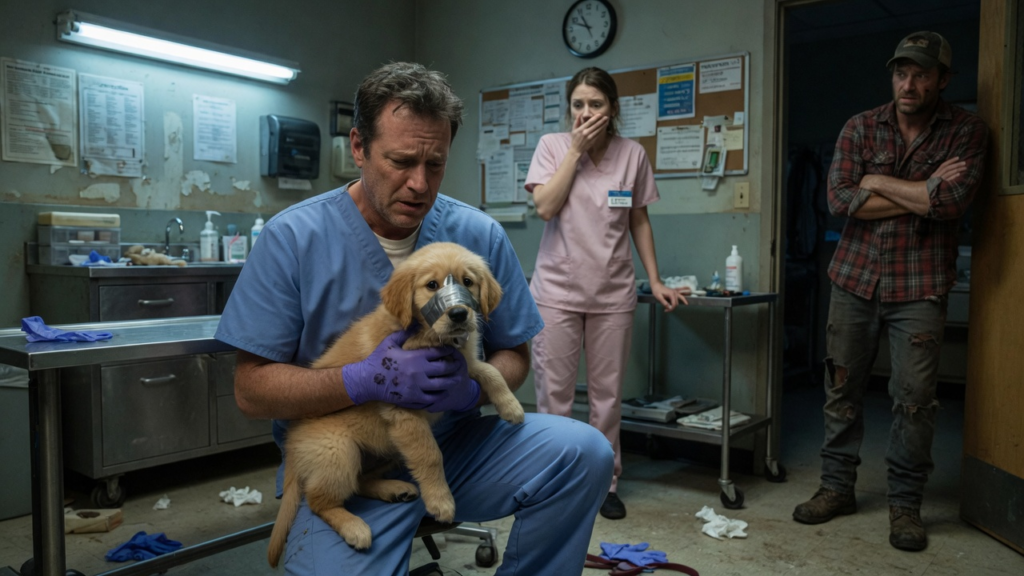
The bell above the clinic door didn’t just chime; it violently smashed against the glass.
I looked up from my clipboard at the reception desk.
It was 11:42 PM on a Tuesday. The graveyard shift at Crestwood Emergency Vet was usually quiet.
Usually.
A man shoved his way through the double doors, bringing the freezing October wind in with him.
He was a broad-shouldered guy in his late thirties. He wore a faded, grease-stained flannel and heavy work boots coated in dried mud.
His face was flushed red, a deep scowl carved into his features.
But it wasn’t the man’s aggressive entrance that made the hair on the back of my neck stand up.
It was what he was dragging behind him.
At the end of a thick, frayed nylon rope was a puppy.
Maybe four months old. A Golden Retriever mix, entirely skin and bones, shaking so violently its paws were slipping on the linoleum floor.
The puppy wasn’t making a sound.
It couldn’t.
Wrapped tightly around the dog’s delicate snout were two thick, crushing layers of heavy-duty silver duct tape.
It wasn’t just loosely applied. The tape was wound so tightly that it compressed the soft tissue of the puppy’s muzzle, burying into its fur.
The poor animal was frantically pawing at its face, its dark eyes wide with sheer, unadulterated terror. Bloodshot and pleading.
It was letting out a pathetic, muffled whistling sound through its nose every time it tried to take a breath.
Sarah, our receptionist, gasped out loud, her hand flying to her mouth.
“Hey,” the man barked, his voice echoing in the empty waiting room. “I need someone to give this thing a shot. Put it to sleep for the night. Or forever, I don’t care. Just make it stop.”
I stepped out from behind the desk, my heart hammering against my ribs.
I’ve been an emergency vet for eight years. I’ve seen hit-by-cars, poisonings, and awful accidents.
But deliberate cruelty? It always hits different. It freezes the air in the room.
“Sir,” I kept my voice terrifyingly calm, stepping toward the dog. “I need to remove that tape immediately. He’s suffocating.”
The man sharply yanked the rope, dragging the puppy backward across the slick floor. The dog stumbled and collapsed onto its belly, letting out a stifled whimper.
“No,” the man snapped, stepping between me and the puppy. “You leave the tape alone. He wouldn’t stop screaming. I tried locking him in the shed, but he wouldn’t shut up. I had to tape him. It took me twenty minutes to get him still enough to put it on.”
Everyone thought it was just a case of severe, misplaced anger. A frustrated owner who lost his temper.
I thought so too. At first.
“If you don’t let me assess this animal, I am calling the police,” I said, locking eyes with him.
He glared at me, his jaw clenching so hard I could see the muscle twitching. For a second, I thought he was going to lunge at me.
Instead, he suddenly dropped the rope.
“Fine. Whatever. Just knock him out so I can get some sleep.”
I didn’t wait for him to change his mind. I dropped to my knees, gently scooping the trembling puppy into my arms.
The dog weighed almost nothing. His ribs felt like brittle twigs beneath my fingers.
As I lifted him, the stench hit me.
It was faint, masked by the smell of the man’s stale cigarette smoke, but it was there. The unmistakable, metallic, sickeningly sweet scent of rotting tissue.
My stomach churned.
Something was deeply wrong.
I rushed into Exam Room 2, kicking the door shut behind me with my heel. Sarah followed close behind, her face pale.
“Get me the trauma shears,” I ordered, placing the puppy on the stainless steel exam table.
The cold metal made the puppy flinch. He huddled into a tight ball, his taped snout tucked under his paws. He refused to let me near his face.
Every time I reached out, he flinched violently, letting out a high-pitched, muffled shriek.
“It’s okay, buddy. It’s okay,” I whispered, gently stroking the back of his neck.
His heart was beating so fast it felt like a hummingbird trapped inside his frail chest. 180 beats per minute. Maybe 200. He was in medical shock.
Sarah handed me the heavy, blunt-tipped scissors.
Just as I raised them, the exam room door swung open.
The man stood in the doorway, his massive frame taking up the entire frame.
“I told you,” he warned, his voice low and dangerous. “Don’t take it off. If he starts screaming again, I’m taking him back.”
Nobody understood why he was so incredibly desperate to keep that tape on.
It didn’t make any sense. If the dog was at the vet, why would he care if I removed it?
Unless the tape wasn’t just a punishment.
Unless the tape was hiding something he desperately didn’t want me to see.
I ignored him. I gripped the puppy gently but firmly by the back of the head.
I slid the blunt edge of the shears under the thick, silver adhesive, right near the corner of the puppy’s mouth.
The adhesive was incredibly strong. It pulled at the delicate skin and fur as the scissors slid beneath it.
The man took a step into the room. “Stop!” he yelled.
I squeezed the handles of the shears, slicing through the first thick layer.
The heavy tape snapped open.
And as the silver adhesive peeled back from the puppy’s jaw… a flood of dark, coagulated blood spilled out onto the sterile silver table.
I froze.
The scissors slipped from my gloved hand, clattering loudly against the metal.
I stared at the gaping wound hidden perfectly beneath the tape. My breath caught in my throat.
He didn’t tape the dog’s mouth shut to stop it from barking.
He taped it to cover up what he had done to him.
CHAPTER 2
The sound of the heavy trauma shears hitting the floor felt deafening in the tiny exam room.
I couldn’t breathe. I couldn’t move. I just stared.
The thick, coagulated blood wasn’t just dripping; it was pooling rapidly across the sterile stainless steel of the exam table.
It was thick, dark, and carried the undeniable, metallic stench of trauma that had been left to fester for hours.
Beneath the heavy layers of silver duct tape, the puppy’s snout hadn’t just been bound.
It had been sliced wide open.
A deep, horrifically clean laceration ran from the corner of the puppy’s mouth all the way up his left cheek, exposing bone and shredded muscle tissue.
It wasn’t a tear from a dog fight. It wasn’t a scrape from a wire fence.
The edges of the wound were terrifyingly straight.
It was the unmistakable work of a very sharp, very heavy blade.
“You stupid bitch!”
The man’s voice exploded behind me, shattering my paralysis.
Before I could even turn around, a massive hand clamped down onto my left shoulder, gripping my scrubs so hard the fabric ripped.
He violently yanked me backward.
My heavy work clogs lost traction on the linoleum, and I slammed hard against the metal cabinets behind the exam table.
Pain shot up my spine, but the adrenaline instantly drowned it out.
“I told you not to touch it!” he roared, his face turning an apocalyptic shade of purple.
Saliva flew from his lips as he lunged forward, reaching directly for the bleeding, terrified puppy on the table.
The dog didn’t even try to run. He was too weak.
Instead, the puppy just flattened himself into the pool of his own blood, letting out a horrific, gurgling scream that sounded like a child drowning.
“Get away from him!” I screamed, entirely on instinct.
I threw my body forward, wedging myself exactly between the man’s massive frame and the exam table.
He slammed into my back, knocking the wind out of my lungs, but I locked my hands onto the edges of the table and refused to move.
“Move!” he barked, his voice dropping into a guttural, terrifying register. “He’s my property. I’m taking him home. Right now.”
“He is bleeding to death!” I yelled back over my shoulder, my voice cracking with panic.
“He was fine until you cut the damn tape!” he shot back, his logic so twisted and insane it made my head spin.
He didn’t tape the dog to silence a bark.
He used the industrial duct tape as a makeshift, torturous tourniquet to hold the dog’s severed face together so he wouldn’t bleed out in his truck.
Or worse, he did it to hide the evidence of what he had just done to the animal.
“Sarah!” I screamed at the top of my lungs. “Call 911! Now!”
The receptionist was frozen in the doorway, her eyes wide with unadulterated horror, staring at the blood dripping off the edge of the table onto my shoes.
“Sarah, hit the panic button!” I roared again.
That broke her trance. She spun on her heel and sprinted down the hallway toward the front desk.
The man realized exactly what was happening.
The panic finally broke through his rage. His eyes darted toward the hallway, then back to me, assessing his options.
“You didn’t have to do that,” he said, his tone suddenly shifting from enraged to eerily calm.
It was a terrifying psychological pivot.
He took a step back, holding his hands up in a placating gesture, though his fists were still clenched so tight his knuckles were stark white.
“Look, doc. You’re overreacting. It was an accident.”
I kept my body shielded over the puppy. I grabbed a stack of sterile gauze from the tray next to me and pressed it gently against the gaping wound on the dog’s face.
The puppy flinched, letting out another gurgling whimper, but his eyes were starting to roll back.
“An accident?” I hissed, not taking my eyes off the man.
“Yeah,” he said, taking a slow step toward the door, trying to block my only exit. “He was running around out back. He got his head caught in some rusted sheet metal by the tractor. Sliced himself right up.”
He was lying. And he wasn’t even good at it.
“Sheet metal doesn’t make a perfectly straight, surgical cut,” I said, applying more pressure to the gauze. It was soaking through instantly.
“Well, it did,” he snapped, the anger flaring back up in his eyes.
“And sheet metal doesn’t magically wrap two layers of heavy-duty duct tape around a wound to hide it.”
“I was trying to help him! I was trying to stop the bleeding so I could bring him to you!”
“You walked in here and asked me to kill him,” I reminded him, my voice trembling but loud enough to echo in the small room.
He stepped closer, closing the distance between us until I could smell the stale beer and cheap tobacco rolling off his breath.
“He was in pain. I wanted to put him out of his misery. That’s what you people do, right?”
He was gaslighting me. He was trying to spin the narrative in real-time.
But I didn’t have time to argue with a psychopath. I had a dying patient on the table under my hands.
The puppy’s breathing suddenly changed.
It shifted from rapid, panicked panting to shallow, irregular gasps.
I quickly lifted the puppy’s lip on the uninjured side of his mouth.
His gums were stark, ghost-white. There wasn’t a drop of pink left in them.
When I pressed my thumb against the pale tissue, the color didn’t return. Capillary refill time was nonexistent.
He was crashing. Hard.
The sudden release of the tight tape had acted like removing a pressure bandage. The built-up blood pressure was now freely draining out of the severed vessels in his cheek.
Hypovolemic shock was setting in. His tiny heart couldn’t pump enough blood to keep his organs alive.
“I need an IV catheter, right now!” I yelled, hoping Sarah could hear me from the front.
There was no answer. Just the faint sound of the police dispatch ringing from the phone at the front desk.
I couldn’t wait. I had to do it myself, right here, with this monster standing two feet away from me.
I kept my left hand clamped firmly over the gauze on the puppy’s face, applying heavy pressure.
With my right hand, I blindly reached into the open supply drawer behind me.
My fingers fumbled over bandage wraps and syringes until they finally closed around the plastic packaging of a 22-gauge IV catheter.
I ripped the packaging open with my teeth, spitting the plastic wrapper onto the floor.
“What are you doing?” the man demanded, stepping aggressively toward the table again. “I didn’t authorize any treatments. I’m not paying for this.”
“I don’t care about your money,” I growled, grabbing a pair of clippers from the counter.
“You’re not touching him anymore,” he warned, his heavy work boot stepping squarely on my dropped trauma shears, pinning them to the floor.
“If I don’t get fluids into him in the next sixty seconds, he dies,” I said, looking dead into his eyes. “And then you’re not just looking at animal cruelty. You’re looking at a felony.”
I didn’t know if that was legally true in this state, but it was the only thing I could think of to make him back off.
It worked. He hesitated, taking a half-step backward, his eyes darting nervously toward the hallway.
I turned my focus entirely to the dog.
I shaved a small patch of fur off the puppy’s right front leg. His skin was freezing cold to the touch.
I wrapped my hand tightly around his forearm, trying to act as a tourniquet to make the tiny cephalic vein pop up.
It was completely flat. There was no blood pressure left to fill the vein.
“Come on, buddy. Give me something,” I whispered, tapping the shaved skin frantically.
A tiny, microscopic blue line appeared. It was thinner than a piece of thread.
I uncapped the needle. My hand was shaking violently from the adrenaline and the pure, unadulterated rage coursing through my veins.
I took a deep breath, steadied my wrist against the metal table, and inserted the needle.
A tiny flash of dark red blood appeared in the hub of the catheter.
I was in.
I swiftly slid the plastic tube into the vein, pulled the sharp needle out, and tossed it into the sharps container.
Just as I reached for a bag of saline fluids to hook him up, the heavy front doors of the clinic flew open with a massive crash.
The sound echoed down the hallway, followed immediately by the heavy, authoritative thud of tactical boots on the linoleum.
“Crestwood Police! Where are you?” a deep voice commanded.
Relief washed over me so intensely my knees almost buckled.
“Exam Room 2! In the back!” Sarah’s voice yelled from the front, sounding breathless and terrified.
The man in the room with me cursed under his breath. It was a vicious, vile sound.
He quickly wiped his hands on his dirty jeans, his entire demeanor changing in a fraction of a second.
He suddenly slumped his shoulders, arranged his face into a mask of deep concern, and stepped away from me, leaving a respectful distance.
Two police officers rounded the corner and stepped into the cramped doorway of the exam room.
The first officer, a tall, older man with grey at his temples, immediately placed his hand over his holster.
The scene must have looked absolutely insane to them.
The room looked like a slaughterhouse.
There were bloody gauze pads everywhere. A severed pile of thick silver tape lay on the floor.
I was backed against the wall, my scrubs smeared with dark red stains, holding a plastic fluid line like a weapon, breathing heavily.
And then there was the man.
He didn’t look like an attacker anymore. He looked like a grieving, panicked pet owner.
“Officers, thank God you’re here,” the man said, his voice actually cracking with fake emotion.
He pointed a thick, calloused finger directly at me.
“You need to arrest this woman right now.”
The older officer frowned, his eyes darting between me, the bleeding dog, and the man.
“Step back, sir. What’s going on here?” the officer asked cautiously.
“I brought my puppy in because he got a terrible cut on his face playing out in the yard,” the man lied, his voice dripping with faux desperation.
He took a step toward the officers, entirely ignoring me now.
“I wrapped it in a bandage to stop the bleeding and brought him straight here. But this vet… I don’t know what’s wrong with her. She snapped.”
“What?” I gasped, entirely blindsided by his audacity.
“She ripped the bandage off violently, tore the wound wide open, and then started screaming at me,” he continued, shaking his head as if he was in disbelief.
“That is a lie!” I shouted, pointing to the thick duct tape on the floor. “He taped the dog’s mouth shut! It took trauma shears to get it off!”
“It was emergency first aid!” the man countered smoothly, looking at the cops for sympathy. “I live twenty miles out in the county. I didn’t have gauze. I used what I had to save his life.”
The younger officer, who had been quiet until now, looked at the tape on the floor, then at the massive, straight slice on the puppy’s face.
“Ma’am, please lower your voice and step away from the animal,” the older officer instructed, pulling out a notepad.
“I can’t step away!” I argued, my panic rising again. “I have to hook up these fluids or he is going to die right in front of you!”
“I don’t want her touching him!” the owner yelled, playing the part of the protective father perfectly. “She’s hysterical! She’s the one who made it worse! I want to take my dog to another clinic.”
“He won’t survive the car ride,” I stated firmly, ignoring the officer’s command and quickly twisting the fluid line into the puppy’s catheter.
I cranked the fluid valve wide open, letting the life-saving saline rush into his collapsed veins.
“Ma’am, I said step away from the table,” the officer repeated, his tone much harsher this time. He took a step toward me.
He was actually buying it.
The man was a local, probably knew some of the deputies, dressed in working-man clothes. He looked like a regular guy who had a bad accident on his property.
I was a hysterical woman covered in blood, disobeying direct police orders.
“Officer,” I said, trying to force my voice into a calm, clinical register. “Look at the wound. Just look at it.”
The younger officer stepped closer to the table, shining a small penlight onto the puppy’s exposed cheek.
“It’s a straight laceration,” I explained rapidly. “It severed the buccal nerve and major vessels. If he ‘ran into scrap metal,’ the edges would be jagged, torn, and irregular. This is a clean, sharp slice.”
The younger officer leaned in, his brow furrowing as he studied the horrific injury.
“And,” I continued, pushing my advantage, “if you look closely at the edges of the wound…”
I gently pulled the skin back just a millimeter.
“There’s no bruising. No secondary tearing. But there is a distinct, secondary shallow score line right above the main cut. A hesitation mark.”
Both officers looked up at me.
“A hesitation mark?” the older officer asked.
“Yes,” I said, my blood running completely cold as I finally realized exactly what I was looking at.
I looked up from the dog and locked eyes with the man. His fake, concerned mask slipped for just a fraction of a second, revealing the pure, predatory panic underneath.
“This isn’t an accident,” I said to the police, my voice dropping to a whisper.
“Someone held this puppy down. They placed a blade against his face. They hesitated, making a shallow cut first. And then…”
I couldn’t even finish the sentence. The sheer cruelty of it choked the words out of my throat.
“And then they sliced him open on purpose.”
The room fell dead silent.
The only sound was the rapid, shallow gasping of the dying puppy on the metal table.
The younger officer slowly stood up, turning off his penlight.
He didn’t look at me. He looked directly at the owner.
“Sir,” the young officer said quietly. “Step out into the hallway. Now.”
The owner didn’t move. He stood his ground, his fists balling up at his sides.
“This is bullshit,” the man growled, all the fake concern evaporating instantly from his voice. “She’s a crazy bitch making up stories. You’re gonna believe her over me?”
“I said, step into the hallway,” the officer repeated, his hand now moving to rest squarely on his duty belt.
The tension in the tiny exam room was a physical weight, pressing down on all of us.
Just as the man took a defiant step forward, ready to fight his way out of the room… the puppy let out a sound I will never, ever forget.
It wasn’t a whimper. It wasn’t a cry of pain.
It was a wet, heavy cough.
I looked down.
Bright, frothy, oxygenated pink blood was bubbling out of the puppy’s nostrils.
Oh god.
“He’s aspirating,” I gasped, the realization hitting me like a freight train.
The knife hadn’t just sliced his cheek.
When the man had taped the dog’s mouth shut, the immense pressure had forced the pooling blood backward, down the dog’s throat.
The puppy hadn’t just been bleeding.
For the last hour, trapped beneath that suffocating silver tape, the puppy had been slowly drowning in his own blood.
And his lungs were completely full.
CHAPTER 3
The sound of that wet, bubbling cough echoed off the cold tiles of the exam room like a death knell.
I didn’t wait for the police to give me permission. I didn’t wait for the owner to stop his screaming.
I dove for the red emergency cart in the corner, my heart hammering so hard it felt like it was going to burst through my own ribs.
“He’s drowning!” I screamed, my voice raw and jagged. “Sarah! Get the suction unit! Now!”
I could hear the older officer, the one with the grey hair, shouting at the man to get back, to put his hands behind his head.
But I couldn’t look. I couldn’t afford to take my eyes off the tiny life fading on the table.
The puppy’s eyes were starting to glaze over. That beautiful, deep amber color was turning into a dull, lifeless grey.
His head fell back against the metal table with a sickening, hollow thud.
He wasn’t fighting anymore. He didn’t have the strength left to even flinch.
“Come on, come on, come on,” I whispered, my fingers trembling as I grabbed a long, thin suction catheter.
I clicked the machine on. The low, mechanical hum filled the room, a jarring contrast to the chaos happening just a few feet away.
I slid the plastic tube down the puppy’s throat.
The sound was horrific—a wet, slurping noise as the machine began to pull the thick, dark blood out of his tiny, congested lungs.
It looked like a fountain of red liquid gold, filling the plastic canister on the machine.
One ounce. Two ounces.
Where was all this blood coming from? A cut on the cheek shouldn’t be producing this much internal hemorrhaging.
Behind me, I heard the sound of a heavy struggle.
“Get your hands off me!” the man roared.
There was the sound of a fist hitting flesh, followed by the heavy grunt of one of the officers.
“He’s resisting! Down on the ground! Now!”
The sound of the struggle moved toward the door, feet scuffing and heavy bodies slamming against the drywall.
The exam room door was kicked open, and I heard the man groan as he was tackled into the hallway.
“I have a right to my property!” he was still screaming, his voice muffled now by the floor. “That dog is mine! I can do whatever I want with it!”
I ignored the violence behind me. I focused entirely on the gurgle in the suction tube.
“Give me the intubation kit,” I barked at the air, hoping Sarah was there.
She was. She appeared at my side, her hands shaking so badly she almost dropped the laryngoscope.
“I’ve got it, Dr. Miller. I’ve got it,” she whimpered, her face streaked with tears.
I took the metal blade from her, my movements becoming cold and clinical. This was the only way to save him.
I tilted the puppy’s head back. His jaw was loose now, the muscles having given up the ghost.
I slid the blade into his mouth, illuminating the back of his throat.
What I saw made me stop breathing.
It wasn’t just blood.
His throat was raw. It was shredded.
It looked like he had swallowed something sharp, something that had been forced down his throat before the tape was even applied.
“Sarah, look at this,” I whispered, my voice trembling.
She leaned in, her eyes widening as the small light from the scope hit the back of the puppy’s throat.
“Is that… wire?” she asked, her voice barely a breath.
Deep in the back of the puppy’s throat, embedded in the soft tissue of the esophagus, was a thin, glinting piece of high-tensile copper wire.
It wasn’t an accident. It wasn’t a piece of scrap metal from a yard.
This puppy hadn’t just been taped. He had been used as a vessel.
“Keep the suction going,” I ordered, my mind racing a thousand miles an hour.
I carefully slid the endotracheal tube past the wire, securing his airway.
I hooked the other end to the oxygen bag and began to squeeze.
Squeeze. Release. Squeeze. Release.
I was breathing for him now. His life was literally in the palm of my hand.
I looked at the monitor. His heart rate was starting to climb. 110… 120…
He was coming back.
But the mystery was only getting deeper, and the air in the room felt heavy with a secret I wasn’t sure I was ready to uncover.
The younger officer, the one who had seen the “hesitation marks,” stepped back into the room.
His uniform was disheveled, and there was a fresh scrape on his cheek where the man must have caught him during the struggle.
“We’ve got him in the back of the cruiser,” the officer said, his voice tight with controlled anger. “He’s not going anywhere.”
“Officer,” I said, not stopping the rhythm of the oxygen bag. “You need to search his truck.”
The officer looked at me, confused. “We’re already calling for a tow, ma’am. Why?”
“There’s something in this dog’s throat,” I said, nodding toward the puppy. “Copper wire. Clean cuts. And he’s malnourished to the point of starvation.”
I looked at the silver duct tape lying in a heap on the floor.
“That tape wasn’t just to keep him quiet. It was to make sure he couldn’t spit out whatever is inside him.”
The officer’s expression shifted. He pulled out his radio.
“Dispatch, this is Unit 42. I need a secondary search of the suspect’s vehicle. Check for high-tensile wire, industrial adhesives, and… check the glove box for any IDs that don’t match the suspect.”
I turned my attention back to the puppy. Now that he was stabilized, I had to address the wound on his face.
I grabbed a bottle of sterile saline and began to flush the deep gash on his cheek.
As the blood washed away, the true nature of the injury became clear.
The tape hadn’t just covered the cut.
Because the tape had been wrapped in two thick, crushing layers, the sheer pressure of the adhesive had acted like a slow-motion saw.
The edges of the tape had literally sliced through the puppy’s skin over the course of hours, deepening the original wound.
“Found what it had cut,” I muttered to myself, my stomach turning.
The tape itself had become the weapon.
But as I cleaned deeper into the muscle tissue, my forceps hit something hard.
Clink.
It wasn’t bone. It was too high-pitched for bone.
I leaned in, my heart skipping a beat.
I used a pair of fine-tipped surgical tweezers to reach into the gaping wound, right where the jawbone met the cheek.
I pulled.
Slowly, a small, mud-caked metallic object emerged from the puppy’s flesh.
It was a key.
A small, brass key, the kind used for a high-security padlock or a safe-deposit box.
It had been shoved into the open wound on the dog’s face, and then the tape had been applied to seal it inside the animal’s cheek like a grotesque, living envelope.
Sarah let out a small, choked-off sob. “Oh my god. He used the dog to hide it.”
“He didn’t just hide it,” I said, the realization hitting me with the force of a tidal wave.
“He was trying to get through a checkpoint. Or a border.”
Suddenly, the front doors of the clinic flew open again.
This time, it wasn’t the police.
It was a woman.
She was drenched from the rain, her clothes torn, her feet bare and bleeding.
She looked like she had been running for miles.
She collapsed into the waiting room, screaming a name I didn’t recognize.
“Barnaby! Where is he? Did he bring him here?”
The older officer rushed into the lobby to intercept her.
“Ma’am, stay back! This is a crime scene!”
“Is the puppy here?” she shrieked, her voice echoing through the entire building. “Please! He took him! He told me if I didn’t give him the key, he’d kill the dog!”
I froze, the brass key still gripped in my tweezers, dripping with the puppy’s blood.
I looked down at the dog. Barnaby.
I looked at the key.
And then I looked toward the hallway, where the “owner” was currently sitting in the back of a police car.
Everything I thought I knew about this case was about to be turned upside down.
Because the man in the car wasn’t the owner.
And the puppy wasn’t just a victim of a random act of cruelty.
He was the only witness to a crime that was much, much larger than a single night in an emergency vet clinic.
“Dr. Miller!” Sarah’s voice snapped me back to reality.
The monitor was flatlining.
The puppy’s heart had stopped.
The stress, the trauma, and the sudden realization of the truth had pushed his tiny body over the edge.
“Charge the defibrillator!” I yelled, dropping the key onto the table and grabbing the pediatric paddles.
“We are not losing him. Not today. Not after everything he’s been through.”
But as I placed the paddles on his tiny, shaved chest, I realized something.
The man in the police car wasn’t just a stranger.
I recognized the tattoo on his wrist now.
It was the same symbol I had seen on the woman’s neck as she screamed in the lobby.
They weren’t strangers. They were a family.
And the “accident” wasn’t a punishment.
It was a ransom.
CHAPTER 4
The flatline on the monitor wasn’t a sound. It was a silence so heavy it felt like it was crushing the air out of the room.
That single, horizontal green line was a mocking reminder of how close we had come, only to have the truth slip through our fingers.
“Charging to twenty joules,” I said, my voice sounding like it belonged to someone else. Someone colder. Someone who wasn’t currently vibrating with a mixture of terror and rage.
I rubbed the tiny pediatric paddles together, the gel slick and cold.
Sarah was still bagging him, her rhythmic squeeze-release of the oxygen bag the only thing keeping his lungs from collapsing entirely.
“Clear!” I shouted.
I placed the paddles on Barnaby’s frail, blood-stained chest. His body was so small that the paddles nearly touched in the middle.
When I hit the button, his tiny frame arched off the metal table. A sickening, involuntary convulsion.
Then he fell back.
The line stayed flat.
“Nothing,” Sarah whispered, a tear finally escaping and landing on the puppy’s fur. “Dr. Miller, he’s gone.”
“No,” I hissed. “Increase to thirty. Charge again!”
In the lobby, the woman’s screams had turned into a low, guttural wailing. I could hear the older officer trying to calm her, his voice a low rumble through the walls.
“He’s going to kill me!” she was shouting. “If he knows I’m here, if he knows the dog didn’t make it… he’ll kill me!”
The words registered, but I couldn’t process them. Not yet.
“Clear!”
Another shock. Another arching of the spine. Another silent, agonizing second of watching that green line.
Beep.
A tiny, erratic spike appeared on the screen. Then another.
“We have a rhythm!” Sarah gasped, her grip on the oxygen bag tightening. “It’s weak, but it’s there!”
“Keep bagging him,” I commanded, my hands shaking so hard I had to grip the edge of the table to stay upright. “Don’t stop until he tries to take a breath on his own.”
The adrenaline was starting to recede, leaving behind a cold, hollow realization.
I looked down at the brass key lying on the silver tray. It looked so ordinary. So small.
How could something that size cause so much suffering?
The exam room door opened slowly. It was the younger officer. His face was pale, his eyes fixated on the blood-covered table.
“The woman,” he began, his voice low. “Her name is Elena. The man in the car is her brother, Mark.”
I didn’t look up from Barnaby. I was watching the rise and fall of the puppy’s chest, matching it to the rhythm of Sarah’s hand.
“He’s not the owner,” I said, my voice flat.
“No,” the officer replied. “He kidnapped the dog three days ago. He’s been using him as leverage.”
The officer stepped closer, looking at the key.
“She just told us everything. Their father passed away last month. He left a safety deposit box—only one key. It contains the deed to a property Mark has already tried to sell to some very dangerous people to cover his gambling debts.”
My stomach did a slow, sickening turn.
“He couldn’t find the key,” I whispered, the pieces finally clicking into place.
“She hid it,” the officer said, nodding toward the lobby. “She knew if he got his hands on it, he’d disappear and leave her with the debt. So he took the one thing she loved. He took Barnaby.”
I looked at the deep, clean slice on the puppy’s cheek.
“He didn’t just take him,” I said, my voice trembling with a new kind of fury. “He used him as a safe. He cut him open, shoved the key inside, and taped him shut so she couldn’t get it back without him knowing.”
The cruelty of it was breathtaking. It wasn’t just a crime; it was a violation of the very bond between humans and animals.
“And the wire?” I asked. “In his throat?”
The officer sighed, a sound of pure exhaustion. “He told her he’d fed the dog a ‘tracking device’ so she couldn’t run. It wasn’t a tracker. It was just a piece of copper wire to keep her terrified. To keep her compliant.”
The “Stay Quiet” excuse wasn’t for the dog’s barking. It was for the secret.
The two layers of thick tape weren’t just a gag. They were a seal.
If the vet—if I—hadn’t insisted on peeling it off, if I had just given the dog a sedative and sent them on their way, the puppy would have died in that truck within the hour.
The blood would have filled his lungs, and Mark would have simply cut the key out of a dead animal and left the body in a ditch.
Suddenly, Barnaby let out a sharp, jagged gasp.
His legs twitched. His eyes, still clouded but flickering with life, opened.
He looked at me. Not with fear, but with a strange, weary recognition.
I reached out and gently stroked his ear, the only part of him not covered in blood or tape residue.
“You’re okay, Barnaby,” I whispered. “You’re safe now.”
“Can she see him?” the officer asked quietly.
I looked at the puppy. He was still incredibly fragile. He needed surgery to repair the nerve damage in his cheek and the lacerations in his throat. He needed days of intensive care.
But I looked at the lobby door. I heard the woman’s broken sobs.
“Bring her in,” I said.
The older officer led Elena into the room. She looked like a ghost—grey-faced, trembling, her eyes red and swollen.
The moment she saw the puppy, she collapsed.
She didn’t run to the table. She just fell to her knees on the bloody floor, her forehead resting against the metal leg of the exam table.
“Barnaby,” she choked out. “Oh, my sweet boy. I’m so sorry. I’m so, so sorry.”
The puppy tried to lift his head. He couldn’t quite manage it, but his tail—that tiny, thin Golden Retriever tail—gave a single, weak thump against the metal.
Thump.
It was the most beautiful sound I had ever heard.
Elena reached up, her hand shaking as she touched his paw. “I thought he’d killed you. He told me he’d already done it.”
“He’s a fighter,” I said, handing her a clean towel so she could wipe the blood from her hands.
The younger officer picked up the brass key with a pair of sterile forceps.
“We’ll need this for evidence, ma’am,” he said to Elena. “And your statement. Mark is going away for a long time. Kidnapping, extortion, felony animal cruelty… the list is growing by the minute.”
Elena didn’t even look at the key. She didn’t care about the deed, the property, or the money.
She just looked at the puppy.
“I don’t want it,” she said, her voice finally steadying. “Give it to the state. Give it to the lawyers. I just want my dog.”
The next few hours were a blur of activity.
I spent four hours in surgery, meticulously repairing the damage to Barnaby’s face. I had to be careful—the tape had compressed the tissue for so long that the blood flow was temperamental.
I removed the copper wire from his throat. It had caused some scarring, but his vocal cords were intact. He would bark again someday.
By the time the sun started to peak over the horizon, Barnaby was tucked into a warm, padded kennel in the recovery ward.
He was wrapped in a soft blue blanket, a heating pad beneath him, and an IV drip slowly ticking away.
Elena was asleep in the chair next to his kennel, her hand still resting against the bars.
I stood in the doorway, a cup of lukewarm coffee in my hand, watching the two of them.
The clinic was quiet now. The police were gone. The blood had been scrubbed from the exam room floor.
But the memory of that silver tape—the way it had been layered like a shroud—would never leave me.
People ask me all the time why I do this. Why I work the graveyard shift in a place where I see the worst of humanity.
They think it’s about the medicine. The science. The “saving lives” part.
And it is.
But it’s also about the truth.
Animals can’t tell us who hurt them. They can’t point a finger at the monster in the room.
They can only show us.
They show us through their fear, through their wounds, and through the way they still choose to wag their tails when the nightmare is over.
Barnaby had been silenced by two thick layers of industrial tape. He had been used as a tool for greed.
But in the end, his silence was the loudest thing in the room.
It was the silence that forced me to look closer. To peel back the lies. To find what had been cut.
I took a sip of my coffee and looked out the window at the morning light.
Somewhere in a county jail, Mark was sitting in a cell.
And here, in a quiet recovery ward, a puppy was finally getting the sleep he deserved.
I walked over to the kennel and reached through the bars, softly bopping Barnaby on the nose.
He didn’t wake up, but he let out a tiny, contented sigh.
The owner had wanted him to stay quiet.
But Barnaby had plenty to say. And for the rest of his life, I was going to make sure everyone heard him.
The tape was gone. The secret was out.
And for the first time in a long time, the world felt a little bit more like it was supposed to.
EPILOGUE
Six months later, the bell above the clinic door chimed.
It wasn’t a violent smash this time. It was a cheerful, light sound.
I looked up from my desk.
A woman walked in, looking healthy and vibrant, her hair pulled back in a bright yellow ribbon.
And at her side, bounding on a leather leash, was a beautiful Golden Retriever mix.
His coat was thick and shiny. His eyes were bright amber.
And on his left cheek, there was a thin, silvery scar.
It was almost invisible, hidden mostly by his fur, but it was there. A badge of honor.
“Barnaby!” I laughed, stepping around the counter.
The dog didn’t hesitate. He lunged forward, not in fear, but in pure, unadulterated joy.
He pinned me against the wall, his front paws on my shoulders, his tongue frantically licking my face.
“He’s been waiting all morning to see you,” Elena said, her eyes sparkling.
She told me that Mark had been sentenced to ten years. The property had been sold, and the proceeds were used to set up a foundation for abused animals in the state.
But more importantly, she told me that Barnaby had found his voice.
“He barks at the mailman now,” she said, smiling. “Every single day. And every time he does, I just laugh.”
I knelt down and hugged the dog, burying my face in his soft fur.
He smelled like sunshine and grass. Not blood. Not tape.
“Good boy,” I whispered.
He let out a loud, proud bark, his tail wagging so hard his whole body shook.
The silence was officially over.